Review: Carl Perkins on Sun Records

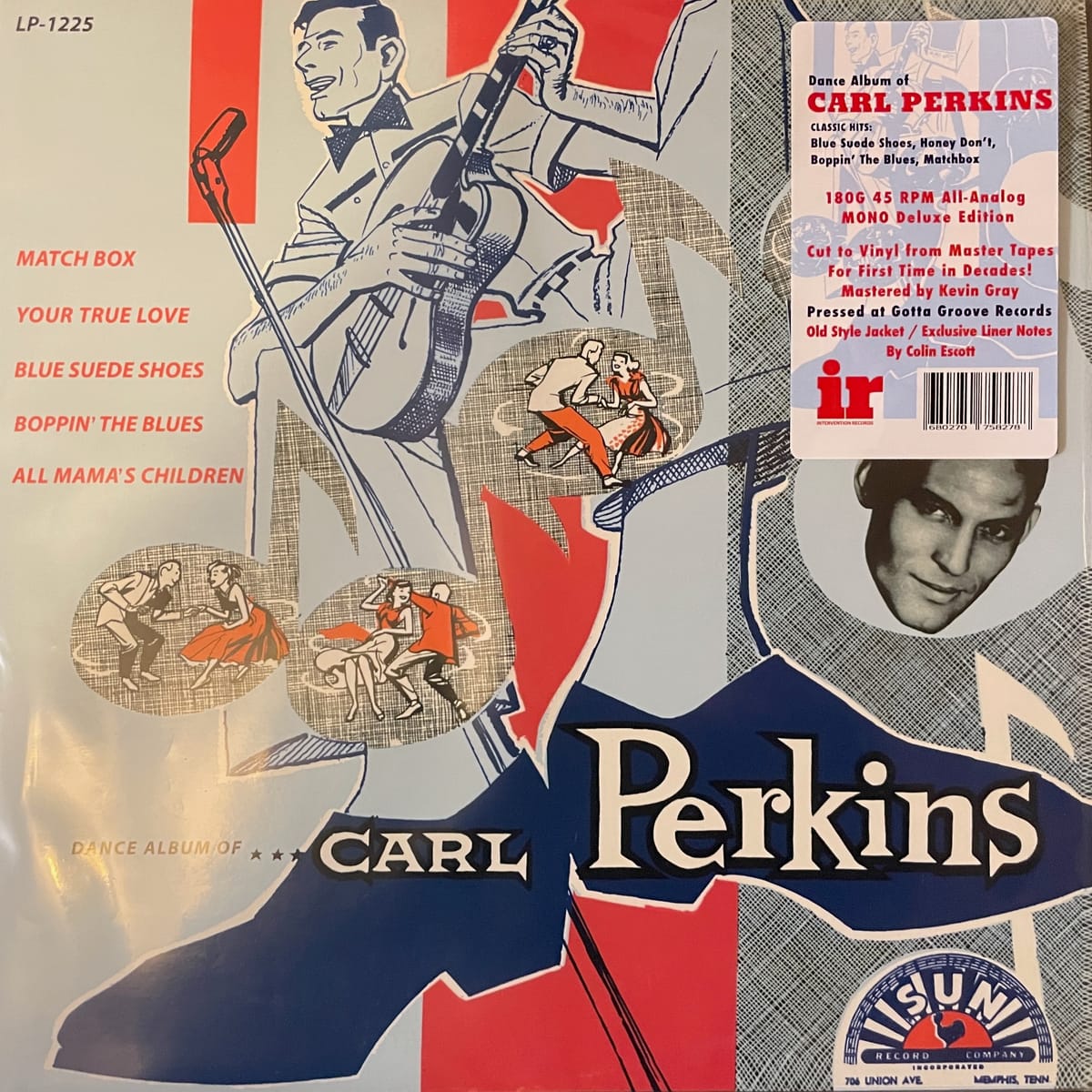
The new all-analog cut of 1957’s Dance Album of Carl Perkins does justice to a formative rock ’n’ roll text.
It would be natural to start this review by rehashing Carl Perkins’ vital importance to the history of American popular music. But I’m finding it difficult to summarize the rockabilly legend’s impact in a way that would be new, or useful, or even interesting. Everyone knows Perkins’ songs, whether through his own recorded versions or via covers by such moderately successful acts like, y’know, Elvis Presley and the Beatles—as such, it’s easy to take his contributions for granted. Let’s just take it as a given that Carl Perkins was a musical titan, perhaps the most important rockabilly performer who ever lived, and his blend of country and R&B was among the most significant developments in the trajectory of rock ’n’ roll. Late at night, after a drink or two, I might even argue that he’s more important than Elvis, who never wrote any of his own material. Perkins wrote plenty—and they’re some of the best songs ever written.
Carl Perkins’ first full-length, and his only album for Sun Records, came out in 1957 at the tail end of his tenure for the storied Memphis label. Dance Album of Carl Perkins collects most of his Sun singles from 1955 and 1956 as well as some contemporaneous recordings. It’s an action-packed, all-killer-no-filler blueprint for dozens if not thousands of rock musicians to come. It’s got “Blue Suede Shoes,” of course, which was Perkins’ biggest hit and which Presley covered to great success, and it also contains “Matchbox,” “Honey Don’t,” and “Everybody’s Trying to Be My Baby,” all of which made their appearances on Beatles studio albums; the Fab Four played other Perkins songs on their radio sessions as well. In fact, the Beatles, either together or separately, have recorded versions of all 12 of the songs on Dance Album, according to Colin Escott’s liner notes for Intervention Records’ new vinyl reissue.
This reissue of Dance Album is an immaculate rendering of a very important and formative text, auguring well for a forthcoming series of definitive Sun Records reissues. Earlier this year, Intervention announced a partnership with Sun to release all-analog vinyl versions of several of their most important albums, and the Perkins LP is the first fruit of those labors, with Johnny Cash with His Hot and Blue Guitar due out in February. Intervention, a reissue label based in Gig Harbor, Washington, boasts an idiosyncratic catalog that reflects the tastes of owner/operator Shane Buettner. Using excellent audio sources and offering high-quality pressings, he’s been responsible for some of my favorite vinyl reissues, including the Flying Burrito Brothers’ The Gilded Palace of Sin and a superb 2-LP rendering of Murray Head’s overlooked Nigel Lived.
Now Buettner and Intervention have hands on some of the most important recordings ever made, and Dance Album suggests their stewardship is more than justified. Per the information on the website, digging up the original Sun Records analog master tapes for Dance Album wasn’t easy:
“Intervention worked closely with Sun Records and the Archive Team at Iron Mountain to compile a completely NEW set of A/B reel master tapes for this release. In the late 1960s when Shelby Singleton purchased Sun Records from legendary Sam Phillips, the original 7" single master tape reels were compiled onto many different sets of 1/4" tapes. Identifying any one tape as "THE master" for a given song is no longer possible, but hours and hours were spent by Sun and IR's Shane Buettner listening to tapes and identifying the absolute best sounding tape version of each and every song. Kelly Pribble, Mark Berger and Scott Delaney at Iron Mountain made flat 1/4" transfers at our direction to a newly minted set of 1/4" A/B reels for this release.”
Those new reels made their way to Kevin Gray at Cohearant Audio, who was able to cut the lacquer at 45 RPM, since each LP side runs around 15 minutes. The recordings are mono, of course, but they’re vivid and rich, capturing the energy of the sessions and all of the musical elements happening in the room. I don’t believe personnel info for every session has been fully documented, but Perkins at this time was performing with his two brothers, Jay on guitar and Clayton on upright bass, as well as their friend W.S. “Fluke” Holland on drums. Jerry Lee Lewis also turns up on piano on “Matchbox” and “Your True Love.”

Each of the musicians is superbly represented on this new cut. Jay’s acoustic guitar and harmony vocal elevates “Sure to Fall” into a gorgeous two-step, one that surely went on to inspire the Everly Brothers. Clayton’s clickety-clack double-slap on the bass provides one of the building-block sounds of rockabilly, and Holland’s backbeat both anchors the grooves and lets ’em swing. The recordings sound fresh and alive, with slightly fluffed endings and back-and-forth interaction suggesting a level of spontaneity that wasn’t quite as appreciable via earlier presentations of the LP.
Perkins and his brothers faced severe difficulties during their time at Sun Records. A serious car crash in 1956 put Carl in the hospital just as “Blue Suede Shoes” hit the top of the charts. Jay, also injured in the crash, would die of a brain tumor in 1958, as Carl was struggling to regain the success he’d had just a few short months ago. It wasn’t until the Beatles paid forward the immense influence Perkins had on them that he was recognized for his contributions to the nascent form of rock ’n’ roll and not thought of as a ’50s flash in the pan.
My pressing, from Gotta Groove, is flawless and flat, with dead-silent vinyl backgrounds and Gray’s mastering reproduced with impeccable presence and detail. Any technical limitations on the mid-’50s recordings are a moot point—the recordings sound natural and alive, with all the punch and excitement that must have been going through the recording console at the time. The sound is clear and detailed enough to sound great coming through a high-end home system, and lively enough to soundtrack any Saturday night dance. My only complaint is that some of the tracks end abruptly, before the notes have a chance to fade naturally, but that could simply be what’s on the tapes. Carl Perkins’ stature may have been overshadowed by pioneers like Elvis Presley, Chuck Berry, and Buddy Holly. This Intervention Records reissue makes as good a case as has ever been made that Perkins is the equal of any of them.
Intervention/Sun 1-LP 45 RPM 180g black vinyl
• New remastering of the 1957 mono album, which compiled recordings made 1954–1956, some of which were released on 45s and 78s
• Jacket: Tip-on single-pocket
• Inner sleeve: Gotta Groove custom rice-paper-style poly
• Liner notes, insert, or booklet: Double-sided insert with essay
• Source: Analog; “1/4” flat transfer from original master tapes”
• Mastering credit: Kevin Gray at Cohearent Audio, North Hills, CA
• Lacquer cut by: Kevin Gray at Cohearent Audio, North Hills, CA; “KPG@CA” in deadwax
• Pressed at: Gotta Groove Records, Cleveland, OH
• Vinyl pressing quality (visual): A
• Vinyl pressing quality (audio): A
• Additional notes: Comes in reusable outer poly sleeve with hype sticker attached
Listening equipment:
Table: Technics SL-1200MK2
Cart: Audio-Technica VM540ML
Amp: Luxman L-509X
Speakers: ADS L980