Reviews: Jellyfish, Heart, Erykah Badu, and Peter Frampton on Vinylphyle


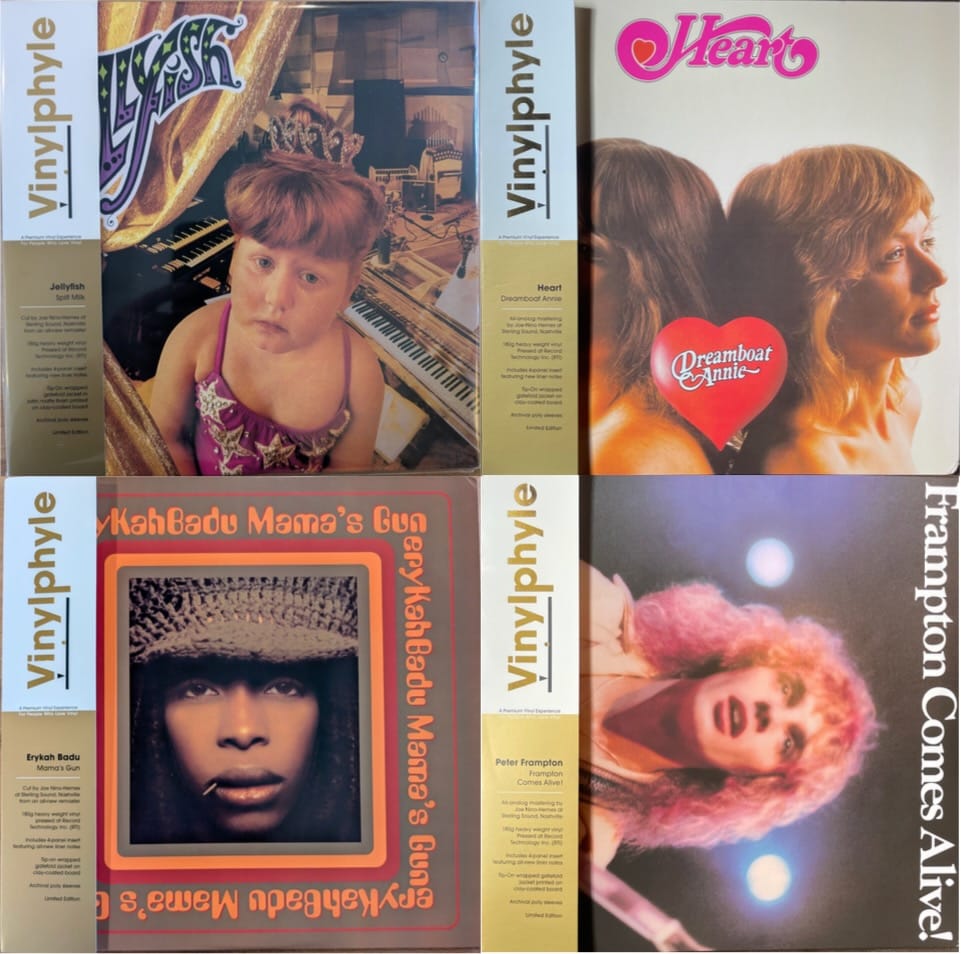
Today we’ve got a quartet of vinyl reviews for you, exploring the four most recent releases from Universal’s budding Vinylphyle imprint. We dug into the first four Vinylphyle reissues at the end of last year (read those reviews here and here) and we were impressed, to say the least. Vinylphyle—its ungainly name aside—has elevated the vinyl reissue game, following the precedent set by Blue Note’s Tone Poets and Rhino’s High Fidelity series by offering premium pressings with excellent mastering (all-analog, whenever possible) and featuring high-quality jackets and inserts that include liner notes and images of the master tapes.
This next batch of four doesn’t disappoint. You’ll have to read on for more details, but the headline is that these Vinylphyles are the real deal. Right now they’re only available direct from Universal, and the price point is a reasonable but not thrifty $40; however, three of the four reissues in this batch are double LPs priced at $55, making ’em a bit more wallet-unfriendly. Nevertheless, we think they’re as good as modern pressings get, so if it’s a record you love, it’s money well spent.
Here’s today’s rundown:
- Jellyfish: Spilt Milk
- Heart: Dreamboat Annie
- Erykah Badu: Mama’s Gun
- Peter Frampton: Frampton Comes Alive!
And before you scroll down to the reviews, we’ve got a very exciting announcement: We’re giving away—yes, giving away—a bundle of these four Vinylphyle titles for our monthly vinyl giveaway, to celebrate The Vinyl Cut’s six-month anniversary. It’s our biggest and best giveaway yet, so make sure you enter. We’ll send out the contest entry details tomorrow, but you will need to be on our paid tier in order to be eligible, so take advantage of your opportunity to upgrade now:
For the fiscally astute among you, an annual Vinyl Cut subscription costs far less than these four Vinylphyles do, so signing up for our paid tier doesn’t merely support our work and make future editions of the newsletter possible—it’s simply good financial sense.
And now, let’s listen to some records.
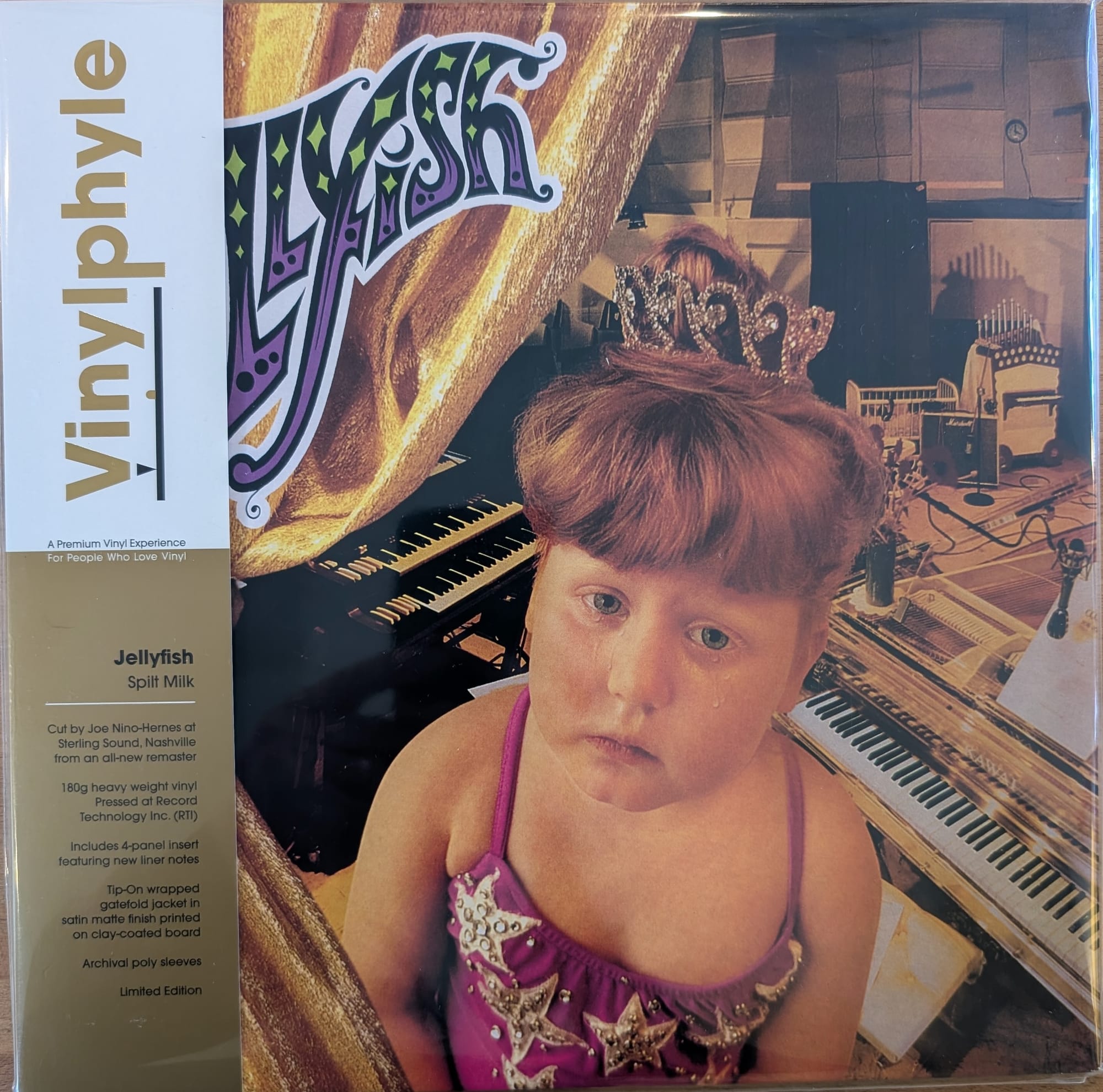
Jellyfish: Spilt Milk
Review by Robert Ham
Spilt Milk, the second album from California pop group Jellyfish, was always going to be a tough sell. When it was originally released in 1993, the band had some wind in their sails. Their debut, 1990’s Bellybutton, had critical support and produced a single, “Baby’s Coming Back,” that managed to land in the lower reaches of the Billboard Hot 100. And their throwback sound—pulling from ’60s psychedelic pop and ’70s rock groups like 10cc, Supertramp, and Queen—landed them choice if ill-fitting gigs like opening for the Black Crowes on a six-week tour.
It was enough to earn Jellyfish a blank check from their benefactors (Charisma Records in the US; Virgin Records in Europe) when they set about making their follow-up, but the process became an uphill battle. According to Andy Sturmer, the band’s drummer, vocalist, and principal songwriter, they pulled 14-hour days in the studio for weeks on end. As he told People’s Eric Levin in 1993, “Once I literally passed out doing a vocal and woke up in the next room.” (For a fuller account of the trials of making Spilt Milk, track down a copy of Brighter Day: A Jellyfish Story, Craig Dorfman’s amazing biography of the band.) When the finished album was released in early ’93, it was barely heard amid the still-swelling waves of the post-Nevermind sounds populating the stages at Lollapalooza and the nightly episodes of Alternative Nation on MTV. Jellyfish soldiered on for a year promoting Spilt Milk, but internal tensions and the lack of commercial momentum caused the band to break up in mid-’94.
Thirty-plus years later, Spilt Milk still sounds deliciously out of step with the rest of the musical world. Sturmer and keyboardist/vocalist Roger Joseph Manning, Jr. set about making the album of their dreams: an epic that stuffed horns and strings into their already densely packed compositions and matched the ambition of other big-swing masterpieces like the Zombies’ Odessey and Oracle and XTC’s Skylarking. They succeeded on every count. With Albhy Galutin and Jack Joseph Puig behind the boards and Lyle Workman and Jon Brion filling in on guitar, Spilt Milk is a rich, multi-layered listen with indelible pop hooks and lyrical wit.
The album is also one that needs to be heard in the best fidelity possible to fully appreciate how detailed it is. Every instrument, from the banjo strums and theremin whines that pop up at the end of “The Ghost at Number One” to the trombone blasts that punctuate “Brighter Day,” is placed just so, and to let them get lost does a disservice to the songs and their creators. That’s what made the 2023 “Listener Edition” reissue from Capitol and Universal such a disappointment. Though the lacquer was cut from the original analog master tapes by Kevin Reeves at Sterling Sound, the album sounds swampy and dim with absolutely no power behind it at all.
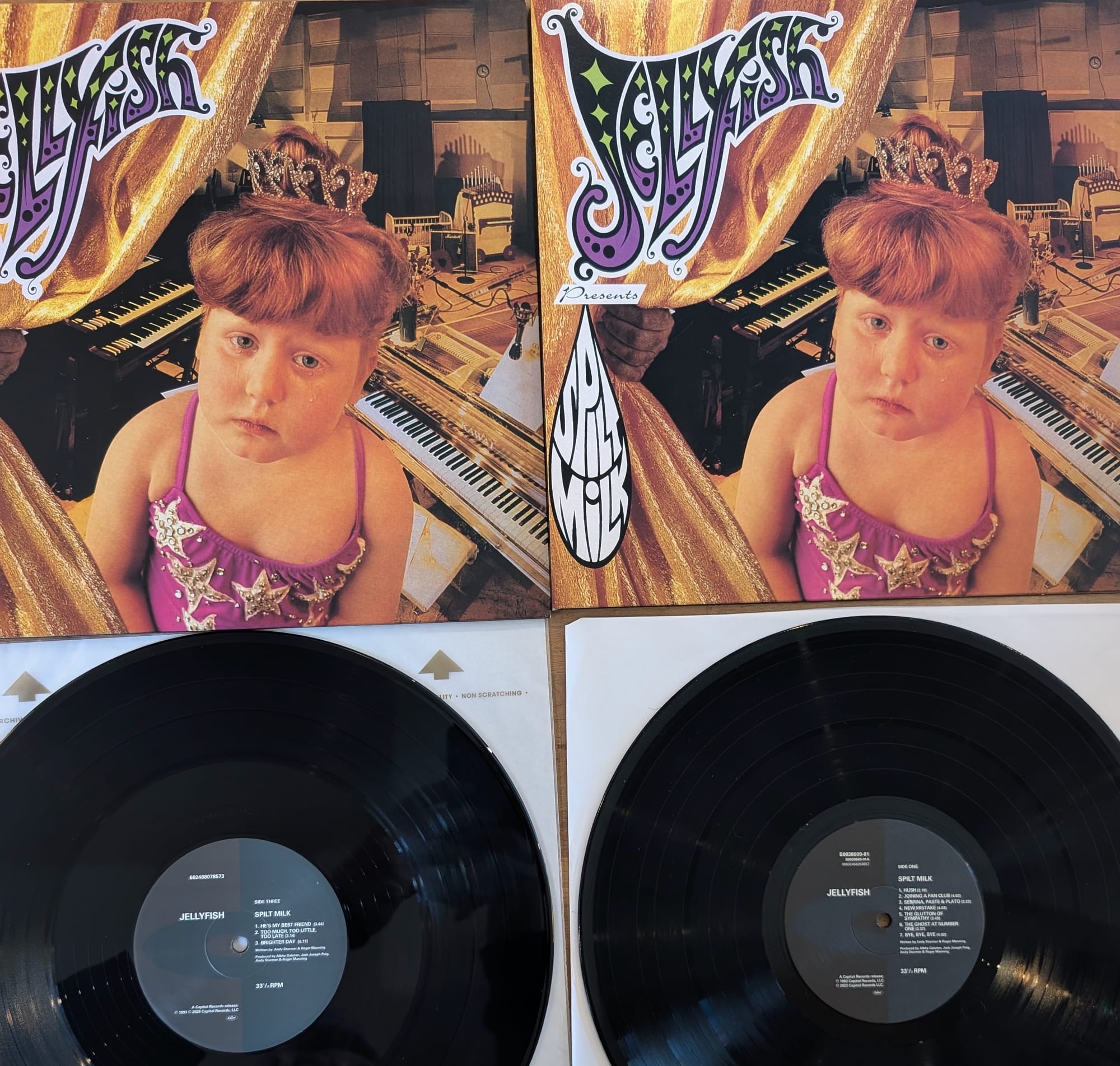
Luckily, the powers that be at Universal quickly course corrected, adding Spilt Milk to their growing roster of high-quality Vinylphyle reissues. Released this month, this new edition, pressed from a hi-res digital master made in 2023 by Justin Perkins at Mystery Room Mastering and lacquers cut by Joe Nino-Hernes at Sterling Sound, is sheer perfection. For one, they wisely opted to spread the 46-minute-long album over three sides of vinyl rather than cramming it onto a single LP. This decision brings back the clarity and separation to the music, especially highlighting the meshing of Sturmer’s supple drumming and newest member Tim Smith’s wandering bass lines as well as giving a wider space for each layer of the group’s thick vocal harmonies to shine out. Combined with quiet backgrounds and a nicely flat pressing from RTI, Spilt Milk has never sounded better.
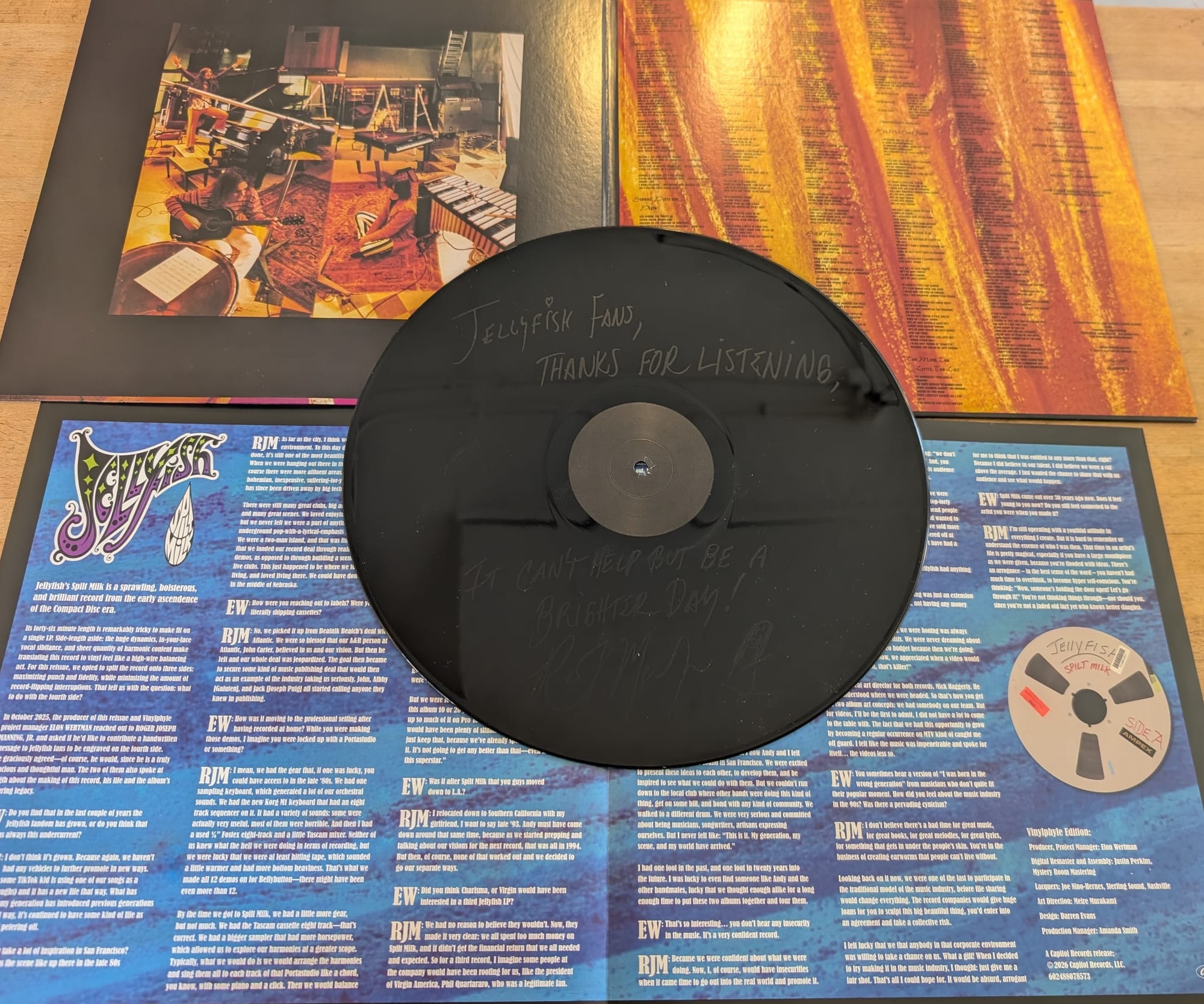
If forced to find a flaw in this reissue, I can only point to the choice of putting an engraved message from Manning on Side 4 of the vinyl. Though the Vinylphyle edict seems to require that they stick to the original tracklist, this was a great opportunity to tack on some of the equally great B-sides found on the CD singles from the era, like the heartbreaking “Watchin’ the Rain” and glammed-up “Family Tree.” But, again, that’s just me straining to find the smallest of nits to pick. As a longtime fan of this band and this album in particular, I couldn’t be happier with this new pressing of Spilt Milk as it stands. I have little doubt that you’ll feel like I do.
Vinylphyle/Capitol/UMe 2-LP 33 RPM black vinyl
• New Vinylphyle remaster of Jellyfish’s 1993 album
• Jacket: “Tip-On wrapped gatefold jacket in satin matte finish on clay-coated board” with wraparound obi
• Inner sleeve: Vinylphyle-branded rice-paper-style poly
• Liner notes, insert, or booklet: Four-panel insert with interview with Roger Manning, Jr., reissue credits, and photos of original master tape; inner gatefold features lyrics and album credits
• Source: Digital; “1993 Ocean Way Mixdown Tapes – 2025 96khz/24bit three-sided vinyl masters”
• Mastering credit: Justin Perkins, Mystery Room Mastering, Madison, WI
• Lacquer cut by: Joe Nino-Hermes, Sterling Sound, Nashville, TN; “JN-H” in deadwax
• Pressed at: RTI (Record Technology Incorporated), Camarillo, CA
• Vinyl pressing quality (visual): A
• Vinyl pressing quality (audio): A
• Additional notes: Limited edition according to obi. Comes in a resealable outer bag.
Listening equipment:
Table: Cambridge Audio Alva ST
Cart: Grado Green3
Amp: Sansui 9090
Speakers: Electro Voice TS8-2
Heart: Dreamboat Annie
Review by Ned Lannamann
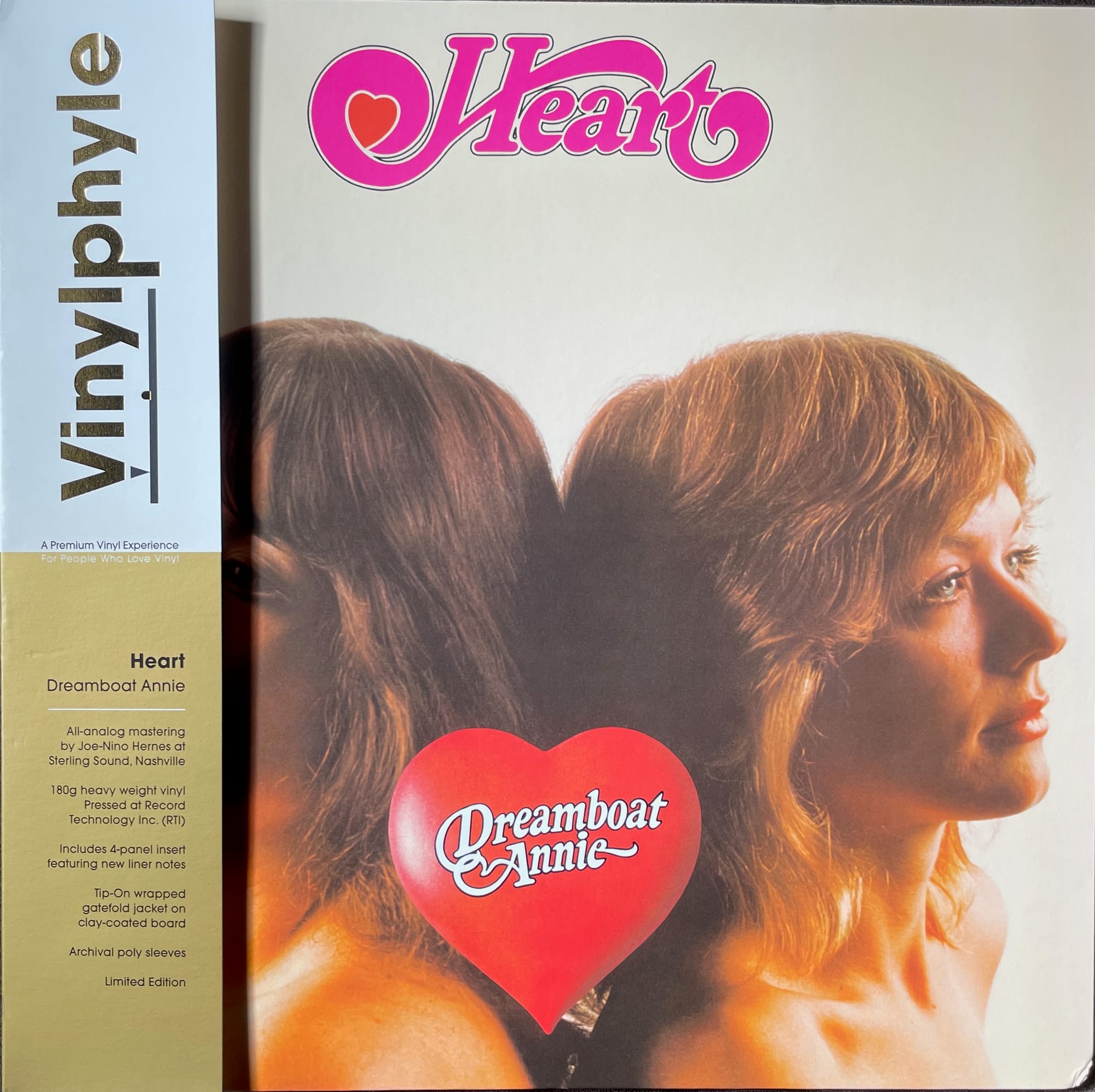
There really wasn’t anything like Heart in 1975. And I don’t just mean that they were a hard-rock band fronted by a female singer and female guitarist—in this case, sisters Ann and Nancy Wilson, army brats who spent their teen years in the Seattle area before crossing the border to join Heart in Vancouver, British Columbia. It’s true that there weren’t many antecedents in the rock world for Ann’s style of singing, in which her clarion soprano could increase its volume to become something operatically powerful. But the Wilson sisters’ stylistic diversity in their songwriting and performing style set the band even further apart. Heart’s debut, Dreamboat Annie (first released in Canada on the Mushroom label in 1975 and the following year in the US) has some fiercely hard rock sitting alongside phantasmal folk and traces of psychedelia and prog. It showed Heart was capable of, and interested in, a lot more than their Zeppelin-influenced showstoppers might suggest.
Dreamboat Annie is a consistently strong debut, but it’s nevertheless dominated by its two enduring radio hits: “Crazy on You” and “Magic Man.” The former is both the hardest-rocking song on the album (only “Sing Child” gives it serious competition) and the most melodically catchy, a convincing display of Heart’s greatest asset at this time: the mixture of exciting guitar riffage paired with Ann Wilson’s banshee wail. By contrast, the album-opening “Magic Man” begins with a backward guitar solo, instantly placing Heart on more illusive, shape-shifting ground, with a mark tree providing fairy-dust sparkles and Ann’s overlapping vocal tracks weaved among the sustained guitar notes. While the song details Ann’s fascination with her boyfriend at the time, Heart’s manager Michael Fisher, she conjures a musical milieu of myth, bewitchment, and white magic, where feminine power ultimately reigns. It must have been a remarkable breath of fresh air in the oppressively masculine hard-rock world of the mid-’70s.
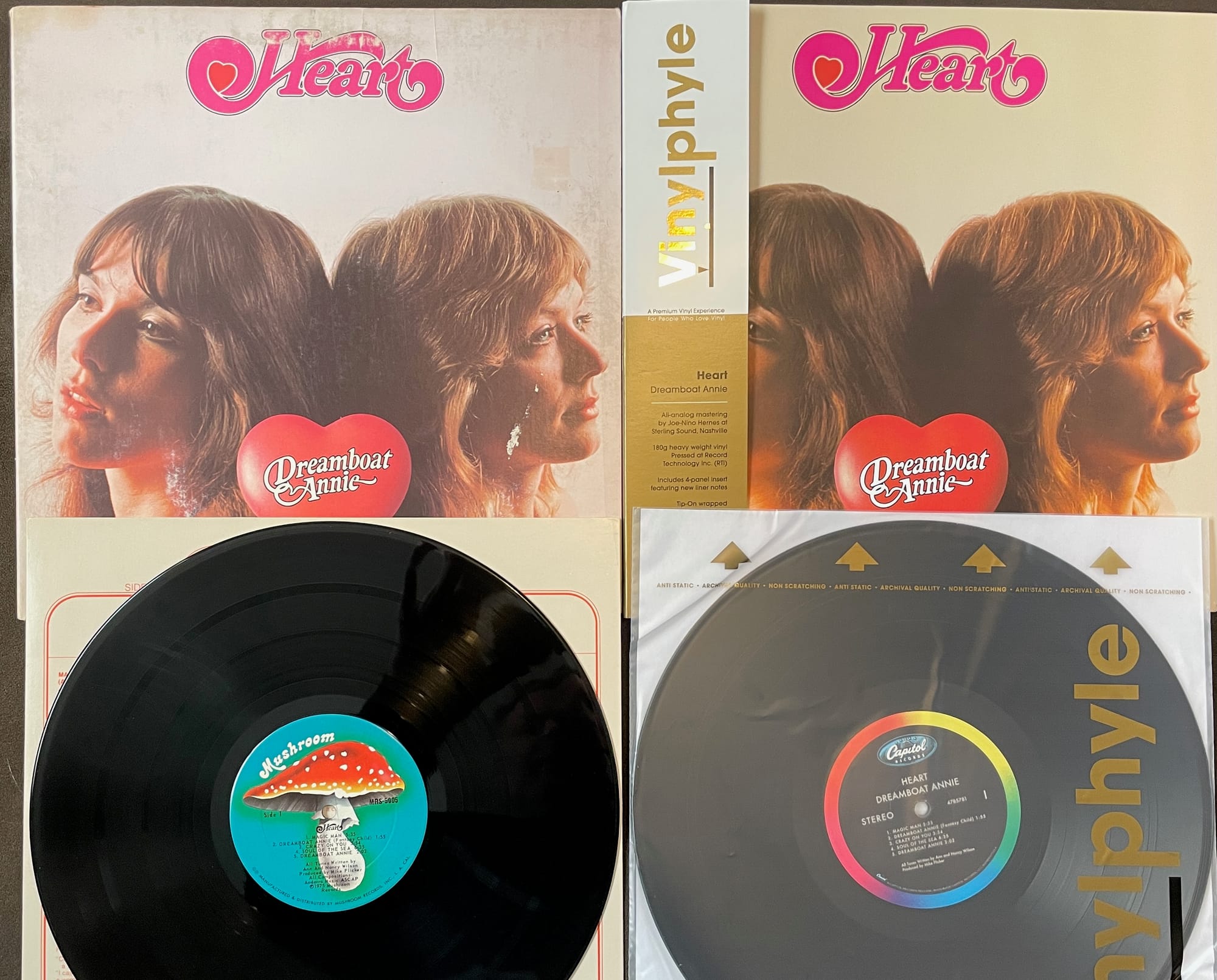
The album’s new Vinylphyle pressing bears all the expected care and sonic enhancement the series has offered thus far. Originals of Dreamboat Annie were mastered at Kendun Recorders, with Patrick Collins credited on the album’s inner sleeve. My particular US copy, on Mushroom Records and pressed at Columbia’s Santa Maria plant, also has “JG” in the deadwax, suggesting that John Golden cut that particular lacquer. It’s a phenomenal-sounding record, with wonderfully full dynamics, some nice slam to the hard-hitting rhythms, and a reined-in treatment of the album’s high end, both in the lead guitar and in Ann’s singing. There is some minor crush to the cymbals and things get very slightly congested when the upper mids are at their busiest (the congas during the Minimoog solo on “Magic Man” are a bit of a jumble), but otherwise it remains a really stellar piece of vinyl.
The Vinylphyle disc is cut from the master mixdown made at Vancouver’s Can-Base Studio, where Dreamboat Annie was constructed over several summer weeks with an evolving band lineup and a couple of session drummers. The new cut reveals the original recording to be even more impressive, with complicated arrangements and a bevy of production tricks done with the type of care that one doesn’t usually encounter on a band’s debut. Joe Nino-Hernes has just slightly finessed the sound to have an extra inch of power and dynamism. The sustained Minimoog bass note on “Magic Man” might be the highlight of the Vinylphyle pressing, reaching down to subterranean levels. The cascading waves on “Soul of the Sea” feel more naturally integrated and less like a sound effect. And the subtleties of the guitar playing—a blend of acoustics and electrics played by Nancy Wilson, Roger Fisher, and Howard Leese—shine throughout the entire record.
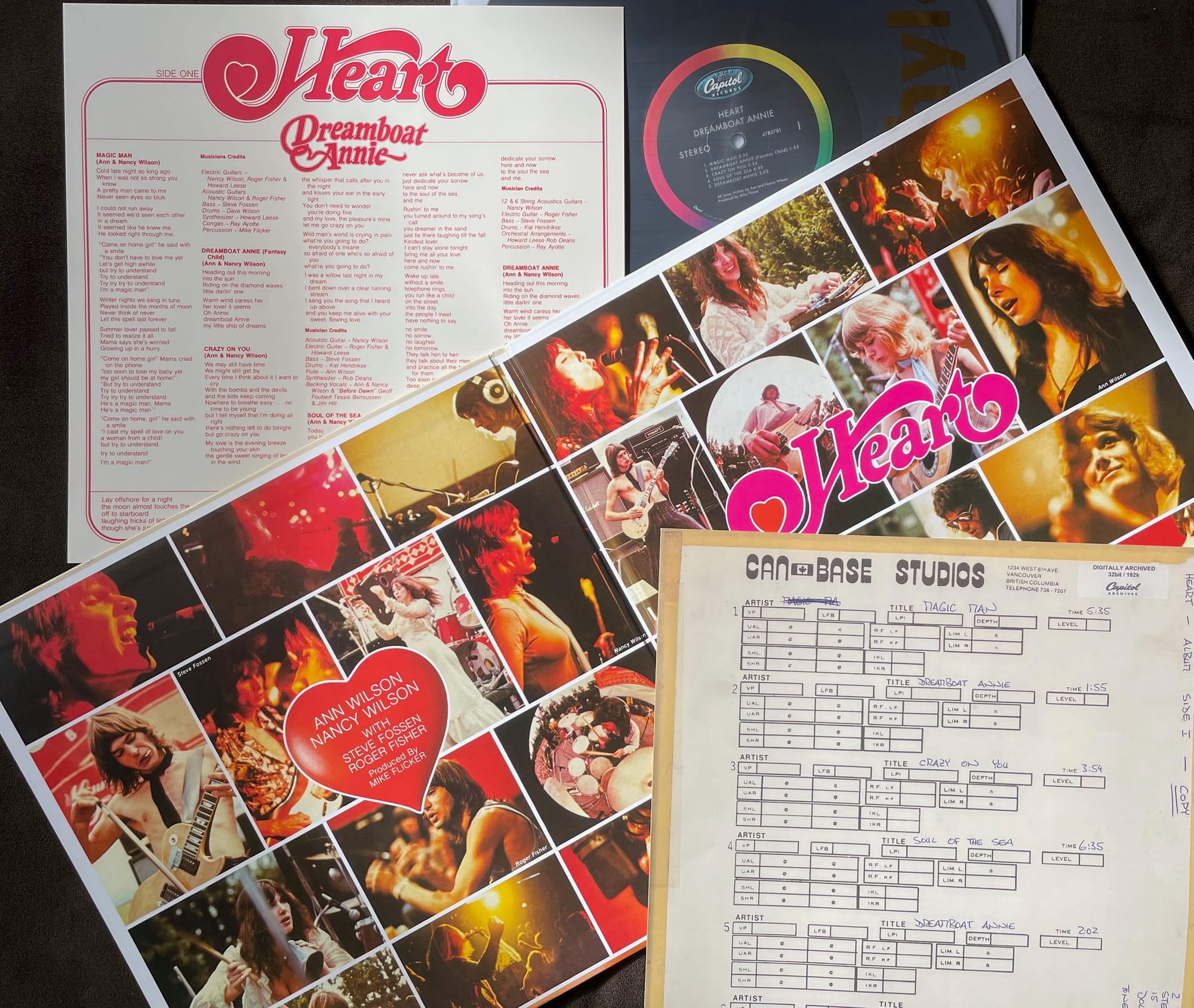
It’s a close enough comparison that it could be considered a toss-up, but to my ears the Vinylphyle offers just a fraction more realism and power—not to mention excellently pressed vinyl from RTI, dead-silent and flat in my case. There is also a 2-LP Mobile Fidelity pressing from 2025 that I have not heard, although that was cut from a copy tape and apparently has some problems on Side 1; there’s also a Nautilus half-speed master from 1979 that seems to be well-regarded. The Vinylphyle edition reproduces the Capitol label from the 1980s reissue rather than the original ’70s Mushroom label, and includes an insert with informative liner notes detailing the album’s creation and a sidebar of quotes from other musicians raving about Heart’s impact, particularly within the Seattle scene, where the Wilson sisters settled permanently.
Dreamboat Annie was as strong a debut as any young band could hope for, and the commercial response was resounding, but the album’s success immediately led to conflict with the record company, as the band felt they were getting screwed by a reduced royalty rate. Mushroom ended up releasing a follow-up, 1977’s Magazine, without the band’s consent, by which point they had defected to Columbia-owned Priority Records and released Little Queen the same year. Dreamboat Annie’s mixture of hard rock and gentle melodicism perhaps situated them uneasily within the rock ecosystem of the late ’70s, and the band relied on outside songwriters in the 1980s, losing their individuality even as they experienced their biggest success. Their debut album, then, remains Heart’s most cohesive and enduring statement, one that traverses the full rock spectrum, from aggressive barn-burners to pastoral, orchestral-tinged lullabies. And this new pressing puts all of Heart’s incarnations on equal footing.
Vinylphyle/Capitol/UMe 1-LP 33 RPM 180g black vinyl
• New all-analog Vinylphyle remaster of Heart’s 1975 debut album
• Jacket: “Tip-On wrapped gatefold jacket on clay-coated board” with wraparound obi
• Inner sleeve: Custom Vinylphyle-branded rice-paper-style poly
• Liner notes, insert, or booklet: Four-page insert with images of tape boxes, essay by Rick Florino, and testimonials by David Draiman, Kim Thayil, Lzzy Hale, and Jerry Cantrell; additional two-sided insert replicating original album inner sleeve with lyrics and credits
• Source: Analog; “original analog tapes” and “1975 Can Base Studios tape” per product page on uDiscoverMusic
• Mastering credit: Original mastering credit is Patrick Collins at Kendun Recorders, Burbank, CA
• Lacquer cut by: Joe Nino-Hernes, Sterling Sound, Nashville, TN
• Pressed at: Record Technology Inc. (RTI), Camarillo, CA
• Vinyl pressing quality (visual): A
• Vinyl pressing quality (audio): A
• Additional notes: Limited edition per obi. Comes in reusable outer bag with perforations.
Listening equipment:
Table: Technics SL-1200MK2
Cart: Audio-Technica VM540ML
Amp: Luxman L-509X
Speakers: ADS L980
Erykah Badu: Mama’s Gun
Review by Robert Ham
At the end of 1996, D’Angelo was set to begin work on Voodoo, his much-anticipated sophomore album, with his pals drummer Ahmir “Questlove” Thompson, bassist Pino Palladino, and keyboardist James Poyser. Initially, the plan was to hole up at New York’s Battery Studios, chosen, according to Questlove, because “that’s where Q-Tip, Ali Shaheed Muhammad, and Phife recorded all of their A Tribe Called Quest records.” Unimpressed with the vibe of the Midtown space, D’Angelo insisted the crew head south to Greenwich Village and convene at Electric Lady Studios, the recording house commissioned and funded by the late Jimi Hendrix. As D’Angelo put it, “It has the blessings of the spirits… It’s only right.”
For the next few years, the crew of musicians and producers known collectively as the Soulquarians stuck almost exclusively to Electric Lady and, through their efforts, helped set the course for the next few years of soul, R&B, and hip-hop. In addition to Voodoo, this creative team was responsible for part or all of Common’s 2000 album Like Water For Chocolate, the Roots’ brilliant 2002 release Phrenology, and 2000’s Train of Thought, the debut release from Reflection Eternal, the partnership of rapper Talib Kweli and producer Hi-Tek.
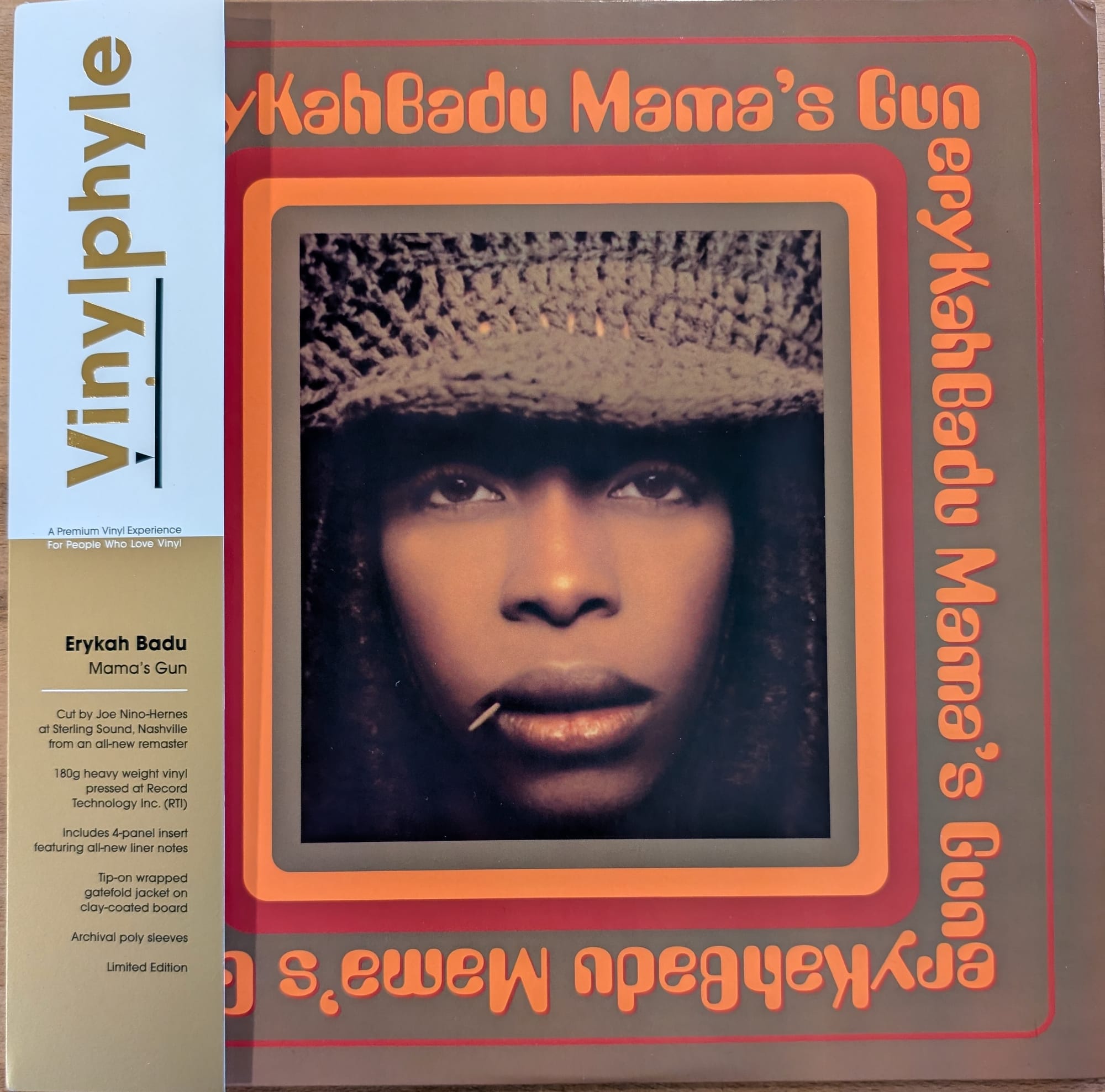
Great as those albums are, one Soulquarians project stands above the rest: Mama’s Gun, the 2000 album from singer-songwriter Erykah Badu. Having already established herself as a force to be reckoned with in the worlds of soul and R&B with her 1997 debut Baduizm, the Dallas-born artist took a massive leap forward with her second LP. Buoyed by the support of her chosen musical family, Badu worked spontaneously in the studio, jamming with the Soulquarians as her backing band. The music slid fluidly from the Funkadelic slam of opening track "Penitentiary Philosophy” to the slippery soul of “Bag Lady” to the playful yet lamenting blues-jazz of “Green Eyes.”
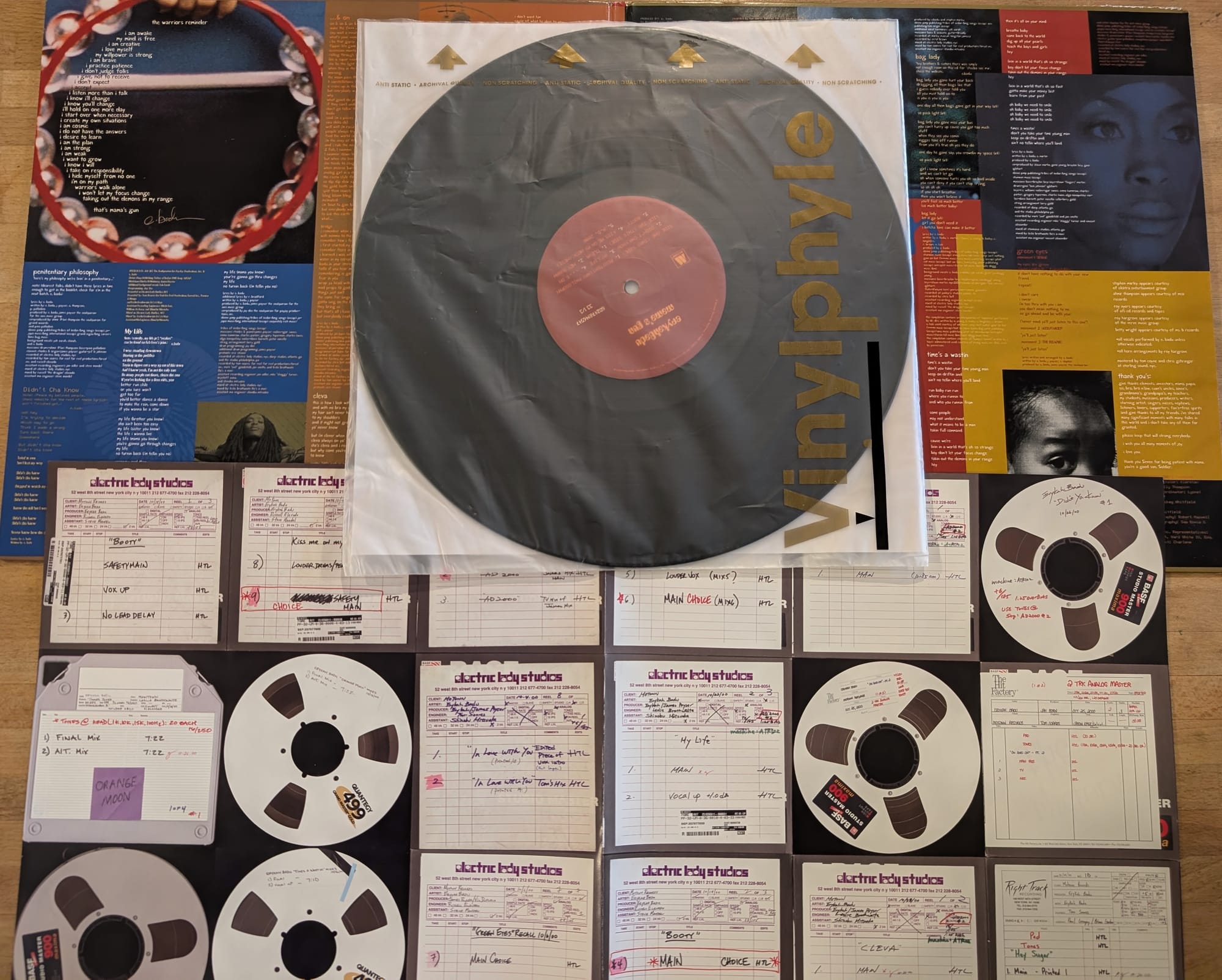
With that music as her backdrop, Badu was inspired to write lyrics that, as she comments in the liner notes accompanying the new Vinylphyle pressing of Mama’s Gun, “engaged all the senses—a multi-layered experience that conveyed not only personal narratives but also universal truths.” She scored on both fronts, with songs that explored her still-fresh separation from partner Andre 3000, societal ills like homelessness, her desire for a new lover, and, on the powerful “A.D. 2000,” the 1999 murder of Amadou Diallo by members of the NYPD.
Listening to Mama’s Gun, as I’ve done regularly in the 25 years since it was released, it’s not hard to gather why D’Angelo and the Soulquarians were drawn to Electric Lady. Whether or not the blessings of the spirits were upon them, the team took full advantage of the vintage gear on hand—Poyser made use of both the Clavinet and Fender Rhodes that Stevie Wonder played on Talking Book, while Questlove worked with a Ludwig drum kit from the late ’60s—and the analog recording equipment. Every track on here, even those few tunes that were recorded elsewhere (“I’m in Love With You,” Badu’s duet with Stephen Marley, came from a session at Tuff Gong in Kingston, Jamaica), sound present and vivid. The detail that the many recording and mixing engineers involved with this album were able to capture in these sessions is overwhelming and consistently exciting.
What I didn’t know until now was just how good this album could sound. My previous experience with the album came from an early CD version and a colored Vinyl Me, Please pressing from 2020 cut by Barry Grint at London’s Alchemy Mastering and pressed at GZ Media. The latter is plenty fulfilling; there’s a pleasant brightness to the album that pairs well with the deep oomph of the music’s low end. But this new Vinylphyle edition truly brings Mama’s Gun into a new dimension.
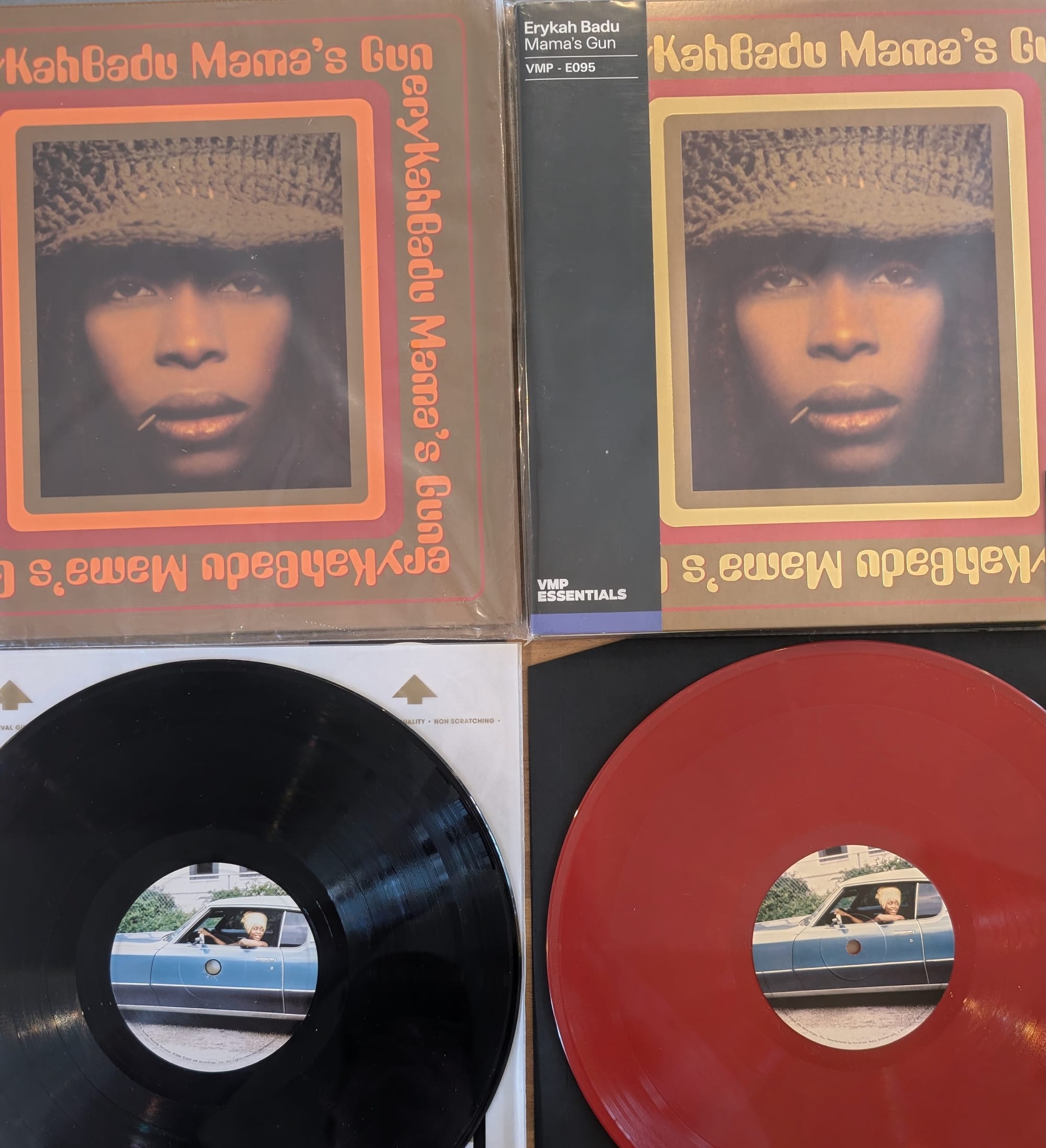
According to the liner notes, there isn’t a single analog master available for this release. The sessions, scattershot as they were, stretched across over a dozen individual reels. As such, previous vinyl editions of Mama’s Gun came from “original 44.1kHz/16bit files, with the original CD mastering and limiting.” For this new pressing, all the tapes were tracked down and the album was “reassembled and rebuilt digitally” by Justin Perkins at Mystery Room Mastering, who also transferred the music to 96kHz/24bit files. Using that source, engineer Joe Nino-Hernes at Nashville’s Sterling Sound cut new lacquers, and the album comes alive. I found myself constantly snapping to attention when spinning the Vinylphyle cut as instrumental features popped out of the mix: D’Wayne Kerr’s flute on the heated “Kiss Me on My Neck (Heti),” the quiet, breathy self-talk that opens up the album, Questlove’s subtle snare accents throughout. Any tightness to the sound on the CD and the 2020 vinyl is loosened by the emphasis on room tone and, yes, the analog warmth that evokes Electric Lady–born albums of the past like Talking Book, Chic’s 1977 self-titled debut, and Patti Smith’s Horses.
As this new pressing sinks in further, I wonder if other Soulquarian-produced albums could get similarly careful and considered reissues. If there were spirits haunting the live rooms and mixing desks while this crew of top-notch musicians and engineers were holding court at Electric Lady Studios, they were truly bestowing their blessings on everything that came out of that fruitful creative period. Here’s hoping we can hear them all with the clarity and depth that was brought to Mama’s Gun.
Vinylphyle/Motown/UMe 2-LP 33 RPM black vinyl
• New Vinylphyle remaster of 2000 studio album
• Jacket: “Tip-on wrapped gatefold jacket on clay-coated board” with wraparound obi
• Inner sleeve: Vinylphyle-branded rice-paper-style poly
• Liner notes, insert, or booklet: Four-panel insert with liner notes from Erykah Badu, Vinylphyle credits, and photos of the master tapes
• Source: Digital; “The record was reassembled and rebuilt digitally from 14 individual track tapes, newly transferred in 96kHz/24bit”
• Mastering credit: Justin Perkins, Mystery Room Mastering, Madison, WI
• Lacquer cut by: Joe Nino-Hernes, Sterling Sound, Nashville, TN; “JN-H” in deadwax
• Pressed at: RTI (Record Technology Incorporated), Camarillo, CA
• Vinyl pressing quality (visual): A
• Vinyl pressing quality (audio): A
• Additional notes: Limited edition according to obi. Comes in a reusable outer bag with perforations.
Listening equipment:
Table: Cambridge Audio Alva ST
Cart: Grado Green3
Amp: Sansui 9090
Speakers: Electro Voice TS8-2
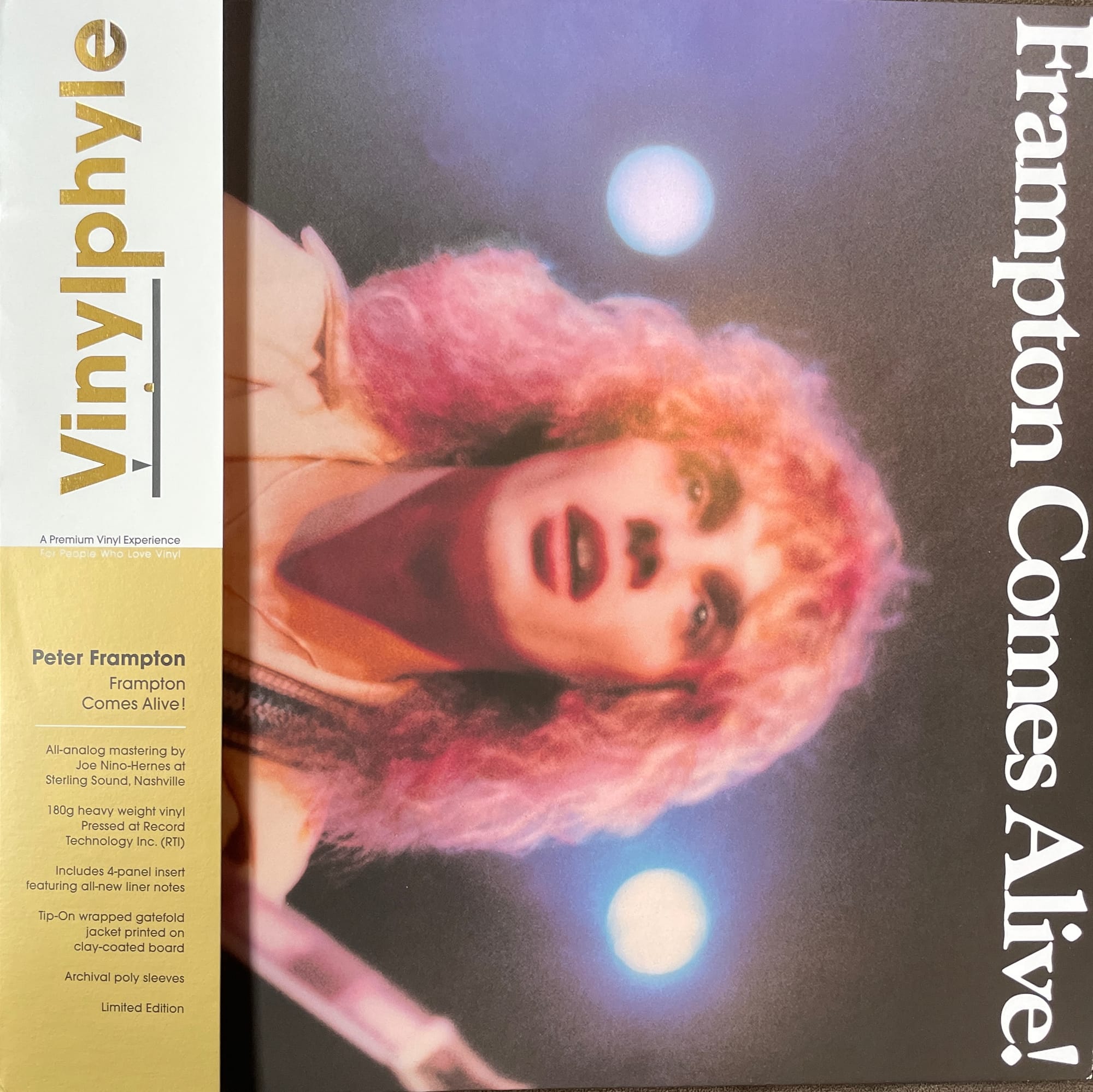
Peter Frampton: Frampton Comes Alive!
Review by Ned Lannamann
Frampton Comes Alive! is the ne plus ultra of 1970s double live albums. This was the era when every band, side project, and solo act extended their album-tour-album cycle by dropping a two-LP set captured live in concert (at least in theory), in front of screaming crowds and boasting extended jams of their biggest hits. I thought I might list some examples here, but then I realized that if I started, I would never be able to stop. (Okay, just a few: Deep Purple’s Made in Japan, Earth, Wind & Fire’s Gratitude, Neil Diamond’s Hot August Night, Kiss’s Alive!, Bob Seger’s Live Bullet.) Peter Frampton’s 1976 live set outsold them all, becoming so gargantuan that one could argue it played a part in killing off the trend.
Is that to say that Frampton Comes Alive! is the best double live album from the ’70s? I would certainly contest that point; it may not even be my favorite ’70s double live album that Frampton appears on (Humble Pie’s Performance: Rockin’ the Fillmore from 1971 gets a bit more play on my turntable). But something about Frampton Comes Alive! perfectly encapsulates the ’70s live album experience, from the perhaps chemically altered exuberance of the crowd to the guileless geniality of Frampton’s onstage persona to the goofiness of the album’s most memorable feature: Frampton’s talk box, the at-the-time futuristic effect that makes his guitar sound like a friendly singing robot. All of that is present and accounted for on the new Vinylphyle edition, which offers a premium, all-analog vinyl pressing of this very well-known album on the occasion of its 50th anniversary.
Across four sides, Frampton and his backing band cover more musical ground than you might remember, from the couples-swaying soft rock of “Baby, I Love Your Way” to the extended workout of their cover of “Jumpin’ Jack Flash.” Frampton even offers up some solo acoustic numbers (“Wind of Change” is famously interrupted by someone in the crowd setting off a firecracker). The album climaxes with the 14-minute “Do You Feel Like We Do,” which simmers along at a steady boil, then hunkers down for some extended vamps before building to a rafter-raising crescendo. I was surprised to be reminded that only four musicians made all of these sounds: Frampton on guitar, Bob Mayo on keys and guitar, Stanley Sheldon on bass, and John Siomos on drums. The ensemble sounds much bigger than that, perhaps due to the amplification of sound for the live show and to Frampton’s economical arrangements, in which the different instrumental components add up to more than the sum of their parts without sounding like anyone is over-playing. While the radio hits, “Baby, I Love Your Way” and “Show Me the Way,” have never been my cup of tea, this revisit led me to fully appreciate how the band cooks up substantial heat on tracks like “I Wanna Go to the Sun” and “It’s a Plain Shame.”
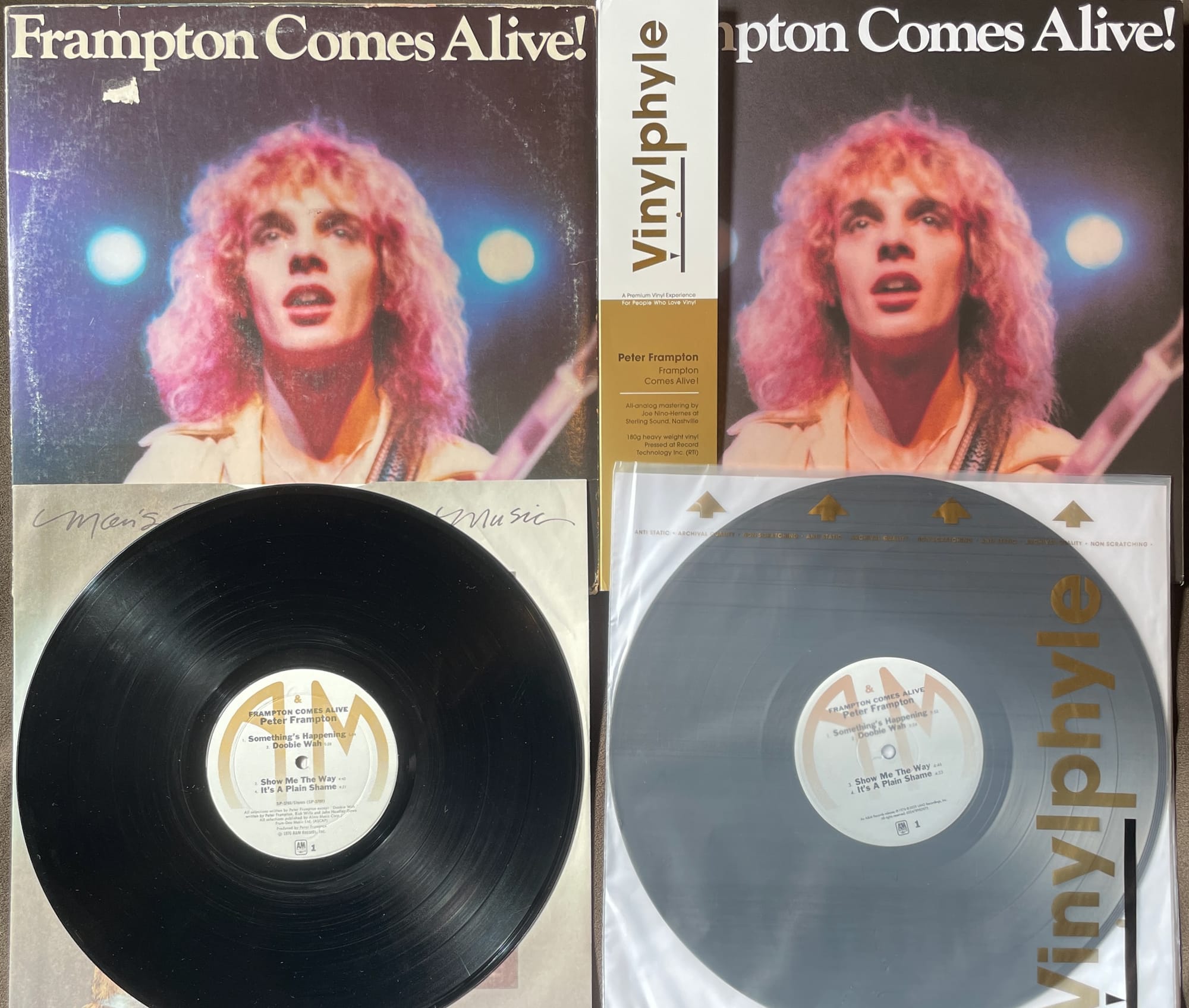
The new Vinylphyle pressing—featuring analog mastering by Joe Nino-Hernes at Sterling Sound in Nashville and a high-quality pressing from RTI—has its work cut out for it. The original 1976 pressing of Frampton Comes Alive! on A&M Records was pretty terrific-sounding to begin with. The live tapes were mixed at Electric Lady Studios in New York by Frampton and Chris Kimsey, and the master was prepared at Doug Sax’s Mastering Lab in Los Angeles. Mike Reese is the credited mastering engineer on the original album sleeve, but the liner notes and the promotional page for the Vinylphyle reissue suggest that the quarter-inch production master tape was prepared by Sax himself. A lacquer cutter is not credited in the original deadwax (at least not on my Monarch copy), but the Mastering Lab’s stamp (either “TML-M” or “TML-S,” depending on which lathe was used) is there. It’s likely either Reese or Sax cut several original lacquers for the first run, and then the album sold so many copies that at some point new lacquers were made. Any ’70s US pressing comes from that Mastering Lab master tape, though, and it was Frampton’s wish that it be located and reused for this pressing—which it was.
Nino-Hernes, to my ear, has successfully reproduced all the excellent qualities of the original pressing and subtly improved upon them. You can hear “into” the mix a bit better and dig out the individual musicians—no small thing because this album was designed to make the four-piece sound as massive as possible. You can also detect the splices and editing of different sources on the original album, something that was flattened out on the original pressing; the revealing quality of this new pressing lets you hear the studio doctoring a bit more. (This is a plus in my book, although some might rather have the illusion of seamlessness preserved at the expense of sound clarity). I can locate just an extra bit of sweetness and excitement in the Nino-Hernes cut, too, such as when the drums kick in on “(I’ll Give You) Money,” the album’s hardest-rocking tune, where the goosebump factor is just amped up a little bit. Some of this sonic improvement comes from the RTI pressing, which on my copy is essentially flawless. The backgrounds are dead silent, with the vinyl not adding any noise or interference with the actual music.
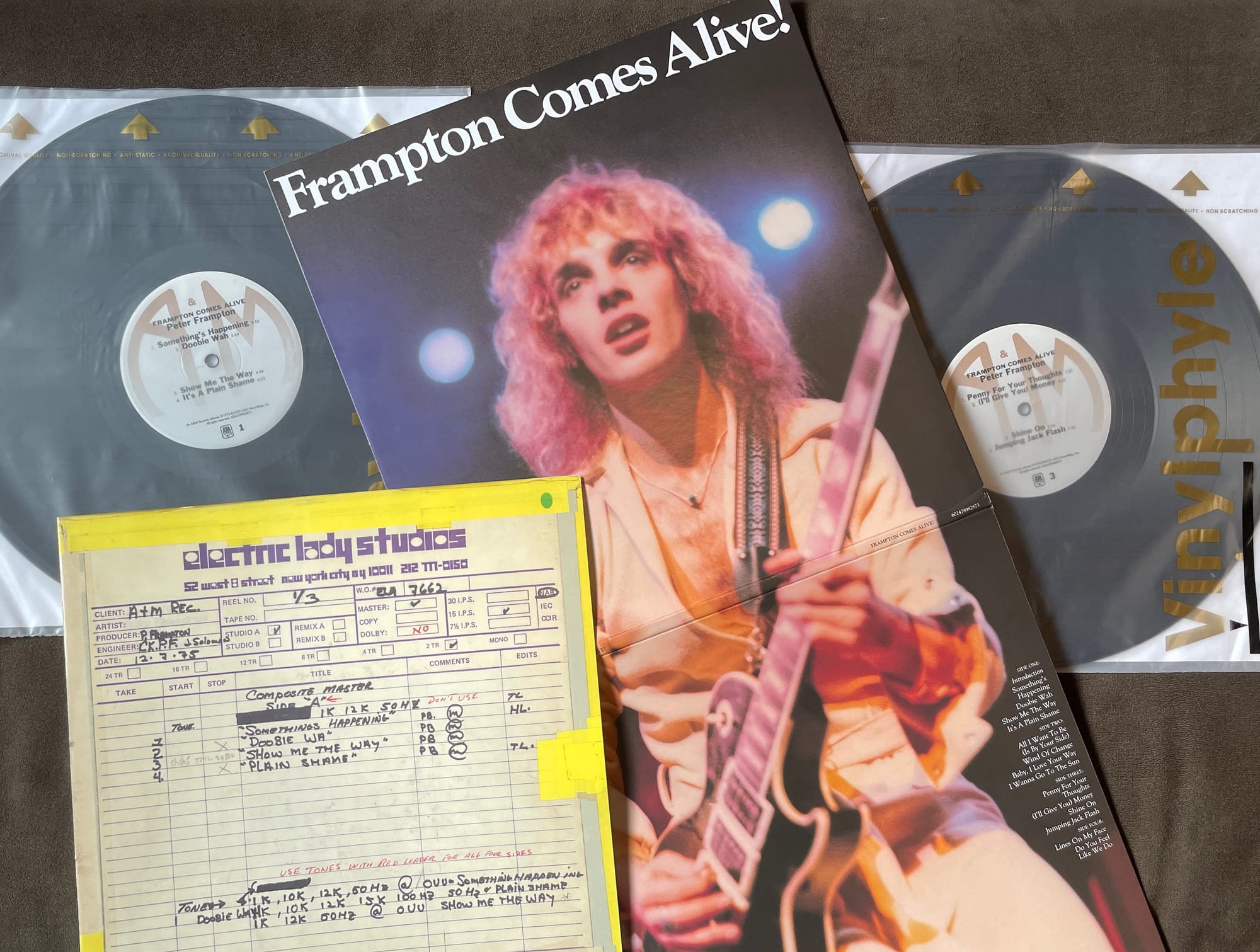
In fact, I’d say the only disappointment is in the liner notes, which are not especially illuminating. They take the form of a Q&A conducted by Anthony Fantano, asking Frampton generic questions about the album’s 50th anniversary. (Example: “So this record became one of the biggest-selling of all time. Why do you think it continues to resonate across generations?”) The only real revelation is that the Winterland concert, which makes up the bulk of Alive!, was actually Frampton’s first time playing a headlining show in San Francisco. The jacket is lovely, perhaps a bit too nice to justify the cover photo that’s famously soft and unflattering; I also discovered two very small seam splits on the inside gatefold, suggesting that the heavyweight 180-gram vinyl and the tip-on clay-coated board are not ideally compatible roommates.
Aesthetics aside, the real victory with this new pressing of Frampton Comes Alive! is the chance to hear the album anew. I’ll admit I was surprised to find that I can safely say I like this album a lot more than I did a few days ago, before I embarked on the multiple listens for this review. As with the recent Rhino Reserve pressing of Donny Hathaway’s Live, this Vinylphyle edition plops you in the thick of the live-show action, right in the venue’s acoustic sweet spot, where you can soak in the band’s tightness and Frampton’s finger-flashing guitar prowess. Even the talk box solo in “Do You Feel Like We Do” sounds thrillingly fresh, more than capably shaking off the ’70s time-capsule status it’s acquired over the years. If the massive success of Frampton Comes Alive! helped kill off the double live album, the 50th anniversary Vinylphyle edition sounds so good that it could conceivably inspire a revival of the format.
Vinylphyle/A&M/UMe 2-LP 33 RPM 180g black vinyl
• New all-analog Vinylphyle remaster of Frampton’s 1976 double live album
• Jacket: “Tip-On wrapped gatefold jacket printed on clay-coated board” with wraparound obi
• Inner sleeve: Custom Vinylphyle-branded rice-paper-style poly
• Liner notes, insert, or booklet: Four-page insert with photos of tape boxes and Anthony Fantano’s Q&A with Frampton
• Source: Analog; “sourced from the original 1975 Doug Sax 1/4” production master” per product page on uDiscoverMusic
• Mastering credit: Original album mastering credited to Mike Reese (not Doug Sax) at the Mastering Lab, Los Angeles, CA; “Vinyl mastering by Joe Nino-Hernes, Sterling Sound, Nashville” per insert
• Lacquer cut by: Joe Nino-Hernes, Sterling Sound, Nashville; “JN-H” in deadwax
• Pressed at: Record Technology Inc. (RTI), Camarillo, CA
• Vinyl pressing quality (visual): A
• Vinyl pressing quality (audio): A
• Additional notes: Limited edition per obi. Comes in reusable outer bag with perforations.
Listening equipment:
Table: Technics SL-1200MK2
Cart: Audio-Technica VM540ML
Amp: Luxman L-509X
Speakers: ADS L980