Review: A vintage live Who show from 1971
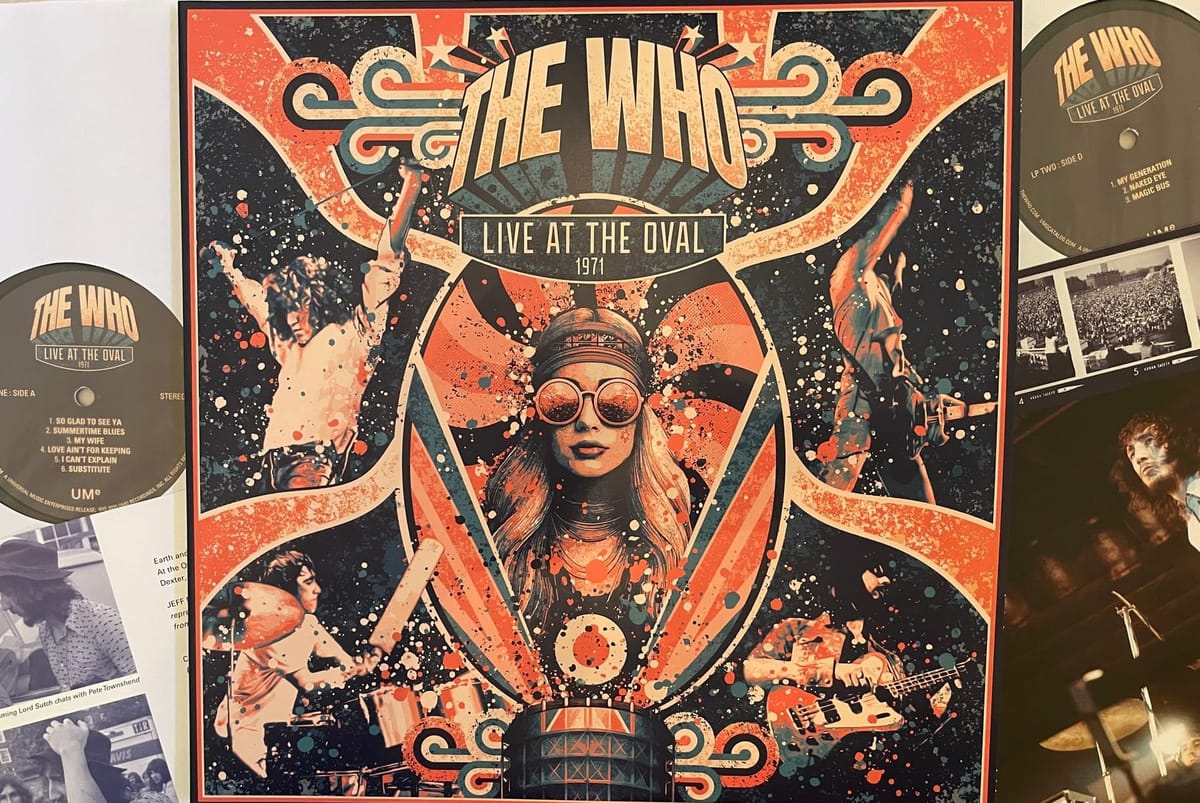
The Who: Live at the Oval 2-LP set

Live at the Oval finds the band at their Who's Next–era best.


On September 18, 1971, the Who headlined an all-day festival at the Oval, a cricket ground in South London. Named Goodbye Summer, the event was a benefit for famine relief in Bangladesh, following George Harrison's lead with the two high-profile benefit concerts he'd headlined in New York earlier that summer. For this London event, the Who brought along their massive new PA and a clutch of songs from Who's Next, the magnificent album they'd released just six weeks earlier. And as evidenced from the new archival release, Live at the Oval, the four-piece also brought the thunderously powerful live show they'd honed into a juggernaut during the months of touring 1969's Tommy (and famously documented on 1970's Live at Leeds).

On 2-LP vinyl, Live at the Oval has decided strengths and a couple of minor drawbacks, which I'll get into. As a document of an early British festival show—this was a bit before crowds of 35,000 on sports fields became the norm—Live at the Oval is a marvel, a truly exciting recording of what must have been quite the gig. For anyone even mildly disposed toward the Who's music from this period, it's essential listening.

This show was well-known to have been recorded on 8-track tape, but for decades the working knowledge was that the tapes were unusable. In fact, the Pye Mobile Recording Unit—also responsible for Live at Leeds—was parked next to the stage with reels rolling throughout the entire day of performances, which included sets by Cochise, the Grease Band, Lindisfarne (just a few weeks before Fog on the Tyne became a smash), Quintessence, Mott the Hoople (fresh out of the studio for their forthcoming Brain Capers), America, Eugene Wallis, an In Hearing Of...–era Atomic Rooster, and Faces, who would in very short order be big enough to headline festivals on their own. (Within days of Goodbye Summer, Faces singer Rod Stewart would top the English and American charts with "Maggie May" and the Every Picture Tells a Story album.) Maybe some day we'll hear more of the Goodbye Summer recordings—a deluxe box set with all the performances is nice to dream about, at least. For now, the Who's set will do.

The Pye engineers, with Who's Next producer Glyn Johns on hand to oversee proceedings, carefully positioned their microphones during the gap between the Faces' and Who's sets. But to their horror, as the Who took the stage, the band's roadies moved their handiwork around, resulting in several of the microphones pointing away from where they were supposed to. (Drummer Keith Moon reportedly also played his role in this.) The recording technicians were forbidden by security to get back up on stage to fix the microphone positioning—there was a general attitude that the show comes first, and any resultant recordings were just a bonus. And with Live at Leeds released just the previous year, the Oval tapes were deemed superfluous and quickly forgotten. They apparently fell into the hands of a private collector and disappeared for decades, although a partial audience recording of the show has circulated among fans.

Fortunately, the long-standing belief that the Goodbye Summer multitrack tapes were no good is clearly inaccurate. Live at the Oval may be a far-from-perfect recording—Moon's drums, in particular, occasionally go in and out of focus, and there are all the usual anomalies that happen whenever an energetic live show is caught in the moment. But if the multitracks needed a salvage job or any serious doctoring, it is more or less invisible to the listener. And the sheer excitement of the show explodes from the speakers, with Roger Daltrey's voice in apex condition, John Entwistle's bass growlingly prominent in the left speaker, and Pete Townshend's guitar—which occasionally falls out of tune, as on "See Me, Feel Me"—possessing a glowing, thrilling tone in the right. By and large, the four elements leave room for each other, and the sound remains massive without ever becoming cluttered. Such was the magic of the Who in those days.

Much of the show's backstory is documented in the terrific 16-page booklet included with the double-LP set, which details the Goodbye Summer event and the circumstances around the recording. These liner notes are exemplary for an archival release such as this, and will not just inform but actually enhance your appreciation of the music—a worthwhile selling point for those thinking about the vinyl. The cover art is less successful, with Josh Townshend (Pete's nephew) responsible for the incongruous image of a hippie girl in tinted glasses that dominates the front. Josh makes generally quite appealing concert poster art (which you can see here) and otherwise seems to have a keen handle on the Who's visual legacy, so I'm not quite sure why this particular artwork doesn't work for me. It may just be a taste thing. The booklet contains plenty of fabulous photos from the concert itself, so it's easy to focus on those instead (and even more photos are viewable at Getty).

A glimpse inside the terrific booklet for Live at the Oval, including suggestions of cover art that might have been.

Two other 1971 live recordings of the Who—each currently available on the super deluxe Who's Next box set from 2023—provide interesting points of comparison. The April 26 show at the Young Vic Theater finds the band working out Who's Next/Lifehouse material in front of a smaller, selected crowd, resulting in a somewhat stilted, tentative affair. The December 13 show at San Francisco's Civic Auditorium falls at the other end of the spectrum, a tremendous gig by a road-honed band. However, the mix on the San Francisco show is distracting, and there are looped crowd noises that suggest some funny business with the tapes.

This Oval set is different enough to set it apart from both—it's a good-time, high-energy show delivered after an, um, festive day spent on the grounds with plenty of rock-star partying. Townshend evidently fell under the malevolent influence of the Faces and was totally drunk by the time he took the stage. "I'm completely blind tonight," he says before "Behind Blue Eyes," presumably referring to the stage lights, although he just as well could be referring to his state of mind. He's quite rowdy on mic throughout the show, exaggerating his London accent for the Kennington locals but never losing a step musically. (Some additional Townshend crowd banter can be heard on the audience tape but not on Live at the Oval, although it is outlined in the liner notes—the victim of the microphone mishigas.) Moon's antics are less audible, although at one point he apparently played the drums with a cricket bat pilfered from show host Jeff Dexter; Moon then chucked the bat into the crowd, never to be seen again, much to Dexter's dismay.

Indeed, the entire show runs right up to the brink of chaos without ever fully going off the cliff, and that's what makes it such an exciting listen. Kicking off the show, the 40-second "So Glad to See You" is an improvised vamp that's far more engaging than it has any right to be, and it quickly explodes into the power-chord riff of their rendition of "Summertime Blues"—an apt tune for the Goodbye Summer theme. A clutch of songs from Who's Next follow, including a bellowing take on "My Wife," a forceful "Love Ain't for Keeping," and fully loaded renditions of "Bargain" (Daltrey hits the high note with ease), "Behind Blue Eyes," and a slightly messy version of "Won't Get Fooled Again" where the band sounds like they're still getting used to playing to the backing tape, falling slightly out of sync at Daltrey's scream. The only conspicuous absence is "Baba O'Riley," which the band had only attempted live once before and was probably not entirely sure how to pull off in front of a crowd, with its organ-pattern underpinning, piano chords, and fiddle outro. (They'd figure it out later that year.)

Tommy is abridged to a simple pairing of "Pinball Wizard" and "See Me, Feel Me/Listening to You," and early singles "I Can't Explain," "Substitute," and "My Generation" are fully aired, with "Magic Bus" closing the proceedings. There's also a great version of "Baby Don't You Do It" (which Daltrey mistakenly introduces as an Elmore James song) and a climactic "Naked Eye," the live staple that eluded official release on Who's Next but would eventually be collected on Odds and Sods. In short, the 75-minute festival set is the condensed-milk version of a Who concert of the era, hitting all the high notes and sacrificing only a few subtleties.

So the performance speaks for itself, and the recording is more than adequate—frankly, it sounds sparkling, joyous, aggressive, and intoxicating, with the hallmarks of an exciting bootleg and none of the clinical sterility of an overly fussed-over '70s live album. As mentioned, Moon's drums don't always sound their best, but everything else is present and alive. If it is a notch below Live at Leeds, well, everything is.

Some vinyl-nerd specs (that's why you're here, presumably): Bob Pridden and Richard Whittaker are credited with the mix, which was almost certainly a high-resolution digital file mixed from the 8-track tape, as it would not make economic sense to create an analog mixdown in the year 2025. Mastering was a family affair, done by Townshend's former brother-in-law Jon Astley and his daughter Layla at Close to the Edge Mastering; this master is likely the source for all digital versions of the release. Presumably the Astleys then handed off a high-resolution, fully mastered file to Miles Showell at Abbey Road Studio, where Showell performed the lacquer cut and etched his name into the deadwax (note that it was NOT done via the half-speed process, although Showell is well-know for doing those, including several for the Who). The runout grooves also bear the code of GZ Media, the mammoth Czech pressing plant, although my black-vinyl version had a "Made in Canada" sticker on the shrink-wrap, which to me indicates it was pressed at GZ's partner plant, Precision Record Pressing in Burlington, Canada. The jacket's standard paperboard, a bit too snug to allow the poly-lined sleeves to slide in and out with ease (and the 16-page booklet doesn't help matters).

Sadly but perhaps unsurprisingly, my pressing was less than perfect—there were some annoying clicks at the very beginning of Side 1, as well as a few isolated clicks on all four sides. My disc 2 had a minor warp, too, that did not affect play but caused my tonearm to shiver a little bit. I also detected a non-negligible amount of surface noise, especially at the end of each side as the applause faded to silence. With all that said... I didn't really care. The show is loud enough and the music is exciting enough that any extraneous noises are easily ignorable. This is a package that I'm thrilled to have on the shelf.

Some may prefer to listen to the digital version, without interruptions between each vinyl side. I can't fault that logic—it would certainly be a more immersive way to mentally whisk yourself back to 1971. But I was happy to discover my discs sounded noticeably better than the high-resolution stream on Apple Music, which sounded perfectly great but, to me, lacked the holographic quality and full dimensionality of the vinyl.

With the actual anniversary of the Goodbye Summer show mere days away (September 18), Live at the Oval is a fine way to noisily wind down the warmer months. And if it's a qualified recommendation for the vinyl edition, in some ways it meets the idealized standard of that elusive beast, the 1970s-era double-live album, as it's friskier and rawer than those typically ended up being. The Who always rose to the challenge whenever they were in direct competition with other bands in a festival setting—see the Rolling Stones Rock and Roll Circus and, of course, Woodstock—and Live at the Oval finds them powering up to the next level, with the rocket of Who's Next beneath them. It's as good as an archival concert release has any right to be, and we're lucky we finally got it after more than half a century.

UMe 2xLP • black vinyl (limited colored variants are also available)

Listening equipment
Table: Technics SL-1200MK2
Cart: Audio-Technica VM540ML
Amp: Luxman L-509X
Speakers: ADS L980