Review: Bob Dylan's Earliest Years

Charting the breakthroughs on Through the Open Window: The Bootleg Series Vol. 18, 1956–1963.
We’re still catching up on all the great things that have come out over the past few weeks, particularly the larger box sets that take a bit of extra time to absorb. Today we get into this season’s Bob Dylan set, which hit shelves back on October 31. The 4-LP vinyl set is a condensed version of a larger 8-CD box.
Before we get into the review, though, here’s a reminder about The Vinyl Cut’s first-ever vinyl giveaway! It’s for paid subscribers, so if you’d like to support our work and be eligible to win, click here for all the necessary info:


Bob Dylan: Through the Open Window: The Bootleg Series Vol. 18, 1956–1963
It’s fruitless to try to pinpoint the moment Bob Dylan arrived. Where do you place it? Is it the day he first set foot in Greenwich Village, or the night he played Gerdes Folk City and got a writeup by Robert Shelton in the New York Times? Was it when he headlined Carnegie Hall, or when he infamously plugged in and blew away the crowd at the Newport Folk Festival? Dylan just kept arriving and arriving and arriving, and the newest installment of his long-running Bootleg Series documents about the first half-dozen or so of those arrivals.
Through the Open Window: The Bootleg Series Vol. 18, 1956–1963 gathers up all sorts of early Dylan recordings, from juvenilia recorded at a music store in St. Paul, Minnesota, to a galvanizing take of “The Lonesome Death of Hattie Carroll” taken from a tape made at a party in Los Angeles. Most of the stuff here was recorded in New York City, of course, and it includes very early live performances from Gerdes and the Gaslight, as well as that 1963 show at Carnegie Hall, which was professionally recorded by Columbia. There are outtakes from the sessions for his first three albums, impromptu recordings captured at friends’ gatherings, and even an early BBC appearance.
The bounty here is dizzying, but it’s only partial. The 4-LP vinyl edition of Through the Open Window is the same as the 2-CD set and what’s currently available on streaming services, but these are mere highlights taken from a much more comprehensive 8-CD box set. The historical importance of this pre-fame stuff goes without saying, but I wasn’t prepared for how engrossing a journey it would be to explore all these early triumphs and detours. Maybe the vinyl version is really the cream of the crop, but I was so entertained that I’m now thinking about getting my hands on the 8-CD version. While it takes the form of an aural scrapbook, it’s almost wall-to-wall excellence.
And what’s not musically great is fascinating for other reasons. On the very earliest recording, from when Dylan was 15, he bangs out a sloppy version of Shirley and Lee’s “Let the Good Times Roll” on the piano, at a time when that song may have still been in the charts. Any sign of future genius is decidedly not present. A series of home recordings follow, with Dylan singing in a precursor of his Nashville Skyline Kermit voice, but before Side 1 is halfway done, Dylan is recognizably Dylan—or at least recognizably a Woody Guthrie disciple.
From there, his growth was lightning fast, but Through the Open Window manages to capture isolated freeze-frames of it. A recording of “I Was Young When I Left Home” from a 1961 party in Minneapolis is maybe the first complete picture of his budding genius, when performer and songwriter unite and shed all influences to become something entirely unique. More strokes of brilliance ensue, in varying levels of fidelity; there’s a sense of “can you believe this is happening?” to a lot of the live and impromptu recordings. You can hear, in early performances of “Don’t Think Twice, It’s All Right” and “The Times They Are a-Changin’,” that Dylan hasn’t fully figured out all the lyrics just yet. But it’s not all off-the-cuff—some of the most remarkable things here are the alternate takes of “Masters of War” and “Girl from the North Country” from the Freewheelin’ album sessions. It’s hard to believe these have never been released before.

Mind you, much of what’s on here has been released before, on the first Bootleg Series Vols. 1–3 box set, or on a pair of archival live albums, or on some extremely limited-edition compilations that were released as copyright dumps to keep unissued recordings from lapsing into the public domain. But a good chunk has never been heard before, and while the recordings aren’t always of professional quality, they are always fully listenable (apart from the very earliest tracks, which, again, have their own historical merit). It’s mostly Dylan’s voice and guitar, and he’s able to get his point across, even in limited fidelity. So by and large, this stuff sounds awfully good—it’s a wonder so much of it was captured for posterity, and thank heaven it was.
The restorers and compilers deserve high marks for making this sound not just presentable but united as a listening experience. Credit is also due to Ryan K. Smith at Sterling Mastering, who cut the lacquers for the vinyl. Again, these are not complicated recordings, but Smith locates their musical centers and offers them up without fuss or distraction. No tape anomalies get in the way of the music, and no mic bump or harmonica screech detracts from the experience. Audio-wise, this is very smooth sailing.
The pressing, from Memphis Record Pressing, is almost as smooth. The first two discs in my box were absolutely flawless, easily among the best vinyl I’ve gotten from that pressing plant—silent backgrounds, no extraneous noises, flat, centered, and great. However, the third disc had one side that was pressed off-center, and on the other side, while the grooves were more or less in the right place, the label was comically off its mark. This disc had quite a bit of noise as well, perhaps due to it being off-center (although I can’t quite figure out the logic of that, so maybe it’s unrelated). The fourth disc was better, but was dished to the point where one edge reached up and kissed my stylus before I even dropped the tonearm. (Note: Non-US/Canada pressings were made at Pallas in Germany.)
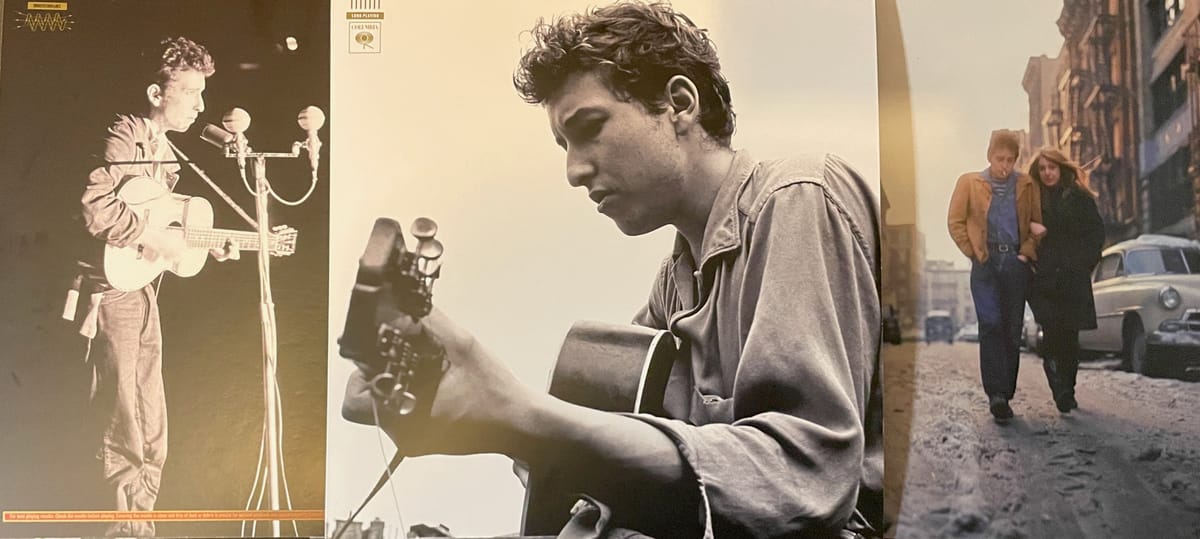
I won’t harp on that, because I am basically really pleased with the box. The individual jackets feature terrific photos of Dylan, and the discs come inside handsome sleeves, although they are paper and not poly-lined. The 24-page booklet is printed on nice thick paper and contains an additional bevy of fantastic photos. The introductory essay by one of the set’s producers, Sean Wilentz, is curiously efficient; he basically says the music speaks for itself and refers the reader to Dylan’s own memoir, Chronicles: Volume One, for any necessary background info. The track info is scant, offering just recording location and date, if known, and no additional context around the recordings themselves. Apparently there are “extensive” liners in the larger box, and it’s a shame those aren’t offered in the abridged version.
All told, this is neither a museum piece nor a time capsule. Through the Open Window is just a plain ol’ fun listen, cruising through two and a half hours of really great moments from Dylan’s early days. You get a sense of his playfulness and humor, but what’s more compelling is that you can sense his excitement at the connection his music is making with people. The best-known protest songs are here, as are some of his early comic setpieces; Dylan tries his hand at traditional songs, which directly inform his own compositions, and you can hear this flow of ideas in real time. The set’s coup de grace is the fourth LP, filled up with selections from the Carnegie Hall show—the complete recording appears on the larger box set. It’s a great capper to the whirlwind we’ve just experienced. And while the set as a whole functions as a taster to a larger history lesson, it’s an awfully cohesive and enjoyable one. If it hits you like it did me, you’re going to want to hear the rest of it.
Columbia/Legacy 4-LP 33 RPM black vinyl
• Assorted non-album recordings from 1956 to 1963; 18 are unreleased and 9 are “super-rare”; these are highlights culled from a larger 8-CD box set
• Jacket: Four direct-to-board single-pocket sleeves inside a sturdy slipcase
• Inner sleeves: Custom die-cut paper with vintage-looking but not period-accurate Columbia branding
• Liner notes, insert, or booklet: 24-page booklet with short essay, brief track info & lots of pics
• Source: Digital (six different people are credited with the analog-to-digital transfers)
• Mastering credit: “Mastering and restoration by Michael Piacentini and Steve Addabbo”
• Lacquer cut by: Ryan K. Smith at Sterling Mastering, Memphis, TN (“RKS” in deadwax)
• Pressed at: Memphis Record Pressing, Memphis, TN
• Vinyl quality - visual: C (disc 3 was off-center and disc 4 was significantly dished)
• Vinyl quality - audio: B (disc 3 had some noise and clicks)
• Additional notes: None.
Listening equipment:
Table: Technics SL-1200MK2
Cart: Audio-Technica VM540ML
Amp: Luxman L-509X
Speakers: ADS L980