Review: Universal’s Definitive Sound Series


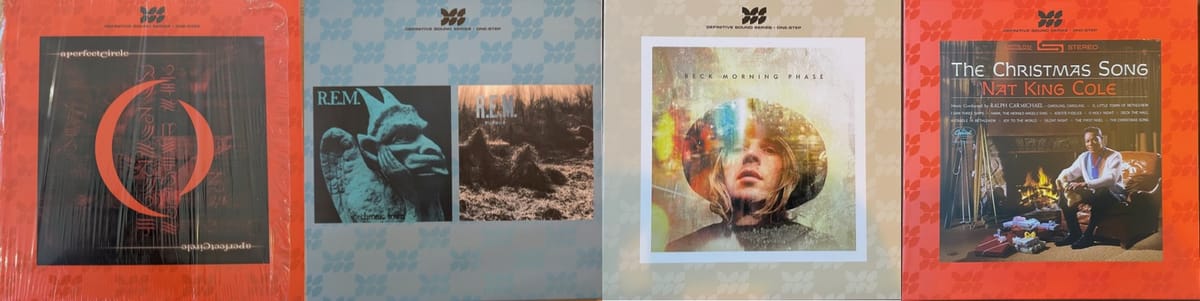
Fancy one-step pressings of R.E.M.’s Chronic Town and Murmur, Beck’s Morning Phase, A Perfect Circle’s Mer de Noms, and Nat King Cole’s The Christmas Song.
A couple of weeks back, we checked out two recent releases in Warner’s Because Sound Matters series, which offers deluxe one-step vinyl treatments of selections of their back catalog.
Universal has also gotten into the premium vinyl game with their recently launched Definitive Sound Series (DSS). These are one-step pressings on a high-end vinyl compound, boasting excellent sonics and little-to-no background noise. They come in tip-on jackets with outer slipcases, and with appropriate price tags to match. In other words, they’re for vinyl nuts willing to drop a bit extra for a really, really good-sounding version of their favorite record.
If Universal’s and Warner’s series seem similar, that’s because they’re ideated and managed by the same guy: Tom “grover” Biery, an industry veteran and music obsessive who has relationships with both camps and also works closely with Record Technology Inc., the vinyl pressing plant that is handling both lines.
Today we wanted to dig into the Definitive Sound Series titles, which are being primarily offered via a direct-to-consumer model through Universal’s labels, although certain online retailers, such as Acoustic Sounds and Music Direct, have gotten allotments as well. DSS recently dropped a double LP of R.E.M. that we think is pretty major; we are pretty blown away by the new Beck reissue as well, and the other titles sound just as incredible. We don’t have reviews of the very first Definitive Sound Series release (Dr. Dre’s The Chronic) or the very latest one, which ships out this week: (Lionel Richie’s Can’t Slow Down), but we were able to dig into the rest of the line, which cuts a pretty wide stylistic swath across Universal’s immense catalog. Here’s what we reviewed:
- R.E.M.: Chronic Town and Murmur
- Beck: Morning Phase
- A Perfect Circle: Mer de Noms
- Nat King Cole: The Christmas Song
Let’s get into what DSS is throwing down!
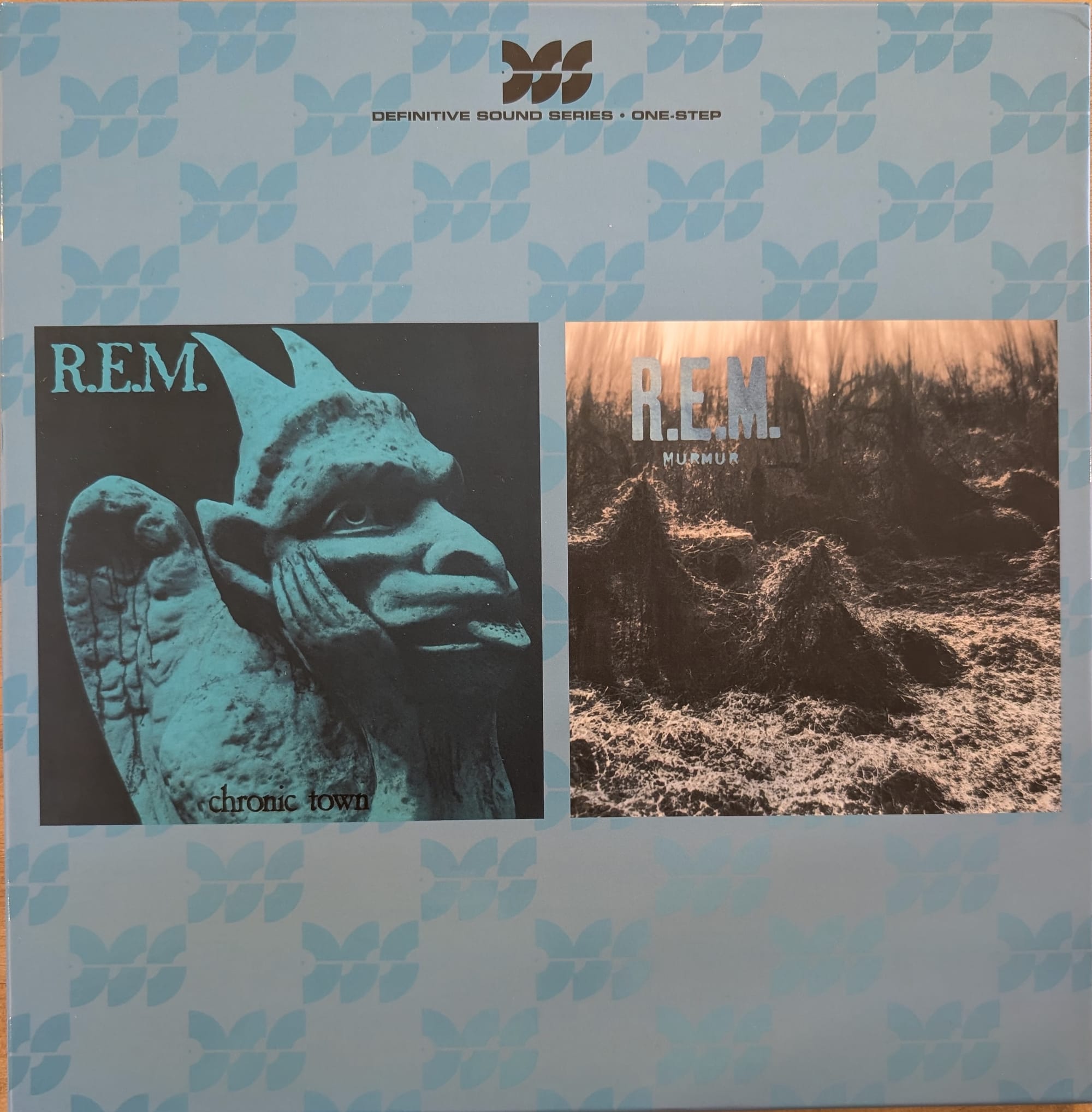
R.E.M.: Chronic Town and Murmur
Review by Robert Ham
During the band’s first decade as recording artists, R.E.M. were my north star and the yardstick to measure all other artists against. The college-rock band from Athens, Georgia, perfectly fused the jangle and snap of the ’60s pop I imbibed from oldies radio with the ’70s punk and post-punk from New York and UK that I was hearing on left-of-the-dial stations. And with their artful album artwork and enigmatic music videos, they had an undeniable air of cool that was catnip for this young music obsessive.
My love for R.E.M. has since softened as other artists have commanded my attention, but there’s no shifting the fact that the two titles reissued in this new Definitive Sound Series release, a double LP that couples their 1982 debut EP Chronic Town and their first full-length, 1983’s Murmur, still rank high in my informal rundown of the greatest recordings ever made. Even though I may not listen to as much R.E.M. as I once did, my anticipation for this set was still pretty high.
I’m happy to report that this set exceeded my expectations and then some. With the analog master tapes for both sessions in hand, mastering engineer Chris Bellman has helped breathe new life into these 40-plus-year-old recordings. That’s obvious from the first ringing notes of guitarist Peter Buck’s 12-string Rickenbacker on “Wolves, Lower,” the amped-up opening track on 1982’s Chronic Town. As the song picks up steam, details that were present but deadened on the original IRS release I have owned for years began to pop through the mix: the Gang of Four–like swing of bassist Mike Mills, the slightly off-balance backing vocals of Mills and drummer Bill Berry, the backwards guitar line that growls through the song’s breakdown. And so it goes through all five songs on the EP, with revelations coming from every corner. I definitely never clocked how wobbly Michael Stipe’s vocals were on “1,000,000,” as if the nerves of working in a proper recording studio, even one as modest as Mitch Easter’s Drive-In Studio, were catching up with the young frontman a bit.
None of those jitters are audible on Murmur, the 1983 full-length that R.E.M. made with Easter and co-producer Don Dixon. The stakes were definitely higher, as their label, IRS Records, insisted that the group step up their game by initially setting them up with Stephen Hague, the producer who had worked with Slow Children and the Gleaming Spires. It was a bad pairing, but wiser heads prevailed, and the quartet were soon back in the arms of Easter who, with Don Dixon, recorded the band at Reflection, a 24-track studio in Charlotte, North Carolina. The resulting sessions were thrilling—a road-tight band confidently playing their material with strength and melodic aplomb.
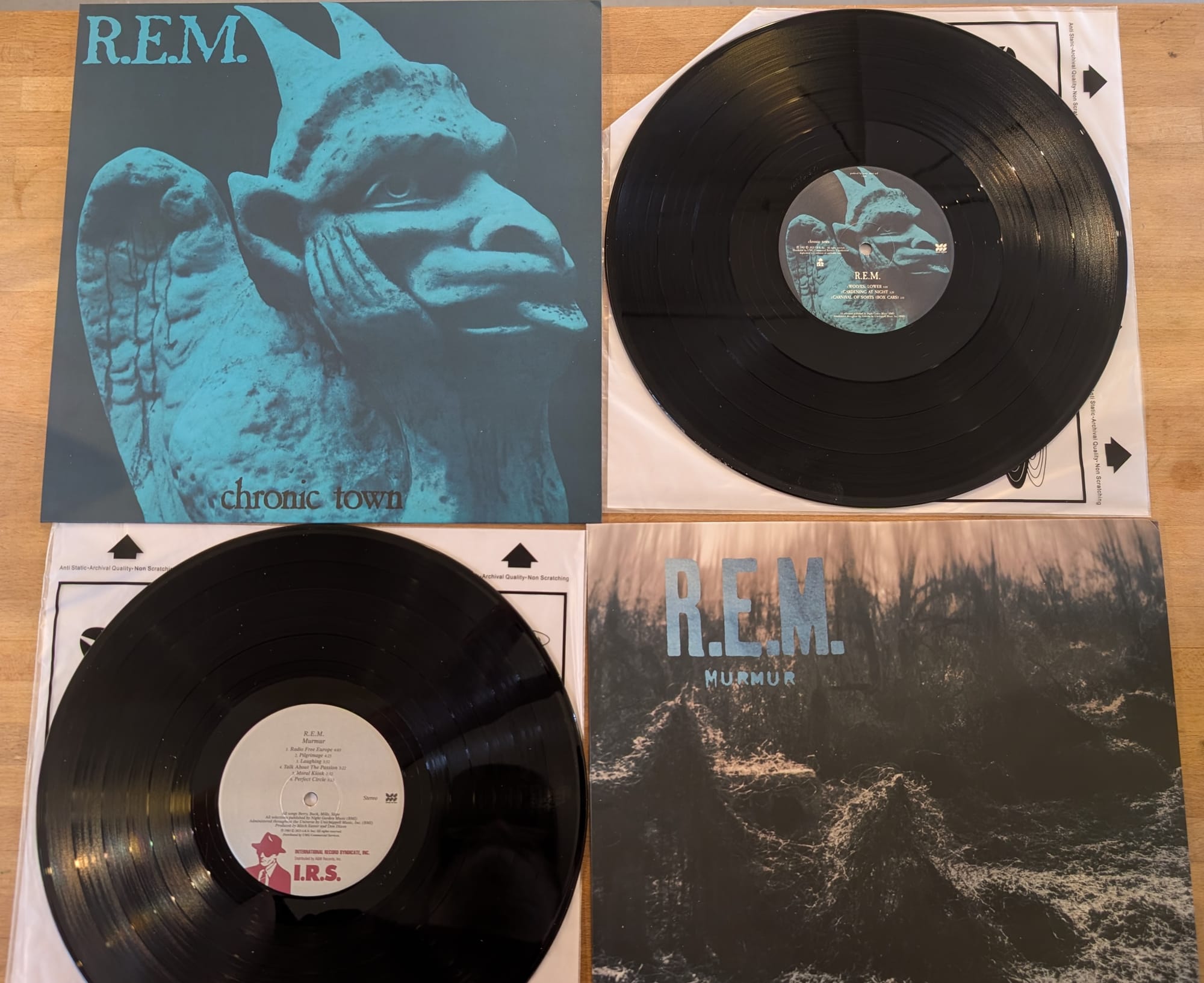
The remastered version of Murmur doesn’t offer the same immediate, revelatory moments as the new pressing of Chronic Town, but there’s no denying that it is a massive improvement over the already fine original pressing mastered by Greg Calbi and pressed at Electrosound Group Midwest in Shelbyville, Indiana, that I have in my collection. Berry’s drums have far more bite, Buck’s multilayered guitars sound thicker and more weighty, and the whole affair has a much wider and more pleasant soundstage. There are still surprises to be had: the ghostly percussion touches that appear in the left channel during “Perfect Circle” and the dubby production touches on “Moral Kiosk” that once only simmered are given an extra jolt of sonic heat.
What this new pressing isn’t is perfect. The majority of the copy I listened to was stunning and noise-free. But that only made it more frustrating to find a small scratch on the first track of the album, the inimitable “Radio Free Europe,” that added a light ticking noise to the opening seconds. To be fair, those first moments in the song are the low hum of an electronic noise gate that Easter caught on tape and spliced onto the beginning of the track for a bit of dramatic effect, but, again, having absorbed every last detail of this album into my central nervous system, it is dismaying to have that quiet intro be interrupted by a pressing flaw.
Still, one small blemish isn’t enough to get me to dismiss this set by any means. How could I when the clear, full sound of each disc repeatedly plucks a nostalgic string deep within, taking me back to those heady days when I heard this music for the first time? Crucially, the set has also deepened my appreciation for these rich musical texts and renewed my interest in a band I had previously let fade into the background.
IRS/A&M/Definitive Sound Series 2-LP 33 RPM slightly translucent vinyl
• One-step pressings of the 1982 EP and 1983 LP
• Jackets: Two tip-on single pockets with outer slipcase
• Inner sleeves: RTI-branded rice-paper-style poly
• Liner notes, insert, or booklet: A reprint of the original album insert for Murmur, plus a DSS certificate of authenticity
• Source: Analog; “Original analog master tapes”
• Mastering credit: Chris Bellman at Bernie Grundman Mastering, Hollywood CA
• Lacquer cut by: Chris Bellman at Bernie Grundman Mastering, Hollywood CA; “CB” in deadwax
• Pressed at: Record Technology, Inc., Camarillo, CA
• Vinyl pressing quality (visual): Chronic Town: A / Murmur: B+
• Vinyl pressing quality (audio): Chronic Town: A / Murmur: B+
• Additional notes: Limited edition of 3000. Vinyl compound is Neotech VR900-D2.
Listening equipment:
Table: Cambridge Audio Alva ST
Cart: Grado Green3
Amp: Sansui 9090
Speakers: Electro Voice TS8-2

Beck: Morning Phase
Review by Ned Lannamann
Through no fault of its own, Morning Phase may be doomed to a fate similar to Dances with Wolves. That movie has earned retrospective resentment due to its beating GoodFellas for Best Picture at the 1991 Academy Awards ceremony; its director Kevin Costner also beat the long-overdue Martin Scorsese for Best Director. In February 2015, Beck edged out presumptive front-runner Beyoncé and won the Album of the Year Grammy, upsetting her enormous fan base and surprising the music-industry cognoscenti at large. Is Morning Phase a better album than Beyoncé? History may come to its own conclusions about that, but here at The Vinyl Cut, we have a maxim about awards: It’s usually cooler not to win, grasshopper.
In retrospect, it’s surprising that Morning Phase achieved such consensus among Grammy voters. The 2014 album is the mellowest of golds, a sun-dappled, orchestral-tinged ramble through yawning beats, gently plucked acoustic guitars, and cavernous soundscapes. Beck is in his Water Lilies phase, using massive canvases to depict placid still lifes, emphasizing sonic color and texture the way Monet used brushes and paint. It’s a stunningly gorgeous-sounding recording, making artful use of unhurried arrangements and extended reverb trails.
Beck is not doing the Wall of Sound thing here, where the sonic elements stack up to achieve a blurry transcendence—rather, he’s carefully sculpting an endless reflecting pool in your head, where the sounds can extend on forever and a single ripple will move unobstructed across the vast expanse. He and engineer Darrell Thorp used a patented “Delay Verb” to achieve that never-ending echo, with some of Beck’s vocal lines achieving a koan-like profundity through their resonance. The power and mystery of Morning Phase comes from that sound and the duality it suggests: Is Beck making proclamations from the mountaintop, or is he lamenting into the abyss?
In many ways, Morning Phase is an extension of what Beck set out to do on 2002’s Sea Change, positioning the albums as twins in Beck’s catalog. But whereas Sea Change was about turmoil in the wake of a painful breakup, Morning Phase’s often cryptic lyrics seem to be about acceptance and healing, or at least acknowledging the importance of those things even if they can’t quite be achieved. That makes it a bit less gripping from a listener’s perspective, so the album lets the sonics provide the emotional content. Indeed, the album is basically all surfaces, which become appealing in their own regard; Beck’s father David Campbell scored the orchestral parts, and several of the same musicians from Sea Change make reappearances here. There aren’t many other points of comparison to make—Morning Phase really doesn’t sound like anything other than Beck—but I am reminded of the large-scale productions Simon and Garfunkel undertook on Bridge Over Troubled Water; in fact, “Turn Away” seems to be deliberately evocative of their harmonies.

To circle back to the laborious movie metaphor I started this review with, the Definitive Sound Series one-step pressing of Morning Phase feels like a freshly struck 70mm print of the album. At times, this pressing even feels deliciously wet, like it’s a reel that just came out of the lab, and no light has passed through it until now. Crispness and separation aren’t really qualities this album possesses, but the purity and sonority of tone are thickly rendered, as sweet and sticky as nectar. The soundstage takes on the properties of a never-ending horizon, and on “Morning,” “Unforgiven,” and “Waking Light,” the bass is leviathan-deep, sending satisfying vibrations along the floorboards. For an album that seems to be constructed of gentle sounds, the force it amasses is impressive.
The one-step pressings were cut from a 96kHz/24-bit digital file that the album’s original mastering engineer, Bob Ludwig, prepared back in 2014 for its first vinyl release, which was cut by Bernie Grundman. This time, Levi Seitz at Black Belt Mastering has cut the lacquers—several of them this time, as is necessary for one-step vinyl pressings. The album is on the long side, but there’s no constriction or compression of sound evident; in fact, the LP’s giant scope is awe-inducing, transforming an album I have occasionally thought of as a bit polished and frictionless into an enrapturing listen. I have not heard any other vinyl pressings of Morning Phase, but I can’t imagine them sounding as plush and velvety as this.
In fact, the only parties that could possibly be dissatisfied with this version are those who have sentimental attachments to an earlier presentation of the album and those members of the Beyhive still holding a grudge. Because the subject matter of Morning Phase’s lyrics is so deliberately diaphanous, the ethereal quality of the music can take root at the front of the listener’s mind, making for an experience that is a bit similar to listening to classical music. Morning Phase may once have been destined to be the answer to the trivia question, “What album did Beyoncé lose the Grammy to?” To that, the DSS one-step says: Let go. Such trophies are meaningless, grasshopper.
Capitol/Definitive Sound Series 1-LP 33 RPM 180g slightly translucent vinyl
• One-step pressing of the 2014 album
• Jacket: Tip-on gatefold with outer slipcase
• Inner sleeve: RTI-branded rice-paper-style poly
• Liner notes, insert, or booklet: None, but a DSS certificate of authenticity is included
• Source: Digital (“96/24 Original Vinyl Files”)
• Mastering credit: Original mastering credit: Bob Ludwig, Gateway Mastering, Portland, ME; DSS mastering credit: Levi Seitz, Black Belt Mastering, Seattle, WA
• Lacquer cut by: Levi Seitz, Black Belt Mastering, Seattle, WA; “BLACKBELT-LEVI” in deadwax
• Pressed at: Record Technology Inc. (RTI), Camarillo, CA
• Vinyl pressing quality (visual): A
• Vinyl pressing quality (audio): A
• Additional notes: Limited edition of 3000. Vinyl compound is Neotech VR900-D2.
Listening equipment:
Table: Technics SL-1200MK2
Cart: Audio-Technica VM540ML
Amp: Luxman L-509X
Speakers: ADS L980
A Perfect Circle: Mer de Noms
Review by Robert Ham
When it was announced in early 1999 that Maynard James Keenan had joined a band called A Perfect Circle, the news was met with a mixture of excitement and mild frustration. Up to that point, fans of the singer’s other band had been hanging on every last scrap of news they could dig up about the recording and potential release of a new Tool album. Keenan diverting his attention to a new project only meant more delays. On the other hand, their favorite vocalist was making new sounds, which could only mean good things, right?
Going strictly by the sales numbers for Mer de Noms, the 2000 debut by A Perfect Circle, it seems clear that the enthusiasm for Keenan’s new endeavor won out. The album debuted at number four on the Billboard 200 and, by the end of the year, had gone platinum. Critics, too, heaped praise upon the band’s first full-length when it was first released and continue to add to lists of the greatest debut albums of all time.
This was all news to me, as I had more or less checked out of anything Keenan-related around the time of the 1996 Tool album Ænima. I knew generally what he was up to but couldn’t tell you what it sounded like. At the same time, this knowledge did help clear up my brow-furrowing over the news that Mer de Noms would be one of the first of Universal’s high-end Definitive Sound Series releases. My forehead further smoothed out once I dropped the needle on this fantastic-sounding reissue.
Some quick background for the uninitiated: A Perfect Circle is co-led by Keenan and guitarist Billy Howerdel. The two met when the latter was working as a guitar tech for Fishbone. They became fast friends and were soon sharing a house together, where Howerdel played demos of future APC tracks to his roomie, and even though the initial plan was to hire a female singer for this new project (apparently Cocteau Twins’ Elizabeth Fraser was floated as an option), Keenan came on board. He was soon followed by bassist Paz Lenchantin, guitarist Troy Van Leeuwen, and, at first, drummer Tim Alexander. After knocking some material together, the quintet made their debut at LA’s Viper Room followed by a much higher-profile gig at the 1999 Coachella Festival. By the time of that last show, Alexander had departed and was replaced by the equally capable Josh Freese.

For such an abbreviated formation, there was immediate chemistry. You could chalk that up to the fact that some of the musicians had earned their stripes as session players, a role where you have to slip into and out of a session with as little friction as possible. But watching clips of their ’99 Coachella set and listening to Mer de Noms, the quintet sounds complete. Their individual parts are distinct and exciting on their own, but they become so much better when they lock together as one.
Engineer Levi Seitz, who handled both the mastering and the lacquer cutting for this reissue, allows that cohesiveness to shine here. Working from a 96kHz/24-bit transfer of the analog files that were hidden inside a workstation at Capitol Records (more details on the process are on the one-step’s info page), the music is perfectly balanced and sounds huge, especially in the opening duo of “The Hollow” (the only track to feature Alexander) and “Magdalena,” a dual statement of musical purpose that draws power from forebears like King Crimson, Siouxsie and the Banshees, and Pink Floyd.
There are several previous vinyl editions out there, from the original 2-LP set from 2000 to multiple re-releases that include a picture-disc zoetrope edition issued earlier this year, but I don’t have those to compare this new pressing against. When it comes to the digital version available on streaming services, the difference is, no surprise, vast. Listening to the album on Tidal was excruciating, with Keenan’s voice pushed to the fore and an emphasis on Van Leeuwen and Howerdel’s guitars. Everything falls into place on the DSS version, with ample space for the various layers of the compositions to be heard with oomph and clarity. I especially loved the vibrancy of the mixture of strings, acoustic guitar, piano, and Freese’s malleted drum kit on the mesmerizing “Renholdër,” and how the cocky bounce of “Thinking of You” sprung from the speakers, led by Lenchantin’s rubbery bass work. My pressing, made at RTI, wasn’t entirely perfect. Both discs were flat and centered, but a visible mark on Side 3 caused an audible tick in the opening minute of “Sleeping Beauty.” I detected some scuffing on the same side, but it thankfully didn’t affect the audio.
The online reviews that I’ve seen on Discogs and the Steve Hoffman Music Forums have been effusive with praise about this new pressing, with one commenter noting, “This is my 3rd copy of this masterpiece on wax, and it's by far the best I've ever heard it sound.” I’m ready to join the chorus. My knowledge of A Perfect Circle and Mer de Noms still remains minimal, especially compared to the fans already gushing over this DSS edition, but hearing the band and this album presented like this has me excited to dive deeper into the Maynard James Keenan extended musical universe and see what I’ve missed. Bring on the Puscifer one-steps!
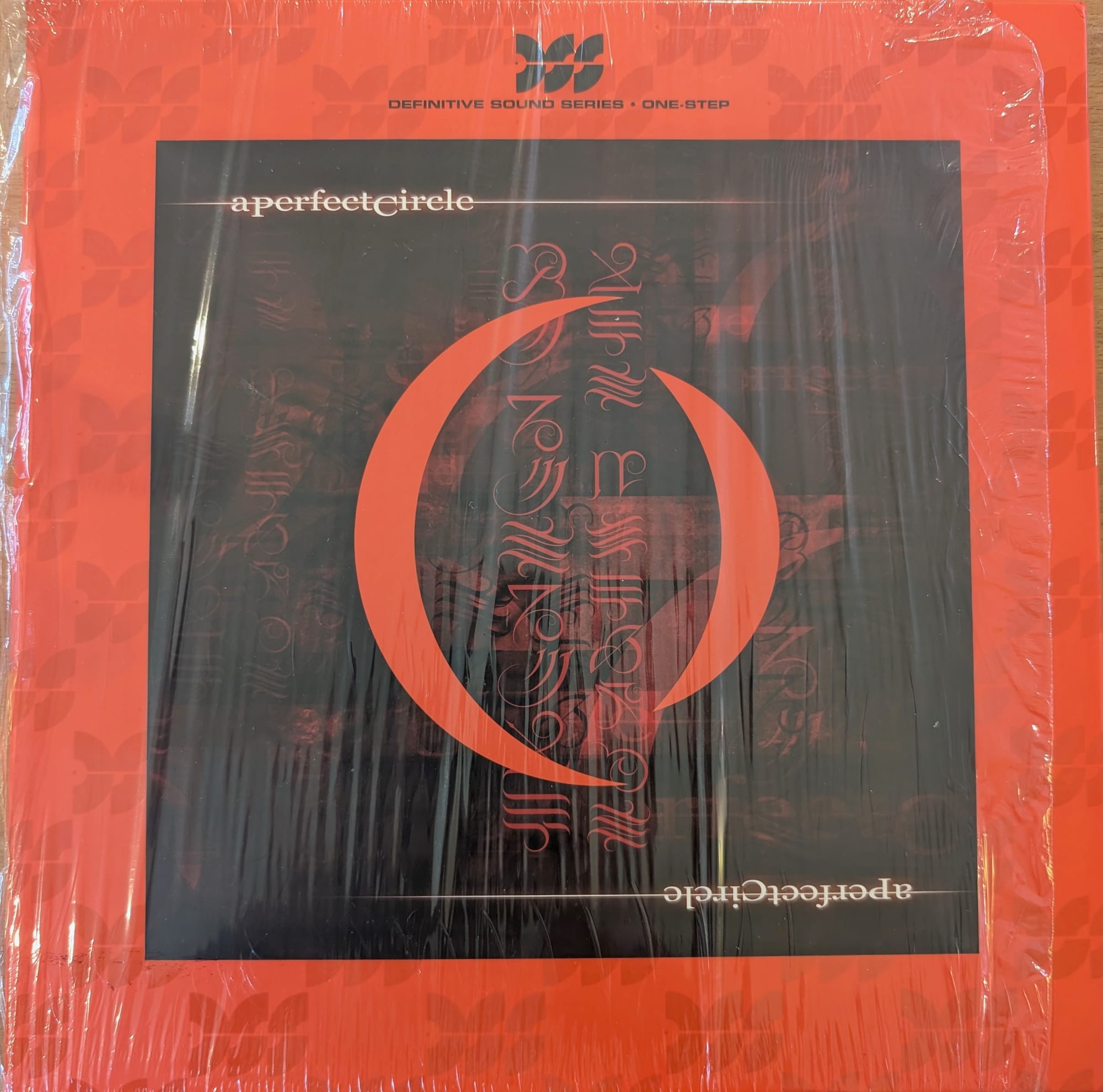
Virgin/Definitive Sound Series 2-LP 33 RPM 180g slightly translucent vinyl
• One-step pressing of the 2000 album
• Jacket: Tip-on gatefold with outer slipcase
• Inner sleeve: RTI-branded rice-paper-style poly
• Liner notes, insert, or booklet: None, but a DSS certificate of authenticity is included
• Source: Digital; “96kHz/24bit files transferred from analog flat masters”
• Mastering credit: Levi Seitz at Black Belt Mastering, Seattle, WA
• Lacquer cut by: Levi Seitz at Black Belt Mastering, Seattle, WA - “BLACKBELT-LEVI” in deadwax
• Pressed at: Record Technology Inc. (RTI), Camarillo, CA
• Vinyl pressing quality (visual): B+ (visible mark on side three)
• Vinyl pressing quality (audio): B+ (mark on side three causes ticking at start of “Sleeping Beauty”)
• Additional notes: Limited edition of 3000. Vinyl compound is Neotech VR900 D2.
Listening equipment:
Table: Cambridge Audio Alva ST
Cart: Grado Green3
Amp: Sansui 9090
Speakers: Electro Voice TS8-2

Nat King Cole: The Christmas Song
Review by Ned Lannamann
I never really thought about it before, but Christmas music usually accompanies an activity of some kind: trimming the tree, exchanging gifts, or simply jingling along in the background during a noggy holiday shindig. It actually feels pretty strange to devote your entire waking attention to a Christmas record—these carols and songs are things we know by heart, and we’re used to letting them become part of the backdrop, never receiving our full consideration, let alone any kind of scrutiny.
So the Definitive Sound Series one-step pressing of Nat King Cole’s 1962 album The Christmas Song makes a surprising ask: Can you sit down, shut up, and listen to the man sing? After all, this isn’t your well-worn hand-me-down pressing of the family’s favorite Christmas record, complete with chestnuts-roasting crackles permanently etched into the grooves. This new one-step is basically as high-end as vinyl production gets, with a price tag to match. It demands careful listening in order to reveal the care and artistry that goes into extracting all the information from these vintage recordings for modern-day hi-fi systems.
It’s been a busy season for The Christmas Song. Universal recently released a different mastering of this very album as part of their Vinylphyle series; I reviewed that version and found it “lush and vivid.” This pressing strips away some of the soft-focus lushness and turns the dial all the way up on the vividness. It’s a more transparent and lucid rendition, with the instruments depicted in newfound clarity and Nat King Cole himself sounding astonishingly lifelike.
There’s a reason for that. This new version doesn’t use the second- or third-generation stereo tapes that have been in use by Capitol Records for the past few decades—in fact, this particular The Christmas Song is technically a newly constructed “mix” that didn’t exist until this one-step. As it turns out, the album initially came out in 1960 under the name The Magic of Christmas with a slightly different tracklist that didn’t include “The Christmas Song.” That song was a much older hit that Cole had recorded and released twice already, most recently in 1953 in high-fidelity mono.
But then “The Christmas Song” was revisited in 1961 for a 3-LP set called The Nat King Cole Story that included stereo re-recordings of his best-loved songs, so for the 1962 Christmas season, Capitol Records spliced the new recording into the existing Magic of Christmas tracklist, removing “God Rest Ye Merry Gentlemen” and retitling the album in the process. That’s the version of the album that became a perennial best-seller over the years, and that’s the version of “The Christmas Song” that is most frequently heard every December.

Later-generation stereo master tapes were used for the Vinylphyle, but for this DSS one-step, mastering engineer Chris Bellman went back and sourced the original three-track master tapes (which date from the era when stereo had a center channel in addition to the usual left and right channels). As the various tracks were on different reels, a new assembly had to be made, with “God Rest Ye Merry Gentlemen” reinstated, along with the additional outtake “O Come All Ye Faithful.” Bellman cut the lacquer directly from his newly assembled three-track reel, which meant the audio did not undergo the treatment that Capitol Records gave to all previously released versions, with Capitol’s patented reverb added to Cole’s voice as well as other compressions and manipulations to the instruments and backing vocals. Without those post-production effects, the album sounds dryer and more articulate—a good comparison is how the Beatles’ UK Parlophone albums sound alongside their American counterparts released by Capitol in 1964 and 1965.
Not only is Cole’s voice dryer, but the orchestrations and choir arrangements are less shrill and take advantage of more of the sonic spectrum. The little instances of distortion are gone, as are some of the Vaseline-on-the-lens blending effects, made to give the album extra oomph when pumping out of a midcentury console but no longer necessary with today’s responsive audio equipment. Cole’s voice has a purity that’s breathtaking here, and he’s rendered in near-holographic dimensionality on the one-step. But Ralph Carmichael’s orchestrations and choir arrangements are occasionally overbearing or kitschy—for some, this over-the-top quality is exactly what they want out of a Christmas record, but the sound was originally designed to pop against our lively holiday backdrops, and from underpowered phonograph equipment to boot. When you give it your full attention on the one-step, Carmichael’s brashness can be a little much.
The mastering and pressing, however, are excellent, with near-silent vinyl backgrounds and Bellman’s cut providing an immaculately transparent aural window onto the recordings. In fact, this thing sounds so honest that I could hear a tape splice in “The Christmas Song,” during the first time Cole sings the line “Although it’s been said many times, many ways...” The packaging, as per usual for the series, is exceptional, with an appealing matte-finish gatefold and accompanying slipcase.
The necessity of this Definitive Sound Series one-step pressing really comes down to how deeply Nat King Cole’s Christmas album is embedded into your heart. My particular Grinch-sized heart doesn’t have a ton of room for it, beyond the famous title track and Cole’s stirring rendition of the Christmas obscurity “A Cradle in Bethlehem.” But for those who have listened to it several times every December for their entire lives, the one-step should provide the ultimate listening experience. I can confidently say it’s never sounded better.
Capitol/Definitive Sound Series 1-LP 33 RPM 180g slightly translucent vinyl
• One-step pressing of the 1962 album, a re-release of a 1960 album with one track replaced; this version also includes the replaced track and an additional outtake
• Jacket: Tip-on gatefold with outer slipcase
• Inner sleeve: RTI-branded rice-paper-style poly
• Liner notes, insert, or booklet: None, but a DSS certificate of authenticity is included
• Source: Analog; “1/2” 3 track original analog tapes”
• Mastering credit: Chris Bellman of Bernie Grundman Mastering, Hollywood, CA
• Lacquer cut by: Chris Bellman of Bernie Grundman Mastering, Hollywood, CA; “CB” in deadwax
• Pressed at: Record Technology Inc. (RTI), Camarillo, CA
• Vinyl pressing quality (visual): A
• Vinyl pressing quality (audio): A
• Additional notes: Limited edition of 3000. Vinyl compound is Neotech VR900-D2.
Listening equipment:
Table: Technics SL-1200MK2
Cart: Audio-Technica VM540ML
Amp: Luxman L-509X
Speakers: ADS L980