Review: The Jimi Hendrix Experience

A new box set charts the course of 1967’s Axis: Bold as Love.
We’re still catching up on the many vinyl reissues, re-releases, and box sets that have landed this fall, and today we dig into the new deluxe Jimi Hendrix Experience box set. Titled Bold as Love, the 5-LP collection has somehow managed to dig up new Hendrix material that has never been released before—and even more shockingly, these are no barrel dregs.
But before we get into that, I wanted to give you one last reminder about our December vinyl giveaway! Entries will close tomorrow—Sunday, December 14—at midnight Pacific time, so you have one last chance to become a paid subscriber and become eligible for our monthly giveaways. (As a nice little bonus, you also get to support our work and help two working writers be able to afford things like health insurance and running water and whatnot.)
The giveaway is for a new copy of Neil Young’s recent Official Release Series box set, including the albums Harvest Moon, Unplugged, Sleeps with Angels, and Mirror Ball. It’s a fantastic set that you very much want to win. Do so by clicking here:


The Jimi Hendrix Experience: Bold as Love
For the Jimi Hendrix Experience, the separation between the first album, 1967’s Are You Experienced?, and the second, Axis: Bold as Love from the same year, was porous at best. “There was no break,” says engineer Eddie Kramer in the liner notes to the new deluxe edition of Axis, a 5-LP/1-Blu-ray set simply titled Bold as Love. “We went from one album to the next.” Indeed, Hendrix, drummer Mitch Mitchell, and bassist Noel Redding had already started work on Axis before Are You Experienced? hit UK record stores on May 12. “Chas [Chandler, the Experience’s producer] wanted to keep recording,” Kramer says. “He knew that Jimi was developing as a songwriter and had more songs ready.”
That wellspring of creativity can be heard throughout the Bold as Love box, which includes mono and stereo pressings of Axis from the original master tapes, two LPs of early versions and works in progress, and an additional LP of audio from TV and radio appearances. The two discs of alternate studio takes are perhaps the best window we’ve gotten into the Experience’s working methods, and Bold as Love’s strongest selling point is getting a chance to hear the album take shape, via barebones backing tracks that show the trio’s concatenated tightness as an ensemble, and then as studio practitioners as they build upon the music from the foundation up. It’s also a nice bonus that the mono and stereo pressings of the finished album sound absolutely aces—more on that in a bit.
After those initial May ’67 sessions, Hendrix and the Experience had to pause work on Axis to go on tour. They recorded a non-LP single that summer in New York and Los Angeles: “Burning of the Midnight Lamp” backed with “The Stars That Play with Laughing Sam’s Dice” (both songs’ developments are fully charted in the set). It wasn’t until October that serious work on the album resumed at Olympic Studios in London. By that time, they were under a tight deadline, and the bulk of Axis was hastily recorded during two weeklong sprints so that the album would be out on December 1 in the UK. (It wouldn’t be released until early 1968 in the US.)
Among Bold as Love’s revelations is the recovery of some rehearsal demos recorded on two-track at Regent Sound Studios. These were taped during the daytime before Chandler and the band went over to Olympic for their evening sessions, so they were working incredibly quickly and trying out ideas and sounds in real time. The three Regent Sound tracks on the box—“Stone Free/Up from the Skies,” “Ain’t No Telling,” and “Little Miss Lover”—are raw, urgent, and, and bursting with creativity.
The Olympic sessions themselves are a peek behind the curtain at how a monumental album is constructed. It all comes down to great playing, and the basic tracks of drums, bass, and guitar show that Mitchell and Redding were more than backing stooges for Hendrix—the Experience, at this stage, were locked into each other on a supernatural level, providing support and space for each other’s contributions and allowing for new ideas to blossom wherever they happened to. You can also hear Hendrix falling in love with the studio process; he would develop that romance more extensively on the Experience’s next and last album, 1968’s double LP Electric Ladyland. But in these Axis sessions, you can hear him coaxing a strength and beauty out of his sound that didn’t necessarily translate to live performance. The songwriter was becoming a sonic architect, much like the Beatles had been doing the past two years across town at Abbey Road.
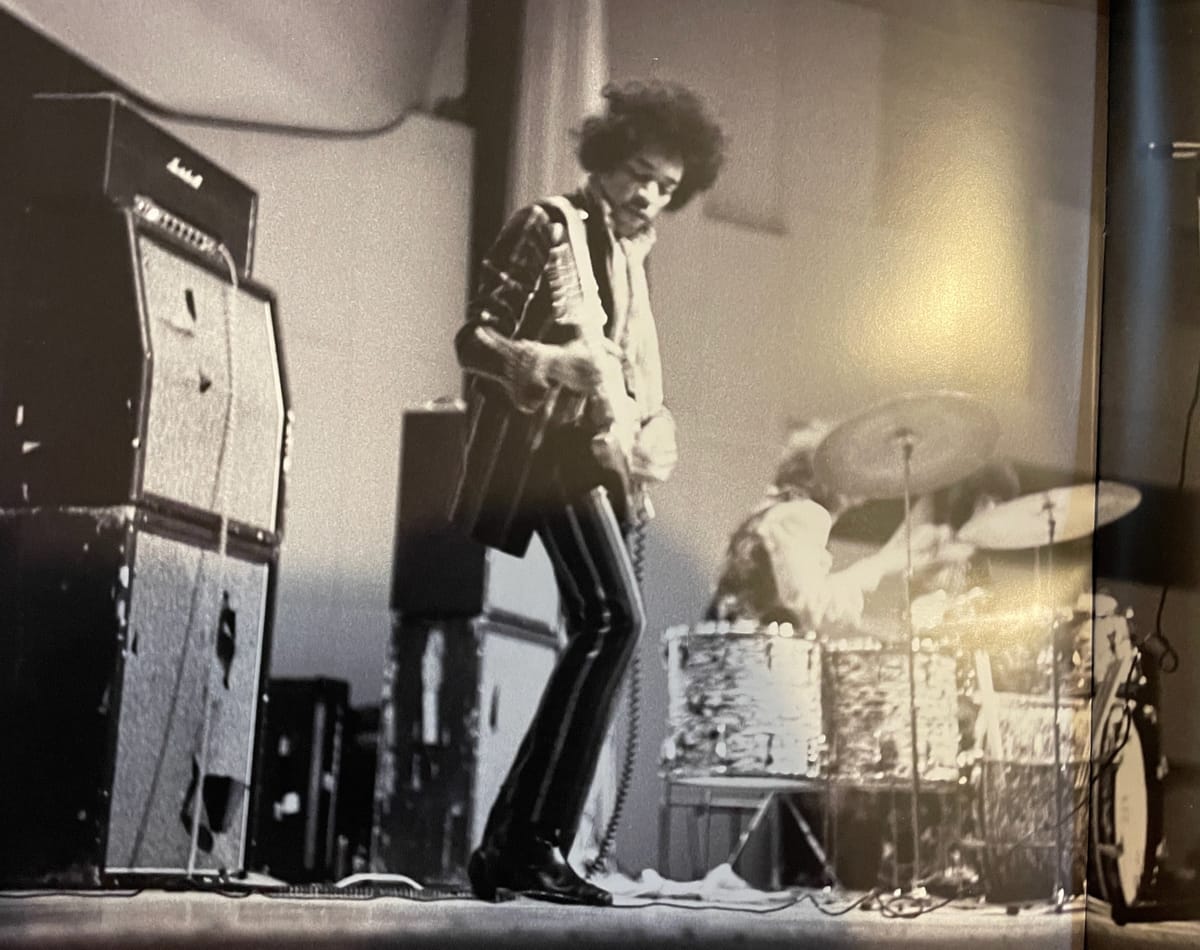
The fifth LP, of radio and television performances, is centered around a September 1967 session for Sweden’s national radio service that first appeared in the 1990 box set Stages. Recorded before the bulk of the Axis sessions, it finds the Experience running through the A-sides of their first three singles, some Are You Experienced? LP tracks, the cover of “Sgt. Pepper’s Lonely Hearts Club Band” that they had been opening shows with that summer, and the first-ever live performance of “Burning of the Midnight Lamp.” The sound is generally sturdy and clear, with Hendrix’s guitar slightly dimmed in the mix and Mitchell’s snare sounding a little pit papery; there’s a quick audio dropout during the jam section of “I Don’t Live Today.” I have heard that a fan-circulated version of this material provides better audio, but I haven’t heard that version to compare. What’s here gives a more-than-adequate indication of how the band was operating as a live unit at that point in time, although it doesn’t sound like the small audience gave Hendrix a ton of energy to work off of. The LP also includes two different versions of Hendrix singing along to the backing track of “Midnight Lamp” for BBC TV, and two excellent, authentically live cuts from Dutch TV recorded after the Axis sessions wrapped but before the album’s release.

For some, however, the major selling point of this set is the inclusion of new masterings of the mono and stereo mixes of the original Axis: Bold as Love album. These are all-analog cuts reportedly made from the flat, non-EQ’d master tapes by Bernie Grundman. Analog versions of Axis have been available on vinyl for years; George Marino did a stereo cut in 2010 that has been readily accessible since then, and Grundman did the mono in 2013. (Side note: There has been some question whether this box reuses Grundman’s 2013 mono cut, as it contains the same 11-digit number in the deadwax. I believe these are different cuts, but perhaps someone who has both can compare the handwriting in the deadwax to see if they are an exact match. I think Grundman simply reused the 11-digit catalog number—as he did for the stereo, using the same number as Marino’s cut—because these will be the operating versions going forward, replacing the older cuts.)
In short, these new cuts rip. The tapes still sound astonishingly fresh, with Mitchell’s kit in particular sounding remarkable across the board. There’s plenty of low-end thump; fine separation between the instruments; indelible sizzle, smoke, and presence in Hendrix’s guitar; and a massive soundstage that expands beyond the range of the speakers—all the more impressive during Axis’s innovative panning effects, among the first recordings to use stereophonic sound to create a genuinely psychedelic experience. The oscillation between ferocity and tenderness that Hendrix was so adept at is perfectly rendered here. His guitar snarls, then serenades; it stabs holes in the darkness, illuminating the sonic picture note by note. Like no other musician, Hendrix sounds like he’s wielding electric current through his fingertips, and that power and delicacy is captured in astonishing vividness in these two new pressings of Axis.
I did not refer to any of the recent cuts of Axis, but I did compare these new versions to my originals: a 1968 US Reprise stereo pressing from Santa Maria with the tri-color label, and a 1967 Track Records UK mono. (The US mono is rarer than hen’s teeth, and original UK stereos are apparently not very good, although I haven’t heard one.) The new Grundman cuts compare very favorably to both. The Reprise stereo has an airiness and immediacy that is more refined on the Grundman stereo, and the Track mono has a certain British-cut elegance that is slightly diminished on Grundman’s. But the new cuts offer greater bass extension and improved clarity across the board; my older cuts, too, have seen better days and it’s exciting to hear the music on decidedly less timeworn pressings. Grundman has also given me a new appreciation for the mono mix, which is objectively less exciting than the stereo but offers its own specific power and integrity that is amplified by his excellent cut.
The cuts for the other three discs are of similar quality. The two sessions LPs sound terrific, apart from the Regent Sound demos, which have their own rawness and character. Some of the early mixes, whether they’re vintage or newly constructed, are pretty spectacular, with each instrument depicted in high definition before the tracks were bounced down to make room for additional overdubs. The only weak spots are the original mono single mixes for “Burning of the Midnight Lamp” and, in particular, “The Stars That Play with Laughing Sam’s Dice,” which sound constricted, compressed, and subpar. The vinyl, pressed at Acoustic Sounds/Analogue Productions’ Quality Record Pressings (QRP) facility in Salina, Kansas, is flat, well-centered, and defect-free. The backgrounds are very quiet if not quite perfectly silent. Zero complaints.

A box set like this naturally prompts discussion about what’s missing. There’s about another LP’s worth of previously released things from the Axis sessions that could have been included here for completion’s sake, but those are already available on two other box sets—2000’s The Jimi Hendrix Experience purple box and 2010’s West Coast Seattle Boy—that many fans likely own to begin with. But that means that the two discs of sessions don’t include any alternates of Axis’s centerpiece, “If 6 Was 9,” which only appears in the set in its finished mono and stereo album versions. It also might have made sense to include something from the Experience’s legendary appearance at the Monterey Pop festival, which took place smack dab in between the two halves of the Axis sessions, although that show is certainly well documented and can be found easily enough.
There’s also a mysterious alternate stereo mix of the entire album that could have been included. Originally released in Germany, Japan, and a few other countries, this so-called “safe” mix—which is inferior to the more familiar mix—eventually appeared in 1970 in the UK as part of the BackTrack reissue series. I don’t know whether it would have made sense to include that on its own separate disc, but it might’ve been neat to put it on the Blu-ray as an easter egg or something. Speaking of the Blu-ray, it’s not really within our purview to discuss non-vinyl things around here, but the Atmos mix is an interesting diversion, although I found the two session LPs and the excellent album masters provided more than enough new information for me to chew on.
The package has good qualities and less-good ones. The box’s front cover is a drawing Hendrix reportedly did when he was five years old, although I strongly suspect he was older than that. The outer o-card slips off the box set, and it’s on surprisingly thin paper that features an intricate stencil cutout; I suspect most people will end up with torn letters on their copies before too many years go by. The box itself is a not especially sturdy, open-ended slipcase, with the five LPs each in their own sleeve. The stereo LP is inside a reproduction of the US gatefold; I really wish that they’d instead replicated the superior UK version, which features a fantastic black-and-white photo of the trio across the entire inner gatefold and includes a separate sheet for the lyrics. The mono LP is in a repro of the original French sleeve, which features an alternate cover shot of the Experience on a TV set and French liner notes on the back. The other three discs are housed in pseudo-psychedelic images of Hendrix rendered in pinks and purples, meant to further his mythology as a superhuman seer. I would have preferred something more photorealistic and less cartoony. The 36-page booklet is very good, with an essay by David Fricke and track breakdowns of the bonus material by Hendrix catalog director John McDermott. Weirdly, there is no track-by-track info for the actual album itself; it must be gleaned via the writeups for the alternate takes and from Fricke’s essay. There are pictures galore, and the whole thing is generally handsome and informative.
Fricke’s essay refers to Axis: Bold as Love as “underloved.” I’ve never found that to be the case, although if this album has been historically underestimated, it may be because of the varispeeded comedy bit (“EXP”) that opens the album. Frankly, it’s impossible for me to think of a record that includes “Little Wing,” “Castles Made of Sand,” and “If 6 Was 9” as anything but legendary, and with deeper cuts such as “One Rainy Wish,” “Wait Until Tomorrow,” and “Up from the Skies,” you’re talking stone-cold masterpiece. That’s why it’s such a joy to hear the session tracks and learn how the album was conceived and developed—it’s astonishing that so many of these things have been unheard until now, despite the very thorough milking of everything Hendrix ever recorded. When the new treats include the Regent Sound demos or the breathtaking Take 19 version of “Bold as Love,” this set becomes revelatory. And with excellent new vinyl pressings of the finished album itself, the set becomes something even better—definitive. Sing on, brother; play on, drummer.
Legacy/Experience Hendrix 5-LP 33 RPM black vinyl
• New mono and stereo masters of the 1967 album, with two discs of session outtakes, one disc of radio and TV performances, and a Blu-ray with high-res 96/24 of the mono and stereo mixes, plus a newly made Atmos mix by Eddie Kramer and Chandler Harrod; 27 of the tracks are previously unreleased
• Jackets: Direct-to-board with some sort of matte finish; the stereo mix is in a gatefold, while all others are single-pocket
• Inner sleeve: QRP-branded rice-paper-style poly
• Liner notes, insert, or booklet: 36-page booklet; details provided above
• Source: Analog (“the 1967 stereo and mono mixes remastered… from the original flat master tape”); the other three LPs are from a mixture of analog and digital sources. An email published on the Steve Hoffman forums from Jon Gasser of Experience Hendrix states: “[Analog mastering] applies for the other three LPs apart from a few of the tracks featuring Jimi’s two TV appearances, etc. Where possible, all of the material was mixed from the original session tapes to tape.”
• Mastering credit: Bernie Grundman of Bernie Grundman Mastering, Hollywood, CA
• Lacquer cut by: Bernie Grundman of Bernie Grundman Mastering, Hollywood, CA (“BG” in deadwax)
• Pressed at: Quality Record Pressings (QRP), Salina, KS
• Vinyl quality - visual: A (flat and blemish-free)
• Vinyl quality - audio: A (no audible flaws)
• Additional notes: Some copies are numbered.
Listening equipment:
Table: Technics SL-1200MK2
Cart: Audio-Technica VM540ML
Amp: Luxman L-509X
Speakers: ADS L980