Reviews: Because Sound Matters one-steps of Prince and Tom Petty

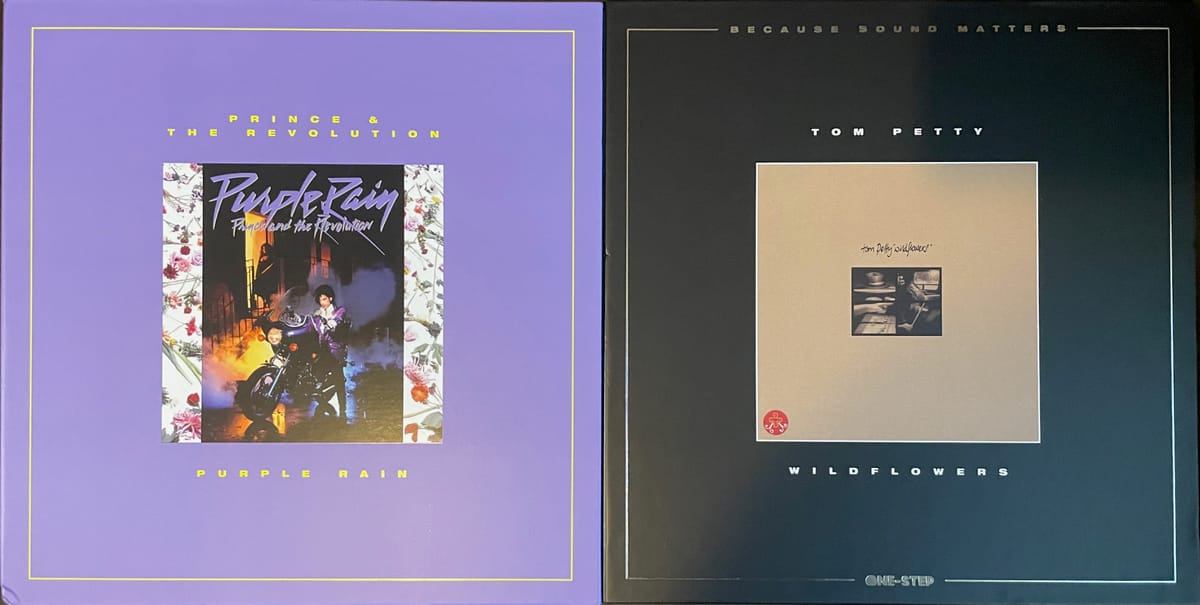
Cover art for Prince and the Revolution and Tom Petty.

We indulged in the fancy new pressings of Purple Rain and Wildflowers.

As December plows forward, the seasonal deluge of reissues and box sets is tapering off. So we’re taking the opportunity to catch up on some major releases that we missed earlier. Today we’re dissecting the two most recent titles in Warner Records’ Because Sound Matters series of one-step pressings. They’re heavyweights, to say the least:

But first: Have you heard about our December vinyl giveaway? We’re giving away a copy of Neil Young’s Original Release Series #6 box set to one of our paid subscribers. To learn more about it—and to upgrade to our paid tier so you can be eligible—click here:

Win a vinyl copy of the new Neil Young box set!
We have been promising that paid subscribers will be eligible for our first-ever vinyl giveaway. Well, that day has arrived—it’s giveaway time at last, and that’s just the beginning, as we’re planning to hold similar giveaways for our paid subscribers every month going forward. The prize

And now, let’s see what these fiendishly expensive one-step pressings have to offer, and whether they’re worth the coin.


Cover art for Prince and the Revolution.

Prince and the Revolution: Purple Rain [Because Sound Matters one-step]

It doesn’t feel right referring to Purple Rain as an album. Prince and the Revolution’s 1984 smash has always been much more than that: a time, a feeling, a phenomenon, a philosophy, a never-ending enigma, a movie soundtrack, a (partial) live record, a multi-platinum bestseller, a generation-defining document, a slab of utter filth (if you’re Tipper Gore), or—perhaps most accurately—one of the best and catchiest and deepest and most important pieces of music of the 1980s. It could well be the greatest movie soundtrack of all time, but even that undersells it. Not since A Hard Day’s Night have song and film worked so well together to not just launch a talent into the commercial stratosphere but also reach the highest apex of artistic achievement. It could have been dumb luck that Prince happened to do his greatest work just as he was poised to break through to superstar status. More likely, Prince saw the opportunity to step up to the plate and deliver something that would change the world.

On vinyl, Purple Rain has been surprisingly neglected. The original 1984 copy, mastered by Bernie Grundman, sold millions, of course. But it was then basically left untouched until 2007, when Kevin Gray cut an all-analog version that was well-regarded but has since fallen out of print. Prince approved a “Paisley Park” digital remaster in 2015 that was used for the super-deluxe 3-CD/1-DVD edition from 2017, and Gray then cut a new lacquer using that Prince-approved digital transfer. More or less every vinyl edition since 2017 uses the Gray digital cut.

But in October, Warner released a one-step pressing as part of its Because Sound Matters premium vinyl series—the highest of high-end vinyl editions, with a price tag to match. Considering that Purple Rain sold millions in its day, a new $100 pressing is a pretty hard sell. Sure, clean originals may be harder to find than they used to be, but the sheer volume of copies out there means that it shouldn’t be too difficult to snag a good one. And make no mistake, those 1984 pressings still sound fantastic.

In fact, it’s surprising how great those originals sound. The production on Purple Rain is frenzied and by no means audiophile-level, as much of it was recorded in non-studio environments with heavy track bleed. Its final three songs were recorded live at Minneapolis’s First Avenue nightclub, and “Let’s Go Crazy” and “Computer Blue” were recorded at a rehearsal space under similar circumstances. Heavy overdubs, a mixture of digital and analog instruments, and lack of clean, isolated tracks meant that the album relied on spontaneity, punch, and some serious alchemical luck during the mixing process to sound as good as it does. The Linn and Simmons drum timbres, the extensive synth work, and the noticeable compression and processing to all of the voices and instruments could have resulted in a very unnatural and fatiguing-sounding record. But the songs on Purple Rain sound killer in every situation: on a car radio, at home on a calibrated high-end system, streaming through crummy Bluetooth earbuds, pumping through a dance club at immense volume, or blasting out of a cassette boombox, which is likely how most people experienced it in the ’80s.

Contents of the Purple Rain one-step.

There are four factors that make this pressing notable. The first is obvious: the one-step process of manufacturing the vinyl. That process has been better explained elsewhere, but sure, I’ll have a go: My limited understanding of it is that most vinyl is pressed from generationally removed metal stampers. One-step vinyl, on the other hand, is pressed directly from an original stamper, aka the “father,” which is the original metal part made directly off the lacquer. Usually an inverse image of the “father” is created, called the “mother,” and then several new stampers are made from inverse images of the “mother,” resulting in lots of offspring stampers that can then be used to make large pressing runs, since each stamper can only press around 750 to 1,000 records before it gets worn out. In this case, several individual lacquers were cut in order to create enough “fathers” for a pressing run of 6,000 (six or eight or so, I would reckon, although that number is not publicized anywhere). One-step pressings ostensibly reduce the deterioration of sound and potential for additional noise that might result from making a copy of a copy—of metal parts, in this case—but the improvement it offers is very subtle, in my opinion.

The second factor has to do with the audio source used. The information on the reissue’s promotional page is transparent and informative—so much so that I wish the “Notes for This Release” section had been replicated somewhere in the vinyl package itself (I’ll probably print out a copy for myself and tuck it into the sleeve). It states that the original 1/4-inch EQ’d master tape Prince delivered to Warner Bros. Records in 1984 is the only physical master he ever provided during his lifetime. (Before his death, he also approved the 2015 “Paisley Park” digital remaster that was used in the 2017 3-CD/1-DVD deluxe edition and subsequent vinyl editions.) And since the one-step process requires making multiple runs of the master tape to produce all the individual lacquers, they opted to instead use a 192kHz/24-bit high-resolution digital transfer of that 1984 tape. The promotional language says the one they used is an “original” transfer, presumably the one to make the HDTracks version from 2013; there was also a “more recent 96kHz/24-bit update” that I am guessing is the 2015 “Paisley Park” remaster. So this new version has been cut from the 192/24 file rather than put additional stress on the master tape itself, which at this point can most assuredly be considered a historic artifact. (It may also not be in fighting shape, although its condition has not been officially disclosed.) This concession—using a digital transfer rather than the original analog tape—appears to be the only one made during the entire process. Levi Seitz of Black Belt Mastering cut the various lacquers from that digital transfer, and my particular cut has tiny runout grooves on both sides, meaning Seitz used every bit of real estate on the 12 available inches of vinyl, although that may not be the case with the other cuts he made.

The third factor is the quality of the vinyl, as touted on the package: This pressing was made at Record Technology Inc. (RTI) on a premium vinyl compound that’s so fancy it has its own name: Neotech VR900-DR. (Rolls off the tongue.) Neotech VR900-DR has an incredibly low noise floor, resulting in dead-silent backgrounds, and RTI has a very high but not unimpeachable reputation among vinyl aficionados for the quality of their pressings. I found that my copy was awfully good but not quite flawless, with one or two minor bits of vinyl noise turning up here and there—the sort of flaws that I ordinarily don’t mind in terms of my own listening but are worth a mention in a written review.

The fourth factor is the packaging, which is both lovely and excessive. The album’s original single sleeve is expanded to a gatefold, with the inside featuring the flower motif from the original jacket. One of the album’s two original inner sleeve designs—the lake-reflections one as opposed to the raindrop one—is replicated on heavy card stock, and the hilarious poster that was included in the initial pressings is also here (hilarious because the famously diminutive Prince has blown himself up look twice as large as his Revolution band members). It all comes inside a sturdy purple slipcase that’s numbered on the back.

The shootout: The 2025 Because Sound Matters one-step pressing and a 1984 Specialty Records pressing of the original Bernie Grundman cut.

All of this would be window dressing if the sound was not up to snuff. And while I don’t have the 2007 Kevin Gray analog cut to compare to the new one-step, I do have a well-preserved 1984 Grundman-mastered Specialty pressing that has always sounded miraculous to my ears. I spent a lot of time going back and forth between the two pressings and found things I loved about each. The 1984 pressing is noticeably brighter, with the high-end throttle fully opened. This is especially evident during cymbal crashes, but also the end of “The Beautiful Ones,” when Prince screeches in falsetto, or during the synth solo in “Baby I’m a Star,” when Prince repeatedly screams “baby!” That heightened treble occasionally swallows up some of the other sound, resulting in the imaging becoming intermittently blurry, but it also creates a huge amount of excitement, and it is basically impossible to sit still while this 1984 pressing is playing, at any volume.

The new Because Sound Matters one-step, featuring Seitz’s mastering, has a perceivably bigger soundstage, and the treble is tamed with the bass gently nudged up a couple notches. (The ’84 is no slouch in the bass department, mind you, as can be heard during the kick-drum explosion at the end of “Let’s Go Crazy.”) There’s also an illuminating clarity to the sound to the one-step that, coupled with the expanded soundstage, should be more than enough to satisfy those looking for stellar sound. For example, “When Doves Cry” has a famously skeletal arrangement, with sparse instrumentation and no bass whatsoever. It sounds absolutely phenomenal on the one-step, as each individual transient just leaps out of the speakers, with huge impact and tons of space around each timbre. When Purple Rain’s production gets more thickly woven, the one-step loses a little momentum. “Take Me With U” doesn’t quite have the sparkle and sweetness of the ’84 Grundman, and the breakneck programmed rhythms of “I Would Die 4 U” occasionally sound a bit more rigid than on the propulsive ’84 version. Interestingly, “Let’s Go Crazy” sounds messy on the one-step, its heavy, dense arrangement not quite standing up to the scrutiny of either the digital transfer or the careful lacquer cut. On the 1984 pressing, that messiness is also there, but the wildness of the performance triumphs.

So I found plenty of good reasons to listen to both pressings, which I have been doing lately, over and over. I think the knockout sound on “When Doves Cry” alone more than justifies the one-step’s existence, and its capable handling of the piercing highs throughout the rest of the album make it a far more digestible listen on bright systems. Seitz’s work is incredible across the board—the sound is clear, impactful, and balanced, and it retains the spirit of Prince and the Revolution’s collective musical wizardry. But I am also glad to have my ’84 Grundman cut, which is just a touch more vivid and results in a slightly more emotional impact. In any case, it’s just gratifying to see Purple Rain receive the high-end treatment, even at this high price point; in fact, it’s surprising the album hasn’t been done to death by now in the audiophile reissue arena. Perhaps because it was such a big seller, it’s been easy to overlook its artistic impact—but this new Because Sound Matters one-step pressing corrects that oversight and treats Purple Rain with the respect and care it deserves.

Warner/NPG 1-LP 33 RPM 180g black vinyl
• One-step pressing of the 1984 album
• Jacket: Stoughton tip-on gatefold with outer slipcase
• Inner sleeve: Custom Because Sound Matters–branded poly
• Liner notes, insert, or booklet: No new liner notes, but includes replicas of original inner sleeve and poster
• Source: Digital; “192kHz/24 bit files transferred from the original EQ’d analog master tapes”
• Mastering credit: Levi Seitz at Black Belt Mastering, Seattle, WA
• Lacquer cut by: Levi Seitz at Black Belt Mastering, Seattle, WA - “BLACKBELT-LEVI” in deadwax
• Pressed at: Record Technology Inc. (RTI), Camarillo, CA
• Vinyl quality (visual): A (flat, blemish-free vinyl)
• Vinyl quality (audio): A- (mostly silent backgrounds with just a few stray clicks after cleaning)
• Additional notes: Limited edition of 6000. Vinyl compound is Neotech VR900-DR.


Tom Petty: Wildflowers [Because Sound Matters one-step]

I remember how strikingly simple Tom Petty’s Wildflowers sounded when it was released in 1994. It had a warm, vintage flavor that was very much at odds with most rock music at the time. Grunge and alternative were still dominating the mainstream, with sounds intended to be aggressive, dirty, and larger than life. But here was Petty, not necessarily reducing the scope of his already-established Byrdsian style, but making it far more precise, relying on the voicings of superbly intoned musical instruments and reproducing them unfussily and honestly. It harkened back to the sound of The Band’s first two albums, Neil Young’s early ’70s records, and the Beatles—especially the Beatles.

In fact, I recall thinking that Wildflowers was Petty’s White Album, probably at first due to its length—15 songs, over an hour. (I didn’t know at the time that Wildflowers was originally intended to be an even larger double album that got cut down from 25 tracks.) But the comparison to The Beatles only grew deeper the more I listened: Each song was an individual, stand-alone statement, and the album’s power drew from its very grab-bag nature. Here’s a hard rocker backed up against a mournful acoustic lament; here’s a tune with Stax-style horns, and another with a sumptuous Michael Kamen orchestral arrangement; this song features mellotron and psychedelic flourishes, while that one could very well be a Creedence outtake. It was not a shock to learn, years later, that Petty’s major musical influence while making Wildflowers was a bootleg of the not-yet-released Esher demos, the 1968 tape of intimate run-throughs of many of the White Album’s tracks that the Beatles recorded prior to the marathon album sessions.

The only thing missing from Wildflowers, then, is an eight-minute experimental sound collage and a couple of brief McCartneyesque throwaways; in truth, there is nothing throwaway about any part of Wildflowers. It’s an intentionally designed and immaculately crafted songbook that never flags for an instant, perhaps because Petty and his co-producers, Rick Rubin and Heartbreakers guitarist Mike Campbell, decided to use the true cream rather than go for the complete warts-and-all White Album experience.

Contents of the Wildflowers one-step.

Recorded without any gimmick other than getting the very best take and making it sound as good as possible, Wildflowers is an album that’s always sounded fabulous. So the new Because Sound Matters one-step pressing has its work cut out for it. As it turns out, Wildflowers has a funny history on vinyl. Despite being recorded on 24-track analog tape and mixed down to analog stereo, no analog assembly reels of the 15-song album were created in 1994, and its initial 2-LP vinyl release was cut from a digital CD master. (The ’90s were just not a great time for vinyl, or analog for that matter.) Those scarce copies became incredibly valuable until a new vinyl edition, cut by Kevin Gray, popped up sometime around 2009—but even that became hard to find, and its pedigree is very likely the same digital source that the 1994 cut came from. It wasn’t until 2016, with the release of Petty’s The Complete Albums Volume 2 box set, that a 100-percent confirmed all-analog vinyl cut appeared in the world. In fact, it came from newly assembled analog master reels, compiled in 2015 specifically for the box set by Chris Bellman of Bernie Grundman Mastering and Petty’s archivist, Ryan Ulyate. Mastered by Bellman and pressed at Pallas, the Complete Albums version of Wildflowers was nothing short of stunning—the definitive version of the album thus far released. [NOTE: This paragraph has been updated to reflect the information available here.]

Then in 2020, after Petty’s death, Wildflowers received a deluxe overhaul, with the 10 outtakes added on as a third LP. Furthermore, additional live, demo, and alternate material was slotted into box-set configurations of anywhere from seven to nine LPs. For this massive Wildflowers & All the Rest reissue campaign, Bellman cut a brand-new Wildflowers lacquer from the 2015 assembly tape. It, too, sounded really, really good—just not quite as good as his earlier Complete Albums cut, in my opinion. The sound’s a little thinner, a tiny bit edgier, and a touch more rickety. The pressing quality of my copy of Wildflowers and All the Rest box set is a bit sub-par as well (it was pressed at Record Industry), with vinyl noise eating into the music.

Still, armed with my phenomenal Complete Albums 2016 cut, I remained skeptical of what the new one-step had to offer. And friends? I hate to break it to you, but this $125 new one-step sounds best of all. It’s Bellman’s third time at bat with Wildflowers, so he’s clearly perfected the process. Apparently he ran the tape at least seven times to make the seven different lacquers for this run of 6,000, with Ulyate overseeing the process. On my particular lacquer, the soundstage is wider, the tones are juicier, the air surrounding the instruments and voices is fuller, the transients and decay are more lifelike, and the dimensionality and presence is off the charts. Annoying, right? The vinyl shootout’s not a bloodbath, mind you, but there are small distinctions and improvements on the one-step that make Wildflowers sound the best it ever has. Sorry.

Take “It’s Good to Be King,” for instance. The song’s a musical journey, at times very simple, such as during the opening verse, when Petty’s voice interacts with single piano notes, and at other times quite ornate, such as when Kamen’s orchestration swirls in a kaleidoscope during the final instrumental passage. Every piece, from Campbell’s unflashy guitar solo to the wordless backing vocals, is placed just so, and it’s absolutely lovely on the one-step, hitting the ears with both impact and pillow-like resistance. And “Don’t Fade on Me,” the album’s simplest recording, is jaw-dropping here, with Petty and Campbell on two acoustic guitars and Petty singing as if you are in the studio just a few feet away. The realism of the sound is astonishing.

The shootout: The 2016 pressing from the Complete Albums Vol. 2 box set, the 2020 pressing from the Wildflowers & All the Rest box set, and the 2025 Because Sound Matters one-step.

The one rough patch is during “You Don’t Know How It Feels,” perhaps Wildflowers’ best-known tune. Featuring a chopping hi-hat, a Leslie’d guitar, and electric piano with heavy vibrato, there is some intentional quavering to the sound itself. But I did notice the sound flickering just a teeny-tiny bit, particularly during the refrain of the first chorus, as if some of the information on the master tape was missing. After hearing this, I went back and relistened to my other two vinyl copies, and couldn’t make up my mind—if the issue is there, it is barely detectable. But it can be heard on the new one-step, if you go hunting for it, during those few instants on “You Don’t Know How It Feels.” (I recommend that you don’t.) If I had to guess, I would say that the master has some age-related damage in that particular spot, although this is idle speculation. I also wonder if it is like this on all seven lacquers or if some are better than others.

My only other complaint is one common to other recent Chris Bellman cuts—that he cuts the lead-in groove way too tight, resulting in me repeatedly dropping the needle on music rather than the silence preceding it. Considering that the lead-in groove is the most likely spot for the vinyl to get damaged, it would be nice to have a little more grace in that particular area.

But still, the Because Sound Matters pressing is a winner overall, with a flawless RTI pressing in my case. The heavier-rocking songs like “Honey Bee” and “You Wreck Me” blow your hair back, while acoustic-oriented ones like the title track and “To Find a Friend” have an irresistible golden hue about them. Again, I reiterate that the previous versions of Wildflowers are truly excellent—they should be more than enough for more people. But for those with cash to spare and curiosity to sate, the one-step makes Wildflowers sound more alive than ever.

Warner 2-LP 33 RPM 180g black vinyl
• One-step pressing of the 1994 album
• Jacket: Stoughton tip-on gatefold with outer slipcase
• Inner sleeves: Custom Because Sound Matters–branded poly
• Liner notes, insert, or booklet: None; lyrics and musician credits are reproduced on the inner gatefold instead of on a separate insert as per the original
• Source: Fully analog; “Original analog master tapes”
• Mastering credit: Chris Bellman at Bernie Grundman Mastering, Hollywood, CA
• Lacquer cut by: Chris Bellman at Bernie Grundman Mastering, Hollywood, CA (“CB” in deadwax)
• Pressed at: Record Technology Inc. (RTI), Camarillo, CA
• Vinyl quality (visual): A
• Vinyl quality (audio): A
• Additional notes: Limited edition of 6000. Vinyl compound is Neotech VR900-DR.

Listening equipment:
Table: Technics SL-1200MK2
Cart: Audio-Technica VM540ML
Amp: Luxman L-509X
Speakers: ADS L980