Reviews: Devo and T. Rex on Rhino High Fidelity


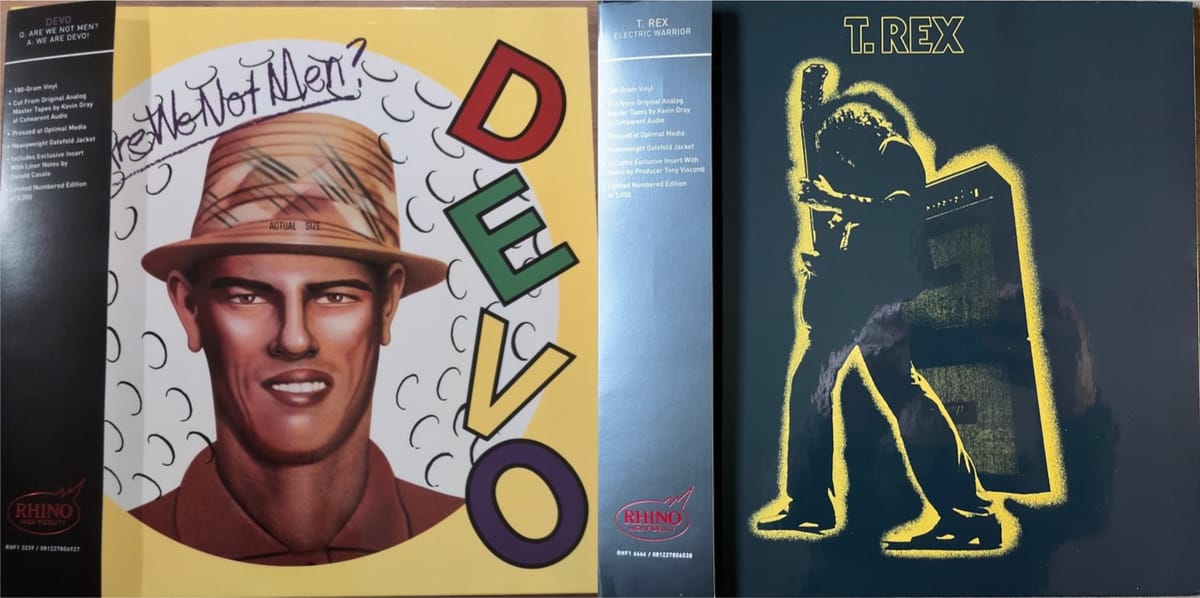
New all-analog vinyl editions of Q: Are We Not Men? A: We Are Devo! and Electric Warrior.
Just in time for the year’s end, we’ve got reviews of the latest two Rhino High Fidelity releases. These follow the established format of previous RHF productions, with thick glossy jackets, liner notes, and—most importantly—expert analog mastering from low-generation sources. Amid record collectors’ complaints that vinyl reissue labels often tread well-established territory, it’s tough to argue with either of these selections, as they’re two of the most significant rock records in the 1970s and still have qualities to amaze listeners today.
- Devo: Q: Are We Not Men? A: We Are Devo!
- T. Rex: Electric Warrior
Since this is our last newsletter of 2025, I just wanted to reiterate the gratitude I expressed in our year-in-review newsletter on Monday. It’s been a lot of fun putting this newsletter together, and you, the readers, have been fantastic. We’re really looking forward to 2026, as it already looks like a staggering amount of cool reissues will be heading our way. We’ll be busy.
And now, on with the reviews.
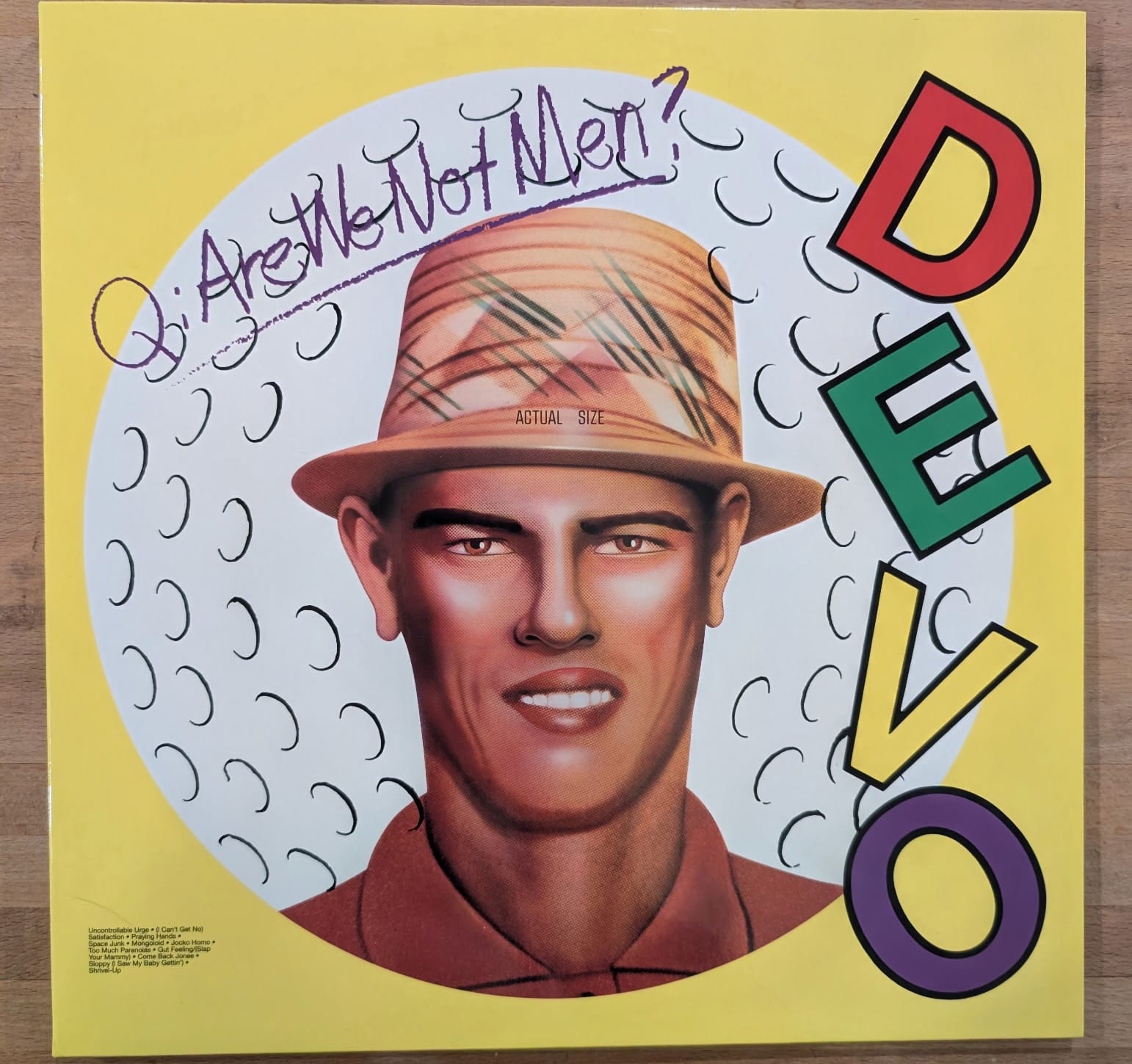
Devo: Q: Are We Not Men? A: We Are Devo!
Review by Robert Ham
It’s a bittersweet time to be a Devo fan. There’s much to celebrate concerning the Akron, Ohio-born quintet with the recent release on Netflix of director Chris Smith’s lovely documentary on the band. And the group has a good number of tour dates on the books for 2026, including a stop at the upcoming Coachella festival. Sadly, though, the end is likely nigh for the group, as they have been intimating that those upcoming live shows might well be their last.
The knowledge of Devo’s eventual conclusion adds a brighter nostalgic glow to this Rhino High Fidelity edition of the group's debut full-length, 1978’s Q: Are We Not Men? A: We Are Devo! Like many of the punk and punk-adjacent releases that have been part of this audiophile-tempting series, it isn’t necessarily a record I would have thought needed a sonic polish by mastering engineer Kevin Gray. My Warner Bros. copy from ’78, pressed at Capitol Records Pressing Plant in LA, is plenty satisfying, perfectly capturing the slash-and-burn guitars, squirrely modular synths, and drummer Alan Myers’s metronomic thwomp.
All of that is still very much present in this new Rhino pressing, but I was thrilled by how much more of it is available to me now. Gray has found all the hidden pockets of sound within each song, pulling them right to the fore. Mark Mothersbaugh’s keyboards benefit most from Gray’s careful mastering, both rising above and supporting the band’s herky-jerky assault. Listening to “Uncontrollable Urge” and “Space Junk,” I could more easily visualize Mothersbaugh’s wild curly locks and gangly limbs sweeping through the air as he played.
I could also detect the greater presence of producer Brian Eno more than I ever have. According to the many stories that have been written about the making of this album, including the liner notes for this reissue penned by bassist Gerald V. Casale, Devo had a hard time taking seriously the suggestions of the then-29-year-old Brit. So much so that Eno (and occasionally his pal David Bowie) went about adding synth parts and vocals to the recordings when the band wasn’t present. According to an article about the producer published in GQ earlier this year, Mothersbaugh “subtly pulled down the faders on many of Eno’s parts” during the mixing process. Even so, Casale writes in the liner notes that the final mix of Are We Not Men? does include some of the producer’s contributions, and knowing that makes the sheets of synthesizer noise in “Too Much Paranoias” and throughout the second half of “Jocko Homo”—all of which is elevated by Gray’s remastering—feel particularly Enossified.
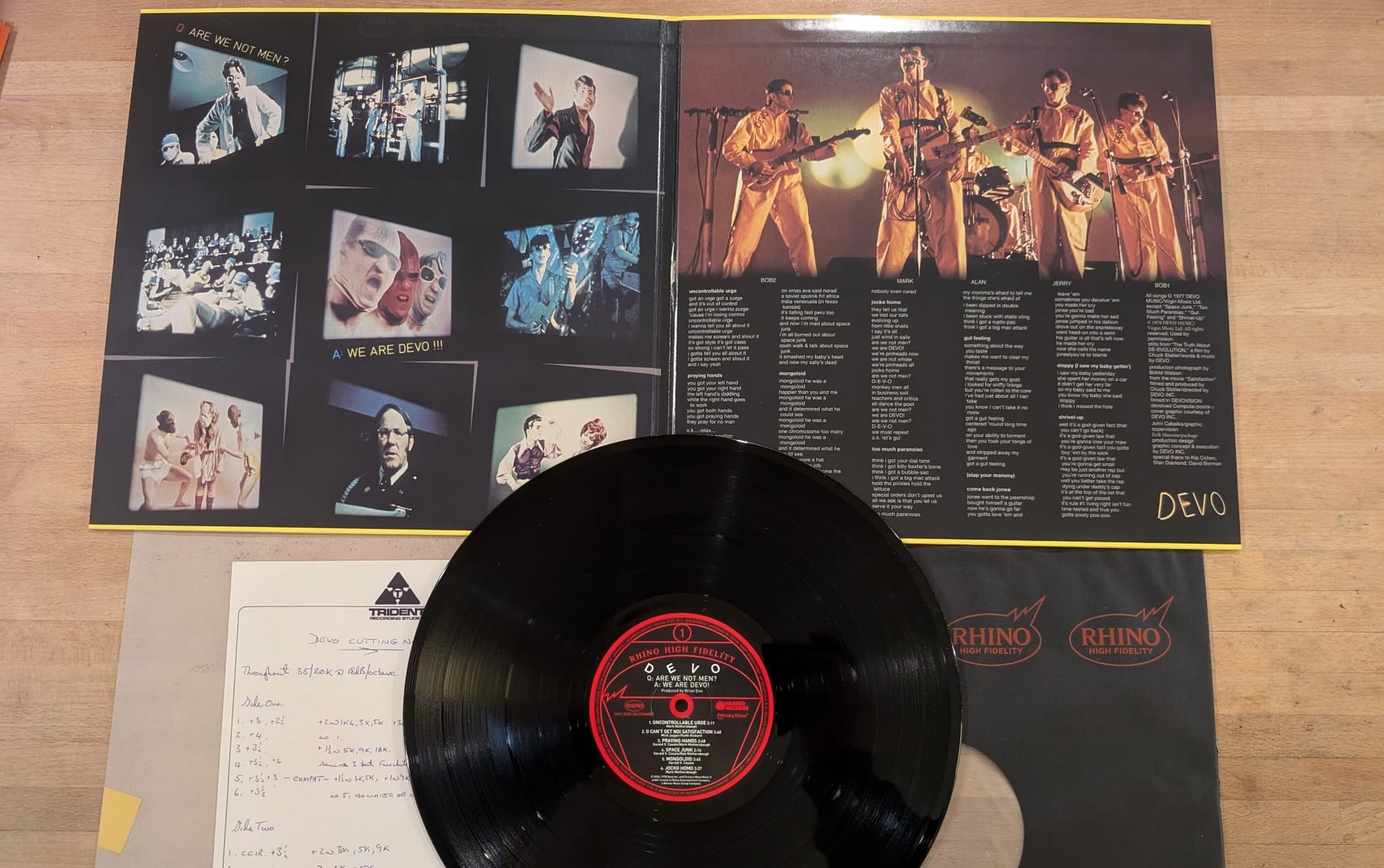
Gray’s master also emphasizes the differences between the material that Devo recorded with Eno at Conny Plank’s studio in Köln, Germany, and the two tracks the band laid down at San Francisco’s Different Fur Studios with engineer Patrick Gleeson. The room tone shifts audibly as they ping-pong from Europe to the US and back again on the album’s final four tracks. The original pressing of the album balanced those different sessions out well. The RHF edition turns it into a subtle yet noticeable sonic seesaw that only works to the benefit of a band and an album that aims to disorient.
Devo approached every element of Are We Not Men? from an odd angle—turning a rock standard into shape-shifting art-funk brutalism with “(I Can't Get No) Satisfaction,” writing a goofy, disquieting thesis statement on de-evolution in 7/4 time with “Jocko Homo,” and taking aim at organized religion, sex, and consumer culture with a snickering, juvenile glee. Those qualities don’t suggest an album that is a prime choice for a high-end reissue like this. But now that Devo has reached elder statesmen status across a wide swath of music fans, it’s the kind of royal treatment their art deserves.
Rhino High Fidelity 1-LP 33 RPM 180g black vinyl
• Analog remaster of Devo’s 1978 album
• Jacket: Heavyweight glossy tip-on gatefold with obi
• Inner sleeve: Rhino High Fidelity–branded black poly-lined
• Liner notes, insert, or booklet: Four-page insert with essay from Devo member Gerald Casale and photos of master tape boxes
• Source: Analog; “Cut from original analog master tapes”
• Mastering credit: Kevin Gray at Cohearant Audio, North Hills, CA
• Lacquer cut by: Kevin Gray at Cohearant Audio, North Hills, CA; “KPG@CA” in deadwax
• Pressed at: Optimal Media, Germany
• Vinyl pressing quality (visual): A
• Vinyl pressing quality (audio): A
• Additional notes: This is a numbered, foil-stamped run of 5,000.
Listening equipment:
Table: Cambridge Audio Alva ST
Cart: Grado Green3
Amp: Sansui 9090
Speakers: Electro Voice TS8-2
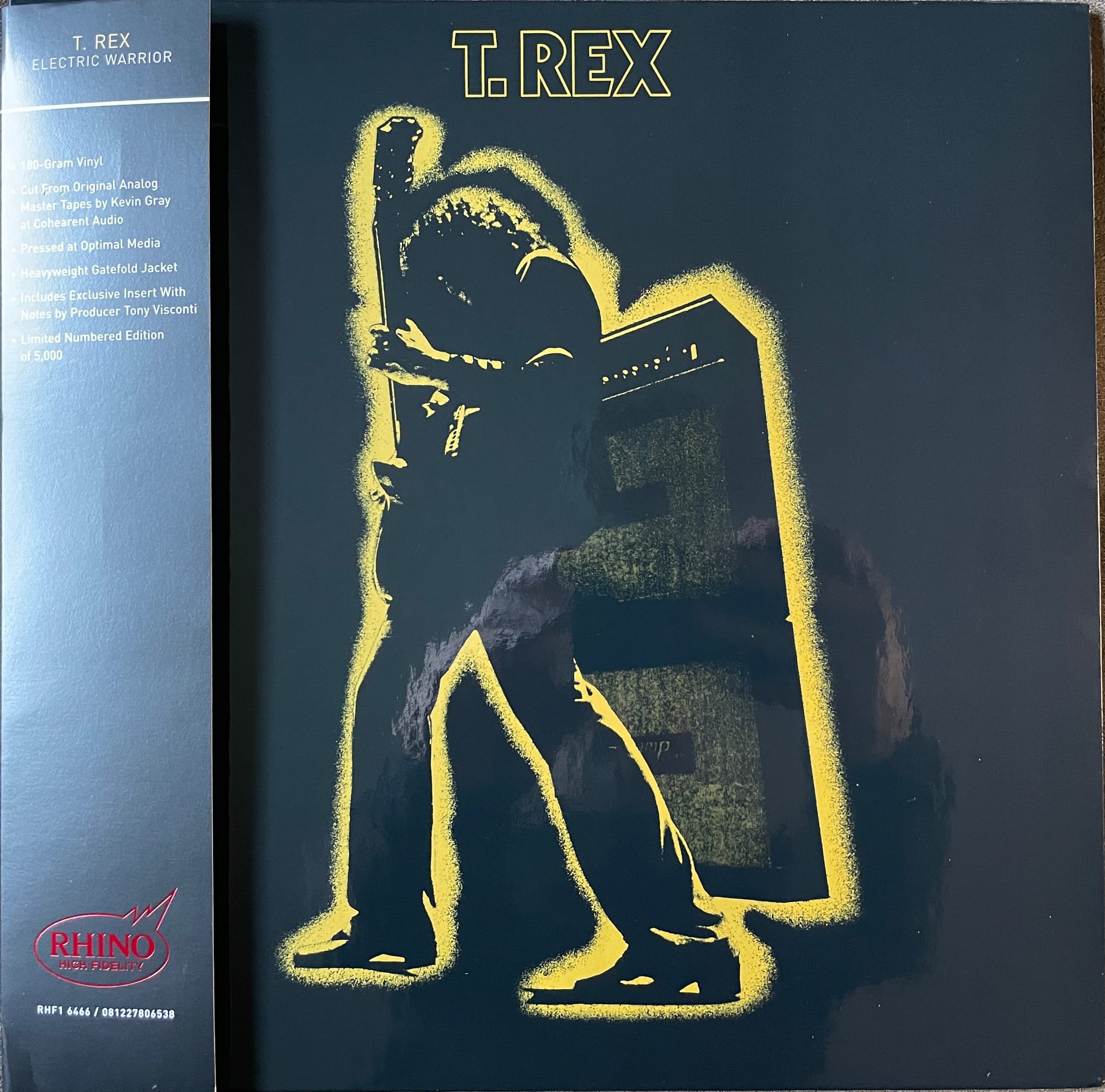
T. Rex: Electric Warrior
Review by Ned Lannamann
Once in a while, there’s an album that doesn’t just define an entire genre but inhabits it entirely, functioning as its ground zero, its site of mass contagion, and its finest exemplar. For glam rock, Electric Warrior is that album. It’s where Marc Bolan fully realized his vision for T. Rex, shedding the last of the outfit’s psychedelic folk origins by embracing crunchy guitars, foot-stompin’ and hand-clappin’, and innuendo-ridden lyrics. The sound of Electric Warrior is of bubblegum hitting the pavement, with the catchy pop rhythms and ooh-la backings achieving a layer of grease and androgynous sexual awakening. But it stops well short of sleaze: All of the booty-shaking bump ’n’ grind is intertwined with romantic yearning and an almost chaste naïveté—this is music that soundtracks the moment when hand-holding turns into heavy petting, when mash notes become come-ons. It could be the most hormonal music that’s ever been recorded.
Upon Electric Warrior’s release in 1971, the UK was feeling the vacuum of the Beatles’ breakup a year prior, and T. Rex’s inventive-yet-familiar sound primed the pump for Bolan & Co. to become the biggest thing in Britain. Indeed, the nation fell into the throes of T. Rextasy for the next two years or so, with the only real competition coming from David Bowie. It’s interesting to compare the two directly, as Bolan and Bowie were friends from adolescence—T. Rex was all about the waist down, with gyrating hips and shimmying feet. Bowie generally operated within the mind, tackling philosophy, psychology, alienation, and aestheticism. Bolan repurposed blues riffs and cooed instinctive, almost primitive lyrics; Bowie rarely used the building blocks of rock and blues (“The Jean Genie” being a notable exception) and dealt in thought experiments and surrealism. Bolan exuded glam, while Bowie simply tried it on for size. Electric Warrior may not reach the intellectual heights of Ziggy Stardust, but it doesn’t need to—it does something more immediate and physical. Put both records on at a party and watch what happens.
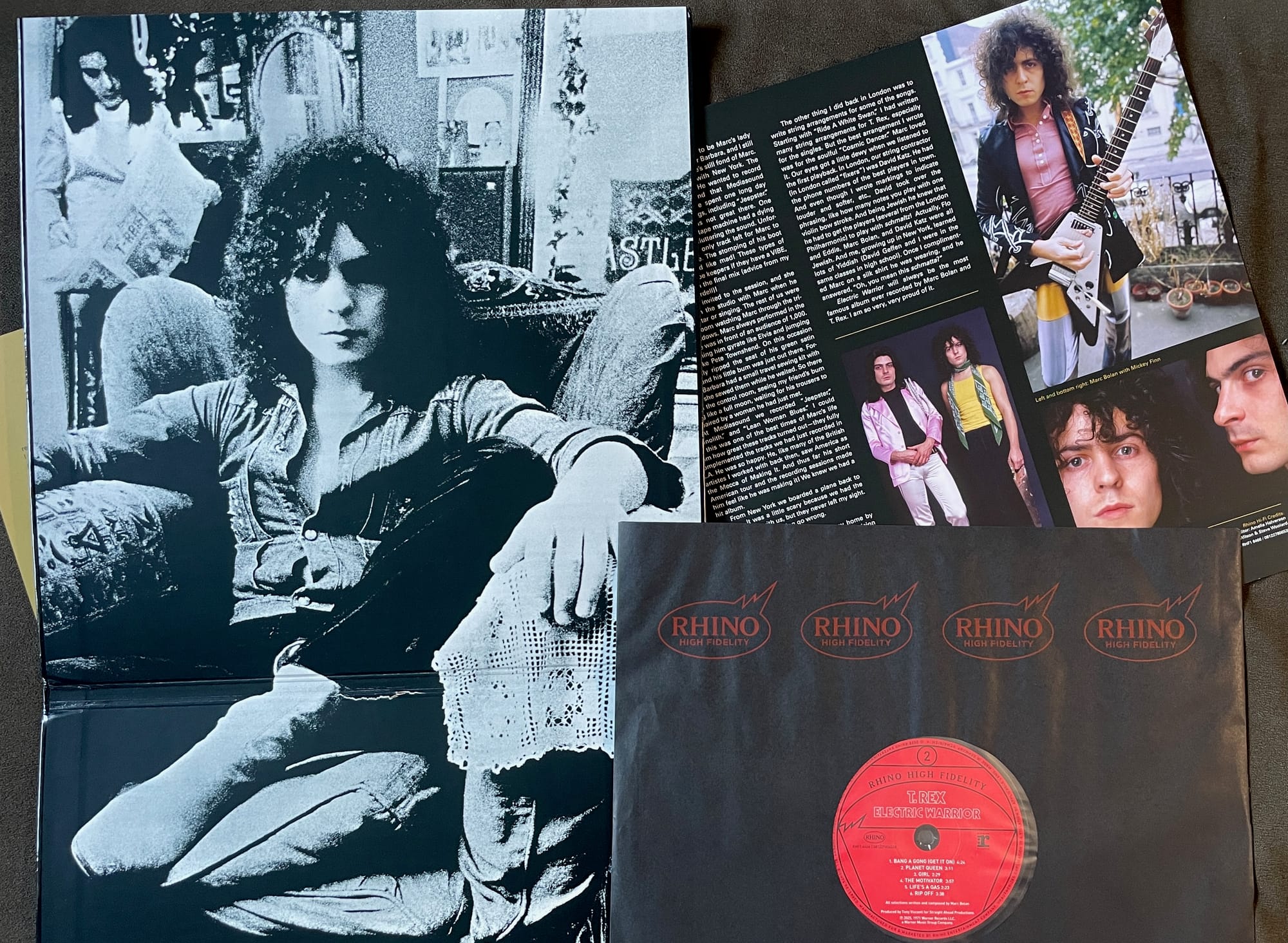
The new Rhino High Fidelity vinyl pressing of Electric Warrior comes on the heels of a reel-to-reel edition that inaugurated Rhino’s foray into the incredibly expensive R2R market. Both are sourced from the US master tape that is part of the Reprise Records catalog, owned by Warner. This new all-analog vinyl cut was undertaken by Kevin Gray and pressed at Optimal Media in Germany; it continues the Rhino High Fidelity format with a deluxe gatefold jacket and four-page insert with liner notes. Happily, these notes were written by Electric Warrior’s producer, Tony Visconti, who provides a first-hand account of his relationship with T. Rex and recounts the making of Electric Warrior specifically. It’s a lovely read. Bolan and the band recorded a big chunk of the album in Los Angeles and New York during a US tour, and they were all in great spirits. “The morale of the band was at its highest here,” Visconti writes, and that joy and enthusiasm can be heard throughout the album.
“Get It On” is the most familiar song—renamed “Bang a Gong (Get It On)” for the US market—and it’s got all the ingredients that make up the album’s particular alchemy. Bolan’s casually tossed-off guitar riffs ride a backbeat that’s propulsive but unhurried, and Visconti’s light touch with strings adds a cinematic, eerie tone, bolstered by the falsetto harmonies of Flo & Eddie. There’s a turnaround midway through where the rhythm section drops out before Bill Legend’s snare and bass drum slam down a two-count to get the groove going again. It might be the emotional climax of the LP, and it sounds fantastic on this cut, with the sensation of air physically whooshing out from the drums.
“Cosmic Dancer” is another high point, a feyer-than-fey traipse that behaves like a ballad but creates its own twirling, indelible groove. Visconti’s string arrangements really blossom here, alternating between sustained chords and percussive chops to add a nocturnal sweetness and epic scope. “Planet Queen” is the album at its most psychedelic, with phased drums and some unhinged Flo & Eddie vocals. And “Ripoff” is a zany treat, a high-octane stomp that features Bolan squealing and screeching to great effect, juxtaposed with an avant-garde flair from Ian McDonald’s saxophones.
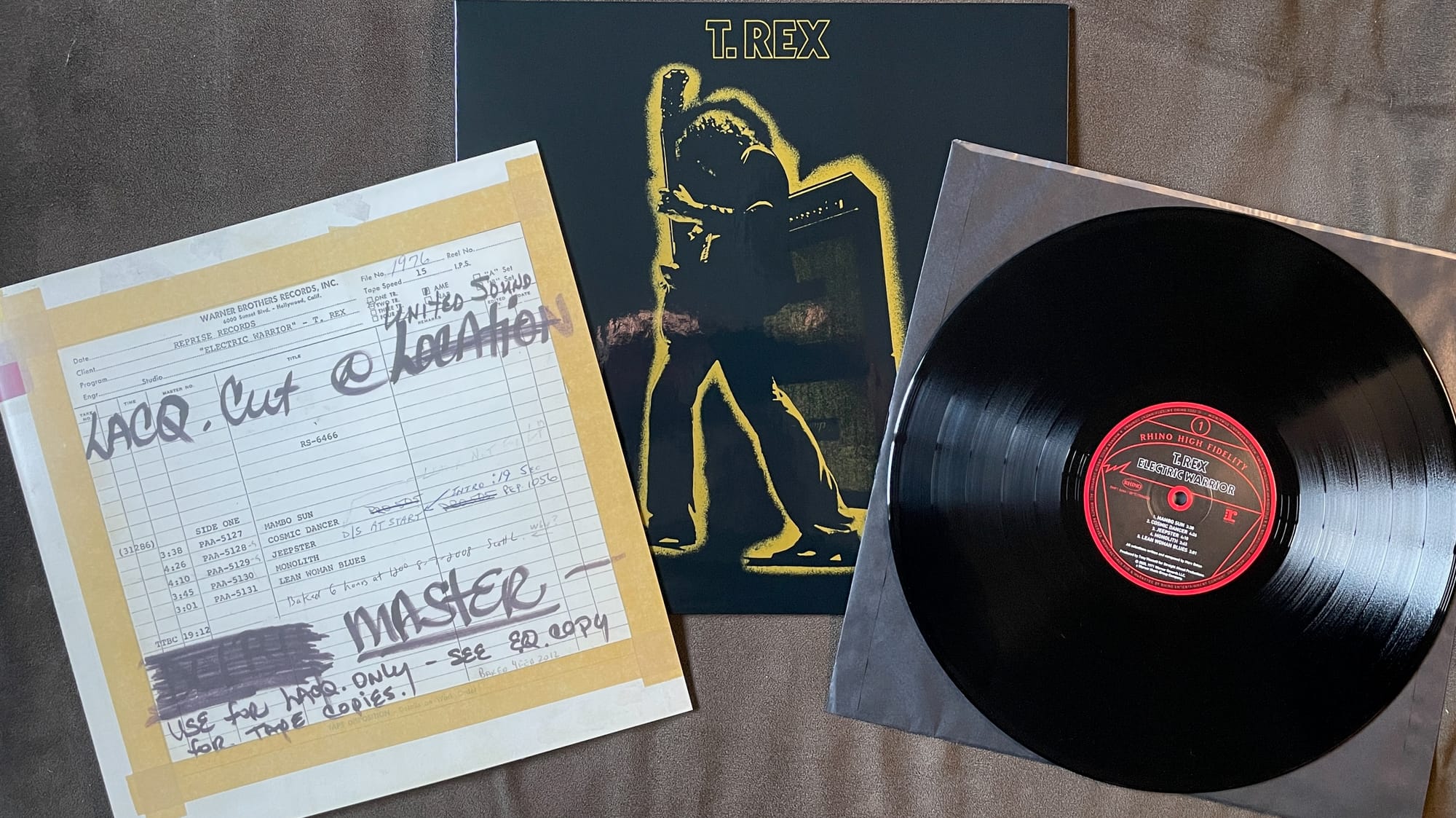
While there is no shortage of vinyl pressings of this album, I’m at something of a disadvantage as I don’t have any of them on hand to directly compare this new version to—my apologies for that. By all accounts, the 1971 UK original on Fly Records is the one to beat. Cut by George Peckham (aka “Porky”), it was not only freshly cut from the just-finished UK master, but it also reportedly has a punch and excitement that no other version has fully replicated. Original US pressings, which were cut by Steve Guy per the information on Discogs, would have used a 1:1 duplicate tape made for Reprise/Warner, and that one-generation-removed tape is most likely the one Gray used here. I’d like to know more about this particular US master, as the images of the tape box included in the insert don’t tell the full story. Where was the US dupe made (in the UK, I’m guessing)? Is there any info beneath the track sheets that are attached to the box with masking tape? And what does the “12/23/71 #100” written in pencil refer to, which would have been written after Electric Warrior’s US release in November 1971? (Amusingly, there are notations that the tapes were baked in 2008, and right next to them, scrawled in different handwriting, is the word “Why?”)
Other notable pressings include a 2003 Rhino version cut by Ron McMaster (unknown whether it was cut from analog or digital); a 40th-anniversary version cut digitally by GZ and issued in Europe in 2012 as part of the Back to Black series with an extra LP of alternate versions (and later reissued as a single disc of just the album); and a 2020 Mobile Fidelity 2-LP 45 RPM version that purports to be cut from an analog copy tape, although that description predates the revelation that MoFi cuts all their lacquers from digital DSD transfers. But perhaps the most notable of all is a different analog cut by Kevin Gray, first issued for Rhino Rocktober in 2017 and still currently available. The online reports suggest that it sounds very similar to this new RHF cut, which stands to reason.
Whatever resemblances it may or may not have to what comes before, the new Gray RHF cut withstands every kind of situation, from background mood-setting to intense, dedicated listening. It sounds great at all times, with plenty of clarity at low volumes and lots of excitement and thrust when the knob is turned up. The soundstage is wide but not excessively so; the bass is firmly defined but never overpowering; the ambience and spontaneity of the performances come through on every track. Bolan’s vocal flutters and asides are all fully audible, and his layered guitars can be picked apart and studied individually. A couple of songs on Side 1 edge into high-frequency territory on my setup, which is admittedly on the brighter side. I didn’t notice anything similar on Side 2.
In fact, I had always thought of this album as having a dense, murky palette, with a sort of Spectoresque wall-of-sound texture that was able to get the pop hooks across in less-than-ideal listening situations but was somewhat impenetrable when examined more carefully. This Gray cut has disabused me of that notion. The graininess and edge creates excitement and vigor in the sound, but there’s a clarity in the production that allows you to hear the ingenuity of Bolan and Visconti’s arrangements. The album rocks harder than I realized, and it’s also more sumptuously beautiful than I ever gave it credit for.
The package mirrors the US Reprise release in most respects, as opposed to the first UK Fly release. The latter included a poster with a black-and-white photo of Bolan and the band; for the US release, the image cropped out two of the band members to fit inside the gatefold. The UK version also featured a custom inner sleeve with drawings of Bolan and percussionist Mickey Finn and a custom label that featured a photo from the shoot that produced the album cover for 1970’s T. Rex. These were not carried over to the initial Reprise release and are not reproduced here either. I should add that you can pay Rhino extra to get two additional 7-inch singles that are reproductions of what T. Rex released around the time of Electric Warrior; they feature non-album tracks that are certainly worthwhile. I’d love an expertly mastered LP compilation that collects all of the group’s singles and B-sides, which were very much a part of the whole T. Rextasy experience and often did not appear on the albums.
With original UK copies of Electric Warrior becoming scarce—and with many of them owned by kids who may not have treated them with care—it seems a reasonable conclusion that this new Kevin Gray cut is the best easily available option. I can’t say whether or not it compares favorably to his 2017 cut, but I’m inclined to assume they are more or less interchangeable; I’d love to hear if someone thinks otherwise. So there’s no vinyl shoot-out here, and as such, you can certainly take my recommendation with a grain of salt. But I think this pressing of Electric Warrior sounds superb enough to honor these songs, with all the raucous rock ’n’ roll grit and whimsical pixie dust that makes ’em sound so dirty sweet.
Rhino High Fidelity 1-LP 33 RPM 180g black vinyl
• Analog remaster of T. Rex’s 1971 album
• Jacket: Heavyweight glossy tip-on gatefold with obi
• Inner sleeve: Rhino High Fidelity–branded black poly-lined
• Liner notes, insert, or booklet: Four-page insert with images of tape box and essay by producer Tony Visconti
• Source: Analog; “Cut from original analog master tapes,” although the US copy tape for Reprise Records was used and not the original UK Fly Records master, which may be lost.
• Mastering credit: Kevin Gray at Cohearent Audio, North Hills, CA
• Lacquer cut by: Kevin Gray at Cohearent Audio, North Hills, CA; “KPG@CA” in deadwax
• Pressed at: Optimal Media, Germany
• Vinyl pressing quality (visual): A
• Vinyl pressing quality (audio): A- (faint repeating tick at end of Side 2)
• Additional notes: This is a numbered, foil-stamped run of 5,000 copies; it’s likely Rhino will issue unnumbered copies after this first run sells out. The first 2,000 come with two additional 7-inch singles, replicating the UK tracklists of the “Hot Love” and “Bang a Gong” singles from 1971.
Listening equipment:
Table: Technics SL-1200MK2
Cart: Audio-Technica VM540ML
Amp: Luxman L-509X
Speakers: ADS L980