Reviews: Neil Young | Ray Charles

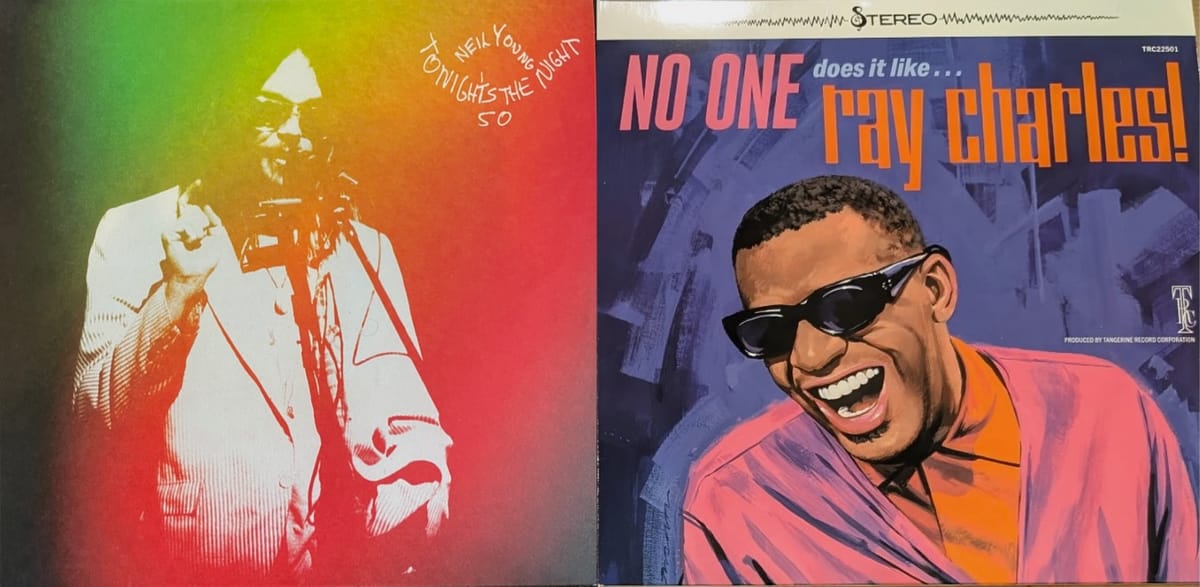
Cover art for Neil Young and Ray Charles.

Black Friday has come and gone, but there’s still plenty of new vinyl to listen to. Today we go long on a few new reissues of note: The 50th anniversary double-LP edition of Neil Young’s Tonight’s the Night, and the four inaugural albums in a terrific new Ray Charles reissue series on Tangerine Records.

• Neil Young: Tonight’s the Night 50

• Ray Charles: Ingredients in a Recipe for Soul; Love Country Style; Come Live with Me; No One Does It Like… Ray Charles

If you’re visiting us today because of Neil Young, you should consider joining our paid tier. Not only do you get to generously support our efforts, paid subscribers are also eligible for our December vinyl giveaway—which just happens to be Neil Young’s new Official Release Series #6, a giant 8-LP box set that includes 1992’s Harvest Moon, 1993’s Unplugged, 1994’s Sleeps with Angels, and 1995’s Mirror Ball. You can read our review of it here. And we’ll be doing excellent vinyl giveaways each and every month for paid subscribers, who will also get some additional perks that we’ll be announcing soon. Sound good?

Thanks for bearing with us as we awkwardly ask for money. It’s a necessary reality with our newsletter model, so any support is enormously appreciated and makes a huge difference for us. You may have noticed there are no ads or affiliate links around these parts—we’re intending to keep it that way, but it of course depends on you.

And that’s more than enough supper-singing for now. Let’s get into today’s reviews.

Cover art for Neil Young.

Neil Young: Tonight’s the Night 50

Review by Ned Lannamann

Maybe Neil Young was never finished with Tonight’s the Night. The 1975 album, just reissued in a 2-LP 50th anniversary version, was recorded in 1973 but famously shelved for two years. The record company blanched at its rawness and disorderliness, but Young, too, seemed uncharacteristically unsure about it. His producer, however, had no doubt—David Briggs wanted it to go out into the world exactly as Young and a version of Crazy Horse laid it to tape in 1973, in a Hollywood rehearsal space under the influence of gallons of tequila. But Young kept tinkering with it, adding songs from later sessions, then shelving it as 1974’s On the Beach began to come together. Tonight’s the Night finally saw the light of day in 1975, taking the place of another shelved album, Homegrown, with the 1973 Hollywood sessions augmented by three songs of varying origins.

But this new Tonight’s the Night 50 sees yet another adjustment. “Lookout Joe,” a 1972 leftover that Young shuffled into the joker’s deck of the original LP, is replaced here with a version that was actually recorded during the 1973 Tonight’s the Night sessions. This version is looser and sloppier, and is very much of a piece with the rest of the album, but it also means the original text has been altered. The loud, aggressive 1972 take—recorded at Young’s Broken Arrow Ranch during rehearsals for the Time Fades Away tour—served as a pick-me-up during the downer home stretch of Side 2. This newly released version does just the opposite, dragging the tempo to a crawl and boozily wallowing in the mire. It’s fantastic. But is it Tonight’s the Night? Only Neil Young can say for sure.

It is a surprise that, at this late date, Young’s decided to tweak what is generally considered to be one of his two or three best albums, if not the best. Few records have so much contextual information available about their creation and still manage to be cloaked in legend. The story goes that Young ditched out on an attempted Crosby, Stills, Nash & Young reunion in the summer of 1973, grabbed Briggs, and went to LA to make “a rock ’n’ roll record.” He enlisted Billy Talbot and Ralph Molina from Crazy Horse as well as former collaborators Ben Keith and Nils Lofgren, and entered Sunset Sound, but it was immediately clear that a fancy, expensive studio wasn’t going to work for the vibe Young and Briggs were looking for. So they hit up Ken Berry, the brother of CSNY roadie Bruce Berry (as well as Jan Berry of Jan and Dean). Ken ran—and still runs—an instrumental rental facility in Hollywood called Studio Instrument Rentals (SIR; it’s now a national brand). Young and Briggs took over one of the rehearsal spaces, knocked a hole through the wall, backed up a mobile recording truck, and let the tapes roll.

Bruce Berry, of course, would be mentioned by name in the title track—he had died of a heroin overdose a few weeks before the sessions began. Young, Molina, and Talbot were also recovering from the November 1972 death of Crazy Horse guitarist Danny Whitten, the night after Young fired him from the Time Fades Away touring band for failing to deal with his own heroin problems. The Time Fades Away tour of hockey arenas and convention centers had been a miserable experience—Young hated the giant venues, and his band of hired guns mutinied midway through, lobbying for bigger paychecks. With the latest attempt at a CSNY reunion sputtering out, Young was in a dark frame of mind, reflected in his newest batch of songs. The environment around the SIR sessions was one of death, drugs, and grief, and the musicians decided to embrace the darkness by turning it into an all-night party.

The contents of Neil Young: Tonight's the Night 50.

Tonight’s the Night is to this day still probably one of Young’s sloppiest recordings. The inebriated musicians were learning the songs as they were playing them, and there are missed notes and lurching tempos, while the singers lean in and out of range of their microphones, or bump into them accidentally. Young’s voice is far from the naïve, reedy mewl of “After the Gold Rush” and “Old Man”; his voice is deeper and hoarser, growling through “Albuquerque” and cracking on the falsetto notes of “Mellow My Mind.” The album’s centerpiece, “Tired Eyes,” is largely spoken, with Young setting an impressionistic scene about a drug deal gone bad, littered with guns and bodies and regret: “He tried to do his best, but he could not,” Young says matter-of-factly. Failing to meet expectations—and resolving one’s self to that failure—is the order of the day.

And yet the sadness is never sour, the depravity is fully self-aware, and over the course of its 12 tracks, Tonight’s the Night accumulates a power that is intense and moving. Its disheveled sound is never the result of carelessness, as it builds to a damaged beauty that precisely locates your nerve centers. For those looking for smoothness and perfection, Tonight’s the Night will never be an album that makes sense. But for those looking for something beyond what simply makes sense, the album possesses a truth and purity that’s hard to find.

For the 1975 release, Young leavened the SIR sessions with three additional tracks, including the aforementioned “Lookout Joe,” which tells the story of a Vietnam vet coming home to a world of drugs and hedonism. “Borrowed Tune” comes from a later session in 1973, recorded around the time of “Walk On” from On the Beach. A solo piano performance, “Borrowed Tune” cribs its melody from the Rolling Stones’ “Lady Jane,” and functions as the album’s locus of self-pity, eating some sins and allowing the debauched nature of the SIR tracks to float a bit freer. Lastly, and crucially, is the addition of a 1970 live performance of Danny Whitten’s “Come On Baby Let’s Go Downtown,” with Whitten singing lead. It’s a phenomenal track from the peak of the Whitten incarnation of Crazy Horse: Here is the ghost Young’s been haunted by, made real like Hamlet’s father. The inclusion of “Come On Baby Let’s Go Downtown”—an upbeat rocker about scoring a fix—is the final ingredient that alchemizes Tonight’s the Night, turning it into the definitive document about the perilous excesses that surround rock ’n’ roll. It may be worth noting that Young was 27 years old at the time he recorded it; chances are, he was thinking about it.

In addition to the new “Lookout Joe,” six other bonus tracks appear on this 50th anniversary edition, all of them dating from the SIR sessions. Three of them were in Neil Young’s massive Archives Vol. II CD box set: “Speakin’ Out Jam,” a vibe-setting, mostly instrumental run-through of the song with a couple of tape glitches; “Everybody’s Alone,” a tune originally dating from the Whitten incarnation of Crazy Horse that sounds great here but maybe too chipper to fit in with the rest of the album; and, bizarrely, a run at “Raised by Robbery” fronted by Joni Mitchell, who dropped by the sessions one night and led the band into one of the heaviest and most shambolic things she’s ever recorded. Also present is a cozy, fun version of Young’s now-perennial outtake “Wonderin’” that originally streamed on neilyoungarchives.com and gets a physical-media release here. The other two tracks are making their first appearance anywhere: a wonderful, spirited SIR version of “Walk On” that’s different from the equally good SIR version streaming on neilyoungarchives.com, and a brisk, early take of “Tonight’s the Night” that finds Young and the band fumbling through the groove. These songs all appear on Side 3 of the vinyl; Side 4 is an etching of the album cover photo.

(A quick grumble, since this double album is listing at $49.99 US: I wish Young and the powers that be had opted to fill out the fourth side with music. That’s where they could have found a home for the SIR version of “Lookout Joe,” keeping the historic version of Tonight’s the Night intact. They could have added the other SIR take of “Walk On,” and thrown on the live version of “The Losing End” that was recorded at the Roxy during a run of shows Young and the band played to open the nightclub right after the Tonight’s the Night sessions. That live version appeared on the Archives Vol. II box set but did not make the cut for the vinyl version of Roxy: Tonight’s the Night Live. And speaking of what’s not here: For years, rumors circulated about a Briggs-compiled nine-song rough mix of Tonight’s the Night that included lengthy raps in between the songs. By many accounts, this was THE true version of the album. But alas, it appears this is genuinely lost to time, as this would have been the perfect opportunity to let people hear it.)

A shootout of three pressings of Tonight’s the Night.

The new mastering by Chris Bellman is exemplary, and he cut the lacquer at Bernie Grundman Mastering—just a few blocks away from where Tonight’s the Night was recorded, as it turns out. Bellman has been expertly cutting all of Neil Young’s vinyl in recent years, including the version of Tonight’s the Night that appeared in the Official Release Series Vols. 5–8 box set from 2014; that same cut was used for a stand-alone release in 2015. On this new cut, the bass is noticeably increased, the soundstage is expanded slightly, and there’s also an increased clarity into the mix that is also present on the 2014 box set version, which lacks the bass increase but to my ears sounds more natural, pleasing, and integrated as a result.

On my 1975 promotional copy, pressed at Columbia’s Santa Maria facility, the sound of the ensemble is blended together a bit more; this 2025 Bellman cut chooses to clean up some of the murk—one of the original album’s defining characteristics. This also means that the stray noises, clunks, and bumps are also more easily noticed. I think the 1975 version had a unified, almost claustrophobic sound that suited the material. It had a peephole quality that drew you into this nocturnal world. The 2014 Bellman cut is a breathtakingly good update, with the unity of the 1975 cut plus a gentle twist of focus and presence, retaining the juice of the analog master white making everything more vivid. Bellman’s 2025 version is bigger and more aired out, delivering everything to your ears on a platter. It sounds great—and “World on a String” in particular sounds better in this new version than it ever has—but I’m glad I have all three cuts. I suspect many current-day listeners will prefer the broader, bassier, more blatant sound of the 2025 cut, as its pleasures are immediate.

Pressing-wise, however, this new Tonight’s the Night is significantly less successful, at least in my case. Disc 1 of my clear vinyl copy, pressed at the Metallica-owned Furnace Record Pressing plant, is as noisy a piece of new vinyl as I’ve experienced in a while. A thorough clean in the ultrasonic did little to mitigate the issues. Considering that virtually all of Neil Young’s vinyl pressings are superb, this one really stands out. There are crackles and pops throughout the disc, particularly noticeable during the quieter passages and in between songs, and there are even momentary splatches of wretched non-fill noise on Side 1. Side 2 is a bit better, and Side 3 is more or less fine, leading me to hope that my excessively noisy Disc 1 is not an across-the-board problem for all copies. Mine is a US pressing, and European pressings were handled by Record Industry in the Netherlands, so it may be worth seeking out one of those copies. The normal black vinyl version could also be an improvement.

The artwork has been given a brazen update by Young, with a colorful red-and-green gel effect superimposed over the high-contrast black-and-white photography of the original. The 1975 version was printed on fuzzy blotter paper, resulting in a black that seemed to absorb light itself, and one that would start to look worn almost immediately. This new version forgoes the blotter paper and is instead printed on a more everyday, matte-finish kind of board. The original’s folded insert—with a concert review written in Dutch—is replicated here, and the original inner sleeve is turned into a two-sided paper insert with a slightly chintzy-looking print job. The discs come in paper sleeves, not poly-lined, which is a shame. The labels replicate the all-black Reprise labels from the original, with all the musician credits crammed on; the printing is a little faint, making it tough to read.

Tonight’s the Night remains a grim listen, but it’s never been a disconsolate one. Its boozy origins have lent the album endless comparisons to an Irish wake, but you could also liken it to a New Orleans jazz funeral once the body has been cut loose, or a Viking funeral with pyres ablaze. While it’s usually not worthwhile to psychoanalyze an artist based on their art, these 1973 sessions do seem like a crucial period for Young, where the darkness that encroached on the rock scene of the ’70s was hitting close to home. By embracing that darkness, and by traveling directly through it, Young may have allowed rock-star Dionysian excess to run its course through his system and then leave him alone. The album allows the listener to do the same—peer steadily into the abyss and then walk away from it. That there is some incredible music to be heard in the bargain makes Tonight’s the Night all the more powerful. Sometimes feeling bad can feel awfully good.

Reprise/Warner 2-LP clear vinyl
• 50th anniversary of the 1975 album, with “Lookout Joe” swapped out for a previously unreleased alternate take, and with an additional six bonus tracks, two of which are unreleased and none of which have appeared on vinyl before
• Jacket: Direct-to-board gatefold
• Inner sleeve: Generic white paper
• Liner notes, insert, or booklet: Includes original folded insert, two-sided insert that replicates the original inner, and one-sided insert with schematic diagram of Neil Young Archives site
• Source: Analog tape
• Mastering credit: Small type on label reads, “Remastered for vinyl from the original master tapes by Chris Bellman at Bernie Grundman Mastering, Hollywood, CA”
• Lacquer cut by: Chris Bellman at Bernie Grundman Mastering, Hollywood, CA - “CB” in deadwax
• Pressed at: Furnace Record Pressing, Alexandria, VA (European copies are pressed at Record Industry, Netherlands)
• Vinyl quality - visual: A
• Vinyl quality - audio: C- (pops, clicks, and nonfill)
• Additional notes: Side 4 is an etching and contains no music. A black vinyl pressing is also available.

Listening equipment:
Table: Technics SL-1200MK2
Cart: Audio-Technica VM540ML
Amp: Luxman L-509X
Speakers: ADS L980
Cover art for Ray Charles.

Ray Charles: Ingredients in a Recipe for Soul; Love Country Style; Come Live with Me; No One Does It Like... Ray Charles

Review by Robert Ham

Ray Charles knew his worth. After scoring hit after hit on the R&B charts for Atlantic, the songsmith from Georgia went for his bag when he decided to sign with ABC Records in the early ’60s. His deal allowed him not only to retain ownership of all his master recordings, but also let him start a boutique label, Tangerine Records, where he celebrated the artists that he loved and was influenced by. Once he got the green light, Charles wasted no time, issuing singles by the jump-blues legend Louis Jordan, the keening vocalist Jimmy Scott, and the undersung Lula Reed, among many others.

Charles would move his own recorded output over to Tangerine in 1966, releasing a run of fantastic albums that further cemented his legacy as one of the premier soul artists of the day. He folded the imprint in 1973 when he left ABC but quickly set up his own shop, Crossover Records, where he would remain until the early ’80s. 

Again, Charles retained ownership over everything he issued during this stretch, but that gold mine of material has remained largely untapped by his estate since his passing in 2004. That all changed this year when the Ray Charles Foundation, the nonprofit he began in 1986 to provide education and support for young people with hearing disorders, decided to launch the Tangerine Master Series on the refreshed Tangerine imprint. The series has come out strong, issuing new vinyl pressings of some key albums from Charles’s ’60s and ’70s heyday—Ingredients in a Recipe for Soul, Love Country Style, and Come Live with Me—as well as compiling No One Does It Like… Ray Charles, a fine collection of singles and B-sides that dropped in late November. 

At a glance, it’s a fairly scattershot selection of LPs from Charles’s impressive discography, but when looked at in context, this quartet of releases provides some clarity as to where the artist was commercially and culturally. The oldest of them, 1963’s Ingredients in a Recipe for Soul, for example, arrived in the wake of his biggest successes to date: the first two volumes of his Modern Sounds in Country and Western Music series. Both were released in 1962 and featured his pop-soul takes on country classics like Hank Williams’s “Your Cheating Heart” and the Everly Brothers’ “Bye Bye Love,” and both went gold in the US. Ingredients was the first small step beyond those hits. Charles retained the services of Modern Sounds producer/arranger Sid Feller and chose songs that would easily resonate with a crossover audience, like “Over the Rainbow” from The Wizard of Oz and “You’ll Never Walk Alone” from the musical Carousel. Every track here is given a big-band arrangement complete with a full horn section and occasionally some syrupy strings and choral backing singers. Charles infuses it all with his bluesy mettle, particularly on the tangy “Busted” and the nasty take on “In the Evening (When the Sun Goes Down),” which arranger Benny Carter slows to a sultry crawl. 

1970’s Love Country Style was something of a calculated move on Charles’s part, coming as it did after a string of commercially underperforming efforts and as his contemporaries embraced the psychedelia and rock sounds of the time. Why not then go back to the commercial well and record another collection of country tunes? This time, however, Charles and Feller cast these tunes in a lava-lamp glow, opting to work with members of the LA session outfit the Wrecking Crew; the strings and choral vocals remained, but as backdrop to grooves worthy of Stax and Motown. The results didn’t set the charts on fire, but it turned out to be a far stronger record than either volume of his Modern Sounds efforts, in this writer’s opinion. 

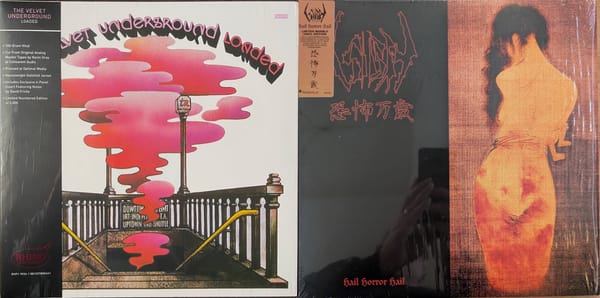
Cover art and vinyl for Ray Charles.

Come Live with Me, originally issued in 1974 on Crossover (the label Charles started after Tangerine folded), continues to tangle with the artist’s dual interests of sticking to a comfort zone of Sinatra-like balladeering and stretching out into modern soul territory—as he did with songs like the self-penned “Somebody,” which sounds like a response to Innervisions, or the Al Green-like Southern funk of “Where Was He,” or “Louise,” a song originally written for the 1929 film Innocents of Paris. It’s a fascinating mix made even more so when you home in on the right channel, where Charles’s electric piano playing is situated. The music may rip toward the saccharine, but his limber solos add the perfect sour tang. 

The final release in this first run of reissues, No One Does It… is surprisingly cohesive for a compilation as it holds its focus on Charles’s ’60s work. Stylistically, it leaps all over the map, ranging from an excellent Latin-tinged track like Percy Mayfield’s “Hide Nor Hair” (originally released as a B-side to 1962’s “At the Club,” which is also included here) and the soaring take on “My Heart Cries For You” to the drippy “Without Love (There Is Nothing)” and the country lope of “No One.” The glue for this collection is Charles. He’s in strong form on every track, cutting through each arrangement and recording like a finely-sharpened chisel. 

This Tangerine reissue campaign seemed to come out of nowhere and without any of the big anniversary hooks—or, at least they aren’t being promoted in any grand fashion like that. The reason to celebrate these reissues, it seems, is simply the excitement of getting them back in print again. As pleasantly surprising as this series is, I was even more thrilled by how much care went into their production. The audio for all four LPs (which I’m assuming came from hi-res digital files) was remastered by Michael Graves, with the lacquers cut by Jeff Powell. Each tangerine-colored disc is spectacular, with a perfectly balanced soundstage that brings out each shimmer of the strings and, on the ’70s releases, the gutbucket thump of the rhythm section. New details emerge as well, via Charles who lets loose with small handclaps and foot stomps that were obscured in the earlier digital versions of these LPs that I’ve heard in the past. 

As with so many reissues like this, I carried some skepticism about these Ray Charles represses up to the moment I dropped the needle on the first one. The three previously released albums are not hard to come by in the secondary market, and they tend to be fairly inexpensive to boot. Multiple spins of all four discs have turned me into a complete convert. I would have liked the Ray Charles Foundation to go the extra mile and include some liner notes, or at least an annotated tracklist for No One, but that’s my only complaint. Otherwise, I expect these to remain in heavy rotation on my turntable while I wait for the next batch of Ray Charles gems to get added to this series.

All four titles: Tangerine 1-LP on tangerine vinyl
• Reissues of three Ray Charles albums and a compilation of singles tracks and B-sides the artist recorded in the ’60s
• Jacket: Direct-to-board single pocket with a glossy front and a matte-finish back
• Inner sleeve: White poly-lined
• Liner notes, insert, or booklet: None
• Source: Unknown
• Mastering credit: Michael Graves of Osiris Studio, Los Angeles, CA
• Lacquer cut by: Jeff Powell of Take Out Vinyl, Memphis, TN - “J Powell” in deadwax of each
• Pressed at: Unknown 
• Vinyl quality - visual: A
• Vinyl quality - audio: A
• Additional notes: None.

Listening equipment:
Table: Cambridge Audio Alva ST
Cart: Grado Green3
Amp: Sansui 9090
Speakers: Electro Voice TS8-2

Read more