Reviews: Record Store Day 2026, Batch 1

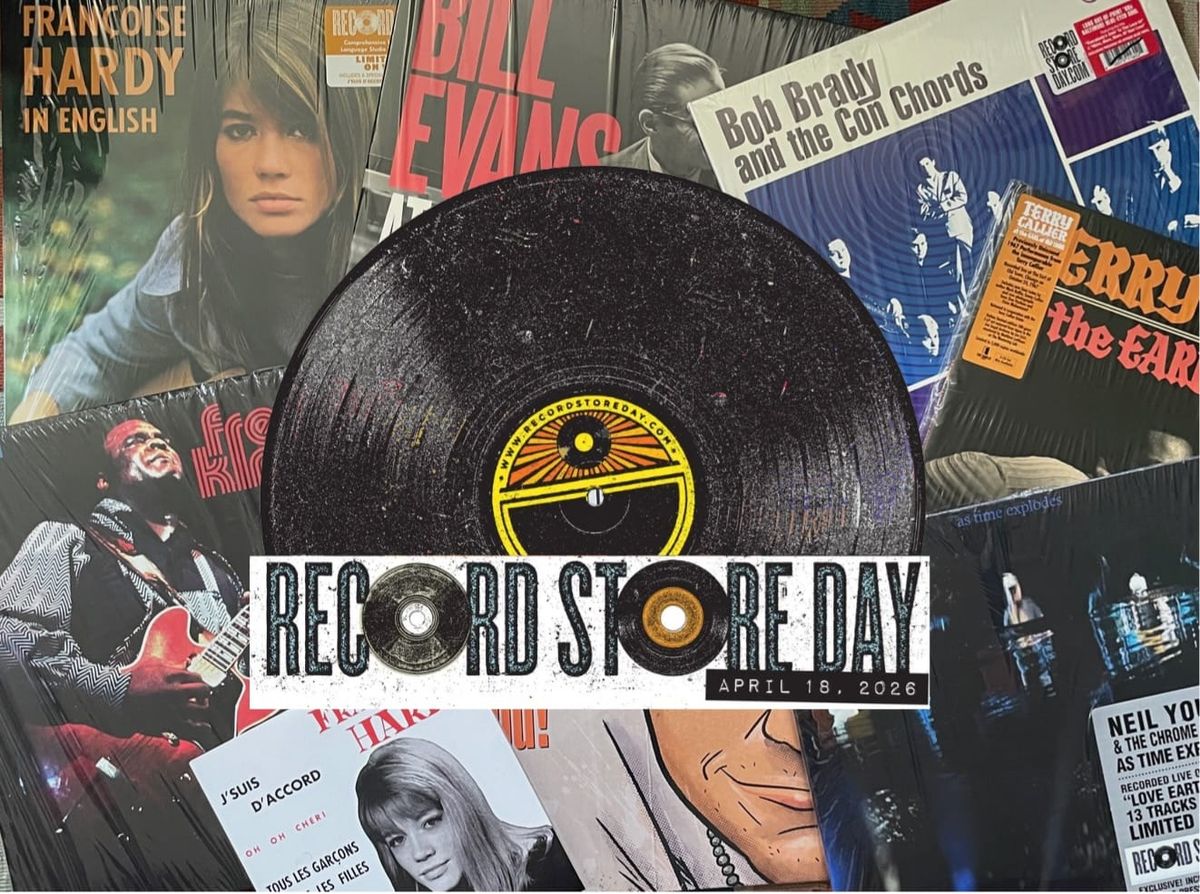
Including Bill Evans, Neil Young, Françoise Hardy, Blur, Freddie King, Buster Williams, Adam Sandler, Terry Callier, and Bob Brady and the Con Chords.
We’re less than two weeks away from Record Store Day, so today we’re launching the first batch of our RSD record reviews. We’ll be publishing more reviews as we get closer to the big day, so hopefully you can get a sense of what vinyl is worth picking up on April 18 and what you can probably live without.
Here are the reviews in today’s edition:
- Bob Brady and the Con Chords: Love-In: The Chariot Records Recordings
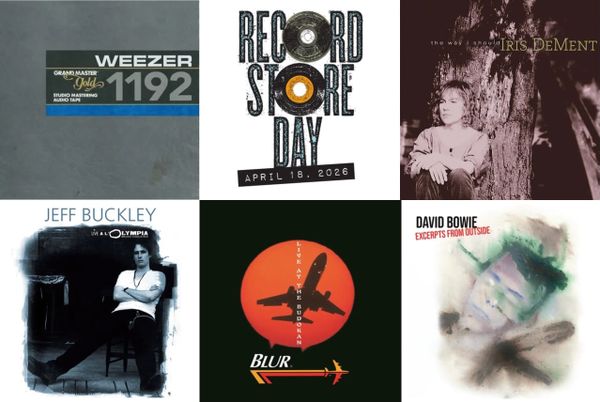
- Blur: Live at the Budokan
- Terry Callier: At the Earl of Old Town
- Bill Evans: At the BBC
- Françoise Hardy: In English
- Freddie King: Feeling Alright: The Complete 1975 Nancy Pulsations Concert
- Adam Sandler: They’re All Gonna Laugh at You!
- Buster Williams: Pinnacle
- Neil Young and the Chrome Hearts: As Time Explodes
It’s a long one, so let’s jump right in! And if this is your first time visiting The Vinyl Cut, be sure to sign up for an email subscription so all these Record Store Day reviews hit your inbox as soon as we publish them.
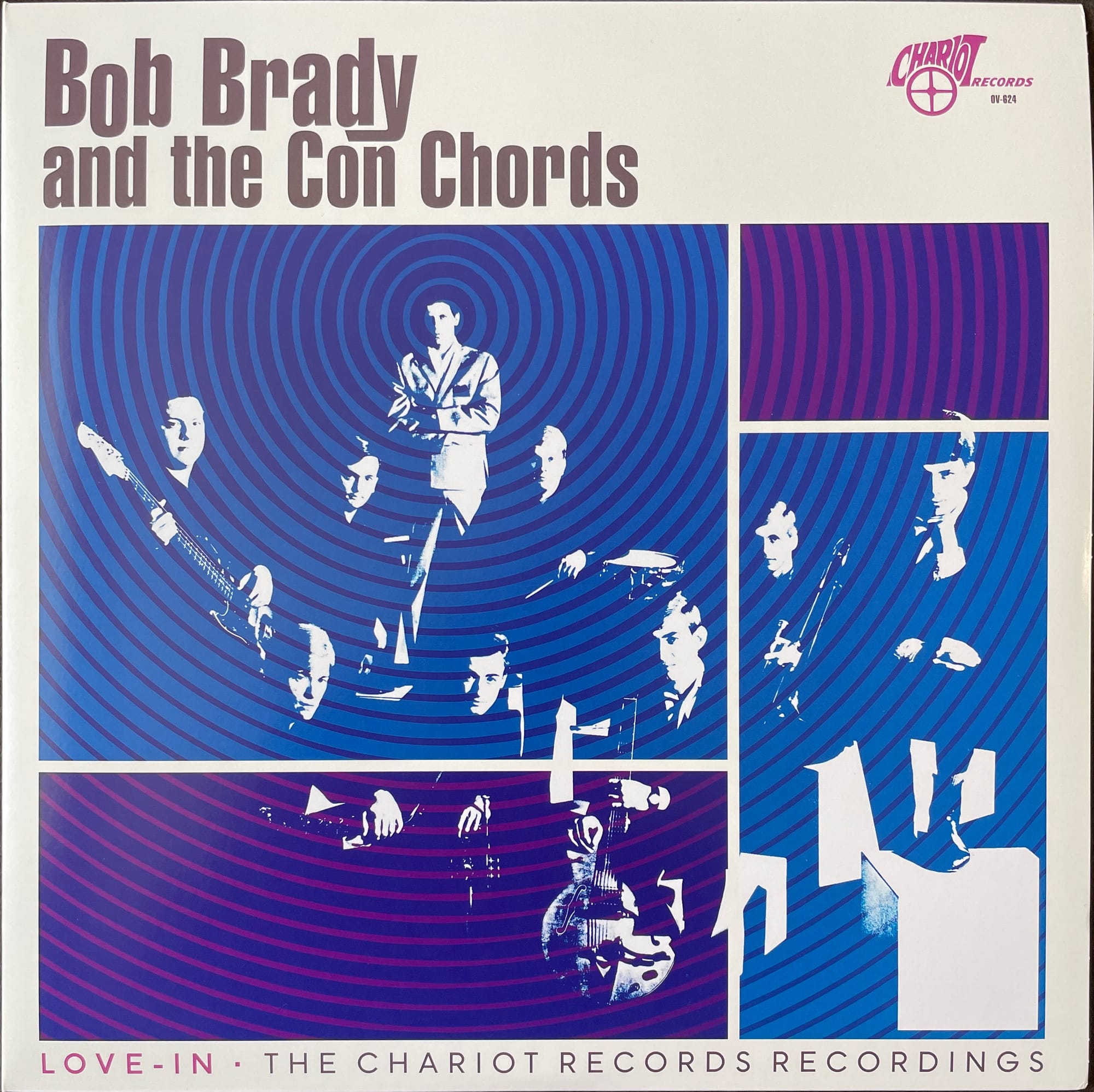
Bob Brady and the Con Chords: Love-In: The Chariot Records Recordings
Review by Ned Lannamann
Despite their singles “Everybody’s Goin’ to the Love-In” and “More, More, More of Your Love” being longtime favorites in the Northern soul scene, ’60s blue-eyed soul band Bob Brady and the Con Chords have never had a full-length album of their very own before. Love-In: The Chariot Records Recordings collects all six of the Baltimore nine-piece’s singles in one place for the first time, with an additional posthumously released B-side tossed in for good measure. It’s a righteous summing-up of Brady and the Con Chords, who were the flagship band for tiny Baltimore label Chariot Records. The label had ambitions to become the Motown of Baltimore but didn’t have quite the same talent pool to draw from; it secured distribution deals through Cameo-Parkway and Bell Records but was never quite able to bring the Con Chords to the next level of recognition.
It’s certainly not because of the material. Bob Brady and the Con Chords’ recorded legacy is one of fine ’60s pop, with a heavy influence from Motown as well as the thriving soul scene of nearby Philadelphia (the group’s later singles were all recorded at Sigma Sound not long after the legendary Philly studio opened its doors). The disc provides a superb, non-chronological overview of the band’s history, which began in 1966 with “Goodbye Baby,” then reached its commercial heights in America with their 1967 cover of Smokey Robinson and the Miracles’ “More, More, More of Your Love,” and moderate international success with 1968’s “Everybody’s Goin’ to the Love-In.” With nine members—including a three-piece horn section and second vocalist George Layfield—the band were capable of an impressive array of styles, as evidenced by the largely original material, penned by Brady and keyboardist Jim Samuel. But their bread and butter was blue-eyed soul, and Brady’s primary singing style was cribbed directly from Smokey Robinson’s distinctive falsetto.
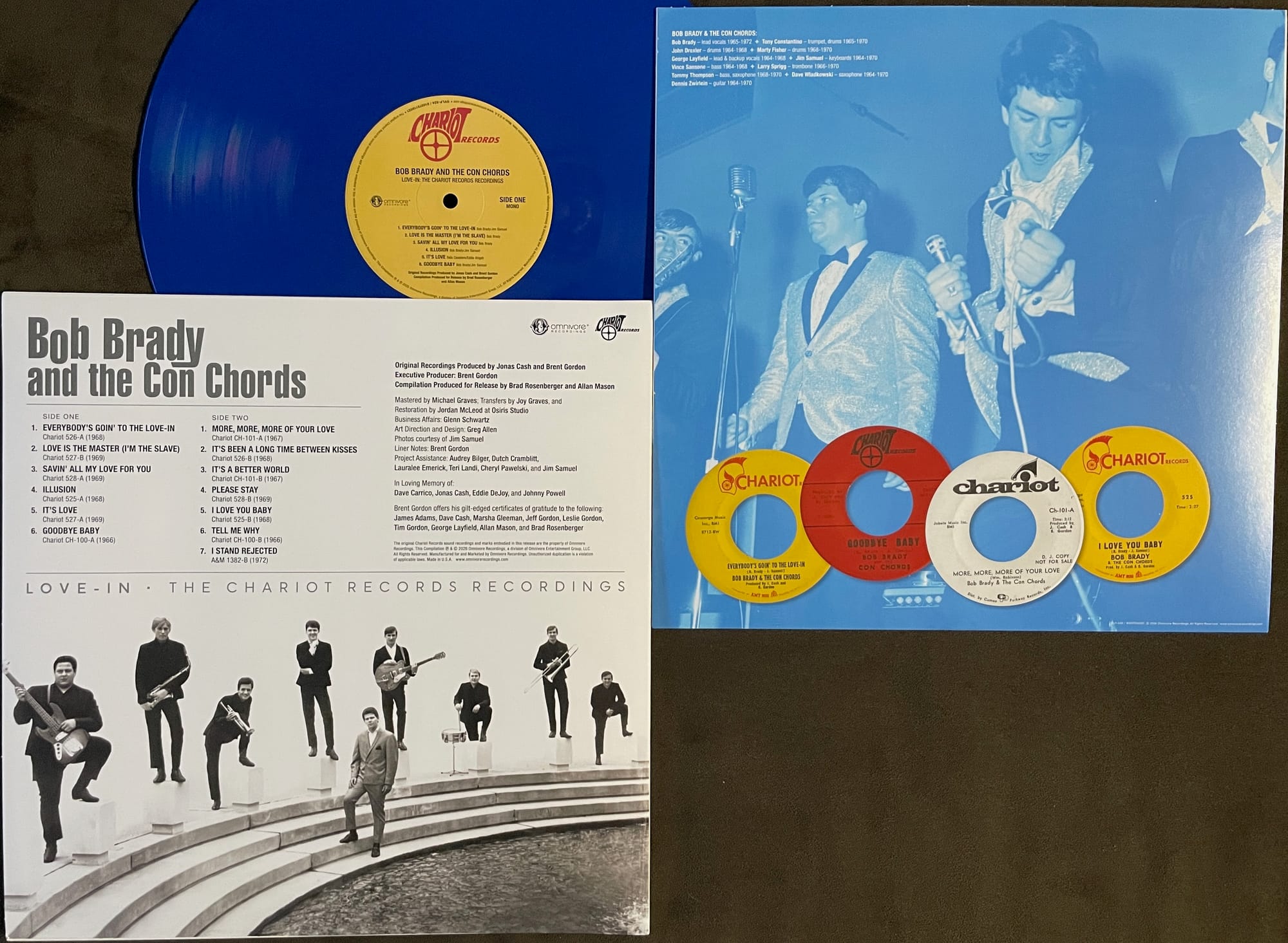
The mono masters sound good if not earth-shattering; this was quickly produced pop music meant for AM radio, and the audio is about as strong as you’d expect from a late-’60s singles collection from a small regional label. There’s not a dud track in the bunch, but the two big singles—”Everybody’s Goin’ to the Love-In” and “More, More, More of Your Love”—are the decided highlights. The album is sequenced for playability, with the two hits leading off the two sides, but I think I would have preferred a chronological tracklist that charted the band’s developing sophistication.
The mastering is clear and full, conveying the sparkle that attracted Northern soul DJs to the Con Chords and also providing the R&B bottom end that makes these songs move on the dance floor. The pressing, by Minnesota’s Copycats, is very nicely done. Neither Bob Brady and the Con Chords nor Chariot Records were long for this world, but this intelligently packaged compilation is just about the best treatment they could have received. Lovers of ’60s pop and soul should definitely have this one on their radar.
Omnivore 1-LP 33 RPM blue vinyl
• Compilation containing the A- and B-sides of all six singles Bob Brady and the Con Chords released on Chariot Records between 1966 and 1969, plus an additional B-side released posthumously in 1972
• Jacket: Direct-to-board single pocket
• Inner sleeve: Printed card
• Liner notes, insert, or booklet: Liner notes by Chariot Records co-founder Brent Gordon included on inner sleeve
• Source: Digital
• Mastering credit: “Mastered by Michael Graves; Transfers by Joy Graves, and Restoration by Jordan McLeod at Osiris Studio”
• Lacquer cut by: Jeff Powell at Take Out Vinyl, Memphis, TN; “J POWELL” in the deadwax
• Pressed at: Copycats Record Pressing, Osseo, MN
• Vinyl pressing quality (visual): B (The stiff card inner sleeve left several superficial scuffs on the blue vinyl)
• Vinyl pressing quality (audio): A
• Additional notes: None.
Blur: Live at the Budokan
Review by Robert Ham
In 1995, there was no stopping Blur. The quartet had exploded in their native UK with their third album, 1994’s Parklife, and the waves of fans and album sales continued to grow when they dropped the follow-up LP The Great Escape less than a year and a half later. Their homegrown success was so seismic that its effects around the world were impossible to ignore, which is what brought the group to Japan in 1995 for a short tour.
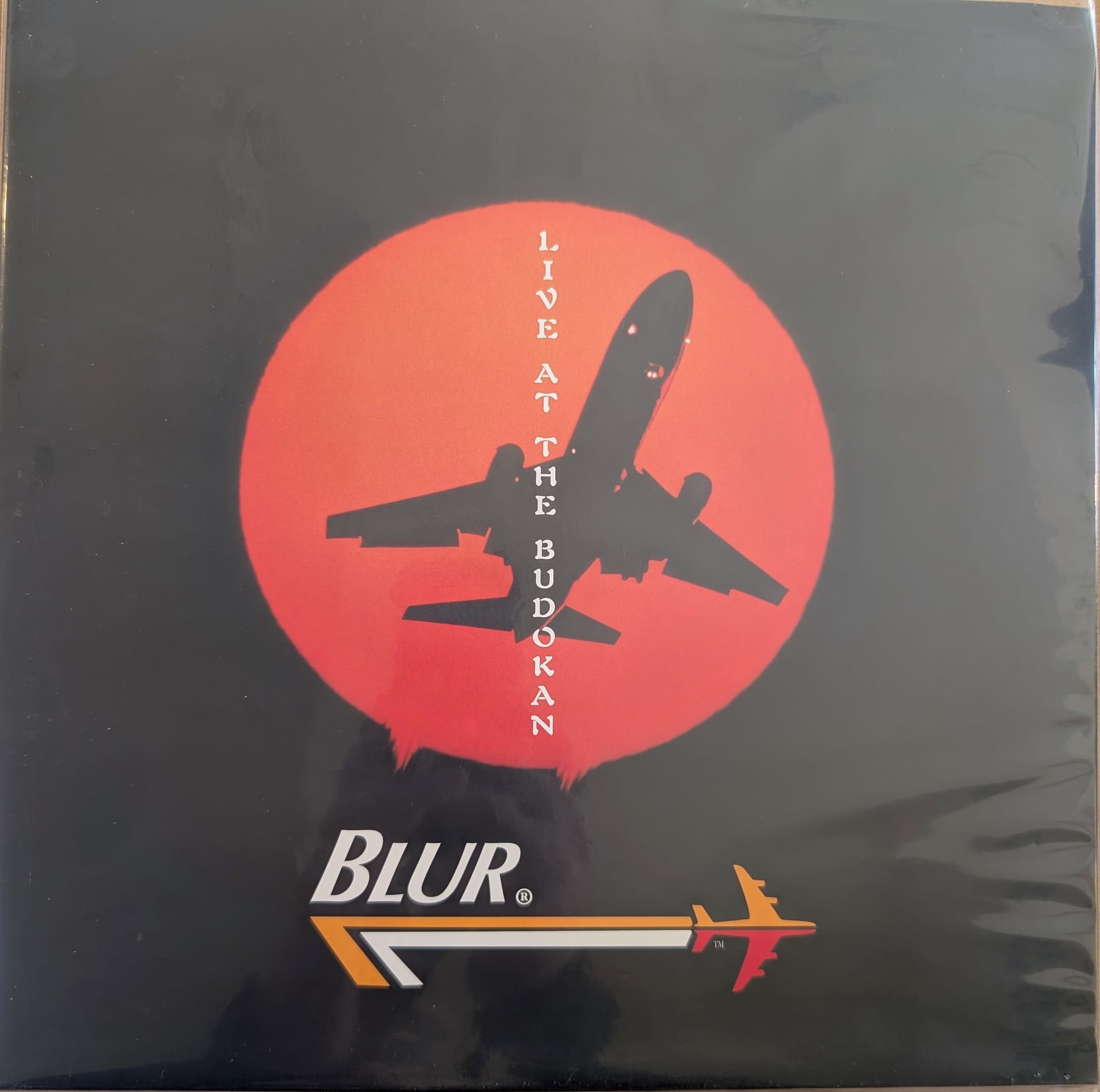
Over a run of six dates, Blur played in some of the bigger concert halls in the island nation, including the Budokan, a Tokyo sports arena immortalized for many outside of Japan by Cheap Trick’s platinum-selling 1978 live album (even though it wasn’t actually recorded at Budokan). No strangers to pop music history and knowing how well they were playing at the time, Blur made their own concert recording at the Budokan, releasing it only in Japan and, for one month, to members of their UK fan club. Now the 96-minute set is making its vinyl bow for Record Store Day in a lovely 2-LP pressing on red wax packaged in a beautifully designed sleeve.
It’s worth repeating the length of this live recording: 96 minutes. That averages out to about 24 minutes per side of this double-disc set—not an egregious amount of music to cut into the vinyl, but there’s just enough bloat to affect the sound of this otherwise-great recording. Blur are in top form throughout. Joined by a horn section and, on set closer “The Universal,” a small gospel choir, the band rips through a fantastic selection of material. The set naturally leans heavily on the still-fresh Great Escape but plucks well from their back catalog, including a killer version of non-album single “Popscene” and a sparkling rendition of “She’s So High” from their debut album Leisure. (The latter was actually recorded the following night at Tokyo’s NHK Hall.)
As much fun as it is to listen to, there’s still a cramped quality to the sound. Some of that is down to the audio being sourced from a digital recording, but the amount of music packed into each side deadens things just so. Dave Rowntree’s drums have a little less verve and punch, the pre-recorded sonic touches like the synth pattern that opens up “Girls & Boys” and the string parts on “The Universal” are noticeably flattened, and both Damon Albarn’s vocals and Graham Coxon’s guitars aren’t as sharply rendered as they could be. It’s not enough to suggest leaving this on the shelves of your local shop come Record Store Day, but it’s worth mentioning for anyone hoping to have their minds blown when dropping the needle on this one.
Parlophone 2-LP 33 RPM red vinyl
• First vinyl release of Blur’s 1996 live album, recorded primarily at the Budokan in Tokyo on November 8, 1995 (one track was recorded on November 9, 1995 at Tokyo’s NHK Hall)
• Jacket: Direct-to-board gatefold
• Inner sleeve: Printed paper
• Liner notes, insert, or booklet: None; sleeves have photos and artwork from original CD release
• Source: Unknown, assumed digital
• Mastering credit: None
• Lacquer cut by: Unknown
• Pressed at: Optimal Media, Germany
• Vinyl pressing quality (visual): A
• Vinyl pressing quality (audio): B
• Additional notes: None.
Terry Callier: At the Earl of Old Town
Review by Ned Lannamann
At the time Terry Callier took the stage at the Earl of Old Town, a folk club in Callier’s hometown of Chicago, he hadn’t yet released a record under his name. His debut album for Prestige, The New Folk Sound of Terry Callier, had been recorded years earlier, when Callier was just 19, but its release was delayed after producer Samuel Charters absconded with the tapes to the Mexican desert. 1968 would finally see it reach record stores, and that year some of Callier’s compositions would turn up on the second LP by Chicago psych band H.P. Lovecraft. But on October 24, 1967, Callier was simply a jobbing folksinger who had grown up in the same neighborhood as Curtis Mayfield, Jerry Butler, and Ramsey Lewis, and was now working the circuit, still in the early stages of devising the unique blend of soul, folk, and jazz that would make him a cult figure.
The show was recorded by Joe Segal, a Chicago music impresario who ran the Jazz Showcase club and often had a tape machine running at concerts around the city. By the standards of 1967, this Earl of Old Town tape might be considered a decent audience recording. But that’s what it is: an audience recording, and sadly, it is really chiefly of interest from a historical perspective rather than an aural or even musical one. The room noise is substantial, and the chatty audience seems indifferent to Callier, who can be heard cleanly but whose voice and guitar are subject to the limitations of the recording. Callier, too, seems thrown by the inattentive crowd, particularly during a doleful version of Tom Paxton’s “The Last Thing on My Mind” (“oh well,” he sighs dejectedly at the song’s finish), although he does build up some assertion over the course of the performance.
At this point Callier was in folk-interpreter mode, and none of the songwriting genius that would be showcased on his exceptional Charles Stepney–produced trilogy of albums for Cadet in the early ’70s is on display here. Rather, Callier’s set consists of songs that folk crowds would likely have been familiar with at the time, like Willie Dixon’s “The Seventh Son,” Nat Adderley’s “Work Song,” and, in a curveball to close the set, the McCoys’ “Hang On Sloopy” (here under its original title “My Girl Sloopy”). His performance is mostly in a gentle-troubadour gear, but in a few places he raises his voice to a holler and accelerates his guitar picking to a Richie Havens–esque flurry of strums.
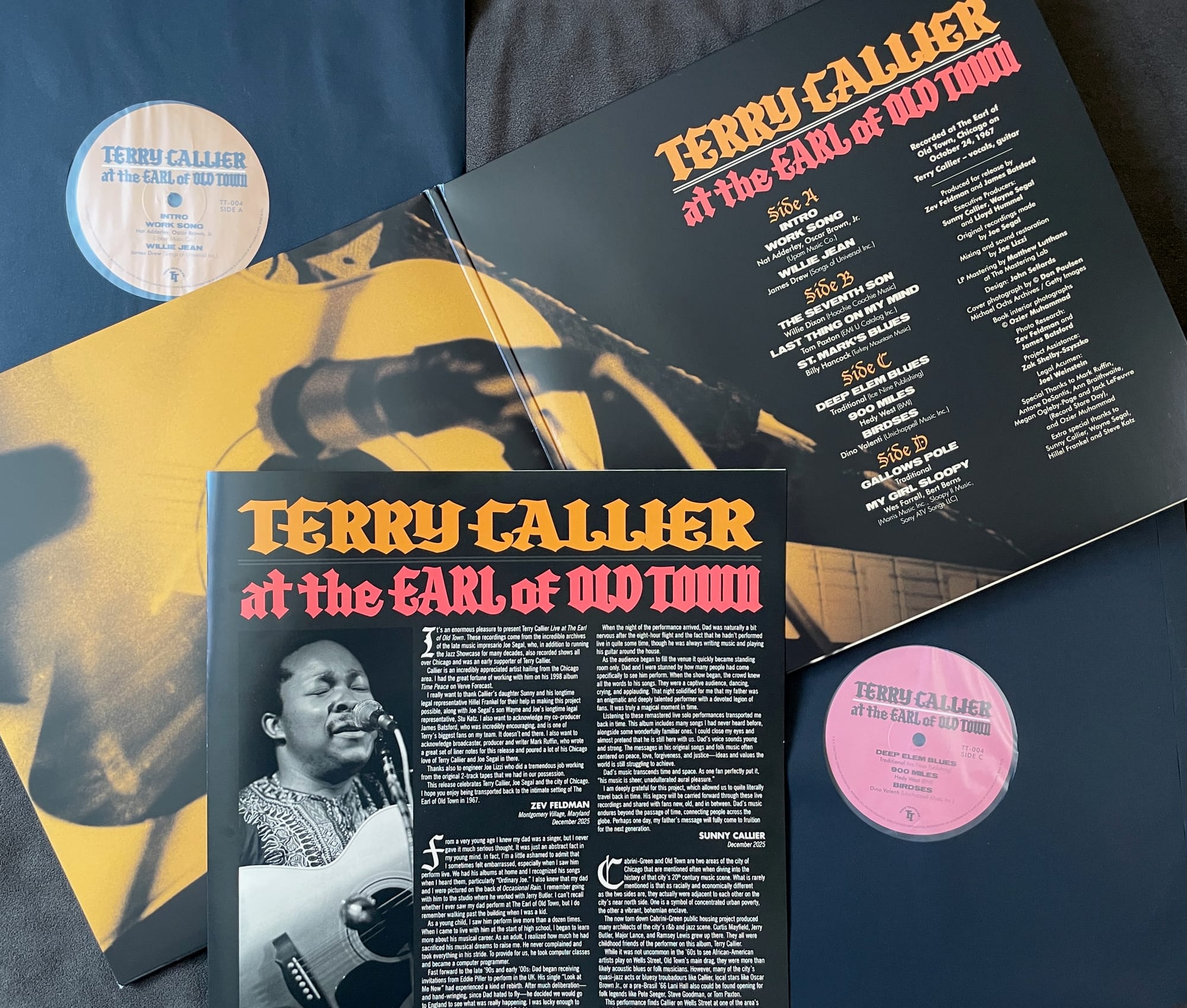
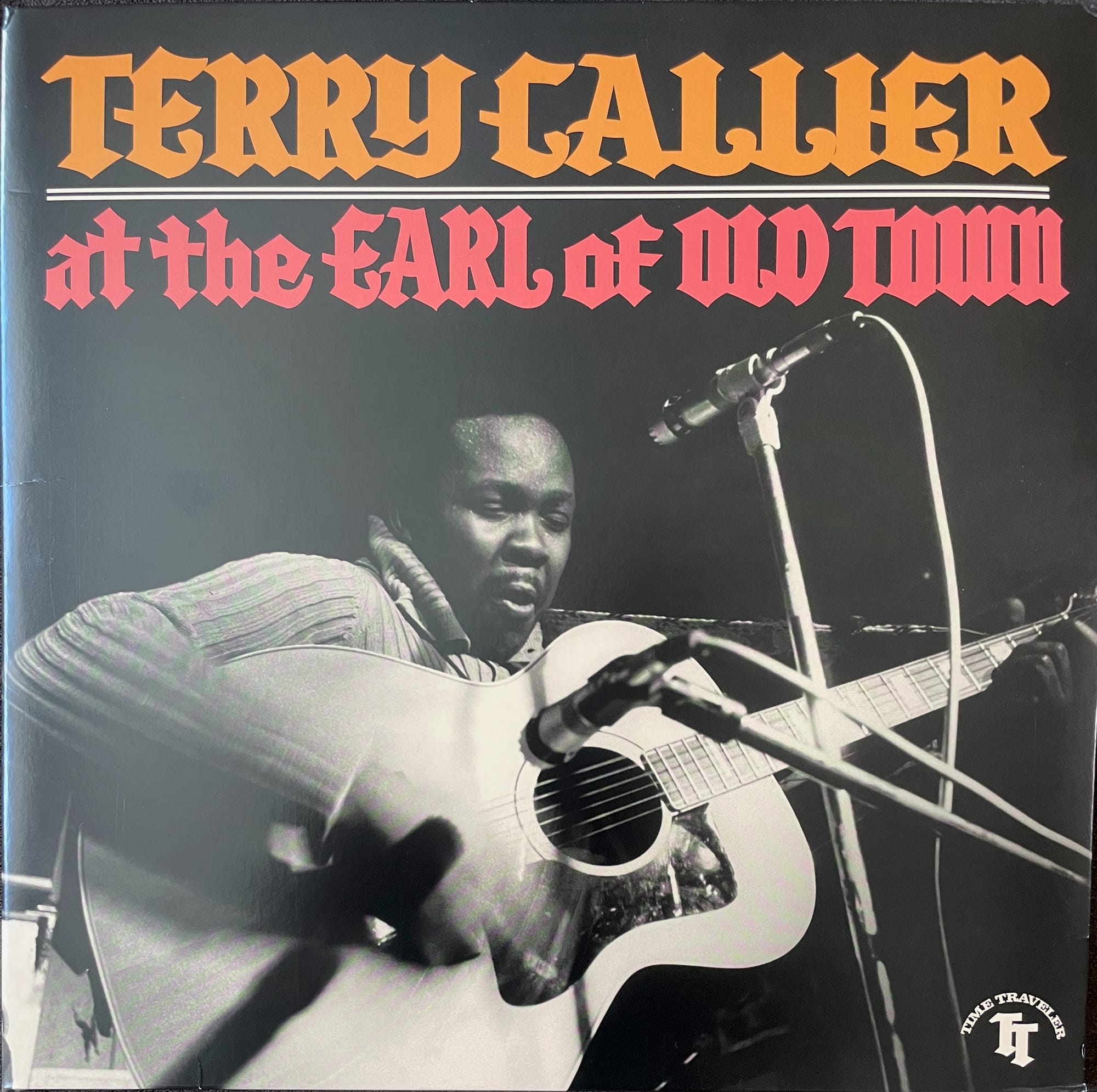
Unfortunately, the louder Callier plays, the worse the tape sounds, and the recording gets severely overloaded for minutes at a time, as on the lengthy version of “900 Miles,” the lone song from this set that also appeared on The New Folk Sound (and here credited to Hedy West, who reworked and popularized the traditional song as “500 Miles”). A fierce “Gallows Pole,” which otherwise might be the highlight of the set, is also marred by passages of distortion. Again, this performance is vital from a historical perspective. But there’s little indication on the outer jacket that this is anything less than a superior archival recording—bearing the imprimatur of jazz reissue guru Zev Feldman, no less—while it really must be thought of as a cleaned-up and well-presented bootleg.
The mastering, however, has brought the compromised audio into its most flattering light. Callier’s voice and guitar have personality and depth, even when they can’t quite overcome the noisy audience. The audio is never murky or distant; it’s a mono recording, although Feldman’s brief liner note says the audio comes from a two-track tape. The lacquers were cut by Matthew Lutthans at the Mastering Lab; interestingly, the deadwax contains the word “FLAT,” which suggests to me that he cut the lacquers without adding any EQ or alterations, but that is pure speculation. The double disc set runs a little under an hour, and I wonder if the confined dynamics could have allowed for it to be effectively cut as a single disc; a lower price point would’ve made the deluxe packaging slightly more palatable in light of the audio quality. The discs were cut at GZ in Czech and my copy was noise- and issue-free.
At the Earl of Old Town is being released for Record Store Day in the UK and in some countries in the EU. It is not on the US list of RSD releases but will be available at certain US stores the week after RSD, on April 24. It’s possible that some stores may have it on their shelves on April 18, but we don’t know for certain. In any case, it can really only be recommended to Callier devotees.
Time Traveler 2-LP 33 RPM 180g black vinyl
• 1967 archival live recording of Terry Callier performing at Chicago’s Earl of Old Town folk club on October 24, 1967
• Jacket: Direct-to-board gatefold
• Inner sleeve: Black poly-lined
• Liner notes, insert, or booklet: 4-page insert with essays from Mark Ruffin, Zev Feldman, and Callier’s daughter Sunny; a previously published 1998 interview with Callier by Ruffin is also included
• Source: Digital; original recording by Joe Segal, restored by Joe Lizzi
• Mastering credit: “LP Mastering by Matthew Lutthans at The Mastering Lab”
• Lacquer cut by: Matthew Lutthans at the Mastering Lab, Salina, KS; “MCL” in the deadwax
• Pressed at: GZ Media, Czech Republic
• Vinyl pressing quality (visual): A
• Vinyl pressing quality (audio): A
• Additional notes: Limited edition of 2,000 hand-numbered copies.
Bill Evans: At the BBC
Review by Ned Lannamann
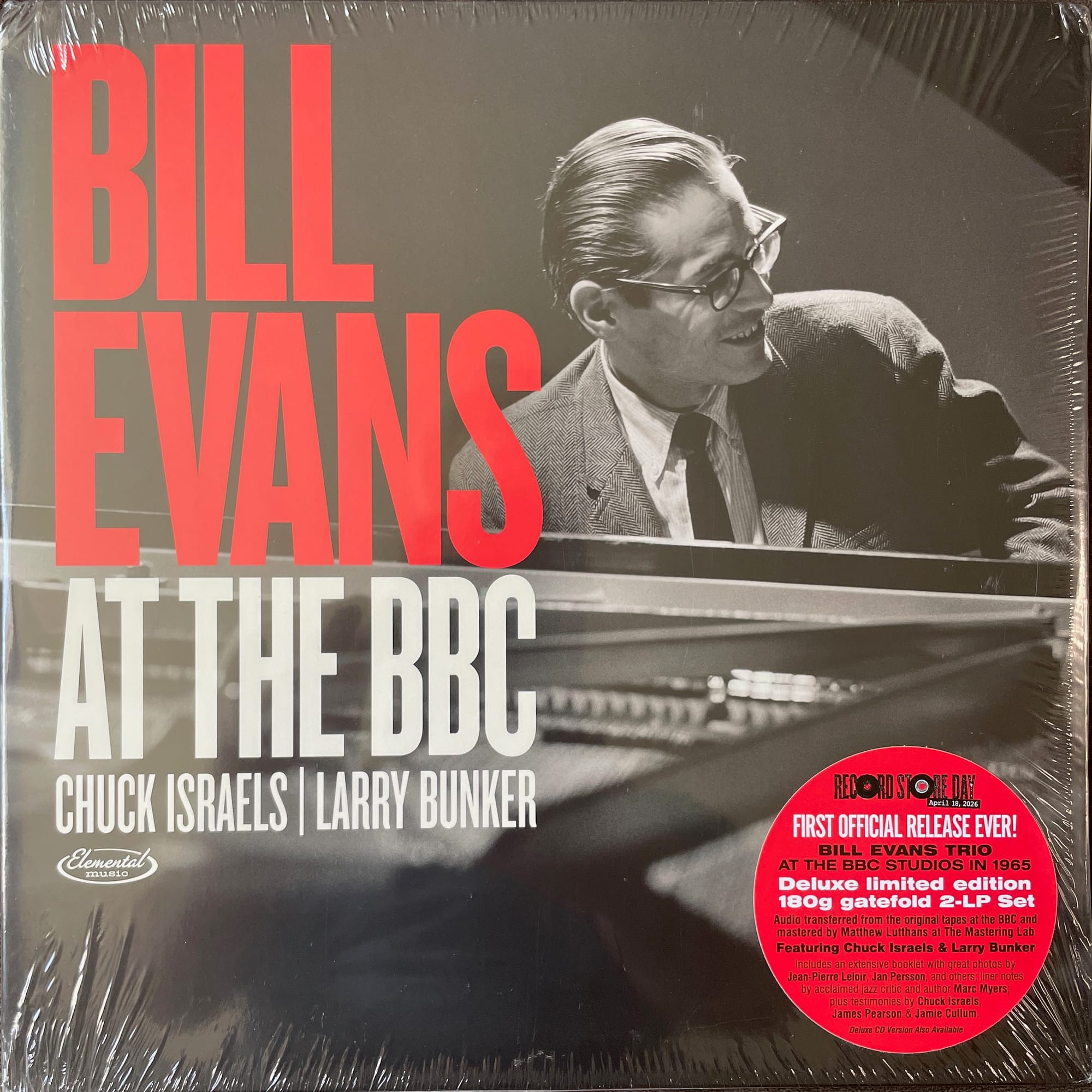
It wouldn’t be Record Store Day without another Bill Evans release. Archival recordings from the jazz pianist seem to pop up every year, usually put together by Zev Feldman for either Resonance Records or Elemental Music. The latter imprint is behind this double disc of Evans and his trio—comprising bassist Chuck Israels and drummer Larry Bunker in this case—performing on March 19, 1965, for the BBC2 television show Jazz 625. The live-music program ran for two years, capturing many essential performances from jazz legends in their prime.
The Evans session was divided up into two separate broadcasts, which means we get the trio’s charming rendition of Evans’ “Five (Theme)” four times over the course of both discs, as it opened and closed both episodes. We also get intermittent narration from host Humphrey Lyttleton, his crisp, proper English at odds with the gangly jazz he’s introducing. I imagine the original broadcasts were a half-hour long but they’re a bit longer here on disc, closer to 35 minutes each. The performances have circulated widely, on LaserDisc and DVD and of course via YouTube, but this is the audio’s first appearance on vinyl. It was recorded in front of an audience of 100 at the BBC Television Theatre, now operating as the O2 Shepherd’s Bush Empire, in the middle of the trio’s four-week run at legendary London jazz club Ronnie Scott’s.
The sound is boxy, as you might expect from a mid-’60s television session, and there’s quite a high level of distortion on both Evans’ piano and Israel’s bass (Larry Bunker’s drums sound pristine throughout). However, there’s also a precision and weight to the sound that suggests the recordings were state-of-the-art television audio for their era; everything here sounds much better than anything you would have heard on American Bandstand or Top of the Pops, for example. The austerity of the BBC surroundings and the reservedness of the audience means that Evans, Israels, and Bunker probably refrained from letting entirely loose, as they might at a nightclub set, but the restraint actually suits Evans’ coolly reticent style quite well.
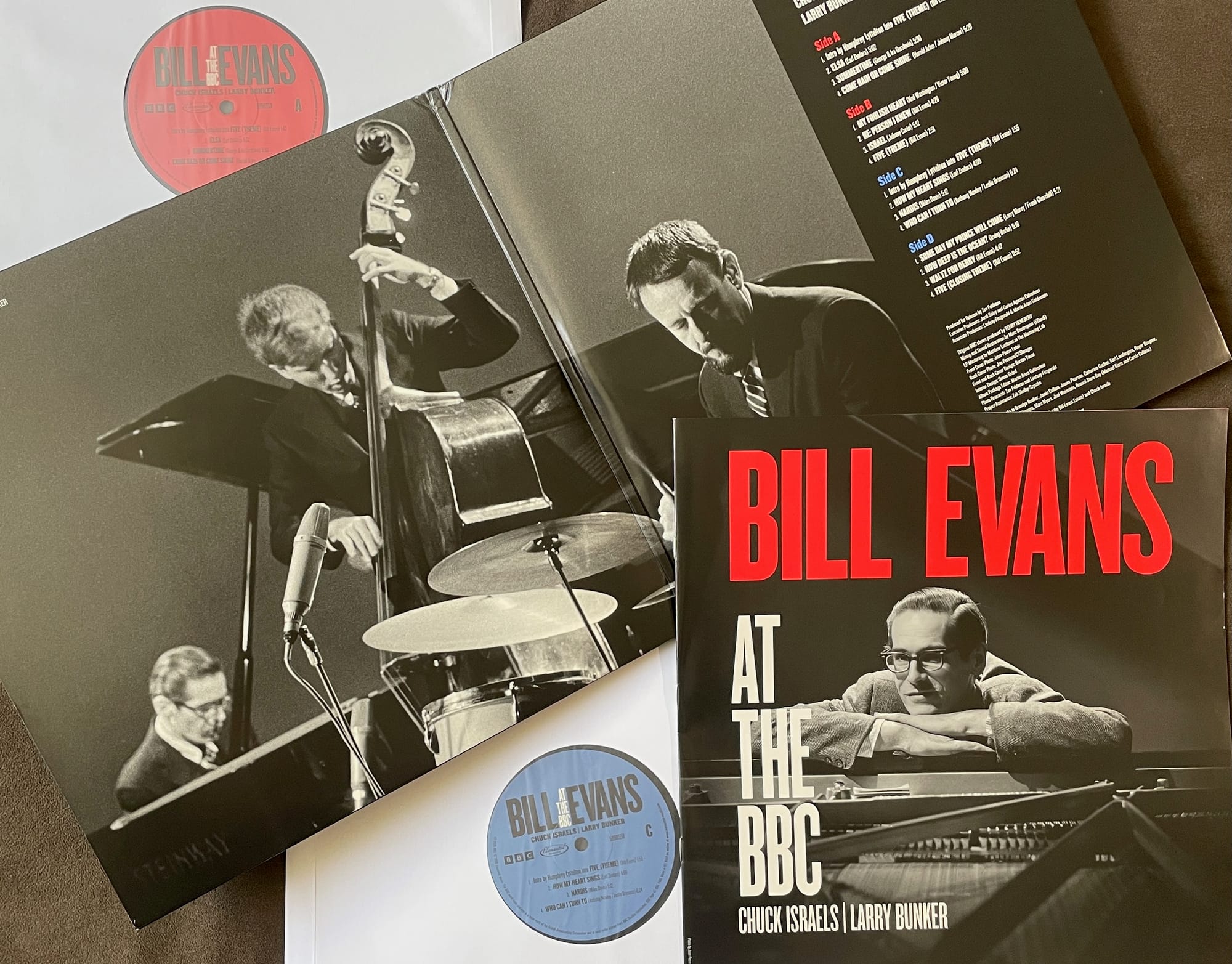
The good news is that seasoned Bill Evans fans will know exactly what they’re getting audio-wise. For the more casual listener, they simply need to be aware that the mono audio is not quite up to the level of Evans’s studio recordings from this period, although it is not too dissimilar from his live recordings for Riverside from a few years prior. Matthew Lutthans’ lacquer cut is warm and focused, downplaying the limitations of the audio source and emphasizing the musicality and interplay that is clearly present. This is not essential Evans, but it is a relaxing and appealing listen that works perfectly well in the background, just less so the closer you listen.
Elemental 2-LP 33 RPM 180g black vinyl
• Live performance recorded by the Bill Evans Trio on March 19, 1965, for the BBC2 TV program Jazz 625, broadcast on May 12 and December 29, 1965
• Jacket: Direct-to-board gatefold
• Inner sleeve: White poly-lined
• Liner notes, insert, or booklet: 12-page booklet with liner notes by Marc Evans, as well as an introduction by Zev Feldman and reflections by Chuck Israels, James Pearson, and Jamie Cullum
• Source: Digital
• Mastering credit: “Mixing and sound restoration by Marc Doutrepont (EQuuS)”; “LP mastering by Matthew Lutthans at the Mastering Lab”
• Lacquer cut by: Matthew Lutthans at the Mastering Lab, Salina, KS; “MCL” in the deadwax
• Pressed at: GZ Media, Czech Republic
• Vinyl pressing quality (visual): A
• Vinyl pressing quality (audio): A- (very minor sporadic noise)
• Additional notes: Limited-edition first pressing of 5,500 hand-numbered copies.
Françoise Hardy: In English
Review by Ned Lannamann
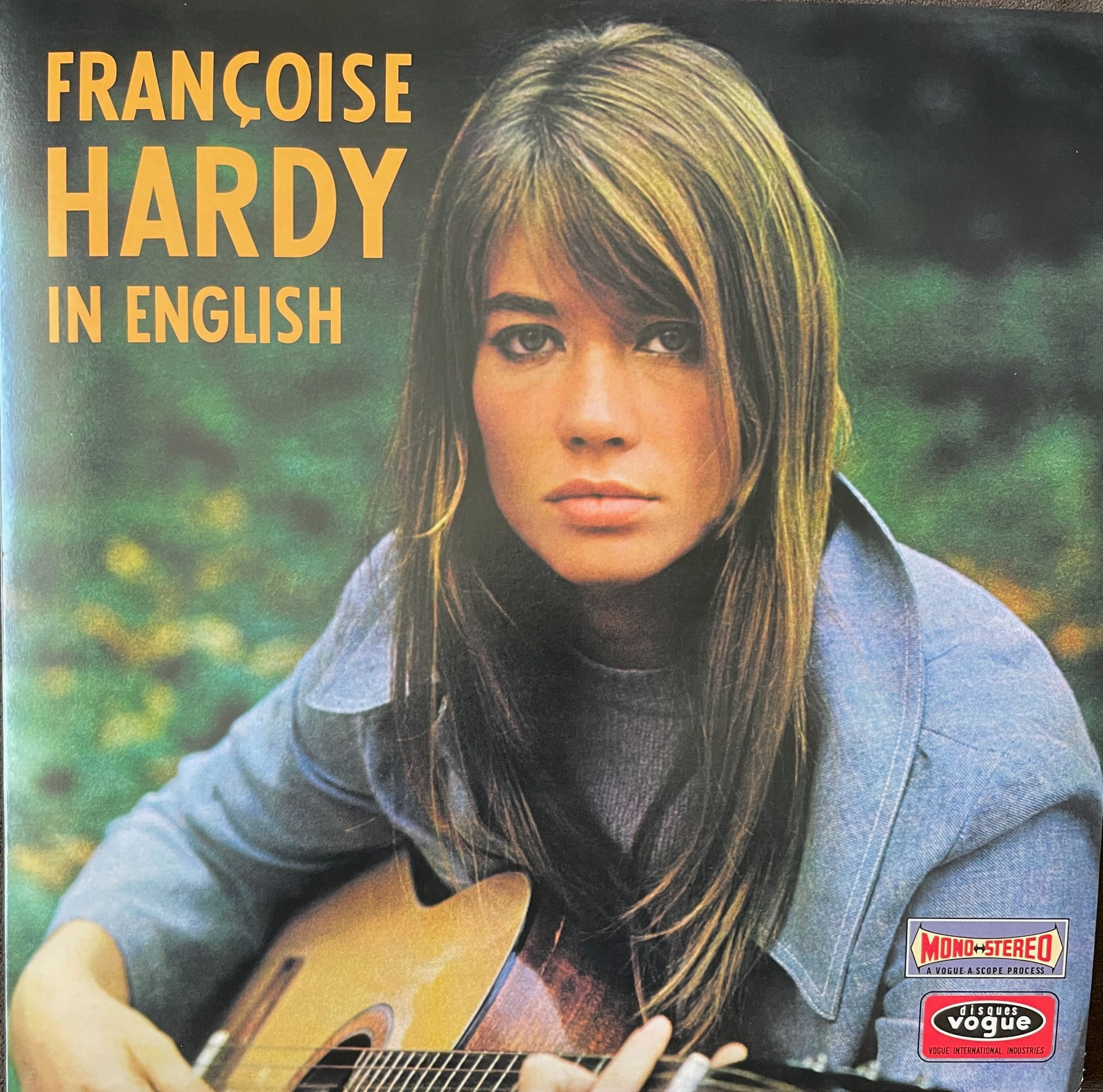
Keeping tabs on the vast discography of French singer Françoise Hardy is no easy task, with her numerous EPs and LPs bearing different configurations, titles, and tracklists across international releases. Hardy’s work for Disques Vogues, spanning the years of 1962 to 1967 and including many of her best-known songs, have recently undergone a thorough reissue campaign at the hands of Sony France. Omnivore Recordings are handling the catalog for US, including the 2025 release of a massive box set containing Hardy’s complete recordings for Vogues, followed by stand-alone releases of some of the individual LPs. For Record Store Day, Omnivore is issuing the augmented version of Hardy’s 1966 album In English, with six bonus tracks added to the LP as well as a separate replica disc of Hardy’s very first EP from 1962. (The LP is already available as a separate release in Europe and the UK, but they are getting the EP on its own for Record Store Day.)
In English is an absolute bowl-you-over blast of dulcet charm, with Hardy’s winsome pop melodies containing just the right blend of melancholy and sanguineness. Hardy recorded the tracks in London’s Pye Studios using British musicians, suggesting that these remakes were constructed with care and intention rather than as copy-and-paste versions with translated lyrics. Some songs suffer slightly (“Tous les Garçons et les Filles” will never sound right as “Find Me a Boy”), but others are improved, and Hardy’s credibility is never in question. Even through a second language, she sounds like she means every word she sings.
As such, In English is a complete artistic statement in its own right, rather than a collection of novelties along the lines of “Komm, Gib Mir Deine Hand.” The extra tracks are slightly clumsier and a touch more saccharine, as they’re mostly collected from one-off singles, but on the whole, it’s a fine collection with a few moments of genuine pop brilliance. The 1962 EP that’s also included has literally nothing to do with the LP, but it’s a wonderful bonus to have, as it contains the original French-language version of “Tous les Garçons et les Filles” as well as “J’Suis D’Accord,” giving curious listeners two of Hardy’s biggest and most important songs in the bargain.
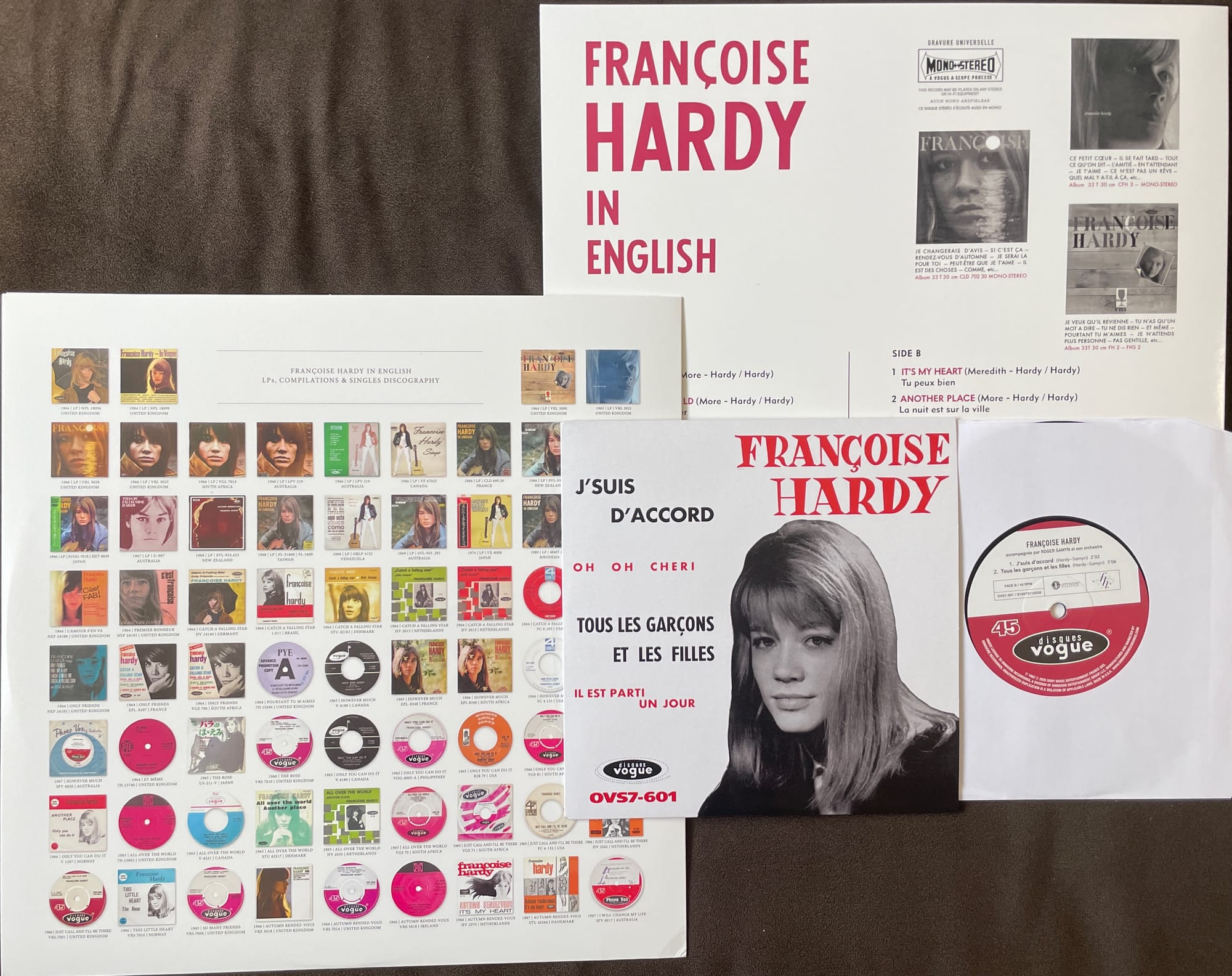
The audio has been digitally handled, but it sounds terrific, full of crisp articulation and faithful reproduction; I have a couple of original Disques Vogues releases which sound good in their own right but do not have the transparency offered here. Hardy’s voice in particular is treated with reverence, and her expressiveness is never compromised. The vinyl mastering is indifferent—I suspect it is a DMM job done at GZ—but does not suffer in the process. The white-vinyl pressing from Memphis is slightly less successful, with flecks of stray noise and a few more pops and clicks than one would ideally want. I believe everything here is mono, although the label says “stereo/mono.” Oddly, the EP is in stereo; on its original release it was a mono-only affair.
Minor pressing defects aside, this is a decided treat. The album is a terrific mid-’60s pop album, with Hardy’s intelligently written songs the equal of any songwriter operating in the UK or the US at that time. Hardy would go on to record in English several more times after leaving Disques Vogues—1971’s If You Listen is a career highlight—but these recordings are evidence that it was a prospect she took seriously from the get-go, and not a distraction from her primary endeavor of performing in French. Hardy is a titan in France, but tracking down her recordings in the US has always been a bit of a catch-as-catch-can proposition. Make sure you catch this one.
Omnivore 1-LP 33 RPM white vinyl + 7-inch EP 45 RPM black vinyl
• A reissue of the mono mix of Françoise Hardy’s 1966 album, which featured English-language re-recordings of her French-language hits, plus six bonus tracks of Hardy’s other English-language recordings from the 1960s; a stereo replica of Hardy’s 1962 debut EP is also included
• Jacket: Direct-to-board single pocket
• Inner sleeve: Printed card; 7-inch inner is white paper
• Liner notes, insert, or booklet: None; inner sleeve includes images from Hardy’s worldwide discography
• Source: Digital
• Mastering credit: Alex Gopher at Translab, Paris
• Lacquer cut by: Unknown, but possibly an anonymous DMM cut done at GZ Media, Czech Republic
• Pressed at: Memphis Record Pressing, Memphis, TN
• Vinyl pressing quality (visual): A
• Vinyl pressing quality (audio): B (incidental noise)
• Additional notes: None.
Freddie King: Feeling Alright: The Complete 1975 Nancy Pulsations Concert
Review by Ned Lannamann
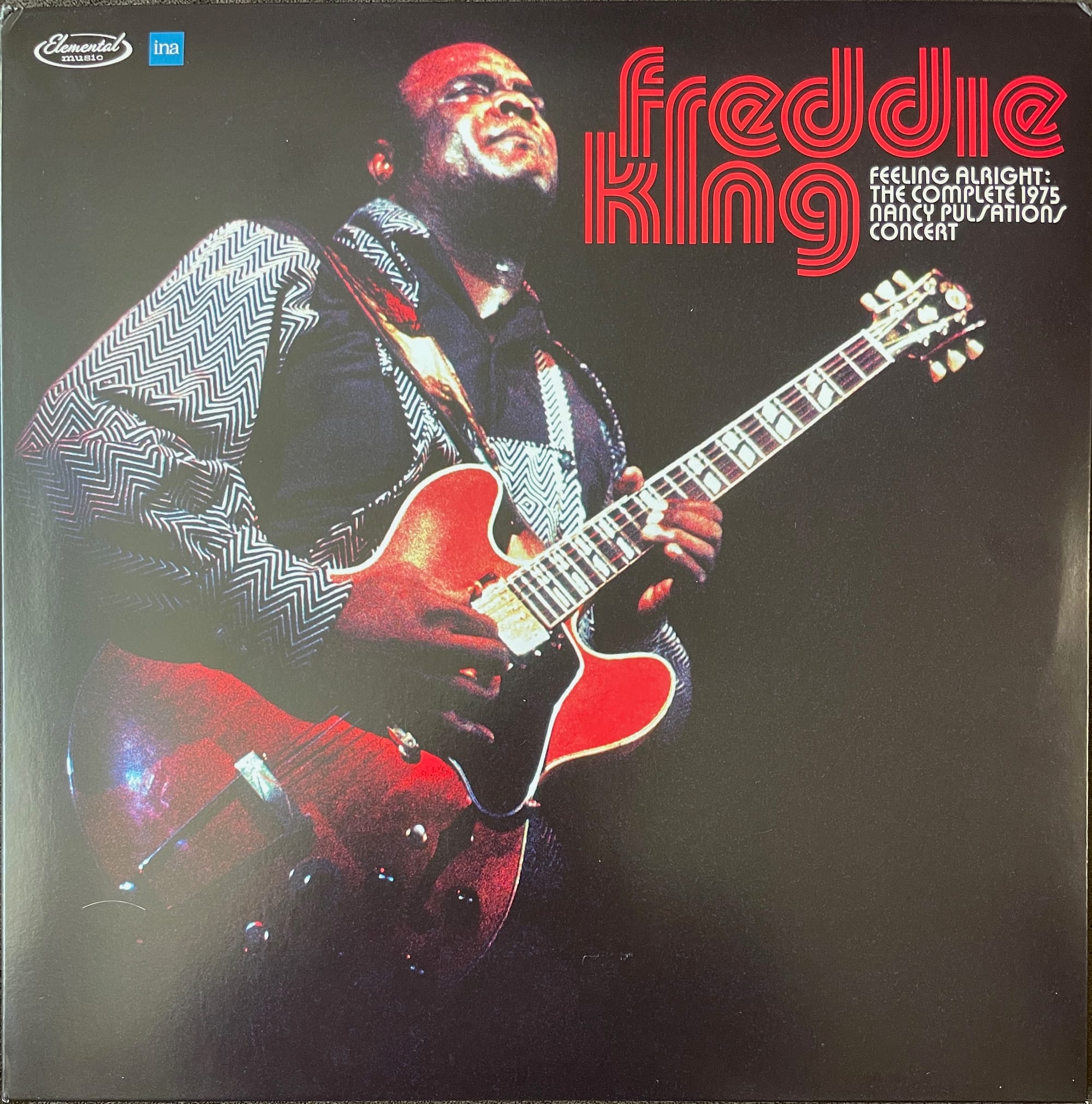
“My name is Freddie King. (Thank you very much.) This is the blues! Are you listening?” The testimonial comes in the middle of the 17-plus minutes of opening track “Have You Ever Loved a Woman?” on the ferocious live recording of King that’s being released in full for the first time on Record Store Day. The two-plus-hour performance was recorded by Radio France at the 1975 Nancy Jazz Pulsations Festival, with excerpts released on a pair of CDs and LPs in 1989. Now it plays uninterrupted on a triple vinyl set with all the trimmings for Record Store Day. For anyone with a passing interest in King or the electric blues, it’s a must-get.
Less than 15 months after this performance, King would be dead at age 42, but at the time of this recording the guitarist/vocalist was musically at his peak, having delivered a trio of spectacular albums for Shelter Records earlier in the decade and followed them up with a pair of equally fine LPs for RSO in 1974 and 1975. Perhaps better than any other, King merged the soulful hunger of the electric blues with the mortar-shell power of ’60s and ’70s rock—epitomized by his best-remembered tracks, “Hide Away” and “Going Down,” but also heard throughout virtually every instant of this dynamite set.
The tracklist doesn’t matter. King and his powerhouse five-piece backing band meander in and out of all manner of blues chestnuts, dropping in verses from one song into the chord progression of another, adding vamps and turnarounds and making their blues a living tapestry that’s as fluid and free-flowing as a particularly nimble DJ set. Bassist Benny Turner (King’s brother) is given a moment on the lead vocal mic, while pianist Lewis Stephens gets a few solo turns on the ivories, and the entire band gets featured spots during “Sweet Little Angel.” But for the most part, this is King’s show, with his emphatic, wrenching lead guitar only matched by his powerful voice. King’s coming-up was split between Texas and Chicago, and those competing environmental influences allowed him to cultivate something uniquely authoritative in its stylistic scope and authenticity.
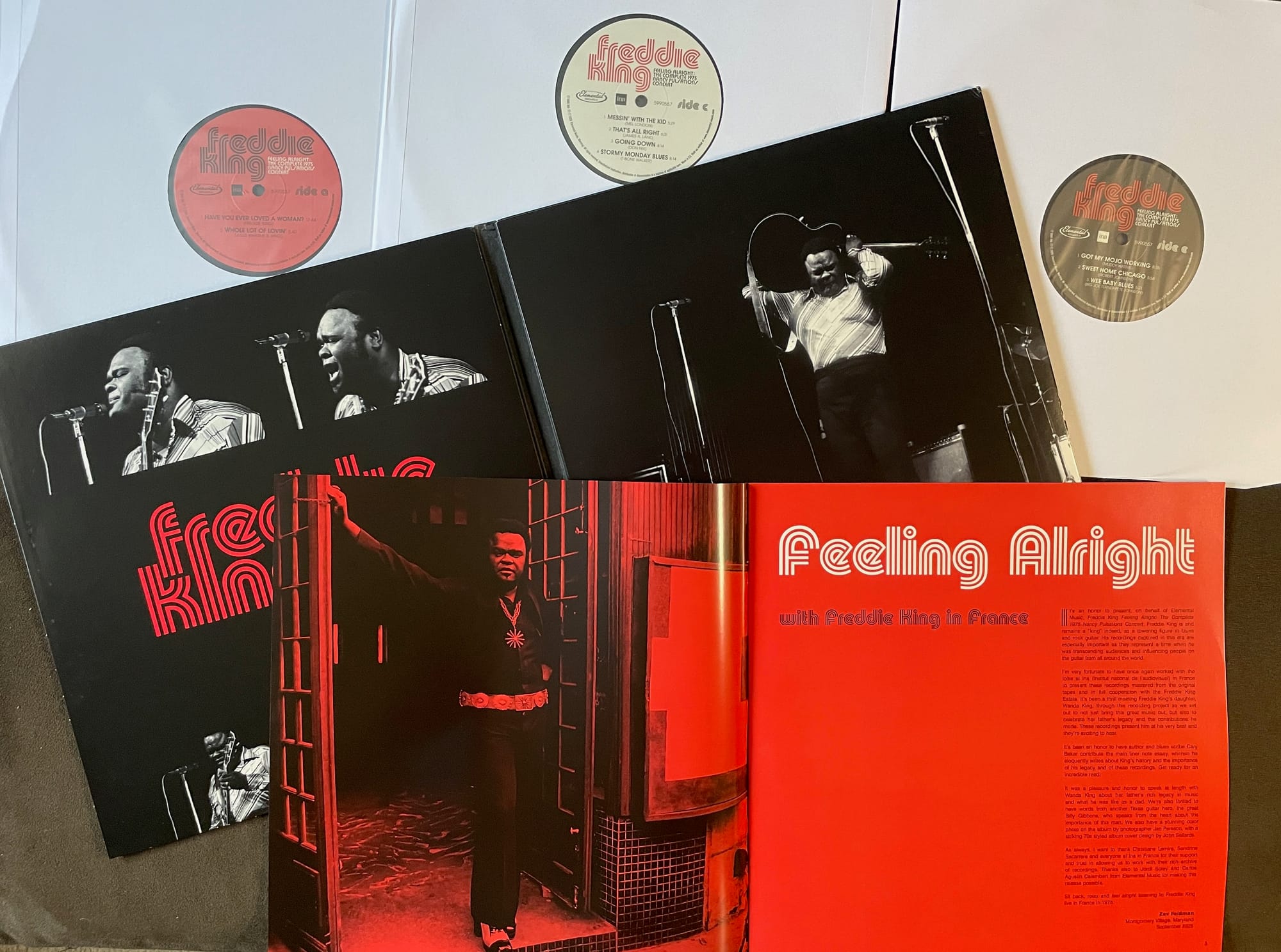
The triple vinyl set comes with a 12-page booklet that contextualizes King’s life and career, with a biographical essay by Cary Baker, an interview with Freddie’s daughter Wanda King, and a short piece by ZZ Top’s Billy Gibbons acting as King’s hype man. The audio is excellent; the show must have been very well recorded by French radio at the time, with each musician rendered clearly in the mix and the balance between the band and the French crowd (who you can audibly hear lose their minds on several occasions) expertly done. Matthew Lutthans has done a terrific job cutting the digitized audio to disc, with a substantial but not over-inflated soundstage, liveliness in the lows, mids, and highs, and a realistic, pleasing presentation that’s as effective as any live album recorded in the mid-’70s. My pressing was very good except for a stray white fleck of something or other embedded in the opening grooves of Side 4 that wouldn’t budge with cleaning, creating an annoying but not overly terrible noise for about 20 seconds during those opening stretches.
The epic scale of this show makes its consistency all the more remarkable. From the very first seconds, King and his crackerjack band fully press down on the gas and don’t let up for more than two hours. It’s difficult to think of a finer window into King’s power as a performer and self-designated steward of a particular blend of Chicago and Texas blues. Record Store Day can be littered with opportunistic releases of live shows that are either barrel-scraping jobs or poor-sounding pseudo-boots. Feeling Alright is decidedly not one of them.
Elemental 3-LP 33 RPM 180g black vinyl
• Live show from October 10, 1975, performed at the Nancy Jazz Pulsations Festival in Nancy, France, and recorded by Radio France; portions were released in 1989 as Live in Nancy, 1975 Vol. 1 and Vol. 2
• Jacket: Direct-to-board trifold gatefold
• Inner sleeve: White poly-lined
• Liner notes, insert, or booklet: 12-page booklet with photos and liner notes by Cary Baker, Billy Gibbons, Zev Feldman, and Freddie’s daughter Wanda
• Source: Digital
• Mastering credits: “INA [Institut national de l'audiovisuel]: Digitization in high resolution, restoration & mastering by Stéphane Rives”; “Mixing and sound restoration by Marc Doutrepont (EQuuS)”; “LP mastering by Matthew Lutthans at the Mastering Lab”
• Lacquer cut by: Matthew Lutthans at the Mastering Lab, Salina, KS; “MCL” in the deadwax
• Pressed at: GZ Media, Czech Republic
• Vinyl pressing quality (visual): B (small white fleck embedded on Side 4)
• Vinyl pressing quality (audio): B (fleck results in brief repeating noise, and there is minor noise elsewhere)
• Additional notes: Limited edition of 3,500 hand-numbered copies; discs are packaged outside of the jacket so as to prevent seam splits and dishing.
Adam Sander: They’re All Gonna Laugh at You!
Review by Ned Lannamann
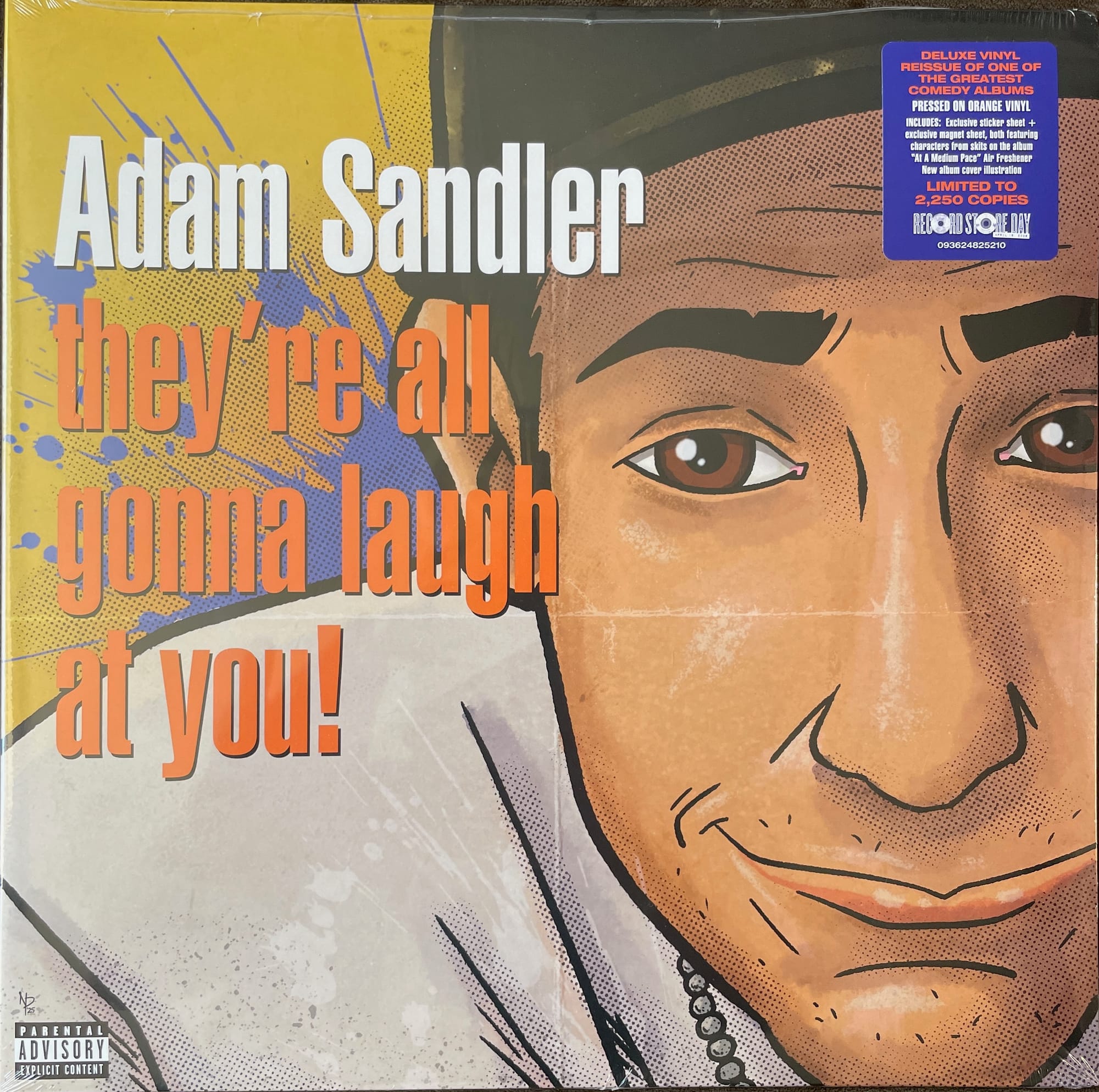
Adam Sandler’s first album, 1993’s They’re All Gonna Laugh at You!, was recorded while he was still at Saturday Night Live and before he made his breakout movie, 1995’s Billy Madison. As such, it feels like a collection of lazy sketches that were either too dirty or too stupid to appear on SNL. Most of the jokes rely on repetition, such as “The Longest Pee” or “Mr. Spindel’s Phone Call.” A few of Sandler’s signature songs are included as well, such as live versions of “The Thanksgiving Song” and “Lunchlady Land,” which likely accounted for the album’s success. Sandler included studio recordings of some other songs, too, like “Food Innuendo Guy” and the absolutely filthy “At a Medium Pace.”
I thought revisiting this album would be an amusing stroll down memory lane, but in the year 2026, it’s a depressing listen. By definition, the humor is juvenile and cruel, but as I listened, I slowly began to remember my disappointment as a teenage fan of Sandler by how unfunny the CD was when I first listened to it back in the ’90s. It’s not quite as offensive as you might be fearing—it’s not as bad as some of the stuff on Cheech and Chong’s records, for instance—although the loathsome “Fatty McGee” should be catapulted into the sun (it’s a three-minute gag about how an overweight kid can’t catch his breath after taking the stairs). I realize this all makes me sound like a humorless scold, but please believe me when I say it as someone who was a big fan of Sandler on SNL, loved his early movies (and some of his later ones, too), and always thought this record sucked.
They’re All Gonna Laugh at You! was first released on vinyl in 2018 for Record Store Day, its 54-minute running time spread across two LPs. Here it’s cut to a single disc, which is the correct decision. The comedy sketches are badly recorded and don’t require strong sonics, and the musical numbers sound perfectly adequate even with the reduced fidelity. The credits say that Bernie Grundman cut the lacquer, but this is surely a carry-over from the 2018 edition; this version has no mastering credit in the deadwax, suggesting that it was cut at GZ Media using their DMM process.
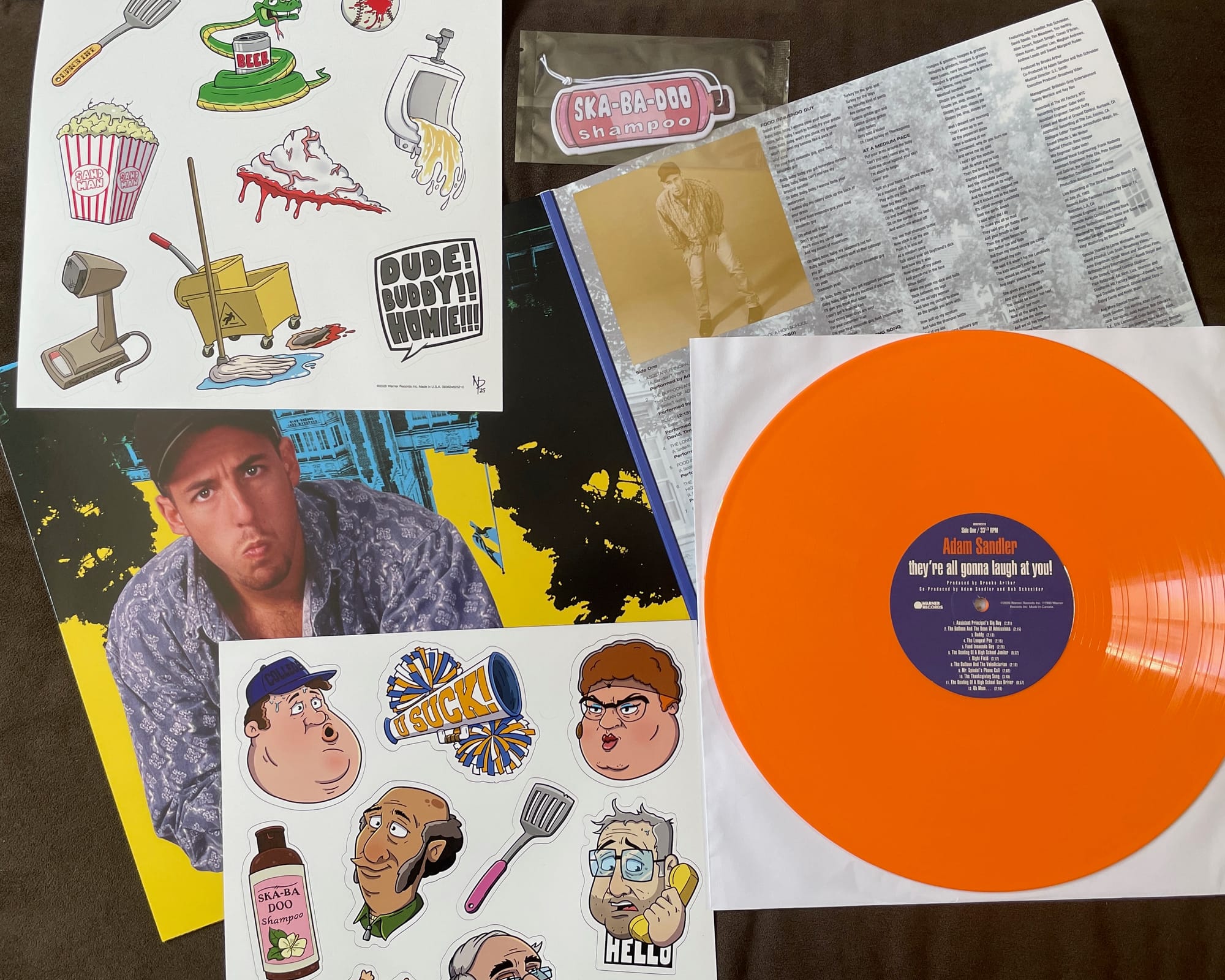
The package also includes a sheet of magnets, a sheet of stickers, and an air freshener, gimmicks that suggest the audio content isn’t really enough to stand on its own. Unfortunately, putting non-flat items like air fresheners inside a record jacket is a surefire way to lead to a warped LP, and my copy came out of the shrinkwrap extremely dished; it played okay on one turntable but not the other. The live version of “Lunchlady Land” is probably the best track here, as it manages to convey Sandler’s sweetness and silliness, but the rest of the album simply feels nasty, and it’s tough to imagine anyone finding this clever or funny nowadays. Still, there’s no fighting nostalgia, and Sandler has deservedly been a superstar for 30 years, so these youthful indiscretions will likely find a few willing buyers. Hope your vinyl is flatter than mine was.
Warner 1-LP 33 RPM orange vinyl
Reissue of Adam Sandler’s 1993 album with newly drawn cover art
Jacket: Direct-to-board gatefold
Inner sleeve: White poly-lined
Liner notes, insert, or booklet: None, but it includes a magnet sheet, a sticker sheet, and an air freshener
Source: Digital
Mastering credit: “Mastered by Stephen Marcussen at Precision Lacquer, Hollywood, CA; Vinyl mastering by Bernie Grundman”; I believe these are leftover credits from an earlier edition and do not apply to this reissue
Lacquer cut by: Anonymous DMM cut made at GZ Media, Czech Republic
Pressed at: Precision Record Pressing, Burlington, Ontario, Canada
Vinyl pressing quality (visual): C- (disc was severely dished, probably due to the various odd-shaped inserts)
Vinyl pressing quality (audio): B+
Additional notes: None.
Buster Williams: Pinnacle
Review by Robert Ham
Until 1975, bassist Buster Williams was content to remain out of the spotlight. For the better part of 15 years, he had been a steady presence in the studio and on stage, backing up fellow jazz musicians like Sonny Stitt, McCoy Tyner, and, crucially, Herbie Hancock. It was with Hancock that Williams helped usher in the fusion era as part of Mwandishi, the sextet that brought electronic instruments into the jazz sphere and incorporated funk and soul influences into their playing.
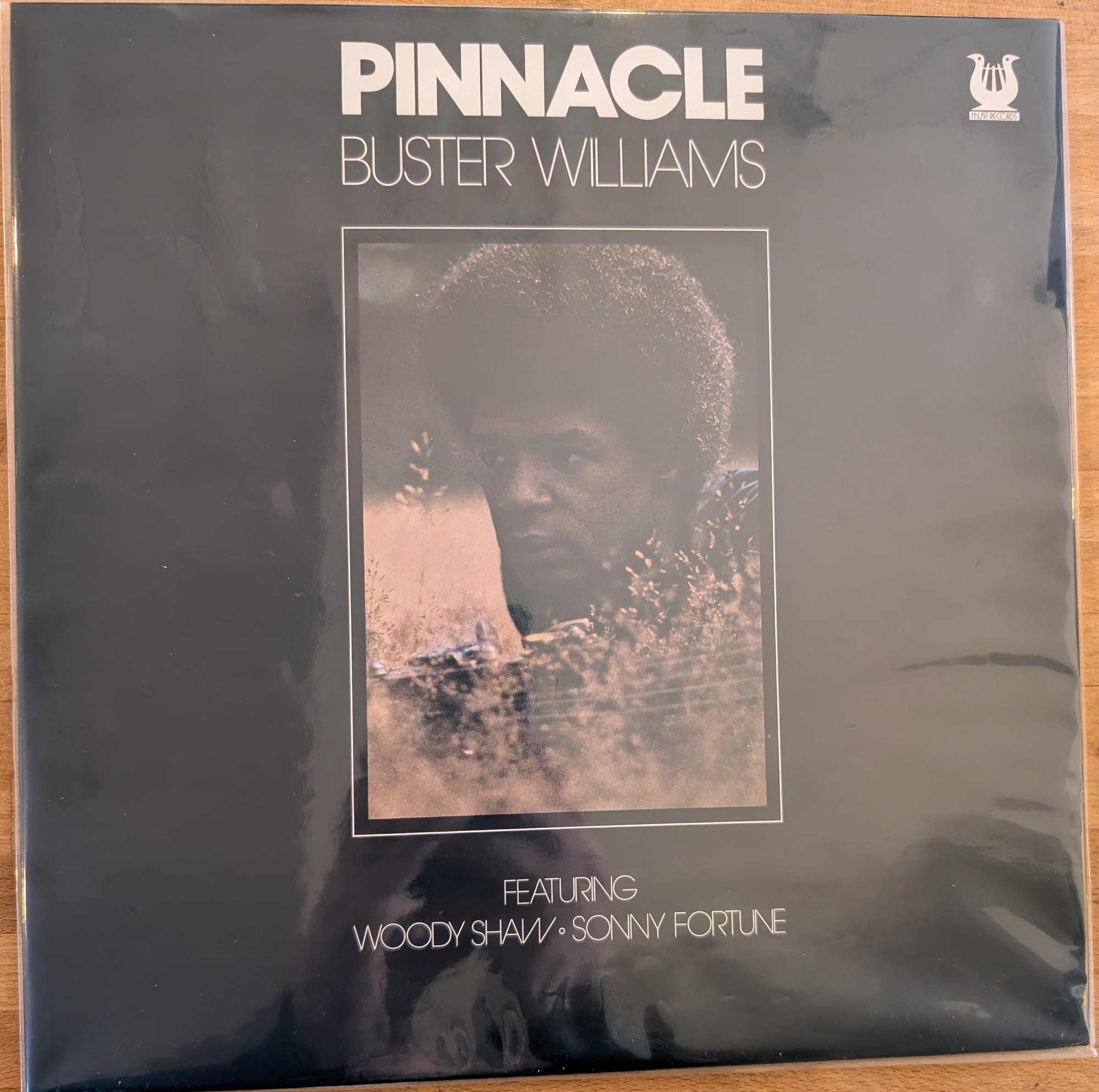
That's the mode that courses through 1975’s Pinnacle, Williams’s first LP as a bandleader, which is getting a luscious all-analog reissue for Record Store Day. At the time, the bassist was making a name for himself at Muse Records, having played on releases for the label headlined by trumpeter Woody Shaw (1974’s The Moontrane) and saxophonist Carlos Garnett (1974’s Black Love). Recognizing Williams’s deft hand at both electric and acoustic bass, ably handling both free-jazz blowouts and greasy grooves, Muse head Joe Fields urged the artist to make a record of his own.
Williams gathered a batch of musicians that he had some level of comfort with: Shaw on trumpet, fellow Mwandishi member Billy Hart on drums, woodwind players Sonny Fortune and Earl Turbinton, keyboardist Onaje Allan Gumbs, and percussionist Guilherme Franco. Together, they laid down a fantastically varied batch of material, most of it written and arranged by Williams, that dipped into post-bop (“Tayamisha,” a giddy ode to the bassist’s daughter), slow P-Funk grind (“The Hump”), and minimalist, electric-era-Miles perambulation (Gumbs’s lone writing credit “Batuki”).
Outside of finding an OG pressing of Pinnacle, I doubt there’s any presentation of this music that would be better than what Zev Feldman has done for this reissue on his Time Traveler imprint. Matthew Lutthans at the Mastering Lab does his typically great work here, finding a perfect balance for the various elements at play in music that is often thick with incident. “Noble Eagle,” for example, throws a pair of vocalists—Suzenne Klewan and the singularly named Marcus—into an already heady mix where Gumbs jumps from piano to Moog and back again, and Hart and Franco tangle playfully. Nothing gets muddled, nor does any one musician overshadow the rest. Every individual melodic line and percussion jangle stays in focus while blending beautifully into the whole widescreen picture.
If one member of the ensemble is treated best by this reissue, it’s Franco. The Brazilian percussionist, who had worked with Azar Lawrence and Lonnie Liston Smith has a lot of noisemakers in his arsenal and an instinctive sense of which one to grab at any given moment. Throughout a song like the 14-minute “Batuki,” he brings in various shakers, triangle, and hand drums, knowing exactly when to deploy them for added emphasis and color. Having only messed with a digital version of this album in the past, I was thrilled at how much of those little details came to the fore through Lutthans’s mastering work.
When I interviewed Feldman last fall about Time Traveler and especially his focus on the Muse Records catalog, he said, in his typical understated fashion, “There are just incredible recordings that were made for this label, and I think a lot of people would enjoy having an opportunity to rediscover, or discover [them] for the first time.” This reissue of Pinnacle epitomizes that humble goal perhaps better than any of the otherwise great records that Time Traveler has issued to date. Jazz fans can now not only get their hands on a vinyl copy that won’t cost them a king’s ransom, but also own a vital musical statement by one of the most nimble and versatile players in jazz.
Time Traveler/Muse 1-LP 33 RPM 180g black vinyl
• All-analog Record Store Day reissue of 1975 Buster Williams album
• Jacket: “Housed in old style Stoughton Tip-on Jacket”
• Inner sleeve: Time Traveler-branded rice paper-style poly
• Liner notes, insert, or booklet: Back cover reprints original liner notes from Elliot Meadow; includes one-panel insert featuring essay from Jazzwise editor Mike Flynn and album credits
• Source: Analog, “Remastered and cut AAA directly from the original tapes”
Mastering credit: Matthew Lutthans at the Mastering Lab, Salina, KS
• Lacquer cut by: Matthew Lutthans at the Mastering Lab, Salina, KS; “MCL” in deadwax
• Pressed at: Optimal Media, Germany
• Vinyl pressing quality (visual): A
• Vinyl pressing quality (audio): A
• Additional notes: Packaged in resealable plastic outer sleeve; sticker on sleeve erroneously states “Insert with newly-written liner notes by Ted Panken and Barney Fields”
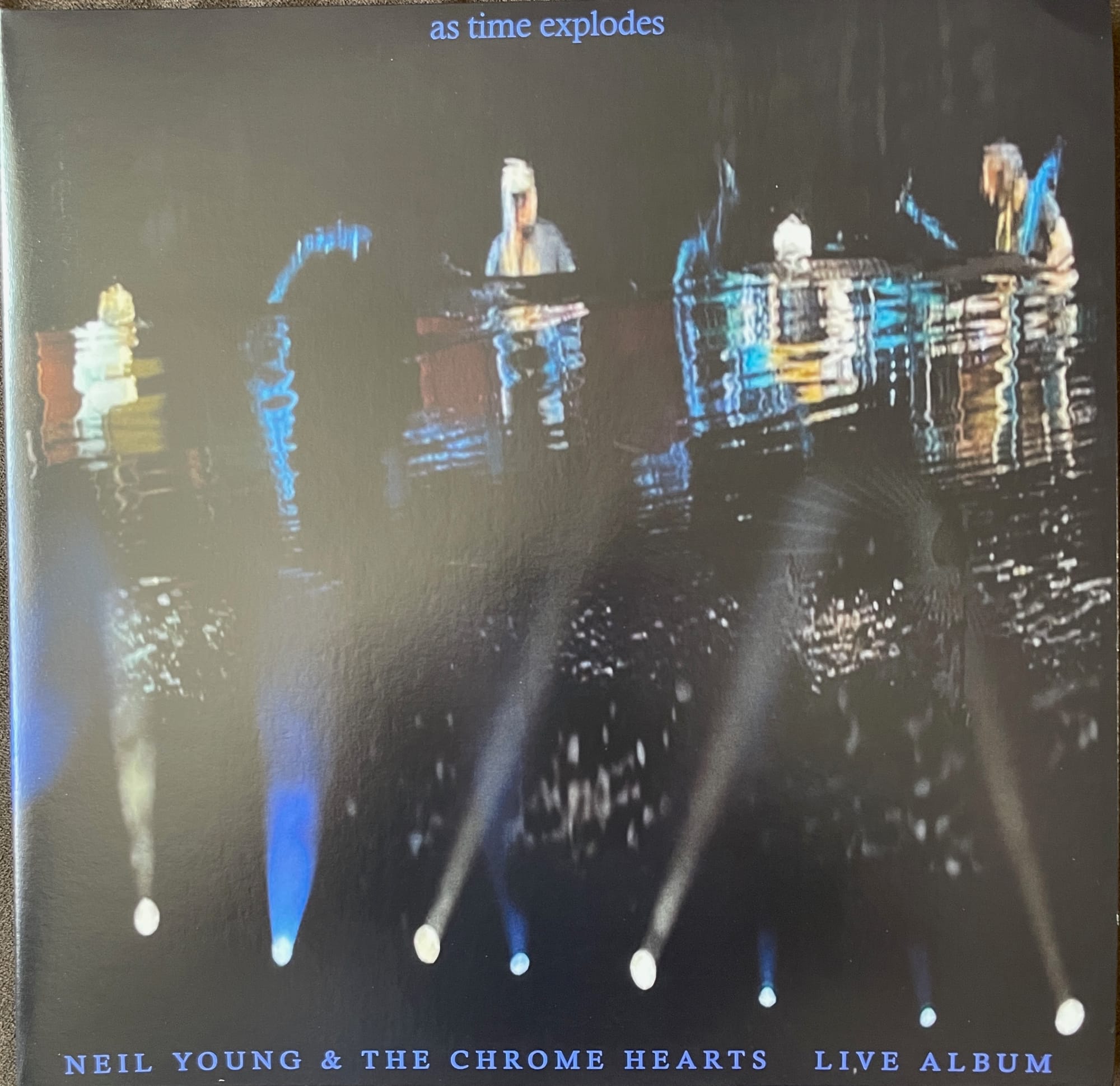
Neil Young and the Chrome Hearts: As Time Explodes
Review by Ned Lannamann
As devoted Neil Young fans know, the only thing that’s consistent with his new albums is inconsistency. Over the past two decades or so, his studio albums have been mixed bags, with moments of brilliance sharing groove space with half-written sketches and forgettable retreads. His live albums are similar gambles; even with his peerless back catalog to pull from, he often frames the albums with conceptual ideas that take away from a live album’s immersive qualities. 2015’s Earth featured disruptive sounds of animals and nature added to the mix, with the voices of commercial jingle singers overdubbed to further the disorienting effect. And 2023’s Before and After took a collage approach to a sheaf of solo recordings, blending them into a longer montage that was meant to be listened to uninterrupted.
As Time Explodes, then, is a more or less conventional live album from Young, collecting 13 recordings from the 2025 tour that saw him backed by the Chrome Hearts, a recently devised outfit that shares most of its members with the Promise of the Real, the band fronted by Willie Nelson’s son Lukas (and featuring Lukas’s brother Micah) that has also served as Young’s backing band for years. Here, Lukas is absent, with Micah joined by Promise of the Real’s drummer Anthony LoGerfo and bassist Corey McCormick, as well as legendary Muscle Shoals keyboardist/songwriter Spooner Oldham playing a very subdued organ. The band is crisper and more articulate than Crazy Horse, adding a restrained definition to the largely acoustic set but also providing ample power for the electric songs. If they’re lacking the transcendent magic that Crazy Horse can sometimes bring to Young’s dust-devil trances, well, what band isn’t?
Young, of course, is a lot older than he was when he originally recorded many of the songs on At Time Explodes, and his voice wavers more than it used to, but its emotional impact has not dulled an iota. In fact, it strengthens some of his more sentimental songs, like “Looking Forward” and “Name of Love,” both plucked from latter-day CSNY albums. His instinctual acoustic strumming can be a bit uneven, with his rhythmic right hand not always keeping to the beat, but his lead electric guitar is as breathtaking as ever, as can be heard on a stupendous version of “Cortez the Killer” and On the Beach track “Vampire Blues.” It’s a treat to hear him constantly playing in the moment, as when he sneaks the riff of “Scattered” into “Daddy Went Walkin’” or adds a long-lost verse back to “Cortez.” The only complaint, content-wise, is over the songs Young didn’t put on the album, such as the Chrome Hearts’ version of “Ambulance Blues,” one of Young’s best-ever songs and one that’s never appeared on one of his live albums.
But overall, As Time Explodes is a pretty darn good record from Young, because of its idiosyncrasies and not in spite of them. However, it may be worth waiting for the black vinyl pressing that should be coming later this year. My clear-vinyl RSD pressing was marred by substantial noise and crackle, particularly during the slow build of “Cortez the Killer” and the obligatory pump-organ version of “After the Gold Rush.” Meanwhile, “Harvest Moon” suffered some of the worst non-fill I’ve experienced on new vinyl recently. With RTI plating information in the deadwax and no other pressing plant markings, I have to imagine they are to blame, but this pressing is uncharacteristically poor for them, as I’ve found their vinyl to be generally of a higher standard. Young has historically been very good to his fans with his vinyl releases, consistently offering superior mastering—usually by Chris Bellman, who cut the lacquers here as well—and elevated pressing quality. This is a strange exception, all the more disappointing because of the sheer enjoyability of the material.
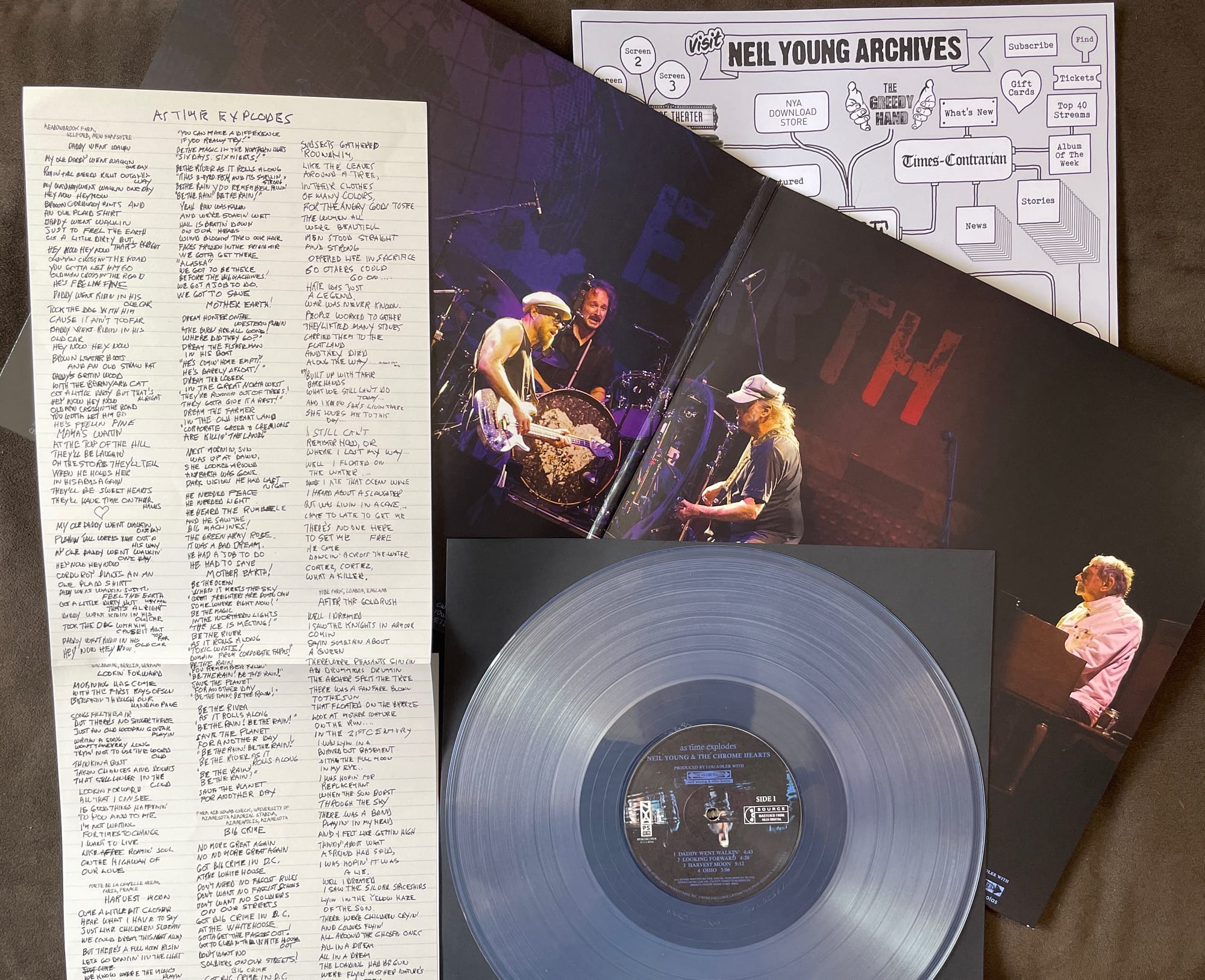
Reprise/Warner 2-LP 33 RPM clear vinyl
• Live album recorded at various venues on Neil Young’s 2025 Love Earth tour
• Jacket: Direct-to-board gatefold
• Inner sleeve: Black paper
• Liner notes, insert, or booklet: Tri-fold poster with handwritten lyrics; one-sided insert with schematic of neilyoungarchives.com
• Source: Digital; “Mastered from 48/24 digital”
• Mastering credit: “Chris Bellman with John Hanlon at Bernie Grundman Mastering”
• Lacquer cut by: Chris Bellman at Bernie Grundman Mastering, Hollywood, CA; “CB” in the deadwax
• Pressed at: Record Technology Inc. (RTI), Camarillo, CA
• Vinyl pressing quality (visual): A
• Vinyl pressing quality (audio): D (severe non-fill on Side A; lots of noise and crackle on Sides C and D)
• Additional notes: An RSD First release; a black vinyl version without the lyric poster will be widely available later this year.
Ned's listening equipment:
Table: Technics SL-1200MK2
Cart: Audio-Technica VM540ML
Amp: Luxman L-509X
Speakers: ADS L980
Robert's listening equipment:
Table: Cambridge Audio Alva ST
Cart: Grado Green3
Amp: Sansui 9090
Speakers: Electro Voice TS8-2