Reviews: Record Store Day 2026, Batch 3


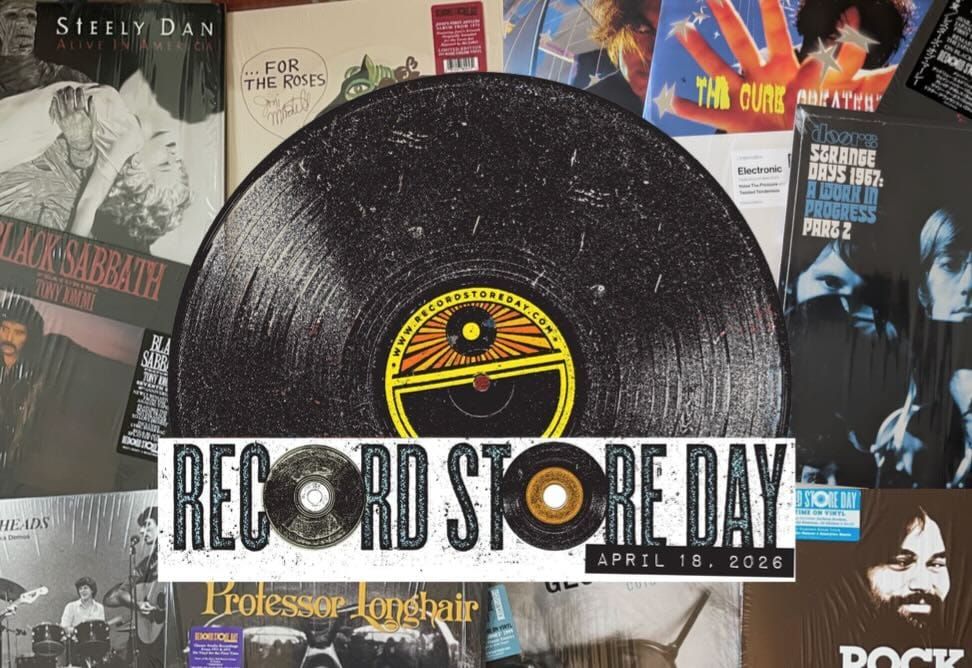
Including the Doors, the Cure, Steely Dan, Talking Heads, Black Sabbath, Joni Mitchell, George Jones, Electronic, Professor Longhair, and a Lowell George tribute album.
We’ve got a big, beefy batch of Record Store Reviews today, and we’ll continue to shovel them out all week long. In case it’s slipped your mind, Record Store Day is this Saturday, April 18, so right now we’re in the middle of a reviewing marathon in order to get them all out before the big day.
Even if you’re not participating on Saturday, we hope you find some interesting tidbits in our reviews. And if you are going to hit your local record store, we’ve got some pointers for ya. Here’s what’s on the docket today:
- Black Sabbath Featuring Tony Iommi: Seventh Star
- The Cure: Greatest Hits; Acoustic Hits
- The Doors: Strange Days 1967: A Work in Progress Part 2
- Electronic: 1996 Remixes 1999
- George Jones: Cold Hard Truth
- Joni Mitchell: For the Roses
- Professor Longhair: Mardi Gras in Baton Rouge
- Steely Dan: Alive in America
- Talking Heads: The CBS/Columbia Demos
- Various Artists: Rock and Roll Doctor: Lowell George Tribute Album
If you haven’t had a chance to read the earlier installments in our RSD review series, it’s not too late to catch up.
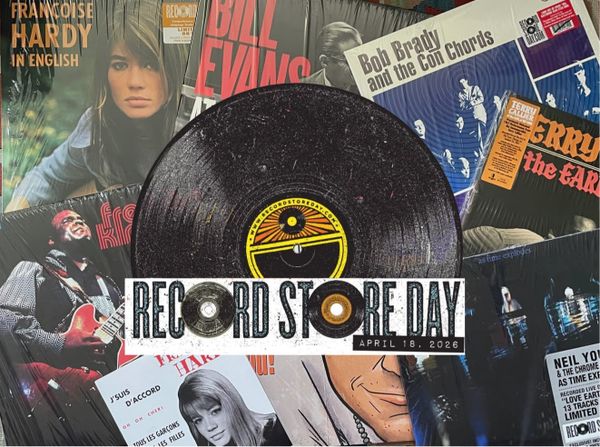
Batch 1 has Bill Evans, Neil Young, Françoise Hardy, Blur, Freddie King, Buster Williams, Adam Sandler, Terry Callier, and Bob Brady and the Con Chords:
 Ned Lannamann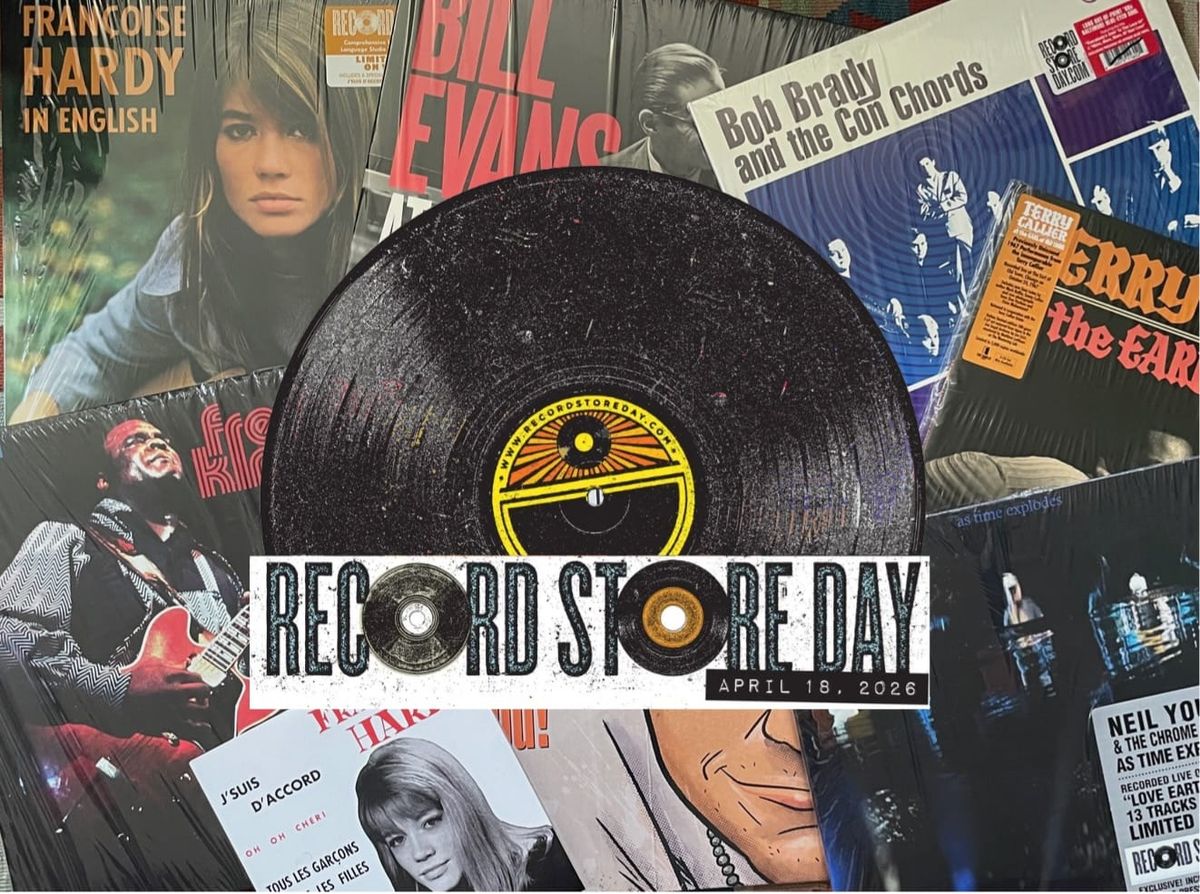
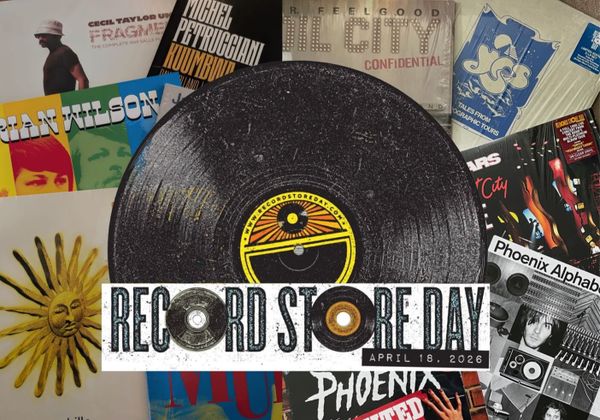
Batch 2 includes Brian Wilson, Yes, the Cars, the Muffs, Cecil Taylor, Phoenix, the Chills, Dr. Feelgood, Jane Weaver, and Michel Petrucciani:
Ned Lannamann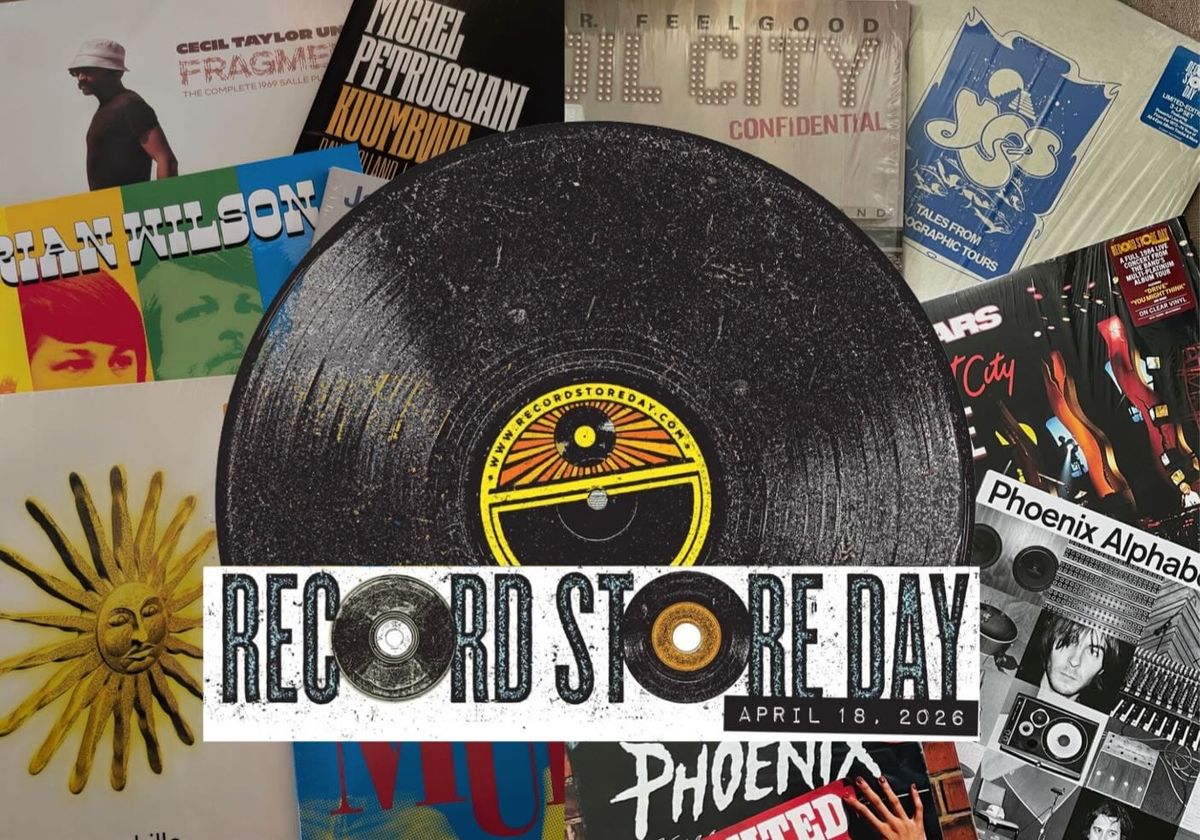
Now, if you’re all caught up and ready for some more RSD reviewing fun, here’s Batch 3.
Black Sabbath Featuring Tony Iommi: Seventh Star
Review by Ned Lannamann
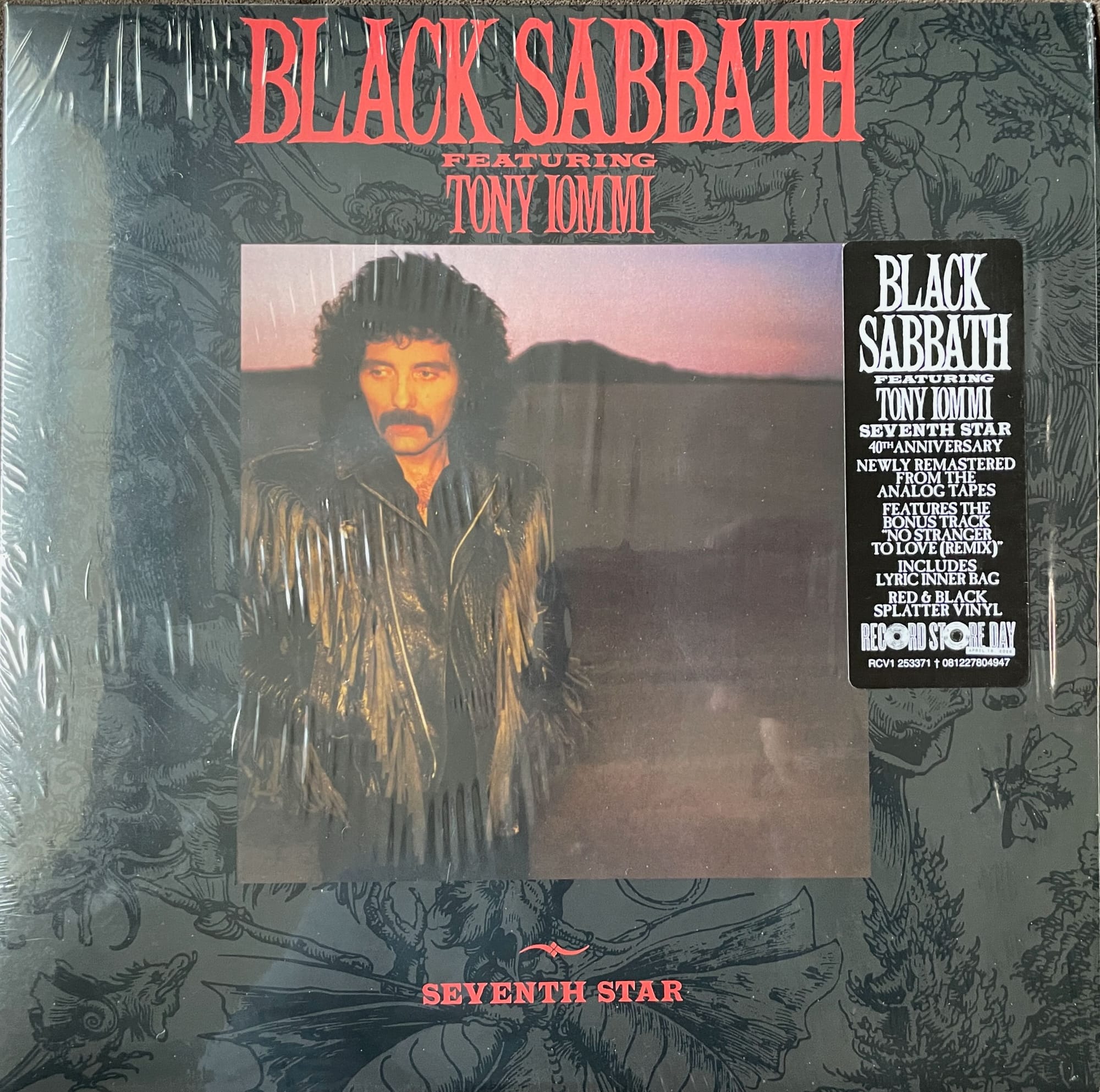
It was supposed to be the end of Black Sabbath. In 1984, after the wrap of a difficult tour for their 1983 album Born Again and then some failed demo recordings with producer Bob Ezrin, the band’s three remaining founding members—guitarist Tony Iommi, bassist/lyricist Geezer Butler, and drummer Bill Ward—went their separate ways. Iommi began work on a solo record with keyboardist Geoff Nichols, intending to use a roster of different vocalists such as Rob Halford and Ronnie James Dio; when former Deep Purple vocalist/bassist Glenn Hughes was brought in for a track, they decided to use him for the entire album. Once work was complete, the US record label, Warner Bros., informed Iommi that they would be releasing it not under his name but as a Black Sabbath album instead. A compromise was reached, and 1986’s Seventh Star bears the awkward credit “Black Sabbath Featuring Tony Iommi.”
One can’t help but feel for Iommi, who lost on two counts: He received heavy criticism for Seventh Star’s decidedly non-Sabbathy sound, and missed out on the opportunity to be recognized for developing his own solo voice. If the “Black Sabbath” name had been stricken from the cover, who knows how Seventh Star would have been received? It’s really a hard-rock album with some goth undertones and concessions to the pop-metal scene happening in LA. The heavy-metal elements are kept to a minimum, mostly confined to the opening number “In for the Kill”—but even there, Hughes’s many overdubbed harmonies nearly turn the song into a Queen-esque parody of metal tropes. Meanwhile, “Heart Like a Wheel” is a slow blues-rock, while the single, “No Stranger to Love,” is a vintage mid-’80s power ballad. Elsewhere, the album-closing suite of “Angry Heart/In Memory” could almost pass as a Bad Company song were it not for some extra snarl in the guitars. And if “Danger Zone” would’ve been a touch too heavy for the Top Gun soundtrack, it probably could’ve slipped into Iron Eagle. No wonder Sabbath fans were confused.
Hughes’s histrionic vocals dominate the album, lending an athletic quality that strips away any remaining Sabbathy darkness. Iommi’s meat-and-potatoes power riffs are generally dispensed with in favor of a more subtle, generic approach. And yet, taken on its own terms, Seventh Star has its slender charms. There’s nothing outright terrible about it, except for maybe the more Van Halen-y elements of “Danger Zone.”
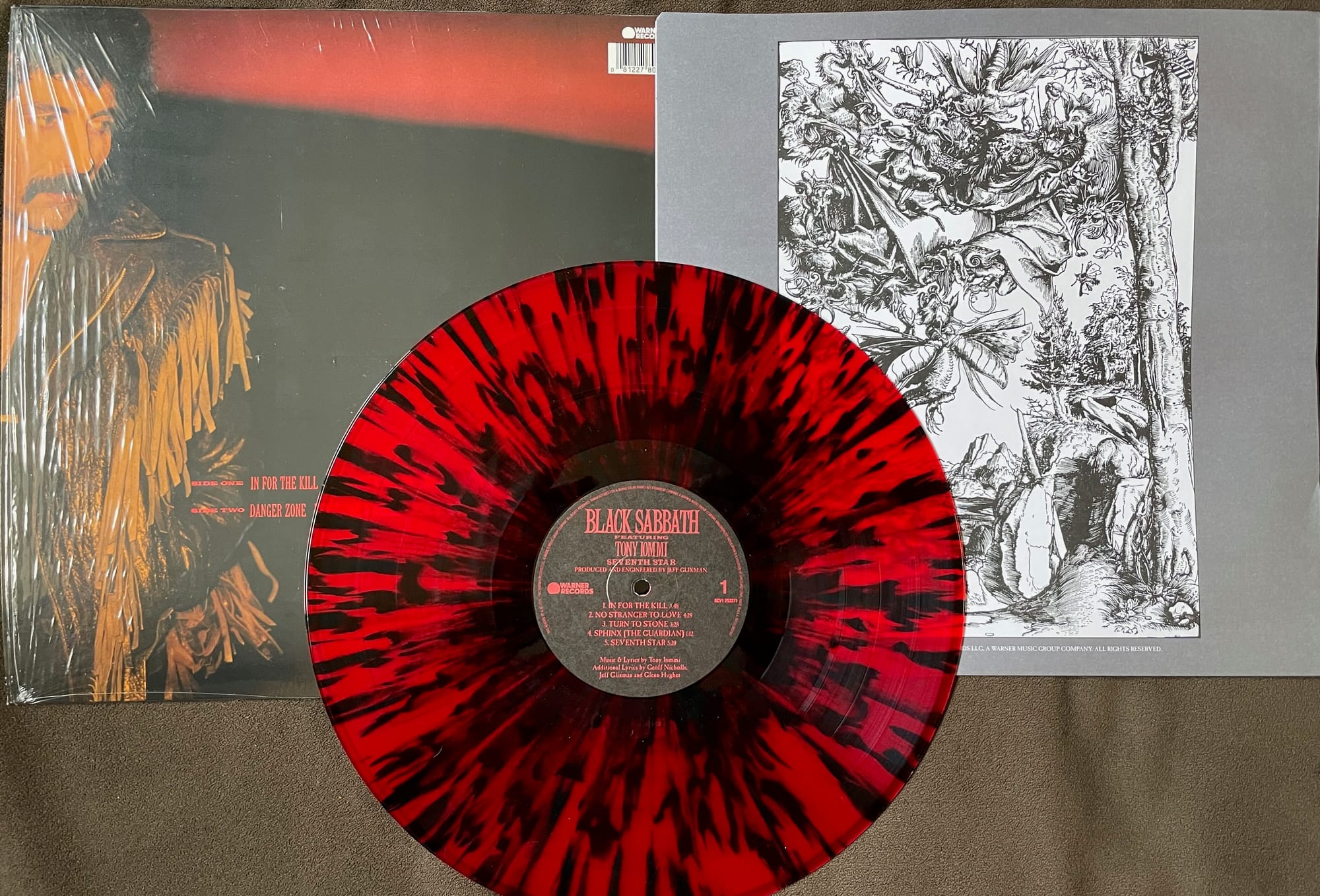
Seventh Star has not been officially pressed to vinyl since its original release four decades ago, making this reissue something for Black Sabbath fans to at least take note of. The album sounds murky and overproduced; Iommi’s guitar and Hughes’s vocals fare okay, but the drums and bass are meant to sound infinite and instead come off as sliced, diced, and stripped of impact. But this was the sound of the era, designed for boom boxes and car stereos rather than carefully calibrated turntable setups.
The hype sticker says it is “remastered from the analog tapes,” but it does not say it is explicitly cut from those tapes. The inner sleeve bears a remastering credit for Barry Grint of Alchemy Mastering at AIR Studios, while the initials of AIR’s Henry Rudkins are in the deadwax. Considering that two engineers are involved, my hunch is that the analog tape was transferred to digital and mastered in that realm before being cut to disc. At any rate, there’s nothing particularly transparent-sounding or warm or revealing about what’s on the vinyl. It simply sounds like a processed-to-hell mid-’80s rock album, served up straight.
The pressing is on a blend of red and black vinyl, and it’s pretty noisy, with heavy surface noise and a few crackles throughout. This album does not need whisper-quiet vinyl, as it gets by on a thick, meaty sound, but those looking for their endgame edition of Seventh Star might be disappointed. There’s also a bonus track stuck on at the end (further backing up my theory that this wasn’t cut from the original album reels): the single remix of “No Stranger to Love,” which sounds significantly more muffled and foggy than the album mix. We could have lived without it.
Those Sabbath fanatics with a Seventh Star–shaped hole in their collections can finally taste sweet relief, because even with all of its demerits, the record does have some good qualities, such as the moody, slow-burning title track. Iommi’s guitar is always worth listening to, and the album’s exploration of the hard-rock world beyond the gated keep of Black Sabbath is an interesting snapshot in time. It’s a roadmap that suggests many potential evolutions that the band—or at least Iommi—could’ve undergone. But the gravity of Sabbath was too strong; like a black hole, it swallowed this album up and the seedlings of Iommi’s solo career along with it.
Warner 1-LP 33 RPM “red and black splatter” vinyl
• New remaster of Black Sabbath/Tony Iommi’s 1986 album
• Jacket: Direct-to-board single pocket
• Inner sleeve: Printed paper with lyrics and artwork from original release
• Liner notes, insert, or booklet: None
• Source: Unknown; “Newly remastered from the analog tapes”
• Mastering credit: “Remastered by Barry Grint,” Alchemy Mastering at AIR; “Vinyl cut at AIR Studios, London
• Lacquer cut by: Henry Rudkins at AIR Studios, London; “H.R” in deadwax
• Pressed at: GZ Media, Czech Republic
• Vinyl pressing quality (visual): B+ (not perfectly flat)
• Vinyl pressing quality (audio): B- (vinyl is noisy throughout)
• Additional notes: Originally intended as a Tony Iommi solo album. Includes a bonus track, the single remix of “No Stranger to Love.”
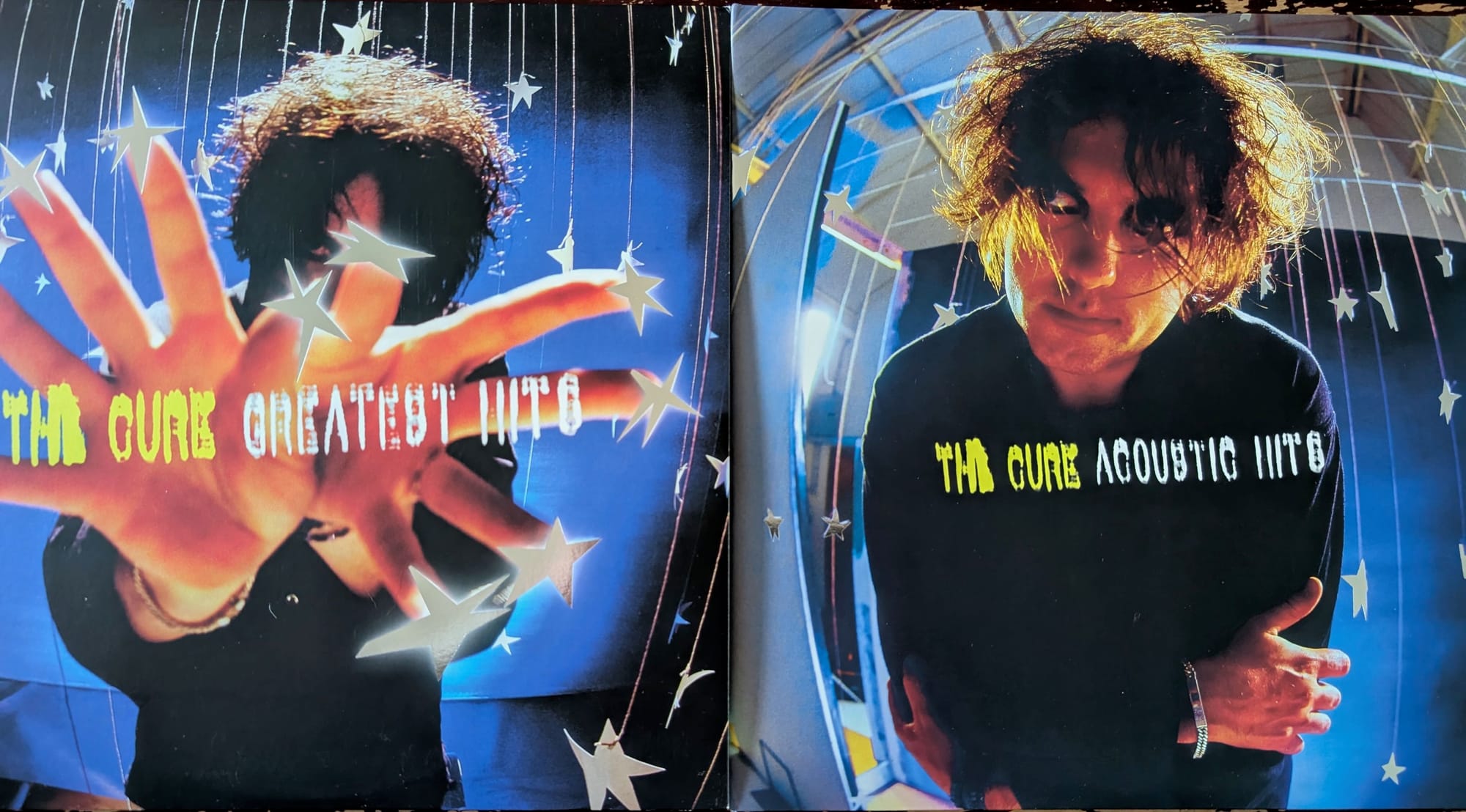
The Cure: Greatest Hits; Acoustic Hits
Review by Robert Ham
As the Cure’s contract with their longtime home at Fiction Records was reaching its end, the goth rock band had to turn in one last album to fulfill their contract. Rather than toss together an underbaked batch of originals, the group’s creative leader Robert Smith agreed to release a greatest hits compilation so long as he could choose the tracklist.
The finished product, 2001’s Greatest Hits, is as good an overview as you’ll find of the Cure’s best moments from their 11 studio albums up to that point. It’s missing the immediacy of the group’s 1986 singles collection Standing on a Beach, which remains one of the finest single-artist compilations ever released, but it’s also free of the chaff that cluttered up 1997’s Galore, another singles collection that covered the albums released from 1987 to 1997. Greatest Hits also has the added attraction of a pair of fine new songs: the devilishly catchy “Cut Here” and “Just Say Yes,” both of which continue the exploration of modern dance music that Smith embraced on the 1990 remix comp Mixed Up.
The fan service didn’t end with those two fresh tracks. The initial CD came with a bonus disc that included newly recorded acoustic versions of every song on Greatest Hits. Though the Cure did film an episode of MTV Unplugged in 1991, the band isn’t known for taking a stripped-down approach. That’s what makes Acoustic Hits such a fun little trifle. The band takes great pains to remain as faithful to the original songs as possible, replicating keyboard melodies and other synthesizer sounds with marimba, xylophone, and other bits of percussion. I could have done without drummer Jason Cooper’s busy playing on early fare like “Boys Don’t Cry” and “Let’s Go to Bed,” but it squares nicely with the more ambitious compositions of the group’s late-’80s period.
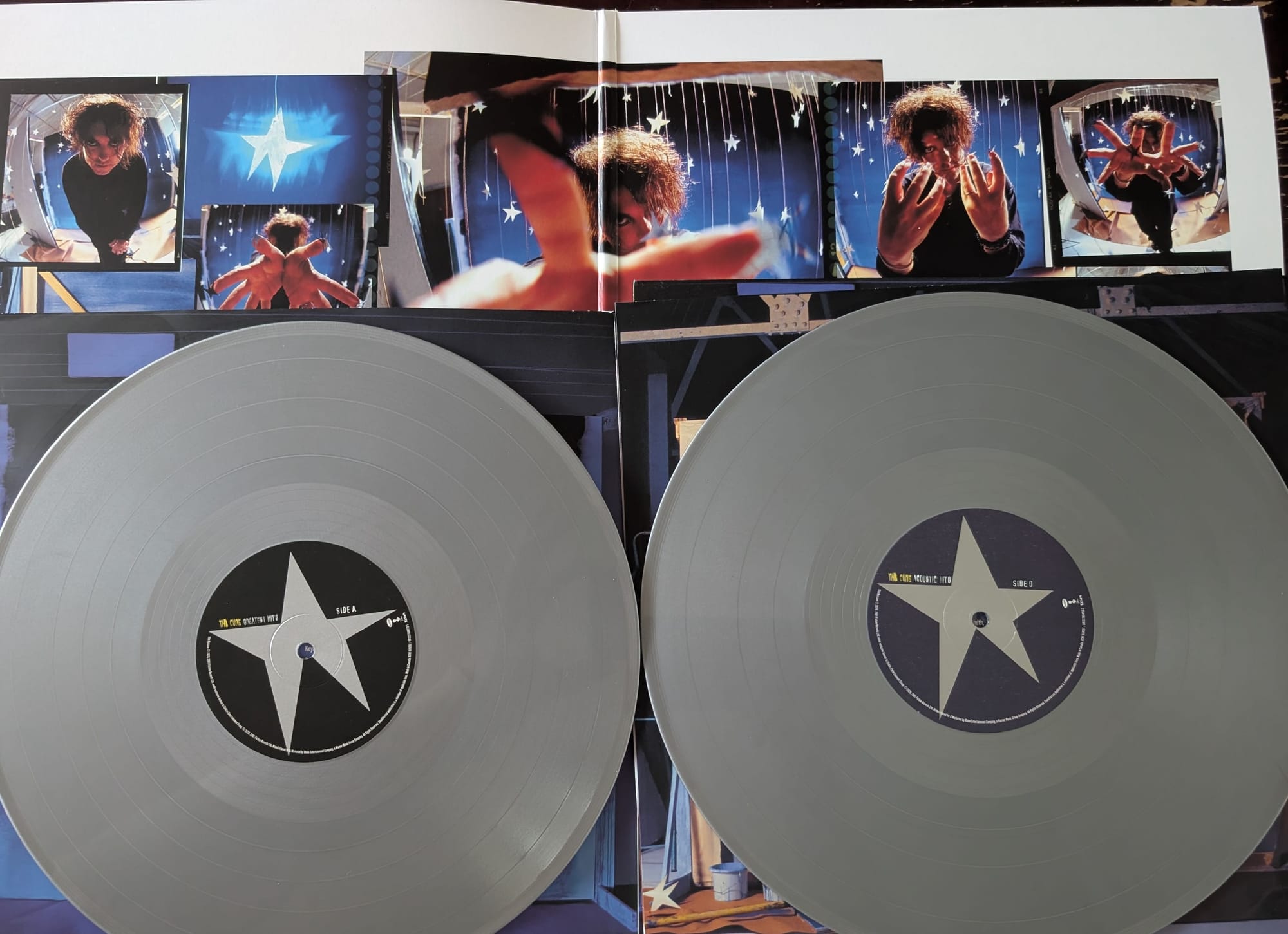
Of all the material from the Cure’s large discography that could have been given a vinyl release on Record Store Day, Greatest Hits and Acoustic Hits are odd choices. Both were pressed on wax in 2017, including picture-disc editions that dropped on Record Store Day that year, and are still fairly available in stores and the resale market. The only fundamental difference with the 2026 versions is that they are pressed on “silver bio vinyl.” Otherwise, they are the same; the lacquers cut for the ’17 pressings by an unknown engineer were dusted off for these new editions.
The pressings of both discs are flawless. These songs on Greatest Hits have been in heavy rotation in my own life for at least 35 years, and I can say that they sound as full and as vivid as ever. Smith has always been a fantastic arranger, and his skills as a producer only grew stronger as the band’s global popularity increased. Those elements come across beautifully on this pressing, with the highs and mids shimmering like polished brass and each instrument getting the perfect placement in the mix.
The same qualities extend to Acoustic Hits. The musical inventiveness of these new recordings comes across as clearly as Smith’s lyrics. He has a tendency to smear words together on the original recordings but seems to take great care to enunciate on the Acoustic Hits session. I hadn’t ever thought to dial up “The Love Cats” on Genius, so I was unaware until now that he was singing, “Not broken in pieces like hated little meeces.” That new knowledge doesn’t really change my enjoyment of the song one way or another, but it’s nice to have that line at the ready when I’m singing along with my 12-inch single of the track. I also don’t know how often I’ll pull this off the shelf for a re-listen. But I’m well chuffed to know it will be in my library in case I have any questions about the lyrics for “The Walk” or “Mint Car.”
Greatest Hits: Fiction/Elektra/Rhino 2-LP 33 RPM silver vinyl
• New pressing of the 2001 compilation album by the Cure
• Jacket: Direct-to-board gatefold
• Inner sleeve: Printed paper with album credits
• Liner notes, insert, or booklet: None
• Source: Unknown, assumed digital
• Mastering credit: “Remastered by Robert Smith”
• Lacquer cut by: Unknown
• Pressed at: GZ’s Precision Record Pressing, Burlington, Ontario, Canada
• Vinyl pressing quality (visual): A
• Vinyl pressing quality (audio): A
• Additional notes: Pressed on eco-vinyl.
Acoustic Hits: Fiction/Elektra/Rhino 2-LP 33 RPM silver vinyl
• New pressing of the Cure’s 2001 release featuring acoustic renditions of the songs from Greatest Hits
• Jacket: Direct-to-board gatefold
• Inner sleeve: Printed paper with album credits
• Liner notes, insert, or booklet: None
• Source: Unknown, assumed digital
• Mastering credit: “Remastered by Robert Smith”
• Lacquer cut by: Unknown
• Pressed at: GZ’s Precision Record Pressing, Burlington, Ontario, Canada
• Vinyl pressing quality (visual): A
• Vinyl pressing quality (audio): A
• Additional notes: Pressed on eco-vinyl.
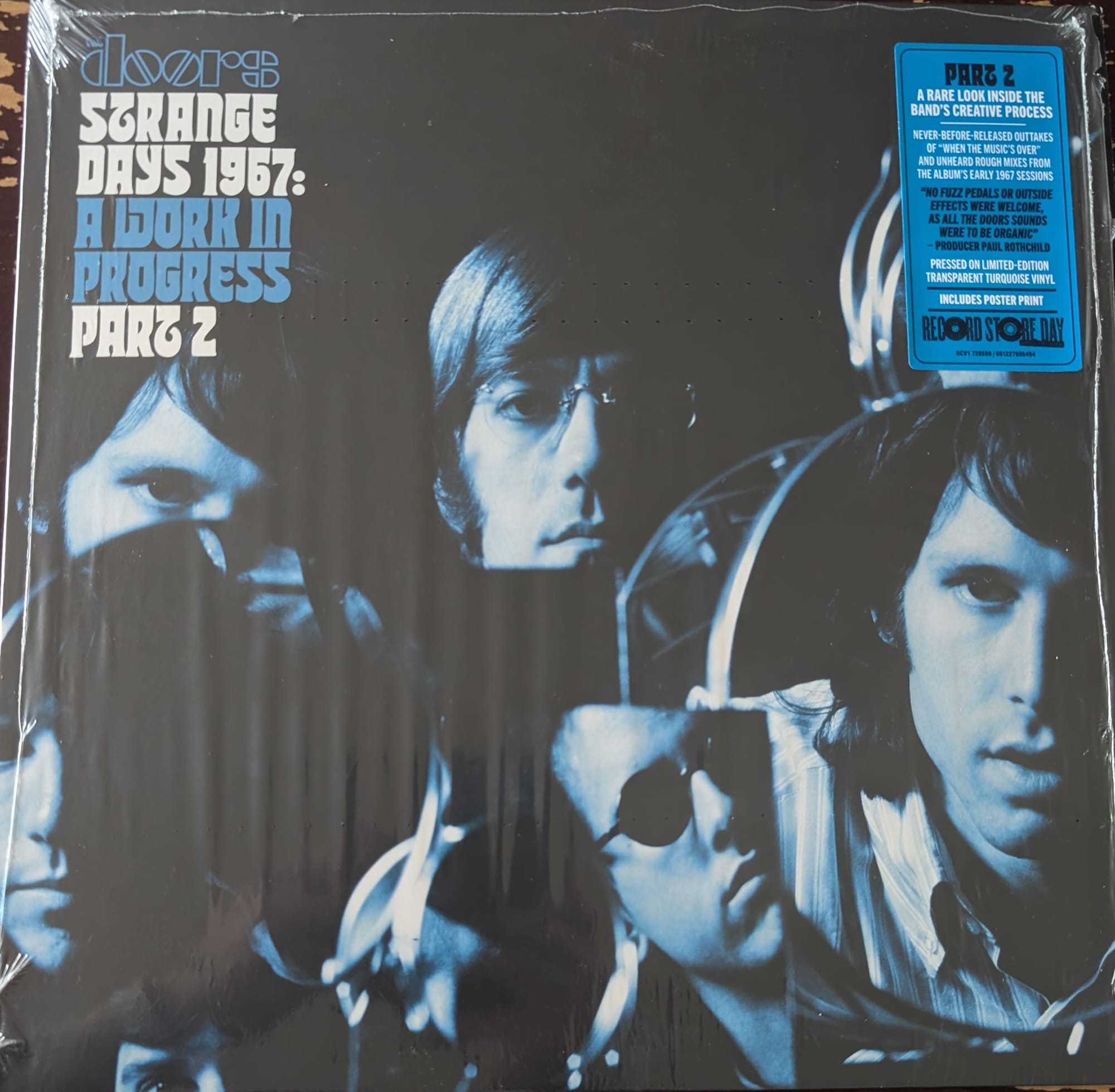
The Doors: Strange Days 1967: A Work in Progress Part 2
Review by Robert Ham
The treatment of the Doors’ recorded legacy by Rhino has been bewildering at best. Though the archival label has been responsible for some solid multi-disc box sets celebrating albums like 1970’s Morrison Hotel and 1971’s L.A. Woman, they’ve also doled out some dodgy live albums and collections of studio outtakes in dribs and drabs, usually on Record Store Day or Black Friday. Last April, Rhino dropped a disc of rough mixes, sans overdubs, of tracks from 1967’s Strange Days, and this year, they’re going back to that well with a second volume of material from those same album sessions. The press notes for Strange Days 1967: A Work in Progress, Part 2 state that this 1-LP release features “newly unearthed material.” I want to take Rhino at their word about that, but I do wonder if the label or the folks managing the Doors catalog have been holding out on fans, slipping this material out in short bursts in hopes of squeezing as much equity out of it as possible.
Whatever the motivations are behind releasing the outtakes and rough mixes from the Strange Days sessions in this fashion, I’ll be the first to tell you that this disc sounds magnificent. Mastered by Bruce Botnick, the famed recording engineer who worked with producer Paul A. Rothchild on many Doors releases, the album has the you-are-there quality that we all want from the best reissues. We are treated to two takes of “When the Music’s Over” in its rawest form before singer Jim Morrison had fully settled on the lyrics and the vocal. He’s nearly there but doesn’t give these versions the ferocity of the finished version. Also of note is that these takes were recorded with Doug Lubhan playing bass, which provides a great depth of field to the low end that was shrunken on the final take by organist Ray Manzarek’s piano bass playing.
The decision to include an incomplete recording of “When the Music’s Over” is another curious choice by the producers of this disc. According to the notes from Botnick printed on the inner sleeve, Rothchild mentions that they may not have enough tape on the reel to get the whole song, and he was absolutely correct. Just as the song is heating up around the nine-and-a-half minute mark, the audio cuts out. It’s incredibly jarring, and even though I knew it was coming, it still threw me for a loop the first couple of times I spun the LP.
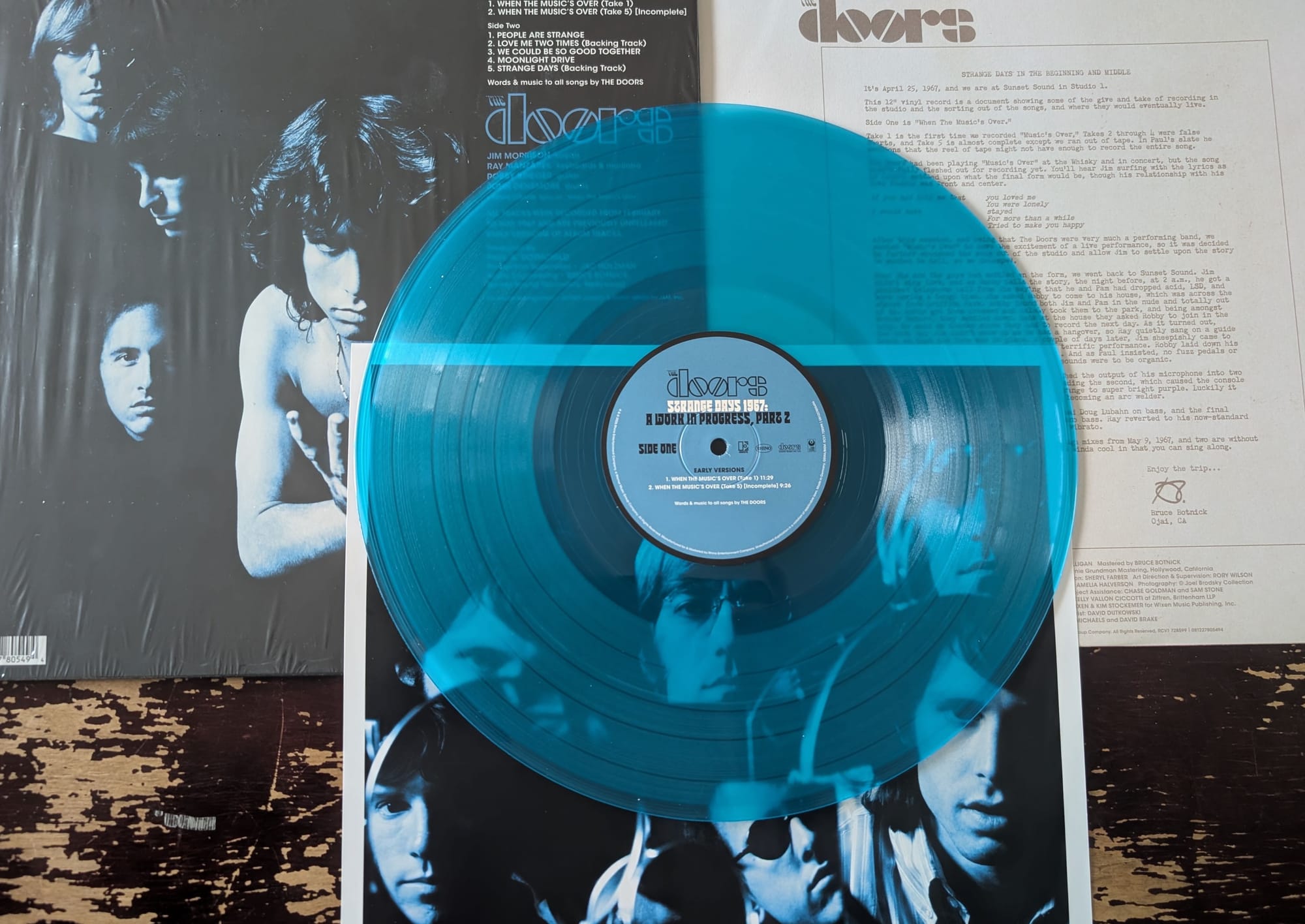
Side 2 is a little less engaging but still worthwhile. There’s an interesting early take of “We Could Be So Good Together,” a track that eventually found its way onto the Doors’ next album, 1968’s Waiting for the Sun, as well as a pair of real gems: instrumental versions of “Love Me Two Times” and “Strange Days.” Morrison usually commands all the attention, so it’s especially cool to be able to really home in on the musical chemistry between Manzarek, guitarist Robby Krieger, and drummer John Densmore. They are all inventive players that found exciting ways to work their jazz and blues influences into the Doors’ psychedelic tapestry. I especially love the swing that Densmore brings to “Love Me Two Times” as he plays around the groove in the manner of Elvin Jones and Art Blakey, so to hear that with few distractions is a real treat.
Will this be the final resting place for this material? I suspect not. My feeling is that Rhino is priming us for a comprehensive Strange Days box set to be released in time for the album’s 60th anniversary next year. If not, I’ll happily spin this and 2025’s Part 1 disc alongside my copy of Strange Days to get as full a picture of the making of that album as possible, and I encourage my fellow Doors fans to do the same.
Elektra/Rhino 1-LP 33 RPM transparent turquoise vinyl
• Second volume of outtakes and rough mixes for the Doors’ 1967 album Strange Days
• Jacket: Direct-to-board single-pocket
• Inner sleeve: Printed paper with album credits and photo of tape box
• Liner notes, insert, or booklet: Notes from Bruce Botnick printed on inner sleeve and poster print of the Doors
• Source: Digital
• Mastering credit: “Mastered by Bruce Botnick” at Sunset Sound Recorders, Hollywood, CA
• Lacquer cut by: Bernie Grundman at Bernie Grundman Mastering, Hollywood, CA; “BG” in deadwax
• Pressed at: GZ Media, Czech Republic
• Vinyl pressing quality (visual): A
• Vinyl pressing quality (audio): A
• Additional notes: Limited edition with stamped number on sleeve.
Electronic: 1996 Remixes 1999
Review by Robert Ham
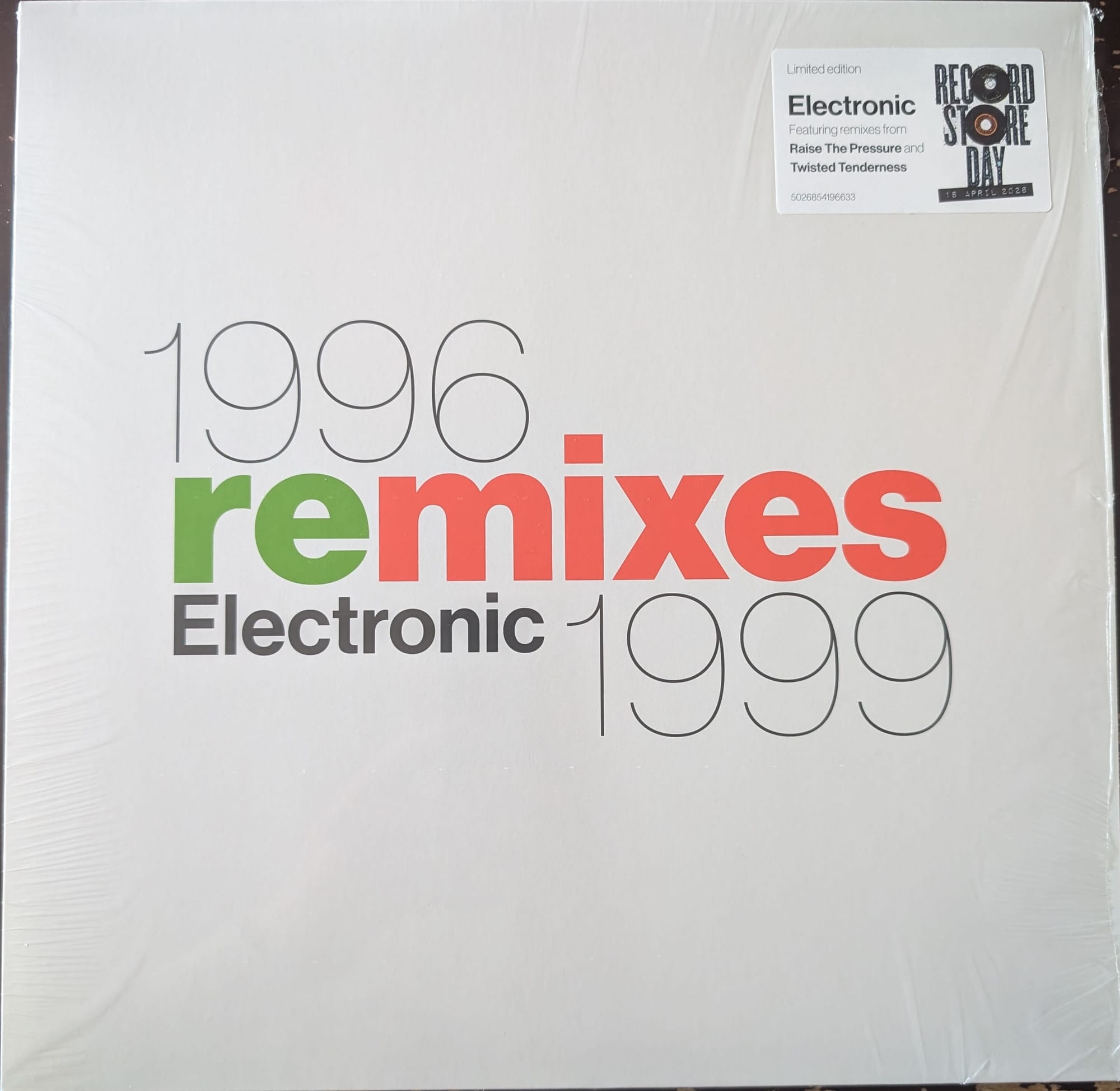
Record Store Day 2022 saw the release of 1989 Remixes 1992, a compilation of remixes of the first four singles by Electronic, the pop project of New Order’s Bernard Sumner and former Smiths guitarist Johnny Marr. It was hardly a comprehensive overview, as it only featured six tracks from the various 12-inch and CD single releases from the time, but it did include some wonderful work from the likes of 808 State, the Manchester group that overhauled Electronic’s non-album single “Disappointed,” and DNA, the duo who put a trip-hop spin on the marvelous “Get the Message.”
Four years later, Parlophone Records is issuing a second set of Electronic remixes, this time covering the material the band recorded for their final two albums: 1996’s Raise the Pressure and 1999’s Twisted Tenderness. Once again, it’s not the complete picture of what the band released during this period, as it misses out on a few great selections like Richie Santana’s deep-house version of Raise the Pressure’s “Second Nature.” But in addition to providing a nice tasting platter of material from Electronic’s late-’90s period, this EP is a wonderful snapshot of the dance music trends of the time.
Two Lone Swordsmen, the production duo of Andrew Weatherall and Keith Tenniswood, for example, applied the cheeky energy and chirpy synth tones from their 1998 album Stay to their remix of “Prodigal Son,” a dance rocker from Twisted Tenderness. DJ Cevin Fisher turned that same track into a tense Paul Oakenfold-esque house banger. Sumner, meanwhile, toned down the steely electro tone of Raise the Pressure’s “Until the End of Time” for the remix he did under the name Fluffy Dice. The new version instead highlights the contributions of former Kraftwerk member Karl Bartos on the track and opts for a warmer house beat.
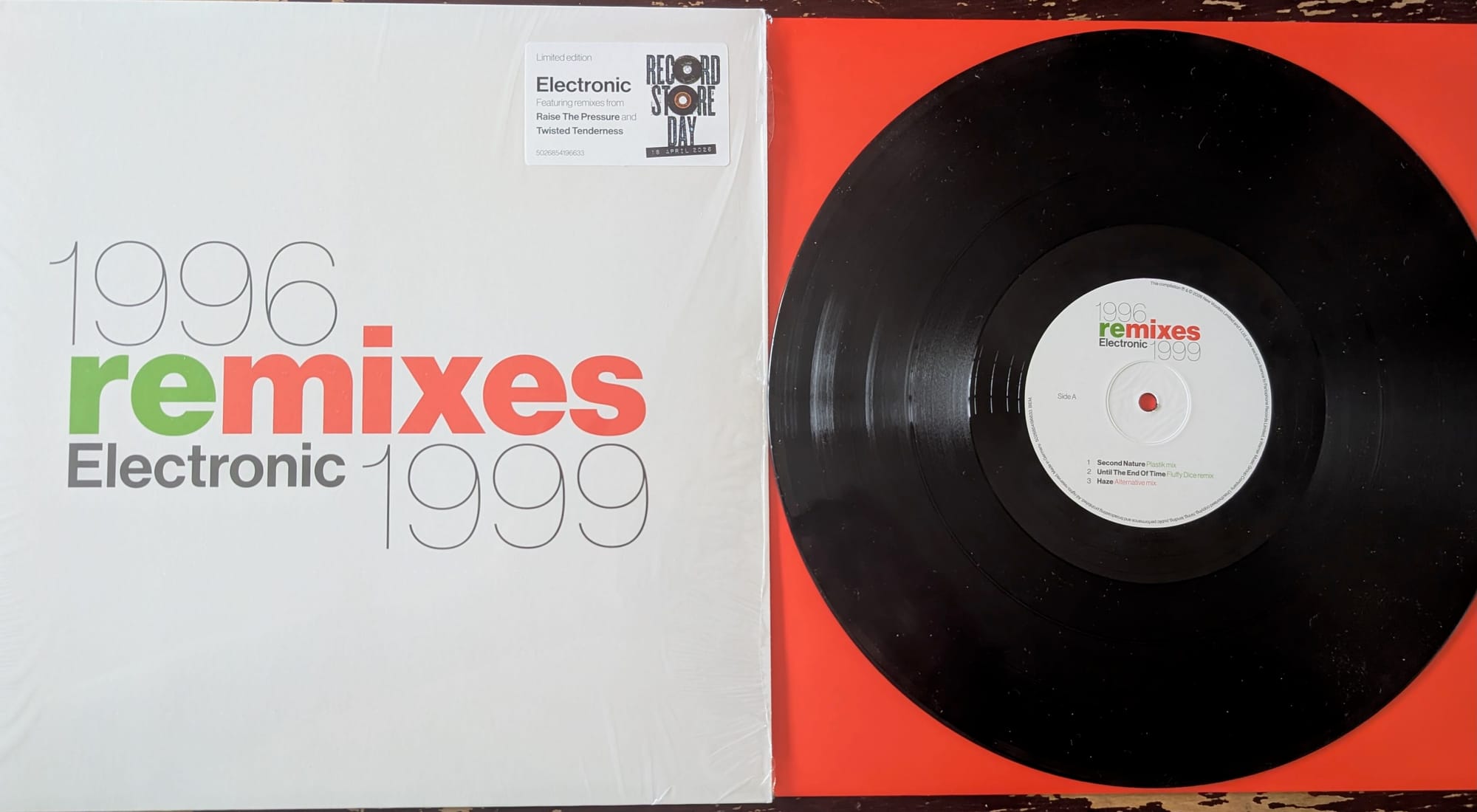
Like many fans of this project, I would love to see Electronic and Parlophone come out with a more exhaustive collection of the group’s singles with all the various remixes and edits in one tidy package. But I’m still more than happy to have this Record Store Day release in my DJ crate. There is no mastering credit on this release, nor any mark in the deadwax to signify who cut the lacquer. My assumption is that the lacquer was once again handled by Abbey Road’s Frank Arkwright, who cut the 2022 RSD release. In any case, it sounds solid, hitting that sweet spot that allows for DJs to push up the volume of each track without the music getting distorted and blown out. Additionally, this is the first time some of these remixes have been available on vinyl, with the Fluffy Dice remix of “Until the End of Time” finally available in a more affordable format than the limited CD single that now sells for more than $100 on the resale market.
Parlophone 1-LP 33 RPM black vinyl
• Compilation of remixes of tracks from 1996’s Raise the Pressure and 1999’s Twisted Tenderness
• Jacket: Direct-to-board single-pocket
• Inner sleeve: Printed paper
• Liner notes, insert, or booklet: None
• Source: Digital
• Mastering credit: None listed
• Lacquer cut by: Unknown
• Pressed at: Optimal Media, Germany
• Vinyl pressing quality (visual): A
• Vinyl pressing quality (audio): A
• Additional notes: According to the matrix number, vinyl was pressed in 2025. Limited edition according to hype sticker.
George Jones: Cold Hard Truth
Review by Ned Lannamann
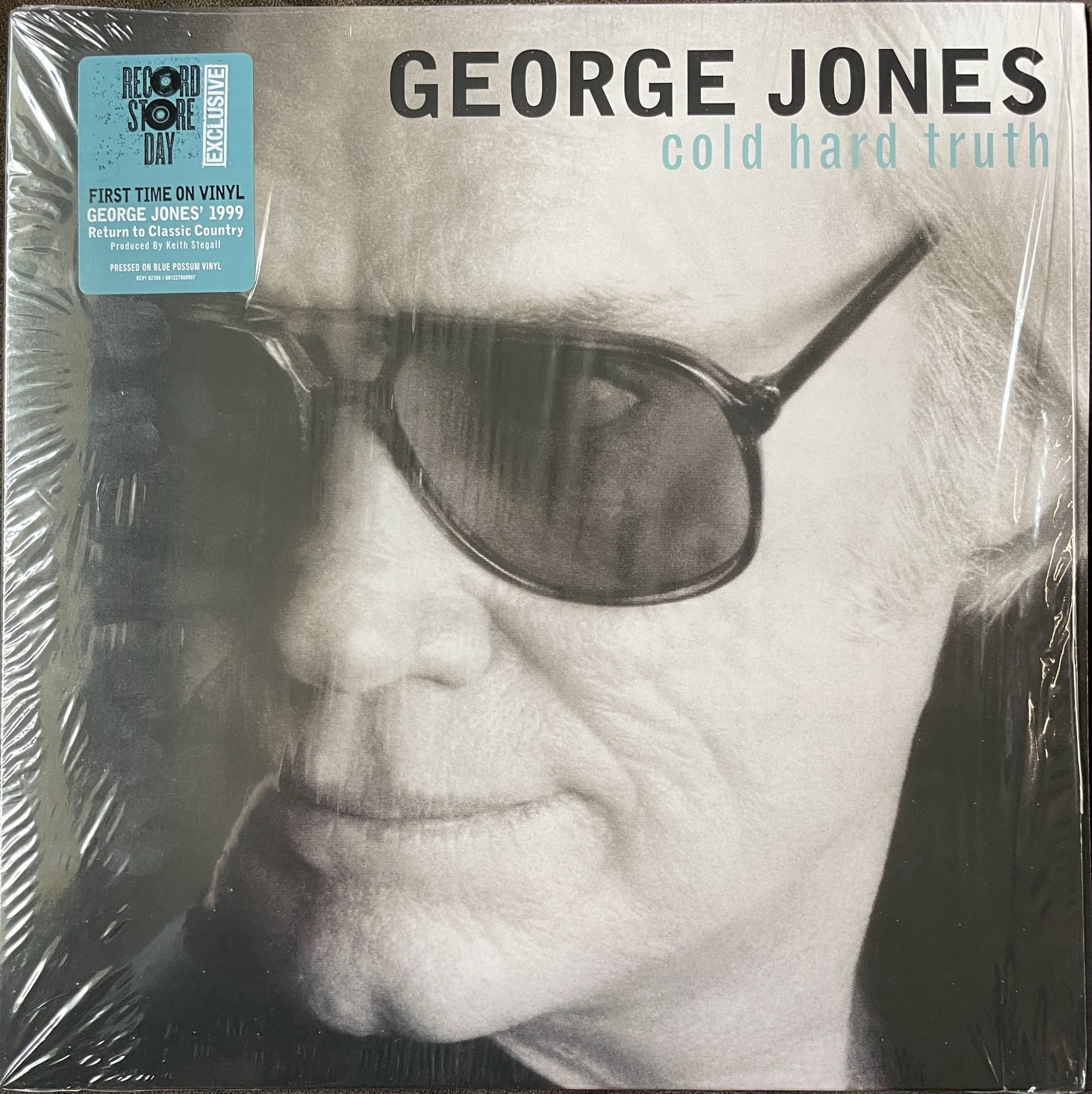
Cold Hard Truth was released a few months after George Jones’s car crash in March 1999, when the country music superstar drove into a bridge railing and was unconscious for 11 days. The album was close to being finished by then; all the backing tracks and guide vocals were done, and all Jones had left to do was go back and fine-tune some of the vocal tracks. And yet Cold Hard Truth plays beautifully as a post-crash summing-up of the man’s life, a reckoning with the darkness in his past and the hurt caused by his shortcomings. Country music’s just like that, I guess. Context is everything, and in this case, a terrible accident shifted the meaning of the entire album.
That wreck did turn out to be Jones’s reckoning, and the lifelong alcoholic pleaded guilty to a DWI charge in the aftermath. He got sober and quit smoking as a result, but one can imagine, if one is so inclined, that all the groundwork for the amends he’d soon need to make were contained within the passages of Cold Hard Truth. Jones ended up not being in any kind of condition to put the finishing touches on the album, so it was released as-is, but you certainly can’t tell by his almost impossibly smooth mellow-gold baritone carving melodic lines like a chisel through soft wood.
The 10 tracks run the gamut from ballads to two-steppers and all the honky-tonk space in between. The production is both well-appointed and matter-of-fact, and every note is placed just so. Vince Gill and Patty Loveless are among the backing vocalists, and a murderer’s row of Nashville lifers litter the songwriting and musician credits. It’s an assuredly competent affair, and a pretty wonderful one. Country music in the late ’90s was having an identity crisis, playacting as if it wanted to be either rock or pop. Cold Hard Truth is decidedly neither—Jones’s tunes see no need to bump fists with any of the other bins at the CD store.
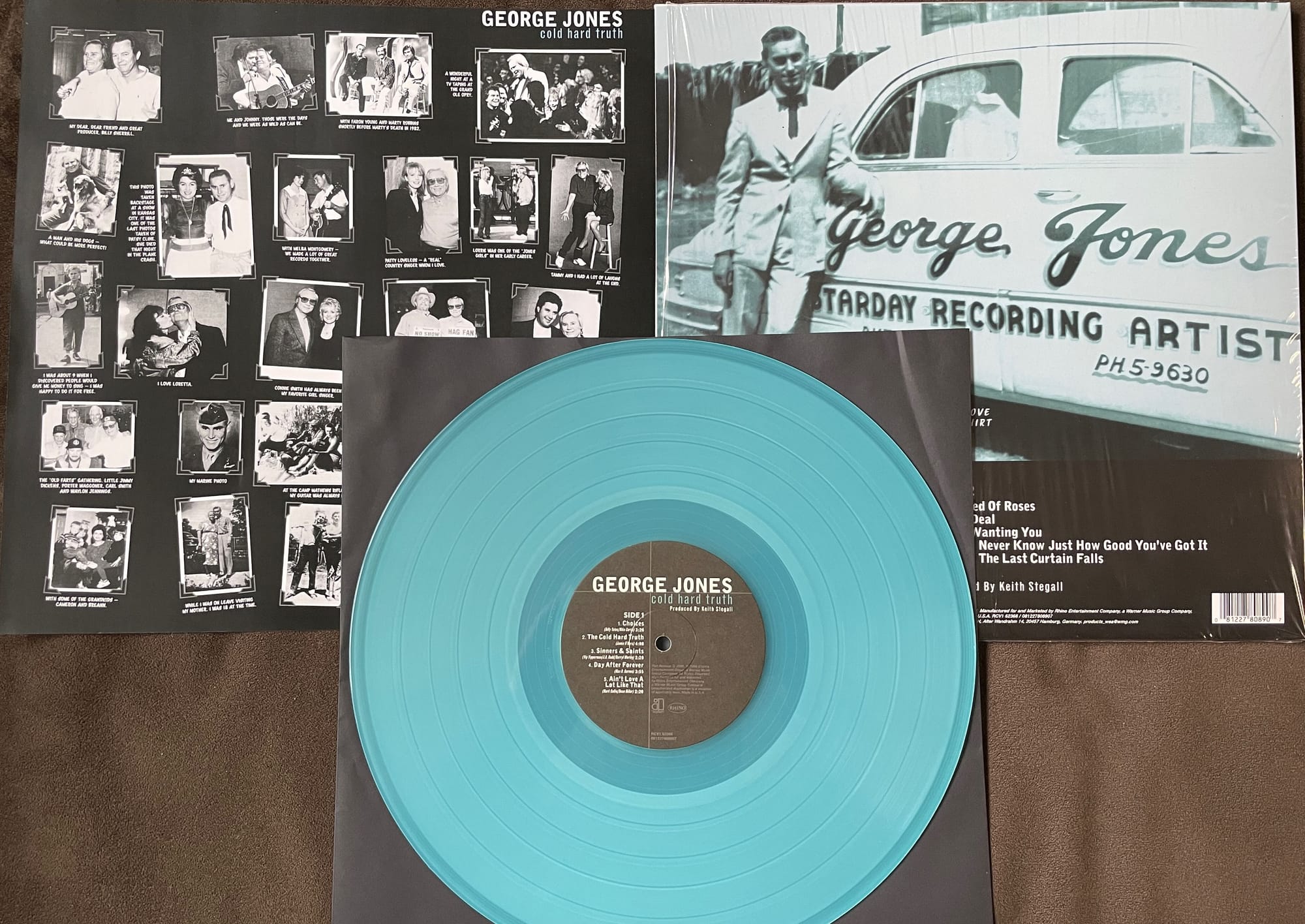
This is its first time on vinyl, but it plays like it was always meant to live there, with five songs a side and a start-to-finish playability that won’t have anyone missing their CD player’s track-forward button. My only complaint is that the CD’s booklet is reproduced on a double-sided insert that even further reduces the booklet’s many photographs that were taken over the course of Jones’s life; it would have been nice if they had blown up the 12 pages to an album-sized booklet rather than cramming them onto a single sheet of paper. Nevertheless, Cold Hard Truth is cut from the same cloth as Jones’s many ’60s, ’70s, and ’80s albums, so it feels right to finally have it in the same format as those.
The album’s got some party-starters: “Ain’t Love a Lot Like That” is a peppy boot-scooter, and “Real Deal” has the rowdy energy of a singer one-third Jones’s age. But in general, Cold Hard Truth is an album that only an older and wiser person could have made. The opening track, “Choices,” feels like a mission statement (“living and dying with the choices I’ve made”), containing lyrics that grapple explicitly with the bottle. Meanwhile, “The Cold Hard Truth” is a hard look in the mirror, as if sung by a ghost of Christmas past to a man who’s made all the wrong choices (“You say you’re not the one to blame… I say you’re nothing but a liar”). Tough stuff.
There is not a single solitary mastering credit to be found, nor are there any markings in the deadwax, other than the plating info from GZ and the matrix number from Memphis. This suggests to me that the album’s digital file was cut at GZ via their DMM process. The finished disc sounds perfectly fine, with impactful transients, a niftily resonant bass end, and plenty of instrument separation. It might be nice to hear some of these tracks presented with a bit more give, allowing the instruments to bounce and roll instead of shining like spangles, but it’s more than likely the album wasn’t recorded that way to begin with.
All told, this is one of Jones’s best records, and certainly the defining work of his later career. The formula is so simple and straightforward—take a carefully selected crop of durable, truthful songs and play them with care and forthrightness—that it shouldn’t be a surprise when it works as splendidly as it does here. Even though Jones didn’t write a single note or lyric on the finished product, Cold Hard Truth feels like it comes straight from the heart.
Asylum/Rhino 1-LP 33 RPM slightly translucent “blue possum” vinyl
• First vinyl pressing of George Jones’s 1999 album
• Jacket: Direct-to-board single pocket
• Inner sleeve: Black poly-lined
• Liner notes, insert, or booklet: Double-sided insert replicating the original CD booklet, with photos from Jones’s life and a short essay by Asylum Records president Evelyn Shriver
• Source: Digital
• Mastering credit: None
• Lacquer cut by: Anonymous DMM master made at GZ Media, Czech Republic
• Pressed at: GZ’s Memphis Record Pressing, Memphis, TN
• Vinyl pressing quality (visual): A
• Vinyl pressing quality (audio): B (loud repeating tick at the end of Side 2)
• Additional notes: None.
Joni Mitchell: For the Roses
Review by Ned Lannamann
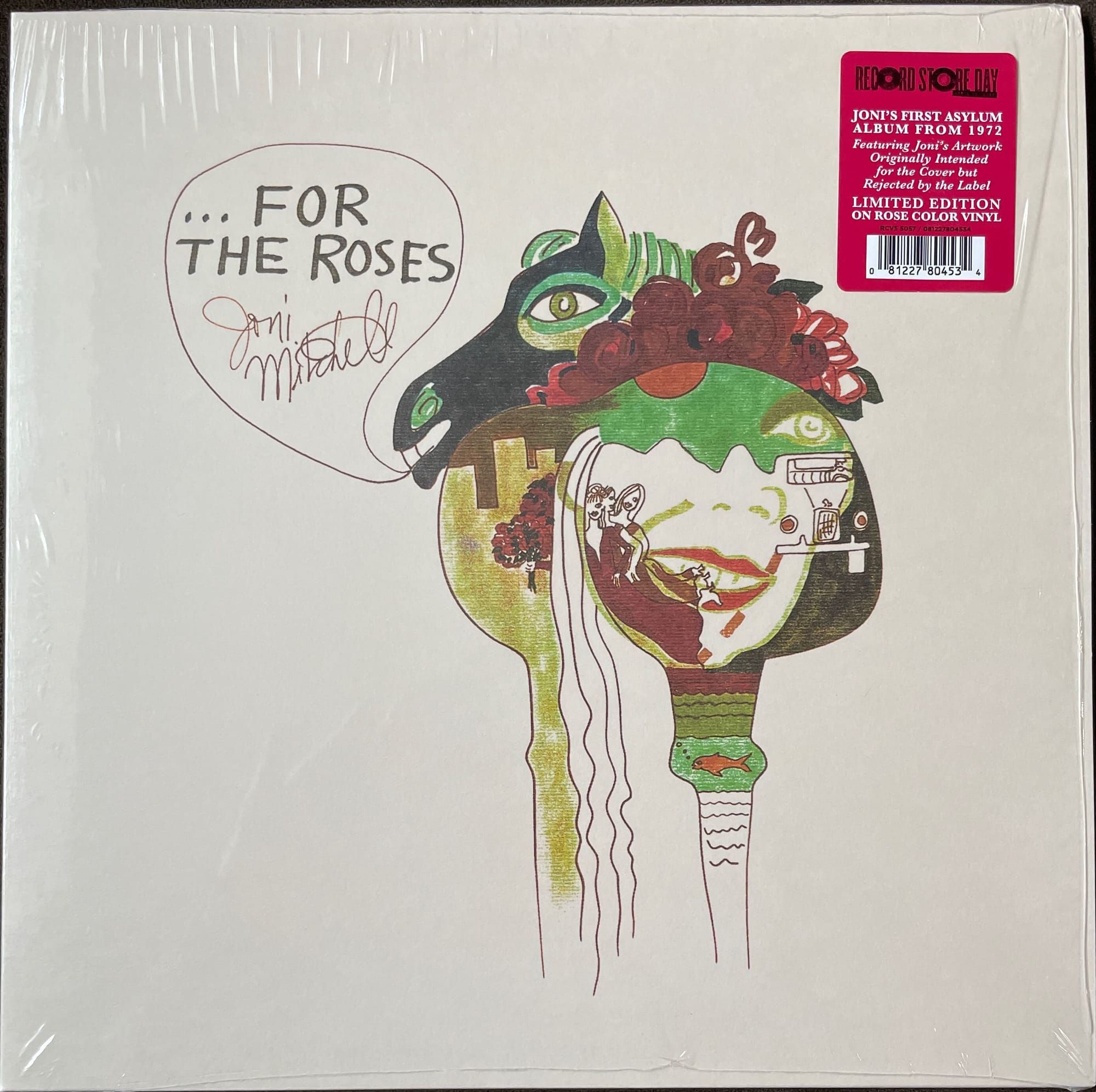
You have to admire her guts. For her first album on David Geffen’s Asylum label (and her fifth overall), Joni Mitchell wanted to put her ink-and-felt-pen drawing of a horse’s rear on the cover, with her smiling face visible inside one of its flanks and a speech bubble—straight from the horse’s mouth—containing the album title: For the Roses. It was meant to none-too-subtly reflect her experience with the music industry and the notion of celebrity, but Mitchell was shot down by the label. She then tried to get a photo of her own butt on the cover, but was talked out of that by her manager Elliott Roberts (the cheeky photo ended up inside the original 1972 gatefold). Now for Record Store Day, the original horse cover has been reinstated, and it’s a little funny now to imagine what all the fuss was about, but maybe Geffen and Asylum knew that Mitchell’s face itself was pretty dang marketable.
The album is otherwise unchanged, and in fact it reuses the Bernie Grundman cut from 2022—the first time the album had been pressed to vinyl since the ’80s—when it was reissued both on its own and as part of the Asylum Albums (1972–1975) box set. That cut was confirmed to be from the analog master tape, which means this one is too, although it seems odd that Rhino didn’t mention it on the hype sticker, as that detail would have assuredly moved some extra copies. At any rate, Grundman—Mitchell’s favored mastering engineer—did a fine job with the cut, perhaps losing a touch of the air and breath that I can hear on my 1972 Presswell original but rendering Mitchell’s trenchant songwriting and innovative arrangements with compassion and diligence.
Otherwise, there’s not much here for the already converted, but if you have never had the pleasure of taking home a copy of For the Roses for your very own, this is a perfectly fine place to start. The album is often overlooked, as it came between Mitchell’s towering achievements on 1971’s Blue and 1974’s Court and Spark, but For the Roses is every bit their equal. For the first time she begins to incorporate jazz ideas into her coldwater folk, with Tom Scott’s woodwinds augmenting her handsome guitar and piano playing. As such, this really is the bridge between her first era as a preternaturally gifted coffeehouse songbird and her second as a jazz-besotten boho experimentalist. Since it points the way both backward and forward, I think the album may well be the perfect introduction to Mitchell’s work.
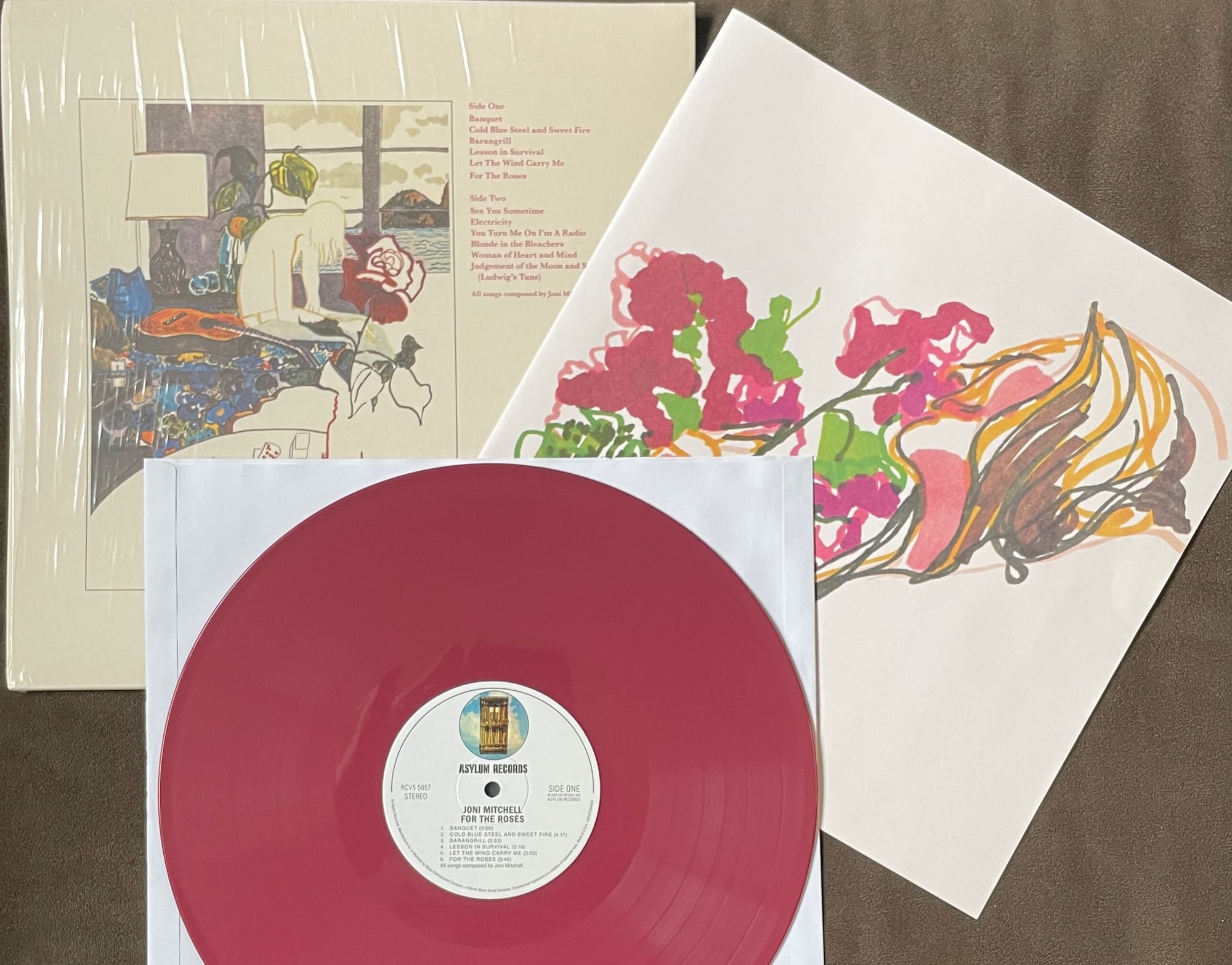
The old etchings from the 2022 Optimal pressing share deadwax space with the new markings from GZ’s Memphis plant, where this new edition was pressed. The rose-colored vinyl matches the rose ink in her artwork, and thankfully it bears silent backgrounds, which are absolutely necessary for the sparse quality of most of these songs. It’s generally a very good pressing, although my copy had a few peculiarities: toward the end of Side 2 there were a few isolated pops that didn’t disappear after an ultrasonic cleaning, and the vinyl was just very slightly uncentered, leading me to detect a tiny wobble of sound during the final piano notes of “Let the Wind Carry Me.” These issues, however, are minor.
For the Roses remains an excellent album that just grows more and more vital with each passing year, so if the story about the cover art tickles your fancy and you’re in need of a clean copy, this is worth a pickup. Mitchell’s songwriting is so incredibly astute about the world around her, so self-lacerating about her own weaknesses, and so uncommonly precise at describing complex emotions that it’s a bit shocking Asylum didn’t just let her put that horse’s ass where she damn well pleased.
Asylum/Rhino 1-LP 33 RPM “rose color” vinyl
• Repress of the 2022 remaster of Joni Mitchell’s 1972 album with the original rejected cover art reinstated
• Jacket: Direct-to-board single pocket
• Inner sleeve: White poly-lined
• Liner notes, insert, or booklet: Four-page insert with lyrics, credits, and Mitchell’s artwork from the original inner gatefold
• Source: Analog
• Mastering credit: “Lacquers cut by Bernie Grundman, Bernie Grundman Mastering, Hollywood, CA”
• Lacquer cut by: Bernie Grundman, Bernie Grundman Mastering, Hollywood, CA
• Pressed at: GZ’s Memphis Record Pressing, Memphis, TN
• Vinyl pressing quality (visual): A- (minor warp)
• Vinyl pressing quality (audio): B+ (silent backgrounds; a couple pops toward the end of Side 2)
• Additional notes: None.
Professor Longhair: Mardi Gras in Baton Rouge
Review by Ned Lannamann
The name Professor Longhair is remembered far and wide as one of the founding fathers of New Orleans rhythm and blues, but that almost wasn’t the case. Prior to his career-resuscitating appearance at the 1971 New Orleans Jazz and Blues Heritage Festival, the musician born Henry Roeland Byrd was living in obscurity and poverty. His string of 78s and 45s that began the late 1940s and continued through the early 1960s had ended; his evergreen New Orleans classics like “Mardi Gras in New Orleans” (aka “Go to the Mardi Gras”) and “Tipitina” remained perennial local favorites, but Professor Longhair otherwise found himself edged out of the rock ’n’ roll marketplace he had helped inspire.
That all changed with that fateful appearance in 1971 at Congo Square, and soon Professor Longhair was booked at festivals around the world, garnering overdue recognition for his pioneering role in R&B piano, with his incorporating of Cuban mambo, rumba, and habanera rhythms into the traditions of boogie-woogie and blues. Eager to capitalize on his comeback, Bearsville Records booked a session at Baton Rouge just a couple of months after the Jazz and Blues Heritage Festival appearance, but an album didn’t immediately materialize; a second session at Memphis’s Ardent Studio in 1972 with Meters drummer Zigaboo Modeliste and a horn section also failed to end up in record stores. (Guitarist Snooks Eaglin played on both sessions.) In 1987, seven years after Longhair’s death, Rounder Records released an LP culled from the two sets of recordings as House Party New Orleans Style; Rhino released the remaining tracks in 1991 on a CD and cassette called Mardi Gras in Baton Rouge.
That second Rhino set is what is coming to stores for the first time on vinyl as part of Record Store Day. The 18-song double LP finds Professor Longhair running through his repertoire, adding his convulsive style to some covers and a healthy portion of his own material. Other than the horn section, there’s not a ton to differentiate the 1971 recordings from the 1972; a large chunk of the tracklist finds him revisiting his back catalog, as the new and otherwise unique songs had already been cherry-picked for the Rounder album.
But when that means Professor Longhair is performing songs like “Mardi Gras in New Orleans,” “Jambalaya,” and “Cry to Me,” that’s nothing to complain about. The album feels like a broken-in pair of comfy shoes, with Longhair and his sidemen ambling through these R&B chestnuts with carefree ease. You’d never guess that the pianist had spent several years away from the spotlight, as his singing and playing feels like second nature. The set is a bit workmanlike—perhaps Bearsville was hoping for lightning in a bottle, which this set doesn’t capture—but it’s enjoyable all the same, and the new vinyl pressing can liven up any weekend afternoon through Longhair’s rambunctiously personable blend of blues and rumba.
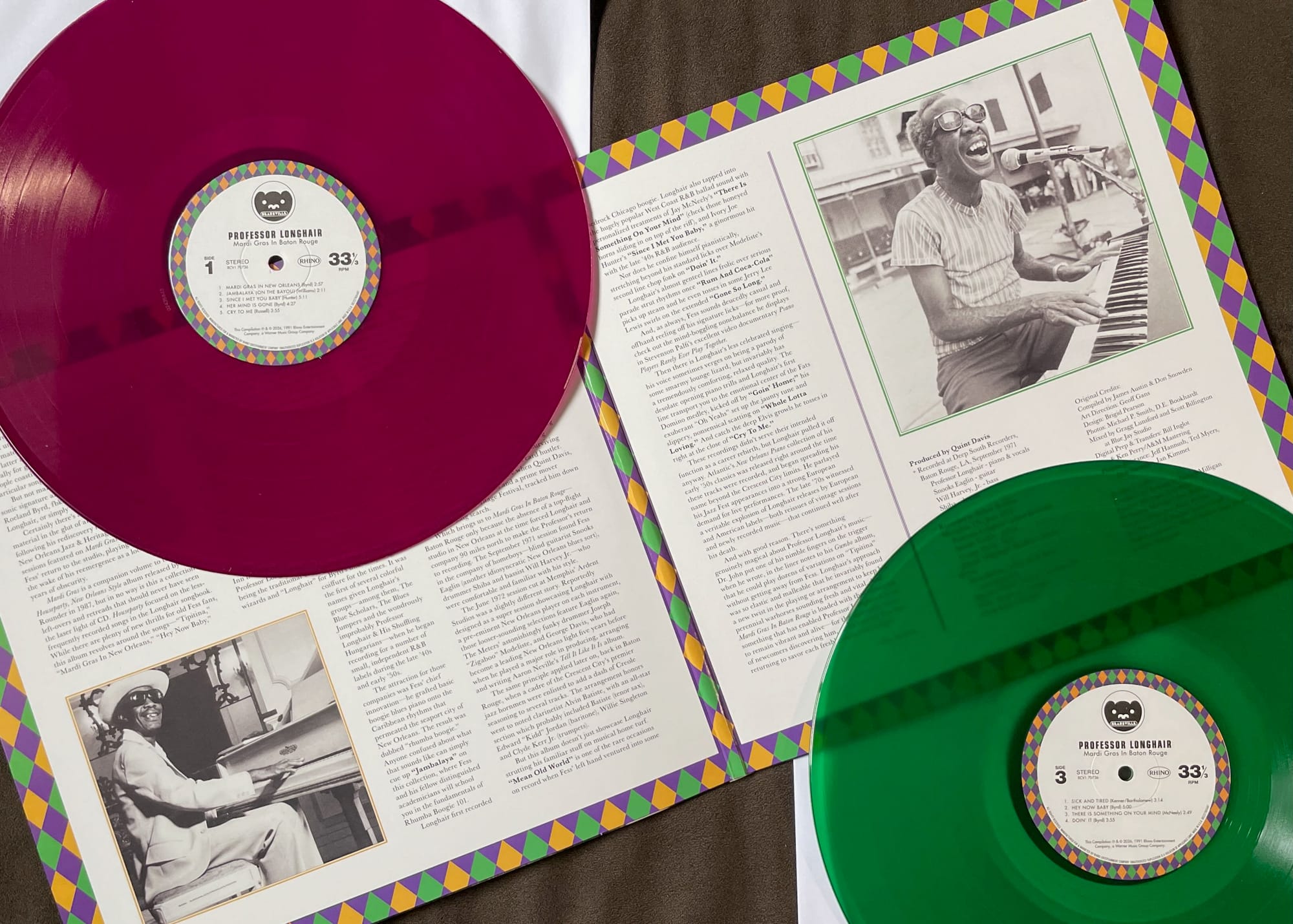
All of the mastering work seems to have been done back in 1991; there is no additional credit on the vinyl reissue, suggesting the digital files prepped for the original CD version were shipped over to GZ for a DMM cut. That’s fine, as the discs sound clear and true, if slightly hemmed in. In fact, the only real deficit is that this set doesn’t include any of the House Party New Orleans Style material—one can’t help but imagine a 3-LP deluxe edition with all of this material in one place, which would provide a more defined portrait of Longhair’s early-’70s career revival and leave us with the complete historical document.
But it’s not to be, and the pleasures of this set are certainly enough to stand on their own. The colored vinyl on my copy did not have dead-silent backgrounds, but I didn’t find that to be a huge detriment, as the music is nonstop shaking and grooving. Several small scuffs on Side 2 looked worse than they played, only materializing through the speakers as a couple of loud ticks at the very end of the side. I was happy to see the original liner notes were included inside the gatefold; indeed, this really does just seem to be a straight-up repackaging of the 1991 CD in vinyl form. And if the most direct route is what it took to get this piece of musical history back in stores, so be it.
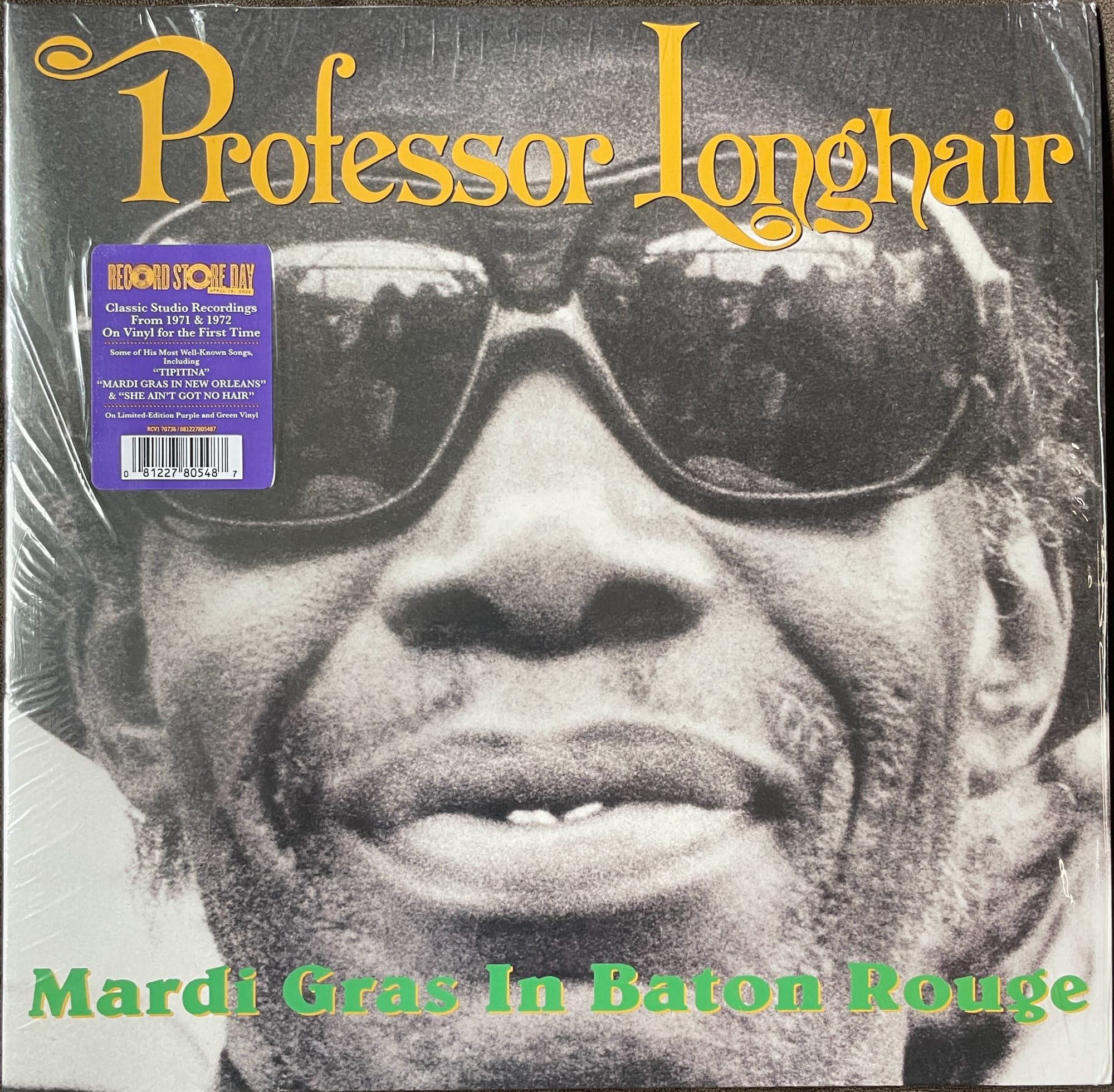
Rhino 2-LP 33 RPM slightly translucent purple (Disc 1) and green (Disc 2) vinyl
• First vinyl edition of 1991 archival release that collected 1971 and 1972 recordings by Professor Longhair
• Jacket: Direct-to-board gatefold
• Inner sleeve: White poly-lined
• Liner notes, insert, or booklet: Don Snowden’s original 1991 liner notes reproduced inside gatefold
• Source: Digital
• Mastering credit: “Digital prep & transfers: Bill Inglot & Ken Perry/A&M Mastering”
• Lacquer cut by: No initials in deadwax; likely an uncredited DMM cut at GZ Media, Czech Republic
• Pressed at: GZ’s Memphis Record Pressing, Memphis, TN
• Vinyl pressing quality (visual): B- (Side 2 has visible scuffs and scratches)
• Vinyl pressing quality (audio): B+ (scuffs did not affect play except at very end of Side 2; very light surface noise from colored vinyl)
• Additional notes: None.
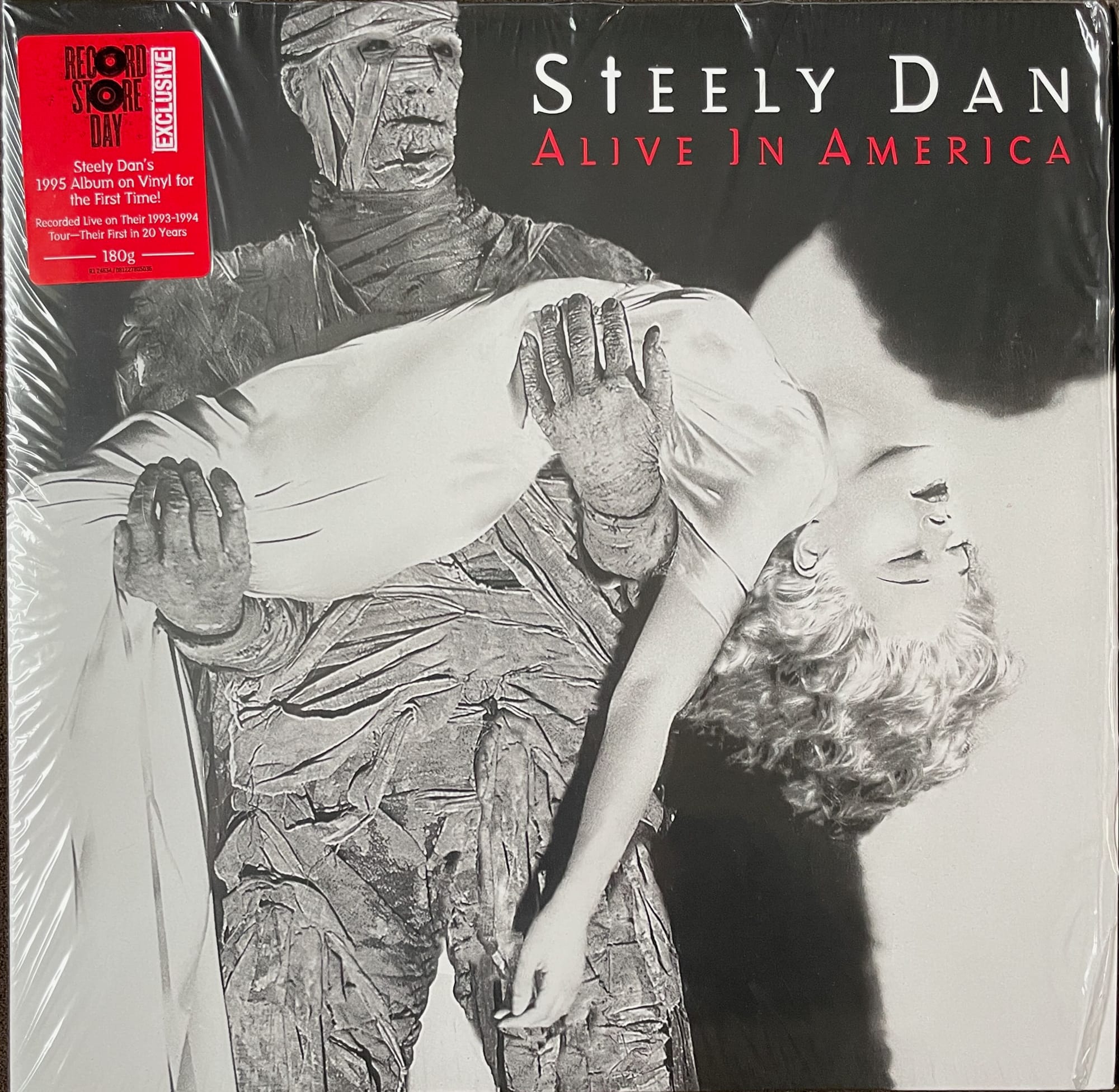
Steely Dan: Alive in America
Review by Ned Lannamann
Minds must have been melting back in 1993. That was the year that Steely Dan, the LA-via-New York group led by Donald Fagan and Walter Becker, got back together for a tour—not merely reuniting after a break of more than a decade since their last album, 1980’s Gaucho, but actually performing live for the first time since 1974, when the band swore off the road in order to focus on writing and recording. (A tour had briefly been considered in 1977 but was aborted on the launchpad when the hired musicians started to compare their paychecks.) Here, finally, was the chance to hear all of the Dan’s pristine, tightly arranged studio concoctions reproduced in the flesh. Aging men with subscriptions to Modern Drummer and “I practice safe sax” T-shirts were having their wildest musical fantasies come true.
Alive in America was recorded during Steely Dan’s 1993 and 1994 reunion tours, and while many more tours followed—as did a pair of studio albums—it was the only Steely Dan live album released before Walter Becker’s death in 2017. Upon its release in 1995, it was generally thought of as a nifty souvenir but no substitute for those immaculately crafted studio albums. But time has been kind to Alive in America; just as Steely Dan’s ’70s catalog has aged into a trapped-in-amber four-quadrant ubiquity—coming to define its era rather than standing in perverse opposition to it—Alive is feeling more and more valuable as an uncommon document of the two having some fun with their legacy.
The tracklist relies heavily on 1976’s The Royal Scam and 1977’s Aja, although there’s room for a new song, too: Becker actually sings, and quite well, on “Book of Liars,” a track from his 1994 solo album 11 Tracks of Whack. The band’s most radio-friendly hit, 1973’s “Reelin’ in the Years,” is reworked with some capriciously dissonant chord clusters (which surely upset some long-suffering Dan-fan wives), but otherwise Fagan and Becker take the approach that they got it right the first time, allowing their team of crack musicians to reenact Steely Dan’s past glories. That’s less antiseptic than it sounds—the musicians’ collective skill and the live setting allows the breath of spontaneity to bring these songs fully to life.
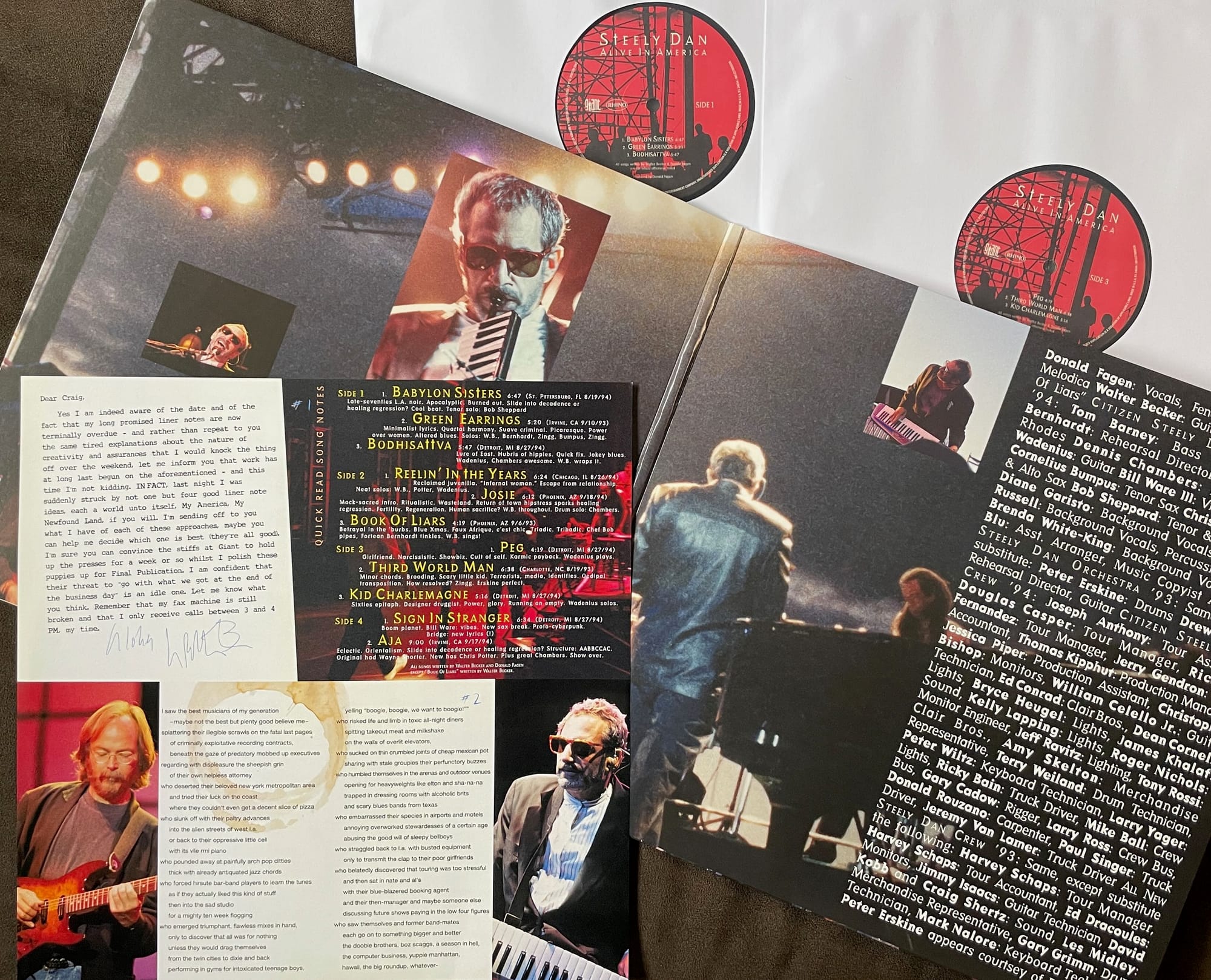
Surprisingly, Alive in America has never been on vinyl before, having been pressed in huge quantities on CD in 1995 but since then spending its past three decades in the used CD bins. Its 66 minutes are now a double LP with mastering by Bernie Grundman. The new vinyl has a crispness and clarity that is more than appropriate for Steely Dan, whose chord progressions and arrangements are deliberately but never artlessly complicated. But I also reacted to a harshness in the high end, which occasionally pierces—the more robust cymbal crashes and even the upper reaches of the guitar can be on the abrasive side. Some of this is likely due to the limitations of on-location recording circa 1993 and ’94, and I should add that there is an appealing bounce and give to the vinyl sound that isn’t present on the more straightforward CD. But the smooth exactitude of Steely Dan’s studio recordings is not present here.
Becker’s humorous deconstruction of the liner-note concept from the original CD booklet is reproduced on a double-sided insert that puts four CD booklet pages onto each side, in a two-by-two layout. The center spread of the booklet is now the inner gatefold; the black-and-white contact sheet image on the back page has been lost altogether. The pressing, from GZ’s Memphis Record Pressing, is adequate, but only just so. I had two or three very quick bursts of nonfill on Side 3, and one of my discs was dished. It’s nothing to prevent a hardcore Steely Dan fanatic from taking home a copy on Record Store Day, but it does fall shy of the highest standards.
It’s funny how Alive in America has been taken for granted within the Dan canon, so perhaps its reincarnation in the vinyl format will lead to reappraisal. I found it a totally engaging listen; the Purdie shuffle of “Babylon Sisters,” the dizzying double-time of “Bodhisattva,” and—in particular—the drum-and-sax breakdown of “Aja” all become spine-tingling when performed by an actual live band before your ears. As musical chops take a backseat to follow counts and this type of musical competence gets rarer and rarer, it does seem all the more miraculous that Steely Dan existed at all. Would you even know a diamond if you held it in your hand?
Giant/Rhino 2-LP 33 RPM 180g black vinyl
• First vinyl release of Steely Dan’s 1995 live album, recorded in 1993 and 1994
• Jacket: Direct-to-board gatefold
• Inner sleeve: Black poly-lined
• Liner notes, insert, or booklet: Double-sided insert reproducing most of the original CD booklet
• Source: Digital
• Mastering credit: “Remastered and lacquers cut by Bernie Grundman, Bernie Grundman Mastering, Hollywood”
• Lacquer cut by: Bernie Grundman at Bernie Grundman Mastering, Hollywood, CA; “BG” in deadwax
• Pressed at: GZ’s Memphis Record Pressing, Memphis, TN
• Vinyl pressing quality (visual): B+ (disc 2 is quite dished)
• Vinyl pressing quality (audio): B (minor noise throughout, and some nonfill Side 3)
• Additional notes: None.
Talking Heads: The CBS/Columbia Demos
Review by Ned Lannamann
Let’s talk logistics: On RSD Black Friday 2025, Rhino released Tentative Decisions: Demos & Live, a clear-vinyl LP and 7-inch combo pack from Talking Heads that collected several of their earliest known recordings. We covered it then, and we covered it again when it was given a wide, non-RSD black-vinyl release in March. (We like Talking Heads.) At the same time as the wide release, a 3-CD set of the same name came out with all of that stuff on Disc 1; Disc 2 contained the well-known CBS/Columbia demos, an oft-bootlegged audition tape for Columbia Records dating from late 1975, and Disc 3 contained more live tracks from 1976 and 1977. It’s a near-comprehensive document of the early years of the New York band, leading up to the recording of their debut album Talking Heads: 77 for Sire Records.
Now The CBS/Columbia Demos gets its own vinyl release for Record Store Day 2026. (I strongly suspect a 2-LP set of the live stuff from Disc 3 will come out later this year on Black Friday.) And with that convoluted explanation of the material’s pedigree out of the way, we can focus on what’s on this set, which has been spread out across two LPs and cut at 45 RPM. As mentioned, it’s familiar stuff to Talking Heads fans, a 15-song, 48-minute professional studio recording that has the band more or less performing their live set in full.
While still wet behind the ears, the group—at this point just a trio of drummer Chris Frantz, bassist Tina Weymouth, and guitarist/vocalist David Byrne—sound leaps and bounds past the demos that made up the first Tentative Decisions installment. (The actual CBS recording date is not specified, just the year 1975, so it may actually predate some of that material.) The group gets better and more fluid as they go along, finding their groove partway through the session and riding it through to its conclusion. The excellent recording helps matters, too; the three play far from flawlessly but manage to offer up plenty of verve, nerve, and artistry. Most of these songs would go on to find places on the first two Talking Heads studio albums, indicating that their material was already quite strong on its own; the band just needed to build up the experience points to credibly deliver it.
Byrne switches between acoustic and electric guitar, and Weymouth uses an envelope filter on a track or two; Frantz allows a drum machine to take over on “The Book I Read” while he plays the vibes. Otherwise the recording is gimmick-free, with a judicious bit of reverb expertly applied. Columbia’s 30th Street Studio was famously a wonderful-sounding room, offering a mammoth recording space inside a former church, and it’s likely the band felt a combination of intimidation and inspiration from their environs as the tape was rolling.
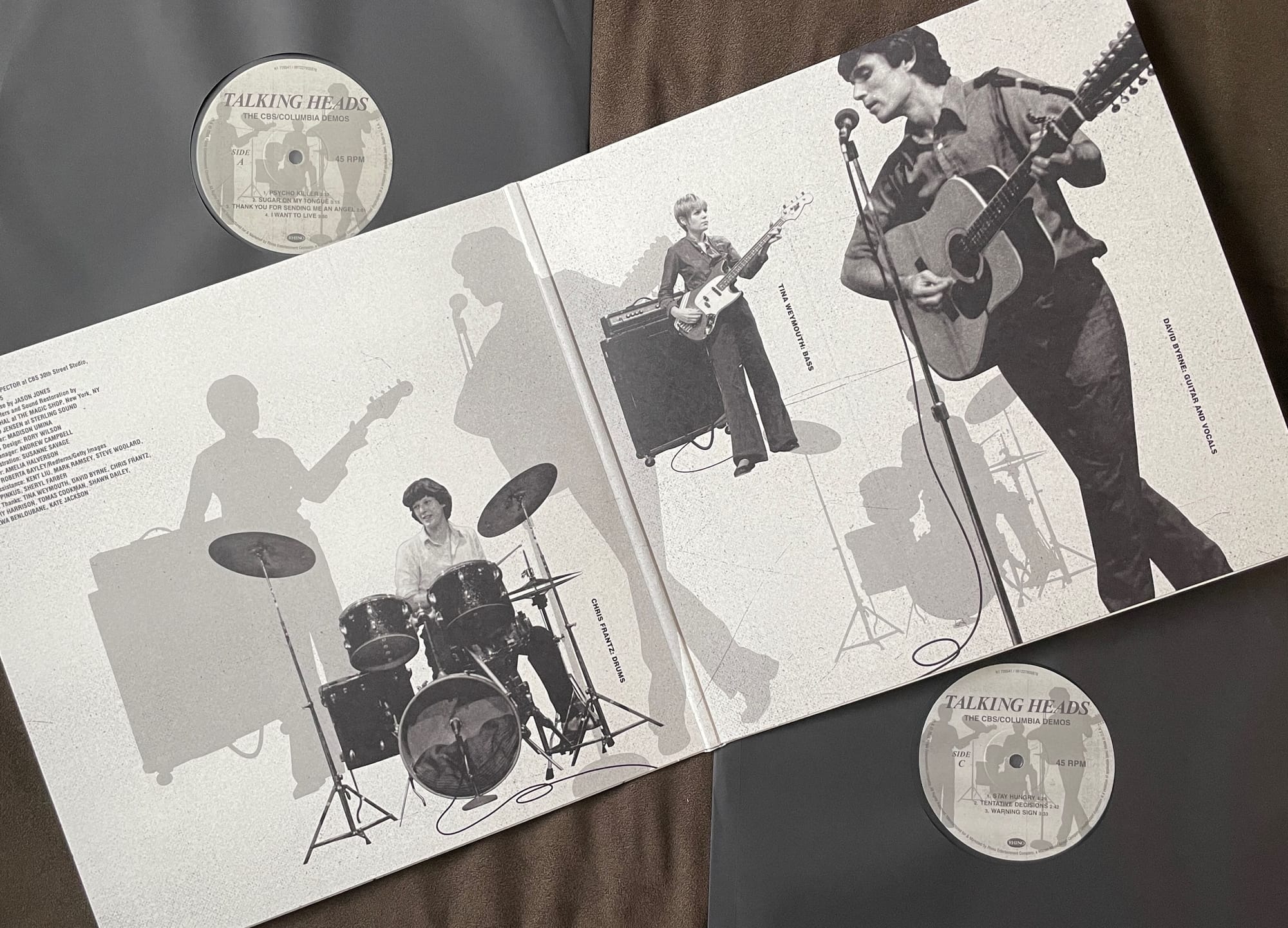
The LPs sound very good. Steve Rosenthal is credited with sound restoration and the transfer from tape to digital; Ted Jensen is credited with the mastering, and Joe Nino-Hernes did the lacquer cut. Interestingly, Rosenthal and Nino-Hernes are mentioned on the hype sticker but Jensen is not. Regardless, the mastering is well-executed, with the band sounding fulsome and complete, even in the stripped-down format. There’s some occasional muddle in the interplay of Byrne’s guitar and Frantz’s drums, but this is likely due to their inexperience than anything to do with the recording itself, which seems to allow the young group to shine as best they can. The only exception comes during “Warning Sound,” when the recording starts to sound a bit overly crispy, as if the tape was beginning to get fried. Byrne’s guitar occasionally takes on ghostly qualities, too, with what sounds like a rattle coming from his onboard reverb unit during “No Compassion,” but I think is merely the equipment, and I actually kind of like the way it sounds.
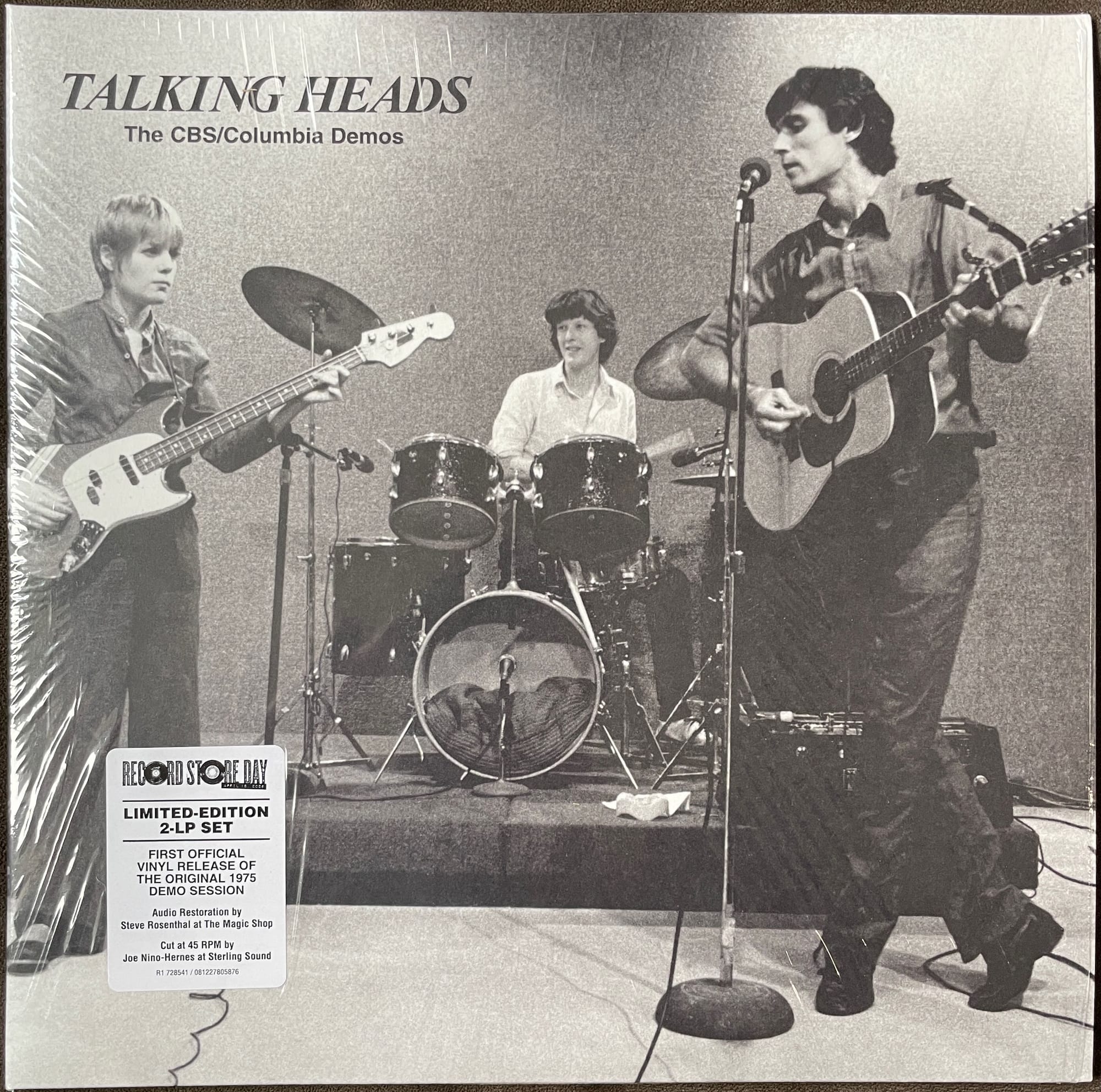
The Memphis pressing is a little disappointing, with some surface noise audible during the quieter stretches. It’s the kind of surface noise that, unfortunately, becomes accentuated at 45 RPM, with the interference taking up a broader portion of the mid-range due to the accelerated speed. However, it’s minor in the general scheme of things and is not present throughout the entirety of the set. The cover photo is great, but Rhino wrings the entire gatefold presentation out of that single photo; there were plenty of photos in the 3-CD edition, so not sure why they’ve skimped here. The lack of liner notes is unfortunate, too. The CD version had a lovely essay from Weymouth and Frantz, although it didn’t say much about this CBS recording specifically. It might have been nice if Rhino had, say, employed a struggling writer to toss together 600 words about the circumstances of the recording, throwing in a little background about the hallowed 30th Street Studio and contextualizing where Talking Heads were at this point in their career.
And where they were was full of promise, a few rungs down the ladder from where they’d need to be to launch a recording career but more than ready to climb. Their jittery style would eventually become Talking Heads’ calling card, and it would grow to incorporate funk and global rhythms, but now it was a technique born out of necessity, allowing the band to make up in energy what they lacked in poise. This CBS demo tape, given a proper presentation at last, makes a welcome addition to the official Talking Heads story. Take note: Unlike the first volume in the Tentative Decisions series, this is not an RSD First title, meaning that Rhino does not currently have a wide re-release planned—get it now while the getting’s good.
Rhino 2-LP 45 RPM black vinyl
• The 1975 demo recording by Talking Heads made at CBS 30th Street Studio in New York for Columbia Records
• Jacket: Direct-to-board gatefold
• Inner sleeve: Black poly-lined
• Liner notes, insert, or booklet: None
• Source: Digital
• Mastering credit: “Analog tape transfers and sound restoration by Steve Rosenthal at the Magic Shop, New York, NY”; “Mastered by Ted Jansen at Sterling Sound”
• Lacquer cut by: Joe Nino-Hernes at Sterling Sound, Nashville, TN
• Pressed at: GZ’s Memphis Record Pressing, Memphis, TN
• Vinyl pressing quality (visual): B (a small warp on Disc 2 is accentuated by the 45 RPM speed)
• Vinyl pressing quality (audio): B (noticeable surface noise in between tracks)
Additional notes: None.
Various Artists: Rock and Roll Doctor: Lowell George Tribute Album
Review by Ned Lannamann
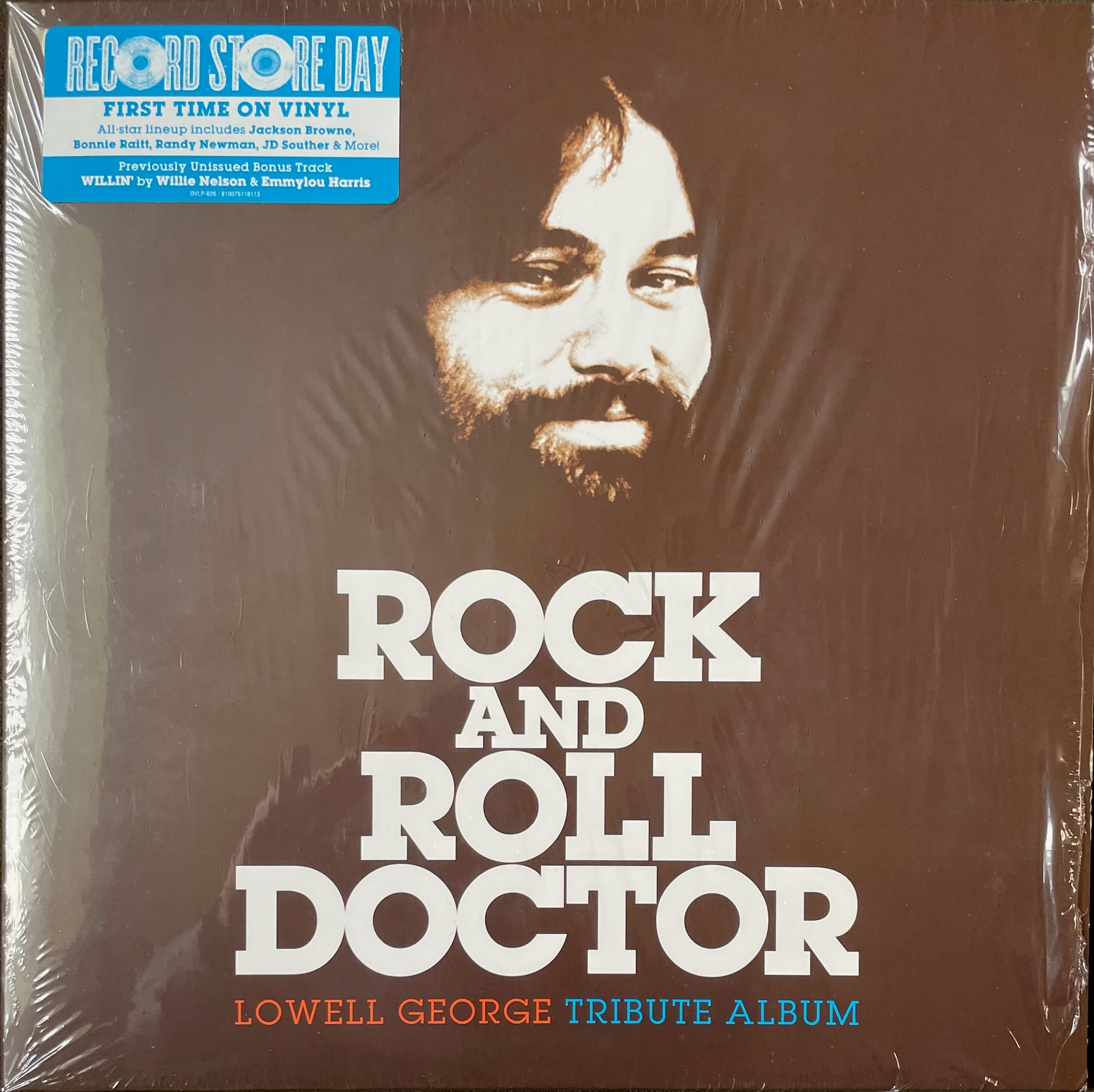
Tribute albums can be a real mixed bag. Usually you get a couple of phenomenal performances surrounded by a bunch of pleasant workmanlike covers and a handful of real duds. Rock and Roll Doctor: Lowell George Tribute Album is no exception. The compilation, originally released on CD in Japan in 1997 (a US release followed in ’98), attracted some heavy hitters, including Bonnie Raitt, Jackson Browne, Randy Newman, and a few more of the usual Southern Californian suspects, most of whom crossed paths with George during his lifetime. Some of the performances are spot-on, but others suffer from a late-’90s production style that approaches sterility. Lowell George was well known for playing slide guitar, so there is an overdose of slide on these tracks as well, albeit rarely played with the taste and sting that George employed.
After leaving the Mothers of Invention, Lowell George formed Little Feat in 1969, and the Los Angeles group released a handful of excellent albums in the ’70s, breaking up shortly before George’s death in 1979 at age 34. They’ve reconstituted since then, but I doubt few would argue that George is what gave Little Feat its mojo, wielding a songwriting pen that was caustically funny and brutally honest, with surprisingly fetching melodies that drew from soul, country, and old weird America.
On Rock and Roll Doctor, those songs are handled with varying degrees of success, but in every case, it’s revealed that the bones are strong. This is a terrific and sturdy songbook, one that can’t be dismantled by some of the performers’ heavy-handedness and over-emoting. And to be fair, the highlights are many: Allen Toussaint and Meters guitarist Leo Nocentelli reclaim Little Feat’s Angeleno pastiche of the New Orleans sound by offering up the real deal on “Two Trains,” also returning the homage Little Feat paid Toussaint with their cover of “On Your Way Down.” Randy Newman is joined by former George protégé Valerie Carter on “Sailin’ Shoes,” gently reworking the song with ingenuity and sympathy. And JD Souther ups the twang on “Roll Um Easy” but preserves the song’s tenderness, playing the song with real affection.
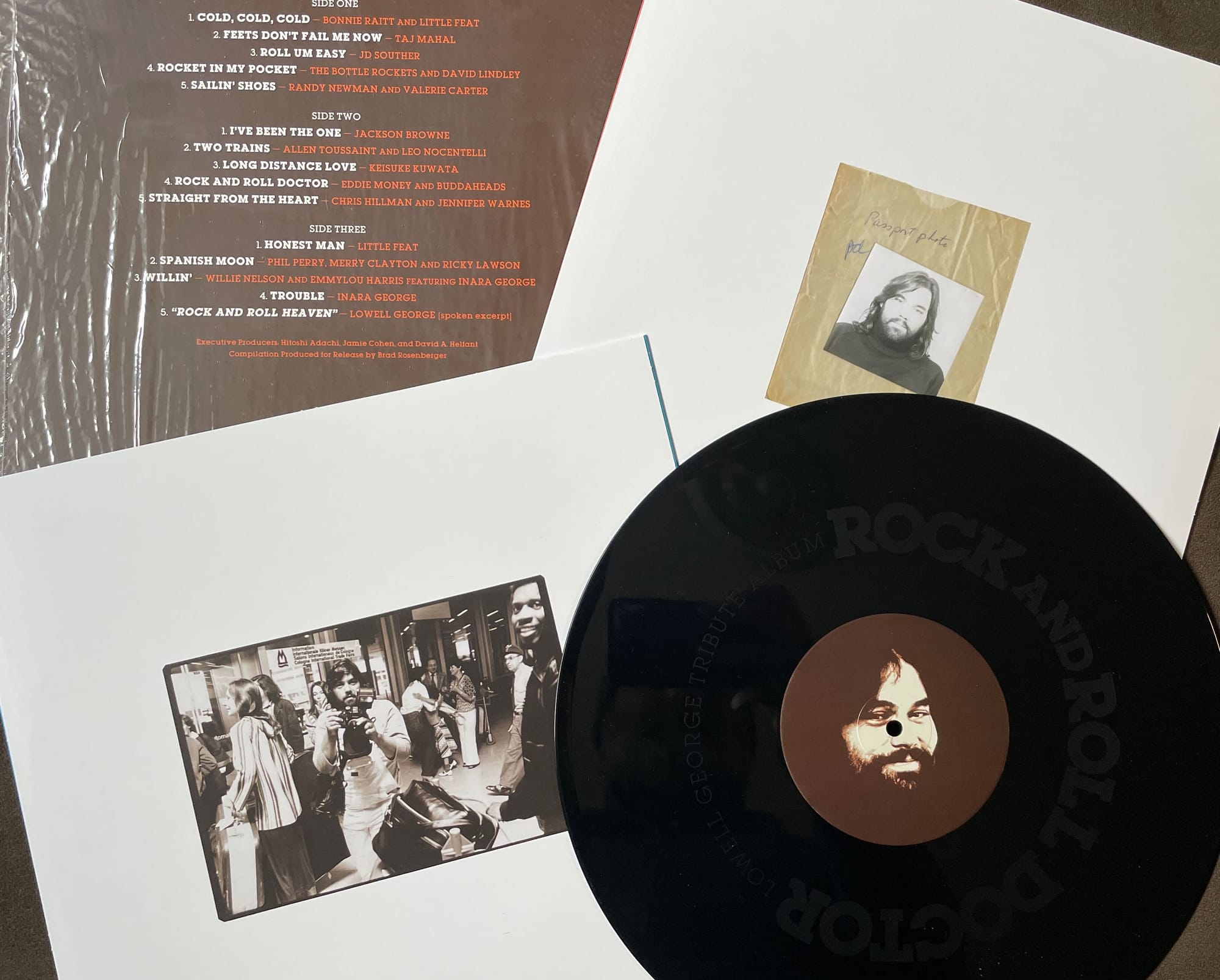
But perhaps the real point of interest in this RSD reissue is the inclusion of a bonus track that was cut from the album’s initial release: Willie Nelson, Emmylou Harris, and Lowell’s daughter Inara George performing “Willin’.” The information says it was recorded for the album but not included for original release, and I have to imagine that it must have been due to some sort of contractual red tape, because it was clearly not axed for quality. In fact, it’s probably the best track here. Nelson sings the song like he’s been doing it every night for years, while Harris adds class and grace with just a few solo lines; Inara holds her own with the two titans, and the song becomes a wonderful baton-passing from one generation to another. One can imagine the heartbreak back in 1997 when the powers that be decided that the Lowell George tribute album couldn’t include George’s best-loved song with a performance by the two biggest names in the lineup and the man’s own daughter.
Little Feat themselves turn up on a couple of tracks, but their version of “Honest Man”—one of the tracks on George’s lone solo album, 1979’s Thanks, I’ll Eat It Here—is execrable white-guy funk-by-numbers. Phil Perry’s “Spanish Moon” suffers from a similar problem, with Perry over-singing like it’s C+C Music Factory night at the karaoke bar. But there are other very fine tracks to rinse those away, like Inara George’s remarkable solo showcase on “Trouble,” featuring a shimmering arrangement by Van Dyke Parks.
The music is well-reproduced throughout; there’s a fully responsive spectrum of bass, mid, and treble against an pleasingly wide soundstage that offers plenty of clarity into the different voices and instruments. Some of that ’90s overproduced slickness I mentioned does rear its head, but there’s also refinement and delicacy in places. Jeff Powell cut the three sides and handled them well (the fourth side is etched); my discs looked a bit splotchy coming out of the sleeve but had no sound issues.
Rock and Roll Doctor manages to triumph on two points: The first is that it’s more good than bad, beating the average of these types of tribute albums, and the second is that even through its ups and downs, it constantly reminds the listener of how great George’s songs were. Perhaps there’s no greater recommendation to say that it will make you want to dig out your Little Feat albums. (Speaking of: We sadly weren’t able to get a copy to review, but keep your eye out for the RSD reissue of Little Feat’s self-titled first album, which has been cut from tape and includes a second disc—cut from digital—of outtakes and alternate versions.)
Omnivore 1-LP 33 RPM black vinyl
• First vinyl release of 1997 tribute album for Lowell George, first released on CD in Japan in 1997 and North America in 1998
• Jacket: Direct-to-board single pocket
• Inner sleeve: Printed card with credits
• Liner notes, insert, or booklet: Inner sleeve includes a short and somewhat indecipherable stream-of-consciousness essay written by Martin Kibbee aka Fred Martin, George’s occasional songwriting partner
• Source: Unknown but almost certainly digital
• Mastering credit: “Mastered by Michael Graves at Osiris Studio, Los Angeles, CA”
• Lacquer cut by: Jeff Powell at Take Out Vinyl, Memphis, TN; “J POWELL” in the deadwax
• Pressed at: Copycats Pressing Plant, Osseo, MN
• Vinyl pressing quality (visual): B+ (vinyl is a bit splotchy)
• Vinyl pressing quality (audio): A
• Additional notes: Side 4 is an etching.
Ned's listening equipment:
Table: Technics SL-1200MK2
Cart: Audio-Technica VM540ML
Amp: Luxman L-509X
Speakers: ADS L980
Robert's listening equipment:
Table: Cambridge Audio Alva ST
Cart: Grado Green3
Amp: Sansui 9090
Speakers: Electro Voice TS8-2