Reviews: The Gits | Letters to Cleo | Ultravox

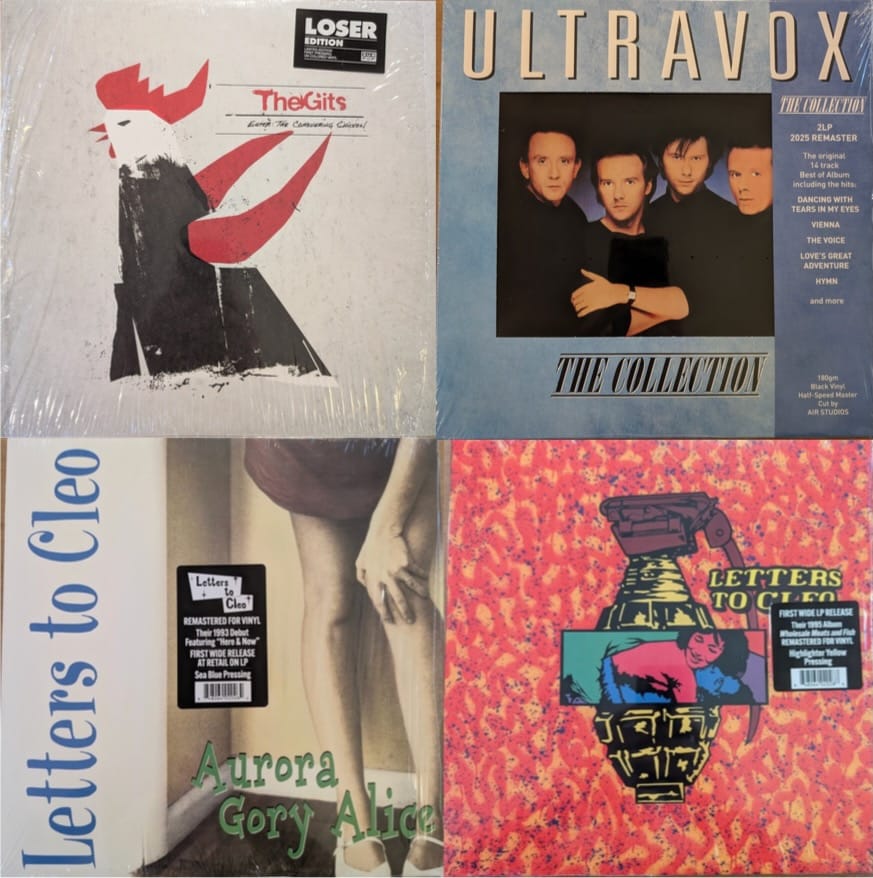
Cover art for the Gits, Ultravox, and Letters to Cleo.

New vinyl pressings of Enter: The Conquering Chicken, Aurora Gory Alice, Wholesale Meats and Fish, and The Collection.

We’ve got three reviews for you today, for four new records. But first, a quick reminder that tomorrow our paid subscribers will have the chance to enter our December vinyl giveaway and win a copy of Neil Young’s Official Release Series #6 box set, including the albums Harvest Moon, Unplugged, Sleeps with Angels, and Mirror Ball. Not a paid subscriber yet? Have I got a button for you:

Today we’re reviewing:

Let’s get into the vinyl.


Cover art for the Gits.

The Gits: Enter: The Conquering Chicken

Any discussion of the Gits is going to be singed around the edges with sadness and anger. In the early hours of July 7, 1993, the Seattle punk quartet’s captivating lead singer Mia Zapata was raped and murdered, her body left in a heap on the sidewalk by her assailant. The killing not only further shook up an already shaken music community that had seen and would see far too many of its members die, but it also halted the upward trajectory of the Gits, who were starting to make serious noise outside the Seattle scene. As Gits guitarist Andy Kessler—credited on their recordings as Joe Spleen—put it in an August 1995 article in Spin, “Without Mia, everything has changed… [The murder] just tore [our lives] up by the roots and threw it away.” 

At the time of Zapata’s murder, the band were recording their second full-length, Enter: The Conquering Chicken, at Seattle recording studio Soundhouse with producer Scott Benson, with serious interest from Atlantic Records. Without their fearless vocalist, the rest of the band—Kessler, bassist Matt Dresdner, and drummer Steve Moriarty—achieved the Pyrrhic victory of finishing the album and handing it over to their friends at indie labels C/Z and Broken Rekids, who co-released its original vinyl edition in 1994. 

The entire Gits discography has slipped in and out of print over the years, with Broken Rekids handling some reissues of the group’s two studio albums (Enter and 1992’s Frenching the Bully) and the compilation Seafish Louisville in the early ’00s. But now their work is in the safest possible hands: Sub Pop, the illustrious imprint that helped bring the Seattle scene to the world. The label made the Gits’ remastered discography available to stream and download, and this year, has begun re-releasing the individual albums on vinyl. The campaign began this past January with a new pressing of Frenching the Bully and continues this week with this reissue of Enter: The Conquering Chicken

Contents of the vinyl reissue of the Gits' Enter: The Conquering Chicken.

Sub Pop’s first great decision was entrusting the remastering to Jack Endino, one of the architects of the Seattle sound. The producer and engineer had already handled this audio once before, when he remixed it for Broken Rekids’ 2003 CD reissues. His hands-on experience comes immediately into play on this clean, flat pressing of Enter. The bluesy, deep-pocket punch of the band is given a rich, layered rendering. All the instruments are balanced beautifully with no one player taking sonic precedence over the other, emphasizing the deep bond the three musicians shared that held them together through a pair of post-Gits projects. Fitting perfectly into the mix is Zapata’s scarred yet tender voice that carries so many shades of emotion—submission, disgust, grief, and joy, among them—from line to line and moment to moment in these deeply felt songs. There are a couple of live tracks on this album, including a searing solo performance of “Social Love” by Zapata, and the experience of listening to them feels as close as one could get to being in the room with the band and letting their collective power wash over you like lava. 

Zapata’s death and the lost promise of what her band could have become is, of course, necessary in recounting the Gits’ story, but as Tim Sommer—the journalist and former A&R exec who convinced Danny Goldberg, then-president of Atlantic Records to bring the group to the label—writes about in the impassioned essay he penned for this release, that’s not where it ends. We should, he writes, “be thankful that we have very goddamn solid evidence of all this gorgeous, twisted, humid, and beatific magnificence in living music.” Kudos to Sub Pop for treating this “living music” with the care it deserves, recognizing, as we all should, that this album and the rest of the Gits catalog is sure to leave a lasting mark on listeners and fellow artists today and for years to come. 

Sub Pop 1-LP 33 RPM clear with “black and red hi melt” vinyl
• Remaster of the 2003 remix of the 1995 album
• Jacket: Direct-to-board single pocket sleeve featuring new artwork by Jeff Kleinsmith
• Inner sleeve: Printed paper with lyrics and credits
• Liner notes, insert, or booklet: Double-sided insert with essay from journalist Tim Sommer and a painting of Mia Zapata by Mark Pollard
• Source: unknown
• Mastering credit: Jack Endino at Studio Endino, Seattle, WA
• Lacquer cut by: Levi Seitz at Black Belt Mastering, Seattle, WA - “BLACKBELT-LEVI” in deadwax
• Pressed at: RTI (Record Technology Incorporated), Camarillo, CA
• Vinyl quality - visual: A
• Vinyl quality - audio: A
• Additional notes: The first “Loser” pressing on colored vinyl is limited edition; the UK/EU version is on “pearl/sunrise” vinyl.


Cover art for Letters to Cleo

Letters to Cleo: Aurora Gory Alice; Wholesale Meats and Fish

Looked at from a wide shot, Letters to Cleo is a mere blip in the timeline of the Boston band’s various members. Vocalist/lyricist Kay Hanley, for example, continues to have a successful career writing songs for children’s television programs like Doc McStuffins and My Friends Tigger & Pooh. Drummer Stacy Jones went on to start American Hi-Fi, a power-pop group that released LPs on Maverick and Island. And bassist Scott Riebling kept busy after Letters to Cleo initially split in 2000 by working as a producer for the likes of Fall Out Boy, Dropkick Murphys, and Cobra Starship. 

Zoom in, and the history of this alt-rock quintet during their initial ’90s run becomes more than just a footnote. Letters to Cleo slugged it out in the East Coast club circuit for a handful of years, gaining just enough traction to keep rolling forward but not enough to take them to the next level. As the legend goes, Hanley was already getting a new project together as they laid down the tracks for their debut full-length, 1993’s Aurora Gory Alice

When that record was released on Boston indie CherryDisc, the needle finally started to move. It received some positive notices in the national press, which helped the band secure a showcase at SXSW. Their performance at that annual industry conference set a bidding war in motion, and Letters to Cleo signed to Giant Records, a subsidiary of Warner Brothers. Crucially, their new label added the best song from Aurora, the infectious motor-mouthed rocker “Here & Now,” to the soundtrack for the blazing-hot primetime soap Melrose Place, and a new MTV Buzz Bin band was born. 

From there, Letters to Cleo spent the next five years perpetually bubbling under the surface of the alt-rock landscape but never quite bursting forth with a generation-defining song or album. They made all the right moves: releasing two more albums on a major (1995’s Wholesale Meats and Fish and 1997’s Go!), dropping songs on the soundtracks for hip movies (The Craft, Jawbreaker), touring with other hotly tipped acts (Sponge, Ned’s Atomic Dustbin), and even making an appearance in the teen romcom 10 Things I Hate About You. But eventually their momentum stalled out and they parted ways. 

Contents of the two new Letters to Cleo vinyl reissues.

I do wonder if that ill-fated story is why we’ve had to wait until now for reissues of Aurora Gory Alice and Wholesale Meats and Fish to receive a wide release. (Both albums were issued on wax in 2017 but only in limited numbers through the band’s website and New England retailer Newbury Comics.) Was the thinking that there’s little interest in the group beyond already established fans or Parks & Recreation nerds who recognize the artwork for Aurora Gory Alice from the weathered T-shirt Ben Wyatt wears when he’s unemployed and depressed? Were there some legal hoops to leap through so Letters to Cleo could regain ownership of their work from Warner? Answers to those questions aren’t likely to come anytime soon, so let’s set those aside and just enjoy the music. 

My allegiance has always tipped toward Wholesale Meats and Fish, as the band had found the perfect marriage of their power-pop jangle with the heavier strain of alternative rock dominating the airwaves at the time. This new vinyl edition, mastered by Mike Milchner at Sonic Vision Mastering and pressed from a lacquer cut by Well Made Music’s Clint Holley, is the ideal presentation of the music, with an appropriate emphasis on Hanley’s sweet-and-sour vocals, the gushing guitars of McKenna and Eisenstein, and the splashing of Jones’s various cymbals. The low end makes its presence known throughout, but the audio is balanced so as not to let it overwhelm the music’s tart sting. But when needed for emphasis, as on the narcotic ballad “Laudanum,” the bass is given its proper spotlight. A similar harmony was a little harder to achieve with Aurora Gory Alice. On the opening tracks on each side—“Big Star” and “Get On With It”—the brightness of the cymbals and the smack of a tambourine is pitched noticeably higher in the mix, giving them a smeared and occasionally stinging quality. And as the LP progresses, the audio gets muddier and less distinct. It’s still fun to listen to, but not nearly as sonically fulfilling. 

What is missing from these otherwise fine albums is any selling point to draw in potential new fans or ’90s nostalgists looking for the next musical step to take after absorbing the work of Buffalo Tom and Veruca Salt. These are bare-bones reissues with no liner notes to speak of nor any bonus material to fill out the details of the Letters to Cleo story. I’ll take these quiet, flat, well-pressed copies of the albums over nothing at all, but there was an opportunity here to reintroduce this band to the world and Real Gone Music let it slip by. 

Aurora Gory Alice
Giant/Real Gone Music/Dot Rat 1-LP 33 RPM sea blue vinyl

• Reissue of 1993 album
• Jacket: Direct-to-board single pocket
• Inner sleeve: White poly-lined
• Liner notes, insert, or booklet: None
• Source: Unknown
• Mastering credit: Mike Milchner at Sonic Vision Mastering, Burbank, CA
• Lacquer cut by: Clint Holley at Well Made Music, Bristol, VA - “CJIII” and “WELL MADE MUSIC” in deadwax
• Pressed at: Memphis Record Pressing, Memphis, TN
• Vinyl quality - visual: A
• Vinyl quality - audio: A
• Additional notes: Limited-edition gold vinyl version available through band’s webstore.

Wholesale Meats and Fish
Giant/Real Gone Music/Dot Rat 1-LP 33 RPM highlighter yellow vinyl

• Reissue of 1995 album
• Jacket: Direct-to-board single pocket
• Inner sleeve: White poly-lined
• Liner notes, insert, or booklet: None
• Source: Unknown
• Mastering credit: Mike Milchner at Sonic Vision Mastering, Burbank, CA
• Lacquer cut by: Clint Holley at Well Made Music, Bristol, VA - “CJIII” and “WELL MADE MUSIC” in deadwax
• Pressed at: Memphis Record Pressing, Memphis, TN
• Vinyl quality - visual: A
• Vinyl quality - audio: A
• Additional notes: Limited-edition silver vinyl version available through band’s webstore.


Cover art for Ultravox.

Ultravox: The Collection [2-LP edition]

If you’re after a comprehensive overview of the work of British new wave group Ultravox, this ain’t it. 

That’s not necessarily a knock on this reissue of The Collection, a compilation of singles that the band released from 1980 to 1984, aka the Midge Ure era. A little backstory: For its first five years, Ultravox was fronted by John Foxx, who steered the sound of their first three albums toward art-rock territory. When Foxx decided to leave the group and pursue a solo career, the remaining members drew in Midge Ure—the Scottish musician who had previously been involved in post-punk ensemble Visage and, for a brief moment, Thin Lizzy—to fill the gap. Ure rerouted the group straight to the pop charts, keeping their synth-heavy approach intact but using it to write big-hearted anthems like “Vienna,” “Reap the Wild Wind,” and “Dancing with Tears in My Eyes,” all of them chart hits. When The Collection was initially released in 1984, it sold like crazy and gave the band their highest position on the albums chart (#2).

This new edition of The Collection arrives this week in a variety of formats, including a 4-CD set filled out with B-sides and remixes, and a 4-LP version with alternate versions of some tunes and a few of the singles that didn’t burn up the charts. The version I’m reviewing is a simple repress of the original Collection, with the audio mastered by Phil Kinrade and given a half-speed mastering lacquer cut by Henry Rudkins at AIR Studios and stretched out over two LPs.

Contents of the reissue of Ultravox's The Collection.

The latter decision makes all the difference. Original vinyl editions of the compilation squeezed nearly 57 minutes of music onto a single disc, severely diminishing the gleaming beauty and emotional thrust of these songs. The added space for the grooves and the thoughtful mastering job by Kinrade and Rudkins do wonders with this material. The arpeggiated synths pulse with an appreciable intensity, the shading of Ure’s otherwise full-throated vocals comes clearer, and those lightning-strike moments that flash through many of these songs—like Ure’s slashing guitar solo on “All Stood Still” and the lonely countermelodies that sneak into the background of “Vienna”—are given welcome clarity. 

As a fan of the group, my hope is that any newbies would head right to the start of Ultravox’s discography and systematically work their way forward. The band’s evolution from the glammy stomp of “Rockwrok,” the opening track of their second album, 1977’s Ha! Ha! Ha!, to the acid-house-inspired tracks on 1993’s Revelation makes for a fascinating listening experience. (The less said about the albums they released after that, the better.) But for a quick and easy hit of the pure stuff, you could do no better than to grab this new edition of The Collection and have your own tear-streaked dance party. 

Chrysalis 2-LP 33 RPM 180g black vinyl
• Half-speed-mastered reissue of Ultravox’s 1984 greatest hits compilation
• Jacket: Direct-to-board single pocket with die-cut cover and obi strip
• Inner sleeve: Black poly-lined
• Liner notes, insert, or booklet: Four-panel fold-out with printed song credits and photos of the singles’ individual picture sleeves
• Source: “Audio… has been newly remastered from the original master tapes”
• Mastering credit: Phil Kinrade at AIR Mastering, London
• Lacquer cut by: Henry Rudkins at AIR Studios - “H.R” in deadwax
• Pressed at: unknown
• Vinyl quality - visual: A
• Vinyl quality - audio: A
• Additional notes: None.


Listening equipment:
Table: Cambridge Audio Alva ST
Cart: Grado Green3
Amp: Sansui 9090
Speakers: Electro Voice TS8-2