Reviews: The Monkees | Bayeté | The Temprees


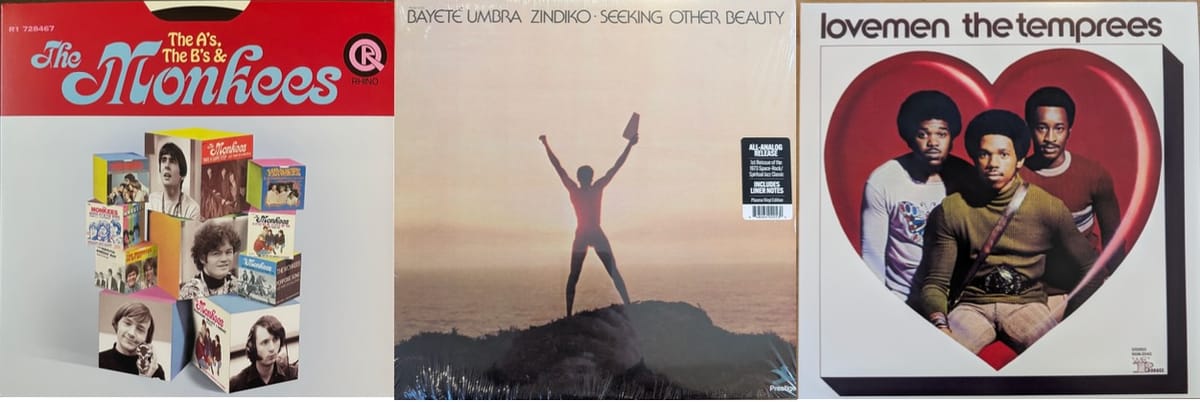
We spin the new Monkees singles compilation and two reissues from Real Gone Music.
Start your weekend with three piping-hot vinyl reviews—just don’t burn your fingers. Today we catch up on the last of Rhino’s Start Your Ear Off Right campaign from January and also get on top of some excellent new reissues from Real Gone Music that just hit record racks today. One of them’s even on “valentine red” vinyl for all you lovebirds planning ahead for V-Day.
- The Monkees: The A’s, the B’s & the Monkees
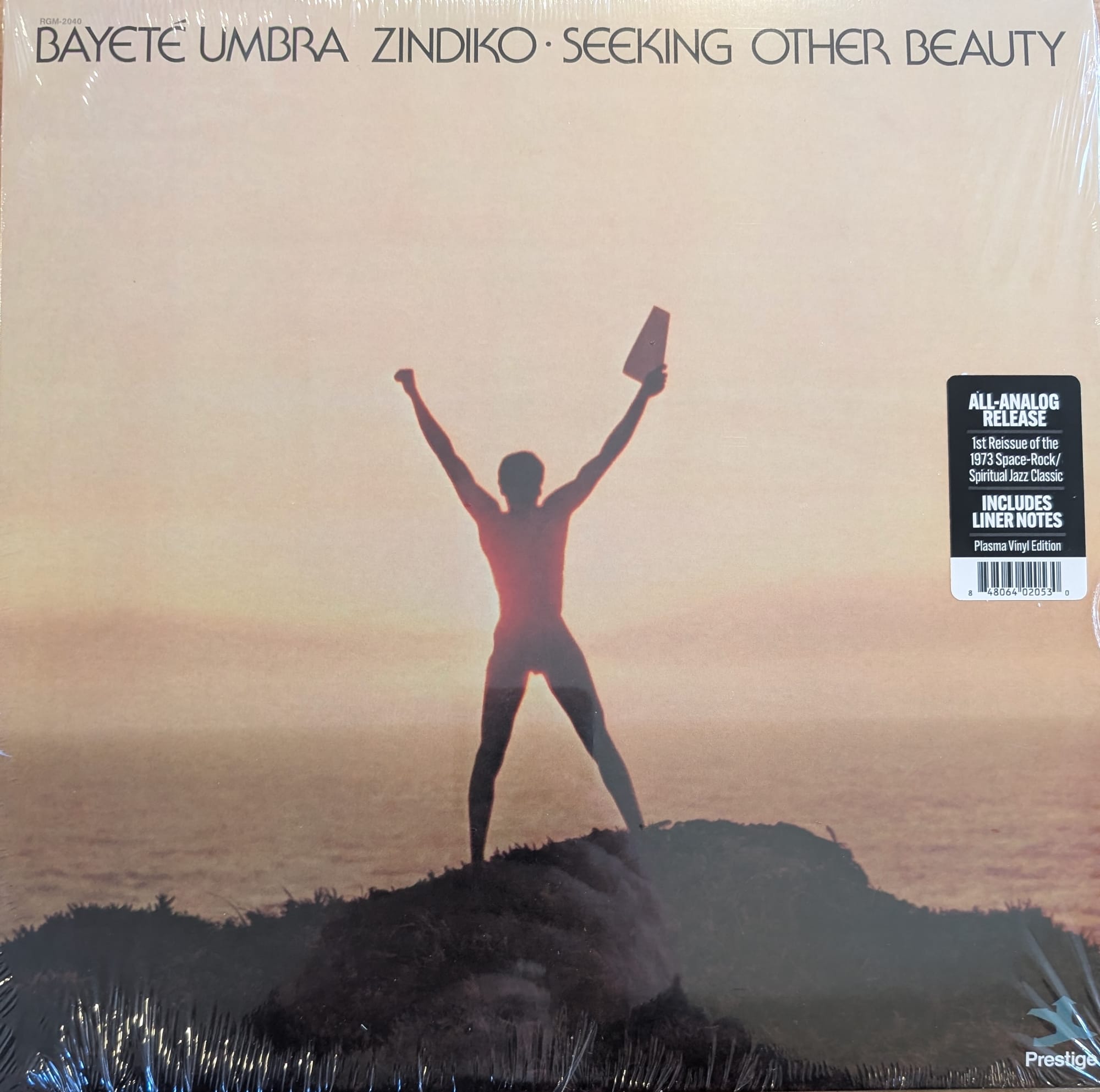
- Bayeté Umbra Zindiko: Seeking Other Beauty
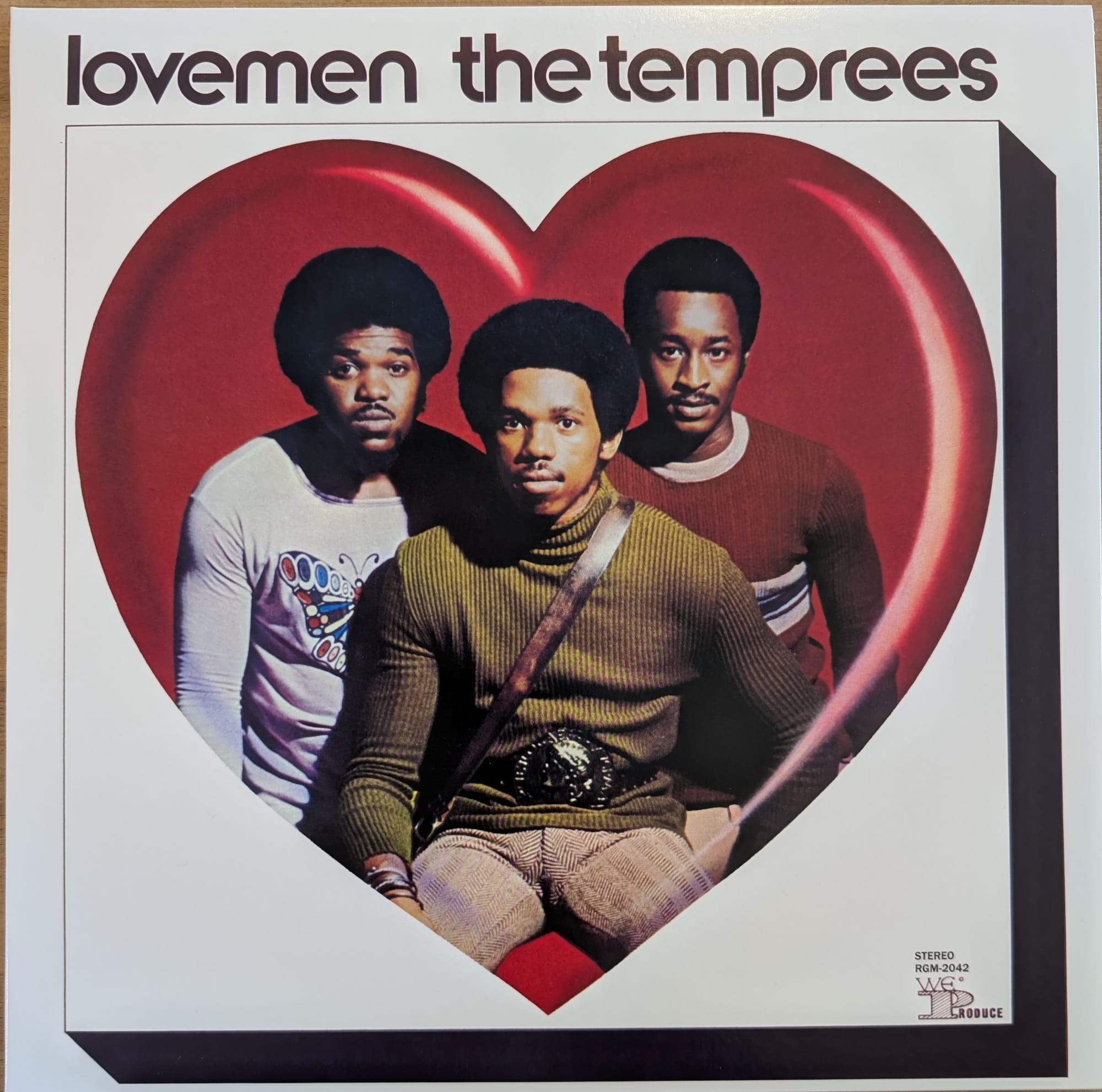
- The Temprees: Lovemen
Before we get started on those, here’s a cheery reminder that we’ve got a paid tier option for those who’d like to support our work and be eligible for extra perks—like our monthly vinyl giveaways. We’ll be announcing February’s giveaway next week, so get your foot in the door early by clicking this button right here.
As we approach the six-month mark here at The Vinyl Cut, we will be making some sections of the site available only to paid subscribers; we have other paid-tier perks in the works as well. We’ll have further details on those as we get closer to March, but for now, let’s sink our teeth into today’s reviews.
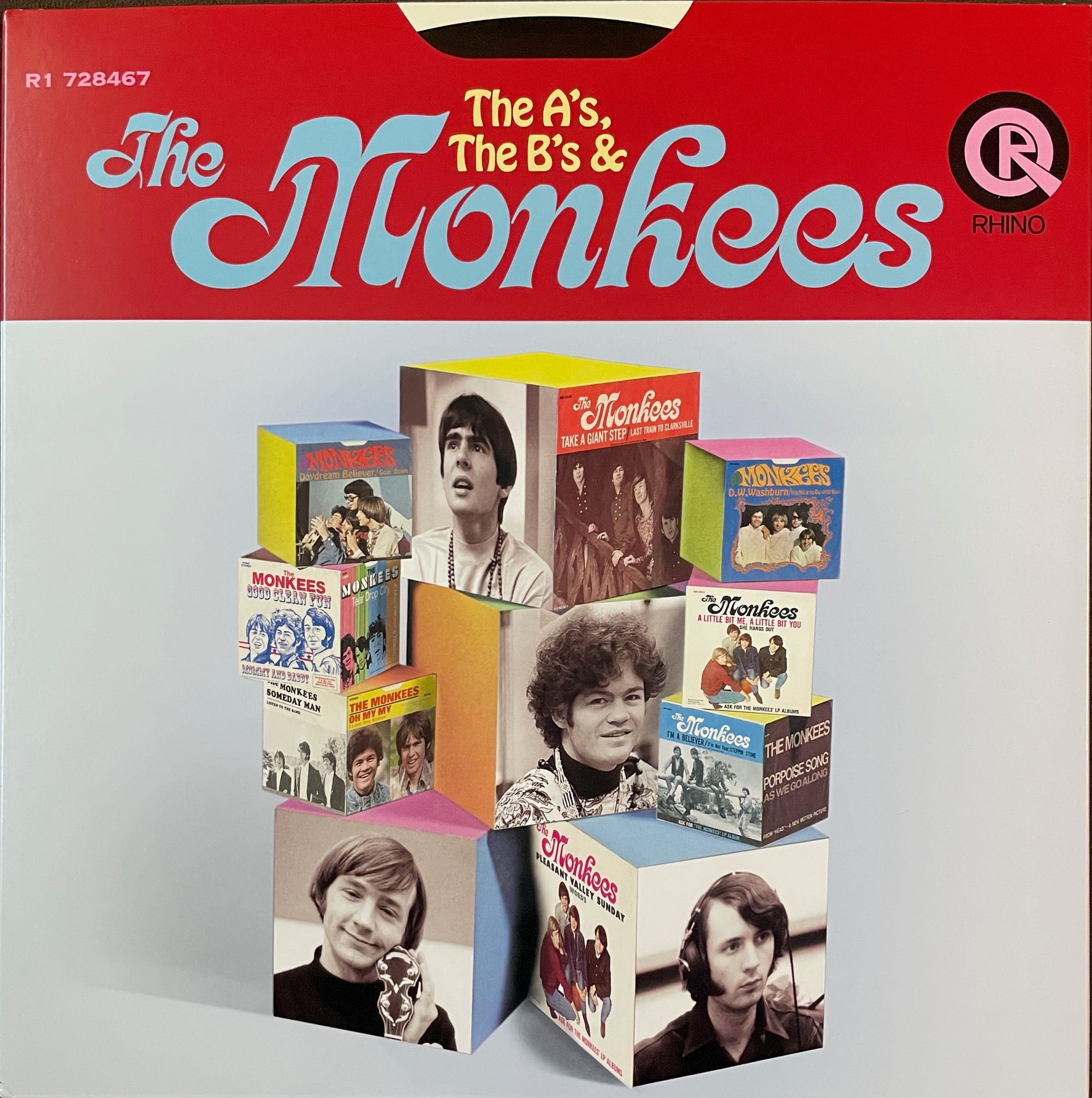
The Monkees: The A’s, the B’s & the Monkees
Review by Ned Lannamann
It’s such a simple idea: A double LP that includes all the A-sides and B-sides of the Monkees’ 12 American singles. It’s so simple that you wonder why it hasn’t been done before. But then comes the next question: Do you braid all the A-sides and B-sides together in chronological order, or do you separate them out each onto their own disc? On streaming, this isn’t really a concern, as you can just make a playlist to suit your preference. But on vinyl, this kind of decision can’t be taken lightly.
Rhino has elected to do one disc of just the A-sides and one of the B-sides. This makes sense, to a degree, so I can’t really fault them. That first disc, then, becomes a concise runthrough of all the Monkees’ US singles, which made for a nearly unimpeachable run of great ’60s pop tunes. (I said nearly unimpeachable—the rotten peaches in this case being 1969’s “Tear Drop City” and the final Monkees single, 1970’s inglorious dismount “Oh My My,” both featuring valiant efforts by the inimitable Micky Dolenz, perhaps one of the most undersung pop vocalists of all time.) The second disc, then, becomes a grab bag of tracks that span the group’s career without little to connect them together stylistically. All told, it’s quite a good batch, and there are even some hits in there, too, such as 1966’s “(I’m Not Your) Steppin’ Stone” and 1967’s “Words,” which both charted as B-sides during the height of Monkeemania. In fact, there’s only one outright dog in the bunch, a drippy Davy Jones–sung tune from 1968 called “It’s Nice to Be with You” that never showed up on an album, and it’s pretty obvious why.
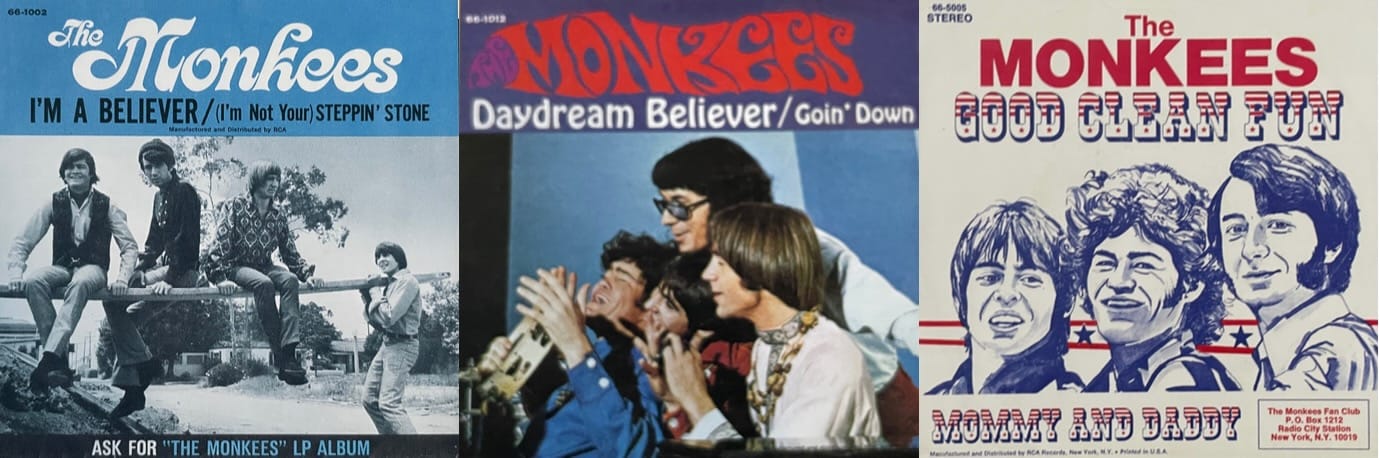
After spending some time with The A’s, the B’s & the Monkees—a title whose reliance on apostrophes and disdain for the serial comma gives me agita—I think I would have preferred a straight chronological run of all 24 songs, with the A-sides and B-sides alternating. That would have provided a more coherent overview of the TV-stars-turned-pop-musicians’ history on 45. However, following the chronological release dates of the singles was never going to result in a perfect flow, no matter how they handled it: “Tear Drop City,” that failed 1969 single, is a drab rewrite of the Monkees’ debut “Last Train to Clarksville,” by which I mean it’s literally the same exact song. Pulled out of mothballs, it was recorded way back in 1966 just as “Clarksville” was edging toward the number-one spot in America. Which means that slotted in between two of the Monkees’ greatest, most ambitious pop masterpieces—the gorgeous psychedelic largo of 1968’s “Porpoise Song” and the horn-spangled Opry mini-suite of 1969’s “Listen to the Band”—comes the unfortunate “Clarksville” karaoke of “Tear Drop City.”
Interestingly, there are a handful of other tracks that never appeared on a Monkees full-length album (in addition to that aforementioned clunker of a B-side, “It’s Nice to Be with You”). There’s “A Little Bit Me, a Little Bit You,” the 1967 Neil Diamond–penned follow-up to “I’m a Believer” that’s no stranger to Monkees hits compilations; “D.W. Washburn,” a genuinely bizarre, bad-trip rag from Leiber & Stoller that is fascinating for being willfully out of step with 1968’s prevailing rock trends; and two outstanding B-sides from 1967, the Michael Nesmith–written “The Girl I Knew Somewhere” and the group-composed “Goin’ Down,” which was a riff on Mose Allison’s “Parchment Farm.” There’s also another Davy feature, Paul Williams’ “Someday Man,” a glitzy, top-hat-and-tails number that was originally intended as the A-side to “Listen to the Band” but got relegated to B-side status (and non-album obscurity) when radio programmers had their say. As far as those kinds of songs go, I have to say it’s a pretty good one.
 Ned Lannamann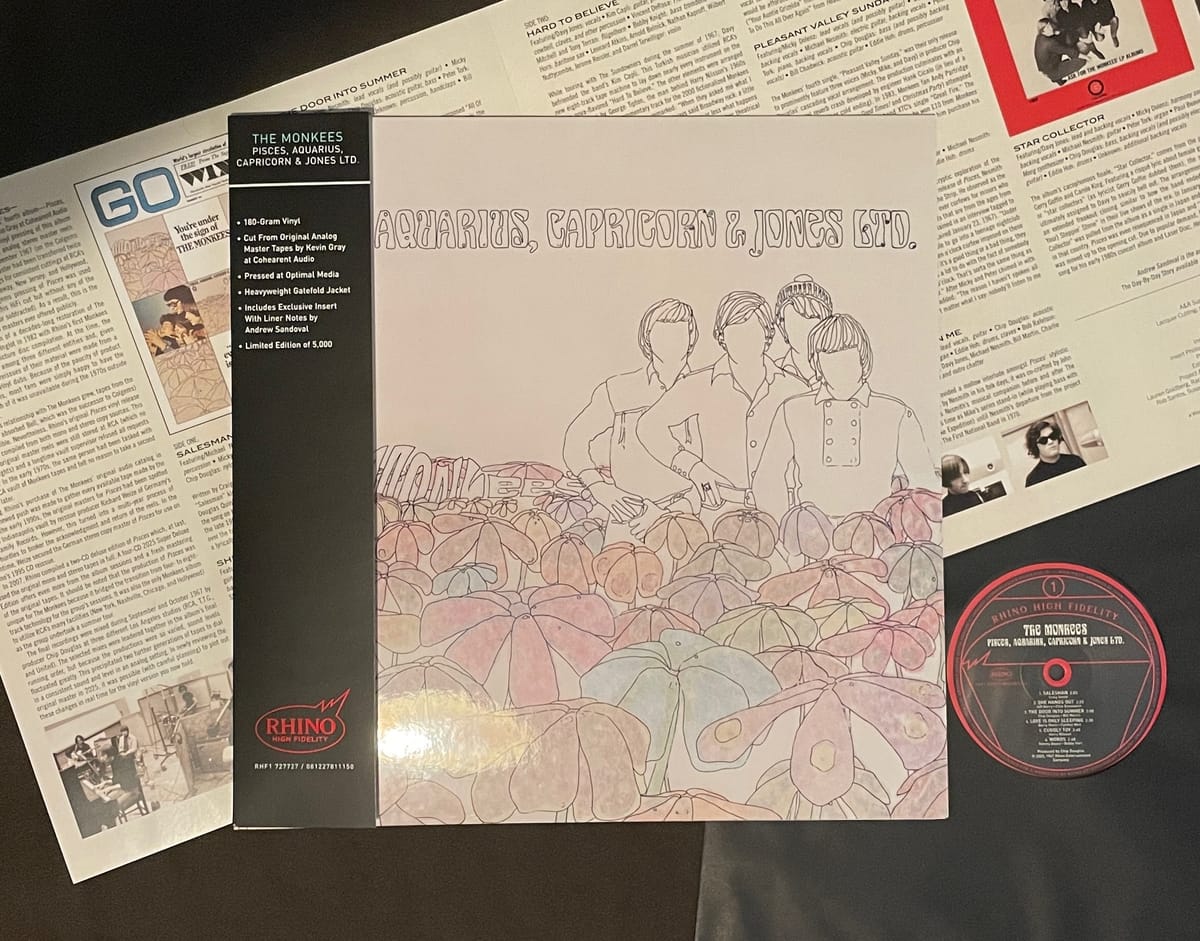
But it faces pretty stiff competition on a compilation that includes several of the most perfect jewels of ’60s American pop. “Porpoise Song” and 1967’s “Pleasant Valley Sunday,” a dazzling, Byrdsian slice of California psych, are two indisputable highlights, but for my money, the Monkees’ finest four recorded minutes were “As We Go Along,” which appeared on the flipside of “Porpoise Song” as well as the soundtrack album for the 1968 movie Head. It’s a gentle but stop-you-in-your-tracks stunner built atop softly plucking guitars (Neil Young, Ry Cooder, Danny Kortchmar, and the song’s writer Carole King reportedly all strummed on the session), and it locates the precise eye of the ’60s hurricane—a graceful moment of peace and calm while all the world stormily revolves around it.
Great effort was undertaken to locate the actual mono single mixes (their last four singles were actually released in stereo, in some cases in unique mixes of their own). Andrew Sandoval is credited with archival audio sourcing—he wrote the liner notes as well—so I feel confident that what’s here is what’s advertised: These were the mixes that appeared on the original singles. I feel less confident in telling you which ones are different from the album mixes, but considering most people nowadays have only heard them in stereo to begin with, there’s plenty to intrigue the ear. (Sandoval’s liner notes don’t spell out the mix differences, sadly; while generally informative, they don’t reveal a ton that even lightly seasoned Monkees fans don’t already know.) Bernie Grundman has done the mastering, and the discs sound natural and true to their origins as mono singles while being upgraded for the record players of today. If some of the consolidated punch is gone, it’s been exchanged for a very welcome clarity and dimension.
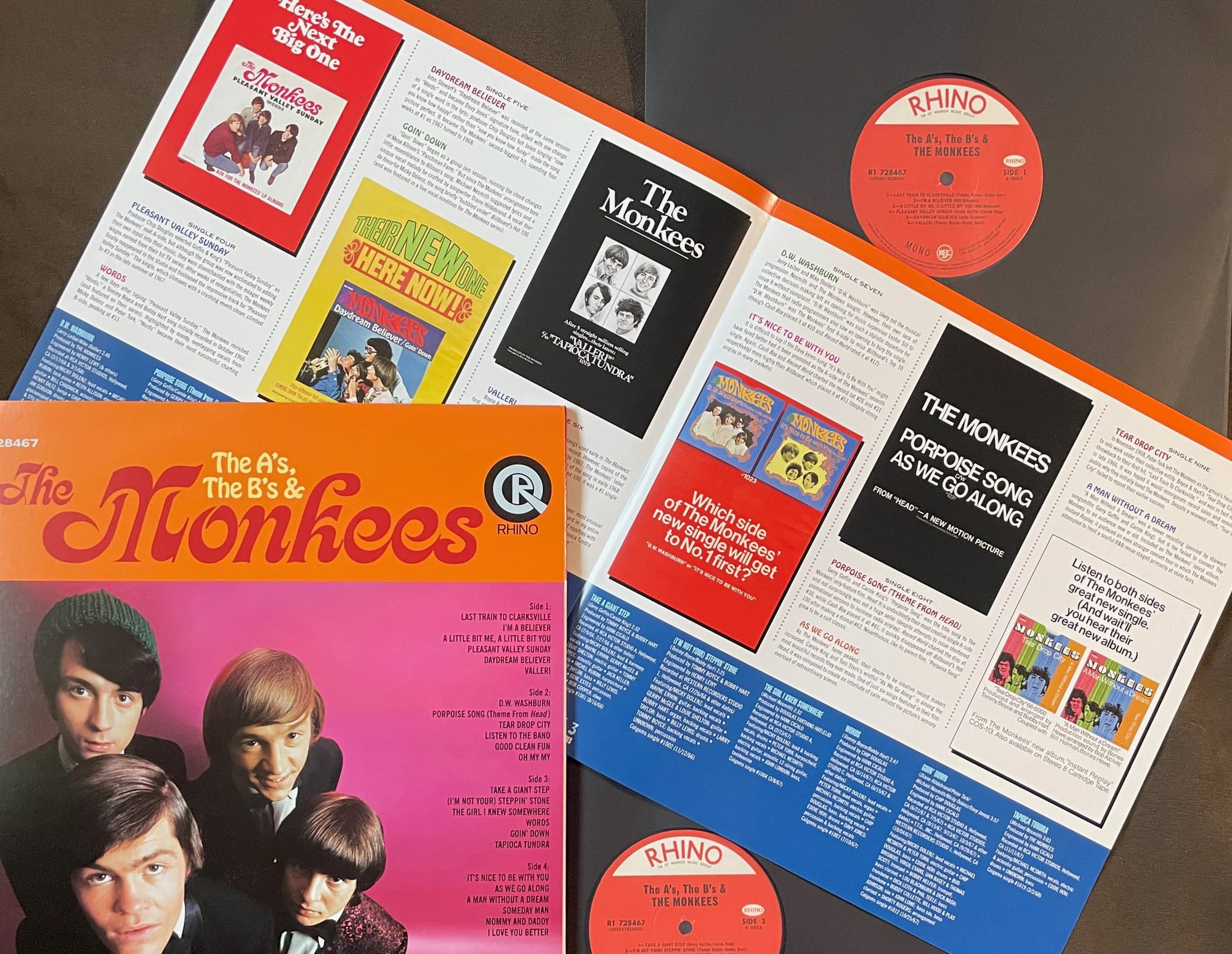
The mono version of “Pleasant Valley Sunday” leans more into the rock of the folk-rock equation, with a powerful sound that’s slightly cleaner than the stereo album mix (despite some missing backing vocals), and “(I’m Not Your) Steppin’ Stone” sounds every bit the garage-rock-inspiring evergreen that it became. The mists and echoes of Nesmith’s kaleidoscopic “Tapioca Tundra” are depicted more cleanly in the single mix, and “Take a Giant Step” allows you to hear around sonic corners, revealing itself to be quite a dense and ambitious production. “Valleri,” meanwhile, is fiercely zippy with a surprisingly heavy bass presence. On the less positive side, “The Girl I Knew Somewhere” in mono is noticeably muddier than the more familiar stereo mix, and the expansive magnificence of “As We Go Along” is diminished within the constricted mono viewfinder.
Nevertheless, this is a useful and wholly enjoyable compilation that distills the Monkees’ best and worst qualities into 24 representative tracks. Their evolution from folk-rock-derived Los Angeles session pop to moony psychedelia before settling on a diverse hodgepodge of styles that embraced Jones’s showbiz schmaltz and Nesmith’s progressive country-rock is charted astutely across The A’s, the B’s & the Monkees. With Dolenz’s acrobatic voice threaded throughout their biggest hits, they were a versatile, ever-changing hit machine. Even Peter Tork is present for a few brief audible snatches, during the verses of “Words” and playing harpsichord on “The Girl I Knew Somewhere.” In other words, there’s something for everyone here—this is the rare compilation that has appeal to newcomers and hardcore fans alike.
Rhino 2-LP 33 RPM black vinyl
• Double LP collecting all the A-sides and B-sides of the Monkees’ 12 US singles, issued between 1966 and 1970
• Jacket: Direct-to-board single-pocket top-loading jacket
• Inner sleeves: Black poly-lined
• Liner notes, insert, or booklet: Four-page insert with liner notes by Andrew Sandoval and track details
• Source: Digital
• Mastering credit: Bernie Grundman at Bernie Grundman Mastering, Hollywood, CA; Digital Mastering by Dave Schulz with Bill Inglot at d² Mastering, Los Angeles, CA
• Lacquer cut by: Bernie Grundman at Bernie Grundman Mastering, Hollywood, CA; “BG” in deadwax
• Pressed at: Memphis Record Pressing, Memphis, TN
• Vinyl pressing quality (visual): B+ (both discs were dished)
• Vinyl pressing quality (audio): B (some noise, static, and clicks on Side 4 after ultrasonic cleaning)
• Additional notes: Part of Rhino’s Start Your Ear Off Right campaign for January 2026.
Listening equipment:
Table: Technics SL-1200MK2
Cart: Audio-Technica VM540ML
Amp: Luxman L-509X
Speakers: ADS L980
Bayeté Umbra Zindiko: Seeking Other Beauty
Review by Robert Ham
Under his given name, Todd Cochran has amassed the kind of credits you might expect from a journeyman keyboardist who worked regularly in the ’70s and ’80s, contributing to albums by R&B stars like Cheryl Lynn and Teena Marie while also playing on Mike Post’s theme song for the TV series The Greatest American Hero. But when the San Francisco-born artist takes on his adopted moniker of Bayeté, he goes into far more fascinating musical areas. Under that name, Cochran worked with Peter Gabriel on the Brit’s second solo album, co-founded the space-rock band Automatic Man, and played on Julian Priester’s 1974 fusion jazz classic Love Love.
The same holds true for the albums Cochran has released under his various names. 1991’s Todd is a decent if bland set of instrumental jazz that works as a fine showcase for Cochran’s piano playing. The two albums he recorded for Prestige under the name Bayeté—1972’s Worlds Around the Sun and 1973’s Seeking Other Beauty (credited to Bayeté Umbra Zindiko)—on the other hand, are funk/fusion gems where Cochran wrestles with the personal, political, and spiritual to electrifying effect.
With Worlds Around the Sun getting a justly celebrated vinyl reissue in 2022 as part of a collaboration between Craft Recordings’ sub-label Jazz Dispensary and embattled subscription service Vinyl Me, Please, this week’s first-ever repressing of Seeking Other Beauty feels long overdue. But as exciting as it is to finally have a comfortably priced edition of the 1973 record readily available, this new edition highlighted some strange choices made by Bayeté and Prestige Records when mixing and mastering the original album sessions.

Both sides of the LP open with loud, raucous statements of purpose. The A-side kicks off with “Let It Take Your Mind,” a short explosion of wah-wah guitar, electric clavinet, and chanted vocals, while the flip starts with “Don't Need Nobody,” a 10-minute mind-melter that finds a delicious technicolor middle ground between Head Hunters and Maggot Brain. But on both tracks, just as the songs catch fire, the heavier bass tones start to take on a wildly distorted sound, overpowering everything else in a particularly ugly manner. Worried I had somehow unseated the woofers in my speakers, I spun the record on a different stereo setup: a Technics SL-1200MK2 fitted with an Ortofon Concorde stylus and playing through a Technics SU-CO4 amplifier. Heard through AKG K240 Studio headphones, the same bass tones were a little less blown out but still intrusive to the rest of the song. And to see if it was simply my particular copy of the LP, I fired up a YouTube video made from a vinyl rip of an original pressing and found the same issue prevailed.
Those ultra-distorted moments are particularly curious as they are isolated to just those two tracks on the LP. The rest of the album is a flawless delight to listen to, with Bayeté and his band veering into free jazz freakouts and soulful ballads with ease. I suspect Clint Holley and Dave Polster, the two engineers whose signatures are etched into the deadwax, did the best they could with these messy moments, but those slips into overdrive make the otherwise great tracks a little tough to take when played through my system.
Real Gone Music/Prestige 1-LP 33 RPM “plasma” vinyl
• All-analog reissue of Bayeté’s 1973 album
• Jacket: Direct-to-board single pocket
• Inner sleeve: Gotta Groove–branded rice-paper-style poly
• Liner notes, insert, or booklet: Double-sided insert with liner notes by Pat Thomas and an interview with Bayeté
• Source: Analog; “All-Analog Release” on hype sticker
• Mastering credit: None listed, but both Clint Holley and Dave Polster’s marks are in deadwax
• Lacquer cut by: Clint Holley and Dave Polster at Well Made Music, Bristol, VA; “CJIII + dP” in deadwax
• Pressed at: Gotta Groove Records, Cleveland, OH
• Vinyl pressing quality (visual): A
• Vinyl pressing quality (audio): A- (overdriven bass on a pair of tracks)
• Additional notes: A black vinyl variant is also available, as is an ultra-limited Wax Mage colored-vinyl edition.
Listening equipment:
Table: Cambridge Audio Alva ST
Cart: Grado Green3
Amp: Sansui 9090
Speakers: Electro Voice TS8-2
The Temprees: Lovemen
Review by Robert Ham
The tale of the Temprees, the vocal trio from Memphis, should be a success story. Deljuan “Del” Calvin, Jasper “Jabbo” Phillips, and Harold “Scotty” Scott all met in junior high, bonding over their love for the soul and R&B sounds that dominated the local music community and honing their vocal harmonies to highlight Phillips’s keening falsetto. They eventually caught the attention of Stax producer Josephine Bridges, who mentored the group and signed them to her We Produce label. Together with co-producer Tom Nixon, Bridges put the full weight of the Stax talent pool—including the crackerjack house bands the Bar-Kays, the Movement, and the We Produce Band—behind the Temprees on three good-to-great albums that came out in quick succession: 1972’s Lovemen, 1973’s Love Maze, and 1974’s Three.
Despite high-profile showcases at 1972’s Wattstax benefit concert in LA and an appearance on Soul Train, the Temprees never caught fire commercially, with only one single—their rendition of the Pauling/Bass classic “Dedicated to the One I Love”—scraping the lower rungs of the Billboard Hot 100. After Stax folded in early 1976, the group tried to ride the rising wave of disco with a pair of stand-alone singles on Epic, but when their chart prospects fizzled out, they quietly went their separate ways. (The original lineup reunited in the ’90s, performing regularly on the nostalgia circuit until Phillips’s death in 2001.)
As with so much R&B music of the time, the ’70s output by the Temprees has been rescued from potential obscurity by crate diggers and rare-groove DJs, tipping up the price of their albums on the secondary market and making the arrival of this fantastic all-analog repress of the group’s debut Lovemen all the more appreciated.
The tone of the music and the song selection were both meant to reinforce the image of the three men as the ultimate romantic partners. There are no broken hearts or mournful regrets to be found here, just the first blushes of a new relationship or the heat of a midnight coupling. The Temprees make a meal of their slow-burning rendition of “Dedicated to the One I Love,” riding the loping groove as they repeat the line “All the stars above” with increasing levels of intensity.
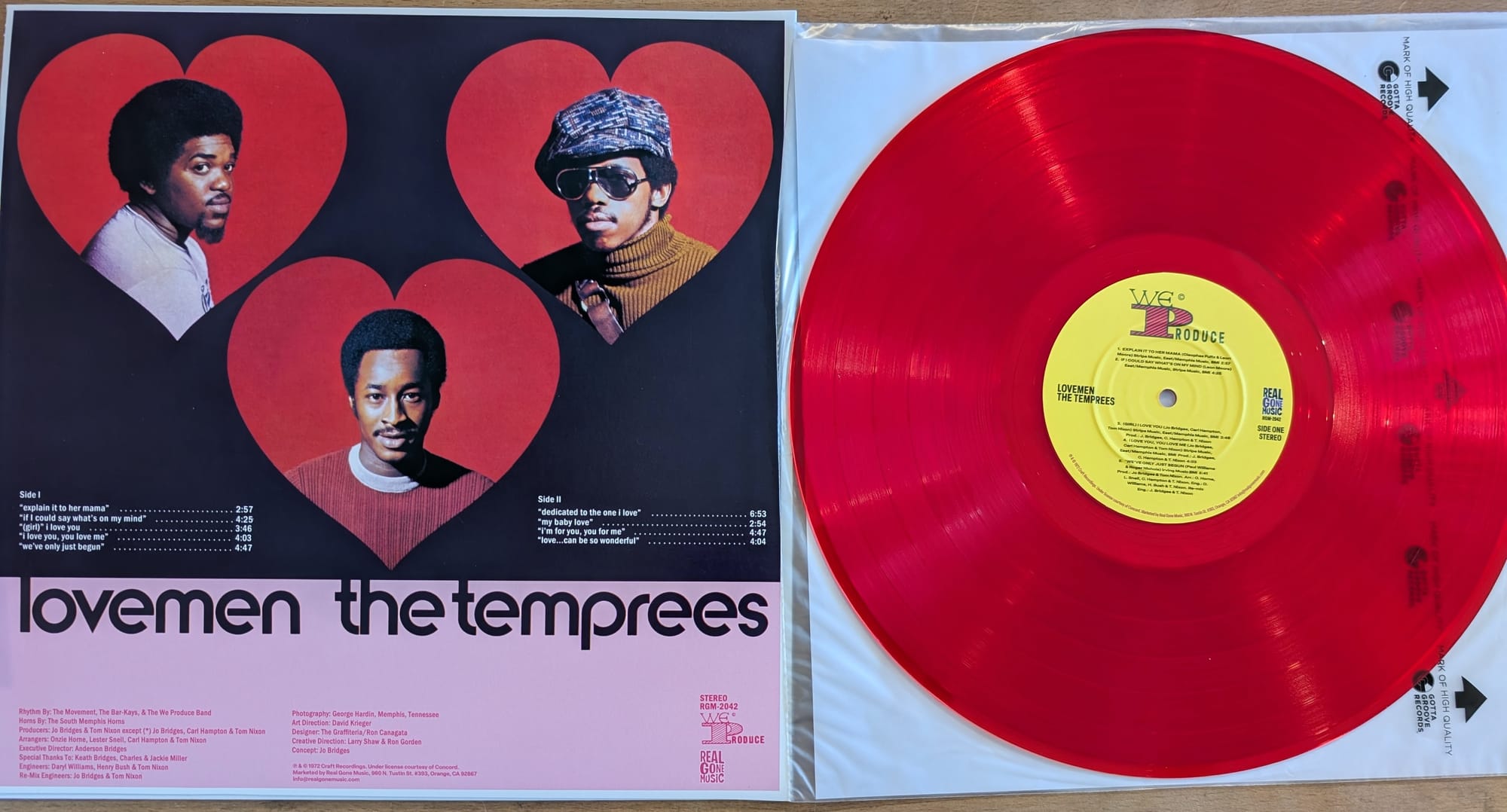
Even better is their take on the Paul Williams/Roger Nichols tune “We’ve Only Just Begun.” Rather than try to match the soppy tone of the Carpenters’ 1970 hit version, the Temprees’ arrangement goes for a silky-smooth midtempo groove topped off by a straining string section and a coda that puts a little disco stomp into the mix for good measure. Phillips responds with a biting joy that skitters over the music.
The rest of Lovemen leans heavily on Philly-soul-inspired ballads, but that’s a perfect playground for the Temprees’ skin-tingling harmonies. It took a few years before the format known as quiet storm would gain popularity around the US, but the satiny and occasionally syrupy tunes like “Love…Can Be So Wonderful” and “If I Could Say What’s On My Mind” would have fit comfortably on to those radio stations’ late-night playlists.
I haven’t heard an original pressing of Lovemen, but I can only hope that it sounds as good as this reissue. Working from the original analog tapes, mastering engineers Clint Holley and Dave Polster produced a truly delectable piece of wax, capturing the resonance and depth of field that marked so many of the great releases on Stax and their subsidiaries. It oozes from the speakers like smoke, enveloping the room with a lovely balanced approach that lets the rhythm section creep forward on the uptempo tracks and the strings and horns float up on the ballads. And cutting through it all are those knee-buckling vocal harmonies, set at just the right temperature to scintillate and tantalize.
Real Gone Music/We Produce 1-LP 33 RPM “valentine red” vinyl
• All-analog reissue of 1972 album
• Jacket: Direct-to-board single pocket
• Inner sleeve: Gotta Groove-branded rice-paper-style poly
• Liner notes, insert, or booklet: None
• Source: Analog; “All-Analog Release” on hype sticker
• Mastering credit: None listed, but both Clint Holley and Dave Polster’s marks in deadwax
• Lacquer cut by: Clint Holley and Dave Polster at Well Made Music, Bristol VA; “CJIII + dP” in deadwax
• Pressed at: Gotta Groove Records, Cleveland, OH
• Vinyl pressing quality (visual): A
• Vinyl pressing quality (audio): A
• Additional notes: A black vinyl variant is also available, as is an ultra-limited Wax Mage colored-vinyl edition.
Listening equipment:
Table: Cambridge Audio Alva ST
Cart: Grado Green3
Amp: Sansui 9090
Speakers: Electro Voice TS8-2