Reviews: Vinylphyle editions of Bob Marley, The Band, and Nat King Cole


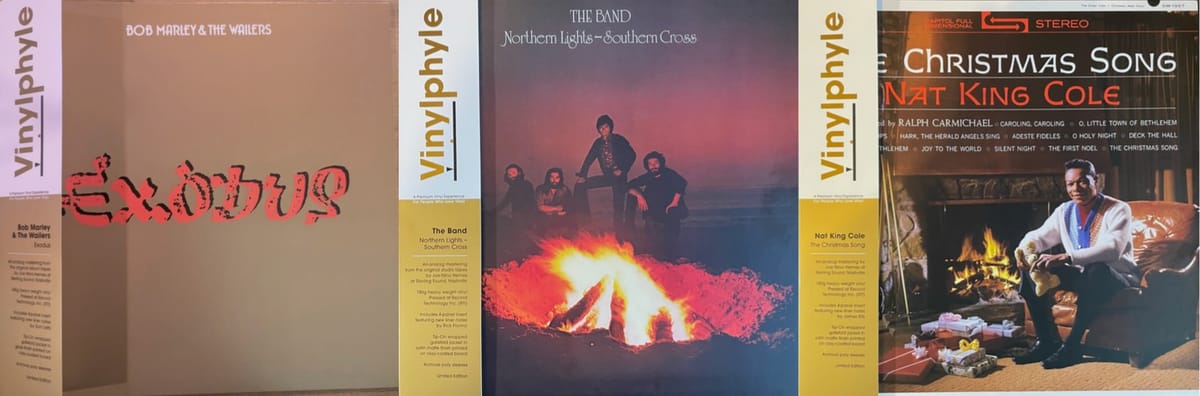
Cover art for Bob Marley, The Band, and Nat King Cole.

We dig into the rest of the Vinylphyle starting lineup, including Exodus, Northern Lights–Southern Cross, and The Christmas Song.

Two weeks back, we jumped on one of the first four titles of Universal’s new all-analog Vinylphyle series. Today we’ve got reviews of the remaining three.

Broadly speaking, we’re dang impressed with the series so far, with all the cuts sounding fantastic and the pressings being close to flawless. Really, the only criticism is the name “Vinylphyle”—everything else is superb, from Joe Nino-Hernes’s expert mastering to the high-quality pressings, from the sturdy gatefold sleeves to the unfailing inclusion of liner notes.

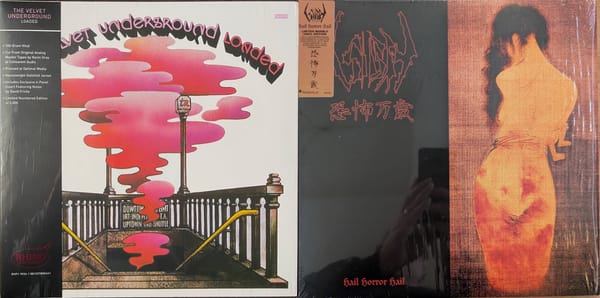
If you missed our review of the fourth Vinylphyle title, The Velvet Underground & Nico, you can check that out right here:

Reviews: The Velvet Underground | Sister Irene O’Connor
The Vinylphyle edition of The Velvet Underground & Nico, and a worthy reissue of Fire of God’s Love. We’ve got two vinyl reviews for you today, including our first look at the ballyhooed Vinylphyle series, and a loving reissue of a gentle, inspirational oddity. The Velvet Underground & Nico: Vinylphyle

Before we get to the reviews, here’s the obligatory mention of our paid subscriber tier.

Ahem. We have a paid subscriber tier!

All right, I’ll sell it a bit harder. The paid tier helps everything we do here at The Vinyl Cut, for obvious money reasons, and it allows you to support independent music journalism and keep this place sponsor-free. Bob and I chose the newsletter model deliberately, as we felt it was the best way to connect directly with readers, but it is a model that’s reliant on paid subscriptions.

However, there’s another excellent reason to sign up. Our paid subscribers are about to get the chance to enter our very first vinyl giveaway, for a copy of Neil Young’s Original Release Series #6. This 8-LP collection gathers all of his albums from 1992 to 1995, many of which were impossible to find until this immense box set’s welcome appearance a few weeks back. I reviewed it here, if you’re looking for more info about it.

So—if supporting our work and getting the chance to win free vinyl sounds like your kind of thing, here is a nifty button for you to click:

And if you simply can’t support us at this time, that’s 100 percent A-OK with us too. We’re really glad you’re here, all of you. Thanks for reading. Let’s get into the reviews.

Cover art for Bob Marley and the Wailers.

Bob Marley and the Wailers: Exodus

Review by Robert Ham

There’s a sound logic behind the choice of Exodus for Universal’s new Vinylphyle series of premium, all-analog pressings of classic albums. The 1977 album by Bob Marley and the Wailers remains one of the most beloved in that group’s catalog, regularly cited in lists of the greatest LPs ever recorded—Time magazine went so far as to name it the best album of the 20th century. For fans, Exodus’s reputation is sterling, aided in no small part by Island Records plucking five songs from it for Legend, the monumental 1984 Marley compilation that remains a staple of dorm rooms and hostels across the globe. 

The timing of this pressing of Exodus, on the other hand, is curious. While it comes as part of the first shot across the audiophile market bow that Universal is undertaking—along with premium reissues of albums by the Velvet Underground, The Band, and Nat King Cole—it also arrives on the heels of many recent audiophile-minded reissues of the same material. 

Exodus was part of a much-crowed-about 2020 series that re-pressed all the albums Marley released on Island, with the audio given the half-speed master treatment at Abbey Road Studios and lacquers cut by engineer Miles Showell. And as recently as May, Analogue Productions issued the album in a limited-edition UHQR all-analog 2-LP 45 RPM pressing, with mastering and lacquers handled by Ryan K. Smith at Sterling Sound in Nashville. (Smith was also behind the mastering and lacquers for the single-LP UHQR edition that Analogue Productions released in 2023.)

Although nothing on the 2020 half-speed pressing I have on hand indicates that Abbey Road and Showell had access to the original master tapes, this all still feels like a lot of wear and tear to inflict upon the nearly 50-year-old reels. It left me initially concerned with how this new edition was going to stack up, even after reading my colleague’s effusive praise for the Vinylphyle version of The Velvet Underground and Nico

I was fretting needlessly. With the sure hands and ears of Sterling Sound’s Joe Nino-Hernes working with the original analog tapes, Exodus is given a beautiful presentation here. From the first flickering notes of “Natural Mystic” to the dying embers of the smoldering album closer, “One Love/People Get Ready”—a ska tune of Marley’s that he reworked to include some melodic details cribbed from the Impressions—the album casts an unearthly glow upon whatever room it's playing in. This new pressing only amplifies the heat and warmth of the music, with the proper emphasis on the low end provided by bassist Aston “Family Man” Barrett and the swirling midrange where Marley and his stunning backup singers the I-Threes comfortably reside. 

When compared to the Showell cut, I did notice a drop in the overall brightness, but that is more than made up for by the remarkable detail Nino-Hermes brings out. Each clatter and ping of Alvin “Seeco” Patterson’s percussion instruments, the talk box intoning “movement of Jah people” throughout the title track, and the various little melodic touches played on organ, piano, and synthesizer by Tyrone Downie are startlingly clear. 

Contents of the Vinylphyle edition of Bob Marley and the Wailers' Exodus.

Another element of these recordings laid bare here came as something of a surprise. No matter how many times I’ve heard “Waiting in Vain,” the delicate, loping love song that was a Top 30 hit in the UK, I had never noticed that the bridge section (the part that begins “’Cause if summer is here…”) was clearly spliced into the tapes or punched in by the band during the album sessions. For those brief few seconds, the audio takes a small dip in quality and range before leaping back to normal once the next proper verse gets underway. The change is not quite as remarkable as it is on the 2020 half-speed edition, but it is far more glaring than the streaming version of the song or a CD copy of the album I referenced. 

Those little and large details are the reason listeners like myself got into this whole vinyl reissue game. With a great mastering job, a solid pressing, and illuminating liner notes, we are brought as close as possible to the rooms where this music was created and recorded. The Vinylphyle Exodus ticks all those boxes. The essay included on the insert is by filmmaker and artist Don Letts, who spent ample time with Marley after the reggae star and his band relocated to London in 1976. At the time, Marley was still reeling from an attempted assassination at his home in Kingston days before he was to perform at a concert meant to quell ongoing political violence in Jamaica. The attack left Marley, his wife Rita, his manager Don Taylor, and band associate Louis Griffiths with injuries, but all survived. The artist performed as planned but left his home soon after and, with the help of Island Records head Chris Blackwell, exiled himself and the band to London. Blackwell also gave the Wailers the run of Island’s Basing Street Studios, where Exodus and its follow-up, 1978’s Kaya, were recorded. 

With all the chaos swirling around Marley’s life, it's a wonder that Exodus sounds as easygoing as it does, especially on Side 2, which features the album’s most heartfelt (“One Love,” “Waiting in Vain”) and drippiest (“Three Little Birds,” “Turn Your Lights Down Low”) tunes. The opening side, meanwhile, is where Marley drills down into the plight of his fellow Rastafarians and his hope of them finding freedom from their oppressors in Jamaica. For all the stoned grooves and laid-back energy of the songs on Side 1, they are suffused with anger, frustration, and fiery Biblical references. 

The duality of Exodus is what has kept this album resonating with listeners for nearly five decades now, but that same quality has always left me wanting. It’s never been my favorite of the band’s work, which is why I would have liked to have seen Universal go back to one of the more fervid earlier efforts like Burnin’ or Catch a Fire, both released in 1973. But that’s not how you get folks to buy into a high-end reissue series like this. Universal has given the people what they want, and it will undoubtedly satisfy their musical souls. 

Tuff Gong/Island/UMe 1-LP 33 RPM 180g black vinyl
• New Vinylphyle all-analog remaster of the 1977 studio album by Bob Marley and the Wailers
• Jacket: “Tip-On wrapped gatefold jacket in gloss finish printed on clay-coated board” with reproduction of the embossed details from the original LP, and a Vinylphyle obi
• Inner sleeve: RTI-branded rice-paper-style poly sleeve
• Liner notes, insert, or booklet: Four-page insert featuring essay by musician/filmmaker/DJ Don Letts and photos of the master tape boxes
• Source: “All-analog mastering from the original album tapes” 
• Mastering credit: Joe Nino-Hernes at Sterling Sound, Nashville, TN
• Lacquer cut by: Joe Nino-Hernes at Sterling Sound, Nashville, TN - “JN-H” in deadwax
• Pressed at: RTI (Record Technology Incorporated), Camarillo, CA
• Vinyl quality - visual: A
• Vinyl quality - audio: A
• Additional notes: Nice reproduction of the original Island labels for this one; limited edition according to obi. Comes in reusable outer bag with perforations.

Listening equipment:
Table: Cambridge Audio Alva ST
Cart: Grado Green3
Amp: Sansui 9090
Speakers: Electro Voice TS8-2
Cover art for The Band.

The Band: Northern Lights–Southern Cross

Review by Ned Lannamann

By 1975, the wheels for The Band were starting to come off—not yet on fire, but definitely shedding sparks at the axles. The four Canadians and one Arkansan hadn’t recorded an album of original material since 1971’s Cahoots, and the unit was fractured, with the four Canadians now roaming the hills and warm beaches of Malibu, and drummer Levon Helm jetting in and out from Woodstock or Arkansas. Keyboardist/vocalist Richard Manuel was in particularly bad shape, drinking multiple bottles of orange brandy every day.

To reunite the clan, the group took over a Malibu ranchette across the highway from Zuma Beach, delighted that it included some motel-style rooms and a separate bungalow; it turned out to be a former bordello, and its stable had once housed Bamboo Harvester, the American Saddlebred that played TV’s Mister Ed. The place was named Shangri-La by its former owner, the blacklisted actress Margo [Albert], and it became The Band’s clubhouse—their new Big Pink—as they went about setting up a recording studio, working slowly throughout 1975. This is where Northern Lights–Southern Cross was created, perhaps as a deliberate, Abbey Road–style attempt to shake off the cobwebs and rouse the group back into fighting form. For the first time, guitarist Robbie Robertson got all the songwriting credit, but Garth Hudson’s contributions were equally front and center, with every track featuring beehive-like layers of his synthesizers.

It’s a good album, about the equal of 1970’s Stage Fright, and it includes some career-best tracks for The Band, such as “It Makes No Difference” and “Ophelia,” although the 1976 live versions from The Last Waltz remain the more familiar renditions. The sweeping historical epic “Acadian Driftwood” is another highlight, the French Canadian counterpart to their masterpiece “The Night They Drove Old Dixie Down.” And for my money, the quirky, jubilant “Jupiter Hollow” is one of The Band’s finest deep cuts, with Robertson’s clavinet offsetting with Hudson’s synths at their blurpy, bleepy best.

The new Vinylphyle edition is cut from the analog master tape by Joe Nino-Hernes, and it’s a remarkable window into those Shangri-La clubhouse sessions, rendered with immaculate clarity and precision. It’s amazing that a brand-new studio already sounded so fully dialed in. (The Vinylphyle liner notes by Rick Florino claim that Northern Lights was the first thing recorded there, contradicting Robertson’s book Testimony, which says that Hirth Martinez’s spaced-out samba-folk opus Hirth from Earth was actually the first thing laid to tape at Shangri-La, and that some Basement Tapes work ensued before The Band embarked on Northern Lights.)

Contents of the Vinylphyle edition of The Band's Northern Lights–Southern Cross.

My 1975 copy of the album, pressed at Capitol’s Jacksonville plant, is a full-bodied, pleasing-sounding pressing that allows all the instruments to shine, some surface noise notwithstanding. “Acadian Driftwood” is a particularly complicated production, with fiddle, piccolo, clavinet, accordion, synths, and three separate lead vocalists all sharing space in the soundscape—the Jacksonville pressing renders all of it with grace and power. The new Nino-Hernes cut takes it one step further, adding a snap and twang to Robertson’s acoustic guitar, cleaning up some of the haze around Manuel’s vocal, and pulling Helms’s drums forward, allowing them to propel the song instead of buttress it. “Ophelia” similarly pops with impact, with Robertson’s clucking guitar prowling around Helms’s down-home vocal and Hudson’s one-man Dixieland horn section. For “It Makes No Difference,” the Vinylphyle version offers a warm, burnished backdrop that allows bassist Rick Danko’s heartfelt vocal to radiate, establishing the emotional core of the LP. I could have used a little more of Danko’s bass throughout the album, as it’s somewhat buried in the mix and jostles for space with the extensively used clavinet, but any of the mixing decisions made at Shangri-La back in 1975 are represented accurately in this splendid pressing.

The jacket puts the track-by-track credits from the original inner sleeve across the inner gatefold spread, and just like the 1975 edition, the tracks are out of order, with the correct sequence not to be found anywhere except the record labels themselves. The tip-on jacket comes in a satin-matte finish with Vinylphyle gold on the inside of the pockets, and the four-page insert contains the aforementioned essay by Florino and images of two master reel boxes for Side 1, leading to some confusion as to which tape was used and the question of what the Side 2 box looks like. Interestingly, one of the tape boxes bears the logo of Village Recorders, leading me to wonder if some mixing or assembly was done there or if the new Shangri-La simply borrowed some tapes from the West LA studio as it was the nearest one to Malibu.

While Northern Lights–Southern Cross remains an album of peaks and valleys, even its more forgettable tracks still sound mighty fine on this new edition, and Hudson’s patented swamp-blend of Lowrey organ and synth always remains interesting to sift through. At certain points, The Band sounds like they’re playing catch-up on the established ’70s styles of Southern rock and funky folk-rock—styles they’d more or less defined on 1968’s Music from Big Pink and 1969’s The Band. But on the album’s highlights (“Acadian Driftwood,” “It Makes No Difference,” “Jupiter Hollow”), their collective alchemy gels, and their clubhouse spirit prevails. If The Last Waltz was their grand farewell statement, Northern Lights–Southern Cross is perhaps a more truthful kind of elegy, one where they got down to business, drew their strengths together, and brought out the best in each other.

Capitol/UMe Vinylphyle 1-LP 33 RPM 180g black vinyl
• New Vinylphyle all-analog remaster of The Band’s 1975 album
• Jacket: “Tip-On wrapped gatefold jacket in satin matte finish printed on clay-coated board” with Vinylphyle obi
• Inner sleeve: RTI-branded rice-paper-style poly
• Liner notes, insert, or booklet: Four-page insert with images of tape boxes and essay by Rick Florino
• Source: “All-analog mastering from the original studio tapes”
• Mastering credit: Joe Nino-Hernes at Sterling Sound, Nashville
• Lacquer cut by: Joe Nino-Hernes at Sterling Sound, Nashville - “JN-H” in deadwax
• Pressed at: RTI (Record Technology Incorporated), Camarillo, CA
• Vinyl quality - visual: A
• Vinyl quality - audio: A
• Additional notes: Limited edition, per obi. Comes in reusable outer bag with perforations.

Listening equipment:
Table: Technics SL-1200MK2
Cart: Audio-Technica VM540ML
Amp: Luxman L-509X
Speakers: ADS L980
Cover art for Nat King Cole.

Nat King Cole: The Christmas Song

Review by Ned Lannamann

As a method of counterprogramming, Nat King Cole’s The Christmas Song’s placement in the initial batch of Vinylphyle releases is an effective gambit. The album is a perennial moneymaker in Capitol Records’ portfolio, and its inclusion is bound to attract a contingent to the Vinylphyle launch who aren’t interested in Bob Marley’s reggae, The Band’s Malibu ramblings, or the Velvet Underground’s avant-rock. The historical and cultural merits of Cole’s work are significant, of course—Cole was a trailblazer in the jazz-derived vocal pop scene of the 1940s and 1950s, a black artist who courted the mainstream, was confronted by some really ugly racism by white audiences, and suffered criticism from some Black figures who perceived him as an Uncle Tom. His early death from lung cancer cut short a groundbreaking career that saw him sing for presidents, host a TV show, and become a visible figure in the civil rights movement.

Cole’s Christmas album conveys virtually none of that. It’s a simple, soothing nostalgia bath, spiced with peppermint and nutmeg, with Cole smoothly delivering his butter-toffee vocal over an array of Christmas carols and songs. The arrangements by Ralph Carmichael are pure midcentury shtick, with shrill, braying choirs, trembling strings, and plenty of jingling bells for good measure. For some, this is what American Christmas music is all about: an aural picture-postcard of a snow-bedecked wingding adorned with gifts and sweets for all, tinged with jolly notions of family and a gently tugging—but not too overt—love for Jesus.

Humbuggery aside, there are indeed some golden moments on The Christmas Song. The title track, of course, is the real classic, the one you involuntarily hear each December somewhere between 60 and 100 times. This was Cole’s fourth recording of the song and its first time in stereo, updating the tune Mel Tormé wrote at age 19 during a sweltering July day. There’s also Cole’s careful, measured reading of “O Holy Night,” where he doesn’t overplay the melodrama. And lastly, there’s “A Cradle in Bethlehem,” a relative Christmas obscurity that lights a spark in Cole as he delivers the LP’s most moving vocal over Carmichael’s relatively tasteful string arrangement. The rest is comfy, cozy kitsch, not too far removed from the Harry Simeone Chorale but with a more distinctive lead singer.

The Vinylphyle edition sources a stereo analog master tape for its cut (performed by Joe Nino-Hernes), and it sounds full and merry and bright. Some more info about the tape’s pedigree would be useful, though—the image of the master tape provided on the insert is for the 1960 configuration of the album, when it was titled The Magic of Christmas and did not yet include “The Christmas Song.” Furthermore, it’s labeled as a “D Copy” (the “D” perhaps standing for “duplicate” or “dub”). The insert also includes an image of the tape box of Disc 1 of 1961’s triple album The Nat King Cole Story, where the stereo re-recording of “The Christmas Song” was first released. What we don’t see is the assembly tape that must have been made sometime in 1962 that added “The Christmas Song” to the album’s running order. Perhaps the assembly tape is gone, meaning it’s possible that a later-generation tape could have been used for this cut. But that is just speculation.

Contents of the Vinylphyle edition of Nat King Cole's The Christmas Song.

What I can hear in this pressing is a small amount of clustering in the chorus and strings, where the sound occasionally becomes syrupy and indistinct. I don’t think there is much cause for alarm, though, as Nino-Hernes’s cut contains ample warmth, a pleasantly large soundstage, some holographic imaging with Cole slightly recessed and above the soundscape, a ripe tonality, and a gratifying dynamic range. The stereo recording is lush and vivid, with wide separation between the two channels and Cole plopped right in the middle.

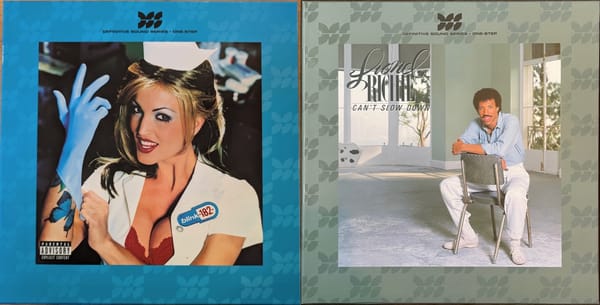
To complicate things, Universal has put out an even higher-end version of this very album to compete with its own product. The Definitive Sound Series one-step pressing of The Christmas Song was released within a week of this Vinylphyle edition and uses a different source altogether—the original three-track masters, which were then reassembled into the album’s running order with two additional tracks and mastered directly to a stereo (two-channel) lacquer. Comparing the Vinylphyle version to a test pressing of the DSS one-step reveals strengths in both, but they sound markedly different. This Vinylphyle version features the familiar reverb on Cole’s voice and the ensemble, added via Capitol’s renowned, trapezoid-shaped underground reverb chambers located beneath their iconic Los Angeles studio. This is the most famous echo sound in the world, heard on recordings by Frank Sinatra and countless others. That echo is present on the Vinylphyle version but not on the DSS One-Step, which features a drier and more articulate rendering of the recording and Cole’s voice in particular. Scholars will want to hear the DSS, as it’s a crisper and more transparent listen, but the version with the echo may be what a lot of listeners are used to and want to hear.

I’m hoping to run a separate review for the DSS one-step at some point; stay tuned to The Vinyl Cut for that. But the shootout was not the cut-and-dry situation I imagined it would be—hence this separate review for the Vinylphyle version. Because of the added echo, I think it’s the more Christmassy sounding of the two, and while it occasionally lapses into muddiness or distortion, it will serve its purpose of instantly adding holiday cheer as soon as you drop the needle.

Capitol/UMe Vinylphyle 1-LP 33 RPM 180g black vinyl
• New all-analog remaster of the stereo version of Nat King Cole’s 1962 Christmas album, itself a reissue of a 1960 LP called The Magic of Christmas with a 1961 re-recording of “The Christmas Song” added and “God Rest Ye Merry Gentlemen” removed
• Jacket: “Tip-On wrapped gatefold jacket in satin matte finish printed on clay-coated board” with Vinylphyle obi
• Inner sleeve: RTI-branded rice-paper-style poly
• Liner notes, insert, or booklet: Four-page insert with images of tape boxes and essay by James Ritz
• Source: “All-analog mastering from the original studio tapes”
• Mastering credit: Joe Nino-Hernes at Sterling Sound, Nashville
• Lacquer cut by: Joe Nino-Hernes at Sterling Sound, Nashville - “JN-H” in deadwax
• Pressed at: RTI (Record Technology Incorporated), Camarillo, CA
• Vinyl quality - visual: A
• Vinyl quality - audio: A
• Additional notes: Limited edition, per obi. Comes in reusable outer bag with perforations.

Listening equipment:
Table: Technics SL-1200MK2
Cart: Audio-Technica VM540ML
Amp: Luxman L-509X
Speakers: ADS L980