Review: Elephant’s Memory | News: Jethro Tull on Rhino High Fidelity

The Jethro Tull 1968–1972 RHF box set is here, sourced from UK tapes.
Hi, record-loving friends—a vinyl review to kick off your week, for Real Gone Music’s reissue of a fantastic and overlooked album from 1970: Take It to the Streets by the New York outfit Elephant’s Memory. The group famously went on to serve as John Lennon and Yoko Ono’s backing band during their Some Time in New York City period of 1971 and 1972, and they also played on Ono’s Approximately Infinite Universe, released in January 1973, but Take It to the Streets finds the group before they teamed up with John and Yoko, writing and playing their own material.
But first…
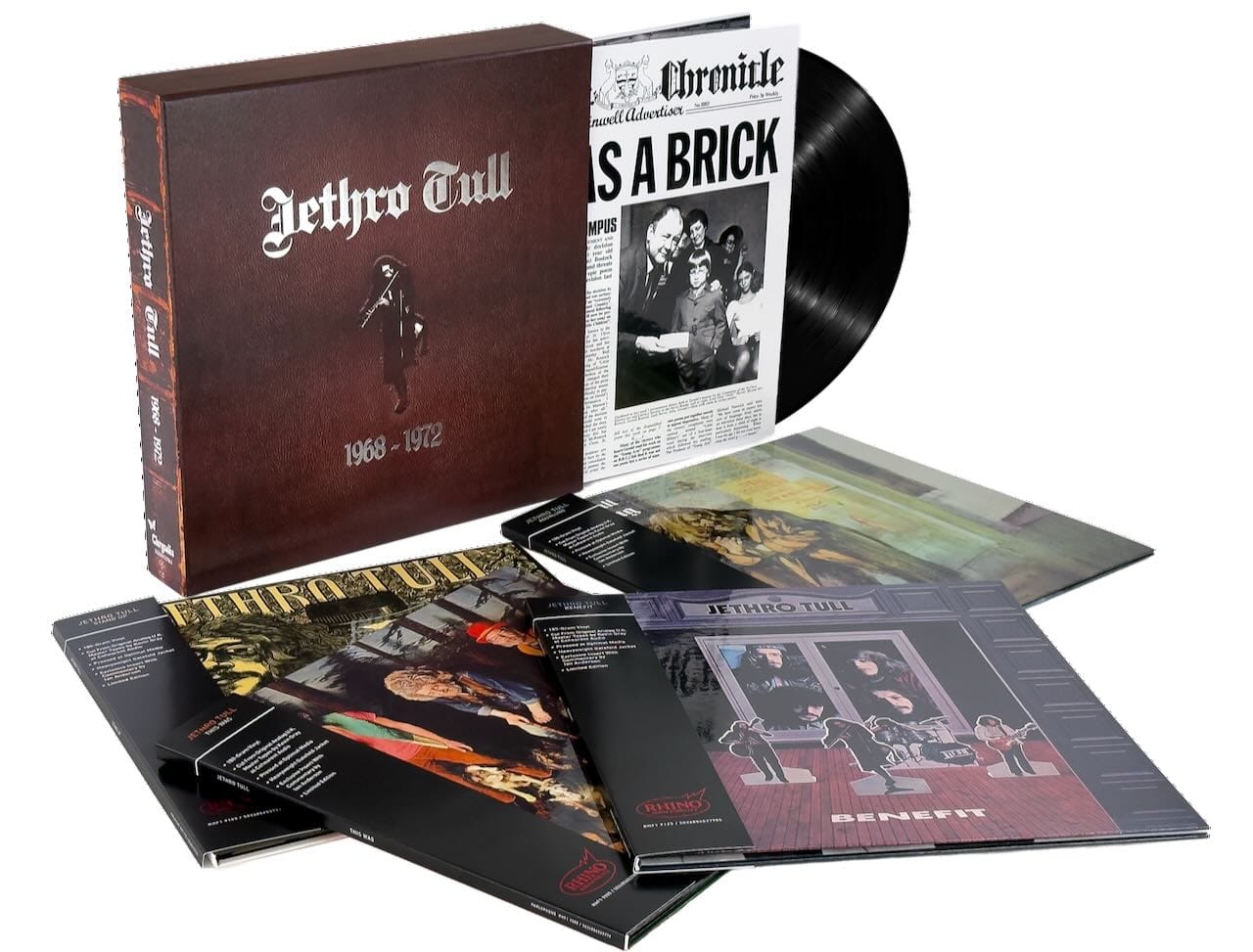
After a brief delay (and endless hours of online speculation), Rhino High Fidelity has announced its new box set. And if you hadn’t already guessed, it’s indeed going to be Jethro Tull, with a 5-LP box containing the British group’s first five albums: 1968’s This Was, 1969’s Stand Up, 1970’s Benefit, 1971’s Aqualung, and 1972’s Thick as a Brick. In an interesting development, the albums are all cut directly from the UK analog master tapes—not the US copy tapes that would have been used by Reprise Records upon their original Stateside release. The use of the UK tapes is uncommon for the Rhino High Fidelity series; their Black Sabbath, Sex Pistols, T. Rex, and Faces reissues used American master tapes, although the RHF of Yes’s Relayer used the UK master. Like previous RHF releases, the lacquers were cut by Kevin Gray and the discs were pressed at Optimal Media.
This period found Jethro Tull evolving from shaggy, flute-flecked blues-rock to a more progressive mixture that simultaneously incorporated British folk-music motifs as well as harder-edged rock from guitarist Martin Barre. Meanwhile, frontman Ian Anderson’s lyrics grew more ambitious, tackling the hypocrisy of religion on Aqualung and positing Thick as a Brick—which consisted of a single 44-minute piece of music stretched over two album sides—as a satirization of the then-pervasive prog-rock “concept” album.
The use of the UK masters for these London-recorded albums means that Gray had access to the first-generation sources, rather than the dubs of the masters that were shipped across the Atlantic for Reprise Records to use. It also means that the new RHF pressing of Benefit will include “Alive and Well and Living In,” which appeared on the UK tracklist—unlike the American LP, which removed that song and added the song “Teacher” instead. Similarly, the opening guitar riff of Aqualung’s title track should cycle through twice before Ian Anderson’s vocals start; on the original American release, the first riff was edited out. And the return of the original album mixes to vinyl is noteworthy, as over the past few years remixer Steven Wilson has completely overhauled the bulk of the Jethro Tull catalog, with his digital remixes replacing the original period stereo mixes. While the Wilson remixes are quite well-thought-of, I believe it’s always important to have the original versions in print. (You hear that, Genesis?)
The albums come housed inside a leatherette slipcase, and the individual jackets are the usual RHF oversized glossy tip-on gatefolds, with inserts that include images of the tape boxes and liner notes that include commentary from Ian Anderson. From what I can tell, the pop-up inner gatefold of Stand Up is not replicated, nor is the fold-out newspaper of the original Thick as a Brick album cover, which instead is reprinted as a separate insert. (And that may be for the best—those lopsided newspaper pages, when folded up, have led many a copy of Thick as a Brick to develop a warp over the years.)
The Jethro Tull 1968–1972 box set is limited to 3000 numbered copies and is on sale now. There’s also a stand-alone reel-to-reel of Aqualung available, duplicated from the UK master and limited to 350 copies.
In case you missed it…
This past Saturday, August 22, I appeared on Steve Westman’s Live Audiophile Roundtable. Alongside Westman and myself, the discussion also included Craig Crane from Analogue October Records and frequent panel guest Michael T from Seattle. We discussed the crazy number of reissue announcements that landed last week, including the Definitive Sound Series one-step of R.E.M.’s Reckoning; the three new Vinylphyles (Allman Brothers, GZA, and Frank Sinatra, which would make for one crazy dinner party); and the gigantic list of Rhino Rocktober titles, which includes Rhino Reserve pressings of the B-52s’ Cosmic Thing and Mott the Hoople’s Brain Capers. If you missed the chat, you can catch up by watching the embedded video above.
And don’t forget to enter our August vinyl giveaway! One paid subscriber will win a copy of the remarkable Albert King live triple album Feeling Alright: The Complete 1975 Nancy Pulsations Concert. The contest closes 11:59 pm Pacific Time on Wednesday, August 26, so the clock is ticking. To find out how to win—and to upgrade to The Vinyl Cut’s paid tier—click on the rectangle below.
 Ned Lannamann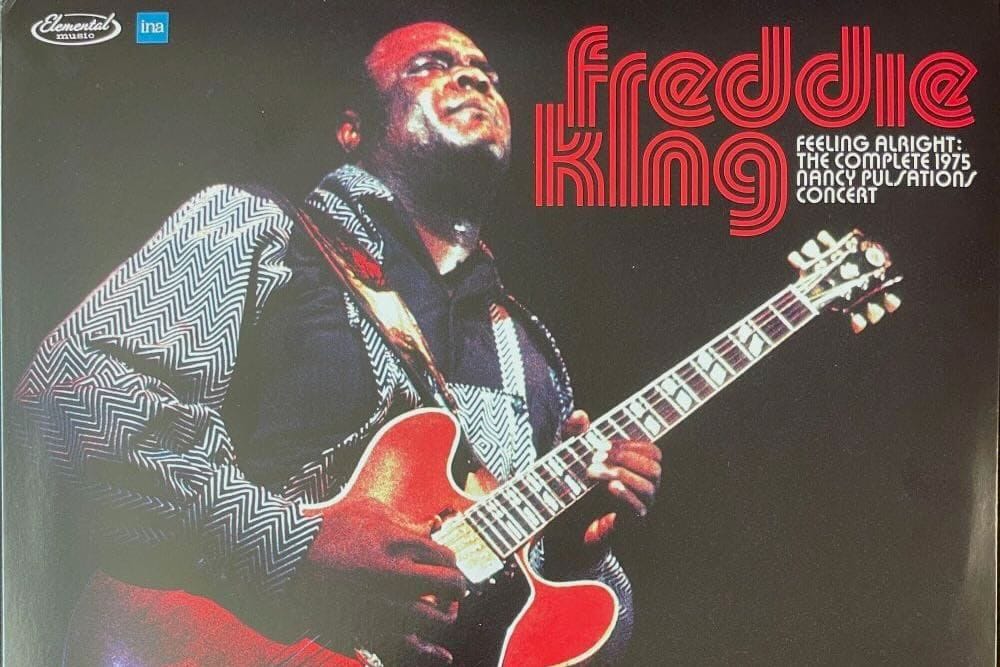
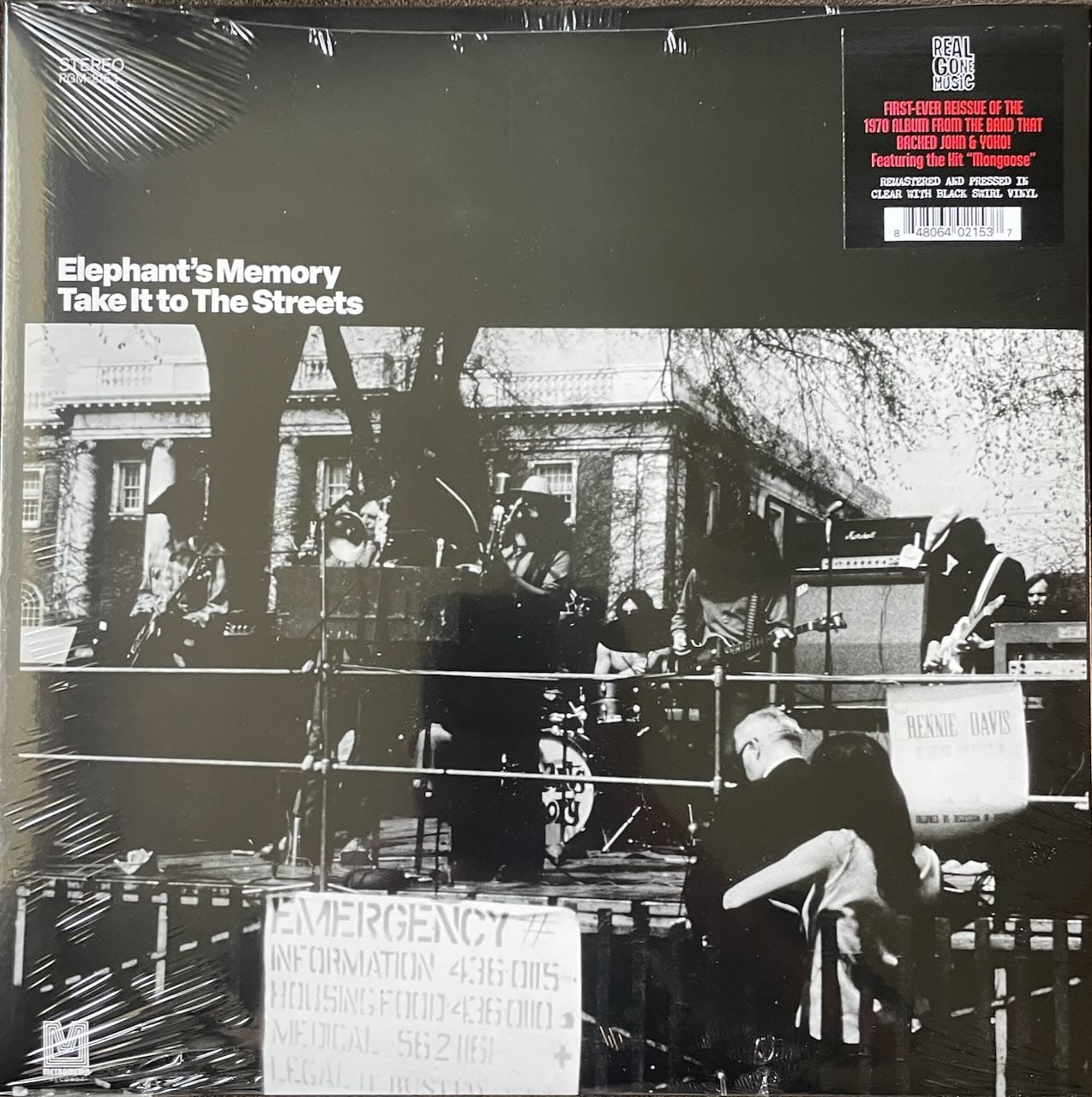
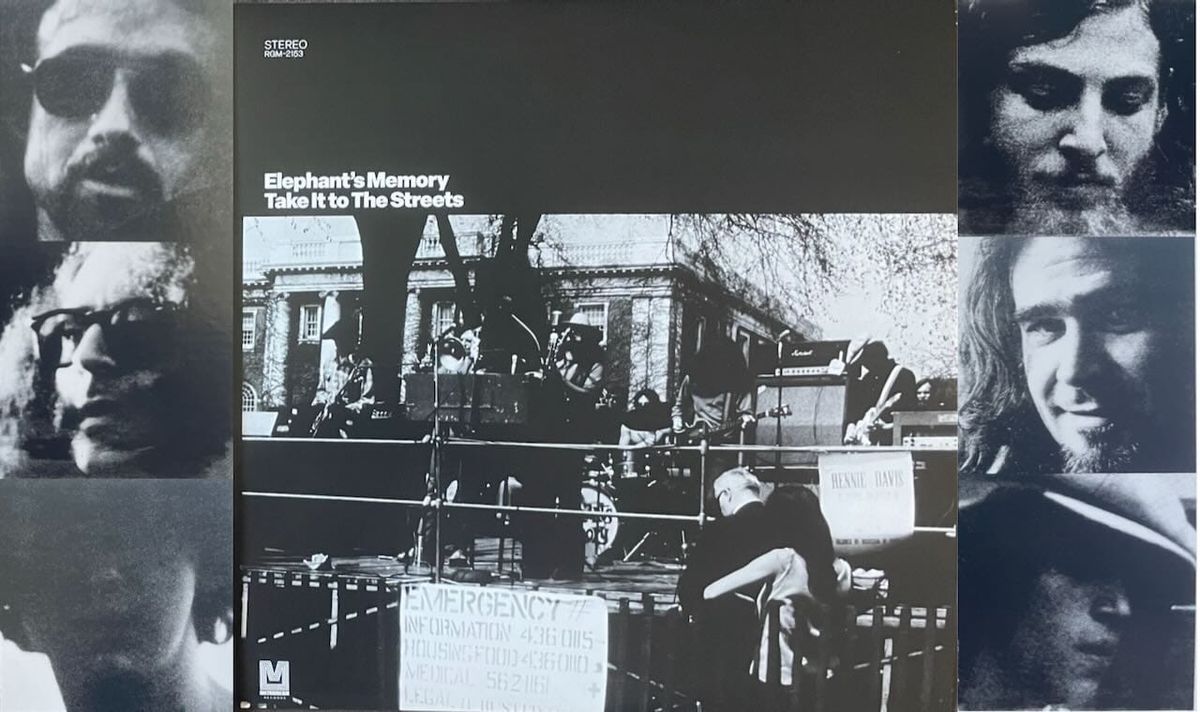
Elephant’s Memory: Take It to the Streets
When Jerry Rubin slipped John Lennon a cassette of the band Elephant’s Memory not long after the former Beatle’s arrival in the Big Apple in 1971, I don’t know whether Lennon was specifically in the market for a band that sounded like New York. But if so, he couldn’t have done much better than Elephant’s Memory, an irreverent, horn-driven outfit whose musical palette was as much of a melting pot as the city itself, with soul, jazz, funk, Latin, hard rock, and Broadway pizzazz all vital ingredients in the group’s musical stew. The band had already gone through a few significant metamorphoses by the time Lennon and Yoko Ono cottoned to them, with singer Carly Simon moving through their ranks during their earliest days and a taste of mainstream attention coming their way via the inclusion of two songs on the Midnight Cowboy soundtrack in 1969.
Following that first flush of success—and before John and Yoko made their way across the Atlantic—Elephant’s Memory were signed to Metromedia Records for one album, 1970’s Take It to the Streets, their second full-length following an ill-fated debut for Buddah Records. The band’s tenure at Metromedia was inaugurated by the single “Mongoose,” a roaring, funky-as-hell rocker that showcased the Memory’s streetwise sound, with a wah-wah guitar ominously circling the waters like a shark and a sharp, lock-tight beat predicting hip-hop trends by nearly two decades.
“Mongoose” is a decided highlight of Take It to the Streets, which jumps over genre boundaries like they’re subway turnstiles. “Dawn” throws Dixieland brass on top of cornpone country before the whole thing shifts into a glitzy R&B revue. “Power” is a double-time klezmer stomp that whirls into an even faster four-on-the-floor slamdown, while “I Couldn’t Dream It” is an easygoing soft-shoe shuffle. And “Piece Now” is an earnest-sounding communal anthem with a deliberate “Dear Mr. Fantasy” cadence and build-up, a sing-along chorus, and singer/saxophonist Stan Bronstein sermonizing about revolution. It’s immediately undercut by the track that follows it, “Tricky Noses,” which is a 50-second goof on “Okie from Muskogee” that ends in a hail of gunfire. The album shows assurance, musical mastery, and devilish humor at every step.
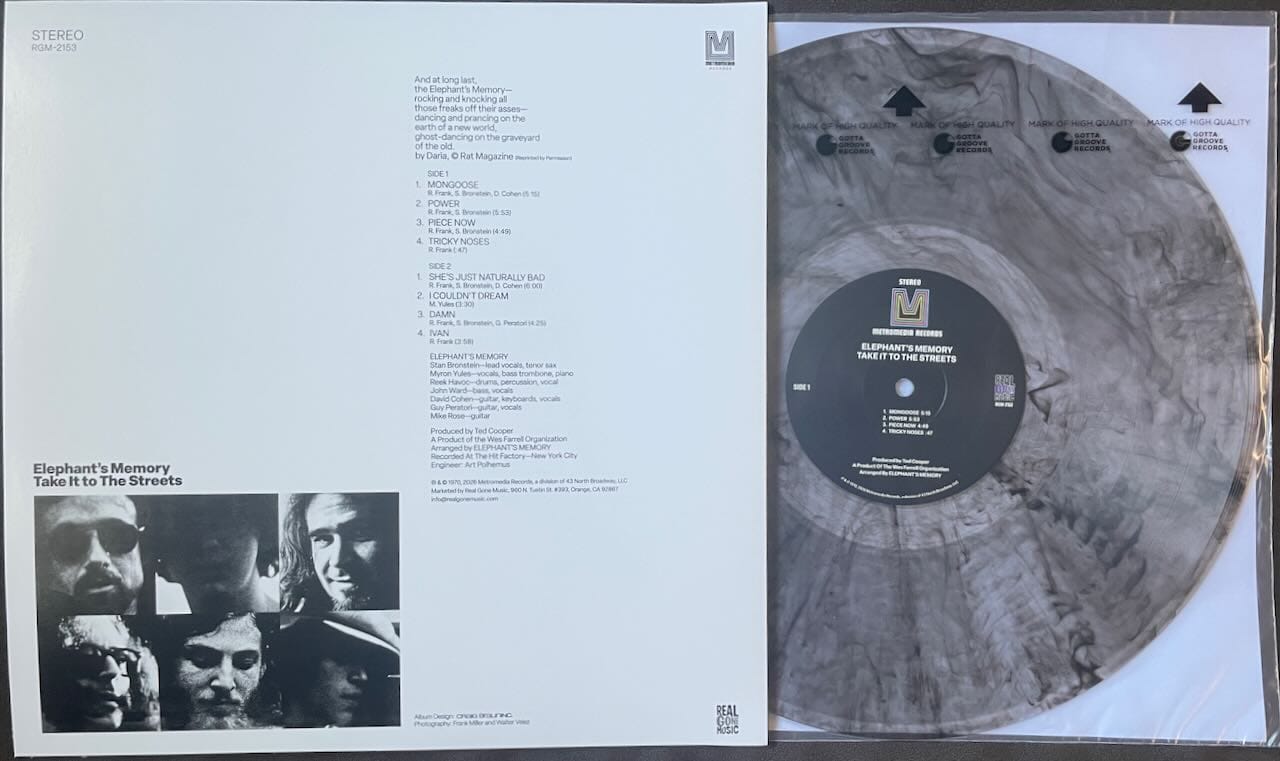
The seven-piece is more ferocious and dangerous-sounding than their rock-with-horns brethren in Chicago and Blood, Sweat & Tears, and strands of their DNA sound sourced from West Coast elements like the Mothers of Invention and the jugband sounds of San Francisco’s Charlatans. But even with those influences folded into its downtown sound, Take It to the Streets captures an ensemble that lives, breathes, walks, and talks New York City, capable of playing at virtually any venue for any crowd—be it a West Village coffee house, a tony Midtown nightclub, an outer-borough dive bar, or a lefty political rally in a municipal park. It’s a wild, electrifying listen.
The biggest problem with Take It to the Streets is that “Mongoose” was horribly recorded. For whatever reason, the fidelity of that particular song remains astonishingly poor, even though the performance showcases the band at their full-tilt, raucous best. Fortunately, the rest of Take It to the Streets—recorded at the Hit Factory—sounds infinitely better. It’s possible that “Mongoose” was recorded either in a different studio or via a different process than the rest of the album, or that it was mixed quickly and cheaply for a single (the album mix sounds monophonic to me) and then couldn’t be altered or improved by the time the full-length was ready. It’s such a dope-sounding song that the terrible quality almost helps the listener lock into its irresistible funk chop, with the grainy hi-hat cutting through the murk, the percussion adding mysterious thumps and bumps, the cemented-together phalanx of guitars and horns sounding impenetrably forceful, and the distorted piano coming off as commanding and cruel. But there’s no doubt that one’s heart breaks a little listening to “Mongoose” and wishing it could have been presented a bit better.
The rest of the album is, while not an aural masterpiece, is much more technologically advanced, with Ted Cooper’s production allowing the group to sound far more realistic and textured. The new vinyl pressing from Real Gone Music marks the first time it has ever been reissued in any physical format, although a streaming version exists as well, sourced from Fuel Recordings, so a digital transfer occurred at some point. I was able to compare my 1970 white label promo (pressed at Columbia’s Pitman plant) to the new 2026 Real Gone pressing, which was mastered from a digital source by Mike Milchner at Sonic Vision, with a lacquer cut by Harrison Hunt at Well Made Media, and the pressing done at the excellent Gotta Groove.
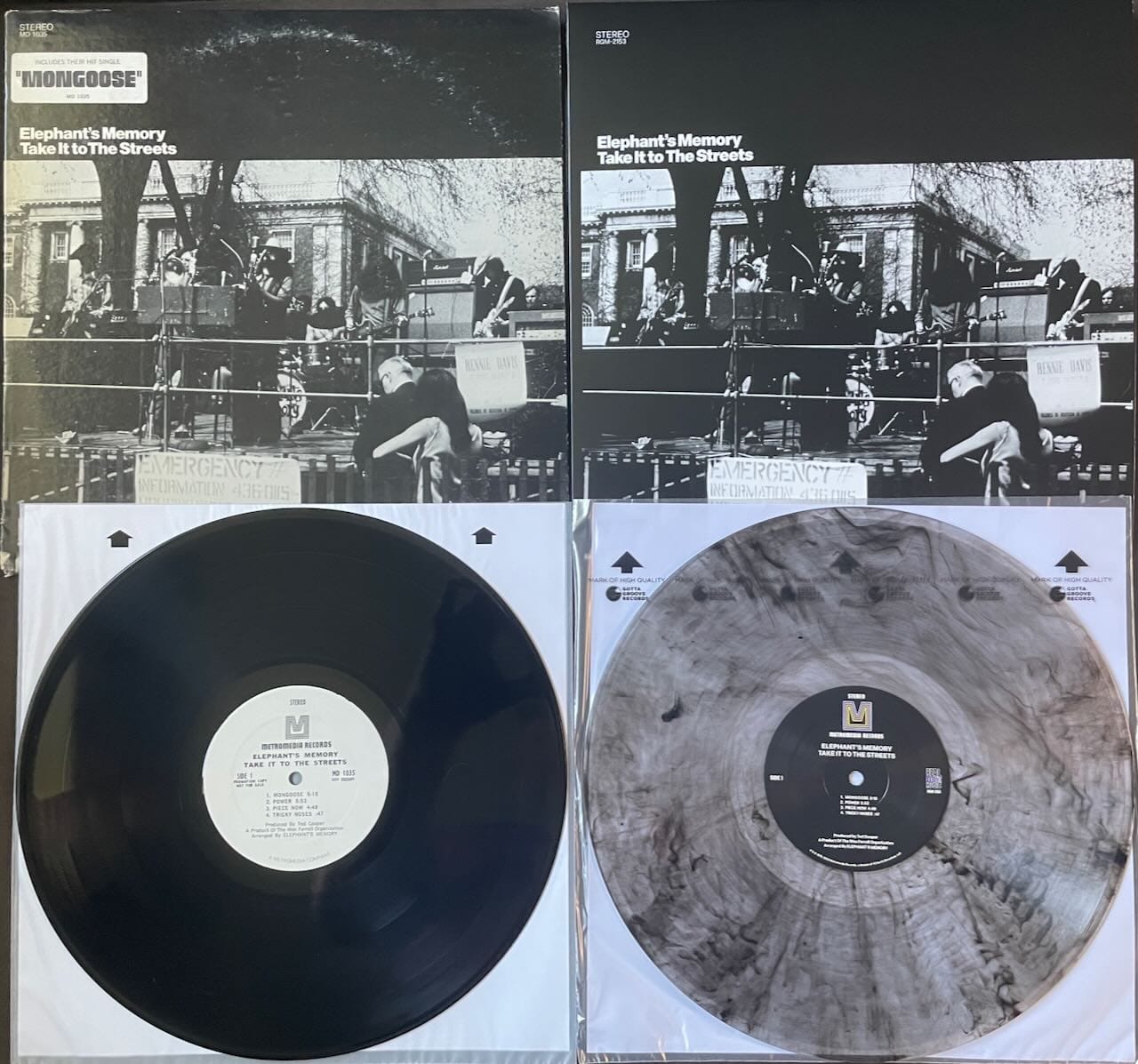
The new mastering removes a thin outer crust of crud off of the entire recording, allowing some of its interior detail and nuance to sparkle. For instance, the intonation of the individual drums can be discerned, and the texture of the electric guitars has more body and character. And when the band fires on all cylinders, the clutter of their collective bashing is clarified and refined, with a dynamic richness not on the older pressing. However, the 1970 pressing has a firmer bass presence and a freshness and heat that I don’t find fully replicated in the new pressing.
There is one brief, small problem with this new edition of Take It to the Streets, and of course the lousy-sounding “Mongoose” is the culprit. In the song’s third and final chorus, during the first repetition of the group-sung title phrase, the sound breaks up for about a second, with the bass dropping out completely and the music sounding as if it’s been sucked into a tinny transistor radio. Thankfully, it’s very short-lived—nearly instantaneous. I confirmed with Real Gone Music and mastering engineer Mike Milchner that this issue was present on the source they received; Milchner worked to mitigate it as much as possible but couldn’t solve it entirely. On my 1970 pressing, the bass dropout doesn’t happen, but it does sound like a crushed-out peak of treble, pretty close to white noise. Whatever happened to that section in the intervening years could be the result of some age-related damage, or perhaps the initial digital transfer did not accommodate for that sudden burst of treble, and the problem then made its way down the (sonic) food chain.
It’s a minor issue in an otherwise very long-overdue reissue of an album that remains a hair-raisingly fun listen. The clear and black-swirl vinyl pressing from Gotta Groove is essentially perfect, and the album’s simple black-and-white artwork is reproduced effectively. I would have loved some liner notes, as this album came during Elephant’s Memory’s “gap” year—in between Midnight Cowboy and John & Yoko—and there isn’t a ton of documented information about this period in the group’s history. And, since I’m just dreaming here, the band’s 1971 single for Metromedia, “Skyscraper Commando,” could have been a cool bonus—it’s now a lost orphan track without a parent album.
But it’s more important that this album is back in print. Over the years, Elephant’s Memory has taken a lot of the heat for the clogged-up, overbearing sound of Some Time in New York City, but anyone leveling those criticisms has obviously never heard Take It to the Streets. The album is incontrovertible evidence that the group was capable of powerful, inventive, and multifarious musical experiences, and it’s great to have it back on record store shelves. Even if “Mongoose” stills sounds pretty atrocious.
Real Gone Music 1-LP 33 RPM clear with black swirl vinyl
• New remaster of Elephant’s Memory’s 1970 album
• Jacket: Direct-to-board single pocket
• Inner sleeve: Gotta Groove–branded rice-paper-style poly
• Liner notes, insert, or booklet: None
• Source: Digital
• Mastering credit: Mike Milchner at Sonic Vision Mastering, Los Angeles, CA
• Lacquer cut by: Harrison Hunt at Well Made Music, Bristol, VA; “HJH” in the deadwax
• Pressed at: Gotta Groove Records, Cleveland, OH
• Vinyl pressing quality (visual): A- (very minor warp)
• Vinyl pressing quality (audio): A (essentially perfect; silent backgrounds and no extraneous noise)
• Additional notes: Also available in a limited “infinity splatter” pressing limited to 50 copies, and a “Wax Mage” edition of 25 copies.
Listening equipment:
Table: Technics SL-1200MK2
Cart: Audio-Technica VM540ML
Amp: Luxman L-509X
Speakers: ADS L980