Review: The Beatles’ Rubber Soul

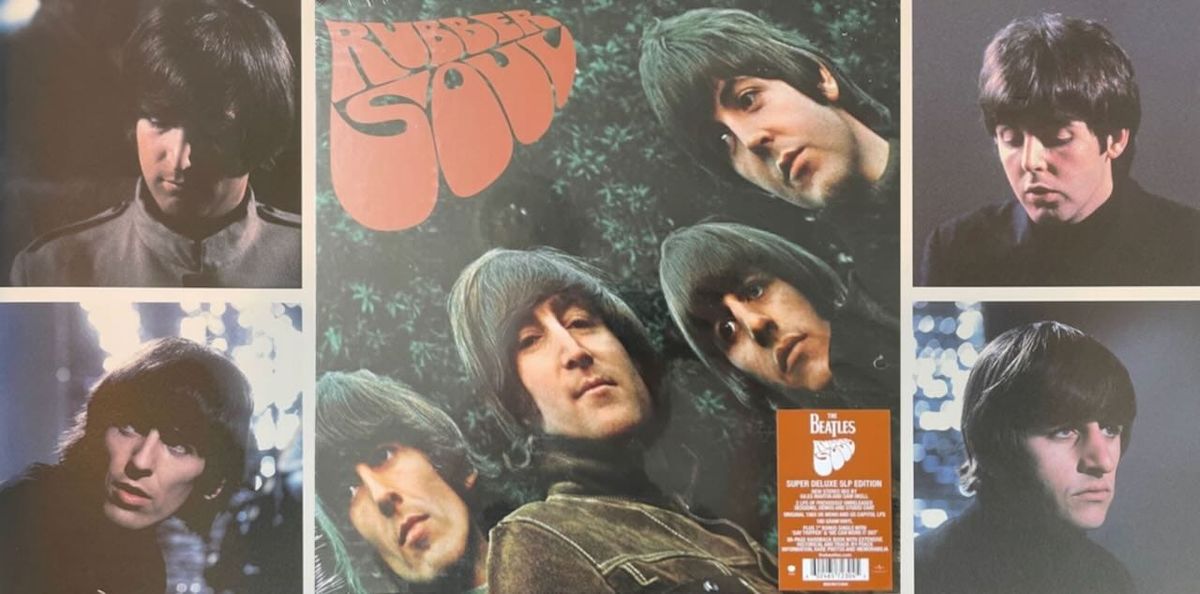
The Fab Four’s 1965 album gets the deluxe treatment at last.
By today’s standards, Rubber Soul was a rush job. In mid-October 1965, as the Christmas deadline loomed, the Beatles convened with producer George Martin at EMI Recording Studios in Abbey Road, St John’s Wood, London, to whip up 16 new songs for an LP and single to come out before year’s end. (They ended up with 15, plundering an older outtake to round out the batch.) In less than a month, the Beatles had readied both Rubber Soul and the world’s first double-A-sided single, “Day Tripper” coupled with “We Can Work It Out,” which were jointly released in the UK on December 3, 1965; their US releases followed three days later.
Any signs of haste didn’t show. Rubber Soul was not just the Beatles’ best album to date—it was the best album released by a British band up to that point in time. (The single was no slouch either.)
Conversely, the just-landed super-deluxe edition of Rubber Soul seems to have been anything but a rush job. Beatle fans began to hear rumors of an expanded Rubber Soul not long after the 2022 release of the Revolver box set, and some claim that Apple has had it finished and ready to go for more than three years now. It seems that each holiday season, something else Beatle-related has come up and taken Rubber Soul’s place: The “Now and Then” single and the 50th anniversaries of the Red and Blue albums resulted in expansions of those collections in 2023, followed in 2024 by a 1964 U.S. Albums in Mono box to mark the 60th anniversaries of those albums. And last year we got a 30th-anniversary Anthology reissue with a new Volume 4 appendix, preempting Rubber Soul’s own 60th birthday.
 Ned Lannamann
Regardless of how long it’s been in the hopper, the new Rubber Soul box set has finally arrived, and while my personal, decades-long obsession with the Beatles might be something of a qualifying factor, I have to say: This thing is flat-out glorious. I have spent the past few days wholly and happily engulfed in the music contained in this set, which goes well beyond augmenting the 1965 album with bum takes and rejected mixes—it is a masterfully done reference work for a major and massively influential artistic breakthrough. Perhaps more importantly, it’s a collection of wonderful, compulsively listenable music made by four exceptionally dab hands (and their equally capable production team). And the box itself is a stunning physical object, too, with the discs, the album jackets, and the exceptionally well-produced book all a joy to hold and behold.
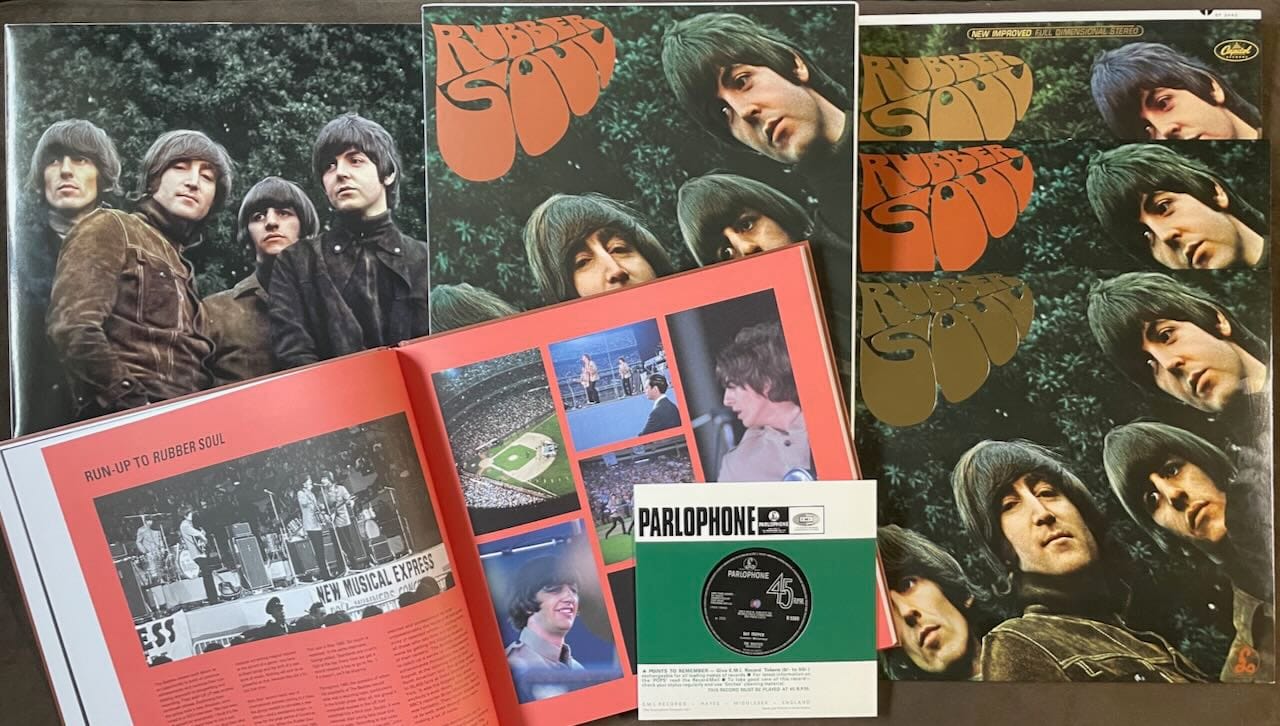
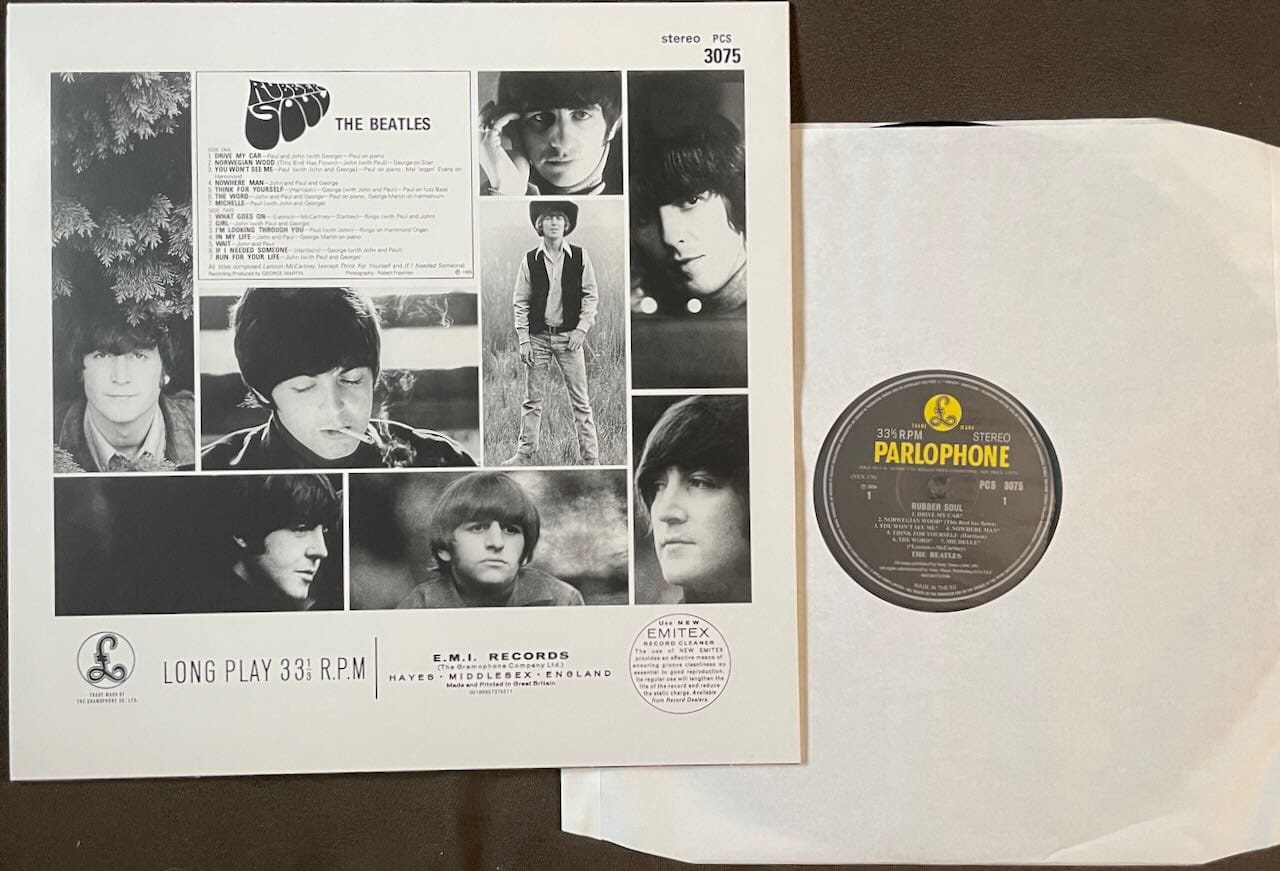
The 5-LP vinyl set includes a new stereo version of the album remixed by Giles Martin (son of Beatles producer George Martin) and Sam Odell. They went back to the original four-track recordings and used MAL source-separation digital technology developed by Peter Jackson’s Wingnut Films—also responsible for the Get Back documentary—to isolate the individual instrument sounds that were fused together on the original multi-track recordings. Accompanying the new remix are two LPs of outtakes, alternate mixes, and demos, showcasing the origins of Rubber Soul’s familiar songs and a few roads not traveled. The box set also includes the original 1965 mono version of the UK album, as well as the 1965 stereo version of Rubber Soul that was released in the US, with an altered tracklist. All five of the vinyl LPs are extraordinary-sounding, with immaculate pressings done by Optimal Media, who seem to have pulled out all of their QC stops for this package. A 7-inch including “Day Tripper” and “We Can Work It Out,” remixed by Martin and Odell, is also tucked inside, and an 88-page hardcover book stuffed with photos and text rounds out the package.
Rubber Soul’s cultural significance likely doesn’t need a lot of explication, but here’s the thumbnail sketch: By the end of 1965, nearly three years into their superstardom, the Beatles had long outlasted their life expectancy in the here-today-gone-tomorrow pop-music marketplace, and the songwriting of John Lennon and Paul McCartney continued to improve exponentially as they continually challenged themselves and each other. George Harrison was also developing as a songsmith—“If I Needed Someone,” one of his two contributions to Rubber Soul, was easily his best work yet—and even Ringo Starr got in on the action, earning his first co-writing credit with “What Goes On.”
The album incorporated unconventional instrumentation, such as Harrison’s sitar on “Norwegian Wood (This Bird Has Flown),” McCartney’s fuzz bass on “Think for Yourself,” and George Martin’s baroque-style piano solo on “In My Life,” and it bore myriad influences in addition to the Indian music that had newly infatuated Harrison and the classical elements from Martin’s background. For instance, the chiming guitars and vocal harmonies of the Byrds—who had hung out with the Fab Four during their California tour stop a few months prior—left their mark, as had the lyrical prowess of Bob Dylan, who, significantly, made the transition to electric rock music earlier that year on Bringing It All Back Home. And as ever, the bass-driven groove of American R&B continued to animate the Beatles on tracks like the Otis Redding–derived “Drive My Car” and the Motown-indebted “You Won’t See Me.” Rubber Soul’s title itself was a knowing reference to British musicians’ widespread appropriation of Black musical styles—the Beatles including themselves in the tongue-in-cheek indemnification.
Much has also been made of Rubber Soul’s folk-rock tint, particularly in relation to the American tracklist, which removed four of the British LP’s more driving songs and replaced them with two leftovers from the Help! album from earlier that year. By kicking off the album with the strummy quickstep “I’ve Just Seen a Face” and compounding it with similarly acoustic-based tracks like “Norwegian Wood (This Bird Has Flown),” “Michelle,” “Girl,” and “I’m Looking Through You”, the American album was perceived in some quarters as the Beatles’ take on folk-rock just as that subgenre was in full bloom. The Beach Boys’ Brian Wilson even described it as such while acknowledging the huge influence it had on him as he was making Pet Sounds, released five months after Rubber Soul.
 Ned Lannamann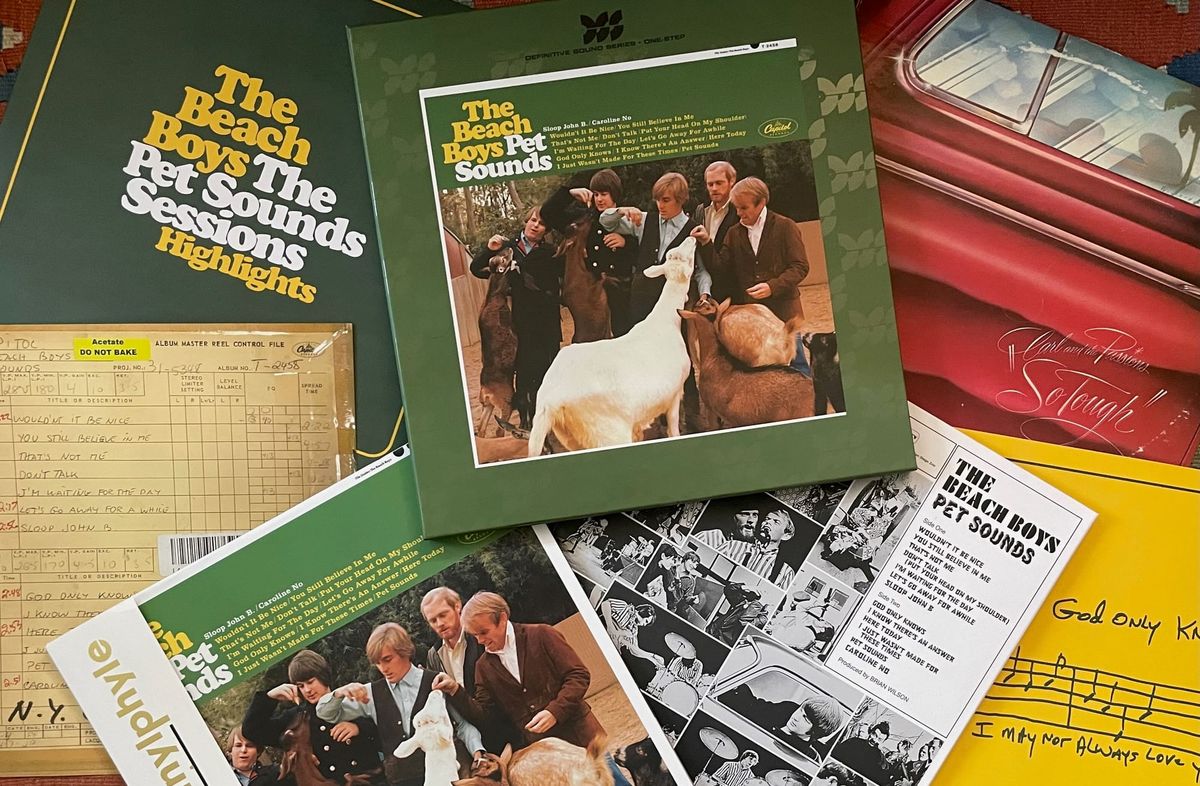
In truth, Rubber Soul has all of these ingredients and more, such as Harrison’s rockabilly picking on “Run for Your Life,” Starr’s own long-simmering love of country and western in “What Goes On,” and the continental influences couched within the cod-French balladry of “Michelle” and the Viennese-flavored “Girl.” With additional elements that eerily presaged the psychedelic shift that was to emerge in 1966—such as the bubble letters that spelled out the album’s title on the front cover, or the “word is love” lyrical conceit of “The Word”—Rubber Soul was an effective and ingenious metabolization of the current trends in popular music, taking the form of a curious but confident finger pointed toward the future. This way, the Beatles beckoned.
I’ll break down each component of the box set separately, as each of the LPs have worthwhile discussion points of their own.
LP 1: The New Stereo Remix
For as conservative as they are, Giles Martin’s Beatles remixes are pretty controversial. Some consider them an unnecessary affront, as the original ’60s mixes remain perfectly fine in their own right. Others find them tastefully illuminating, revealing details hidden in the old recordings and adding power and depth to the individual timbres. I’ve always thought of them as fun but inessential—the original mixes have always sounded “correct” to me, and despite their age, their sonic shortcomings are few and far between. But I always get a kick out of hearing these incredibly familiar songs taken apart and put back together again, and I’ve never felt that some of the technical choices made to make them sound beefier and more modern (especially for low-fidelity streaming devices) have done anything to tarnish the originals.
That said, a Rubber Soul stereo remix is perhaps more necessary than any of the Giles Martin remixes that have come before. (Martin’s remixes are done with Abbey Road mix engineer Sam Odell.) The album’s 1965 stereo mix placed everything to either the extreme left or extreme right, with no musical information in the center of the stereo spectrum. This was evidently EMI policy for about a year or so, as the problem also afflicts the stereo mix of the Help! album; it was likely done so that folks with mono record players could also play stereo records without the music at the center of the stereo image dominating the folded-down sound of mono. But what this meant for stereo listeners is that the vocals and bass, conventionally at the center of most rock mixes, were tucked away to the sides of Rubber Soul, creating for a hollowed-out listening experience—not to mention an imbalanced sound if one is too close to one speaker and too far away from the other.
When the Beatles catalog was released on CD in 1987, George Martin decided to remix Help! and Rubber Soul instead of using the mono versions or the flawed stereo mixes. Bizarrely, though, he chose to recreate the original stereo mixes as closely as possible, right down to their extreme left-right spreads. It was a missed opportunity, to say the least. This means Beatles listeners have not ever had a natural-sounding stereo mix for Rubber Soul, one of the most important albums of the 1960s—making Giles Martin’s remix more than worthy of consideration.
Beatles diehards have already had a chance to hear Martin’s remixes of seven of the album tracks, as they appeared on the 2023 expanded reissue of 1962–1966 (aka the “Red Album”). As best as I can tell, those remixes are reproduced here, although trainspotters might be able to detect differences in the 2026 edition; I could not. The notable exception is “Nowhere Man,” which had a very slightly misaligned hi-hat in the 2023 mix, with each of its eighth-note taps arriving milliseconds early; this was likely due to an error with the mixing software that moved the hi-hat waveform forward a smidge. I am satisfied that this has been fixed. While I found it confoundingly hard to affirm that I was in fact hearing the maladjusted hi-hat in the 2023 mix on the updated Red Album, I did feel slightly seasick as I was listening to it. I did not get that sensation on the 2026 version. Ringo’s hi-hat sounds entirely in the pocket to me, driving the groove but not pulling ahead unnaturally.
And on the whole, I loved the remixed album. Ringo’s bass drum on “Norwegian Wood” has a deep, pleasant boom, and the little emotional inflections in John’s double-tracked voice on “In My Life” are significantly more appreciable. The assembled harmonies of Paul, John, and George on songs like “Michelle” and “You Won’t See Me” are more delectable and differentiated, and the two baby-blue Fender Stratocasters that George and John play during the break on “Nowhere Man” are glistening and great. Despite the software used to make these mixes—and the AI technology that fuels it—I thought the resultant music sounded entirely natural, with just the right level of familiarity and enough fresh sparkle in the details to keep things interesting. I don’t recall enjoying Martin’s previous Beatles remixes as much as I did the ones for Rubber Soul.
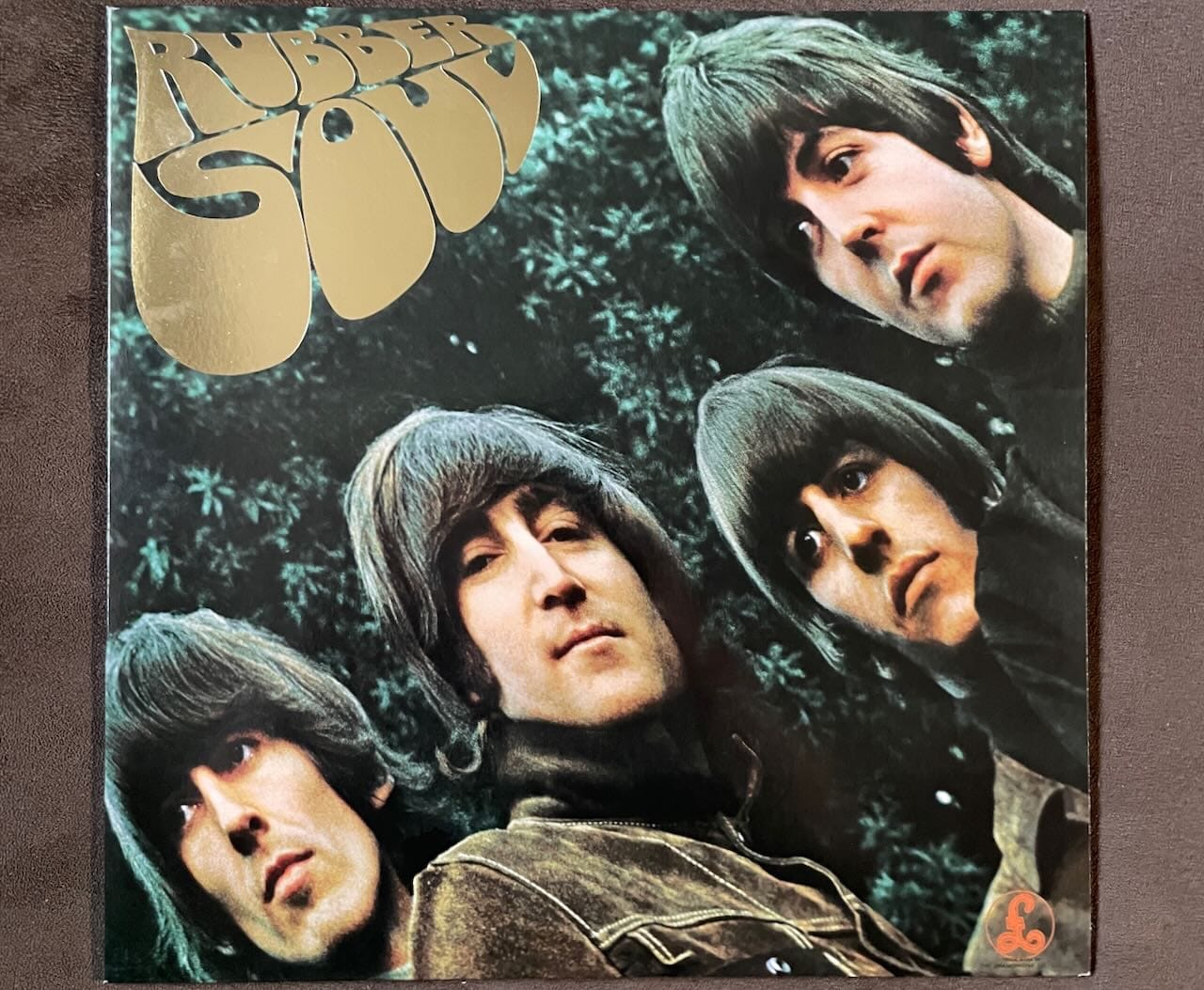
The album cover for the remix features the Rubber Soul “logo” rendered in a sort of gold foil stamp. It’s a nice touch. The remixed album is available individually on vinyl (without the rest of the set), and Martin and Odell have also made a multichannel Dolby Atmos mix, which is available on a separate Blu-ray and on certain streaming services.
1-LP 33 RPM 180g black vinyl
• Stereo remix of Rubber Soul, with some mixes originally released in 2023 and some mixes new to this set; all remixes done by producer Giles Martin and engineer Sam Odell
• Jacket: Direct-to-board single pocket with a gloss finish on the front cover and gold lettering of the title
• Inner sleeve: White poly-lined paper
• Source: Digital
• Mastering credit: “Mastered by Miles Showell,” Abbey Road Studios, London, UK
• Lacquer cut by: Miles Showell at Abbey Road Studios, London, UK; “MILES. ABBEY ROAD 1/2 SPEED. ROOM 30” in the deadwax
• Additional notes: Half-speed mastered by Showell.
LPs 2 & 3: Sessions and Demos
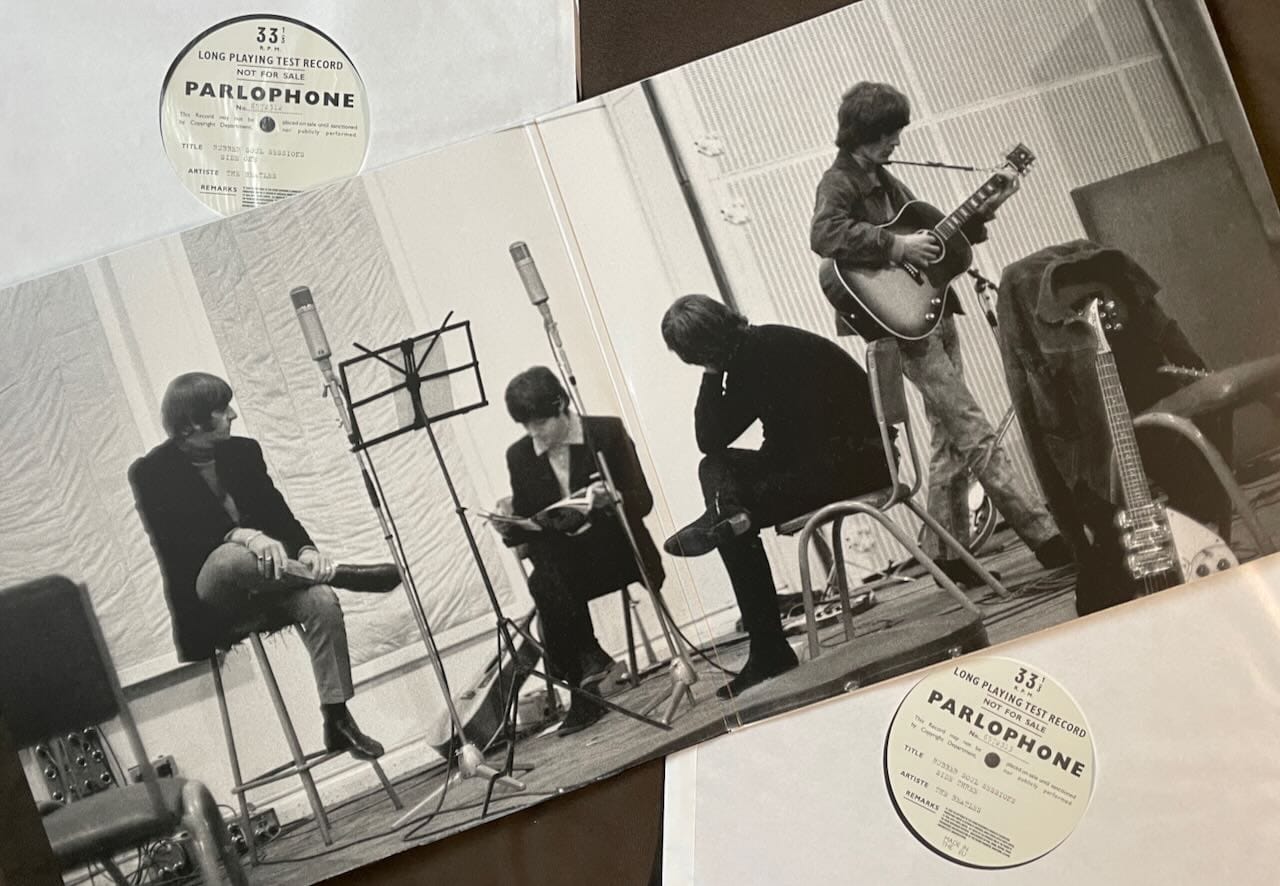
This is where the real fun is. This double LP is, in essence, an audio documentary of the making of Rubber Soul, bringing listeners behind the scenes at EMI Studios. The early takes and rough mixes are speckled with hilarious studio banter and general bonhomie between the four Beatles and the studio staff, which at the time included the invaluable engineer Norman Smith. Due to the encroaching deadline, Rubber Soul marked the first time that Beatles sessions stretched past midnight, and nocturnal recording quickly became standard practice for the group and their recording team.
There was newfound dexterity in the recording process for Rubber Soul. EMI’s recently acquired Studer tape machine was small enough to fit inside the control room; previously, the machine would be located in a different room down the hall, manned remotely by a tape operator. Having the machine and the tape operator close at hand meant that punch-ins and punch-outs were much easier to do, allowing for precision in overdubbing.
At this point, the Beatles would usually rehearse the song thoroughly before the “record” button was ever pressed; once the tapes were rolling, Martin, Smith, and the tape op would typically rewind and record over a failed take with a fresh one. This means that not a ton of early takes of Rubber Soul material exist in the Abbey Road vaults, but Giles Martin has managed to find enough fascinating works-in-progress to make this a coherent and compelling listen.
There are embryonic versions of “Norwegian Wood,” including a take with John strumming a 12-string acoustic guitar instead of a 6-string, as well as a remarkably psychedelic-sounding version driven by George’s sitar. And there are multiple early drafts of “I’m Looking Through You,” which shape-shifted more than once before reaching its final incarnation. Backing tracks of “Drive My Car,” “What Goes On,” Help! outtake “Wait,” and other tunes further elucidate the working methods of the Beatles and their behind-the-desk collaborators.
We also get a brief snatch of Paul’s home-recorded demo of “We Can Work It Out,” which is abruptly cut off as John accidentally records over it with some silliness on his newly purchased Mellotron. An early studio take of the same song is preceded by John delivering the priceless aside, “I know how it goes—it’s when it comes.” The duo’s demo of “Day Tripper” dissolves into giggles as John and Paul attempt to figure out the song’s harmonies. “Beatle Talk” is more than seven minutes of goofing around as John, Paul, and George attempt to lay down the vocals for “Think for Yourself,” preserved as potential material for the Beatles’ annual fan-club Christmas record but left unused; a few seconds of audio eventually made their way into the Yellow Submarine film. And it’s not just the Beatles having fun: During the preparation before a take of “I’m Looking Through You,” George Martin announces the song’s title in a comically drawn out voice so that it might sound something close to normal when played back at twice the speed. (It’s a failed experiment, still sounding like a chipmunk despite Martin’s oral efforts.)
Most intriguing of all is the previously unknown “Little Girl,” a brief, home-recorded Lennon demo. The melody is small and straightforward, but it contains a line that would end up being used during the chorus for “I’m Only Sleeping” on 1966’s Revolver. It’s scarcely an epoch-changing piece of work, but the repeated refrain of “I love you” reveals John at his most unguarded and affectionate.
Look. You either love this stuff or you don’t. I happen to think it’s a revelation to hear all of these pieces of music being conjured out of thin air. The unfinished takes allow me to understand the individual instrumental performances, note by note, and to perceive how the blends of the finished product were actually assembled. And there’s simply an incalculable level of insight into how the group functioned as a unit. For example, after a breakdown during “Day Tripper,” an impatient Paul, still locked in the song’s groove, tetchily entreats the other boys to start the next take immediately: “Okay, let’s do it right away then… Okay, put your tea down, come on.” I imagine that listeners who just want to glide along the top of the finished product, these unfinished versions—these base camps on the way to the summit—are puzzling and disorienting. But for anybody with even a casual interest in how music is actually made, they are invaluable.
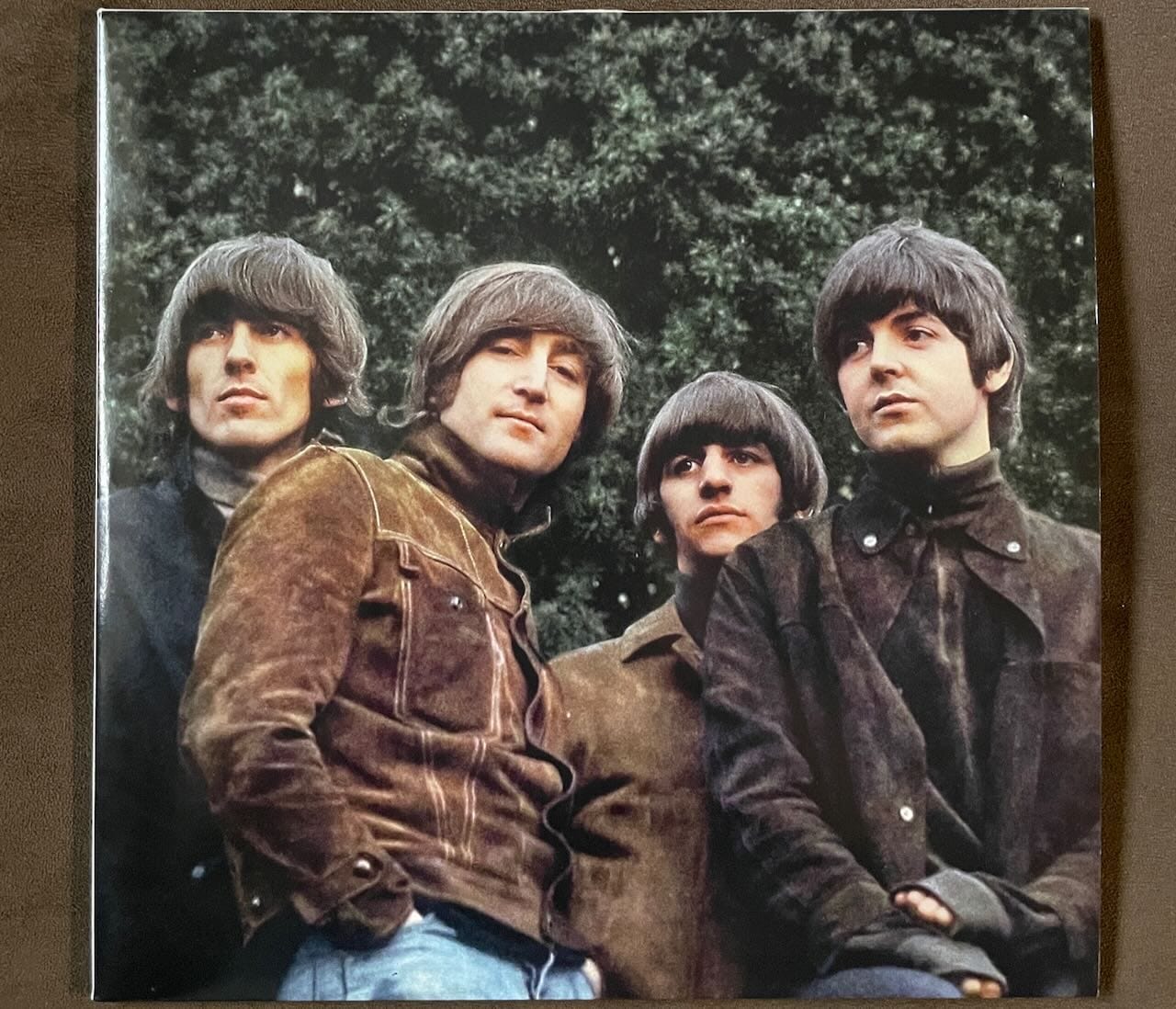
Two of these alternate takes were previously released, in substantially different mixes, on Anthology 2, while early recordings of “In My Life” and “Nowhere Man” turned up on 2023’s Anthology 4 in, I believe, the same versions you hear here. The only thing that’s really missing is the instrumental “12-Bar Original,” an outtake that appeared in edited form on Anthology 2. Its omission is an oversight that prevents these discs from providing the complete portrait of the Rubber Soul sessions—it really should have been included. The fantastic front cover of the double LP features the unaltered Robert Freeman photo that was stretched out for the finished Rubber Soul jacket, while the center of the gatefold features an equally fantastic black-and-white photo of the band during some down time in the studio.
2-LP 33 RPM 180g black vinyl
• Outtakes, demos, and alternate mixes from the Rubber Soul sessions
• Jacket: Direct-to-board gatefold with a gloss finish on the front cover
• Inner sleeve: White poly-lined paper
• Source: Digital
• Mastering credit: “Mastered by Miles Showell,” Abbey Road Studios, London, UK
• Lacquer cut by: Miles Showell at Abbey Road Studios, London, UK; “MILES. ABBEY ROAD 1/2 SPEED. ROOM 30” in the deadwax
• Additional notes: Half-speed mastered by Showell.
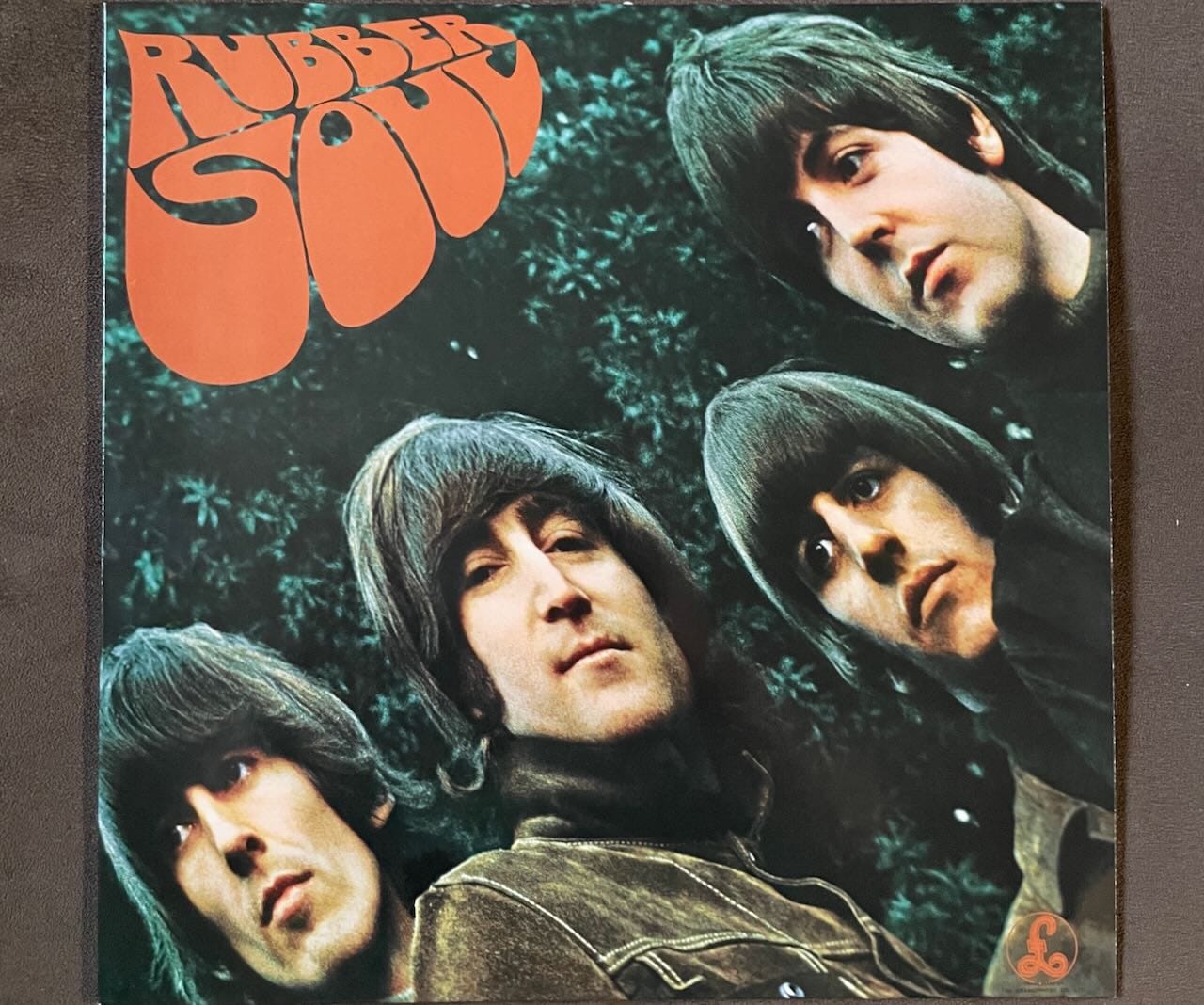
LP 4: The UK Mono Album
This is simultaneously the least essential disc in the package and the most essential. It’s crucial that it was included because this is Rubber Soul as nature intended. It contains the original 1965 mono mix—the one that had the Beatles’ artistic input (stereo was still an afterthought)—and it remains the definitive rendition of the album. If you could only bring one of the LPs from this box set with you to a desert island, this would be the one to take.
It’s the least essential because this disc is a repress of the cut that appeared in the 2014 vinyl box set The Beatles in Mono, using the same metalwork. However, the 2014 Mono box and its 2025 repressing are now out of print (with prices on the secondhand market reaching ludicrous sums), so unless you already own one of those, this disc should be worth its weight in gold. The only shortcoming is that it does not replicate the flipback jacket of the original 1965 edition or the reproduction copy in my 2014 box. Soundwise, the 2014 box set pressing and this new one are virtually identical. (I have not heard a 1965 UK mono original, but I’m confident this new pressing won’t pale in comparison.)
The original lacquer was cut by Abbey Road’s Sean Magee from the analog master tape, and it’s just a spectacular-sounding version, with everything balanced just right, the soundstage perfectly sized and positioned, the bass reaching fullness without overpowering any other element, and the high end crisp and defined without any traces of edginess. So yes, for those who already have The Beatles in Mono, another copy of the UK mono album may be redundant. But you simply couldn’t have a Rubber Soul box set without it.
1-LP 33 RPM 180g black vinyl
• Repress of the 2013 cut of the original British mono version of 1965’s Rubber Soul, as it appeared in 2014’s The Beatles in Mono vinyl box set (and its 2025 repress)
• Jacket: Direct-to-board single pocket with a gloss finish on the front cover
• Inner sleeve: White poly-lined paper
• Source: Analog; “from the UK Beatles tape archive”
• Mastering credit: “Mono album mastered by Sean Magee,” Abbey Road Studios, London, UK
• Lacquer cut by: Sean Magee, Abbey Road Studios, London, UK; “i…i” in the deadwax (Magee’s mark is meant to evoke the famous crosswalk outside Abbey Road)
• Additional notes: None.
LP 5: The US Stereo Album
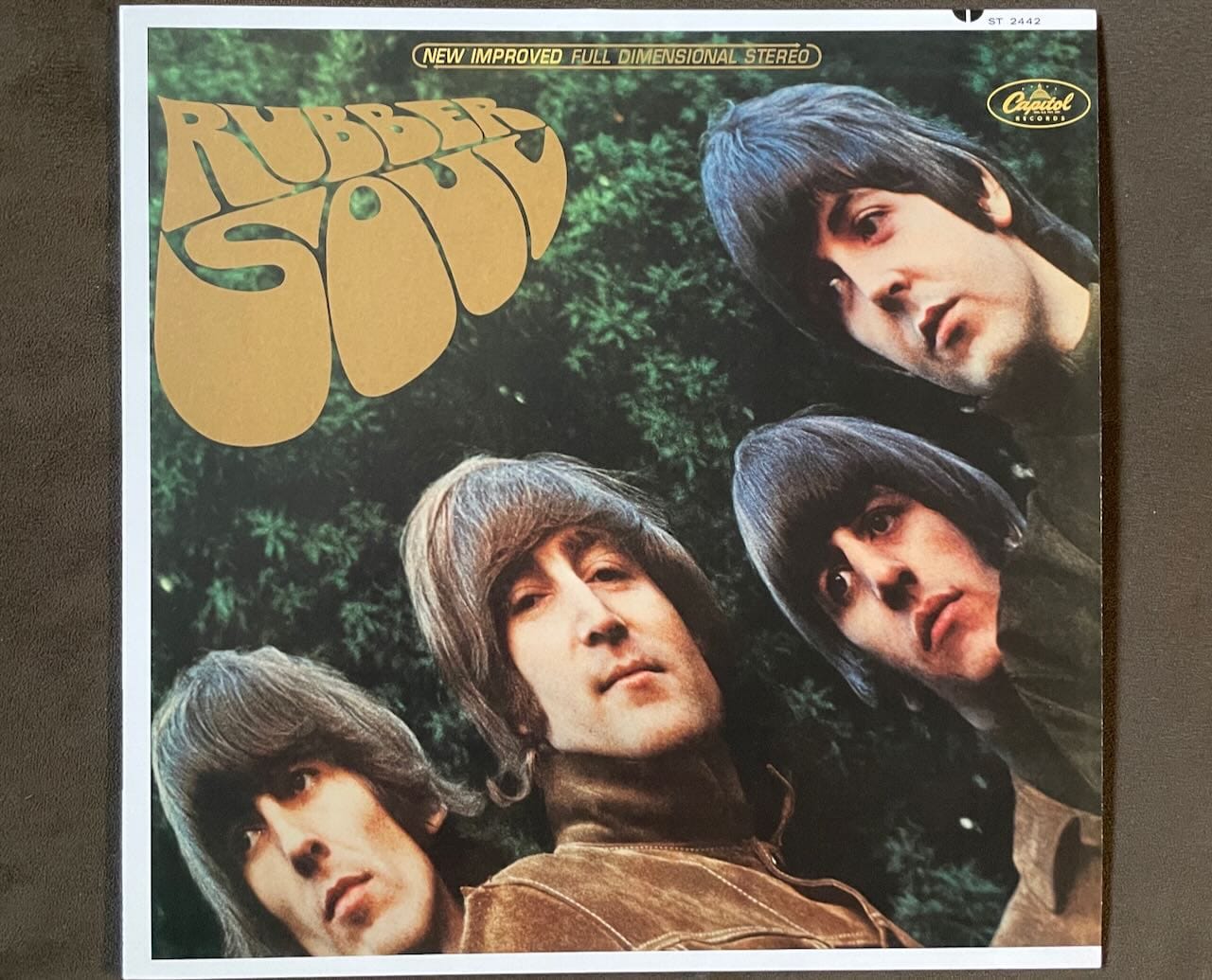
A third iteration of Rubber Soul is included in the box—the US version, with the altered tracklist. In 1964 and 1965, Capitol Records would receive finished Beatles recordings from the UK and release them any old which way they liked, ignoring the 14-track British album configurations in favor of 11-song hatchet jobs released at more frequent intervals—also adding in the non-album single A-sides and B-sides that the Beatles deliberately kept off their LPs in order to provide value to their fans who had already purchased them as 7-inches. Capitol’s practice of slicing and dicing infuriated the group, but by the end of 1965 Capitol was willing to make some minor concessions: The US Rubber Soul contained 12 tracks instead of 11, and it preserved the album’s title and deliberately designed cover art instead of finding some old promotional photos and slapping a generic new title on it (Beatles ’65; Beatles VI).
Capitol removed “Drive My Car,” “Nowhere Man,” “What Goes On,” and “If I Needed Someone” from their version of Rubber Soul, eventually releasing “Nowhere Man” and “What Goes On” as a single in February 1966 and putting all four tracks on the Yesterday and Today album a few months later. To fill up the resultant space on Rubber Soul, they grabbed two songs from the UK Help! album that had not yet appeared on any Capitol releases: “I’ve Just Seen a Face” and “It’s Only Love,” planting them at the top of Sides 1 and 2, respectively. Starting the album with “I’ve Just Seen a Face” accentuated the album’s folk-rock qualities, and the US Rubber Soul became—along with The Beatles’ Second Album, a raucous smorgasbord that happened to spotlight the Beatles’ rock-’n’-roll side—one of the only Capitol albums to earn a reputation as an essential document in its own right.
This reissue reproduces the Capitol stereo album and was cut by Kevin Reeves from the East Coast master tape. (At that time, typically two master tapes would be prepared by Capitol, one for New York and one for Los Angeles, to facilitate production and shipping; the Beach Boys’ Pet Sounds was handled in a similar fashion.) Both Capitol stereo versions shared a couple of unique characteristics that differentiated them from the UK album: “The Word” double-tracked John’s vocal during the verses, and “I’m Looking Through You” contained two false starts from Paul’s acoustic guitar.
But the East Coast master had an additional difference: a layer of echo that was added to the tape, adding yet another variation. At times the extra reverb is difficult to detect, and at others it is unmistakable, such as during the final note of “Think for Yourself” or on John and Paul’s vocals on “Wait.” I actually don’t have a West Coast stereo pressing of Rubber Soul on hand to determine whether it is completely dry, but I have a 1968 pressing made at Capitol’s plant in Jacksonville, Illinois (opened in July 1965 primarily to keep up with the insatiable demand for Beatles records), and a 1978 purple-label pressing with lacquer cutter Wally Traugott’s mark in the deadwax on one side, also pressed at Jacksonville (on slightly translucent vinyl). Both have the East Coast echo.
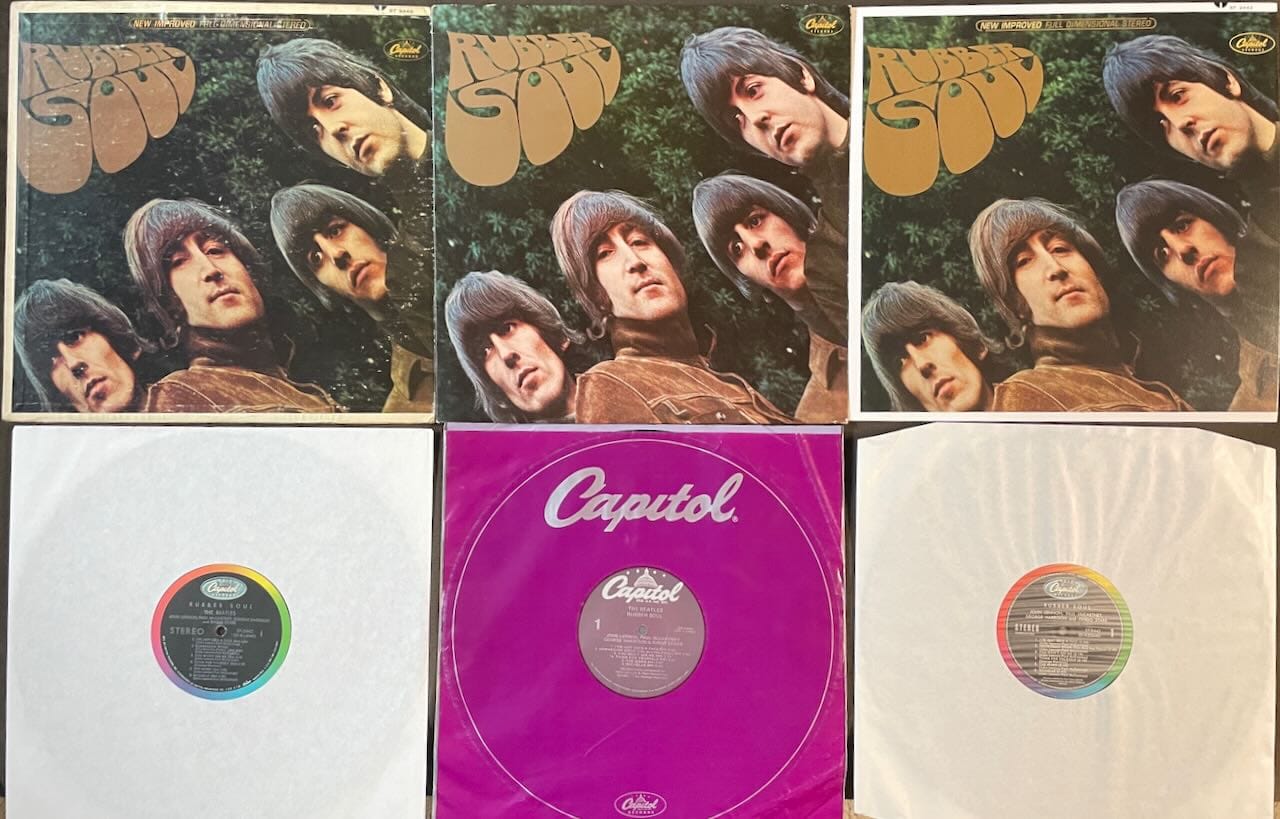
This new pressing makes the added reverb more prominent, due to the silent background of the Optimal vinyl and the excellent all-analog cut from Reeves, which transfers every last detail to the vinyl, pulling the echo trails out of the murk and making them plainly audible. Reeves referred to the original cutting notes and matched the original EQ and azimuth settings as closely as possible, but his work exceeds both my rather crummy-sounding ’68 pressing and my much nicer ’78 Wally cut. (The Wally is great, but with a slightly less focused and slightly more dampened sound.) Reeves also cut the 1964 U.S. Albums in Mono vinyl box set, and his work was a revelation there, making those compromised mono masters—in many cases, folded down from the UK stereo mixes with added Capitol reverb—sound eons better than the original 1960s US pressings. He has done something similar here, and the US stereo Rubber Soul is the best it’s ever sounded.
Whether this version, with its nothing-in-the-middle stereo imaging and added reverb, is worth holding up to the UK version is certainly debatable, but its presence provides crucial historical context. For many American listeners from 1965 until around 1968 or so (when mono was phased out), and for every American listener from 1968 until the 1987 CD release, this was the only Rubber Soul they knew. It’s part of the story.
Again, the pressing just sounds ridiculously healthy, cut at a high level to make use of the shorter side lengths and with enough bass to alert any earthworms living beneath your floorboards. Tonally, the instruments sound richer and riper than previous versions, and the quirks and peculiarities of this Frankenstein’ed master are fully exposed by the accuracy of the cut. It’s enough to make you wish Reeves would cut the remaining Capitol mono albums for a second U.S. Albums box set and then set his sights on the stereo tapes in Capitol’s vaults. Crazy, right?
1-LP 33 RPM 180g black vinyl
• New cut of the American “East Coast” stereo version of Rubber Soul, as first released on Capitol in 1965
• Jacket: Direct-to-board single pocket
• Inner sleeve: White poly-lined paper
• Source: Analog; “from the Capitol tape archive”
• Mastering credit: “Capitol US album mastered by Kevin Reeves,” East Iris Studios, Nashville, TN
• Lacquer cut by: Kevin Reeves, East Iris Studios, Nashville, TN; “Ki Rv @ EAST IRiS” in the deadwax
• Additional notes: None.
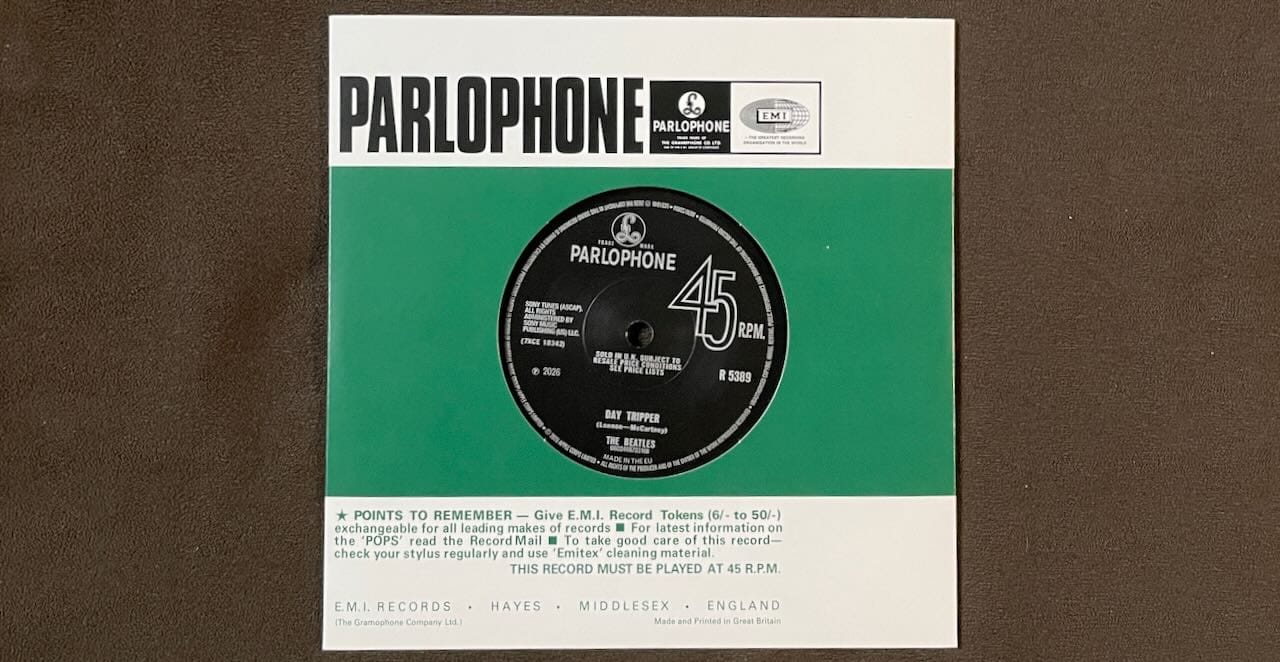
7-inch single: “Day Tripper”/“We Can Work It Out”
Recorded at the same time as Rubber Soul, “Day Tripper” and “We Can Work It Out” are simultaneously an intrinsic part of the album and a wholly separate entity. The acoustic-driven “We Can Work It Out” runs parallel to the album’s folk-rock vein, while the muscular guitar figure of “Day Tripper” shares DNA with the album’s more R&B-oriented tracks, as well as meeting peers like the Rolling Stones, the Who, and the Kinks on their own riff-laden turf.
These remixes by Giles Martin and Sam Odell replace the rushed 1965 stereo mixes that appeared on the US Capitol album Yesterday and Today as well as the 1966 remixes that turned up on the UK comp A Collection of Beatles Oldies (and, eventually, the Past Masters CDs). They previously appeared on the 2023 reissue of the Red Album.
The single is a fun tchotchke to have inside the box, and the disc is well-mastered and well-pressed. But the cardboard jacket leaves something to be desired; the addition of a 7-inch poly sleeve of some sort, while historically inauthentic, would go a long way to ensuring that this disc doesn’t get scuffed up by the cardstock it sits inside, raw-dog style. Also, it’s loosely packaged inside the Sessions and Demos gatefold—probably the safest spot for it, but it can easily fall out of the box or get crumpled as you slide the other discs in and out. It’s the only design flaw in this otherwise exquisitely manufactured set.
7-inch 45 RPM black vinyl
• Stereo remixes of the Beatles’ 1965 single, which first appeared on the 2023 reissue of 1962–1966
• Jacket: Die-cut direct-to-board card sleeve
• Inner sleeve: None
• Source: Digital
• Mastering credit: “Mastered by Miles Showell,” Abbey Road Studios, London, UK
• Lacquer cut by: Miles Showell at Abbey Road Studios, London, UK; “MILES. ABBEY ROAD 1/2 SPEED. ROOM 30” in the deadwax
• Additional notes: Half-speed mastered by Showell.
The Book
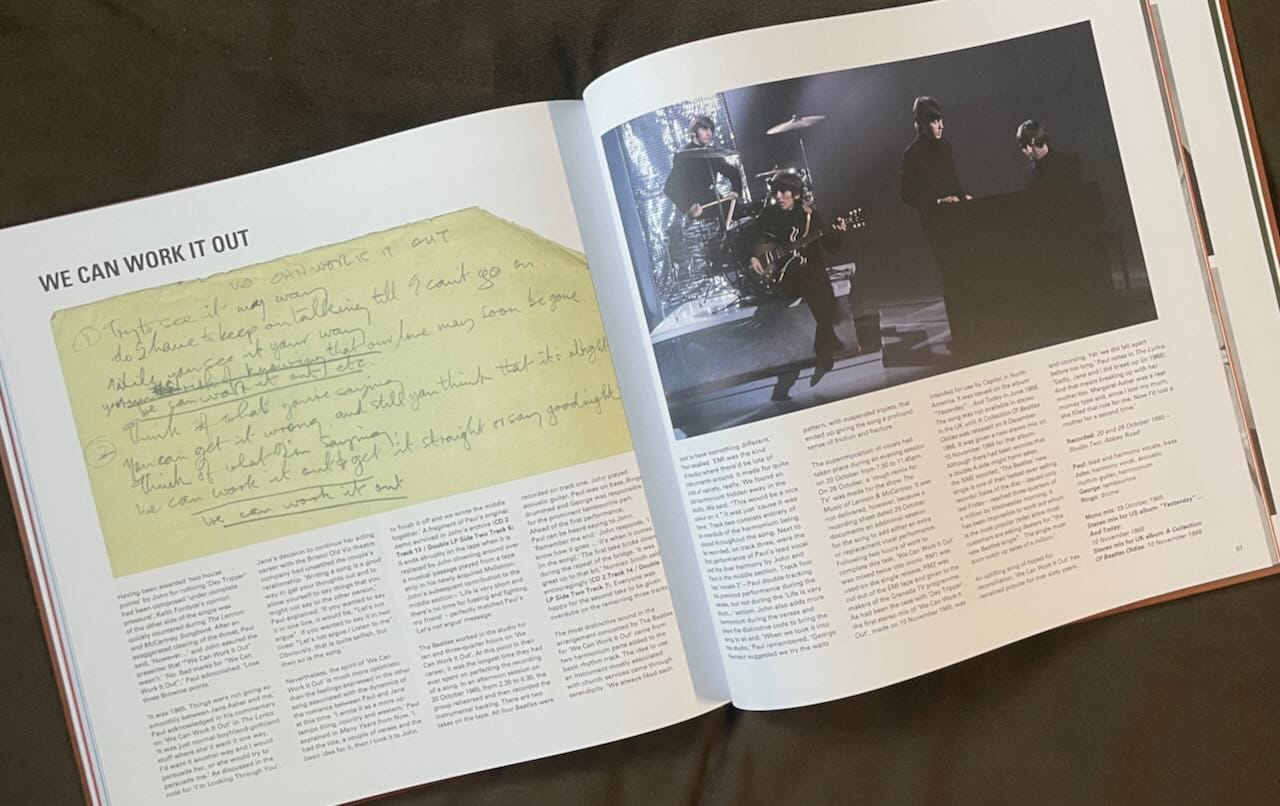
I have to give special mention to the outstanding book that comes with all of these records. Worthy of any coffee table, the 88-page hardcover pulls out all the stops, with introductions by John Lennon and Paul McCartney and exhaustive research from writer and BBC producer Kevin Howlett. His informative, straightforward prose is littered with photos of the band as well as images of tracking sheets, equipment photos, and handwritten lyrics. (John and Paul’s watercolor and felt-tip illustrations on the lyric sheet for “The Word” are nice enough, but my favorite is John’s handwritten lyric for “Norwegian Wood,” scribbled on a torn-out page from The Joan Baez Songbook.)
Howlett’s writing is thoroughly informative, and the documentation about how the individual tracks were put together is ceaselessly fascinating. For anyone who spent hours paging through Mark Lewisohn’s The Complete Beatles Recording Sessions or parsing Ian MacDonald’s guesswork on who played what in Revolution in the Head, the information confirmed by Howlett is priceless. A track-by-track breakdown is provided, as is full context of where the Beatles were at during the latter half of 1965. The book breaks down the cover photo, the US Capitol configuration of the album, and—in a particularly enthralling stretch for vinyl nerds—the various lacquers that were cut by EMI mastering engineers Harry Moss and Hazel Yarwood in an attempt to meet the Beatles’ demands for more bass on the disc. (The album eventually had to be recut when the first pressings caused the needle to jump on cheap record players.)
As has been mentioned here countless times, The Vinyl Cut loves liner notes (as should you). The wonderful Rubber Soul book is as good as liner notes get. It knocked my socks off.
It shouldn’t be surprising that the new Beatles box set is an A-plus premium-grade product. It’s priced to match, of course, although there are smaller configurations to meet most anyone’s budget and interest level. But this really is the gold standard for how a deluxe edition should be done—not just with the refurbished mix but with premium facsimiles of how the album would have originally been experienced back in 1965. As mentioned, I found the Optimal pressings to be without any issues or flaws, a positively rare achievement in a set that contains this many pieces of vinyl. The jackets are equally impressive, and the book is a complete home run.
Although I listened to the same pieces of music in many different permutations over and over as I was researching and writing this review, at no point did I grow sick of a single minute of it. And by supplementing the album with comprehensive historical context and excellent sound, this new presentation turned the act of listening to a beloved album into something akin to a university-level course—one that not only informed but utterly enhanced my appreciation of the music. This Rubber Soul box set did all I could ask of it and more.
Apple/Capitol/UMe box set (5-LP plus 7-inch)
• “Special Edition: Super Deluxe” expansion of the Beatles’ 1965 album
• Jacket: See individual discs above; albums and book come housed in a medium-strength cardboard slipcase
• Liner notes, insert, or booklet: 88-page hardcover book with photos, handwritten lyric sheets, tracking sheets, and other images, plus exhaustive liner notes written by Kevin Howlett, with introductions by John Lennon and Paul McCartney
• Mastering information: See individual discs above
• Pressed at: Optimal Media, Röbel/Müritz, Germany
• Vinyl pressing quality (visual): A
• Vinyl pressing quality (audio): A
• Additional notes: An exclusive version of the box with two bonus posters and two bonus art cards is available on the Beatles’ website, as is an exclusive zoetrope picture disc of the 2026 remix. A single LP of the remixed album and a double LP containing the remixed album plus a selection from the Sessions and Demos collection are available at all retailers. CD and Blu-ray configurations also exist.
Listening equipment:
Table: Technics SL-1200MK2
Cart: Audio-Technica VM540ML
Amp: Luxman L-509X
Speakers: ADS L980