Review: Hōzan Yamamoto, plus a look at Beatball Music

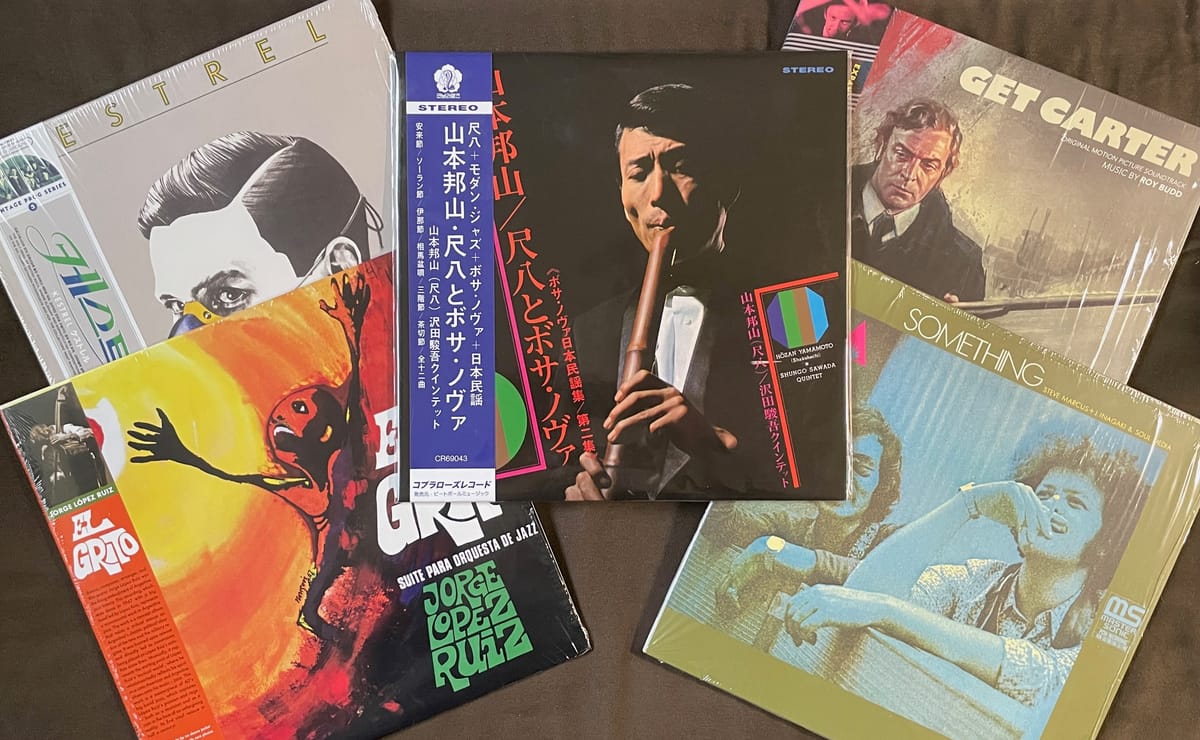
Today I’m reviewing a fascinating reissue of Japanese jazz, released by the South Korean label Beatball Music. I was unfamiliar with the label until its owner, Bongsoo Lee, emailed The Vinyl Cut to inform us of their projects. Based in Seoul, the label is one of the most esteemed independent labels in South Korea and covers so much musical territory that it’s essentially genre-agnostic. While Beatball has released new albums from current artists, Lee has primarily dedicated the label to reissues of music of all types, from all over the world. The label reflects his omnivorous tastes and is all about making the obscure accessible—an attitude that makes Beatball the kind of reissue label that we here at The Vinyl Cut admire above all others.
Beatball’s mission was originally to make overlooked music available to Korean listeners, but it has since widened its scope to vinyl lovers across the globe. They are currently distributed in the US and Canada by Light in the Attic, but be warned that their releases tend to sell out reasonably quickly. With a new Beatball release (on their Cobrarose imprint) hitting the States last week—Hōzan Yamamoto’s Shakuhachi and Bossa Nova Vol. 2, a long-unavailable fusion of jazz, bossa nova, and Japanese folk music—this seemed like the perfect opportunity to dig into Beatball’s catalog and see what gems they’ve uncovered. In this newsletter I explore not just two classics of J-jazz (Japanese jazz) but a ’70s UK rock obscurity, a classic film soundtrack, and an ambitious masterwork of big-band jazz composition from Argentina.
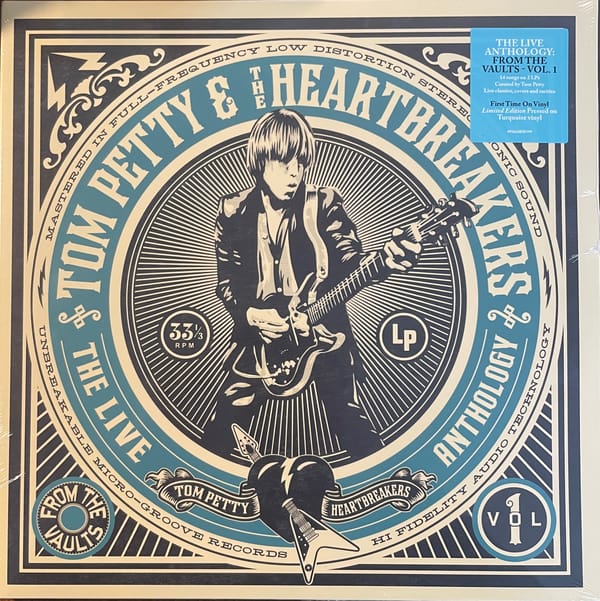
Before we dive in, a reminder that our February vinyl giveaway is now live! We’re giving away the excellent Tom Petty and the Heartbreakers live album that was released on Black Friday last November. It’s hard to find in stores now, so be sure to enter to win! Oh, and you’ll need to be on our paid tier, so if you’re enjoying The Vinyl Cut, please upgrade your subscription and support our work—which you can do by clicking this rectangle here.
 Ned Lannamann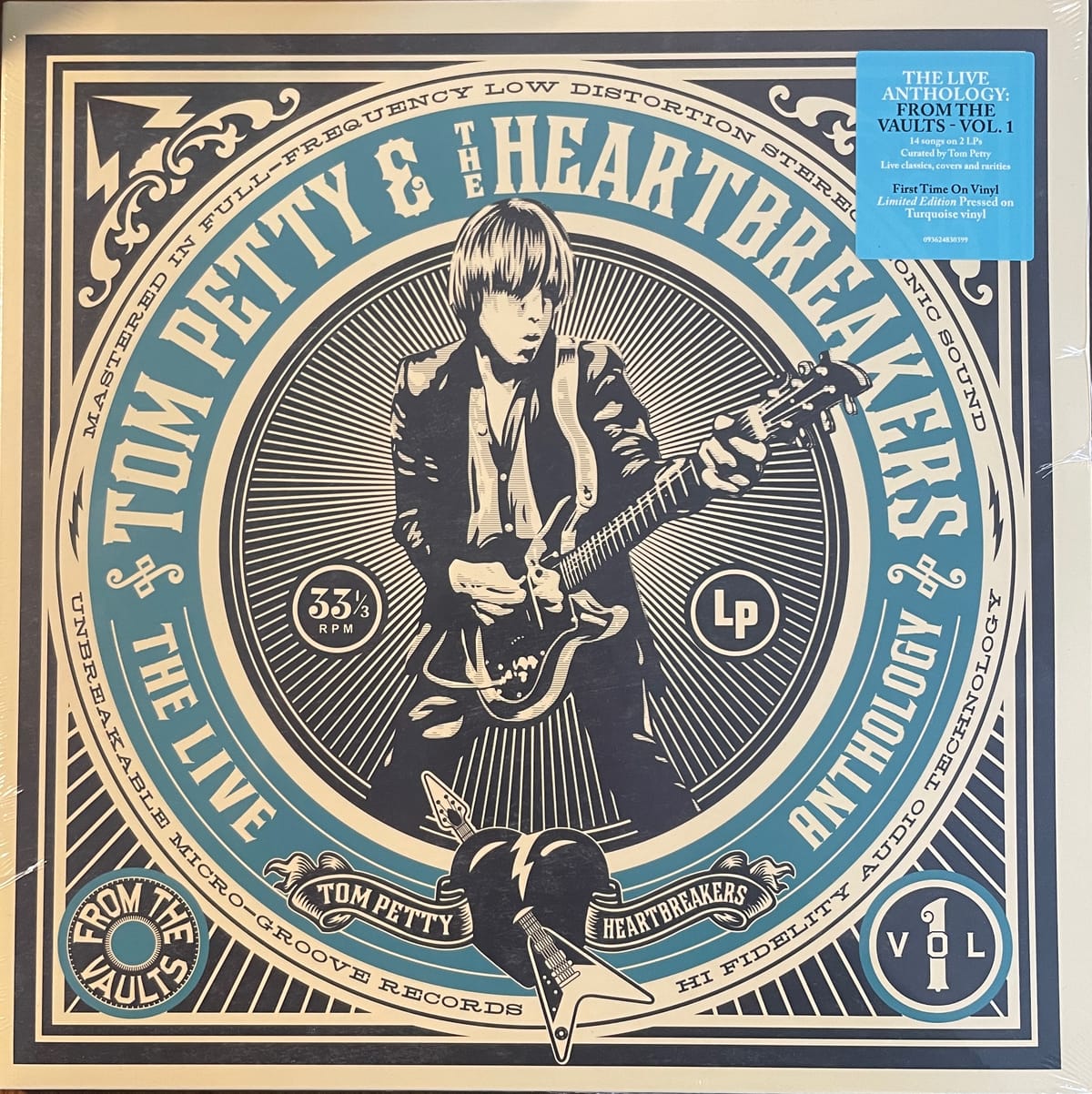
Now, let’s dig into the Yamamoto reissue and some of Beatball’s other records.
Hōzan Yamamoto & Shungo Sawada Quintet: Shakuhachi and Bossa Nova Vol. 2
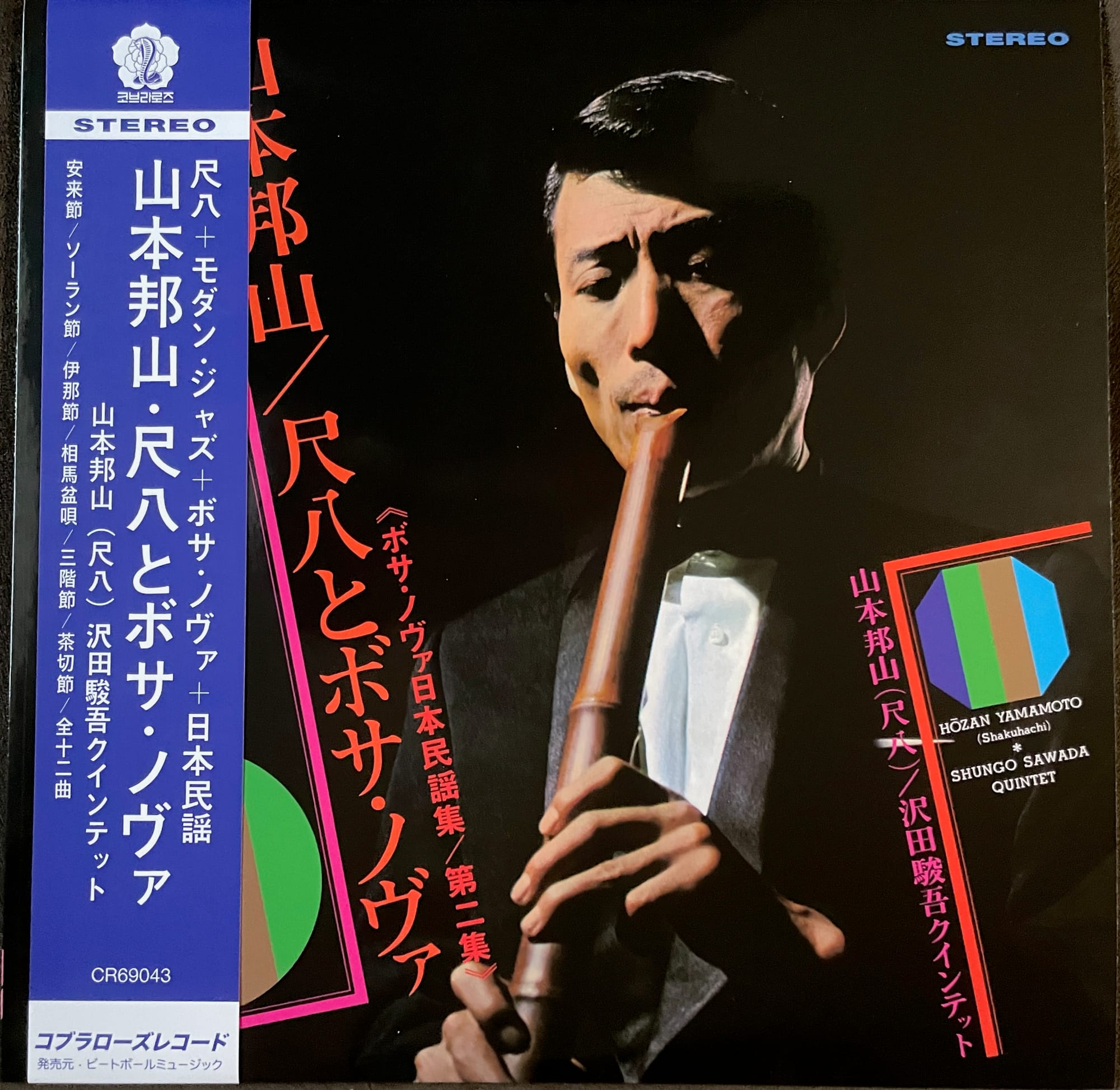
Hōzan Yamamoto was not just a master of traditional Japanese musical forms. The shakuhachi player was also an innovator, working with jazz musicians as well as Eastern and Western classical musicians throughout his career, bringing the Japanese bamboo flute to a huge array of disciplines and styles. One of his jazz efforts—1969’s Shakuhachi and Bossa Nova Vol. 2, the second in a pair of albums he recorded with the Shungo Sawada Quintet—has just been reissued by Cobrarose Records, an imprint of the South Korean label Beatball. It dropped overseas in December, but Light in the Attic has made it available to North American record buyers as of last week.
The album represents a fascinating marriage of schools. Yamamoto adored improvisation but found there were not many opportunities for it within the traditional Japanese musical settings the shakuhachi was conventionally used for. In this way Yamamoto was drawn to jazz, and while several of his later recordings are better examples of pure improvisatory playing, his 1960s albums were about exploring new possibilities for not just Japanese instruments but Japan’s musical traditions. The two Shakuhachi and Bossa Nova records are the culmination points of this first wave of discovery, as they reckon explicitly with bossa nova music, which changed the trajectory of global music in both the pop and jazz spheres during the 1960s. The pliability of bossa nova made for fertile ground on which to reinvent Japanese folk songs, and the genre’s commercial viability ensured that it was something that could attract attention and not just languish in obscurity as a scholarly exercise.
Yamamoto’s shakuhachi and the backing of the Shungo Sawada Quintet make for an appealing blend of the familiar and the unusual—to Western ears, at any rate. The Sawada Quintet was a capable jazz outfit that had already fully metabolized the 1960s bossa nova fad and incorporated it into their command of a wider range of styles. There’s some bebop frenzy within their playing and a full embrace of modal jazz, too, while other forms of Latin jazz beyond bossa nova make themselves heard as well. Sawada’s guitar playing is quite contemporary, mirroring the impact that rock and blues playing had on jazz guitarists like Wes Montgomery and Grant Green.
Within this context, their reworked Japanese folk melodies become something unfamiliar but soothing. Occasionally, the blend of the shakuhachi, the quintet’s instrumentation, and the Japanese pentatonic and heptatonic harmonic structures create something almost akin to the exotica sounds that appeared on American lounge records in the 1950s and 1960s. More often, though, the collaborators hit upon an urbane, energizing version of jazz bearing a refreshingly unconventional flavor. Yamamoto’s playing is fluid but unshowy, as he uses the experiment as an opportunity to unearth new sounds rather than as a platform for his virtuosity. And the sound of the shakuhachi—an organic, breezelike, mournful tone—reveals further complexity and depth by being taken out of its natural habitat.
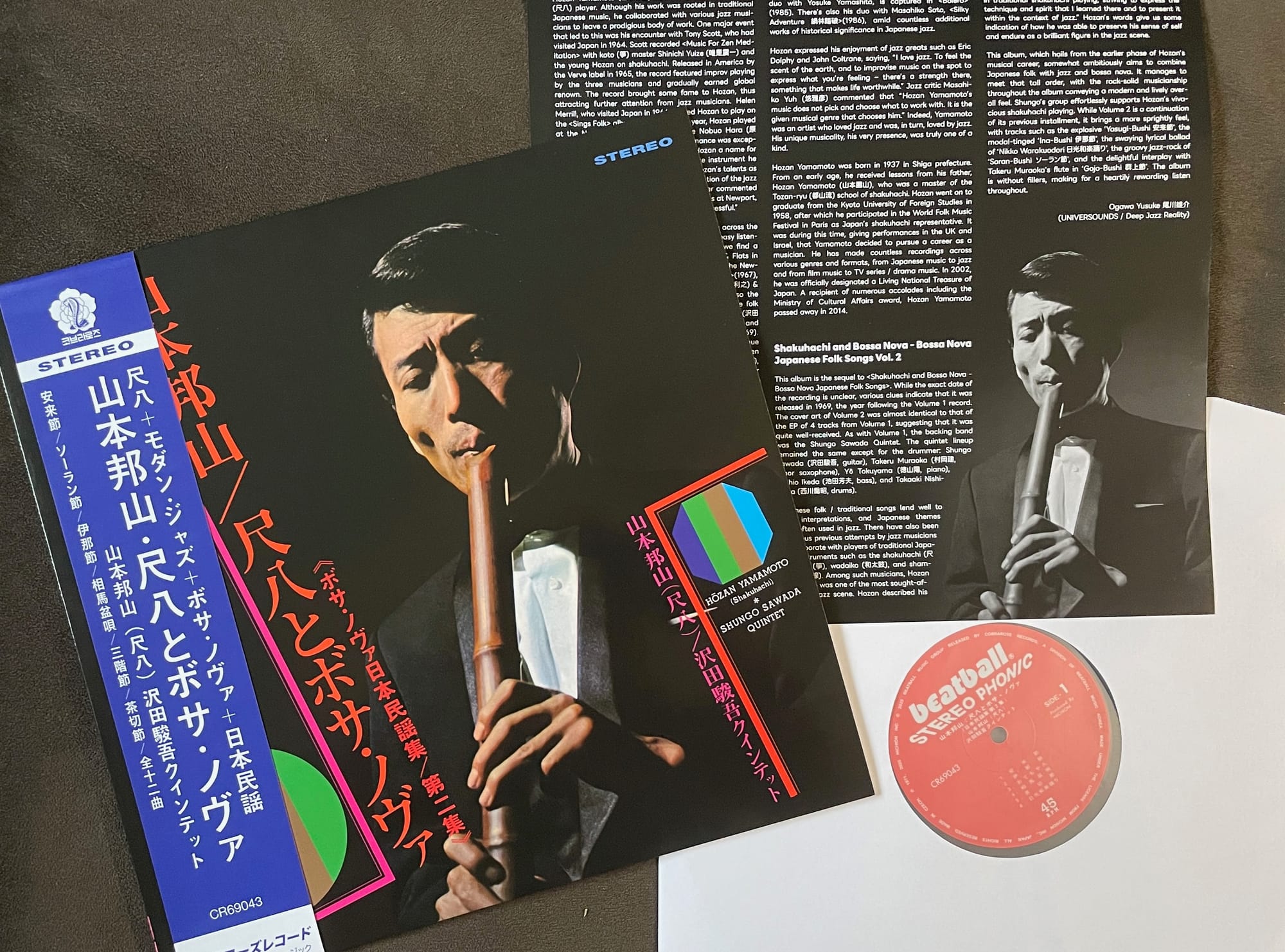
The Cobrarose/Beatball reissue is a lovely piece of vinyl, packaged in a tip-on sleeve with a glossy front cover and an obi replicating the original release. The insert includes liner notes by Yusuke Ogawa, and the disc is cut at 45 RPM, permitting for additional fidelity for what is a roughly 31-minute album. Frederic Stader of Music Matters Mastering cut the lacquer, and his mark in the deadwax indicates that he cut it at Mont Analogue, which was at one point part of Ångström Mastering in Brussels and is now independently run by (the similarly named) Frederic Alstadt. Mont Analogue touts its analog capabilities, and this Instagram post says the disc was “cut from the original master tape source,” suggesting that the analog reels were shipped from Japan to Belgium for this preparation. This is not explicitly stated on the package itself, though. The disc was pressed at GZ Media and is of generally high quality, although some minor noise is occasionally audible in between tracks, and my copy had a soft repeating tick during one of the last songs on Side 2.
The sound of the disc itself is robust, with an ample bass presence, a pleasing level of realism, and a splendid sense of the placement of the different instruments in the stereo spectrum. It’s a very live-sounding recording, with Yamamoto’s shakuhachi residing comfortably in the upper range, carving out plenty of space amid the backing band’s midrange and bass frequencies. There is a warmth and luxuriousness to the sound that confirms this was a very well-recorded session, and the shakuhachi’s delicate, blossom-like qualities are never overwhelmed by the rhythm section. With originals incredibly scarce and commanding prices of a few hundred dollars, this new Beatball reissue is an ideal way to chart this fascinating period in Yamamoto’s prolific career.
Cobrarose/Beatball 1-LP 45 RPM 180g black vinyl
• Remaster of Hōzan Yamamoto’s 1969 album
• Jacket: Tip-on single pocket with obi
• Inner sleeve: White poly-lined
• Liner notes, insert, or booklet: Double sided insert with liner notes by Yusuke Ogawa in English and Japanese
• Source: Analog; “cut from the original master tape source,” per this Instagram post
• Mastering credit: “Lacquer cutting: Frederic Stader at Music Matters Mastering”; no separate mastering credit
• Lacquer cut by: Frederic Stader at Mont Analogue, Belgium; “FST CUT AT MONT ANALOGUE” in deadwax
• Pressed at: GZ Media, Czech
• Vinyl pressing quality (visual): A
• Vinyl pressing quality (audio): B+ (minor noise in between tracks, repeating tick during “Sangai-Bushi”)
• Additional notes: Comes in a resealable plastic outer sleeve.
Listening equipment:
Table: Technics SL-1200MK2
Cart: Audio-Technica VM540ML
Amp: Luxman L-509X
Speakers: ADS L980
Beatball Music is not a household name even among vinyl devotees, so this is a fine opportunity to examine some of their other releases. The label’s head, Bongsoo Lee, provided The Vinyl Cut with a handful of discs from their back catalog, and these selections diagram the wide range of musical styles being reissued by Beatball. You might even be surprised to discover that many of their discs were cut by perhaps the best-known mastering engineer currently on the scene.
Roy Budd: Get Carter
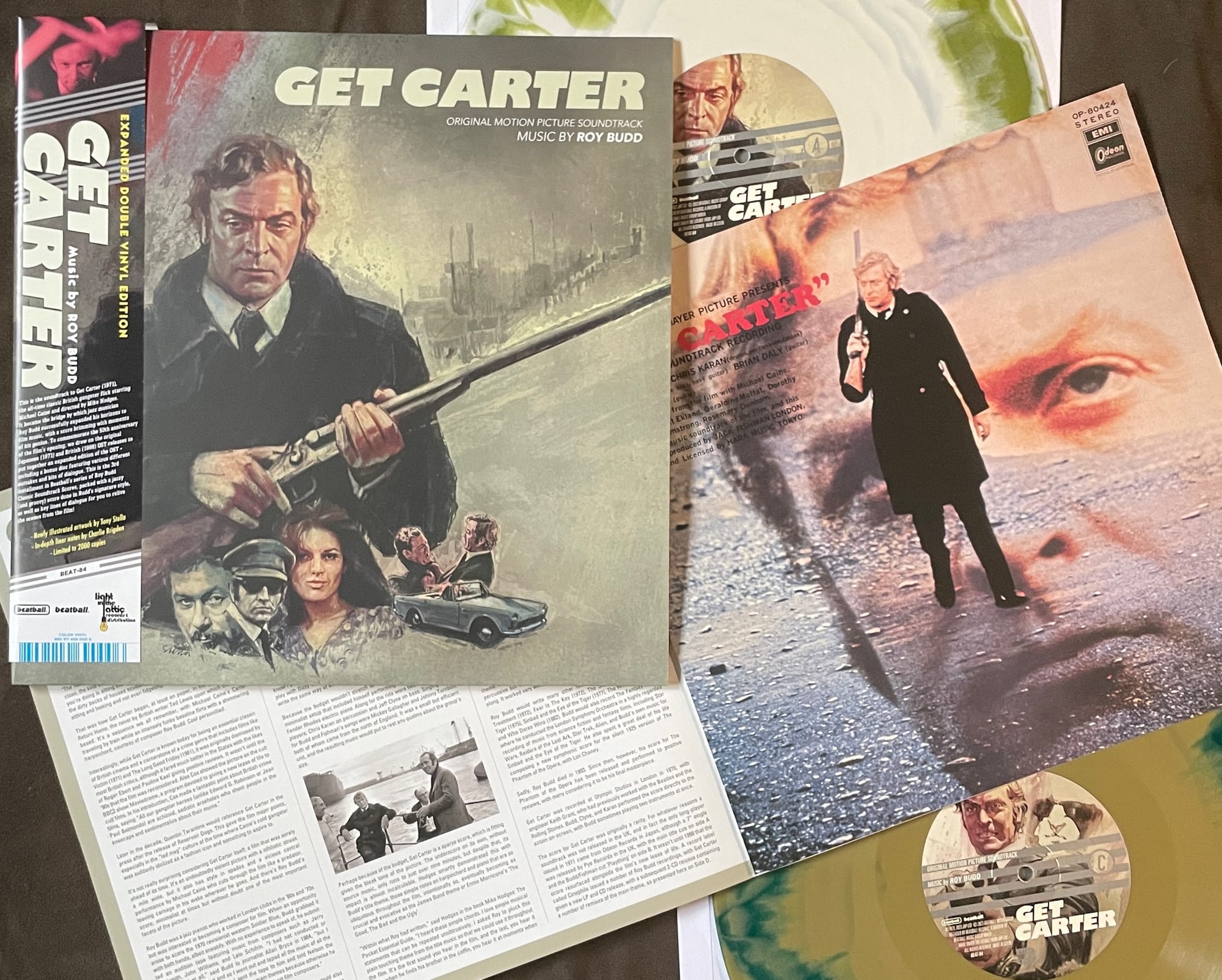
Beatball’s 2024 double LP release of the Get Carter soundtrack is particularly stunning. The vinyl—in black and colored variants—comes inside a tip-on gatefold with a six-page foldout insert and a wraparound obi. There’s artwork galore, including a newly painted cover and the inclusion of several of the movie’s poster variants from around the globe. The lacquer was cut by Frederic Stader and the discs were pressed at GZ; they generally sound pretty terrific, although there are different levels of fidelity for certain tracks, as some are taken from the film audio itself. As part of their Cine Beat series, this was the third LP Beatball had released of Roy Budd’s scores, following their reissues of 1973’s The Stone Killers and 1974’s The Marseille Contract.
Budd’s remarkable music is shuffled with excerpts of dialogue from the film itself, making for an immersively cinematic experience. The tracklist mirrors various editions of the soundtrack album from over the years, which was initially released only in Japan back in 1971. It wasn’t until the CD era that Get Carter was reissued more widely—it received several CD renditions when the film was reclaimed in the ’90s by British “lad” culture—and this version looks to be a comprehensive collection of all the Budd music and dialogue without any of the extraneous ’90s remixes or non–Get Carter music that turned up on some of those editions. Film soundtrack fans, and Budd fans in particular, know the power and uniqueness of the Get Carter score, which uses harpsichords, tabla, and voices within a rock/jazz ensemble to create something ominous and hypnotic. For anyone who wants Budd’s score on vinyl, this is unquestionably the version to track down.
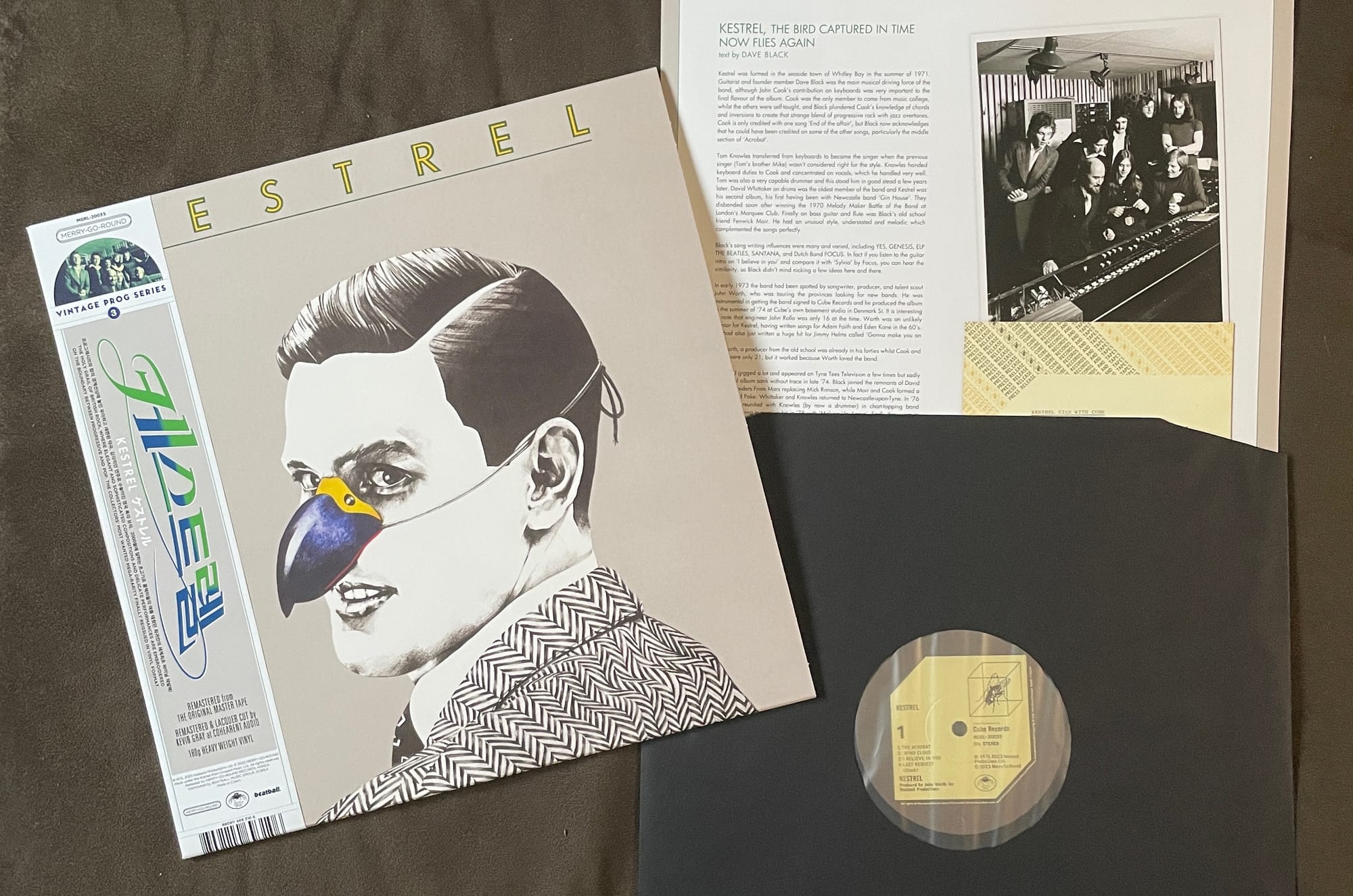
Kestrel: Kestrel
Beatball partnered with the prog- and psych-oriented Merry-Go-Round label for several releases, including a 2023 reissue of the 1975 self-titled album by the Newcastle-area band Kestrel. The original, a mega-obscurity on the Cube label, is a somewhat meat-handed rock record with faint prog overtones, a hint of blue-eyed soul, and some jazzy splashes. It’s an enjoyable listen, although it’s been oversold by some as a lost prog classic, when it’s really more of a mid-’70s pop-rock album with some unorthodoxy to the arrangements but none of prog’s expected complexity. The band was produced by pop impresario Johnny Worth (AKA Les Vandyke), and Kestrel guitarist Dave Black went on to join Woody Woodmansey and Trevor Bolder in a Mick Ronson–less version of the Spiders from Mars before having a big UK hit with Goldie in 1978 with the song “Making Up Again.”
The Merry-Go-Round/Beatball reissue treats the source material with ample respect. Although the master tape was transferred to digital in London (by Cherry Red for a reissue CD on their Esoteric imprint), they got Kevin Gray at Cohearant Audio to master the audio for vinyl and cut the lacquers. The sound is good, if nothing revelatory—the drums have a nice thump, and the mellotron passages have a pleasing ethereal quality, although there’s a graininess to the overall texture to the sound and a bit of breakup during the louder sequences that suggest it was not an especially well-recorded album. (It was laid to tape in a cramped basement studio beneath Essex Music’s office in Denmark Street, London’s fabled Tin Pan Alley; Cherry Red’s transfer may also may also be responsible for some of the limitations.) The GZ pressing is good but not without some minor noise. But with liner notes, an obi, and Kevin Gray’s initials in the deadwax, this is a more than worthy treatment of a fun Britrock obscurity.
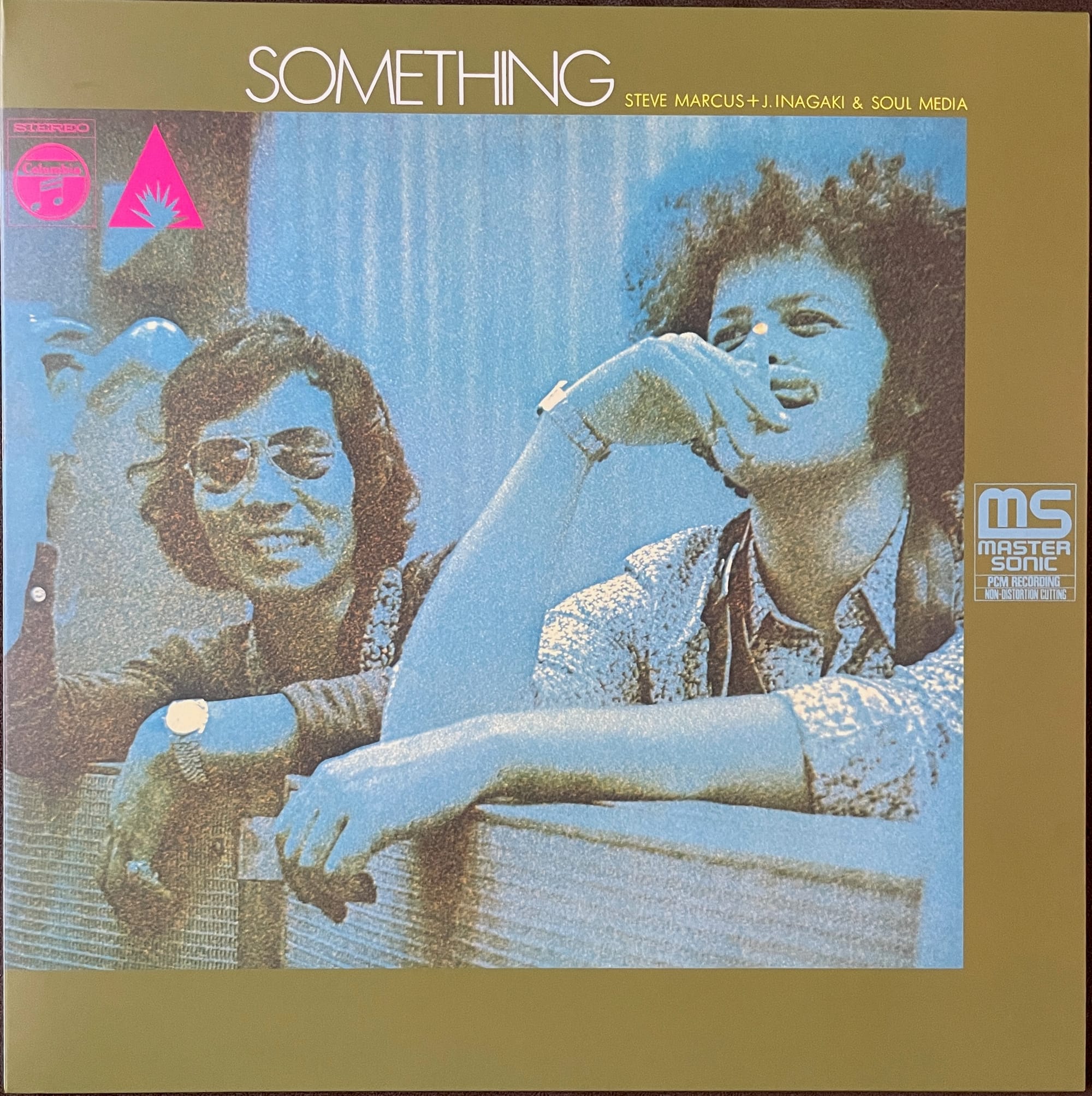
Steve Marcus & Jiro Inagaki with Soul Media: Something
Beatball were also responsible, under their Cobrarose sublabel, for the only vinyl reissue of a historic 1971 recording that American saxophonist Steve Marcus made in Japan with saxophonist Jiro Inagaki and his ensemble Soul Media. Something was the second-ever commercial recording made on PCM digital, and it was the first one ever released. (The first PCM sessions, Stomu Yamash’ta’s The World of Stomu Yamash’ta and Uzu: The World of Stomu Yamash’ta 2, were recorded two weeks prior but not released until after Something.) The album is notable beyond that historic context, too, as it’s a remarkable document of Japanese jazz fusion in its own right. Soul Media at that time featured dueling drummers Hajime Ishimatsu and Seiji Tanaka as well as guitarist Ryo Kawasaki, and their sound was wide-ranging and fearless.
The title track is a relatively straightforward, swinging interpretation of the George Harrison song, but the other two tracks are decidedly freeform, particularly “Fairy Rings,” which transforms from a tranquil, lullaby-like head into a continuously shifting magma flow of drum clatters, horn honks, and guitar squalls. “Serenity” is a cooler, triplet-driven bit of city-rain jazz that also explores the outer reaches. The album is topped off with a bonus alternate take of “Something” that unfortunately somewhat ruins the vinyl flow of this brief album. The album take already begins to wear out its welcome at six minutes, but with the bonus version at more than double that, it’s definitely too much of “Something” for one sitting.
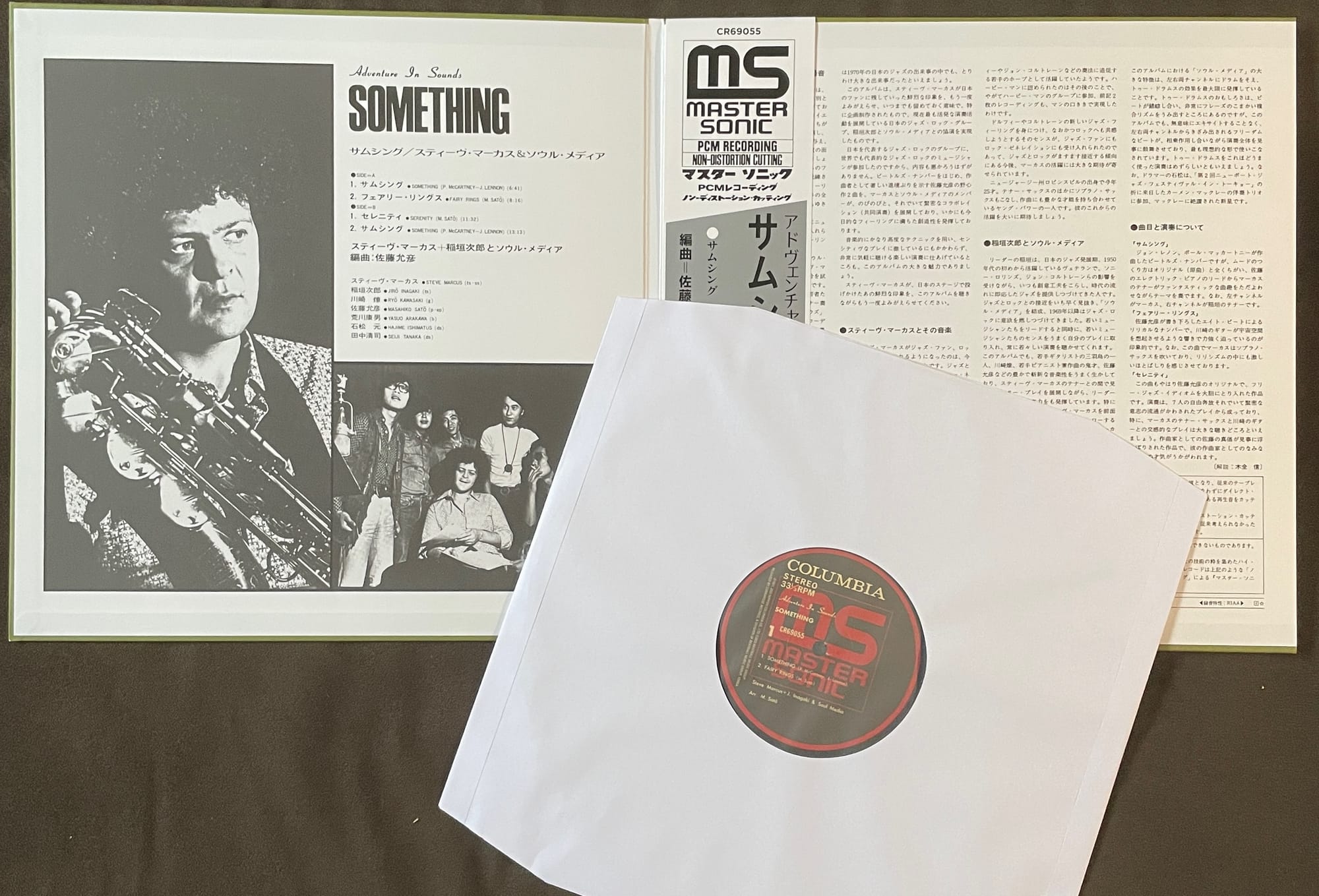
Naturally, this being one of the first digital albums, it couldn’t be cut from analog, but Kevin Gray at Cohearant was the lacquer engineer for this one as well; the obi says it was “remastered and cut from the first-generation Nippon Columbia master tape source, transferred at Victor Studio in 2022.” And it sounds stellar, with the exuberant drums—one drummer in each speaker—dictating the overall shape of the sound. Masahiko Sato’s electric piano is depicted with exciting vividness, although Yasuo Arakawa’s bass was recorded at a low level and is often obscured by all the activity. The tip-on gatefold is beautifully done, making this another exceptional package from Beatball.
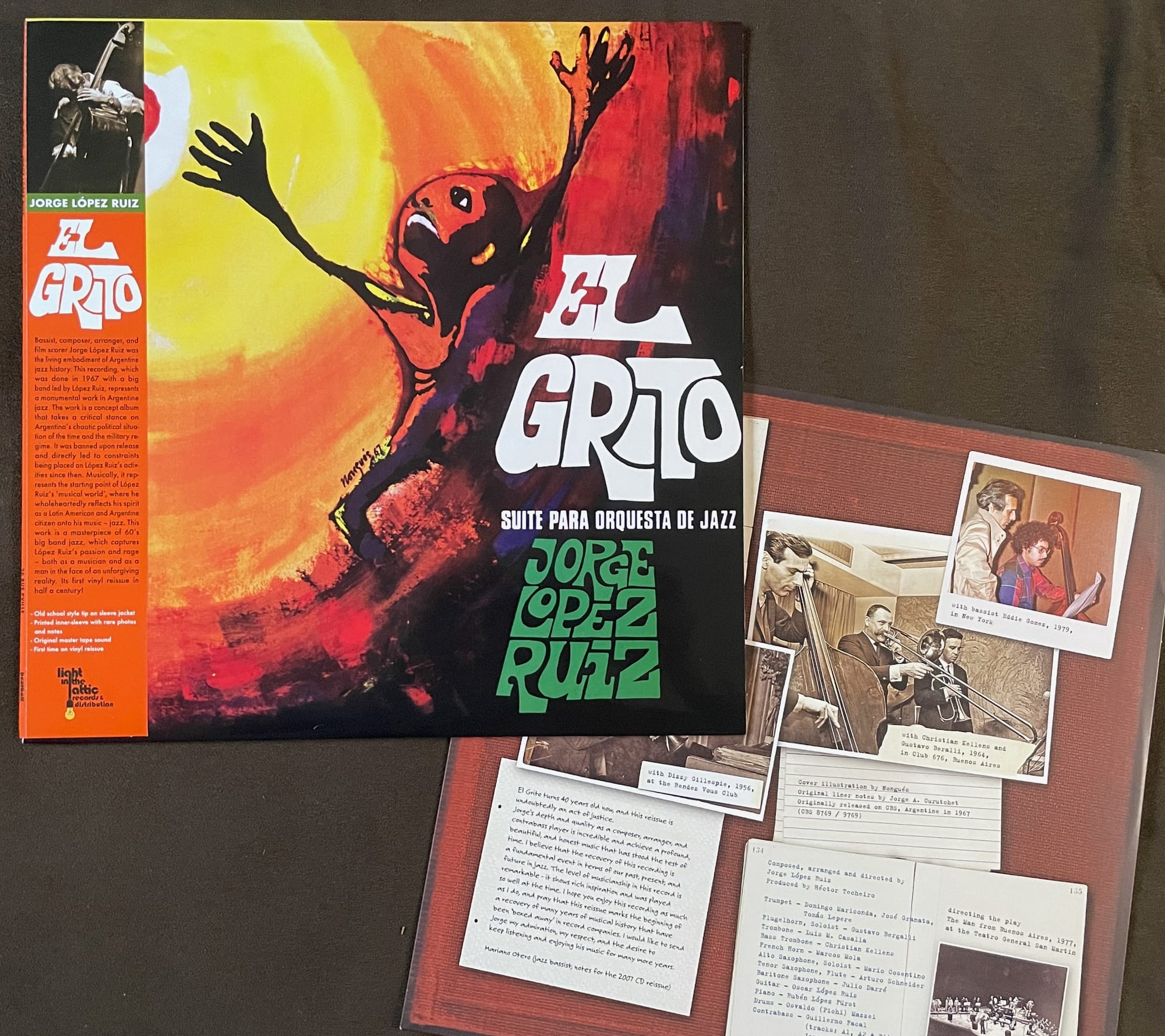
Jorge López Ruiz: El Grito
The last Beatball release in this sampling was released back in 2020 on their Pleasantville imprint. It’s a reissue of an extraordinary 1967 album by Argentinian jazz bassist/bandleader Jorge López Ruiz. El Grito (“The Scream”) is a big-band suite that defies any typical jazz taxonomy, using every facet of jazz developed up to that point and adding a little bit of Argentinian flavor. Some of the compositions are not wholly original—you’ll instantly identify snatches of “Take Five” and “So What” incorporated into the pieces—but Ruiz’s overall vision is what matters here. His instrumental arrangements and his structural design of the five different movements make this a uniquely compelling listen that evokes the artistic freedom Ruiz was trying to attain under the military dictatorship in Argentina at the time.
The disc was cut by Kevin Gray from a digital transfer of the master tape, and it’s a full-throated, Technicolor execution. The diversity of timbres gives the recording incredible liveliness, and the cut provides ample room for them all to shine. Sometimes the 14-piece ensemble sounds like a tight little combo in the corner of a nightclub, and at other times they sound like an orchestra of thousands—but throughout, every line is clearly articulated and presented. It’s a beautiful-sounding record.
As the oldest of the Beatball records in this batch, it’s the only one that didn’t come in a poly-lined inner sleeve; rather, the disc (pressed at RTI, per my amateur deadwax-sleuthing skills) was inside a custom thick paper sleeve that bore liner notes and photos. It had a few minor scuffs as a result, with some noise and clicks here and there. But this was a work altogether unknown to me, and it’s one I am thrilled to have discovered and presented in such a conscientious fashion.
These Beatball reissues are all offering the opportunity to explore some true rarities, and their curatorial selection is some of the most adventurous on the vinyl scene. Every disc is worth delving into, and it’s got me fervently anticipating what Beatball has coming up next.