Review: The Jimi Hendrix Experience on UHQR

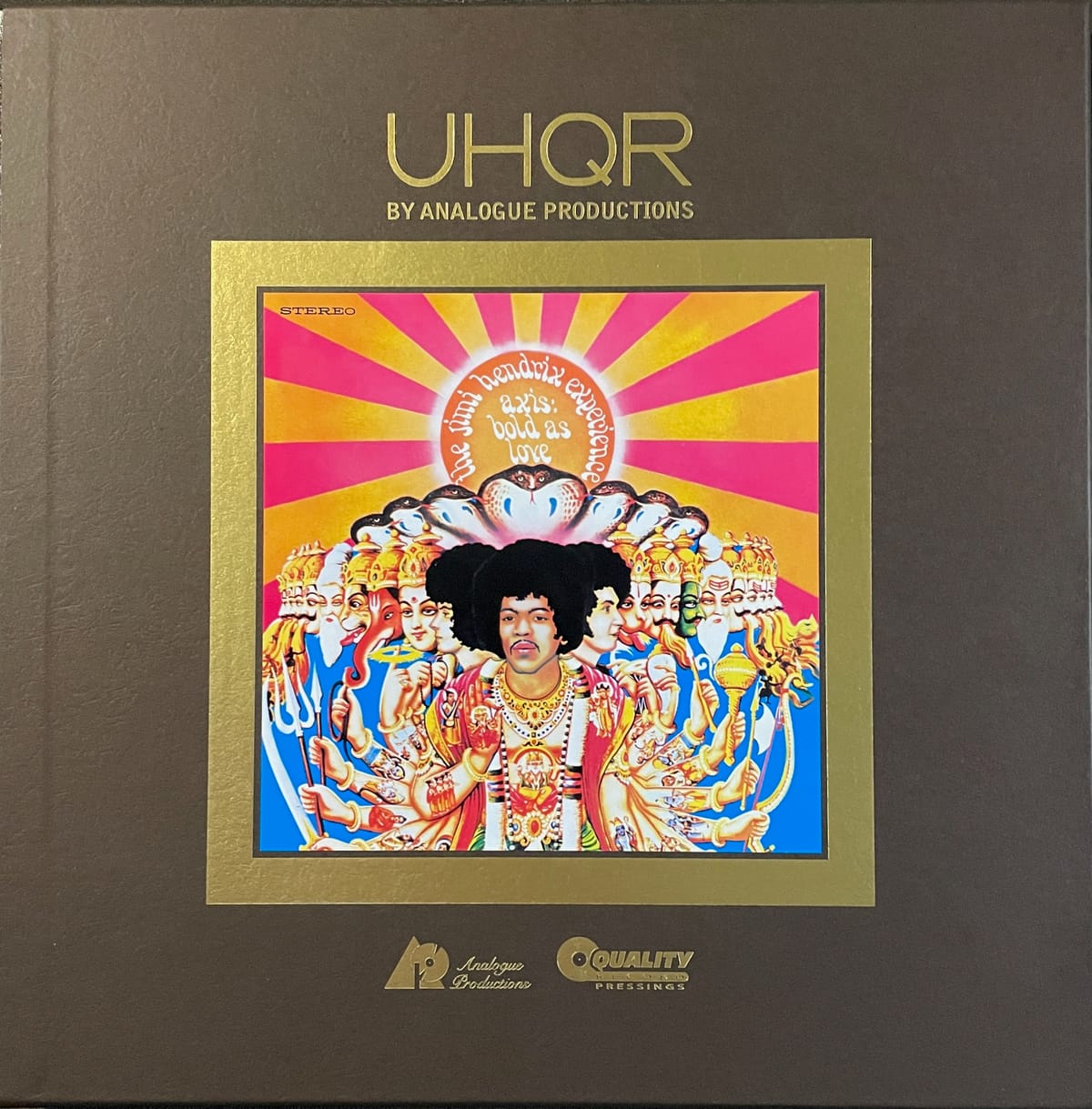
It was scarcely three months ago that we were treated to a definitive box set of the Jimi Hendrix Experience’s sophomore album, 1967’s Axis: Bold as Love. That box, containing analog cuts of the album’s mono and stereo mixes plus three LPs of bonus material and a Blu-ray with a new Dolby Atmos mix, was virtually definitive in my estimation—you can read the Vinyl Cut review of the excellent Bold as Love vinyl box set here.
Around the same time as the 5-LP box was announced last year, Analogue Productions also announced they were giving Axis: Bold as Love their trademarked UHQR treatment, releasing both the mono and stereo mixes in ultra-high-end 45 RPM double-vinyl sets. Bearing list prices that topped the 5-LP box and containing considerably less material, it was clear that Analogue Productions were aiming for the moneyed audiophile market rather than the obsessed-but-sane Hendrix fan who simply wanted to have all the music. Of course, the insane Hendrix fan was going to have to splash out for all three.
Now the UHQRs are finally out and I have been able to listen to the stereo version, comparing it to the 33 RPM cuts that came in last year’s 5-LP box. My ultra-quick evaluation is this: The 5-LP Bold as Love is simply the better buy. It contains five times the music than either of the UHQRs do, and those analog album cuts—done by Bernie Grundman—are superb, as they are fully revealing and dynamic and enjoyable. Simply from a consumer advocacy standpoint, I have to come down on the side of the Bold as Love box. It just gives you more: more music, more liner notes, more insight into the making of the album via the alternate takes, and more for your ear to explore within the new Atmos mix.
But we vinyl fanatics are not a practical bunch. Presented with the option, we sick-in-the-head obsessives can’t help but wonder: These UHQRs—could they sound just that little bit better? Could they erupt out of the speakers with just a smidgen more power and gravity? Could the realism and dimensionality be nudged up just that tiniest fraction?
The answer is, unfortunately, yes: This stereo UHQR pressing of Axis: Bold as Love does sound a notch better, possessing a little extra oomph and a slightly riper flavor, like a particularly perfect strawberry that you find in the carton of really, really good strawberries, or that one especially mind-blowing oyster among the dozen that makes your mouth pop and the rest of your senses tingle. I am very sorry to report this to the financially sensible among you. A UHQR is not a monetarily advisable buy. And you will still need to get the terrific 5-LP Bold as Love for all of the extra music it contains. (In fact, I would recommend that the fiscally responsible among you stop reading this review now.)
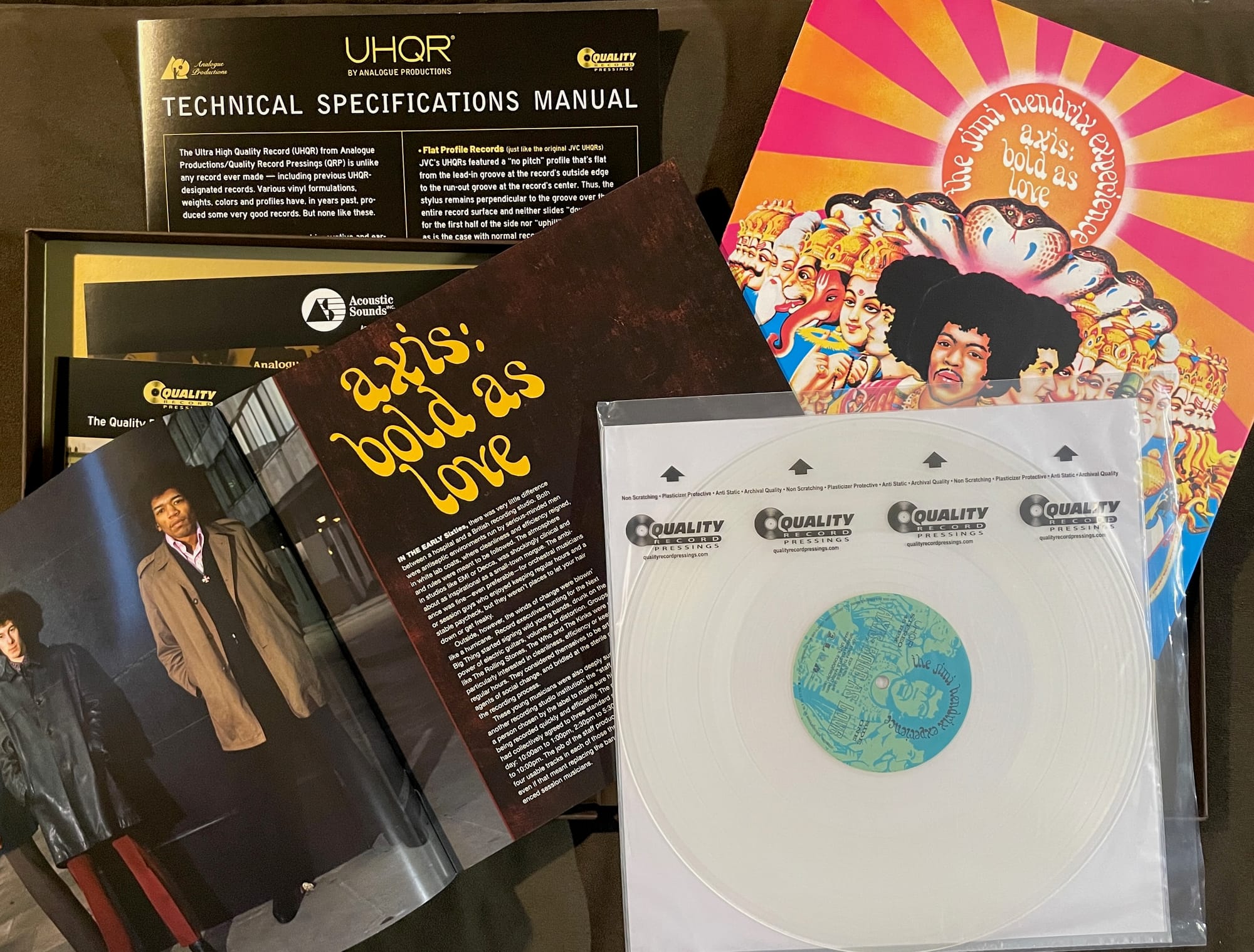
But there it is: The UHQR of Axis: Bold as Love—the stereo version, at least—more than justifies its existence, if not its expense. It is a full-color widescreen experience, with Hendrix’s guitar sounding earth-shatteringly present, and with a near-holographic quality that you can almost “see” around. The beginning of “Little Wing” is a particularly potent example, with the guitar seeming to sit in the room with you, giving off its own presence, space, and heat. Noel Redding’s bass is just a touch deeper and more subliminal throughout, able to reach out and vibrate a slightly larger proportion of molecules inside the listener’s body. The limitations of the 1967 recording are a bit more audible, particularly in the use of phasing and flanging; the hardware used in Olympic Studio during the tracking sessions can be perceived, and the slight hesitation and mistiming of the marching feet on “If 6 Were 9” can be detected. It’s just an astonishingly immersive and exciting experience, never overstretching or inflating any of the sounds but revealing them in the most truthful way possible, like a fully illuminating but completely neutral light on a painting in a gallery.
Bernie Grundman also cut these UHQRs, presumably at the same time as he cut the 33s for the Bold as Love box set. And they were cut at Quality Record Pressings, same as the Bold as Love discs, making this a particularly well-suited use case for comparing a 33 RPM cut to a 45 RPM one. The 45 wins, although there are other contributing factors in the manufacturing of the UHQR vinyl, making the direct comparison slightly more complicated. The UHQRs are not one-steps, as is sometimes misperceived, but they use a proprietary Clarity Vinyl compound and a completely flat platter profile—a particular feature that may be the closest the sales pitch comes to snake-oily territory. (The description on the enclosed pamphlet doesn’t quite pass muster, stating that on an ordinary pressing the stylus slides downhill during the first half of the side and uphill during the second half, but the provided diagram suggests that the stylus has to climb uphill toward the center of the disc at all times. I’m all in favor of a flat record, of course, but Disc 1 of my copy had my tonearm bobbing up and down just a teensy bit, with no ill effects, so maybe the whole uphill/downhill thing is a touch overblown.)
I’m as discomfited by my encounter with the Hendrix UHQR as I am enraptured by the sound. This being my first prolonged exposure to a UHQR pressing, I am alarmed at how easily my resistance was overcome—leaving me now seduced by the prospect of incrementally better sound, not to mention disturbed by the notion that it may be necessary to invest in these incredibly expensive objects for albums I consider fundamental. In fact, it’s quickly altered my vinyl-collecting mentality, to an irritating degree. I can only recommend that those among you who already believe themselves to be wholly satisfied by their Axis: Bold as Love listening experiences to return home, lock your doors, and hold your cherished copy close to you. You cannot un-bite the apple, just as you cannot un-open Pandora’s box—or in this case, the gorgeously appointed UHQR slipcase.
Analogue Productions UHQR 2-LP 45 RPM 200g clear (Clarity) vinyl
• New analog master of the stereo mix of Jimi Hendrix Experience’s 1967 album, pressed at 45 RPM as a UHQR (Ultra High Quality Record)
• Jacket: Outer clamshell box with tip-on gatefold inside box; discs are not housed inside the gatefold jacket but provided in a separate poly sleeve
• Inner sleeve: QRP-branded poly
• Liner notes, insert, or booklet: 24-page booklet with photos, liner notes by Brad Tolinski, and recording notes; four-panel “Technical Specifications Manual”; authenticity pamphlet with patent reproductions; promotional brochure for other Acoustic Sounds/Analogue Productions titles
• Source: Analog; “100% analog masters,” “Original master tapes” on hype sticker
• Mastering credit: Bernie Grundman at Bernie Grundman Mastering, Hollywood, CA
• Lacquer cut by: Bernie Grundman at Bernie Grundman Mastering, Hollywood, CA; fully spelled-out “Bernie Grundman” signature in deadwax, not just “BG,” because these are, y’know, special
• Pressed at: Quality Record Pressings, Salina, KS
• Vinyl pressing quality (visual): A- (Disc 1 not perfectly flat; Disc 2 spindle hole overly tight)
• Vinyl pressing quality (audio): A+
• Additional notes: Numbered edition of 4,500 copies; mono mix also available in numbered edition of 2,500.
Listening equipment:
Table: Technics SL-1200MK2
Cart: Audio-Technica VM540ML
Amp: Luxman L-509X
Speakers: ADS L980