Review: John Coltrane in Mono

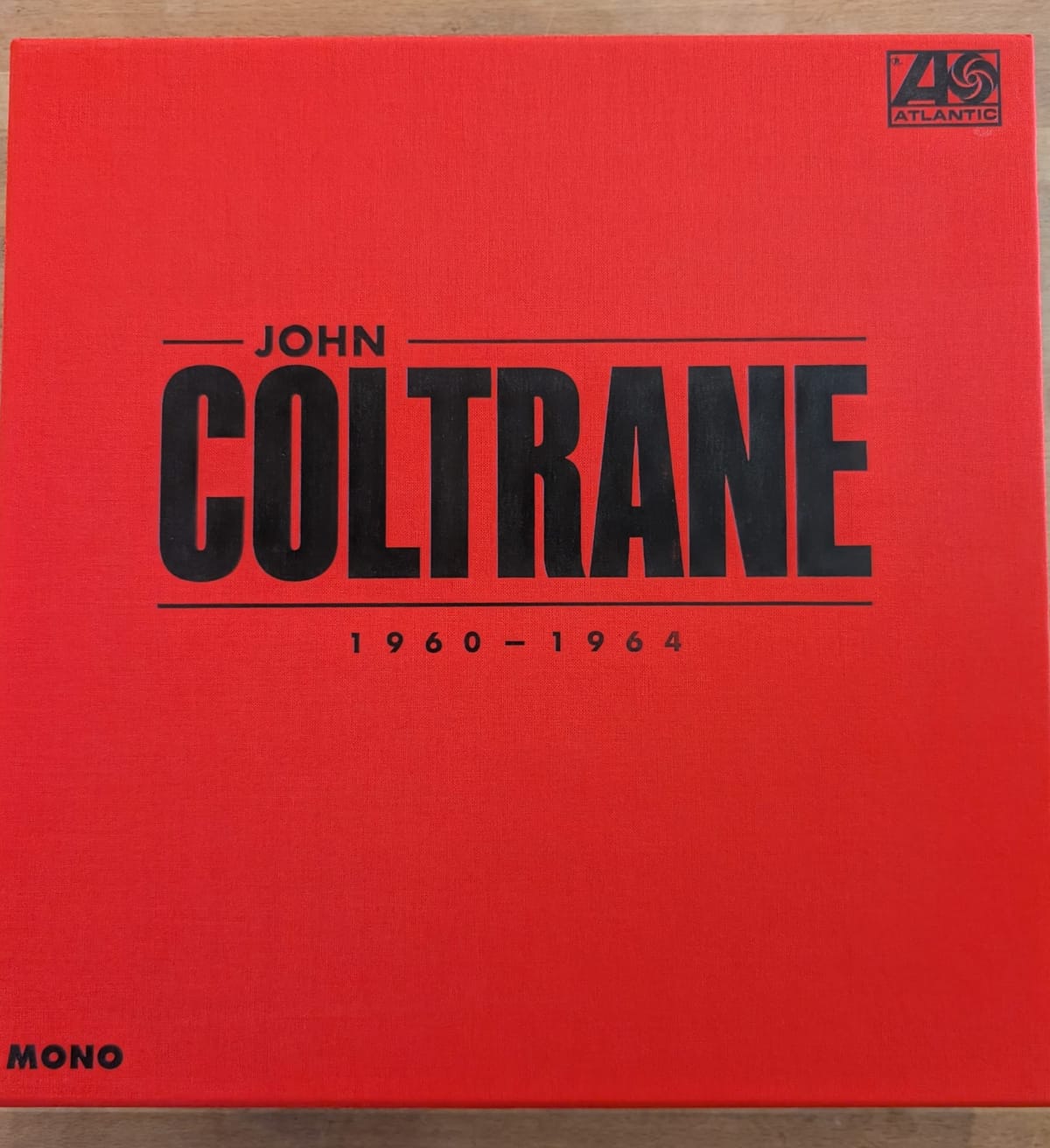
Exploring Rhino High Fidelity’s Coltrane 1960–1964 Mono box and a new mono version of A Love Supreme.
Although the timing for the recent reissues of work from the mighty jazz saxophonist John Coltrane feels a tad off, there is logic to it. The November release of Coltrane 1960–1964 Mono, a limited-edition Rhino High Fidelity box set featuring remastered mono pressings of a half-dozen albums that the artist released on Atlantic, makes for a hell of a holiday gift. And while there’s never a bad time for a repressing of A Love Supreme, Coltrane’s magisterial work of spiritual jazz, Impulse’s release of a new mono mix of the LP in September at least dovetailed nicely with its 60th anniversary. (Impulse also dropped a vinyl edition of The Complete 1961 Village Vanguard Recordings this past October.)
I say off because one huge promotional hook for all of these re-releases comes in 2026: Coltrane’s 100th birthday. Though he left this earthly plane at the far-too-young age of 40 in 1967, what he achieved in that short span was mind-boggling—42 albums as a leader or co-leader; contributions to masterpieces like Miles Davis’s Kind of Blue, Mal Waldron’s The Dealers, and Thelonious Monk’s Monk’s Music; and live performances around the world. His accomplishments are always worth celebrating, but having a nice round number to inspire new essays and thinkpieces—and, yes, fresh reissues of Coltrane’s recorded work—just feels right.
All of that is just me picking nits, much in the same way that I’m hearing some vinyl collectors and jazz fans kick up a fuss over Rhino’s decision to use the covers of the French releases of Coltrane’s Atlantic output, relegating the original, more familiar art to inside the gatefold. Sure, it would be nice to have things the way that I want them, but why gripe when there’s all this great music to listen to? Because above any of these minor grievances is the fact that all six LPs in this weighty set are sensational, as is having them all in one lovely package.
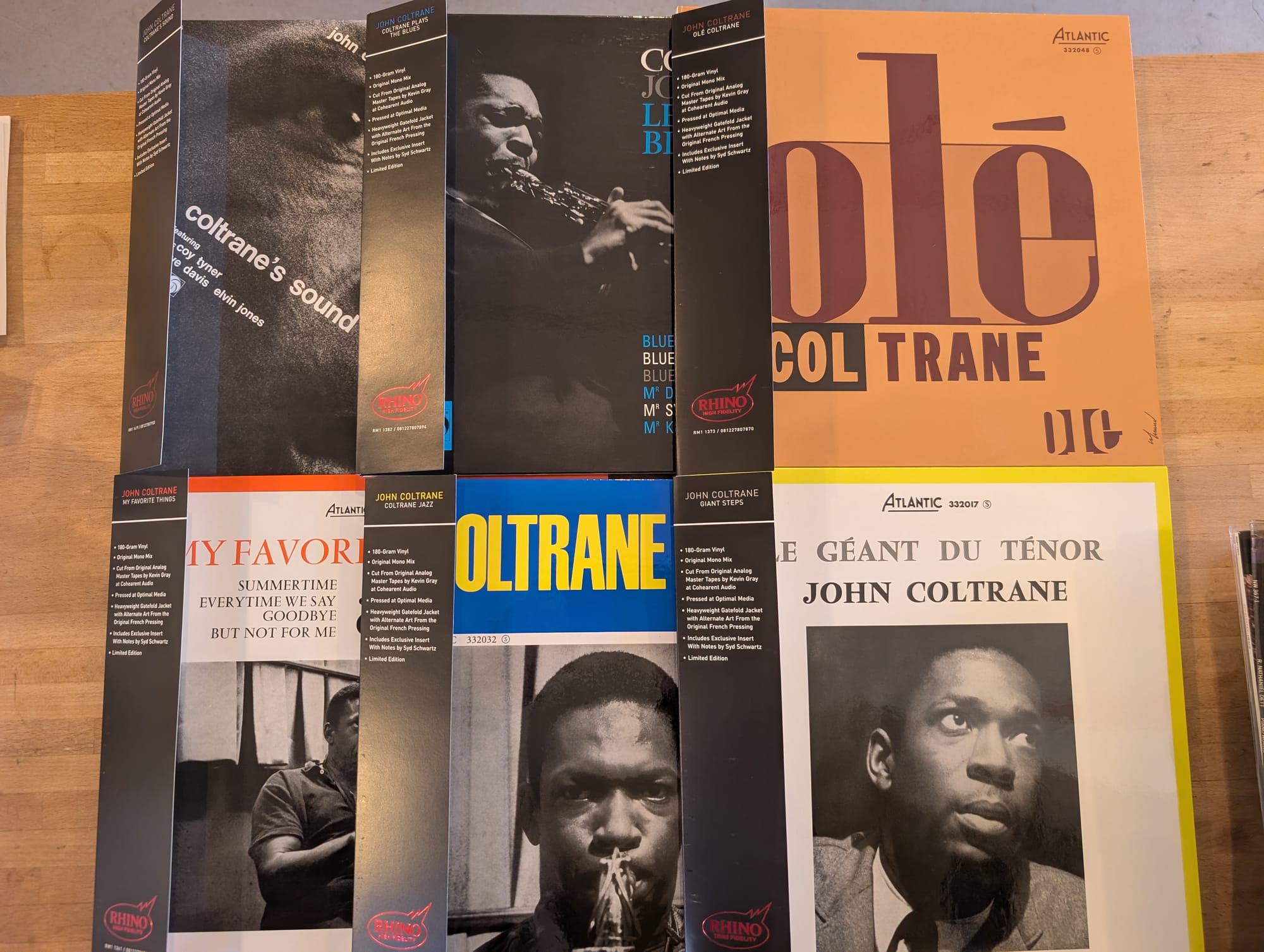
The half-dozen discs in this set represent the bulk of the material recorded for Atlantic Records as part of a two-year contract he signed with the label in 1959. And as great as the work he did prior to that for Prestige and Blue Note is, this is the era when Coltrane truly came into his own, as he explored and exploded hard bop, modal jazz, and the blues, and even took on a new instrument, recording with the soprano sax for the first time.
Atlantic got incredibly lucky being able to tap into this wellspring of creativity, with one fruitful October 1960 session at the label’s New York studio with producer Nesuhi Ertegün yielding enough material for three albums: 1961’s My Favorite Things, 1962’s Coltrane Plays the Blues, and 1964’s Coltrane’s Sound. It should be noted, though, that the latter two were released after the saxophonist had left for Impulse Records and were issued without his input or permission.
Even without that knowledge, there would be no doubt that that trio of records was sonically connected. Beyond the sound of the soprano sax, which Coltrane uses to hypnotic effect on the Rodgers & Hammerstein classic that serves as the title track for My Favorite Things, the rhythm section plays with a surprising spareness. Pianist McCoy Tyner’s solos on “My Favorite Things” and “Mr. Syms” from Blues are marked by hard, stabbing chords and a judicious use of melodic filigrees. Bassist Steve Davis, meanwhile, hangs back in the pocket, often sticking to a straightforward, steady pulse rather than trying to dip and dive around the beat.
The other three albums in this set represent transitional stages in Coltrane’s continued evolution. The stunning Giant Steps from 1960 and 1961’s Coltrane Jazz finds him in a bit of a comfort zone, working with musicians that he had already logged much studio and stage time with: pianist Wynton Kelly, bassist Paul Chambers, and drummer Jimmy Cobb. 1961’s Olé Coltrane, meanwhile, is Coltrane leaning on the core players that would make up his working quintet: Tyner, bassist Reggie Workman, multi-reedist Eric Dolphy (using the pseudonym George Lane here), and drummer Elvin Jones, while augmenting the sound with fellow explorers like second bassist Art Davis and trumpeter Freddie Hubbard. Coltrane began incorporating the influence of music from around the globe into his heady compositions, melding the drone of Indian ragas and the lilt of South American folk into the 18-minute title track. (Further details on all these sessions are explained wonderfully in the liner notes for each disc written by critic Syd Schwartz.)
All of this is rendered with startling clarity on this new set. Kevin Gray of Cohearant Audio worked from the original mono reels (photos of each tape box are printed on the inserts for each album), remastering the audio and cutting the lacquers. The music is brightened considerably through his efforts with the highs of the piano, cymbals, and Coltrane’s sax leaping forward in the mix and the dead quiet backgrounds bringing a presence to these albums that I haven’t heard outside of the 1995 CD box set The Heavyweight Champion: The Complete Atlantic Recordings. That is, apart from the copy of Coltrane Jazz in the set that came out of the box with a visible scuff that resulted in about 20 seconds of noise on “Like Sonny.”
There can be such a thing as too much clarity, however. I’m lucky enough to have an early mono pressing of My Favorite Things and the differences between it and the new version included in this set are fairly striking. Gray’s cut seems to remove all the studio ambience from the recording. It allows for a greater focus on the music and the performance of the individual players, but it loses the depth and fullness of the older pressing. Both are great and I’m overjoyed to have the different copies in my library, but they’re going to serve much different purposes. If I want to home in on the granular details of Coltrane’s mesmerizing solos, I’ll reach for the Rhino set; if I just want the music to fill the background of my day, I’ll pull the ’60s press off the shelf.
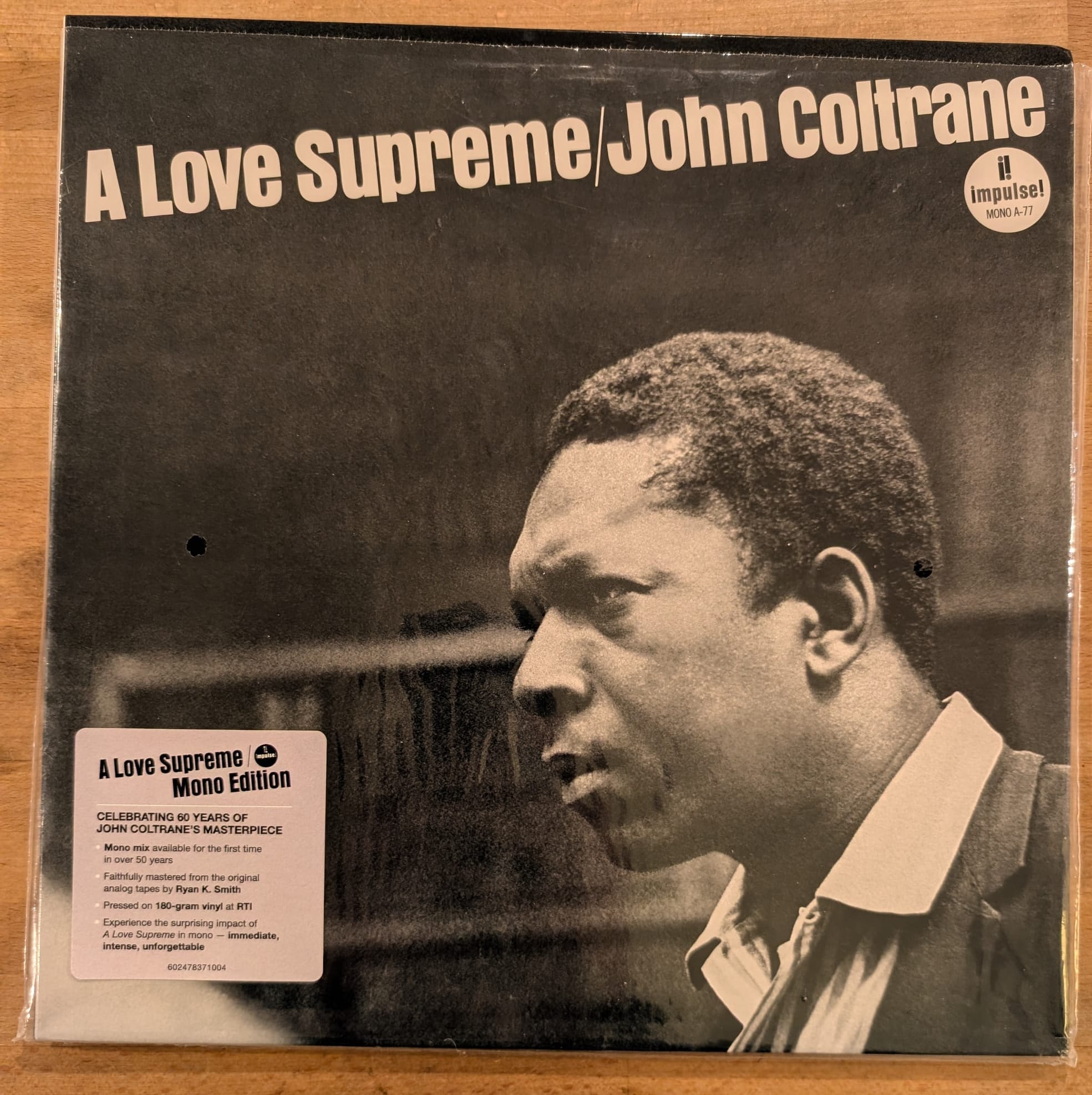
The choice is going to be a little more difficult when it comes to the four different pressings of A Love Supreme that I now have at my disposal: a 1971 US stereo press, a 1973 Japanese press, and two reissues, mastered by Ryan K. Smith from a flat tape copy of the original made by the album’s producer Rudy Van Gelder in April 1965 for use in the UK. The first Smith cut is a stereo press made for the Verve Acoustic Sounds Series in 2020, and the second is this new mono mix—a fold-down made using the same 1965 stereo tape. There’s no clear winner here, but, again, my ongoing shootout between the four reveals that each has something unique to offer.
Listening to the mono pressing was almost overwhelming in its immediacy. Bassist Jimmy Garrison’s opening notes on “Part II — Resolution” are full and commanding, leading perfectly to the loud burst of sound announcing the other three players (Coltrane, Tyner, and Jones). Much like the experience of listening to the rest of the album, it’s like being caught joyously in a vortex of light and warm wind. The 1973 Japanese press flattens everything out, emphasizing the chemistry of the quartet but softening the thematic blow of Coltrane’s spiritual awakening. There’s a sharpness to the 1971 press that can be a little tough to bear at the wrong volume, but the room tone of Van Gelder Studios is much more discernible and lends this a wider soundstage. Smith’s 2020 master, meanwhile, has a shimmery quality that I appreciate but, like Rhino’s new My Favorite Things, there’s a slight coldness to it overall. And that’s not even addressing the matter of mono vs. stereo. The wide separation of the instruments on the stereo pressings does result in a more enveloping listening experience, but there’s something to be said for the dramatic feel of having everything gushing from one channel.
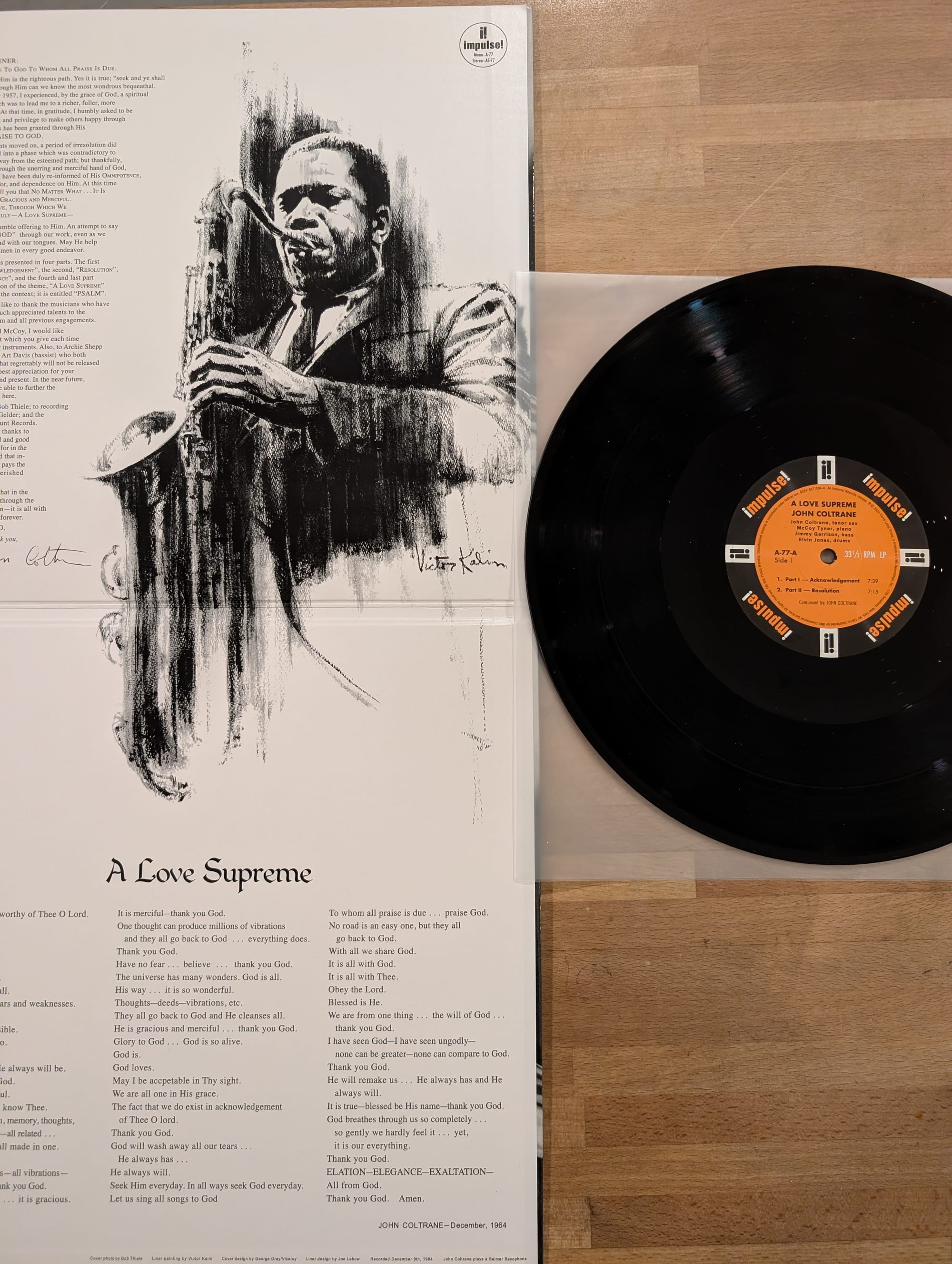
If there is a complaint to be made about either newer pressing of A Love Supreme, it's the lack of liner notes or any discussion of session dates, players, etc. There's surely much more to spell out for new listeners about Coltrane's apology to Dolphy and Davis for not including their contributions on the finished LP. (Their performances on an alternate take of opening track “Part I: Acknowledgement,” recorded the day after the album version, would be added to later deluxe reissues.) The thinking may simply have been that there has been enough ink and pixels spilled about A Love Supreme and there will most certainly be more once Coltrane's centenary is upon us.
That's sound reasoning as, in my mind, this album and the six collected in the Rhino set are just the beginning of a long global conversation about this towering artist and the impact he has had on the world at large. For any musician, artist, philosopher, cultural critic, or jazz fan, dropping the needle on one of his albums is only the first step in a lifelong exploration of exploring Coltrane's life and art. It's a wholly satisfying journey made even more gratifying when the music is treated as well as it is on these wonderful reissues.
Coltrane 1960–1964 Mono • Rhino 6-LP 33 RPM 180g black vinyl
• Mono represses of six albums recorded 1959–1961 and released between 1960 and 1964 in heavy clothbound box
• Jacket: Heavyweight glossy tip-on gatefold with Rhino High Fidelity obi
• Inner sleeve: Rhino High Fidelity–branded black poly-lined
• Liner notes, insert, or booklet: four-panel inserts with liner notes by Syd Schwartz
• Source: Analog; “Cut from original analog master tapes”
• Mastering credit: Kevin Gray at Cohearant Audio, North Hills CA
• Lacquer cut by: Kevin Gray at Cohearant Audio, North Hills CA; “KPG @ CA” in deadwax of each
• Pressed at: Optimal Media, Germany
• Vinyl quality - visual: A
• Vinyl quality - audio: B+, due to scuffing on copy of Coltrane Jazz
• Additional notes: The limited-edition set is part of Rhino’s High Fidelity series; each LP features “alternate art from the original French pressing” with the original US art printed inside the gatefold.
A Love Supreme • Impulse 1-LP 33 RPM 180g black vinyl
• Remastered mono mix of 1965 album
• Jacket: Glossy tip-on gatefold
• Inner sleeve: Black paper
• Liner notes, insert, or booklet: None
• Source: Analog; “Faithfully mastered from the original analog tapes”
• Mastering credit: Ryan K. Smith, Sterling Sound, Nashville, TN
• Lacquer cut by: Ryan K. Smith, Sterling Sound, Nashville, TN; “RKS” and “STERLING” in deadwax
• Pressed at: Record Technology, Inc., Camarillo, CA
• Vinyl pressing quality (visual): A
• Vinyl pressing quality (audio): A
• Additional notes: None.
Listening equipment:
Table: Cambridge Audio Alva ST
Cart: Grado Green3
Amp: Sansui 9090
Speakers: Electro Voice TS8-2