Review: Johnny Cash on Sun Records

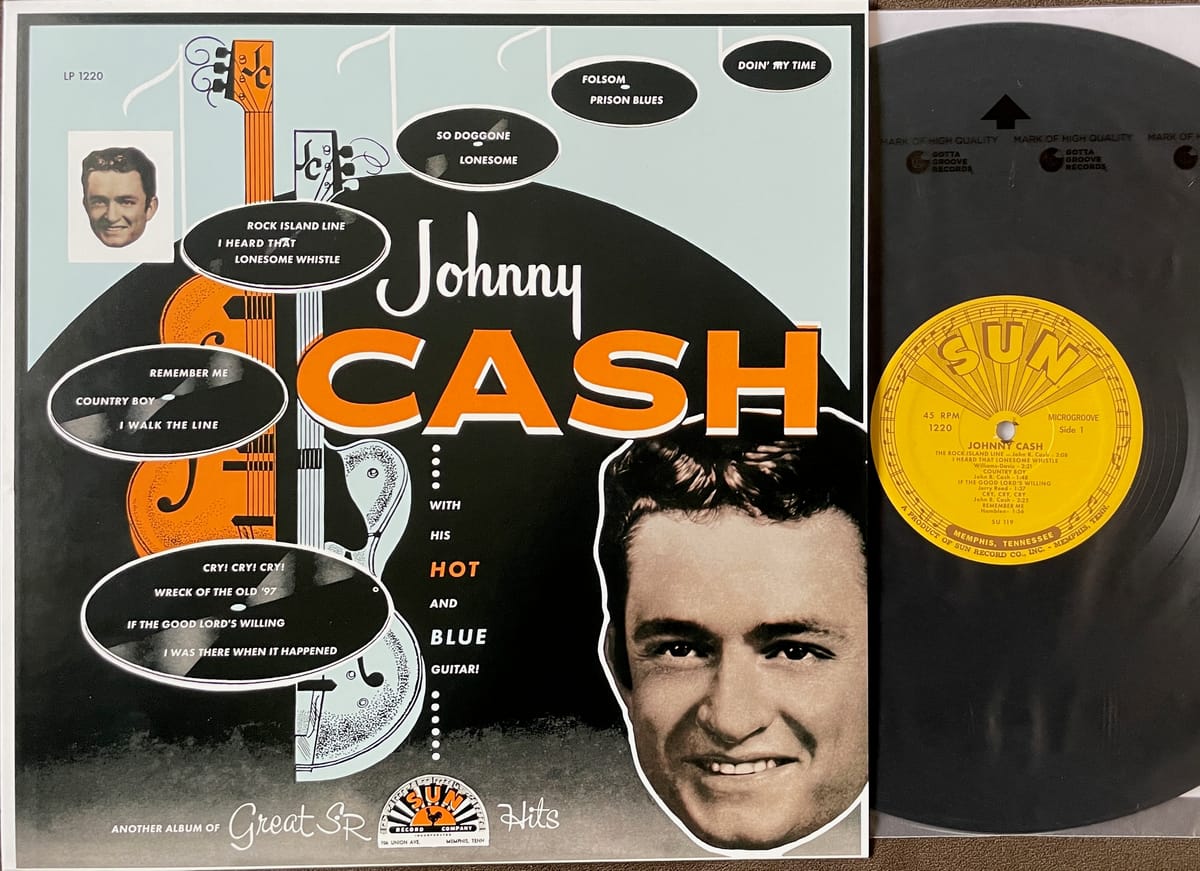
Some musicians exist outside of a genre even as they define it. “Country music” doesn’t quite seem a fitting descriptor for what Johnny Cash did, and yet he was one of its most representative practitioners in the second half of the 20th century. The term is simply too limiting for Cash, even as he maintained a very distinct—you could even say narrow—musical style for his entire career. Perhaps it all started on that very first day he set foot in Memphis Recording Service to audition for Sun Records label head Sam Phillips in 1954. Cash thought of himself as a gospel singer, but Phillips heard something else. “Go home and sin,” Phillips famously (if apocryphally) told Cash, “and come back with a song I can sell.”
What Cash returned with was darker, more rhythmic, and more elemental than likely either man was anticipating. It was rockabilly without any drums to set the backbeat; it was country music without the twang or the high-and-lonesome harmonies; it was folk music without the sense of community and tradition; it was the blues, philosophically if not physiographically. You could even say it was gospel, shot through backwards—reveling in sin rather than pining for redemption.
What it really was was Johnny Cash himself, defined by that deep, sonorous voice that sounded simultaneously authoritative and forlorn. It was the voice of someone who had seen the darkness and passed through it, and was now trying to walk the straight and narrow, as he’d sing in “I Walk the Line.” It was a voice of wisdom but never one of resolution or contentment. It could never convey any hint of warmth, but it would always have the essence of heat.

That voice is present on Cash’s earliest recordings for Sun Records, and on all 12 songs of his first full-length LP, Johnny Cash with His Hot and Blue Guitar from 1957, although some of the songs were released as singles in the years prior. A new all-analog reissue of the album has arrived courtesy of Intervention Records as the second installment in their Sun Records reissue series, which debuted with an absolutely sterling remaster of Carl Perkins’s Dance Album in December 2025. (Read our review of the Perkins reissue here.) Like the Perkins LP, Johnny Cash with His Hot and Blue Guitar is cut from a newly assembled analog master reel, in this case sourced from 1/4-inch flat transfers from as close to first-generation masters as could be located in the Sun Records vault at Iron Mountain. Intervention partnered with Sun to comb through those archives and find the best existing source for each individual track, not relying on copy tapes or previously made assembly reels of lower fidelity. Their painstaking work has resulted in perhaps the best-sounding version of Hot and Blue Guitar that’s ever existed, and the new vinyl is cut at 45 RPM for extra fidelity.
Listening to the new cut, the thing that blew my mind was that Cash was only 25 when the album came out—23 when its earliest songs were recorded. Cash always sounded older than his years, and he sounded positively ancient when he recorded the American Recordings albums with Rick Rubin. (He was merely 71 when he died, a bit younger at the end of his life than I have him in my mind’s eye.) Even at this early age, there’s not a trace of youth in his voice, just the burden of manhood and the regret of lost time. If there has ever been an older-sounding 25-year-old singer in the years since Cash entered Sun Studios, you can bet good money that an enterprising publicist put the words “Johnny Cash” somewhere in their press bio.
That voice is front and center on the Intervention pressing. It would be a cliché to say you’re there in the room with him—and it doesn’t quite apply in this case, as Sam Phillips put a hefty amount of slapback echo on Cash’s voice, giving him a distanced, elevated, vaguely thunderous quality. But there is very little that comes between the musicians’ performances and your ear, and the realism and honesty that comes through is really quite something. Rather than being able to pick apart each instrument on its own—as you might on, say, a Steely Dan record—your ear responds to the unique mono blend of Cash, guitarist Luther Perkins, and bassist Marshall Grant functioning as one inextricable instrument, welded together by microphones, the recording console, and magnetic tape. Grant’s clicks on the upright bass and Perkins’s staccato chops on the guitar function as the rhythm section, with Cash’s quick but gentle strumming on the acoustic guitar creating a surprisingly subtle, golden-hued backdrop. “There are mistakes on several of my Sun records,” Cash wrote in his autobiography, “Luther fumbling a guitar line, Marshall going off the beat, me singing sharp—and we all knew it. Sam [Phillips] just didn’t care that much: he’d much rather have soul, fire, and heart than technical perfection.”
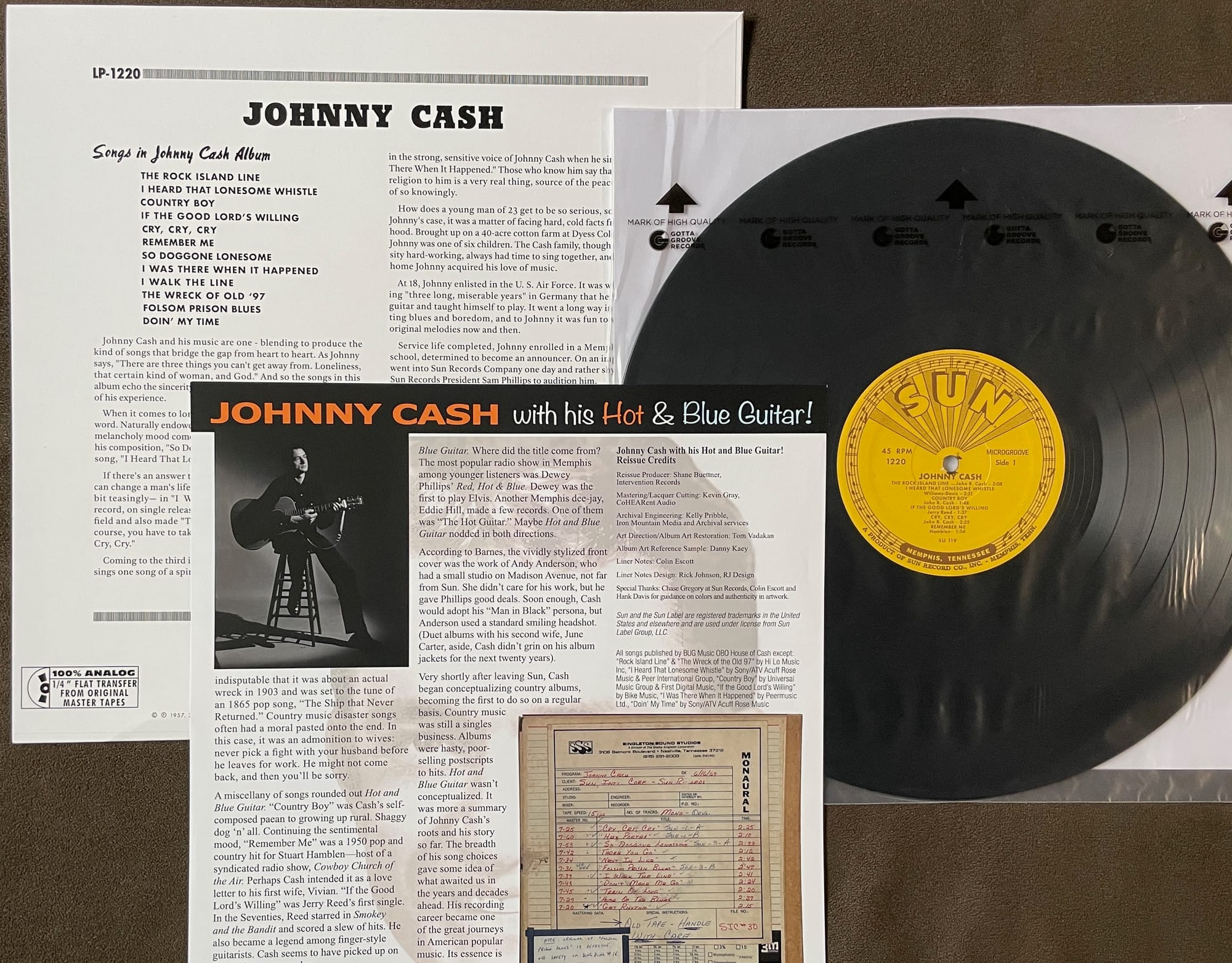
Hot and Blue Guitar is an album chock full of well-known songs, the two most familiar being “Folsom Prison Blues” and “I Walk the Line,” perhaps the two songs that best summed up Cash to the very end. Elsewhere, Cash covers Hank Williams and Jerry Reed, tackles “Rock Island Line” (which had already traveled through Leadbelly and Lonnie Donegan), and offers three more of his own songs, including his debut single “Cry! Cry! Cry!” (Sadly, “Get Rhythm” is missing from the tracklist, but perhaps it will turn up on a future reissue from Intervention.) In many ways the LP remains an encapsulation of everything that Cash would become—it’s all right here, in one form or another, with its power lying in the music’s simplicity.
The new master is cut by Kevin Gray, who has built a sturdy underpinning for the music. The sound is rich and full, with an emphasis on the tonality and musicality of the different voicings. Everything is plump-sounding and colorful, with no constriction or grain on any element of the mix and no weakness to any component of the sound. This is not a bass-heavy record, nor does it have much in the way of highs—everything is comfortably situated in the middle, feeling warm and full of oxygen and energy. There is no metaphorical dust on this sound; it really and truly does, to evoke another cliché, feel like it could have been recorded yesterday. The level of realism is really striking—like the difference between seeing a place in a photograph and being there in person.
Between the Carl Perkins LP and this new Johnny Cash disc, Intervention is not just keeping good music in circulation—it is doing restoration work on some of the most important artworks in the American canon. They have yet to announce what’s coming next, but even with just these two albums, they’ve played a big hand in shaping the legacy of Sun Records for years to come, revealing that these recordings still contain as much life and vigor as they did when they were first set to tape. This new version of Johnny Cash with His Hot and Blue Guitar goes beyond definitive—it is re-definitive, transforming the work of the past into a living and breathing document for future generations.
Intervention/Sun 1-LP 45 RPM 180g black vinyl
• New remaster of the 1957 mono album
• Jacket: Tip-on single pocket
• Inner sleeve: Gotta Groove custom rice-paper-style poly
• Liner notes, insert, or booklet: Double-sided insert with essay by Colin Escott
• Source: Analog; “1/4” flat transfer from original master tapes”
• Mastering credit: Kevin Gray at Cohearent Audio, North Hills, CA
• Lacquer cut by: Kevin Gray at Cohearent Audio, North Hills, CA; “KPG@CA” in deadwax
• Pressed at: Gotta Groove Records, Cleveland, OH
• Vinyl pressing quality (visual): A
• Vinyl pressing quality (audio): A
• Additional notes: Comes in reusable outer poly sleeve with hype sticker attached.