Review: Television on Mobile Fidelity

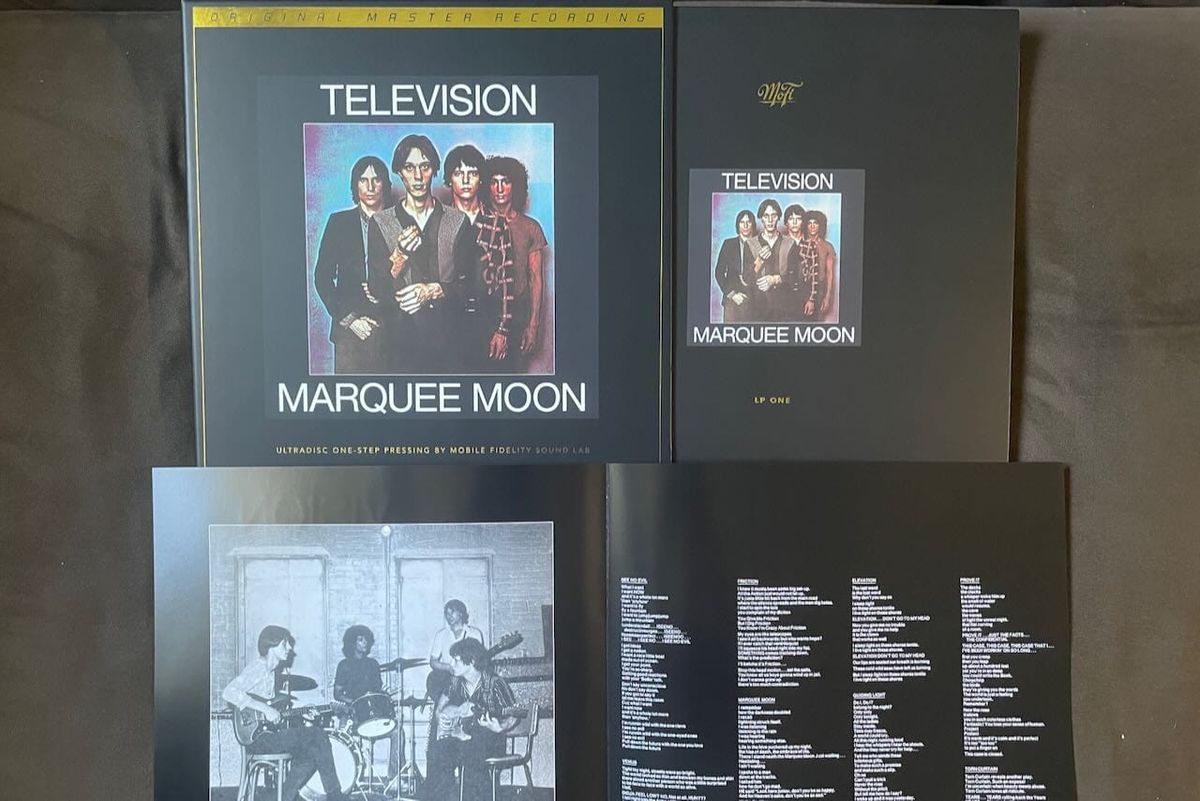
Today I’m reviewing Mobile Fidelity Sound Lab’s new edition of Television’s 1977 debut, Marquee Moon, which underwent Mobile Fidelity’s UltraDisc One-Step process and marks the first time this seminal LP has been pressed at 45 RPM across two discs. (It is also available from MoFi as an SACD.)
But first, it would be egregious for a music-related publication to not mention the passing of Dolly Parton, who died at age 80 yesterday, August 25. Parton was a generational talent—a songwriter, performer, and musician who perhaps had the highest approval rating of any single American.
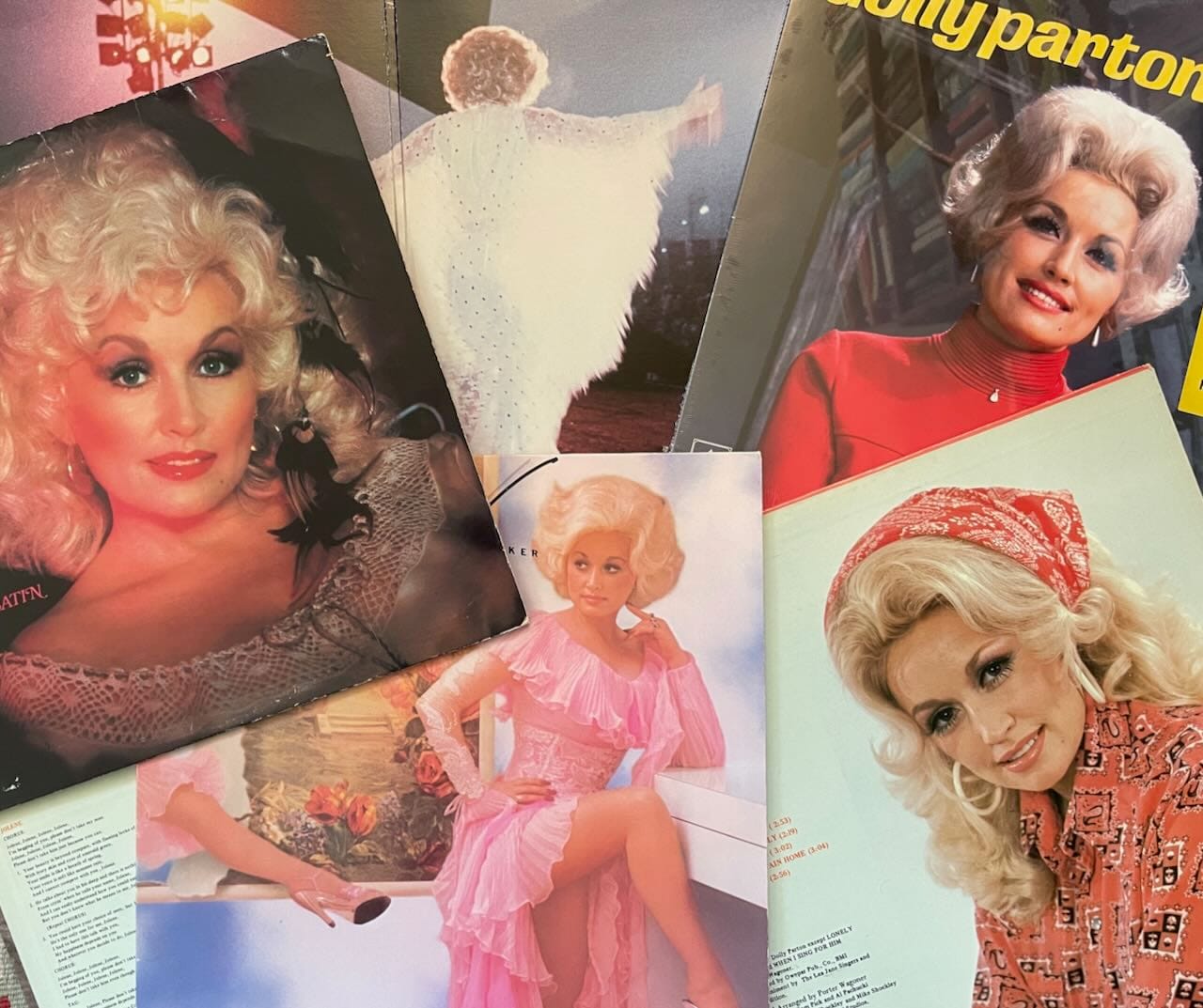
This being a newsletter that focuses on vinyl reissues, I wanted to comment on the lack of Dolly Parton vinyl that’s currently in print. Apart from greatest hits collections and Christmas albums, there’s not a ton readily available. Perhaps that’s a market oversight, or perhaps Parton wanted it that way. In 2023, Vinyl Me, Please launched a series called “Vinyl Me, Parton” that reissued 12 albums from across her career; those are now commanding high prices on Discogs. I wonder if Sony Legacy will now see fit to make more of her back catalog available on vinyl. They probably will. If they do, I hope it’s what Dolly would have wanted.
It was revealed not long after her passing that Parton died following a brief fight with cancer. Seeing as how the rest of this post is about the band Television, I need to mention that Television guitarist Richard Lloyd is going through a difficult battle of his own. A few months ago, Lloyd was diagnosed with cholangiocarcinoma and is in a tough spot, from both a health perspective and a financial one. As he undergoes expensive treatment, he’s unable to work—to perform, to tour, to do any of it. Take a look at the GoFundMe page for Lloyd’s treatment and see if you’re able to contribute.
Shifting gears altogether—it’s your last chance to enter our August vinyl giveaway. We’re giving away a nice new copy of the fantastic Albert King triple live album Feeling Alright: The Complete 1975 Nancy Pulsations Concert, which was one of the unquestionable highlights of Record Store Day earlier this year. The discs document a fabulous concert from King at the peak of his powers, with mastering by Matthew Lutthans at the Mastering Lab. The contest is eligible to our paid-tier subscribers, and it closes 11:59 pm Pacific time on Wednesday, August 26, so get in while the getting’s good and gettable. To find out how to win—and to upgrade to The Vinyl Cut’s paid tier—click on the rectangle below.
 Ned Lannamann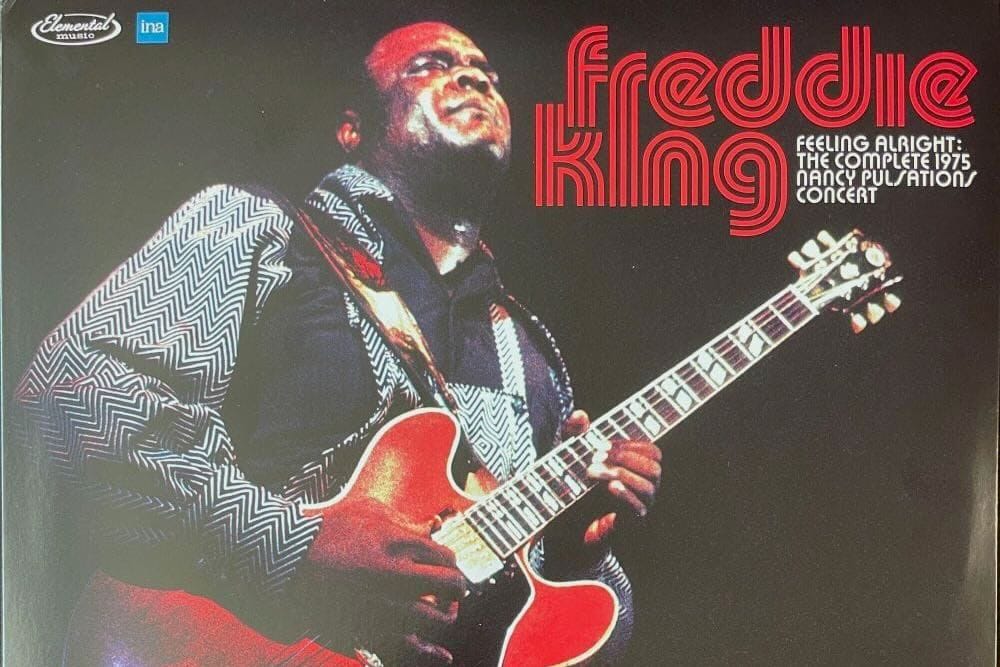
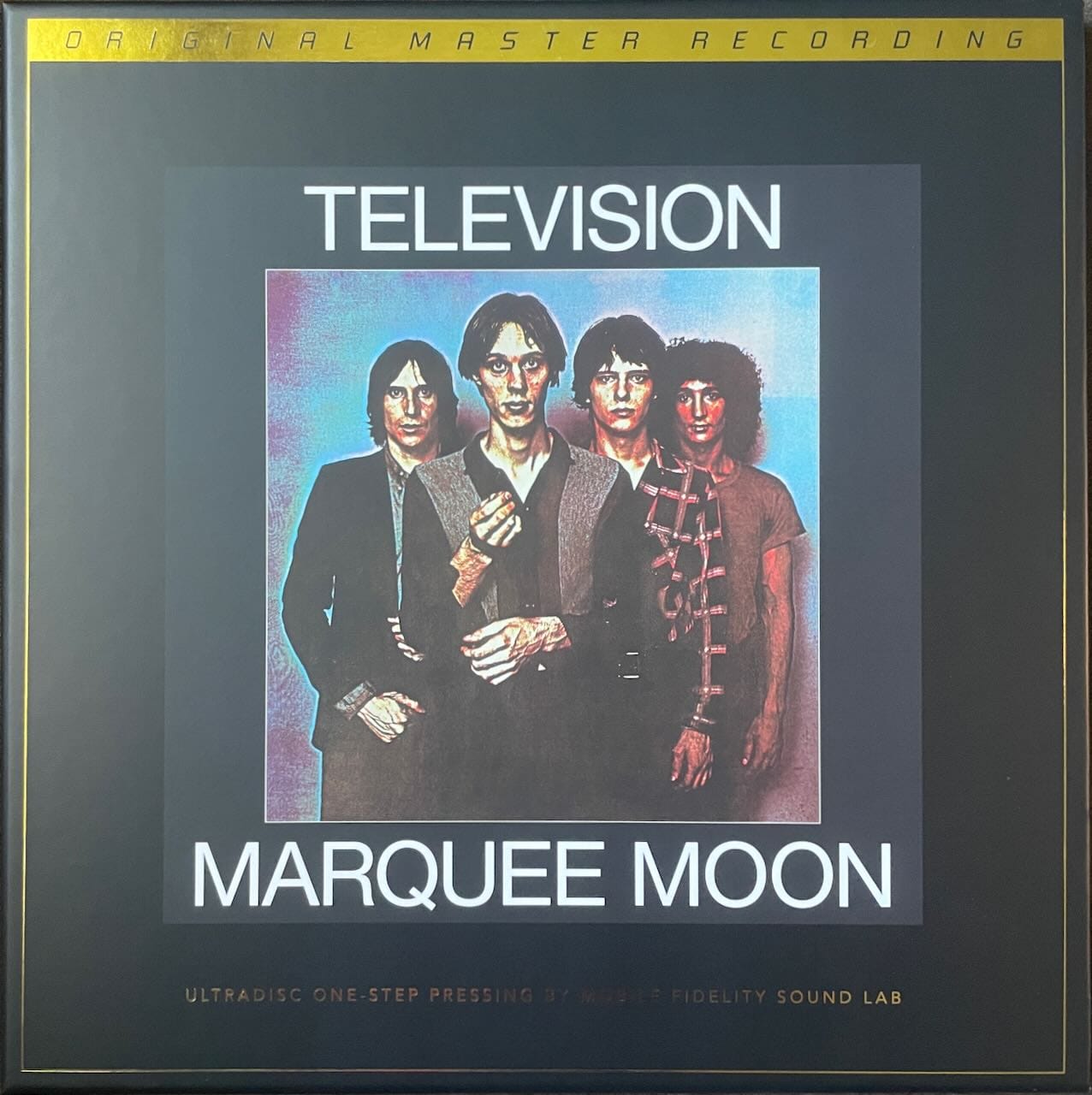
Television: Marquee Moon
It’s sometimes unavoidable for music history to be painted with a broad brush. That’s why Television gets lumped in with the “punk” movement that erupted out of downtown New York, and the infamous CBGB club, in the mid-1970s. But apart from the Ramones, the most high-profile bands that rose from the CBGB scene weren’t punk—not really. The Patti Smith Group fused beat poetry to a garage-rock ethos; Blondie’s DNA included yé-yé and disco, positioning them as framers of what eventually became new wave; Talking Heads’ jittery art-funk escaped any sort of easy classification other than being panglobally omnivorous in its musical influences. And Television were raw, abrasive, and uncompromised—tenets of punk, to be sure—but their antecedents were in the improvisatory free jazz of John Coltrane and Albert Ayler. (The Ramones probably never listened to a jazz record in their lives.)
Television’s 1977 debut album Marquee Moon, then, is probably not what a virgin listener might expect. It is intellectual, ruminative, expansive, and virtuosic, showcasing a band whose remarkable live chops had rightly garnered them significant attention since forming in 1973, leading them to turn down more than one record deal before signing with Elektra. The album’s dueling guitar fireworks—courtesy of bandleader/songwriter Tom Verlaine and guitarist Richard Lloyd—betray Verlaine’s affection for the surf guitar of Dick Dale and the Ventures but actually lie on the continuum with the trancelike jamming of Neil Young and Crazy Horse circa Everybody Knows This Is Nowhere and Fairport Convention’s slow-building instrumental sections in “A Sailor’s Life” and “Sloth.” And while Marquee Moon’s more aggressive tunes, like “See No Evil” and “Friction,” are cousins of ’77 punk, the immortal title track is a 10-minute epic of interlocking riffs and prolonged guitar solos that stack themselves into a palace of instrumental mastery—making for one of the best and most important pieces in the rock canon.
Marquee Moon has just been given one of the most prestigious audiophile vinyl treatments available: an UltraDisc One-Step vinyl pressing from Mobile Fidelity Sound Lab, pressed at 45 RPM across two LPs. This comes two and a half years after Rhino High Fidelity offered up a 33 RPM analog cut, mastered from tape by Kevin Gray; that edition garnered some controversy by veering away from the hard, compacted sound of the original pressing. The new MoFi pressing has the added benefit of being pressed at 45; it features the extended version of “Marquee Moon” with the full ending, which at 33 RPM would make Side 1 play for close to 24 minutes. This new MoFi 45 RPM one-step avoids groove-bunching with its shorter sides and gives “Marquee Moon” an entire LP side in which to luxuriate.
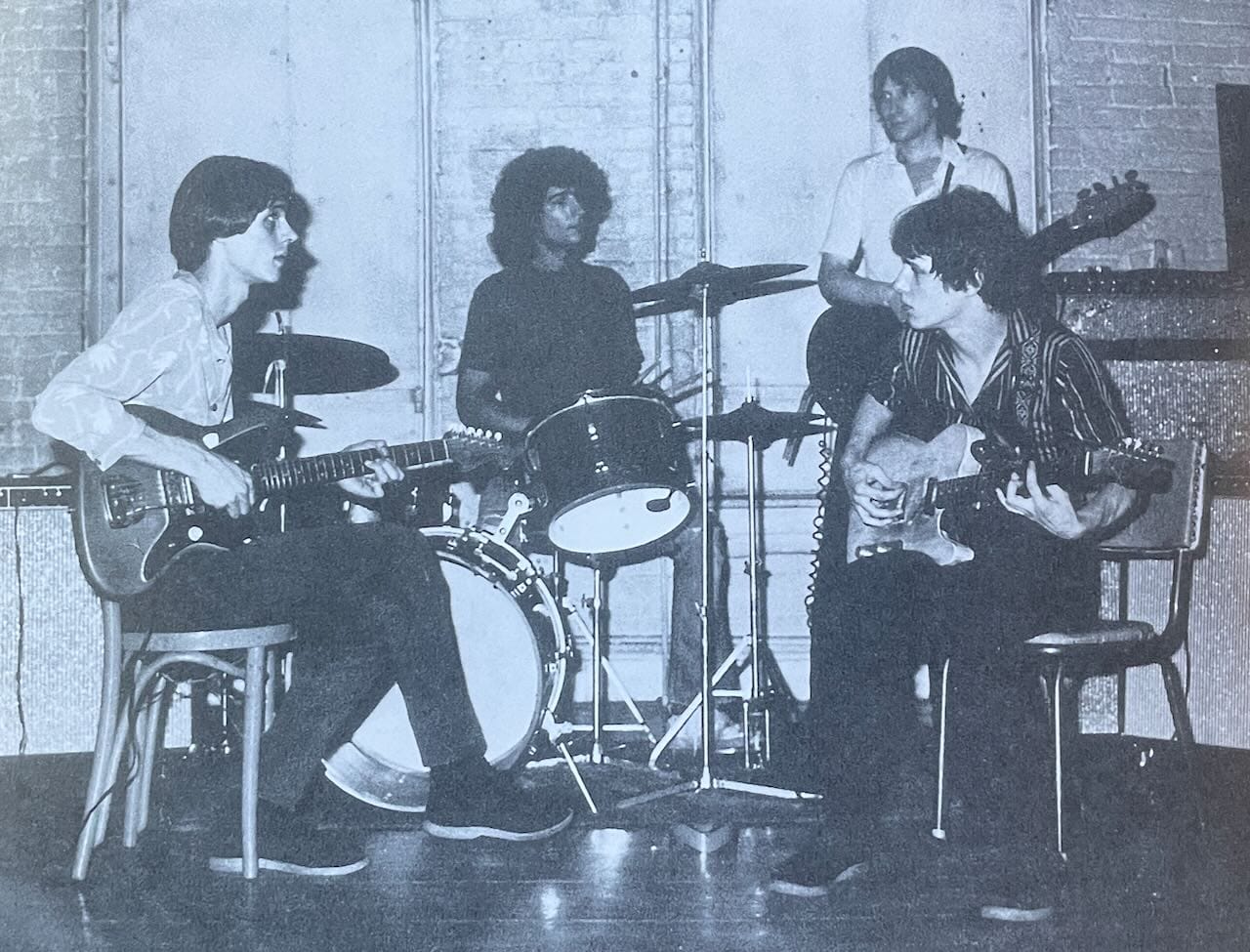
By the time Television entered Phil Ramone’s A & R Recording in Midtown Manhattan to record Marquee Moon, they’d been polishing and perfecting their repertoire at CBGB and other New York clubs like Max’s Kansas City. They’d lost founding bassist (and close Verlaine compatriot) Richard Hell, who was perhaps the band’s one true punk and went on to mine that vein with the Voidoids. But Television acquired Blondie’s bassist Fred Smith as a replacement for Hell, a move that improved the four-piece’s fluidity and musicality.
They’d also had experience in the studio, having recorded some unsuccessful demos with Brian Eno, a bad experience that made them wary of unsympathetic producers. When Elektra asked the group who they wanted to produce Marquee Moon, they selected Andy Johns, the English engineer of classic records by Led Zeppelin and the Rolling Stones who was best-known for working with his brother, producer Glyn Johns. Television wanted an expert engineer who was also looking to prove himself as a producer, a profile that Andy matched perfectly. They also wanted the younger Johns brother’s proven ability at getting terrific guitar tone on tape.
Perhaps due to its proximity to the punk revolution of the day, the album is thought by some to be rough and jagged-sounding. Truthfully, that has never really been the case. Instead, the album is exceptionally well-recorded, with the band delivering exciting, live-in-the-room takes that allow each musician to shine. Jazz-loving drummer Billy Ficca could hit plenty hard enough for Television’s rock, but he also incorporated unusual fills and swing within his impactful beats. His ability to do so was in large part due to the exceptionally steady rhythm of bassist Fred Smith, who anchored the ensemble and gave Verlaine and Lloyd free range to roam with their entangled guitars. And those twin-roving guitars stay surprisingly clean-toned, with only the occasional serrated edge cropping up here and there, the distortion kept to a tasteful minimum so as to not cloud their carefully sculpted lines. Marquee Moon’s edge, then, comes from the band’s collective wallop, the unusual characteristics of Verlaine’s rooster-like voice, and the high-end impact that’s emphasized in the album’s final mix.
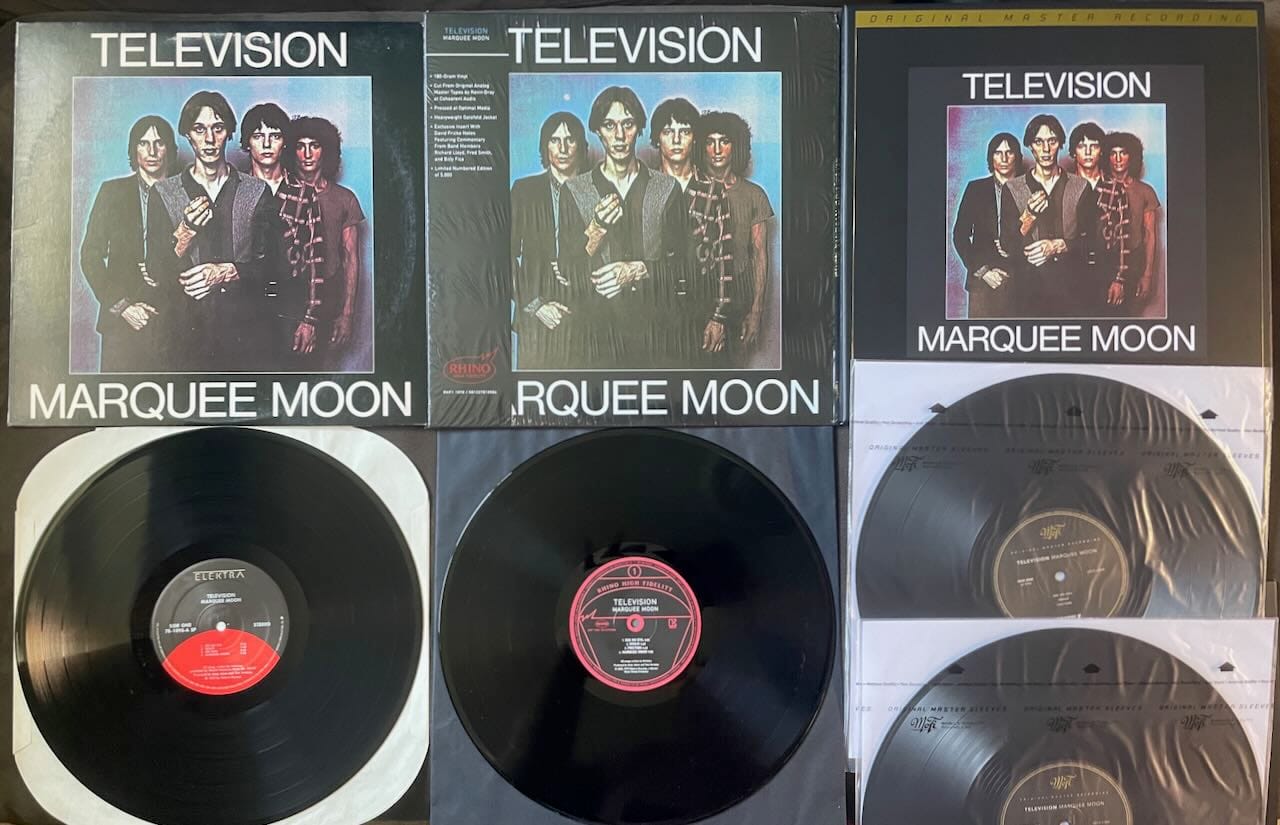
I compared the new Mobile Fidelity UltraDisc to a 1980s Elektra pressing and the Kevin Gray–mastered Rhino High Fidelity version from 2024. Because of the discussion that surrounded the RHF edition two years back, I expected the variance between the three to be quite large. And there are differences. But I actually found that under close comparison, this trio of presentations had more in common than I was expecting—if not necessarily in terms of sonic characteristics, then in terms of their abilities to spotlight different qualities of the recording itself.
Original 1977 pressings have a joint mastering credit for Greg Calbi and Lee Hulko, both of Sterling Sound in New York—located, as it happens, just a few blocks away from A & R Recording—with the “STERLING” stamp appearing in the deadwax. My 1980s repress does not have “STERLING” in the deadwax, nor any other indicator about who might have cut the lacquer. However, it is a phenomenal-sounding disc, and is presumably a direct descendent of the ’77 Sterling cut. Some of the online commentary about the 1977 pressing suggests it bears a piercing high end and a recessed bass presence. My ’80s pressing, pressed at Specialty, doesn’t really match this description. I could hear some minor sibilance during “Friction,” and there was some splashiness to the opening minutes of “Marquee Moon,” which also starts off with a marginally reduced bass presence. But otherwise I could find very little to fault it.
“See No Evil” kicks off the albums with a pleasant beefiness, and the guitars clash and clang just right on “Venus,” giving the Elektra an overall impression of balanced sweetness to the sound and a live-sounding spontaneity to the performances. The rest of the disc is similarly consistent; the only real problem with it is that it has the original fadeout to “Marquee Moon,” perhaps the only bad decision made during the album sessions. The song’s complete, unedited ending was reinstated on the 1989 CD release and has appeared on subsequent pressings since then, vinyl and digital alike.
That complete “Marquee Moon” would be reason enough to own the 2024 Rhino High Fidelity pressing. Otherwise, the primary difference I hear in Kevin Gray’s RHF cut is of much stronger saturation, with the individual components taking up larger sections of the soundstage, reducing the open spaces and somewhat tweaking the album’s subtle grayscale sound in favor of a more vibrant color palette. It makes for a thrilling listen for the most part. The drums and bass are now front and center in the mix rather than riding under it, and the guitars are less like reconnoitering scouts sent out ahead of the pack, with their lines now tethered closer to home to create a stronger ensemble blend. Furthermore, decay and reverb trails are elevated and can be heard much more crisply on the Gray cut. And, perhaps notably, the high-end attack is reduced, although not to an outrageous degree. I generally really like this pressing; maybe the back-and-forth interplay of “Marquee Moon” gets a little swallowed up inside the collective blend, but other details shine, like the drums on “Prove It,” for instance, which sound absolutely incredible.
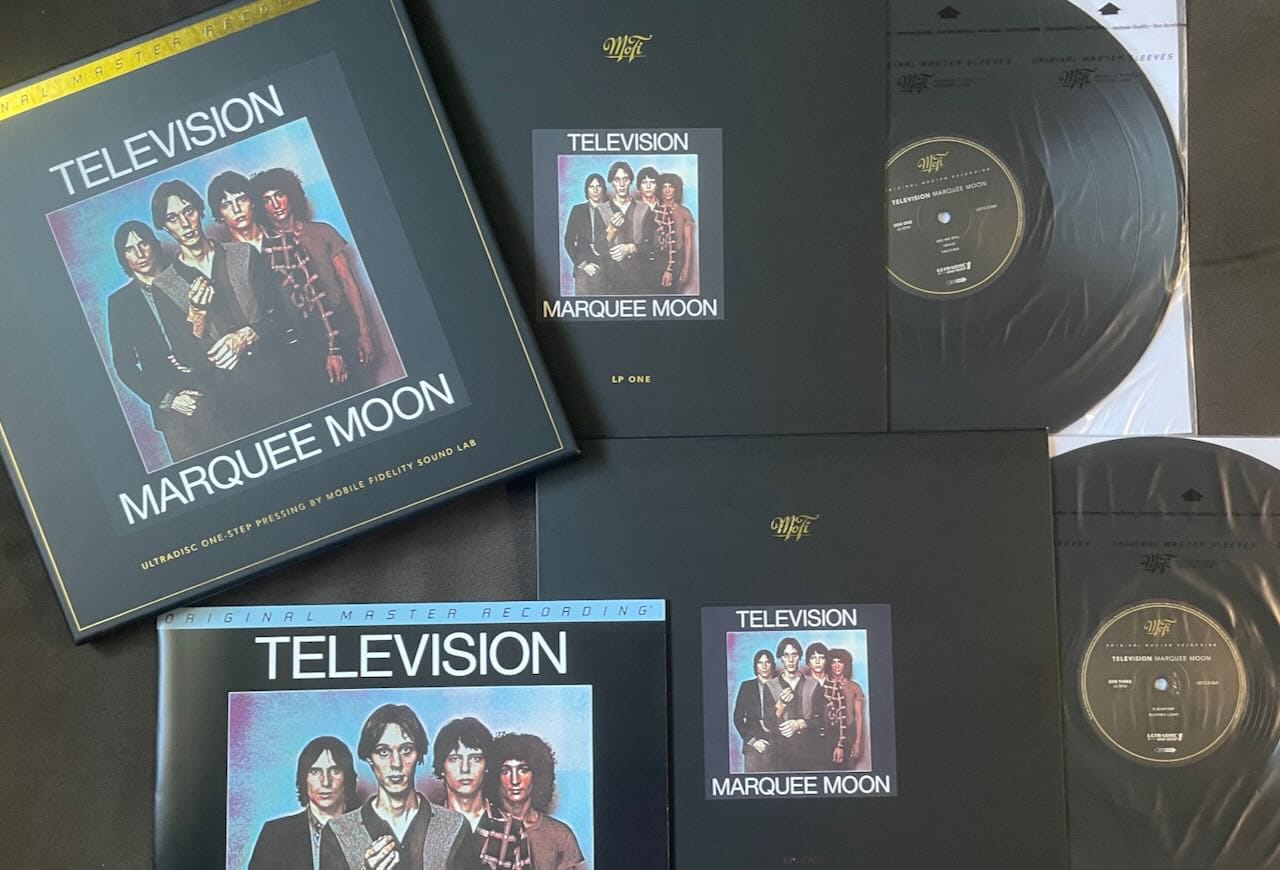
Unlike the Rhino High Fidelity, the Mobile Fidelity UltraDisc One-Step was not cut directly from the master tape. Rather, per MoFi’s proprietary process, the tape was transferred to high-resolution Direct Stream Digital (DSD), which was then fed through an analog console and cut to lacquer by mastering engineer Krieg Wunderlich. The vinyl itself results from a one-step pressing process that eliminates the extra electroplating required to create mothers and stampers; rather, the metalwork in this case was a “father,” or a direct metal inverse of the lacquer, with multiple lacquers cut to make enough fathers to reach the pressing quantities of 3000 (at least three lacquer cuts in this case, perhaps more).
The sonic character of the MoFi pressing is the result of all of those factors, plus additional ineffable ones, and the end result is a remarkably precise, limpid sound that brings all of the musical motion into sharp focus. There is no sonic blur or smeariness—rather, the sound is a little like a pitcher of water filtered through charcoal, with a crisp, uncontaminated quality that emphasizes the transients while simultaneously supporting the body of the individual notes. What is revealed is a slightly metallic essence to the overall recording, with the studio processing and production choices on Verlaine’s vocals a bit more detectable. The high-end impact of the cymbals and upper notes of the guitars are also fully excavated and are occasionally wearing to the ear at high volumes; meanwhile, the bass is not disproportionally larger than it is on the other pressings, but it is more transparent and discernible.
The increased articulation of the MoFi pressing works quite well on “Marquee Moon,” with the band having a reinforced, tempered-glass sound during the track’s opening stretches that allows Verlaine’s extended guitar solo to achieve full liftoff. The flipside is that some of the momentum and sweat of the performance evaporates under the microscope; for instance, when Ficca’s drums slightly wander away from the beat, it’s more noticeable on the MoFi than either the Elektra or RHF pressings. (Legend has it that this track was nailed in the first take, with Ficca thinking it was a rehearsal.)
“Guiding Light” is the finest-sounding song on the MoFi one-step, perhaps because its slow tempo allows for a less impactful presentation and also because the multitrack features the most production sweetening, in the form of Verlaine’s piano and glockenspiel overdubs (it may also be a celesta). Smith’s bass carries both the rhythm and the melody of the verse, with a wonderful low-end warmth that seeps down into the floorboards, and Lloyd’s lovely guitar solo boosts the track while remaining a piece of its inherent architecture. The space in between the notes might be where the unadulterated clarity of the one-step process is best showcased, and the vinyl—pressed at MoFi’s Fidelity Record Pressing—is sonically flawless, with no background noise or other pressing blemishes to detract from the sound.
It’s a superlative presentation of an outstanding record, and the Mobile Fidelity pressing does Marquee Moon ample justice while also revealing the limitations of the original recording. Some of the spontaneity of my ’80s Elektra pressing and the sheer juiciness of the RHF Kevin Gray cut are mitigated in favor of accuracy. And as mentioned, I encountered a very minor element of high-end ear fatigue with the cymbal hits and treble extension in the guitars; this was most noticeable to me during “Torn Curtain,” although it’s entirely possible that it’s only because that song comes at the end of the album. But I was able to distinguish and appreciate the warp and weft of Marquee Moon’s sonic texture to a much greater degree than I was on the other pressings, making it invaluable for those looking to study it as opposed to merely soaking up its musical pleasures.
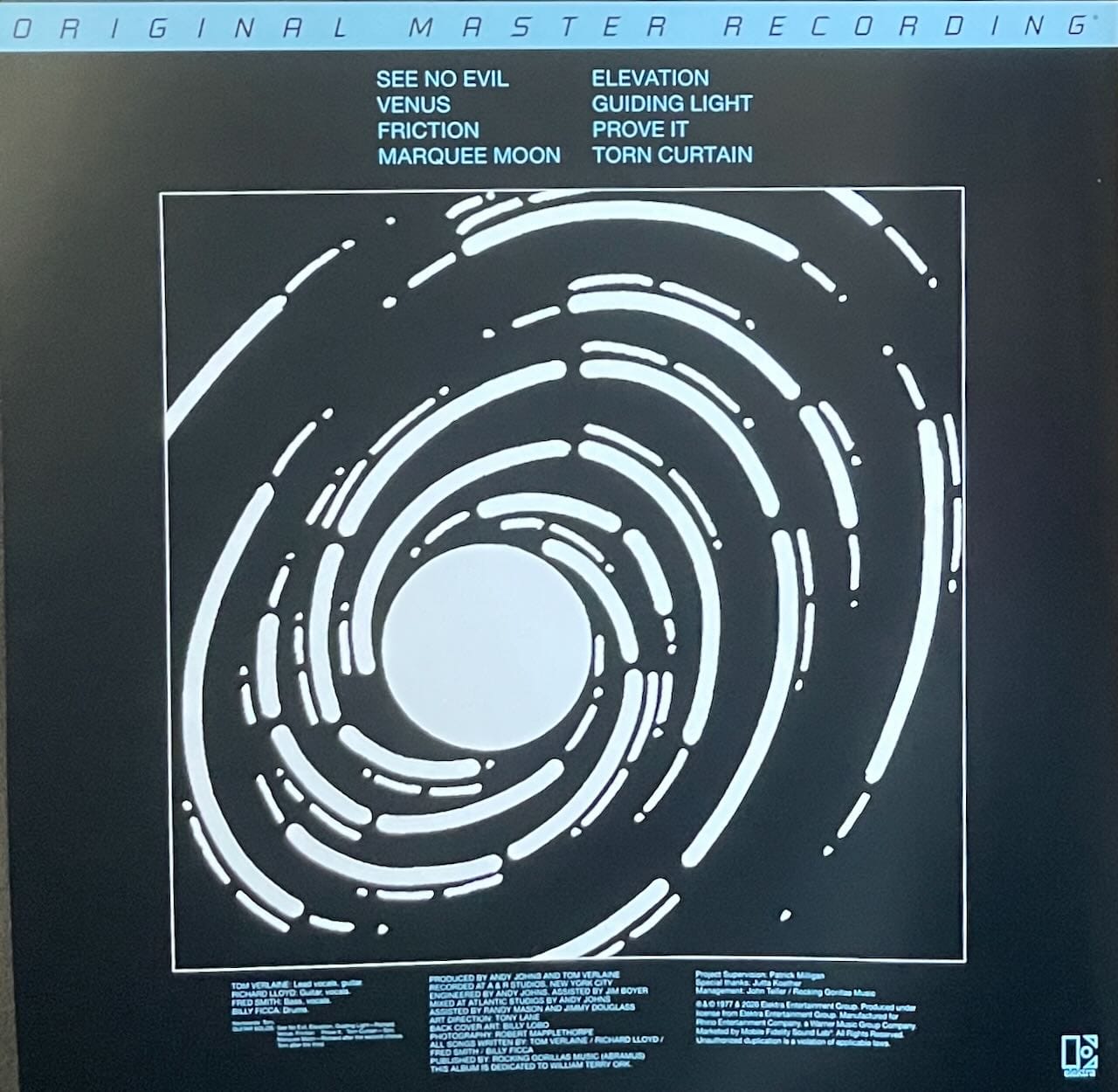
In the end, I found it impossible to pick one of the three pressings of Marquee Moon over any of the others. If this sounds like equivocating, I apologize, but it’s the truth. The ’80s Elektra and the Rhino High Fidelity are better suited for casual, less attentive listening, with the Elektra full of energetic pep and the RHF plumped with sonic richness. The Mobile Fidelity, then, is the scholar’s choice. It allows the listener to investigate the recording and examine the playing to a greater extent than either of the others. And the pressing quality is just astonishingly good. The package includes two separate single-pocket jackets for the discs and an insert replicating the original album art, all housed inside a well-appointed slipcase, making for an impressive addition to any Television devotee’s record collection. And if all that fuss and bother seem anathema to the “no future” punk-rock ethos of 1977, well, remember—Television and Marquee Moon were never really all that punk to begin with.
Mobile Fidelity Sound Lab 2-LP 45 RPM 180g black vinyl
• New remaster and UltraDisc One-Step pressing of Television’s 1977 debut album
• Jacket: Slipcase containing two direct-to-board single-pocket jackets with gold foil stamps
• Inner sleeves: MoFi-branded rice-paper-style poly
• Liner notes, insert, or booklet: Four-page heavy card insert replicating the front and back covers and the inner sleeve of the original album
• Source: Digital; “1/4” / 15 IPS analog master to DSD 256 to analog console to lathe”
• Mastering credit: “Krieg Wunderlich at Mobile Fidelity Sound Lab, Sebastopol, CA on GAIN 2”
• Lacquer cut by: Krieg Wunderlich at Mobile Fidelity Sound Lab, Sebastopol, CA; “KW@MoFi” in the deadwax
• Pressed at: Fidelity Record Pressing, Oxnard, CA
• Vinyl pressing quality (visual): A- (both discs did not lie not perfectly flat on the turntable)
• Vinyl pressing quality (audio): A+ (dead-silent backgrounds; perfect-sounding pressing)
• Additional notes: “Specially plated and pressed on 180g high-definition vinyl.” Limited to 3000 numbered copies.
Listening equipment:
Table: Technics SL-1200MK2
Cart: Audio-Technica VM540ML
Amp: Luxman L-509X
Speakers: ADS L980