Reviews: Morton Feldman | Fanny

Happy Friday, my fellow vinyl obsessives. Hope that you have been able to get out to your local shop and score some of the killer new wax out today. Or you're having a nice time waiting for your postal carrier to arrive with your new purchases.
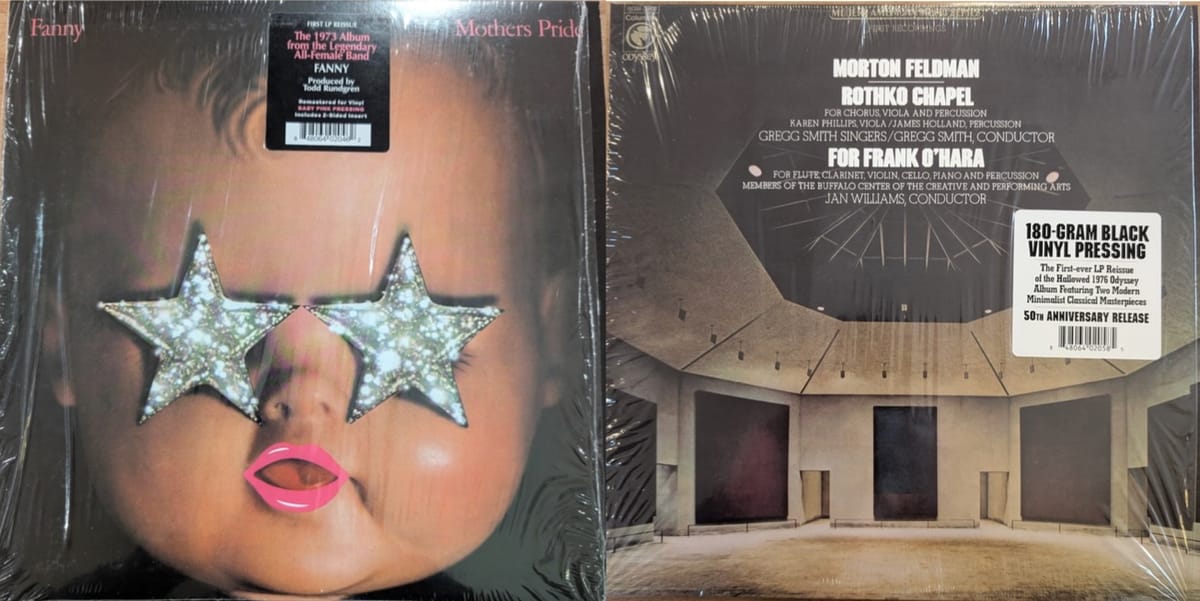
Whatever the case, we have a pair of reviews for you to close out the week, both of which come from the fine people at Real Gone Music: the first vinyl reissue of Fanny's 1973 album Mothers Pride, and the 50th anniversary edition of an album pairing two works by composer Morton Feldman.
First, a bit of news! Music on Vinyl, the genre-agnostic Dutch imprint that has been reissuing all manner of albums since the ’00s, let slip yesterday that they are starting a new imprint called Groove Classics. According to the press release we received, the goal is to "make legendary classic records available to everyone" at "an affordable price." They also promise that each one will be pressed on 140-gram black vinyl and "carefully sealed." You're crazy for this one, MoV!
The first five albums to be released under this new umbrella are: The Byrds' Greatest Hits, the fantastic 1967 compilation from those jangly LA folk rockers; the 1976 self-titled debut by fusion jazz bassist Jaco Pastorius; Nina Simone's lovely 1967 album Sings the Blues; Live at the Harlem Square Club, a blazing hot live set from soul singer extraordinaire Sam Cooke recorded in 1963 but not released until 1985; and Highwayman, the 1985 album by the country supergroup made up of Johnny Cash, Waylon Jennings, Kris Kristofferson, and Willie Nelson. The discs have a release date of February 13 and will cost a very reasonable €20.99 (around $25 USD). Fair warning: if you live in the States, there may be import fees if you order them direct from MoV or if you want to wait until they are available through US distributors, it will likely be a few weeks after the 13th of February. Oh, and if this matters to you like it does to us, you should know that all MoV titles are cut from digital sources.
Don't forget: my partner-in-newsletter Ned Lannamann is going to be a guest on Steve Westman's Live Audiophile Roundtable tomorrow afternoon, Saturday January 10 at 9am PT/noon ET over on YouTube. If you can't watch it live, the episode will be readily available to check out at your convenience.
And if that weren't enough, our next monthly giveaway is ready to be, you know, given away. This time around, one lucky winner could take home a set of test pressings for Universal's Definitive Sound Series editions of R.E.M.'s Chronic Town and Murmur. The only catch is that you have to be part of our paid subscription tier to be eligible. Click on the friendly button below to make that happen.
Alright, enough preamble. Let's get to the goods.
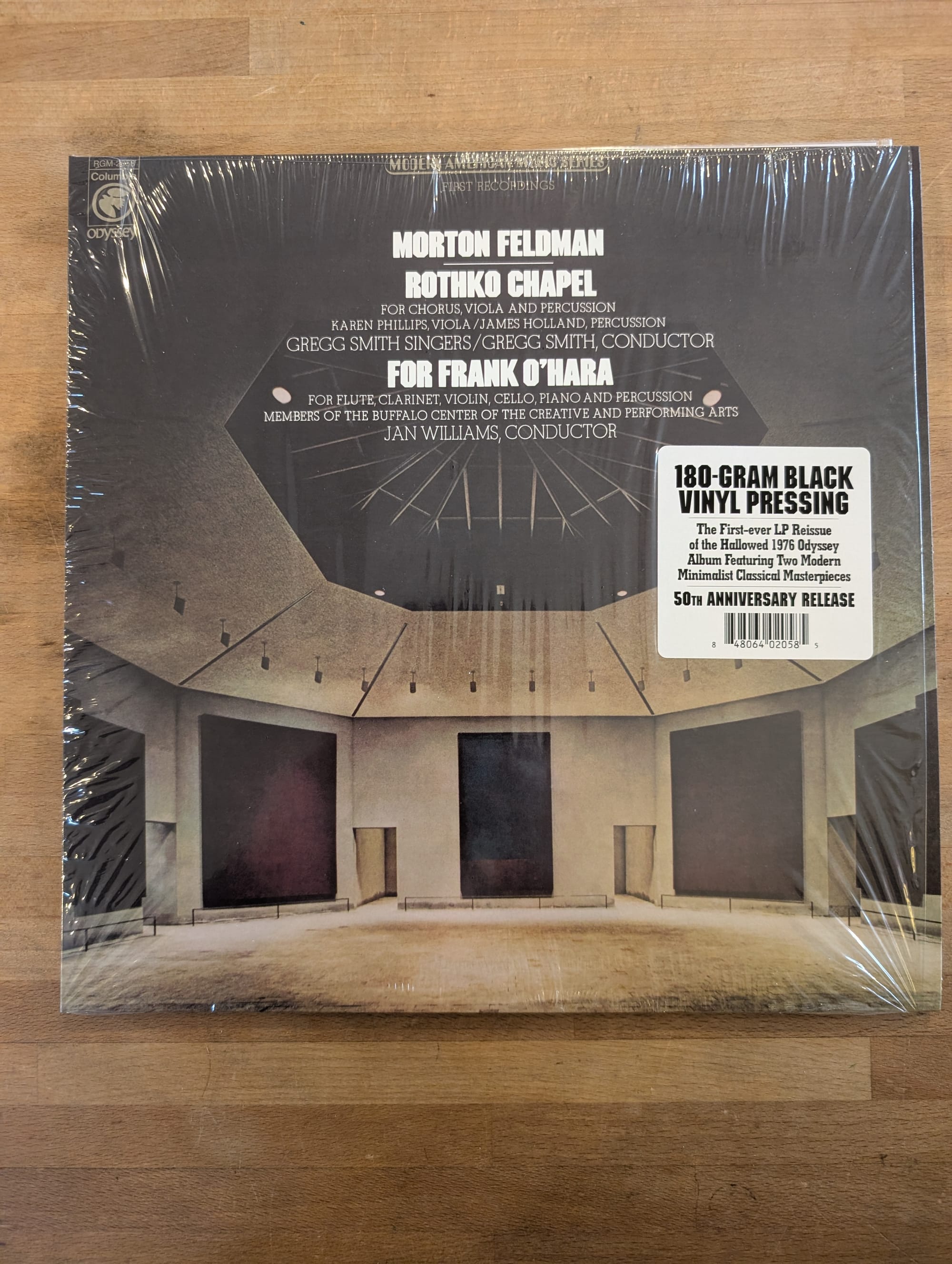
Morton Feldman: Rothko Chapel; For Frank O'Hara
I don’t envy anyone trying to find an entry point into the vast array of 20th-century avant-garde classical music. There are many daunting brick walls to run into, from John Cage’s conceptual works like 4’33”, in which a performer is instructed to sit at a piano and not play it for the exact amount of time mentioned in the title of the piece, to Déserts, a complex and often dissonant composition by Edgard Varèse that interrupts the playing of a woodwind, brass, and percussion ensemble with tape recordings of industrial noise. But for those curious about the developments in modern composition post–World War II, there are some easier ways to find one’s footing. One of the best happens to be Rothko Chapel; For Frank O’Hara, the 1976 album first released on Odyssey as part of Columbia's Modern American Music Series featuring the first recordings of two pieces by American composer Morton Feldman, reissued this week via Real Gone Music.
The works on this LP are also a fine introduction to Feldman’s long career. The son of immigrants from Kiev, the New York–born composer spent his days working in the garment business and his nights consorting with fellow artists, like his close friend John Cage and painter Jackson Pollock. Some of Feldman’s early compositions did away with traditional notation, preferring to use graphic scores and indeterminacy that allowed the musicians to dictate decisions such as when to play and how long to play for. It was fascinating but difficult music; when the New York Philharmonic performed some of Feldman’s work under the baton of Leonard Bernstein, both the audience and the musicians on stage audibly expressed their displeasure.
By the early ’70s, when Feldman wrote the pieces on this album, the composer had moved away from such potential chaos, opting for more contemplative pieces that unfurled at a gentle, steady pace and utilized silence as much as sound. “For Frank O’Hara,” for example, begins with stately, discordant piano chords (played on this recording by the equally great composer Julius Eastman) and minor key drones from flute, clarinet, and violin that slowly melt away before a series of long, sustained notes appear and disappear. In the background, the rumble of timpani evokes the sounds of faraway thunder.
It would be enrapturing if not for the clashing dissonance of the chords Feldman chose and the startling punctuation of a snare roll halfway through the piece. Though written to celebrate the 10th anniversary of the Center for Creative and Performing Arts at SUNY Buffalo, the work is suffused with the confusion and grief Feldman was still feeling after the accidental death of writer and poet O’Hara in 1966.
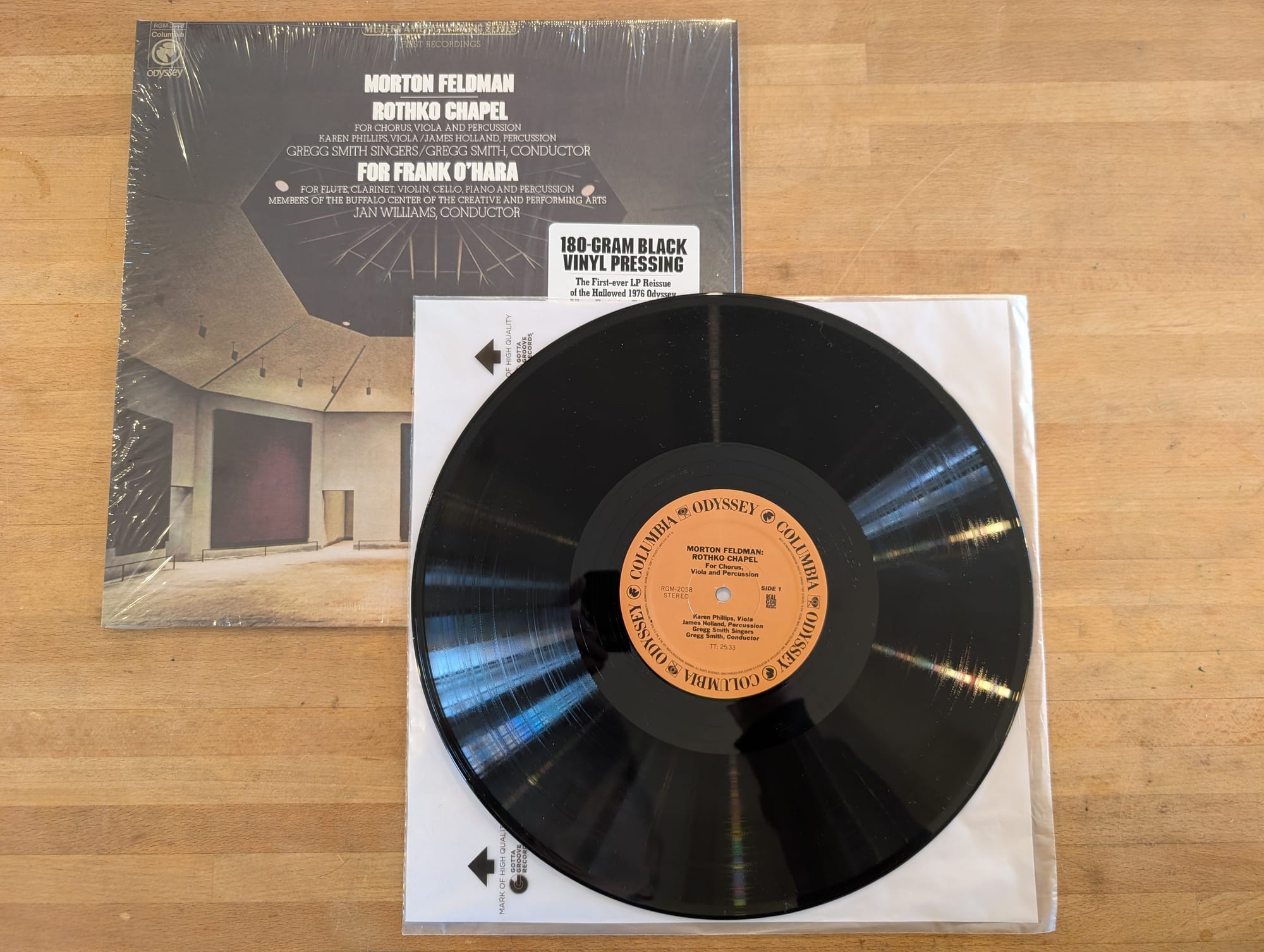
Those same emotions are present in “Rothko Chapel,” a piece commissioned by the donors of the chapel in Houston, Texas, and performed there for the first time in 1972. Feldman was present for the opening ceremonies at the spiritual center, which features 14 large canvases painted by Mark Rothko, and as the composer writes in the original liner notes printed on the back of the LP, he chose the instrumentation for this piece (viola, percussion, and voices) as way to evoke “the space of the chapel as well as the paintings. Rothko’s imagery goes right to the edge of the canvas, and I wanted the same effect with the music.” As such, the 25-minute piece is enveloping, even in its moments of pause. The Gregg Smith Singers and the trills of vibraphone played by James Holland in the early movements are devastating and haunting, with bursts of disquiet provided by timpani and Karen Phillips’s piercing viola. It all resolves beautifully in the final moments with a “quasi-Hebraic melody” Feldman wrote as a teen that, to these ears, evokes the whirls of Ralph Vaughan Williams.
Unless you can track down an absolutely clean copy of the original pressing of this album, Real Gone’s new pressing is likely the ideal way to hear these recordings. Though no mastering credit is listed, Dave Polster at Well Made Music in Bristol, Virginia cut a dead-quiet lacquer for this edition, a necessity for music as hushed as this can be. The smallest snap of a scratch or bit of dust on the wax would instantly break the spell Feldman casts with these works.
Real Gone/Odyssey 1-LP 33 RPM 180g black vinyl
• 50th anniversary re-release of 1976 album
• Jacket: Direct-to-board single pocket
• Inner sleeve: Gotta Groove-branded rice-paper-lined poly
• Liner notes, insert, or booklet: Feldman's original notes reprinted on back cover
• Source: Digital "using new transfers from the original master tapes"
• Mastering credit: None listed
• Lacquer cut by: Dave Polster, Well Made Music, Bristol, VA; “dP” in deadwax
• Pressed at: Gotta Groove Records, Cleveland, OH
• Vinyl pressing quality (visual): A
• Vinyl pressing quality (audio): A
• Additional notes: Limited-edition “chroma” color variant also available
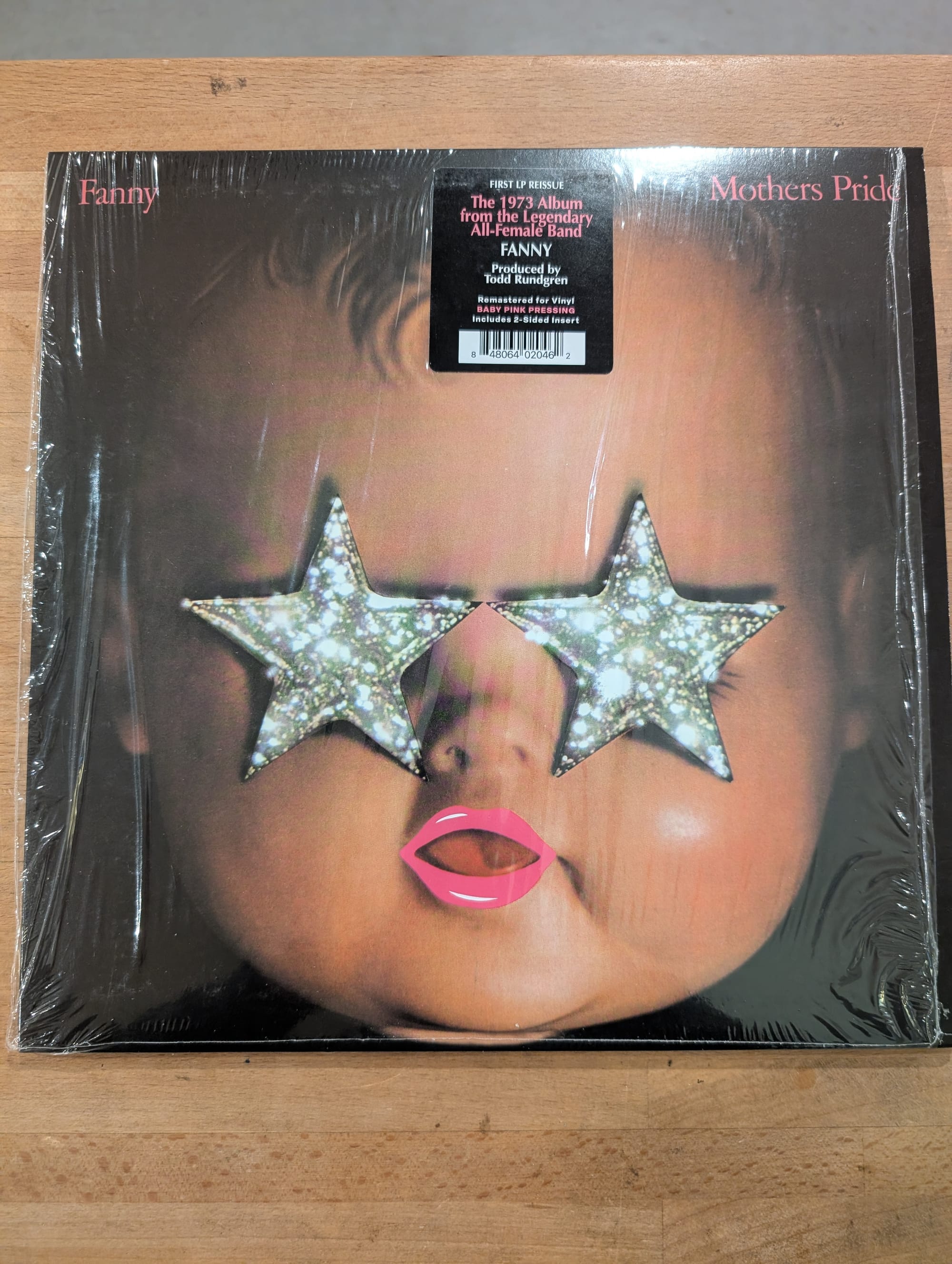
Fanny: Mothers Pride
Fanny occupies a truly singular space in the history of rock music. Started in the ’70s by sisters Jean and June Millington, they were the first all-female group to score a major-label deal with Reprise Records, and the first such band to land a single in the Billboard Hot 100 with the title track to their 1971 album Charity Ball. But beyond those milestones, the journey that Fanny went on made stops and connections that few could have predicted.
David Bowie was a fan, and he invited the band to party with him when they toured the UK and even had a yearlong relationship with Jean. They were invited to contribute to two Barbra Streisand albums: Stoney End and Barbra Joan Streisand, both released in 1971. They sang backing vocals on a cover of one of their songs recorded for Keith Moon’s lone solo album, 1975’s Two Sides of the Moon. And when the Millington sisters and other ex-members of the group reunited in 2017 to record an album (released under the name Fanny Walks the Earth), they were joined by musicians that followed in Fanny’s wake, including members of the Bangles and the Go-Go’s.
Despite the many stamps of approval and the best efforts of folks like Bobbi Jo Hart who directed the 2021 documentary on the band (Fanny: The Right to Rock), Fanny still hasn't cracked the mass cultural consciousness. Real Gone Music has been doing their part as well, reissuing the four albums the band recorded for Reprise on CD and vinyl, with the final entry in this series, 1973’s Mothers Pride, landing in stores this week. These efforts are laudable and, while I'm glad this record has finally been reissued, if I were looking to turn people on to Fanny, this is the last place I would begin.
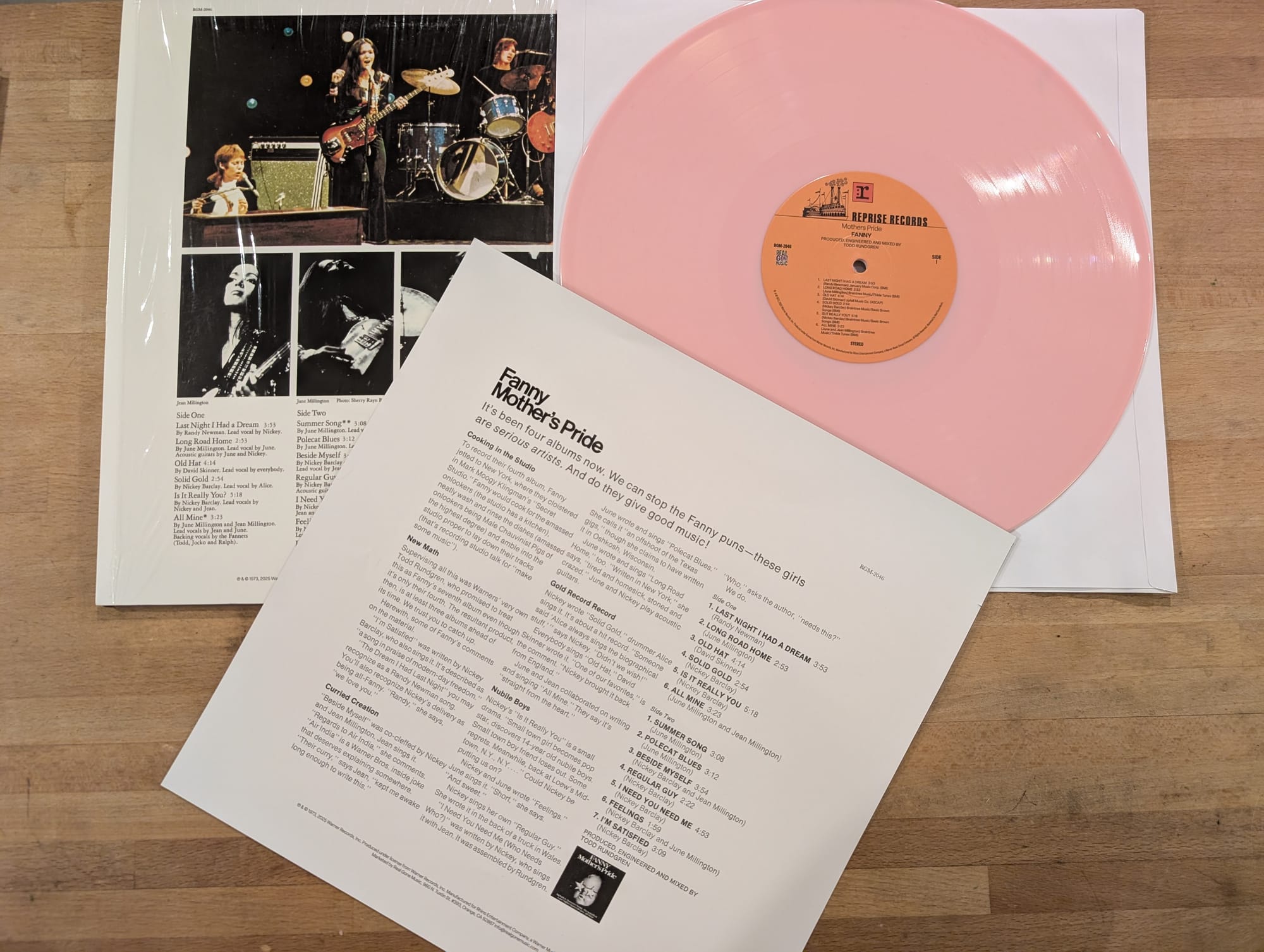
Though it maintains a decent batting average, Mothers Pride is the weakest entry in Fanny’s discography. The band, at this point made up of the Millington sisters, keyboardist Nickey Barclay, and drummer Alice DeBuhr, were making serious compromises in hopes of reaching the higher reaches of pop stardom. According to one NME report at the time, they were pushed to wear revealing outfits on stage and were encouraged to work with someone in the studio other than Richard Perry, who had produced their first three albums.
The only person they could all agree on was Todd Rundgren. The then-24-year-old was already celebrated for his production work for the Band and Sparks, and had just begun making some waves with his own music. On paper, he was a savvy choice for Fanny, but in practice Rundgren stifles the band, dulling down their ability to rock in favor of tunes that sound, well, like castoffs from his 1972 album Something/Anything? Not much on this album makes sense. They turn “Last Night I Had a Dream,” a goofy but rocking Randy Newman tune, into something closer to the Partridge Family. On “Solid Gold,” the song Keith Moon covered, they opt to have DeBuhr sing in an out-of-tune warble. Much of the rest of the running time is taken up with soppy ballads and midtempo shuffles.
It’s only toward the end of the album that Mothers Pride picks up some steam. “I Need You Need Me” is a tempest of desperate emotion and a grinding glam stomp, punctuated by Barclay’s anguished vocal turn. And album closer “I’m Satisfied” explodes from the speakers like a volley of glittering fireworks. If only the rest of the tracks carried a similar intensity and spirit.
For all its faults, Mothers Pride is treated kindly by Real Gone. Though there are no mastering credits to be found on this repress (we’ve reached out to the label for this info), the baby pink vinyl is great, with clear, balanced sound that benefits Barclay’s piano and keyboard work and the tight vocal harmonies of the full group. The songs may not have connected with me, but the quality of the pressing is such that I’m looking forward to tracking down the label’s vinyl reissues of Fanny’s first three albums. I don’t know if that was Real Gone’s intent here, but I hope they’ll take the win just the same.
Real Gone/Reprise 1-LP 33 RPM baby pink vinyl
• Remastered reissue of 1973 album
• Jacket: Direct-to-board single pocket
• Inner sleeve: White poly-lined
• Liner notes, insert, or booklet: Double-sided reproduction of original album insert with lyrics and credits
• Source: Unknown, likely digital
• Mastering credit: Unknown
• Lacquer cut by: Cut anonymously at GZ Media
• Pressed at: Memphis Record Pressing, Memphis, TN
• Vinyl pressing quality (visual): A
• Vinyl pressing quality (audio): A
• Additional notes: None.
Listening equipment:
Table: Cambridge Audio Alva ST
Cart: Grado Green3
Amp: Sansui 9090
Speakers: Electro Voice TS8-2