Reviews: Rush | Soul to Soul


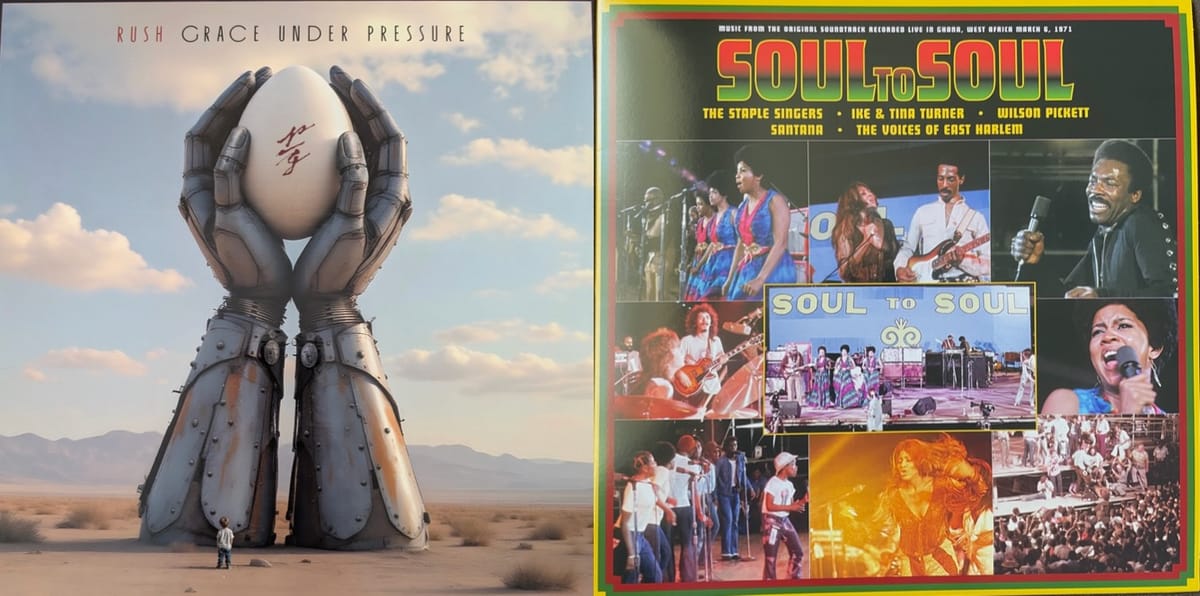
The two vinyl reviews we have today could not be more different. One is for a box set that is the very definition of excessive: a single album stretched out to multiple discs, with alternate mixes, live tracks, videos, and all kinds of tchotchkes to fill out the package. The other is a short, single-LP glimpse at a day-long festival that leaves us gasping for more.
The first is for Rush’s Grace Under Pressure, the 1984 album where they sound like they’ve been listening to a lot of Police records. The second is for Soul to Soul, the soundtrack to a 1971 documentary of a historic concert in Ghana that featured several American acts performing in Africa for the first time.
- Rush: Grace Under Pressure (super deluxe edition)
- Various Artists: Soul to Soul soundtrack
But first, the big vinyl news of the day is that a new Vinylphyle has been announced for the Cranberries’ Everyone Is Doing It, So Why Can’t We? That was the Irish band’s hugely successful 1993 debut, featuring the inescapable hits “Linger” and “Dreams.” The Vinylphyle edition comes out May 22 and features an analog cut by Joe Nino-Hernes and an essay by Hot Press deputy editor Stuart Clark.
Interestingly, another edition of Everyone Is Doing It, So Why Can’t We? is also coming out that very same day: a 3-LP version with a different mastering from album producer Stephen Street, a new remix of the album, and a bonus disc including outtakes and live tracks. With the recent Vinylphyle release of Marvin Gaye’s I Want You being accompanied by a 2-LP set of alternates, I Want You 2, and with the Beach Boys’ upcoming Pet Sounds getting not just the Vinylphyle treatment but also a Definitive Sound Series one-step, I wonder if the new m.o. for the Vinylphyle series is to have alternate product accompanying each release.
You can scope all the different Cranberries configurations here, including a vinyl reissue of the band’s 1991 EP Uncertain that’s also part of the campaign.
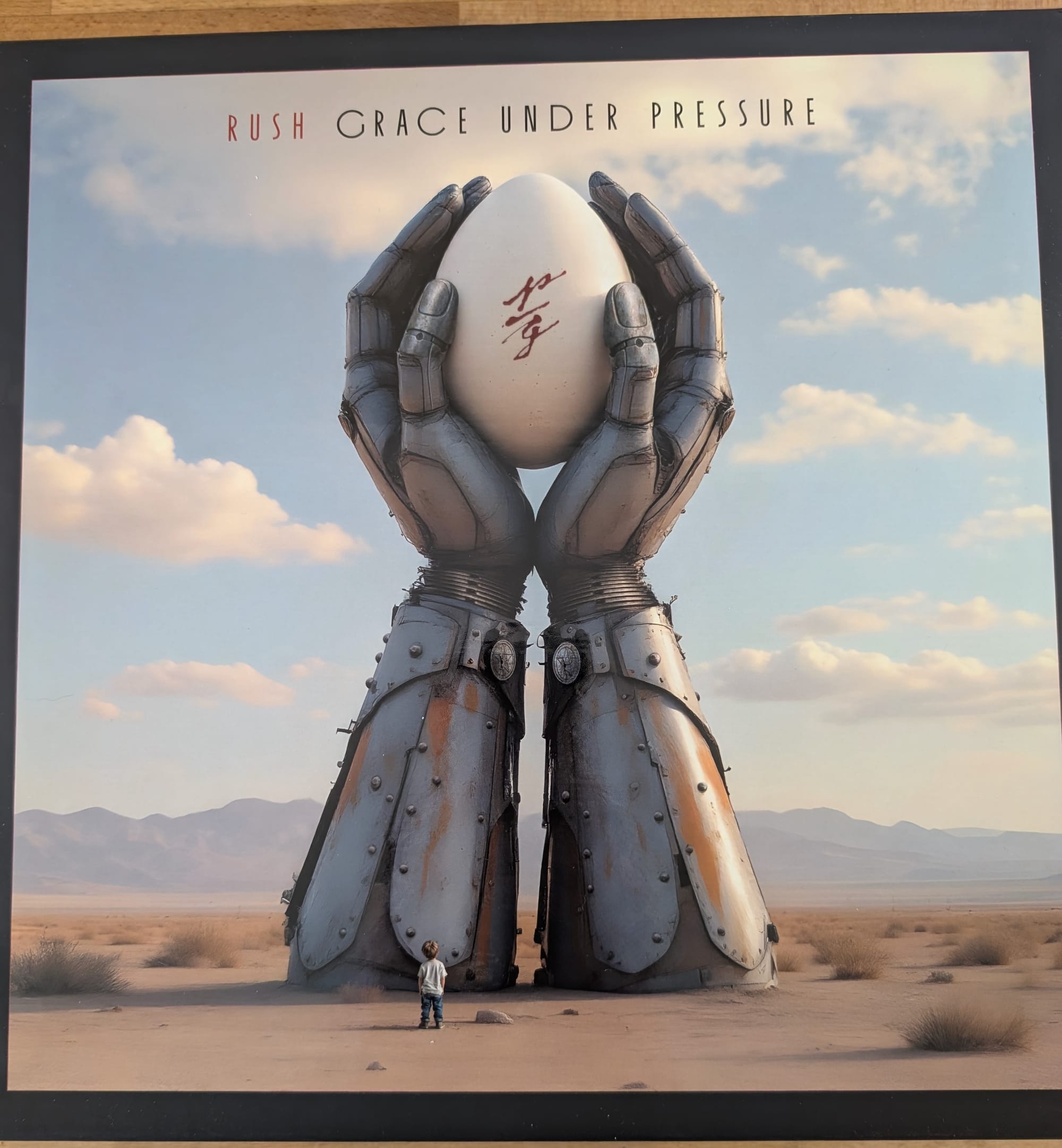
Rush: Grace Under Pressure (super deluxe edition)
Review by Robert Ham
The story of 1984’s Grace Under Pressure, the 10th studio album by Canadian rockers Rush, revolves around a big decision they made prior to recording. For the first time since 1974, the trio would not work with Terry Brown, the producer who helped shepherd the group from the sci-fi prog epics of 2112 and Hemispheres to the more tightly controlled AOR sound of albums like 1980’s Permanent Waves and 1981’s Moving Pictures. As drummer Neil Peart wrote in a press release that has been reprinted for inclusion in the new deluxe box set reissue of Grace Under Pressure, “We wanted, no needed to find out if someone, perhaps from a different background, might have different approaches and different techniques to offer to both our music and our sound.”
After discussions with folks like Trevor Horn and some ill-fated pre-production sessions with Steve Lillywhite, Rush landed on Peter Henderson, an affable Brit who engineered albums by Jeff Beck and Wings and had made a big name for himself for his work producing three albums for Supertramp. According to Peart, Henderson meshed with the band on their shared musical loves and had solid advice about how to improve the material they were working on.
This tale has all the makings of a huge departure for Rush and a radical upheaval of their sound. Instead, Grace Under Pressure was the natural next evolutionary step for the group after 1982’s Signals. Bassist/vocalist Geddy Lee continued incorporating keyboards into his arsenal of noisemakers, leaning heavily on the PPG Wave 2.2, a polyphonic synth that he used for horn and string parts. On “Red Sector A,” he doesn’t touch his bass at all, opting for an arpeggiated rhythm generated by his Roland Jupiter-8. Peart, meanwhile, was adding electronic drums to his already massive kit and permeated the album with their synthetic sounds. And as songwriters, the band were still letting their interest in the post-punk and new wave sounds coming from the UK influence their work. In the liner notes Lee wrote for this reissue, he cites XTC, Propaganda, and Ultravox as part of the band’s listening diet at the time.
Again, all of it seems apropos for where Rush was already at. Henderson’s job, so far as I can tell, was to assure them they were on the right course. When talking about the making of Grace Under Pressure, guitarist Alex Lifeson told Guitar Player that when he asked their co-producer for advice about what effects he should use, Henderson replied, “Just do whatever you think is right.” The note, the guitarist said, gave the album a cohesion he felt was missing from previous Rush full-lengths. While that is one of Grace Under Pressure’s strengths, as are Peart’s heartfelt lyrics, the record sounds slick and, at times, stiff and mechanical. The liveliness of the drums is tamped down, and Lee’s usually buoyant bass is often overtaken by the synth pulses and the wow of the Moog Taurus.
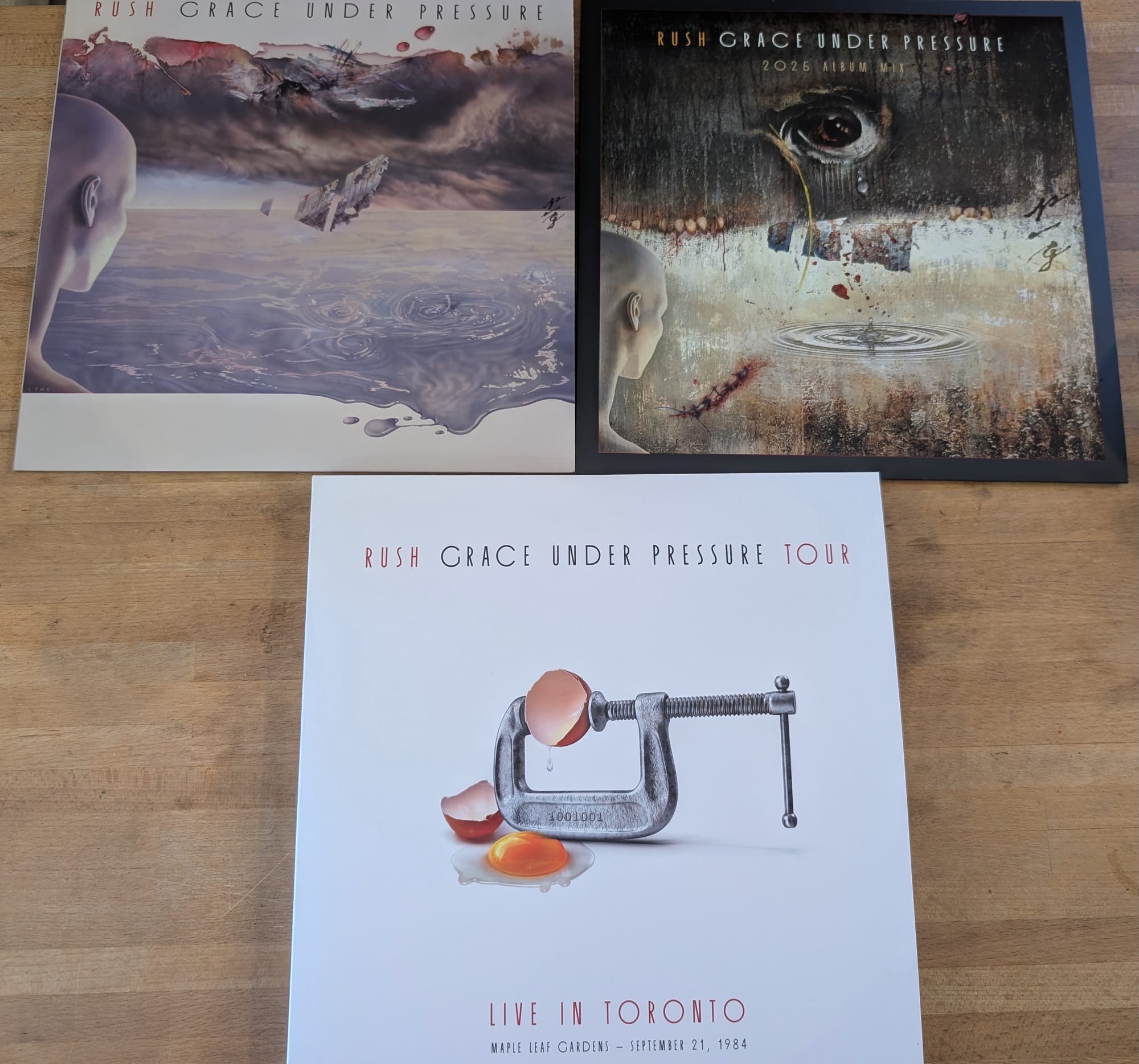
Like much of Rush’s work in the ’80s, Grace Under Pressure was ripe for a remix, something to help inject some life and dynamism into the music. Unfortunately, the opposite happened with the new mix that’s part of the new super deluxe box set. Rush, for some reason, reversed course on their original design for the album and gave the original analog multitracks to their old producer Terry Brown, who put together the 2025 remix included in this set. “I went for a little more detail, different reverbs, and a larger footprint,” Brown notes in the press release, “all while maintaining the integrity of the original record.” That translates to a slightly bigger soundstage that draws out some of the overtones of the keyboards and adds some bite to Peart’s snare. But everything else gets flattened out and dampened in the process. Lifeson’s guitar, by far the most exciting element of the original mix, is especially drawn back into its shell.
The other version of Grace Under Pressure in this set is the 1984 album mix newly remastered by Abbey Road’s Sean Magee. He was the same engineer who got the credit on the vinyl edition that was released in 2015 and repressed in 2023. I’m tempted to track down those versions to see if they sound as off as this one. The drums are occasionally overdriven to the point of distortion, and everything else is brightened to an almost uncomfortable degree.
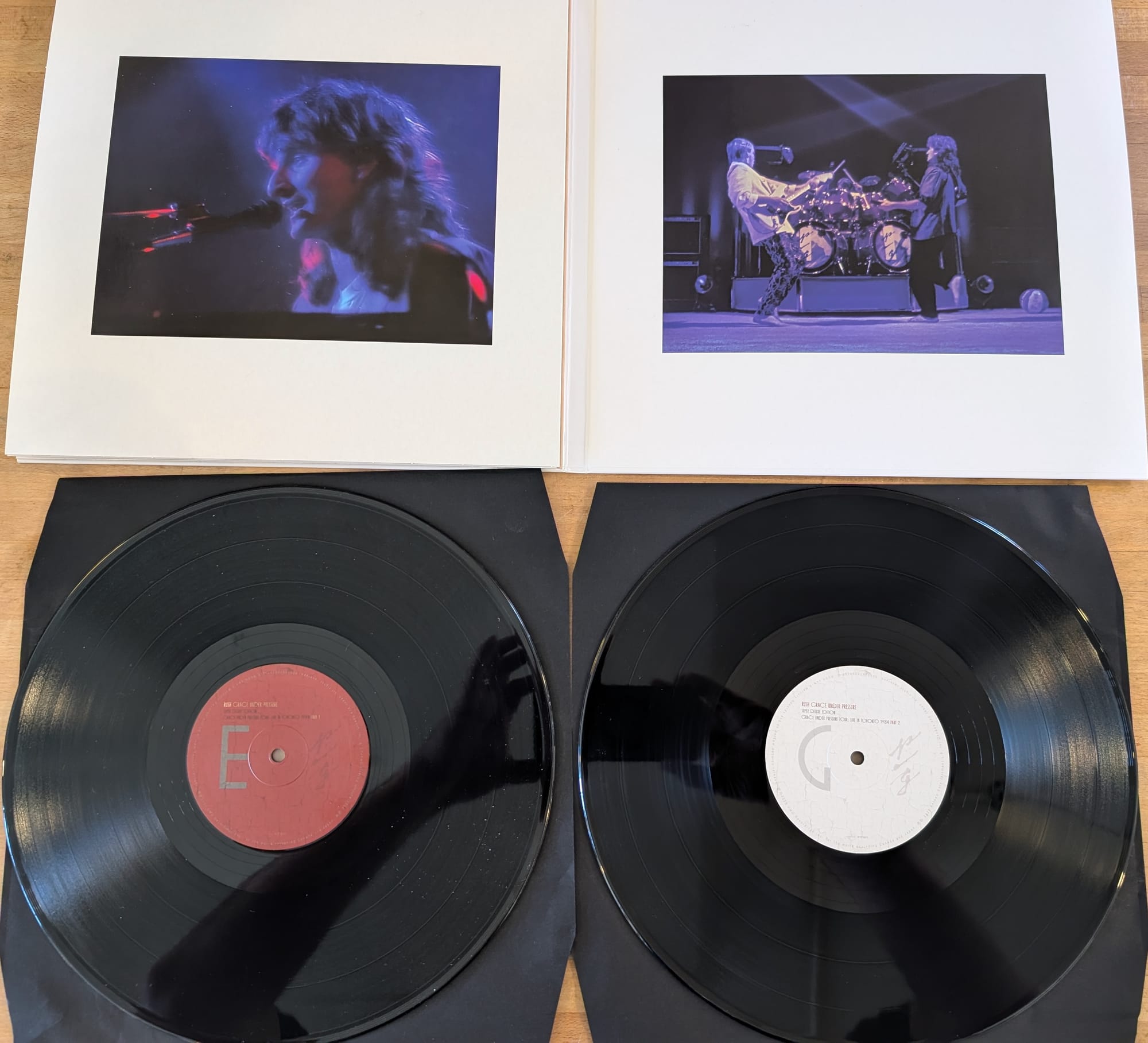
The true highlight of this box is a live performance by the band, featured on both a 3-LP set and the Blu-ray disc. Up to and including their final tour with the classic Lee/Lifeson/Peart lineup in 2015, Rush was a killer live act, bringing crackling energy and power to every stage they set foot on. (And from the sounds of the surprise appearance they made at March 29’s Juno Awards with new drummer Anika Nilles, that tradition will continue for their upcoming live dates.) For this 1984 show, the band were on their home turf at Toronto’s Maple Leaf Gardens, so it’s not hard to detect a little extra spark and spring to their most familiar tunes, like “The Spirit of Radio” and a killer medley that fuses “YYZ,” “The Temples of Syrinx,” and “Tom Sawyer.” The whole set sounds spectacular on this vinyl pressing and has me seriously reconsidering my initial thought of skipping Rush’s shows in Seattle this fall.
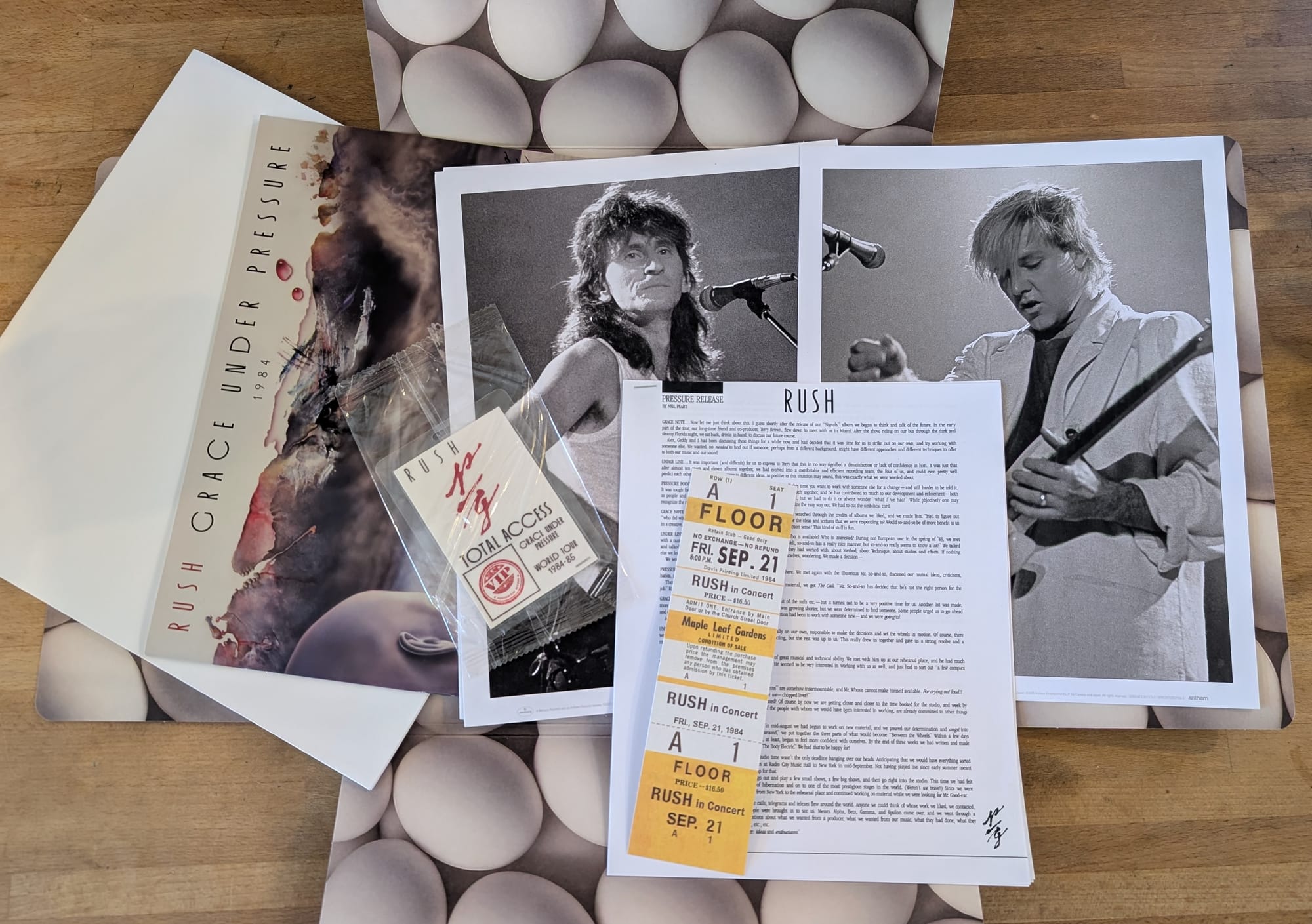
However, the disappointment of this super deluxe edition of Grace Under Pressure is only compounded by the price tag ($374.98) and all the otherwise lovely extras poured into it. The hardbound book features a wealth of wonderful photos of the group on stage and some new artwork from their regular collaborator Hugh Syme. There’s also a small sheaf of collectibles that include a reprinting of the program from the Grace Under Pressure tour, a replica ticket from the Toronto gig, and a sweet poster. And tucked into the back of the box is an acrylic accessory that features the “p/g” script found on the label for the original LP, illuminated in primary colors by some LED lights. With so much care and attention to detail given to the visual presentation of this set, it’s a shame that the same courtesy wasn’t extended to the music.
Mercury/Anthem 5-LP 33 RPM 180g black vinyl
• Super deluxe reissue of Rush’s 1984 album with the original mix, a 2025 remix, and a triple live album of the band performing at Toronto’s Maple Leaf Gardens in 1984
• Jacket: Original album and 2025 album mix in tip-on single pocket sleeves; live album in tip-on triple-pocket gatefold, all packaged inside a hard cardboard lift-top box
• Inner sleeve: Black poly-lined
• Liner notes, insert, or booklet: 52-page hardcover book with essay from Geddy Lee, song lyrics, and artwork by Hugh Syme; a replica of the Grace Under Pressure tour book; a replica Maple Leaf Gardens/Toronto show concert ticket; a backstage pass replica; a replica of the six-page press release; three band member live photo lithographs; and a poster
• Source: Digital; original album “remastered from the original analog stereo master tapes”; 2025 mix “created from the original studio album’s analog multitracks”; and live album “mixed from the original multitrack audio masters”
• Mastering credit: Sean Magee and Oli Morgan at Abbey Road Studios, London
Lacquer cut by: Sean Magee, Abbey Road Studios, London; “i…i” in deadwax
• Pressed at: GZ Media, Czech
• Vinyl pressing quality (visual): A
• Vinyl pressing quality (audio): A
• Additional notes: Super deluxe edition also includes a Blu-ray featuring the Grace Under Pressure Tour: Live in Toronto 1984 concert film; new Dolby Atmos and 5.1 remixes of the album by Richard Chycki; the 1984 stereo mix in 192kHz/24-bit and 96kHz/24-bit PCM stereo; 2025 stereo remix in 96kHz/24-bit PCM stereo; and promo videos for “Distant Early Warning,” “Afterimage,” “The Enemy Within,” and “The Body Electric.” Also in the box is “a custom acrylic Grace Under Pressure LED light-up display.”
Various Artists: Soul to Soul soundtrack
Review by Ned Lannamann
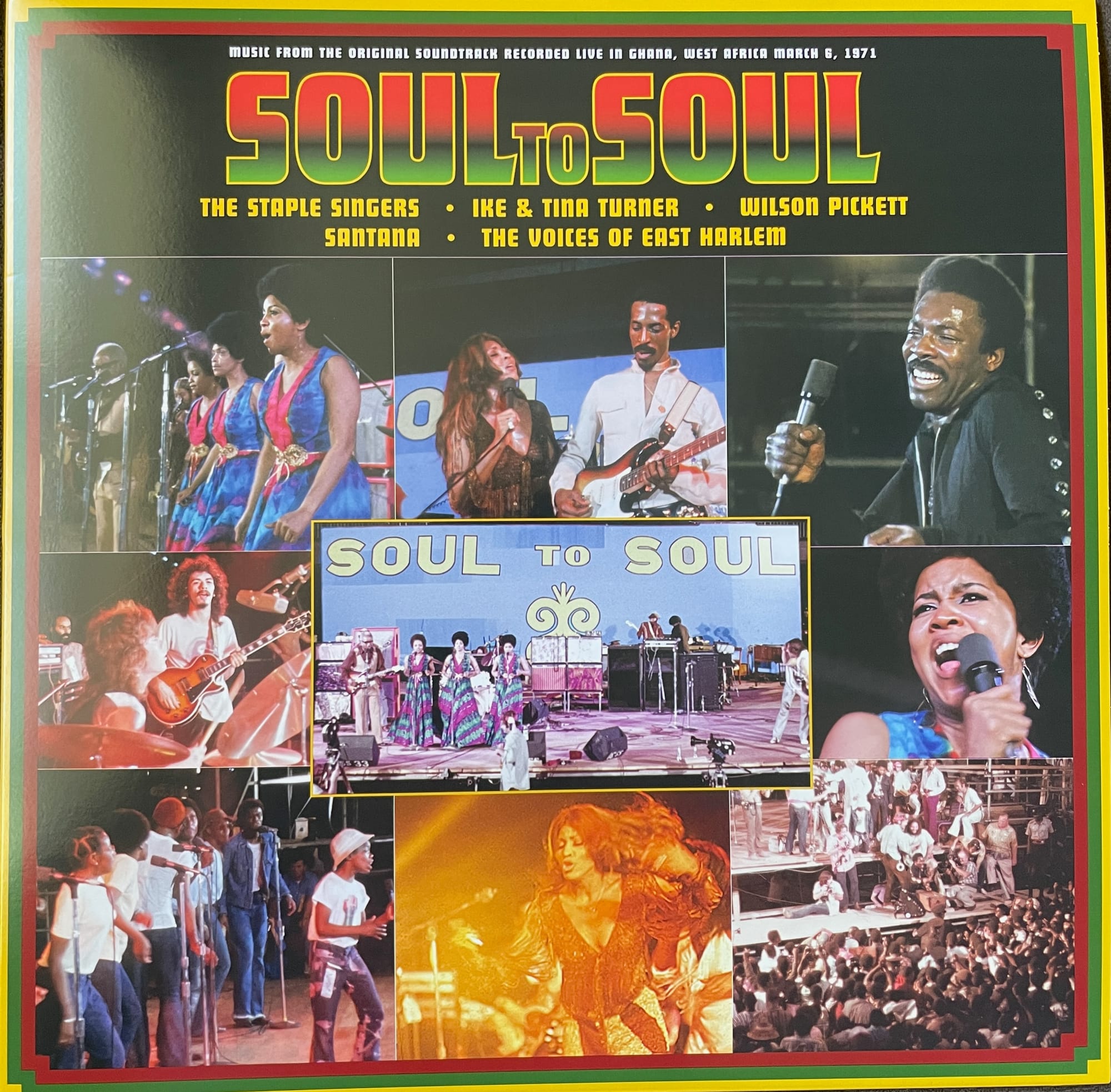
On March 6, 1971, seven American acts performed at a 15-hour concert in Accra, the capital city of Ghana, as part of that country’s Independence Day festivities. Ghana, formerly known as the Gold Coast under British colonial rule, had won its independence in 1957 and hosted annual celebrations each year since. For the 1971 event, the Ghana Arts Council invited several American performers in all genres to come to Ghana to perform on a bill with several Ghanaian acts. The headliner was Wilson Pickett, an immense star in Ghana at the time, but the other American acts—which included Ike and Tina Turner, the Staple Singers, Santana, Roberta Flack, Les McCann and Eddie Harris, and the Voices of East Harlem—were relatively unknown. The event was meant to symbolize global unity and connect African peoples, both in Africa itself and throughout the Black diaspora, through the proverbial power of music. The concert was captured in the 1971 documentary Soul to Soul, and a soundtrack album was released on Atlantic Records.
Liberation Hall and Reelin’ in the Years Productions recently re-released the documentary on Blu-ray and DVD, with some alterations to the 1971 film that mirror the changes made when Reelin’ in the Years (in association with Rhino) first released it on DVD in 2004. At that time, all of Roberta Flack’s contributions were removed per her request, with other performances added to compensate. Now, a new CD and vinyl LP have been released by Liberation Hall, and the contents do not quite mirror the 1971 Atlantic LP or the 2004 CD that accompanied the 2004 DVD release. Flack is still missing, but some additional tracks have been added, including a performance by Santana. The new CD contains more music than the LP reviewed here, which contains some very worthwhile stuff but is not the complete document that the 1971 concert deserves.
Most significantly, none of the Ghanaian performers are featured, which feels like a missed opportunity in properly conveying the unifying, transcontinental purpose of the event. And excising the key Flack performances remains a shame, but following her recent death it may have been legally unavoidable. As such, this third iteration of the Soul to Soul soundtrack feels like a cursory blast of some of the day’s highlights, and while it includes great performances by everyone included, one can’t help but wish for a more extensive document. At the very least, a double LP that included all of the music on the CD as well as the other performances lost along the way would have been ideal. Again, it may have been out of the producers’ hands, but this was a historic event not well remembered by most American music fans, so it’s a shame that it has been reduced in scope to the confines of a single LP.
Nevertheless, that LP is a fantastically enjoyable listen. Remote recording guru Wally Heider lent his gear, and future Academy Award–winning sound engineer Tom Scott ran tape; Tom Dowd ended up with a production credit on the Atlantic LP, although his name does not appear on the new reissue, so it’s unclear what his contribution was. The recording quality is far from breathtaking—it’s not dissimilar to the recording quality of other festivals of the era, namely Woodstock—and I get the sense that a simple stereo two-track setup was employed for the day, rather than cumbersome multi-tracks that would have taken up valuable cargo space.
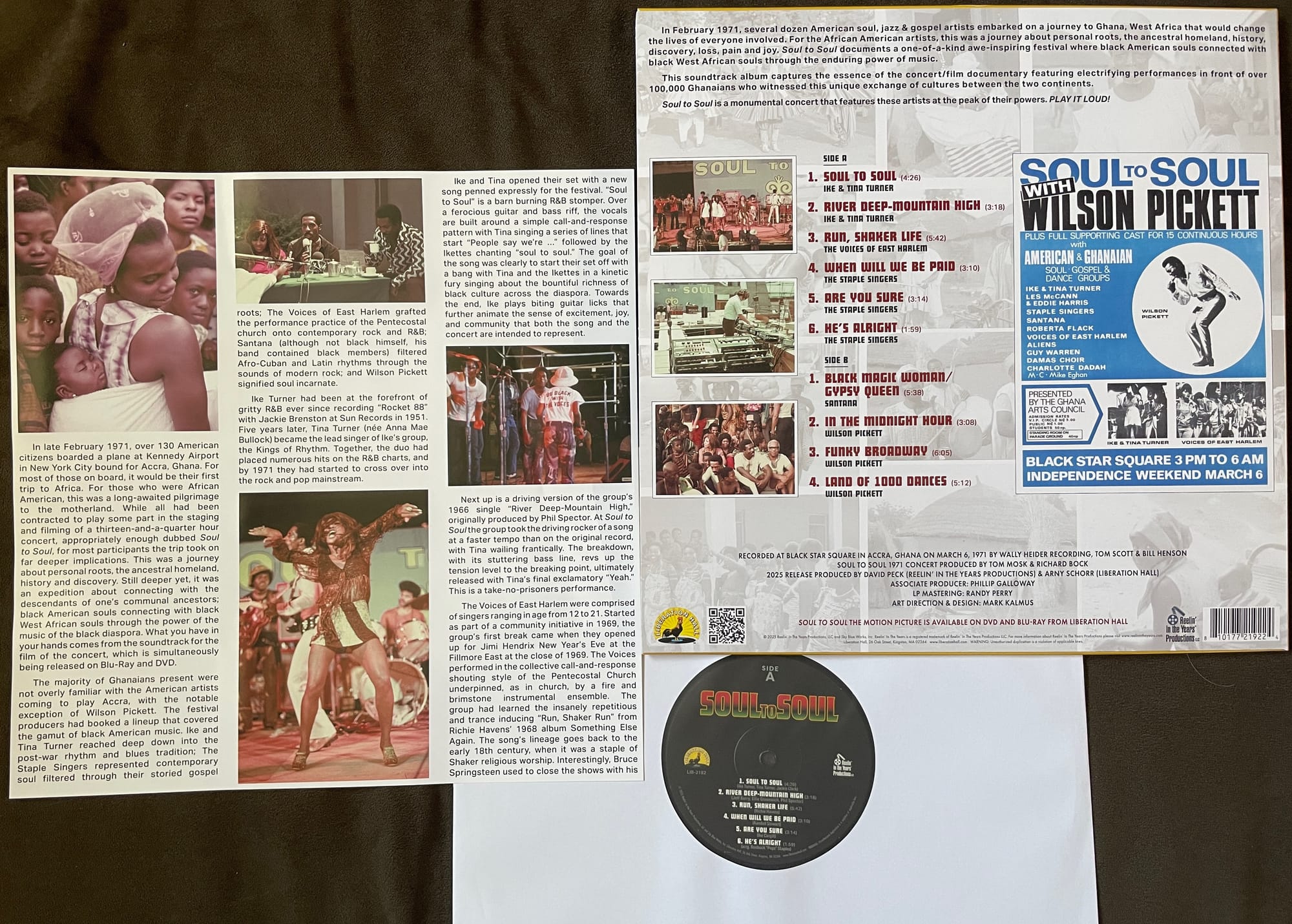
Ike and Tina Turner open the LP with “Soul to Soul,” a song written expressly for the event by Bob Burchman and Neil Seidel; it’s a quick, funky groover that kicks off the proceedings on a high note. A frantic “River Deep, Mountain High” follows before the teenaged singers in Voices of East Harlem perform a lively rendition of Richie Havens’s “Run, Shaker Life” backed by a funk band. Side 1 concludes with three performances from the Staple Singers, highlighted by their version of Randall Stewart’s “When Will We Be Paid,” whose lyrics encapsulate the underlying themes of the event:
We have given our sweat and all our tears
We stumbled through this life for more than 300 years
We’ve been separated from the land which we knew
Stripped of our culture, people you know it’s true
Santana were reportedly the sensation of the concert, with their performance having a lasting impact on the Ghanaian audience; some even say they influenced the trajectory of Afrobeat with their Soul to Soul appearance, but this is impossible to quantify. Their rendition of “Black Magic Woman/Gypsy Queen” is marred by the LP’s weakest audio—parts are obscured by crowd noise, while the band swishes in and out of varying levels of fidelity—but it’s nonetheless an adequate if brief representation of Santana’s presence at the festival. The inclusion of Santana’s more hypnotic, extended jamming would have been welcome (an additional track is on the CD), but it’s not to be. Wilson Pickett closes the event (and the LP) with “In the Midnight Hour,” “Funky Broadway,” and “Land of 1000 Dances.” Pickett took the stage at 4:30 am but sounds fresh and energized, and his backing band is taut and authoritative, turning Accra’s massive Black Star Square into a hot and sweaty nightclub.
The disc is well pressed and good-sounding, sourced from Randy Perry’s digital remaster and cut anonymously at GZ Media via their DMM process. The vinyl was pressed at GZ’s Canadian outpost at Precision Record Pressing, and my copy was pretty dished, although it did not affect playability; the grooves themselves were pristine, with close-to-silent backgrounds and no noise interference at all. As mentioned, the audio is of 1971-live-festival quality, but the musicians are represented cleanly and the dynamics are fine. Drums can be washy and there’s usually a persistent level of ambient or crowd noise throughout, but for a historic event, such compromises seem like a small price to pay.
In fact, my greatest criticism of Liberation Hall’s new vinyl reissue of Soul to Soul is also my highest compliment: There’s simply not enough of it. Rather than offer an immersive sensation of what the all-day-and-all-night event must have been like, this breezes by like a quick taster. A second disc would have allowed for more performances, like Les McCann and Eddie Harris’s “The Price You Gotta Pay to Be Free” from the CD version, as well as some of the Ghanaian music that took place that day in Black Star Square. You’ll need to track down the 1971 Atlantic LP as well as the new Blu-ray to get a fuller picture. Maybe some day we’ll get a multi-disc release with the entire show; for now, we’ll take whatever parts of Soul to Soul we can get.
Liberation Hall 1-LP 33 RPM black vinyl
• Selected recordings from the all-day Soul to Soul concert in Black Star Square, Accra, Ghana, on March 6, 1971, taken from the documentary film soundtrack
• Jacket: Direct-to-board single pocket
• Inner sleeve: White poly-lined
• Liner notes, insert, or booklet: Double-sided insert with essay by Rob Bowman
• Source: Digital
• Mastering credit: “LP mastering: Randy Perry”
• Lacquer cut by: Anonymous, GZ Media, Czech Republic
• Pressed at: Precision Record Pressing, Burlington, Ontario, Canada
• Vinyl pressing quality (visual): B (disc is substantially dished, although it did not affect playability)
• Vinyl pressing quality (audio): A (no sonic issues)
• Additional notes: This LP release is a truncated version of the CD version, which contains more music. The 1971 soundtrack album for the documentary film Soul to Soul contains some different selections from the concert, notably performances by Roberta Flack that do not appear on either reissue.