Reviews: The Flaming Lips | John Prine


Rhino Reserve gets their hands on Clouds Taste Metallic and Sweet Revenge.
As part of their Start Your Ear Off Right campaign for January, Rhino has released a clutch of vinyl reissues in their Rhino Reserve series. And as you likely know already, the Rhino Reserves have all been pretty stellar so far, with top-notch pressings featuring great sound, presented in analog cuts in most (but not all) cases and featuring a friendly price point of around $32 US.
Today we’ve got two of the latest Rhino Reserves on hand for review:
- The Flaming Lips: Clouds Taste Metallic
- John Prine: Sweet Revenge
And we’ll have a lot more to come from the Start Your Ear Off Right collection, so expect to see plenty more reviews of the latest Rhino reissues in the coming days.
Before we dig into today’s reviews, here’s another quick reminder about our January vinyl giveaway for paid subscribers. Each month, those on our paid tier will be eligible to win some pretty choice vinyl. This month we’re giving away test pressings to the new R.E.M. one-steps of Murmur and Chronic Town that were released last month as part of the Definitive Sound Series. These are records that positively bowled us over, as you can read in Bob’s review here.
The giveaway will go live in the coming days, so if you’d like a chance to win, you can join our paid tier by clicking here.
I should add that by becoming a paid subscriber, you don’t just get access to our giveaways, you’ll also support our work and make it possible for us to keep churning out newsletters just like this one. You’ll also always have full access to our archives at all times, plus some other perks we’ve got in the works.
Now, let’s crack open those Reserves!
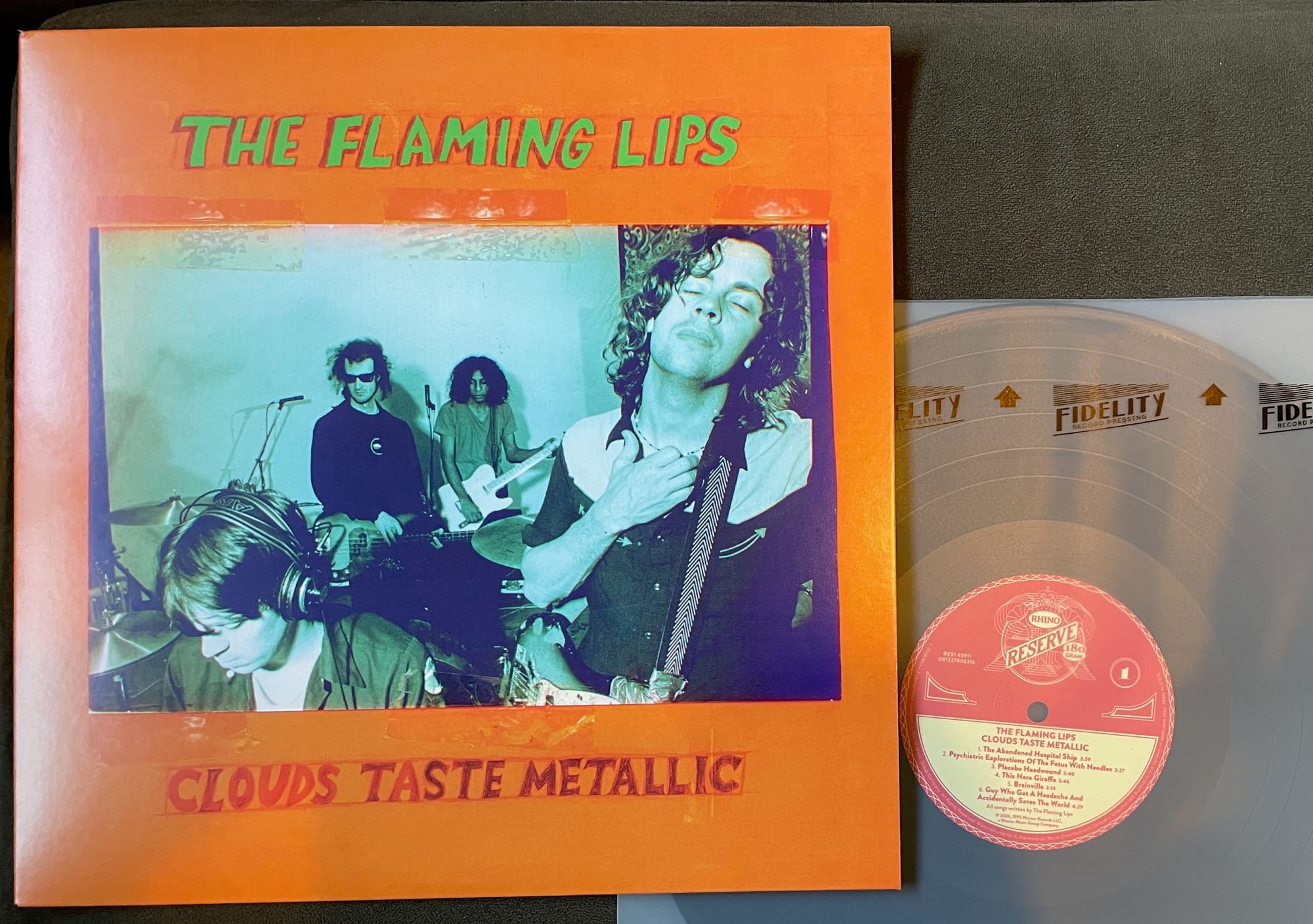
The Flaming Lips: Clouds Taste Metallic
Clouds Taste Metallic found the Flaming Lips at what appeared to be a make-or-break moment. Their previous album, 1993’s Transmissions from the Satellite Heart, had become an unlikely hit on the back of “She Don’t Use Jelly,” an infectiously catchy but defiantly off-kilter wad of sludge-pop. New members Steven Drozd and Ronald Jones were settling into the band with varying degrees of comfort, and their record label Warner Bros. was clamoring for a follow-up they could sell in numbers similar to Transmissions.
Unfortunately, it turned out to be a “break” moment for the Lips, albeit a minor and temporary one. Clouds Taste Metallic, released in September 1995, was decidedly not a smash, failing to crack the Billboard Top 200 albums chart or proffer a song that rock radio could make heads or tails of. Pretty soon, it was looking like the Oklahoma City band might fall into the novelty one-hit wonder phylum, sharing illustrious company with other grunge-adjacent ’90s bands like Ugly Kid Joe and Crash Test Dummies. Fortunately the band already had the ingredients of a formula that would serve them well: roots that stretched back for more than a decade, a hard-earned grasp on a unique sound that would eventually find audiences coming to band on its own terms, and the fortitude to press on in spite of minor inconveniences like lack of sales or the cold shoulder from corporate radio.
It helped that, to the small crowd that was paying attention, Clouds Taste Metallic was a phenomenal record. It remains one that the Lips have perhaps equalled but never bettered, and it finds the sweet spot between their discombobulated psych-punk, their aptitude for noise experimentalism, and the soaring, emotional songwriting that would characterize their work to come. With the Lips reunited with producer Dave Fridmann (of Mercury Rev), Clouds has an arresting but never abrasive sound, rendered in raw tones and primary colors, with Drozd’s distorted, gargantuan-sounding drums acting as the sonic phalanx. Wayne Coyne’s vocals sound more grounded and sturdy here than in the daydreaming-professor persona he’d adapt in the coming years, and the songs, for all their whizzbang fuzz and fur, are indelible pop treats, and sneakily heartwarming ones at that.
Clouds does make for an unconventional choice in the Rhino Reserve series. It was recorded digitally, and sections of it are deliberately lo-fi, including the first minutes of the opening track, “The Abandoned Hospital Ship.” Clarity of sound was not Fridmann and the Lips’ MO at this point in time; they opted to traffic in more tattered, blown-out timbres, eschewing straightforward arrangements in favor of tune-scapes that went from monochrome to Technicolor and back again, shrinking then exploding before the listener’s ears.
I have not heard other vinyl versions of Clouds Taste Metallic. It was released in the US on green wax in 1995, with a well-regarded lacquer by Geoff Sykes. Chris Bellman recut it in 2011, and very successfully so, by most online accounts; that pressing appeared as a stand-alone disc and as part of the Heady Nuggs: The First 5 Warner Bros. Records 1992–2002 box set for Record Store Day. Bellman took another whack at it in 2015 for another stand-alone pressing that was also part of the Heady Nuggs: 20 Years After Clouds Taste Metallic 1994–1997 box set; a 2019 Vinyl Me, Please repress used the 2015 plates. All of these pressings have garnered appreciation for sound quality and definition; I apologize that I am not able to verify or dispute these reports.
What I can confirm is that this version sounds splendid. The sides are long—Side 2 is close to 25 minutes—but the album is vigorous and supple throughout, managing to be both congenial and wildly psychedelic at the same time. Mastering engineer Matthew Lutthans has done commendable work on his lacquer cut, using the Mastering Lab’s tube system to bring roundness and a sense of give to the album’s more jagged, undigested sounds. The bass is fully locked in, and the soundscape expands and contracts per the demands of the arrangement. There’s an infectious quality to the LP that my CD copy strove for but was never quite able to impart. It’s positively intoxicating in this presentation, with Lutthans unlocking beauty from surprising places.
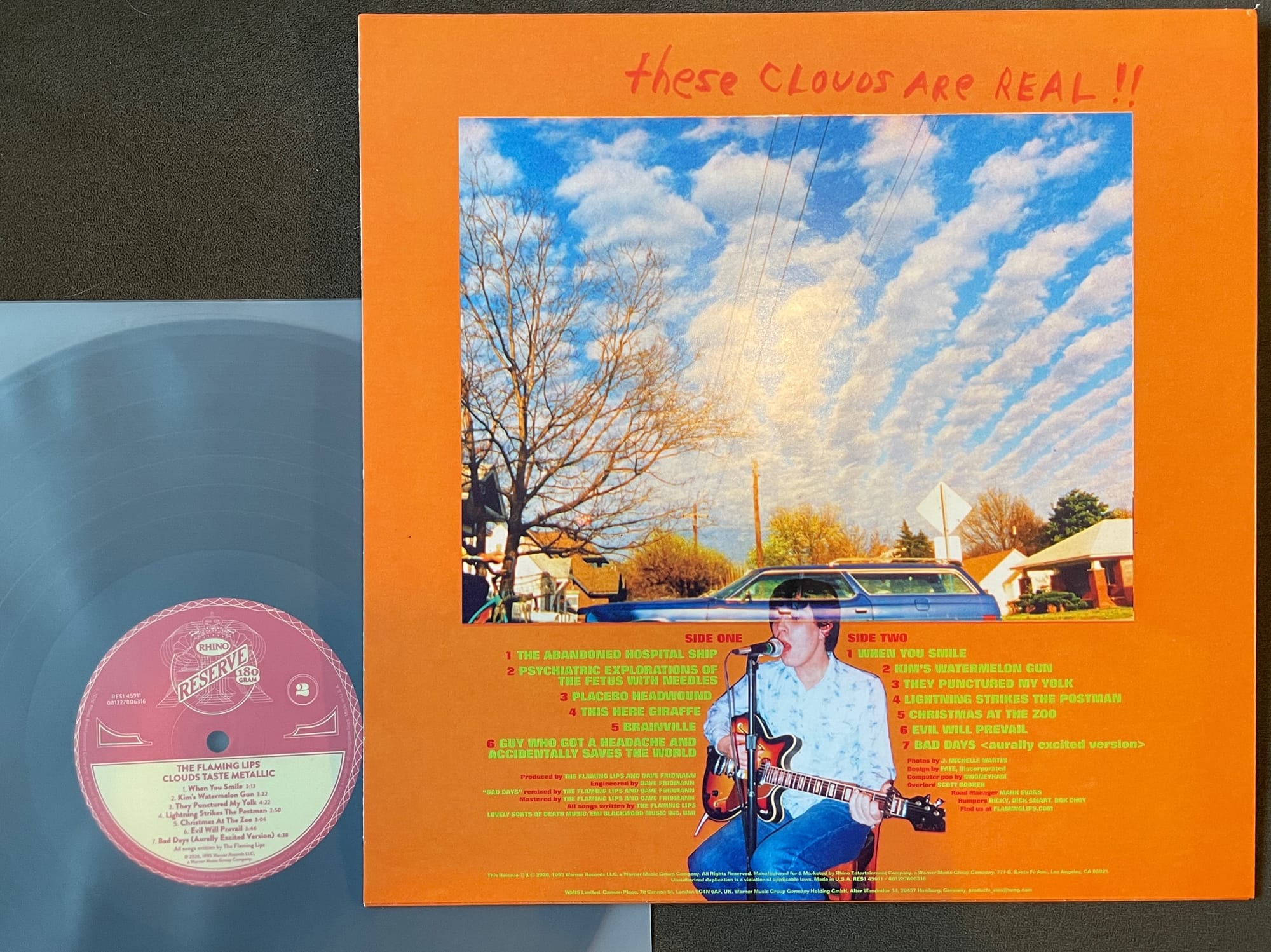
The package is bare-bones, with a single-pocket outer sleeve printed on heavy-duty stock but without any inserts or supplemental material. It would have been nice to have the complete CD artwork reproduced here, or the lyrics and photos that came in later vinyl editions. My vinyl copy, too, had just the barest wisp of noise and crackle to it, something I haven’t encountered on any other Rhino Reserve pressings, which have all been handled immaculately by Mobile Fidelity’s Fidelity Record Pressing plant.
But these are minor quibbles; it’s good enough to have Clouds Taste Metallic readily available on vinyl again, and better yet to have such an open and inviting-sounding version. The album’s lack of success at the time would take its toll—dispirited after a long tour supporting Clouds, guitarist Ronald Jones would leave the band, taking with him that delicious crunch that characterized the sound of Lips’ first albums for Warner. The band would further evolve, reaching a maturation point on 1999’s hypnagogic The Soft Bulletin and experiencing subsequent commercial breakthroughs in the 21st century. But the band would never sound quite as winsome as they do on Clouds, where the shagginess of their lysergic sound is offset by a pop piquancy. This Rhino Reserve pressing makes the case for the album as an overlooked classic, as its many adherents already know it to be.
Rhino Reserve 1-LP 33 RPM 180g black vinyl
• New master of the Flaming Lips’ 1995 album
• Jacket: Heavy-duty direct-to-board single pocket
• Inner sleeve: Fidelity Record Pressing branded poly
• Liner notes, insert, or booklet: None
• Source: Digital
• Mastering credit: “Mastered by the Flaming Lips and Dave Fridmann”
• Lacquer cut by: Matthew Lutthans at the Mastering Lab, Salina, KS; “MCL” in deadwax
• Pressed at: Fidelity Record Pressing, Oxnard, CA
• Vinyl pressing quality (visual): A
• Vinyl pressing quality (audio): A- (very faint noise)
• Additional notes: Comes inside reusable poly sleeve sealed by hype sticker, as per other Rhino Reserve titles.
Listening equipment:
Table: Technics SL-1200MK2
Cart: Audio-Technica VM540ML
Amp: Luxman L-509X
Speakers: ADS L980
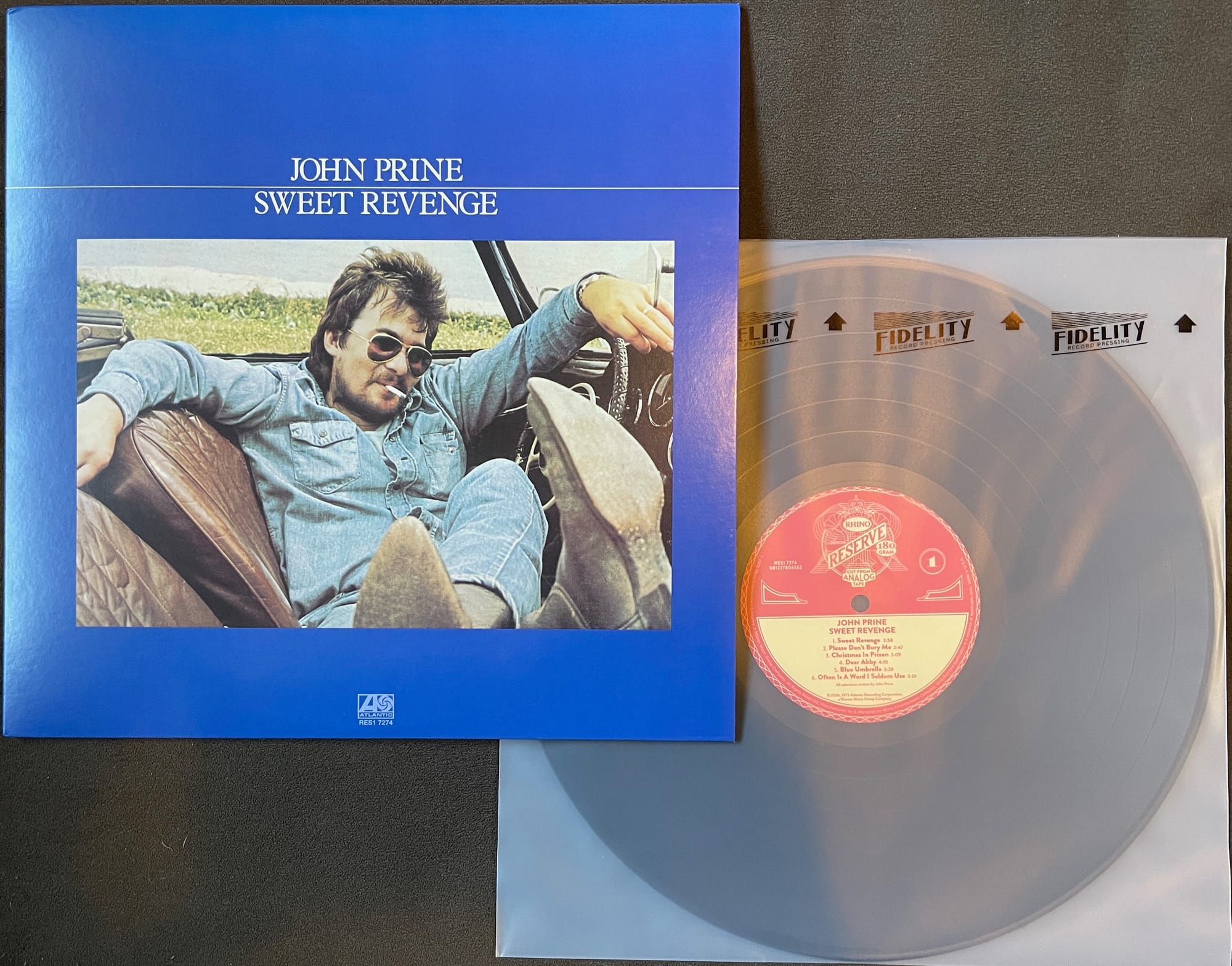
John Prine: Sweet Revenge
The half-assed way to describe John Prine is as a “songwriter’s songwriter,” a term so lazy as to be virtually meaningless. All that suggests is that there were some other songwriters kicking around who thought Prine was pretty great—it tells you nothing about why he was great. Prine was a fan of all kinds of American music from western swing to high-and-lonesome Appalachian folk, and he offset those formative influences with an incisive, slightly pickled wit, a preternatural understanding of the power of meter and assonance in his lyric-writing, and a storyteller’s yearning to impart emotional truth. “All I needed was one image of some feeling I couldn’t describe,” Prine told author Bill Flanagan in the 1986 book Written in My Soul, “and I’d spend a whole song trying to describe that, until I could get everybody in the room feeling that way and turn around and walk out the door.”
John Prine’s third album, 1973’s Sweet Revenge, may be one of the slicker ones he ever did, but it’s a staggeringly good singer/songwriter record, nearly the equal of his classic 1971 self-titled debut. More than that, it’s one of the best country-and-western records of the early ’70s, although Prine doesn’t quite fit entirely within the confines of the country-music genre. While Prine’s modesty and authenticity remain intact, the album is in many ways a tour de force, with his cut-to-the-bone songwriting married to state-of-the-art Nashville production, courtesy of Atlantic’s sympathetic and accomplished in-house producer Arif Mardin. Sweet Revenge runs the gamut of all the different kinds of American music that caught Prine’s fancy, touching on folk, bluegrass, honky-tonk, Southern soul, gospel, rock ’n’ roll, and more. The session musicians are all aces, the arrangements are watertight, and the production is immaculate. And yet Prine is never diminished or obscured; his rusty-knife vocal delivery and incisive songcraft cut through all of the fancy trappings, elevating the musicians’ contributions as Prine shepherds them to a common purpose.
The album’s stroke of genius is including “Dear Abby” in a solo acoustic live performance, with a lengthy spoken introduction from Prine. The song wouldn’t have worked with a studio band, as it relies on the energy of the live audience to propel it forward, and its position midway through Side 1 elevates the entire album, acting as a sly counterpoint to all of the Nashville pickers and grinners on the studio tracks. The song finds Prine telling what seems like a musical joke but actually carries a bit more emotional heft to it, with the kind of simple but brain-sticky melody that enables any first-time listener to start singing along midway through the second verse. His offhanded delivery is pitched just right, and the solo performance provides a direct channel to Prine’s personality, allowing the listener to dial into it on the rest of the LP. Without it, the album might have been missing that direct, personal moment that “Dear Abby” provides.
It’s not immediately apparent to me why Sweet Revenge needed a new Rhino Reserve pressing. The album was cut from tape relatively recently, by Kevin Gray for Rhino’s Start Your Ear Off Right campaign in 2018, and another Gray cut—or perhaps the same one?—was part of the 2020 Record Store Day box set of Prine’s four albums on Atlantic Records; another stand-alone pressing of the Gray cut came out a few weeks after the box and still seems to be readily available. Most recently, Ryan K. Smith cut it in 2023 for a Vinyl Me, Please version on blue vinyl. While a comparison of those versions to this new one seems in order—not to mention how they all stack up against a 1973 original—the album does not exactly possess the sonic fireworks one would listen for in a vinyl shootout. The recording is not exactly unflashy, but it’s an album that works in modest restraint, without overcooked bass, intricate percussive transients, or a soundstage that would benefit from a dramatic widening of scope.
That said, there is plenty of air and liveliness in the Rhino Reserve, and the separation around the individual instruments is exciting to the ear, with a dimensional soundscape that has a pleasing, natural, live-feeling sound. Matthew Lutthans cut it from the analog tape, and he has leaned into the inherent sweetness of the acoustic guitars and vocal harmonies. The dobro guitar has a presence and breadth of sound that leap from the speakers, and the bass is gently nudged up to give the sonic picture some warmth and gravity. Best of all, Prine’s voice is rendered with full clarity, allowing you to hear into the subtleties of his voice and delivery. At this point in his career, he was singing at his very best, leaning into his natural rasp and emphasizing a slightly exaggerated twang that never sounds like a put-on. The relatively stripped-down “Christmas in Prison” gives the listener the clearest window into his vocal excellence; “A Good Time” is similarly transparent, although there are a few plosives on the disc that pop out from the speakers.
All told, it’s a fabulous-sounding disc, all the more so because it doesn’t change the recording’s fundamental character. With this Rhino Reserve pressing, it really does sound like the album could have been recorded yesterday, although I suppose one could argue that it’s more accurate to say that it feels like you are there in 1973 as the tapes are rolling. And that’s really all you can ask from a reissue like this—that the album is depicted with honesty and doesn’t sound like a time capsule. It also shows that Prine was not just capable of handling a multitude of American musical styles, he also could sculpt them in the image of his potent, masterful songs. All those other songwriters who admired Prine so much were really onto something.
Rhino Reserve 1-LP 33 RPM 180g black vinyl
• New all-analog master of John Prine’s 1973 album
• Jacket: High-quality direct-to-board single pocket
• Inner sleeve: Fidelity Record Pressing branded poly
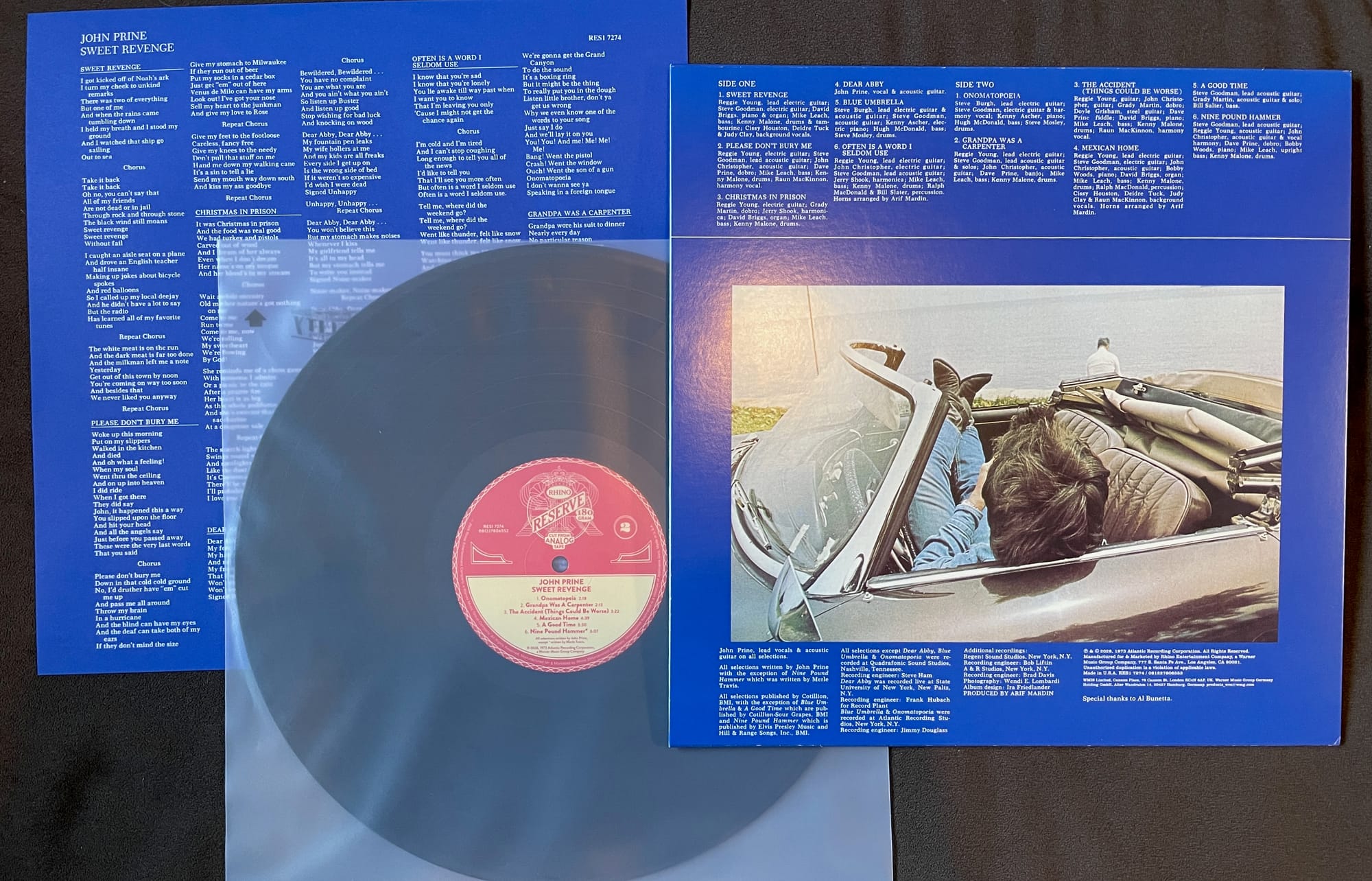
• Liner notes, insert, or booklet: Double-sided insert with lyrics, reproducing the original LP
• Source: Analog; “Lacquers cut from the original analog masters”
• Mastering credit: Matthew Lutthans at the Mastering Lab, Salina, KS
• Lacquer cut by: Matthew Lutthans at the Mastering Lab, Salina, KS; “MCL” in deadwax
• Pressed at: Fidelity Record Pressing, Oxnard, CA
• Vinyl pressing quality (visual): A
• Vinyl pressing quality (audio): A
• Additional notes: Comes inside reusable poly sleeve sealed by hype sticker, as per other Rhino Reserve titles.
Listening equipment:
Table: Technics SL-1200MK2
Cart: Audio-Technica VM540ML
Amp: Luxman L-509X
Speakers: ADS L980