Just a few more Black Friday reviews, and some thoughts about consumerism


First off, welcome to all of our new subscribers! Our RSD Black Friday reviews have gotten a ton of traffic and brought a lot of you to The Vinyl Cut for the first time. We hope you like what we’re up to here and decide to stick around for a bit.
I’ll get the business talk out of the way first and mention that if you’d like to upgrade to a paid subscription, you will be eligible for our monthly vinyl giveaways, which start in December. Our first giveaway is for Neil Young’s new 8-LP box set, Official Release Series #6, which includes several of his best ’90s albums, such as Harvest Moon, Unplugged, Sleeps with Angels, and Mirror Ball. It’s an incredible set and retails for three times the cost of a yearly Vinyl Cut subscription. And we have more perks for paid subscribers on the way. Upgrade to paid here:
Today I have a few more quickie Record Store Day Black Friday vinyl reviews to add on to the stack. If you somehow missed our earlier post, with reviews of 29 different Black Friday releases, that’s here:
 Ned Lannamann
We’ve been hyping Black Friday a lot in recent weeks, and while it’s been exciting, I hope that it hasn’t been too overt a celebration of consumerism around these parts. As a vinyl newsletter, we’re covering a topic that really is a luxury item in many ways, and one that’s out of reach for a lot of people. The latest premium pressing of your 14th-favorite band’s sixth-worst album can be awfully tempting, but sometimes the purse strings just don’t allow for it. And that’s okay. We get that, and we see you. While we hope that you get to buy (or be gifted) everything you really want, if that’s simply not in the cards, then maybe by reading about some of these things here, you can vicariously experience them and move on. That’s the way it was for me back in the CD era when I was reading dozens of record reviews every week for albums I couldn’t afford. Truly: There is no piece of vinyl that you cannot live without.
This is a time of year when corporations work hard to convince us to spend money, and it can be fun to splurge. But we wanted to recognize that things are tight for a lot of people right now, too. Also, today (November 29) is Small Business Saturday, so we encourage you to support your local businesses as best you can. Maybe you already did that yesterday—record stores are usually small businesses. But supporting your local brick-and-mortar stores is something we all need to remember to do throughout the year—whether or not American Express has designed a marketing initiative around a particular day to do so.
All right, let’s get into the music. That’s why you’re here—and we thank you for it.
Table of Contents
• Big Head Todd and the Monsters: Sister Sweetly
• Bob Dylan: The Freewheelin’ Bob Dylan [original version]
• WITCH: Fool’s Ride
• Various Artists: Flowers in the Afternoon
Big Head Todd and the Monsters: Sister Sweetly
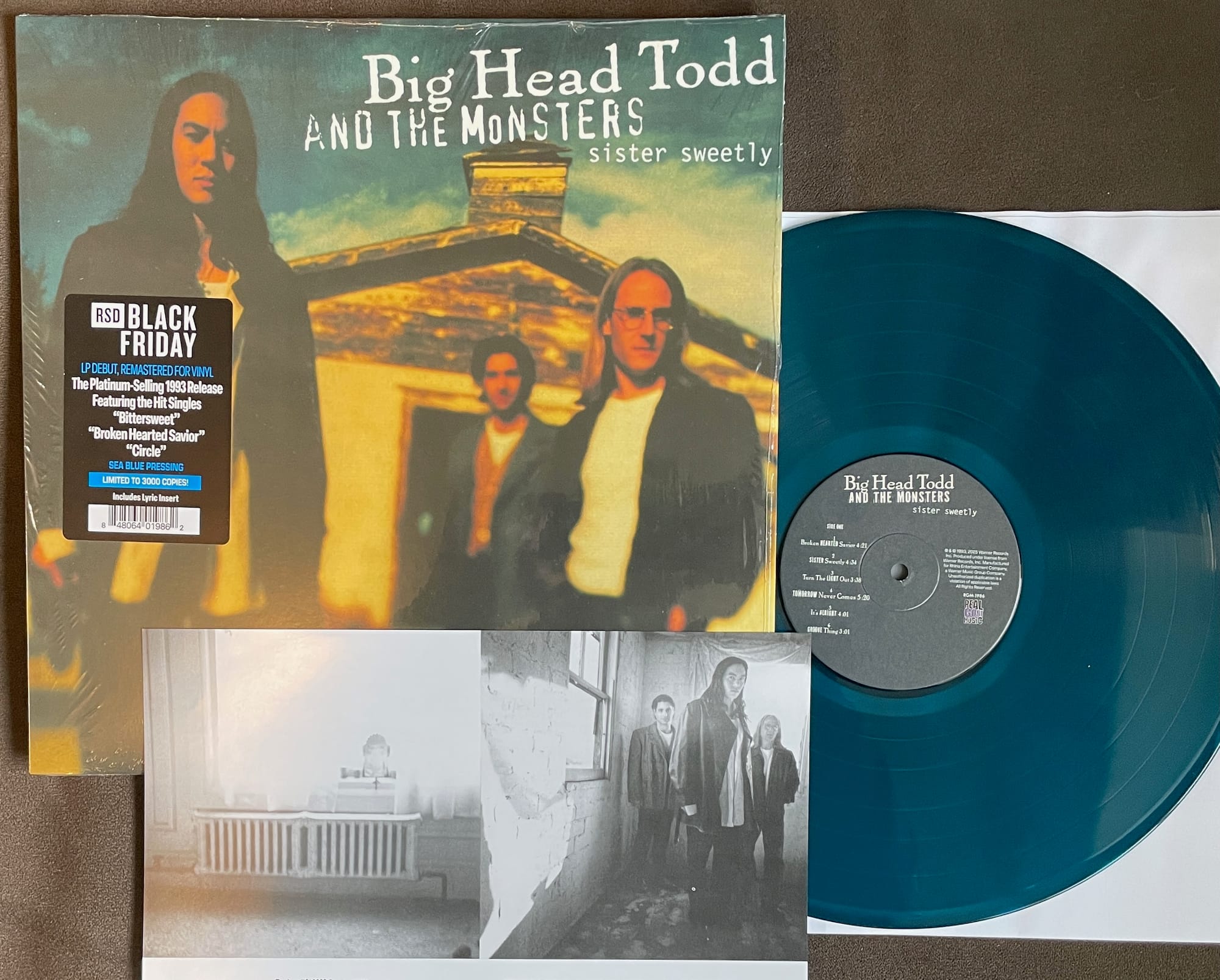
It’s probably not accurate to call Big Head Todd and the Monsters “college rock,” but maybe they could be deemed university rock. It’s music that was designed for frat parties: a clean, melodic version of blues-rock that had just a hint of jamminess and a touch of light funk (sharing many a quality with a microbrewed IPA). The trio was part of the Boulder, Colorado, scene that also included the Samples and Leftover Salmon, and their 1993 album Sister Sweetly was a pleasant lob towards normie ’90s mainstream. This record sounds far more dated to me now than a lot of clattering, coked-out ’80s productions do; the drums are processed and wet, the bass has a few absurdly twangy turns, and the guitars are chorus-effected up the wazoo. But songs like “Bittersweet” and “It’s Alright” probably hold a certain hue of nostalgia for anyone who played beer pong in the quad back in ’93. Surprisingly, Sister Sweetly was never issued on vinyl, and now here’s a complete mystery pressing that has no updated mastering engineer credit nor lacquer engineer, suggesting that digital files were sent to GZ Media and cut there anonymously. Perhaps even more surprisingly, this thing sounds fine—far more powerful than my memory of the original CD. The bass is thick and rumbly, the louder parts are forceful without becoming too edgy, and the layered ’90s sound is rendered with accuracy. Some of the high end gets a bit smeary, but I think that’s due more to production choices than anything else.
Giant/Real Gone Music 1-LP sea-blue vinyl
• First vinyl master of 1993 album
• Jacket: Direct-to-board single pocket
• Inner sleeve: Poly-lined white
• Liner notes, insert, or booklet: Two-sided insert with lyrics
• Source: Unknown
• Mastering credit: George Marino, Sterling Sound, NY (Marino passed away in 2012)
• Lacquer cut by: Unknown
• Pressed at: Memphis Record Pressing, Memphis, TN
• Vinyl quality - visual: A- (a bit dished)
• Vinyl quality - audio: A- (some light noise)
• Additional notes: The album was recorded at Prince’s studio, Paisley Park. Leo Kottke shows up for a track.
Bob Dylan: The Freewheelin’ Bob Dylan [original version]
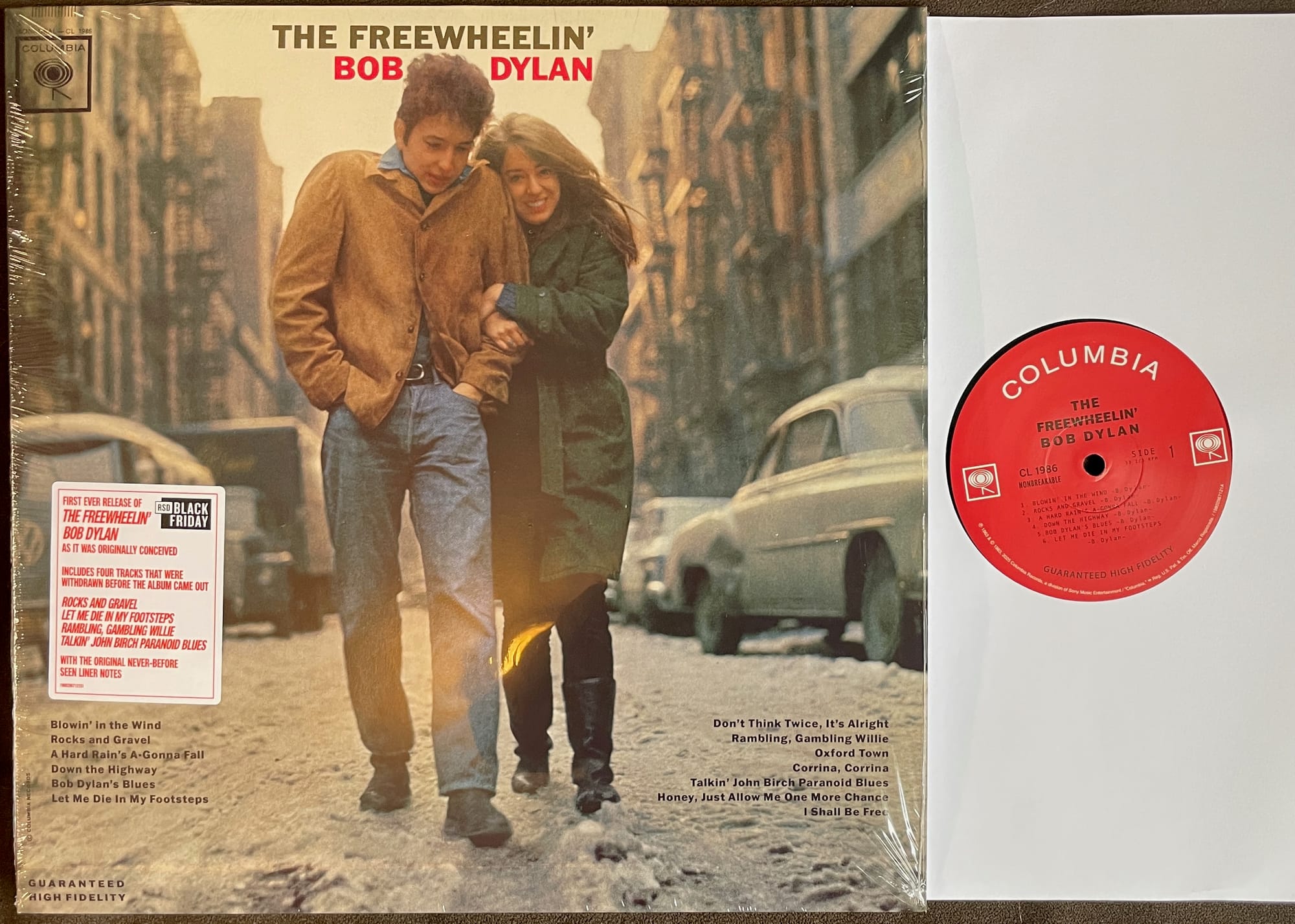
The legendary test pressing of The Freewheelin’ Bob Dylan has got to be one of the rarest records in existence. It contained four entirely different tracks than the officially released version, and the generally accepted story goes that the powers that be at Columbia Records got nervous with the lyrics of “Talkin’ John Birch Paranoid Blues,” a caustic satire of the ultra-right-wing John Birch Society. Well, it’s 62 years later, and it’s a bit distressing to say that the lyrics of “Talkin’ John Birch Paranoid Blues” are still as timely as ever, so maybe the time is right for this version of Freewheelin’ to finally see the light of day. By the time the lawyers got involved and pulled “John Birch” from the tracklist, Dylan had written and recorded enough new material to swap out not just one but four of the songs, and when your latest work includes “Masters of War” and “Girl from the North Country,” that kind of decision makes sense.
With “Rocks and Gravel” (AKA “Solid Road,” as it was originally titled) in the track-two slot, the album initially gives off a more bluesy, rocky vibe, as the take features an electric band similar to the “Mixed-Up Confusion” single that preceded Freewheelin’ (the band is also present on “Corrina, Corrina,” of course, where they play far less raucously). I believe this track has not been officially re-released on any Dylan album, Bootleg Series or otherwise, and has only seen light of day on the True Detective soundtrack. “Let Me Die in My Footsteps” is an excellent piece and could probably have been left on the album, although it appears Dylan grew sick of it at some point. We eventually got it in the first Bootleg Series box, as we did “Rambling Gambling Willie,” a fun, inessential, hootenanny-type number. And then there’s “Talkin’ John Birch Paranoid Blues,” still one of Dylan’s funniest songs—and I believe this is the first official re-release of the Freewheelin’ studio version. It’s fantastic to hear it, and it’s depressing to think about how easily, with a few names changed, it could’ve been written in 2025.
I think, had it been widely released, this version of the album would be considered just as much of a classic as the familiar version, although “Masters of War” would have been a real loss, and moving “A Hard Rain’s a-Gonna Fall” up three slots earlier on Side 1 throws off the album’s center of gravity. The mono vinyl is superb—flat and dead quiet. Jeff Powell cut the lacquer, very likely from files taken from the trove of high-resolution digital that all the Dylan stuff comes from these days. (See also the recently released The Bootleg Series, Vol. 18, Through the Open Window.) While the package is bare-bones—some newly written contextual liners about this suppressed version of Freewheelin’ would be most welcome—it’s tough to imagine how these tracks could sound substantially better than they do here.
Columbia 1-LP black vinyl
• A mono version of Bob Dylan’s 1963 album with the originally conceived tracklist, with “Rocks and Gravel,” “Let Me Die in My Footsteps,” “Rambling Gambling Willie,” and “Talkin’ John Birch Paranoid Blues” in place of “Girl from the North Country,” “Masters of War,” “Bob Dylan’s Dream,” and “Talkin’ World War III Blues”
• Jacket: Direct-to-board single pocket
• Inner sleeve: White die-cut paper
• Liner notes, insert, or booklet: Nat Hentoff’s original liner notes on back jacket, featuring text about the discarded songs; the note for “Let Me Die in My Footsteps” features an extended passage written by Dylan in 1962
• Source: Unknown but probably digital
• Mastering credit: None
• Lacquer cut by: Jeff Powell at Take Out Vinyl
• Pressed at: MPO, France
• Vinyl quality - visual: A
• Vinyl quality - audio: A
• Additional notes: Labels are a close facsimile of the original 1963 Columbia label.
WITCH: Fool’s Ride
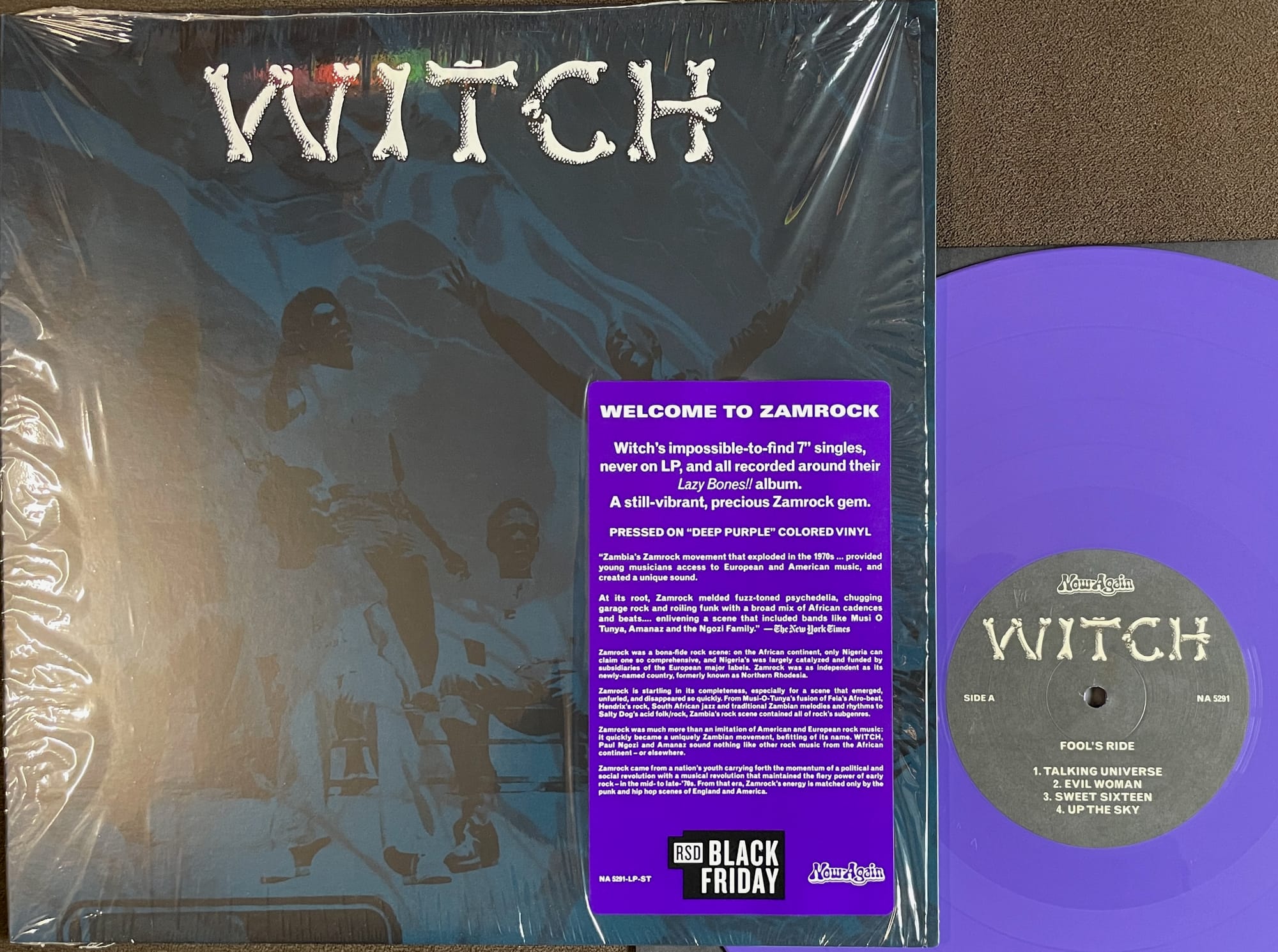
The hype sticker says these four WITCH 7-inches have never been on LP before, but that’s not exactly true: All eight songs, which date from 1975 and 1976, did appear as disc six of the 2012 We Intend to Cause Havoc 6-LP box set, released by Now-Again Records, also responsible for this set. To their credit, Now-Again sets the record straight with the correct info on their website, additionally stating, “This presentation contains audio fixes and restoration beyond that first issue.” So this is apparently not a direct repress of the disc from the box set, although Dave Cooley is again credited for the remastering. It appears these are sourced partly from new needle drops (here, the vinyl transfers are credited to one George Douvartzidis, whereas an Adam Watson is credited on the older box). Vinyl artifacts are indeed audible throughout, and the sound can be boxy and confined—the only stereo tracks are the two from 1976. But the music is consistently great, with fuzz guitars, superb songwriting, and tight ensemble playing from the Zambian outfit. At this stage in their career, WITCH wielded a unique blend of rock aggression, R&B exuberance, and laid-back restraint that gives their music a peculiar power, with a rhythmic potency that continually draws you in. They were at the peak of their powers during this period, and every song here ranks with the best of Zamrock. Maybe it could have sounded better, but we just as easily could have lost these rare sides to the sands of time. Better to have it like this.
Now-Again 1-LP “Deep Purple” vinyl
• A- and B-sides of four 7-inches WITCH recorded and released c. 1975 & 1976
Jacket: Direct-to-board single pocket
• Inner sleeve: Black poly-lined
• Liner notes, insert, or booklet: None, but brief track details are on back jacket
• Source: Unknown, but some are digital needle drops: “Vinyl transfers courtesy George Douvartzidis with thanks to Jason Conoy”
• Mastering credit: “Restoration and remastering by Dave Cooley”
• Lacquer cut by: Dietrich Schoenemann of Complete Mastering, Bethel, CT (“DS” and “Diet” in deadwax)
• Pressed at: Unknown
• Vinyl quality - visual: B+ (my copy had a little warp, but was otherwise impeccable)
• Vinyl quality - audio: A- (one or two spots of noise)
• Additional notes: The “Deep Purple” vinyl is so named because that was WITCH’s favorite band.
Various Artists: Flowers in the Afternoon
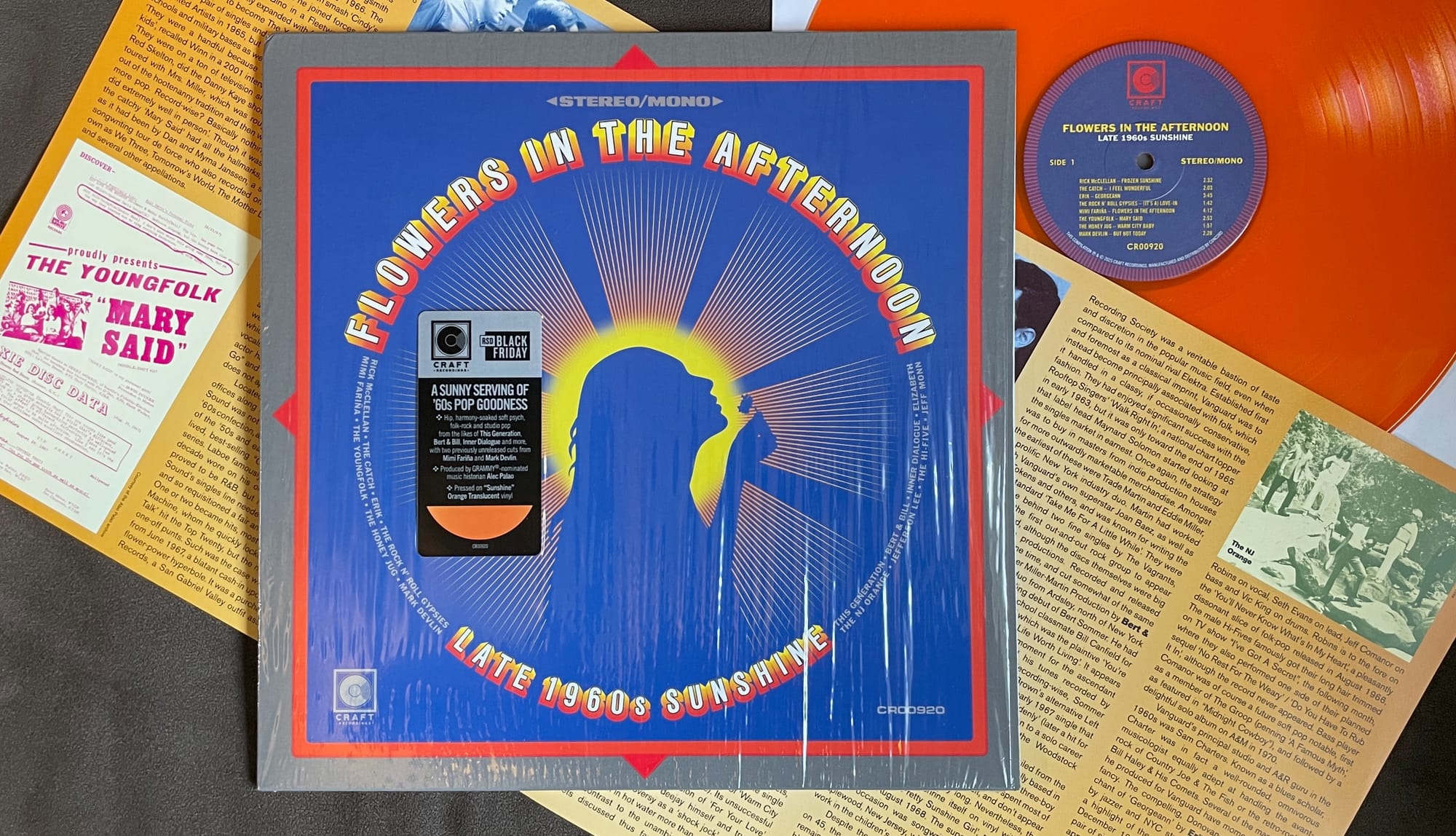
Following the Nuggets model, this fascinating comp from ’60s music historian Alec Palao gathers a batch of 16 true obscurities, all existing somewhere within the realm of sunshine pop. Some tracks are more kitschy than others, but all of them are at the very least interesting, and some are downright fabulous. Almost none of these songs is streaming, and most don’t even have shoddy YouTube rips, so the rarity quotient is off the charts. It seems Palao had full reign to plunder the Concord-owned vaults of several labels, including the long-defunct Double Shot, Original Sound, and Ranwood imprints, as well as Vanguard’s roster of pop 45s and Stax’s offshoot sublabel Hip. The songs differ wildly, but each is an astonishingly creative, ambitiously arranged pop miniature with inventive textures and occasional psychedelic flourishes. The recordings come from all over the US, and most seem to be deliberately resisting the groundswell of rock aggression that was channeling through popular music during this period; the groovily ominous “The Children Have Your Tongue” by This Generation and Jefferson Lee’s freaked-out “Pancake Trees” are exceptions. Two previously unreleased tracks—a lovely folk-rock song by Mimi Fariña and a face-palm-worthy novelty by Mark Devlin—round out the collection. The sound, in both mono and stereo, varies from track to track but is consistently good; with thorough liners and a solid pressing, this is a ’60s pop lover’s dream.
Craft 1-LP “sunshine” orange translucent vinyl
• Obscurities from the Vanguard, Hip, Ranwood, Double Shot, and Original Sound labels
• Jacket: Direct-to-board single pocket
• Inner sleeve: White poly-lined
• Liner notes, insert, or booklet: Four-page insert with liners by Alec Palao
• Source: Unknown; likely digital assembly of various sources
• Mastering credit: Joe Tarantino (Alec Paleo credited with transfers and restoration)
• Lacquer cut by: Jeff Powell, Take Out Vinyl, Memphis, TN
• Pressed at: Memphis Record Pressing, Memphis, TN
• Vinyl quality - visual: A
• Vinyl quality - audio: A
• Additional notes: Palao says this third comp of ’60s rarities for Craft is his last for the time being.
Listening equipment:
Table: Technics SL-1200MK2
Cart: Audio-Technica VM540ML
Amp: Luxman L-509X
Speakers: ADS L980