Review: The Flying Burrito Brothers

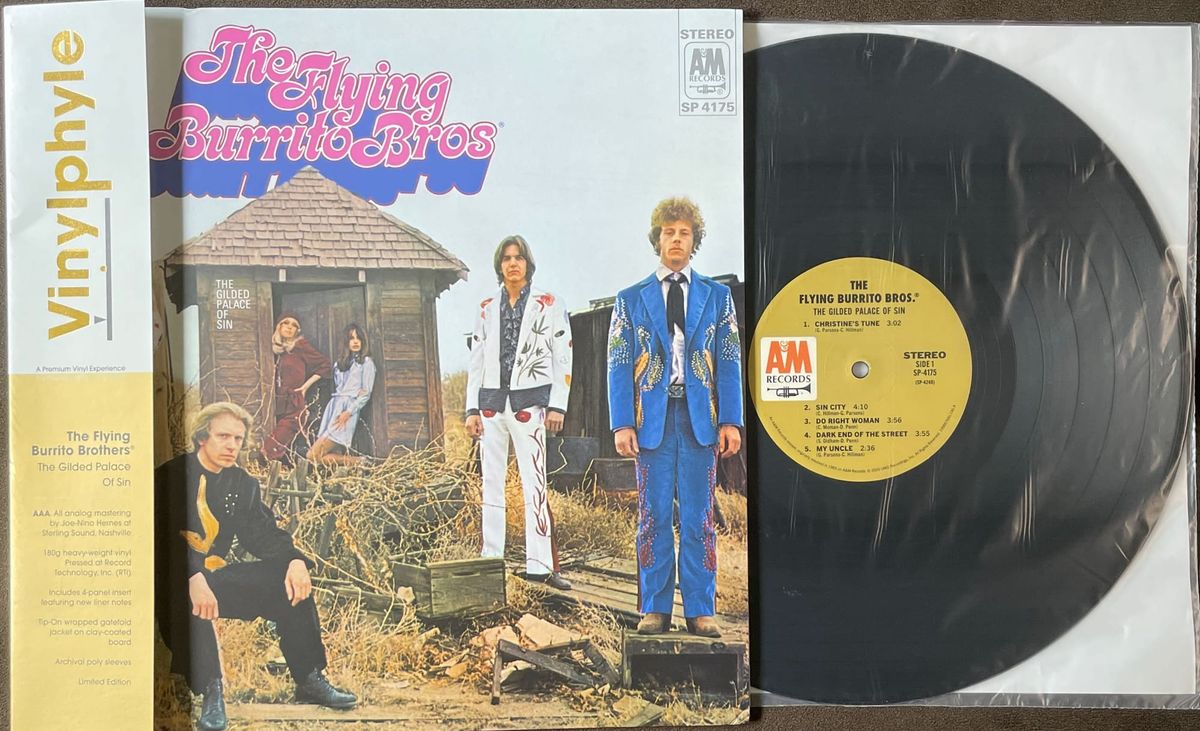
1969’s The Gilded Palace of Sin now comes in an all-analog Vinylphyle pressing.
Today I’m reviewing one of my favorite records, the Flying Burrito Brothers’ debut album. This was one of those records I had read about for years before actually getting my ears on it—and when I finally did, I was almost mad because of how good it was and how long I had gone without it.
Streaming has made those kinds of situations less common nowadays, so I’m assuming most everyone reading this has heard the album by now. But if not, the new Vinylphyle pressing is an ideal entry point. I’ll get more into it in my review below, so I’ll just briefly add the usual entreaty to join our paid tier if you like this newsletter and want to support it.
Paid subscribers are eligible for our monthly vinyl giveaway, plus they get exclusive weekly playlists, commenting abilities, and full access to The Vinyl Cut’s complete archives. Additionally, a paid subscription straightens your posture, sharpens your vision, un-cricks your neck, freshens your breath, and tells those hardening arteries to knock it off and just relax. (*None of these claims have been evaluated by the Food and Drug Administration, but just give ’em a few. You never know what’s gonna happen over there.)

The Flying Burrito Brothers: The Gilded Palace of Sin
The Flying Burrito Brothers were always more of a concept than a band. Initially, it was the name of a loose conglomeration of musicians that formed around Ian Dunlop and Mickey Gauvin, former members of the International Submarine Band, as they’d play honky-tonks around Los Angeles. When their ISS bandmate Gram Parsons started a new project with Byrds bassist Chris Hillman—following Parsons’s brief stint as a Byrd in 1968, resulting in the country-inflected album Sweetheart of the Rodeo—Parsons took custody of the name. But even then, the Burritos were subject to shifting lineups and instability; Parsons, ostensibly the driving creative force, would be kicked out of the band after their second album, 1970’s Burrito Deluxe. The Hillman-led incarnation eventually ran out of tortilla in 1972, although more Burrito Brothers would take on the mantle—with or without the Flying appellation—during subsequent decades.
When we think of the Flying Burrito Brothers, though, one record usually comes to mind: their 1969 debut album, The Gilded Palace of Sin, a radiant slab of cosmic country-soul that became the groundwater for the country-rock movement that flourished in the early 1970s. (Bernie Leadon, who joined the Burritos after the release of Gilded Palace, would go on to become a founding member of the Eagles, the band that did the most to put a mainstream face on the country-rock genre.) Gilded Palace is an album like none other, even within the Burritos catalog—full of psychedelic twang, it documents the dark but fertile Southern Californian music scene of the era while also calling east to Nashville and Memphis through its echoes of classic country and Southern soul.

Universal’s premium vinyl reissue series, Vinylphyle, has newly cut The Gilded Palace of Sin from an analog copy tape made in 1996, as the original master is presumably no longer usable, and this fine new pressing comes from Record Technology, Inc. (RTI). The master is the same duplicate that was used for Intervention Records’ 2017 pressing of the album, cut by Kevin Gray and also originally pressed at RTI, then repressed at Gotta Groove in 2024 and now out of print. (I had an RTI-pressed copy on hand for comparison.) The new Vinylphyle edition comes with the usual trimmings: an appealing tip-on gatefold jacket on gold-backed board, an obi, a poly inner sleeve, and—best of all—a four-page insert that features excellent liner notes from Byrds expert Scott B. Bomar. As with previous Vinylphyles, Joe Nino-Hernes at Sterling Sound in Nashville has cut the lacquer, and his consistently excellent work in the series continues here. The record sounds rich and full, coming close to the similarly outstanding Intervention pressing in some instances and exceeding them in others. I’ll break down the differences in a bit, but to my mind, any kind of shootout can only end up in a draw. (Full caveat: I did not have an original 1969 pressing to compare with the more recent pressings.)
Parsons and Hillman’s newfound collaboration began with their co-writing of “Sin City,” a song good enough to launch any band. Mo Ostin at Warner Bros. Records expressed interest in signing them, but the nascent group ended up going with the far less hip A&M Records. They recruited former International Submarine Band bassist Chris Ethridge, pedal steel guitarist (and stop-motion animator) “Sneaky” Pete Kleinow, and prolific Los Angeles session drummer Eddie Hoh to round out the ensemble. After recording two tracks, Hoh absconded with his portion of A&M’s advance, leaving the group to recruit several other drummers to finish the album, including former ISS drummer Jon Corneal and Dr. Hook’s Thomas "Popeye" Phillips. But even without a consistent member behind the kit, the interplay between the musicians is alchemical, with Kleinow’s otherworldly pedal steel and Ethridge’s gorgeously musical bass lines elevating Parsons and Hillman’s tunes into something paranormal.

“Hot Burrito #1” and “Hot Burrito #2”—written by Parsons and Ethridge—encompass the album’s poles, with the former a tear-in-the-beer country ballad and the latter a steam-pumped gospel roof-raiser with Kleinow’s pedal steel adding cicada-drones of heat. Similarly, the album’s two covers—“Do Right Woman,” recorded by Aretha Franklin, and “Dark End of the Street,” recorded by James Carr, both written by Chips Moman and Dan Penn—map out Gilded Sin’s emotional depths, marrying rock, country, and soul with grace and tenderness. Kleinow’s elegant lines on “Do Right Woman” curlicue beautifully around Parsons and Hillman’s suspended vocal harmonies (aided by David Crosby during the choruses), and Ethridge’s pulsating bottom end on “Dark End of the Street” preserves the heart of Carr’s extraordinary, definitive reading.
“Sin City” is the album’s epicenter, a country waltz that could also pass for a Baptist hymn, with lyrics that condemn the greed of the LA music scene. (The song’s refrain, “On the 31st floor, a gold-plated door won’t keep out the Lord’s burning rain,” is a reference to Byrds manager Larry Spector, who lived in a 31st-floor condo that had a gold door.) Parsons and Hillman sing in close harmony in a style reminiscent of the Louvin Brothers, except the two alternate between melody and harmony. Oddly, the stereo mix completely separates the two voices, putting Parsons entirely in the left speaker and Hillman all the way to the right—a mixing choice characteristic of most of the album. While no producer would replicate that split today, the separated voices somehow work, and Parsons and Hillman manage to blend together in spite of the chasm between them. Ethridge’s roaming bassline is subtle but soothing, while Kleinow’s steel sounds like a high-voltage current is running through it, as if to remind aspirant musicians of the dangers that lurk in LA’s dens of temptation and iniquity.

On the Vinylphyle cut, an odd noise comes through on “Sin City,” a sort of distorted ring that might be from A&M Studio’s echo chamber or from Kleinow’s pedal steel setup or from something else altogether. It’s most noticeable during the song’s final seconds, which cut off abruptly rather than fade out. By contrast, the Intervention version adds a subtle fadeout during that final note, and the strange ringing is not nearly as prevalent. Other minor sonic aberrations that result from the recording’s limitations are apparent on the Vinylphyle cut, and I’m undecided as to whether that’s a detriment or a selling point. It does more accurately convey what’s on the tape, but some listeners may prefer the cleaner sound on the Intervention in favor of authenticity.
Elsewhere, Nino-Hernes’s Vinylphyle cut is a bit more untamed, with slightly more piercing highs on the vocals, such as during “Christine’s Tune,” and a bass presence that leaps out at times and at others is a bit more muted. This is in subtle contrast to the Intervention/Gray version, which is more consistent and, ultimately, more polite. I appreciate a rawer, more transparent sound, which the Vinylphyle delivers, but I also think Gray’s Intervention cut may be what other listeners prefer in general. However, I hasten to add that these differences are generally very subtle; both records sound positively wonderful, and I’m glad to have both. The Vinylphyle gets me a fraction closer to the innards of the recording, while the Intervention is a marginally more composed and cleanly presented listening experience.

Parsons gets much of the credit for Gilded Palace—mostly stemming from the cult that arose around his music in the wake of his premature death in 1973—but Hillman is an equal partner throughout, with his bluegrass background adding authenticity to Parsons’s country-and-western dabblings and his Byrds-honed songwriting chops lending a folk-rock accessibility. Moreover, I think Ethridge’s and Kleinow’s contributions are absolutely essential, something consolidated by studying this new Vinylphyle version. Kleinow’s pedal steel very much defines the “cosmic” part of the “cosmic American music” Parsons was trying to nail down; bizarrely, Parsons would at one point say Kleinow was the wrong steel player for the band. But in particular, the R&B-loving Ethridge really shines on the Vinylphyle, not just holding down the root notes on his bass but roaming around the melodic perimeter of each song, enriching the melodies while also functioning as the band’s consistent rhythmic timekeeper in light of the revolving-door drum throne.
For a few brief months, the Flying Burrito Brothers touched upon their purest, most perfect form—the lack of a consistent drummer notwithstanding—and were able to pack that short-lived spark into the grooves of an 11-song album. As well as being the equal of Hillman’s finest hours with the Byrds, Gilded Palace is Parsons’s best work by a considerable measure. And while the album is typically regarded as an important conjoining of country and rock, that convenient equation overlooks the vital importance of Ethridge’s beloved soul music that provides the album’s heartbeat as well as the wild psychedelic flourishes from Kleinow. All of these ingredients emerge from the speakers in gorgeously rendered colors and tones via this Vinylphyle pressing, and Bomar’s liner notes provide crucial context for the music. Unless you already own the Intervention, it’s a keeper copy of an absolutely essential album.
UMe Vinylphyle 1-LP 33 RPM 180g black vinyl
- New remaster of the Flying Burrito Brothers 1969 debut album
- Jacket: “Tip-on wrapped gatefold jacket on clay-coated board”
- Inner sleeve: Rice-paper-style poly
- Liner notes, insert, or booklet: Four-page insert with essay by Scott B. Bomar
- Source: Analog; 1996 1/2-inch safety tape
- Mastering credit: “Vinyl mastering: Joe Nino-Hernes at Sterling Sound, Nashville”
- Lacquer cut by: Joe Nino-Hernes at Sterling Sound, Nashville, TN; “JN-H” in the deadwax
- Pressed at: Record Technology, Inc., Camarillo, CA
- Vinyl pressing quality (visual): A
- Vinyl pressing quality (audio): A
- Additional notes: Comes in a perforated reusable poly outer bag.
Listening equipment:
Table: Technics SL-1200MK2
Cart: Audio-Technica VM540ML
Amp: Luxman L-509X
Speakers: ADS L980