Reviews: Frank Sinatra | Andrew Hill

Share
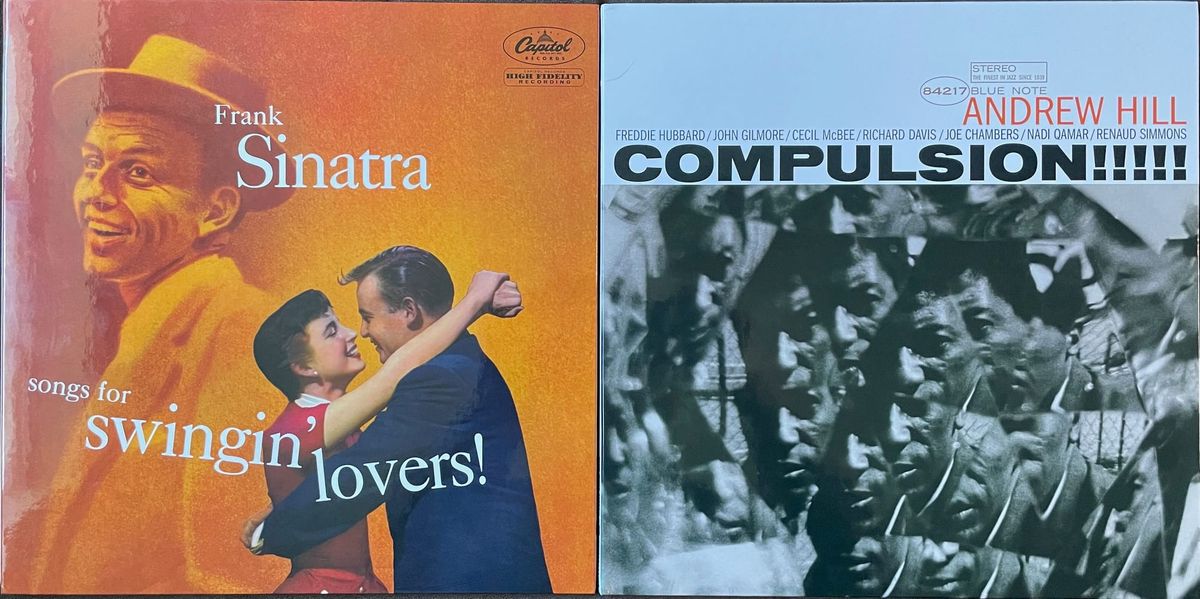
Cover art for Frank Sinatra and Andrew Hill.

Catching up on a pair of Blue Note Tone Poets.

Today I’m reviewing two pieces of vinyl that were released back in March but got temporarily side-shifted during the onslaught of Record Store Day. The good news is that they sound just as good a couple of months later; one in particular—Frank Sinatra’s Songs for Swingin’ Lovers—is worthy of being a cornerstone in any vinyl collection of 20th-century pop music. Andrew Hill’s Compulsion will serve a significantly more niche audience, but it’s pretty incredible that both of these albums, wildly different in mood and appeal, come from the same series.

Dusty Springfield, Cher, and Joni Mitchell on Rhino High Fidelity.

Before we get into that: Since I posted Thursday’s new-release roundup, a few new major reissues have been announced and are already for sale. First is Mobile Fidelity’s long-awaited UltraDisc one-step pressing of Van Halen’s 1984, which is now finally in stock and available for ordering. But the bigger news is the announcement of three new entrants in the Rhino High Fidelity series. They’ve selected Dusty Springfield’s Dusty in Memphis, the 1969 classic that found the English singer on tracks recorded at Chips Moman’s American Sound Studio in Memphis; Cher’s 3614 Jackson Highway from the same year, which brought the LA singer/actress down to Muscle Shoals (that’s the studio’s address in the title); and Joni Mitchell’s 1974 masterpiece Court and Spark, which reinvented the Canadian songwriter’s folk sound to contain heavy jazz inflections. I’ve seen mixed reaction to Rhino’s announcement, ranging from typical male-centric dismissiveness of female performers to complaints about the widespread availability of Dusty in Memphis and Court and Spark via previous reissues and befuddlement at the inclusion of Cher.

To my thinking, the inclusion of the Mitchell and Springfield albums is exactly what Rhino High Fidelity should be doing: creating definitive editions of foundational works for years to come, even if it’s familiar terrain for seasoned record collectors. And as far as Cher goes—it’s a surprising choice, to be sure. But 3614 Jackson Highway was one of the first full-lengths (perhaps the first?) ever recorded at Muscle Shoals Sound Studios in Sheffield, Alabama, a new facility launched when the Swampers split off from Rick Hall’s FAME stable. That alone makes it a record of immense historical importance. Do I think it’s one of the best things recorded at Muscle Shoals? Not necessarily. But its cultural significance can’t be overlooked.

All of that has little to do with the main course today: reviews of two recent releases in Blue Note’s Tone Poet series. Let’s swing in.


Cover art for Frank Sinatra.

Frank Sinatra: Songs for Swingin’ Lovers!

Songs for Swingin’ Lovers! was a conscious pivot from Frank Sinatra’s previous long player, In the Wee Small Hours—a “rhythm” album in contrast to Small Hours’ collection of forlorn ballads. Released in 1956 on Capitol Records, Swingin’ Lovers! once again teamed Sinatra with producer Voyle Gilmore and arranger Nelson Riddle, and while it’s difficult to pick a single crowning achievement in Sinatra’s nearly 60-year recording career, it’s safe to say that he never made a better album. Riddle’s arrangements are animated and bright, occasionally stealing the spotlight away from Sinatra’s silken-silver voice, while the selection of tunes is a jewel-box of nostalgia, mostly dating from the 1930s and updated with the crackle of Atomic-Age ring-a-ding-ding.

Blue Note’s Tone Poet series reissued In the Wee Small Hours last year to much acclaim—read our review of that edition here—and in March they did the same with Songs for Swingin’ Lovers!, with mastering engineer Kevin Gray cutting from a seldom-used analog tape source. The result is every bit the triumph that the Small Hours Tone Poet was. For both albums, Blue Note was able to locate a series of “phono reels” that contained alternate masters of each album track, spread out across different spools of tape and mixed in with music from other artists. These phono reels were made simultaneously with the album masters—via a second tape machine running in the studio, per Blue Note project supervisor Joe Harley—but were stored away and scarcely touched, while the album reels were subject to great wear and tear as the LP was reissued countless times over the decades. Blue Note was able to splice together new album master reels from the phono reels, which were in nearly pristine condition.

Reviews: Frank Sinatra | Aksak Maboul
Vinyl news and in-depth reviews.

While the 1960s Rat Pack–era Sinatra of his Reprise Records years may dominate in the collective memory, this really is what I think of as Sinatra’s peak. At age 40, his voice was richer and more characterful than it was during the Tommy Dorsey period, but it still had a spryness and hunger that would eventually be muted with age. He communicates with the other musicians as if they’re all birds of a flock; his authority is never in question, but unlike some of his later recordings, his authority isn’t the entire point, either.

But for my money, the real points of interest here are Nelson Riddle’s arrangements, which are among his very best. Drawing from the French impressionists like Debussy and particularly Ravel, Riddle was fascinated by orchestral color and tone, but he also had first-hand big-band experience from his years in Dorsey’s orchestra and knew how to make things snap. The marriage of these two musical styles, combined with Sinatra and Capitol’s desire to make a knock-your-bobby-socks-off pop record to compete with the rising fad of rock ’n’ roll, led to an eminently approachable sound that was bright, jazzy, and full of personality and emotion while still retaining a level of cool. The album’s concept is ostensibly of an uptempo dance record, although many of the songs are a trifle slow for actual dancing; they’re perfect for head-nodding and foot-tapping, though, and with that compulsive sense of motion, the melancholy of In the Wee Small Hours was entirely whisked away.

Inner gatefold and disc for Frank Sinatra.

The highlight is the album’s sterling rendition of Cole Porter’s “I’ve Got You Under My Skin,” which Sinatra biographer James Kaplan would refer to as “the most famous song Frank Sinatra ever recorded.” It’s a triumph of Riddle’s arrangement prowess—and all the more incredible because it was apparently done at the nth hour. With the album nearly in the can, Capitol requested three extra tunes be added to the tracklist, as they forecasted huge sales. (What a refreshing shock this is—that they provide more value for money as opposed to less. It’s a far cry from Capitol’s later practice, which would see albums shrink in duration as the market for pop LPs matured. Take, for example, the length of Sinatra’s penultimate Capitol album, 1961’s Swingin’ Session!!!, which at 26 minutes is just over half of the 50-minute In the Wee Small Hours from seven years prior. But I digress.)

A session was hastily planned, and Riddle was called at something like one in the morning and told he needed to come up with arrangements for three songs by the following evening. After hanging up the phone, he blearily wrote arrangements for two songs, got a few hours of sleep, and then began working on the third, “I’ve Got You Under My Skin,” which he finished on the way to the studio in the back seat of the family station wagon, using a flashlight and a leaf from the family dining table as a portable desk while his wife drove. Following Sinatra’s request for a “long crescendo,” Riddle took the building tension from Ravel’s “Bolero” as an inspiration to enhance his arrangement’s casually swinging mambo beat. But it all came together with the contribution from trombonist Milt Bernhart, whose explosive solo provides the release valve for the song’s pressure-cooker build-up.

I’m fully enamored with the sound of this Tone Poet pressing. Gray’s mastering finds succulence in every aspect of the recording, drawing out the individual timbres of the orchestra in a way that I find immensely appealing. Sinatra’s voice, too, sounds appropriately majestic and leonine; sometimes he leaps out of the sonic spectrum for a stray note or two, popping through the ceiling of the apartment above him, but with that keyed-up sonic approach comes enriched chroma and texture from the instrumental backing. Gray’s past work with Blue Note has shown evidence of his very sympathetic ear for jazz ensembles, and he brings that to bear with the Swingin’ Lovers musicians, emphasizing their chops and interplay. Sinatra’s personable voicing and immaculate diction are slightly tamped down in favor of emphasizing the pure tone of his instrument; it’s such a unique sound, both steely and satin-soft, sharing qualities with both hard-knuckle brass instruments and the smoothness of a cello, and yet his delivery is casually conversational and almost never overly dramatic.

A 1956 original Capitol pressing and the 2026 Blue Note Tone Poet pressing.

I compared the new Tone Poet to my 1956 dark-gray-label Capitol pressing (manufactured at Scranton with -D3/-D5 matrices), a wonderful-sounding record in its own right. The original has occasional shrillness to some of the strings, and once in a while the horns can get a little blare-y, but it has an air and naturalism that isn’t fully reproduced on the Tone Poet. However, there’s not as much space within its mono image; the width and depth of the soundstage are reduced, and Sinatra and the band sound enmeshed, without the ear being able to pull apart the different timbres. Occasionally some instruments get lost in the mix when others dominate, while on the Tone Poet, I can always hear each musician clearly. The Capitol has surprising bass punch, and there’s a sonic patina on everything that I imagine is the by-product of 1950s-era studio gear—it’s a lovely, glowing sound, but any equipment coloration on the Tone Poet is virtually invisible, and the record sounds more transparent and more immediate as a result. I can hear the shape and size of the room better on the Tone Poet, too; the Capitol sounds like it all takes place floating inside of some kind of movie-magic cloud. The original pressing has a more contained, nostalgic sound, but the Tone Poet puts me closer to the action. The flawless pressing from RTI helps, too, especially with the newer pressing’s mightily impressive dynamic range, which makes the louder passages really wail.

This second Sinatra entry in the Tone Poet line bodes well for more to come from his run on Capitol—so far these releases have more or less landed on the 70th anniversaries of their respective albums—and while I look forward to what might be next, Songs for Swingin’ Lovers! stands apart to me as an album where simply everything gelled. Sinatra’s voice was at its peak, and Riddle’s charts were alchemizing an altogether new blend in the pop terrain, combining jazz, classical, and more conventional pop-standard arrangements; my opinion is that the albums that followed are, even at their best, essentially more of the same. Sinatra and Riddle feel unbridled from the downtrodden air of In the Wee Small Hours, and the result is a record that’s a perfect blend of gregariousness and glitz. If the album was designed as a tasteful aphrodisiac, it succeeds at that and so much more—it manages to codify our very notions of romance through a perfect marriage of lyrics and music, wedded by the twin high priests of Sinatra and Riddle.

Blue Note Tone Poet 1-LP 33 RPM 180g black vinyl
• New analog remaster of Frank Sinatra’s 1956 album
• Jacket: Tip-on gatefold
• Inner sleeve: Rice-paper-style poly
• Liner notes, insert, or booklet: None; extra photos appear inside the gatefold
• Source: Analog; “Cut directly from the original analog tapes”
• Mastering credit: “LP Mastering: Kevin Gray, Cohearent Audio,” North Hills, CA
• Lacquer cut by: Kevin Gray at Cohearent Audio, North Hills, CA; “KPG@CA” in the deadwax
• Pressed at: Record Technology, Inc., Camarillo, CA
• Vinyl pressing quality (visual): A
• Vinyl pressing quality (audio): A
• Additional notes: None.


Cover art for Andrew Hill.

Andrew Hill: Compulsion

Pianist Andrew Hill had a pretty important champion at Blue Note: label cofounder and company head Alfred Lion, who allowed Hill to record as often as he desired. That led to a steady trickle of Blue Note releases from Hill, whose music, while shockingly prescient and revolutionary, was often not especially commercially viable. One session at Rudy Van Gelder’s in October 1965 wasn’t released until nearly a year and a half later, in February 1967, as Compulsion!!!!! (I’ll take the five exclamation points as a graphic-design decision and refrain from using them going forward), and it found Hill fronting a seven-piece that included Freddie Hubbard on trumpet and flugelhorn and John Gilmore on tenor sax and bass clarinet.

It’s a difficult briar-patch of free improvisation, informed by the breakthroughs of Ornette Coleman and Hill’s tutelage under the New Objectivist composer Paul Hindemith. Hill’s free jazz contains a classical component that stems from his precision on the grand piano, often declaring atonal statements in bright staccato and finding unique chord voicings that evolve in tandem with his continually shifting compositions.

For Compulsion, Hill’s assembled group of musicians include two percussionists, Renaud Simmons on conga and Nedi Qamar on African drums. Their contributions—fully simpatico with drummer Joe Chambers’s relentless tide-pull of rhythmic ebb and flow—add an intentional African flavor to Hill’s exploratory work. Per Nat Hentoff’s liner notes that appeared on the back of the original album jacket, Hill saw clearly the link between the work music of his African and American-born ancestors and the prayerful intent of the sheer music-making in his avant-garde approach. In both cases, music was a declaration of existence and an immutable expression of self. Hill’s ability to wrangle the ensemble to be fully sympathetic with this approach is one of the most striking aspects of Compulsion.

Inner gatefold and disc for Andrew Hill.

The first side—comprising the lengthy title track and “Legacy”—is dense and challenging, with ever-evolving polyrhythms acting like moving tectonic plates. Side 2 is much more approachable, finding room for lyricism within the rubato “Premonition” and anchored to more stabilizing rhythms in the album-closing “Limbo.” But throughout, Hill’s compositions serve as launching pads for his fellow musicians to go beyond the confines of typical playing.

The Tone Poet edition, cut from tape by Kevin Gray, is dizzying in its dimensionality. The wide stereo mix, typical of the era, is perhaps the one drawback, with Williams often coiled up in the right corner and Hubbard and Gilmore blowing jarringly from the left. Hill’s piano notes, while seeming to come from quite far back in the center image, are clear and succinct, and Cecil McBee’s bass buzzes underfoot like a subterranean beehive. The sound is almost disconcertingly vivid, especially when the music unhooks itself from tonal and rhythmic conventions, leading the listener to experience a sensation of free fall.

My pressing, from RTI, was faultless, making it possible to go further inside the thickly woven sounds constructed by Hill and his ensemble. I found myself continually challenged by Compulsion but also arrested by its clarity of purpose. Blue Note released many albums that define the parameters of what we think of as conventional jazz. It’s fascinating that Hill, enabled by the lucky patronage of Lion, was able to use the very same label to explode those same parameters.

Blue Note Tone Poet 1-LP 33 RPM 180g black vinyl
• New analog remaster of Andrew Hill’s 1967 album
• Jacket: Tip-on gatefold
• Inner sleeve: Rice-paper-style poly
• Liner notes, insert, or booklet: Original liner notes appear on back cover; extra photos appear inside the gatefold
• Source: Analog; “Cut directly from the original analog tapes”
• Mastering credit: “LP Mastering: Kevin Gray, Cohearent Audio,” North Hills, CA
• Lacquer cut by: Kevin Gray at Cohearent Audio, North Hills, CA; “KPG@CA” in the deadwax
• Pressed at: Record Technology, Inc., Camarillo, CA
• Vinyl pressing quality (visual): A
• Vinyl pressing quality (audio): A
• Additional notes: None.

Listening equipment:
Table: Technics SL-1200MK2
Cart: Audio-Technica VM540ML
Amp: Luxman L-509X
Speakers: ADS L980