Review: The Rolling Stones in 1976

A deluxe box set explores the Black and Blue era.
Hello again. Today we continue to play catch-up with all those fancy vinyl box sets that came out during the past couple of months to seduce gift-givers for the holidays. These are not cheap items, we realize—but hopefully we can help give you a sense of whether they contain anything you need or if you can happily live without them.
Today we’re delving into a 5-LP/1-Blu-ray box set that expands the Rolling Stones’ 1976 album Black and Blue. But before we do that, we’d like to offer a hearty congratulations to Vinyl Cut subscriber Greg, who won our very first giveaway! Greg won the Neil Young 8-LP set that we’ve been talking about incessantly over the past couple of weeks, and his paid support of the newsletter is hugely appreciated. If you would like to be eligible for our monthly vinyl giveaways, all you need to do is upgrade your tier to paid. You’ll support our work, get a chance to win free vinyl, and who knows? We may have a few additional things up our (poly-lined) sleeves for paid supporters in 2026.
Congrats, Greg, and more importantly, thank you! And a big thanks to all of our other paid subscribers as well.
Let’s start up the Stones.

The Rolling Stones: Black and Blue Super Deluxe Edition
Only the Glimmer Twins know why we’re getting a deluxe edition of the Rolling Stones’ Black and Blue one year shy of its 50th anniversary. Perhaps more than most, Mick Jagger and Keith Richards recognize the inevitability of time’s ticking clock—best get in now while the getting’s still sentient. But if the price point on the new deluxe 5-LP box set is something only a Stone’s grandchild’s trust fund could love, the package itself makes a convincing case that Black and Blue has plenty to offer listeners these many years later—Jagger himself even polished off a couple of unfinished songs for the set, which is remarkably efficient in terms of delivering the goods. There are no wasted or duplicated tracks, no alternate takes or single edits, no demos or rehearsals or rough drafts. Throw in a vintage live set (or two), and you have the makings of a surprisingly indispensable collection.
The 1976 album was touted as the Stones’ first with new member Ronnie Wood, but the recording sessions actually functioned as a sort of audition process for several potential guitarists, including Canned Heat’s Harvey Mandel and Alabaman journeyman guitarist Wayne Perkins, both of whom make memorable guest turns on the finished record. Jeff Beck and Robert A. Johnson were also in the running at certain points, and they appear on box set’s LP of outtakes and jams. Beck’s performances in particular are of significant historical import, and while the three lengthy jams he participates in reveal the incongruity of his style with the Stones’ (this was not long after Beck had recorded the rock-fusion breakthrough album Blow by Blow), it’s fascinating to hear the road not taken. The jams are formless—a quality the Stones deliberately avoided on their tightly constructed albums—and they’re generally less than transcendent, but they do make for interesting listening, as you can hear the group struggling to re-identify itself. As much as Richards wanted to make groove and feel the band’s operating principles, it’s apparent how much they required the engine of a well-written Jagger/Richards song.
Black and Blue itself is presented here in a new remix by Steven Wilson, who has remixed dozens of ’70s albums for immersive presentations, generally to great acclaim. Wilson also created Dolby Atmos and 5.1 mixes that come on the box’s Blu-ray disc; his stereo mix on the LP is more or less a Reader’s Digest version of the more technically impressive Atmos mix. To Wilson’s credit, his new stereo mix sounds remarkably similar to the original 1976 mix, with no big swings or major changes. And that sound is very good indeed, with firmly anchored bass, a well-defined soundscape, and ample separation around the instruments. Does it equal the 1976 version, a fabulous-sounding record in its own right? Not quite—it’s lacking some of the punch and in-the-pocket feel of that excellent mix (“Memory Motel” in particular sounds a bit clinical here), but it offsets any shortcomings with accuracy, clarity, and balance.
I should mention that there’s a glaring error in Wilson’s new mix of “Hot Stuff” that has irked Stones fans: Just before the three-minute mark, after Mandel’s guitar solo, Jagger’s vocal track is muted when he starts to sing the next title refrain. "Hot” is missing, and his vocal part begins with an abrupt “...stuff.” This is pretty minor mistake in the general scheme of things, but it has since been corrected on streaming. Yet the mistake lingers on the physical vinyl and Blu-ray, so I should say that during the dozen or so times I listened to the new mix of “Hot Stuff" in preparation for this review, it didn’t bother me, not even once. Additionally, there is another fan complaint that the opening guitar on “Hey Negrita” fades in on the new mix instead of starting at full volume, but I listened for the problem and didn’t notice anything amiss.
And perhaps Wilson deserves additional grace, because this new presentation makes a terrific case for Black and Blue to sit comfortably within that second tier of Stones albums (it’s obviously not on the level of top-tier Stones records, but almost nothing is). The record’s more audacious moves—like the funky playfulness of “Hot Stuff,” the blues-jazz vamping of “Melody,” and the reggae cover of “Cherry Oh Baby”—all pay off by their fadeouts. The album is a hodgepodge, to be sure: two riffy rockers, two lush ballads, two dance-funk workouts, and two genre experiments. As soon as the band establishes a groove on one track, the next one switches gears entirely. There are none of the folk or country elements that are baked into their best albums, and there’s probably not a song here that’s as well-written as anything on the big four (Beggars Banquet, Let It Bleed, Sticky Fingers, and Exile on Main Street).
But the Stones are still the Stones, and Black and Blue’s two Stones-iest songs, “Hand of Fate” and “Crazy Mama,” are satisfying crunchers. Meanwhile, “Hey Negrita” features a spidery guitar riff from Wood that sets the band spinning off in a heretofore unexplored direction, and “Cherry Oh Baby” shows that the Stones possessed an authentic love for reggae, even if they lacked the god-given ability to pull it off themselves. The two ballads, “Memory Motel” and “Fool to Cry” are among their better slow-dance-in-the-rain numbers, improving markedly upon the template they’d established with “Angie”; “Memory Motel” in particular achieves a poignancy the Stones were either unable or reluctant to inhabit in their earlier work.

The pair of newly released outtakes, “I Love Ladies” and a cover of Shirley and Company’s “Shame, Shame, Shame,” are pretty enjoyable in their own right, too, showing the band’s capability with ’70s R&B stylings. The two songs feature contemporary vocal overdubs from Jagger as well as other sweetening elements, but the new additions are not egregious and work in favor of the finished tracks. (Side note: “Shame, Shame, Shame” songwriter Sylvia Robinson does not seem to be credited anywhere on the disc, nor is current Stones backup vocalist Chanel Haynes, who sings co-lead with Jagger.) The band worked on some other songs during this period, notably “Slave” and “Worried About You,” which later ended up on 1981’s Tattoo You, as well as a terrific instrumental called “Cellophane Trousers” that was reworked as Undercover’s “Too Tough” in 1983. It would have been nice to see these tracks included somewhere to get a sense of the full picture, but it’s not to be.
The box’s largest chunk is devoted to a 100-minute live set recorded during a six-night stint at Earls Court, London, in May 1976. It’s spread across three LPs, and while I think some careful editing and mastering could have tamped it down to two bulletproof discs, it’s still a massively enjoyable live document, with the Stones not quite at their zenith but delivering a boisterous, rough ’n’ ready rock show. Keyboardist Billy Preston gets a solo turn with “Nothing from Nothing” and “Outa-Space,” and the only time the band turns down the jets is for a tender rendition of “Fool to Cry.” Earls Court was a notoriously bad-sounding room, and when the crowd noise first starts up, you can hear the venue’s cavernous echo. But the mix is tight enough to cut through any problematic noise; the band is firmly locked in, and Jagger’s vocals are less barking and more articulate than he would often sound during this period.
Pieces of other live shows are included on the Blu-ray in the form of Les Rolling Stones aux Abattoirs, which comes from four Paris gigs the band played just a couple of weeks later that were videotaped for French television. These shows, at le Pavillon de Paris—colloquially known as les Abattoirs—also made up about half of 1977’s Love You Live album. The contents of the 54-minute Abattoirs video are pretty similar to the Earls Court show, but it’s great to have the visual component. How else would we get to see Jagger hang onto a rope and swing out in front of the audience during Preston’s “Outa-Space,” or throw buckets of water onto the eager Parisian crowd, or ride the famous inflatable phallus during “Star Star”? (Regarding that last one, let’s say that on this particular night, the blow-up toy appears to earn its nickname of “Tired Grandfather.”) Less comically, it was during this Paris run that Richards’ infant son Tara died back home; he chose to process his immediate grief by carrying on with the shows, and any grimness is not evident in his performance.
Pressed at MPO in France, the vinyl itself is good enough. I have the marbled black and blue vinyl instead of the normal black version, and I did detect some light surface noise which I attribute to the blend of colors. (I wonder if the black-and-blue variant is meant to replicate the “Hot Stuff” promotional 12-inch, which came on similarly styled wax.) The minor surface noise did not detract from my enjoyment of the material, though, and never interfered with my listening. The mastering was done by Matt Colton at Metropolis Mastering, and he’s also cut the lacquers for the vinyl. Colton’s done a great job of presenting everything with the appropriate levels of power and subtlety; everything here sounds just-right, with an emphasis on musicality and accuracy.

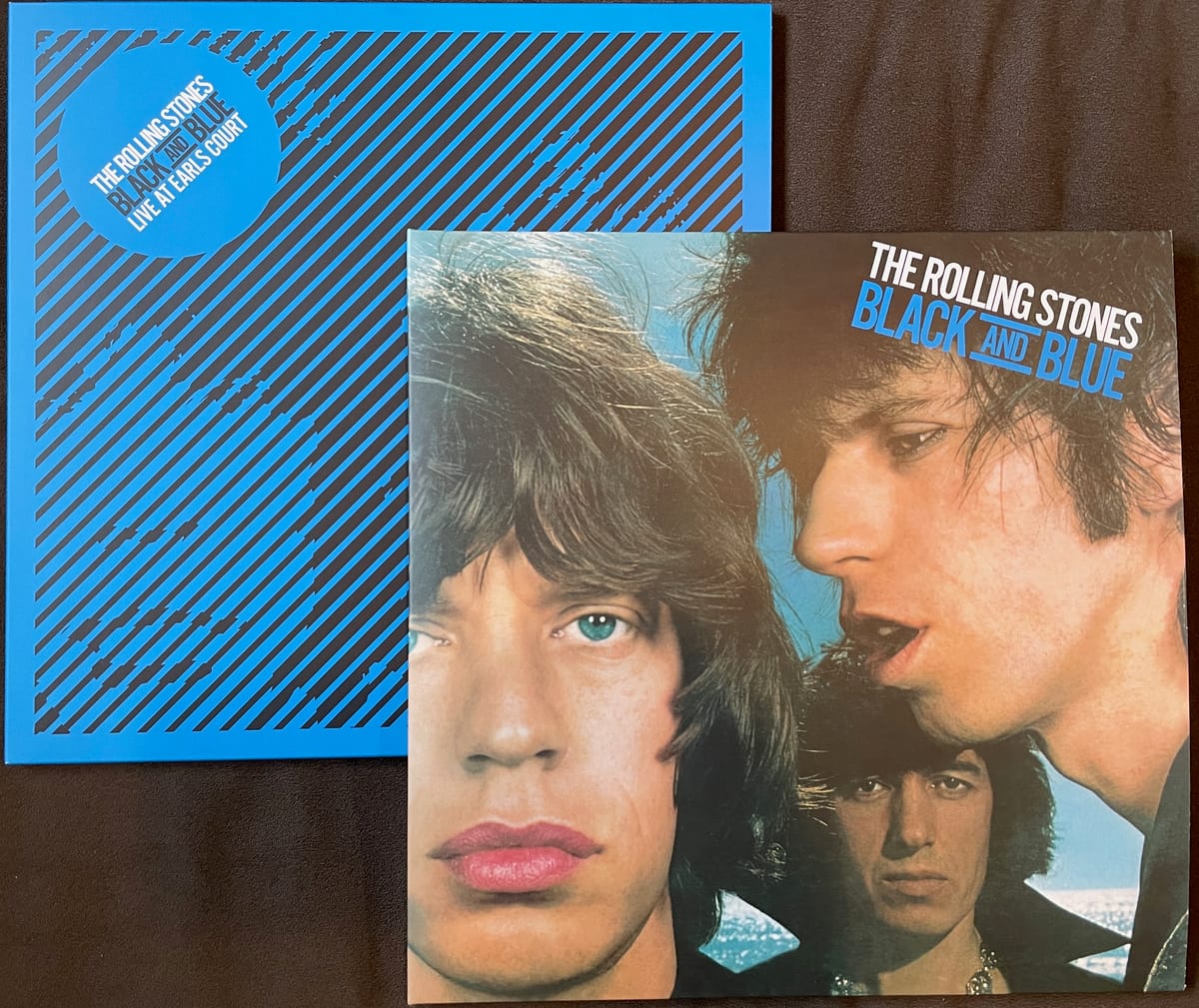
The packaging is a little less worthy of praise. The sturdy outer cardboard box is just a plain blue, with the artwork elements appearing on a somewhat flimsy plastic sheath that you need to slip on and off to access the box. The Black and Blue LP is well-replicated, with a thick inner sleeve that includes the musician credits in the form of studio tracking sheets, as per the original; there’s also a lyric sheet that came with original UK copies. The disc of outtakes and jams is slotted inside Black and Blue’s front gatefold pocket instead of receiving its own jacket; the info provided on its inner sleeve is scant at best. The Earls Court show, too, has virtually no original design elements, as it repeats the outer box image on not just the single-pocket jacket but all three inner sleeves. Even a shoddy-looking “bootleg”-style cover would’ve been more impressive.
The 100-page hardcover book, however, is handsomely printed and bound, with lots of photos and a medium-length essay by Paul Sexton that stretches out across the entirety of the book via innovative graphic design choices. Sexton’s essay incorporates new interview material from Ron Wood and details the events that led up to the Black and Blue sessions, Wood’s joining the band, and the album’s subsequent tour. It’s an informative bit of writing, but the box lacks any sort of track-by-track breakdowns or technical detail, and the book ends up being more of a coffee-table-type piece than a vital trove of archival info.
Still, the Black and Blue box is a thorough excavation of an intriguing period when the Stones seemed to be stuck between stations, coming down from the artistic heights of Sticky Fingers and Exile and yet to rise to their commercial apex with Some Girls and Tattoo You. It’s the very definition of a crossroads record, occurring after the departure of Mick Taylor and at a time when the Stones were incorporating new musical styles into their playing. The possibilities laid out by the rejected guitarists are endless—particularly Wayne Perkins, who would have likely kept them going in the direction they’d established with Taylor—but as is recounted in the liner notes, the Stones were an English band and decided they wanted an English guitarist. This Black and Blue set finds the band expanding ranks and then drawing them close again, all while capitalizing on their power as a live unit. It’s a document of the biggest band in the world figuring out how to rebuild itself, and succeeding wildly.
Rolling Stones Records/Polydor 5-LP 33 RPM 180g marbled black and blue vinyl
• Steven Wilson remix of 1976 album; 1 LP of outtakes & jams; 3-LP live set recorded at Earls Court, London, May 21–23 & 25–27, 1976; Blu-ray disc including all of the above, plus Atmos and 5.1 mixes of 1976 album, Atmos mix of Earls Court show, and French TV concert documentary Les Rolling Stones aux Abattoirs, filmed at Pavillon de Paris (aka les Abattoirs), June 4–7, 1976, with remixed audio
• Jacket: Direct-to-board gatefold for album & outtakes; direct-to-board single pocket for 3-LP live album
• Inner sleeves: Custom thick printed paper
• Liner notes, insert, or booklet: 100-page hardbound book with photos and essay; 2’x3’ reproduction of 1976 French concert poster; Black and Blue LP includes lyric insert
• Source: Digital
• Mastering credit: Matt Colton at Metropolis Mastering, London, UK
• Lacquer cut by: Matt Colton at Metropolis Mastering, London, UK (“MATT @ METROPOLIS” in deadwax)
• Pressed at: MPO, Villaines-la-Juhel, France
• Vinyl pressing quality (visual): A- (one of the live discs was mildly dished)
• Vinyl pressing quality (audio): B+ (minor background noise on all discs)
• Additional notes: Comes in a sturdy box with lift-off lid and outer plastic slip cover. A standard black vinyl version is also available, as are 2-LP and 1-LP configurations and a zoetrope picture disc.
Listening equipment:
Table: Technics SL-1200MK2
Cart: Audio-Technica VM540ML
Amp: Luxman L-509X
Speakers: ADS L980