Reviews: Charles Mingus | Sturgill Simpson


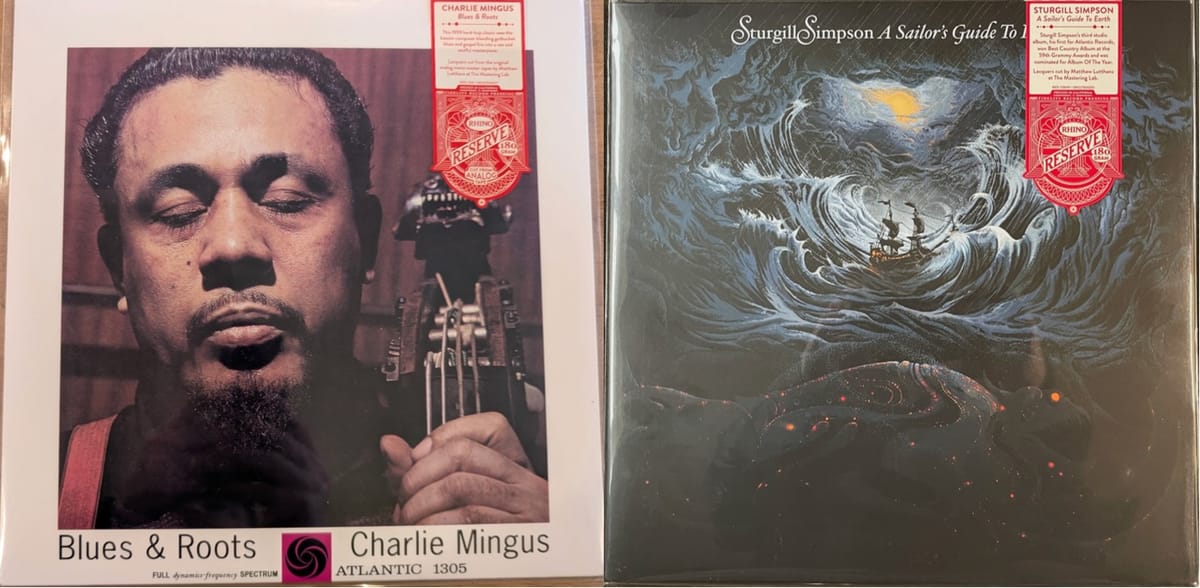
More Rhino Reserves! This time we tuck into the new vinyl reissues of Blues & Roots and A Sailor’s Guide to Earth.
We’ve got a couple more discs from Rhino’s Start Your Ear Off Right campaign to tell you about, and just like yesterday, these are in the distinguished Rhino Reserve series. These are premium cuts from quality sources—analog master tapes wherever possible, although today we’ve got a digital cut as well—and sold at a price point of about $32 USD.
- Charles Mingus: Blues & Roots
- Sturgill Simpson: A Sailor’s Guide to Earth
But first, here’s your obligatory reminder about our forthcoming January vinyl giveaway! This month we’re giving away something pretty remarkable: a set of test pressings to the mind-blowingly good one-step versions of R.E.M.’s Murmur LP and Chronic Town EP. These are part of Universal’s Definitive Sound Series and rank high on the list of best pressings of 2025—in other words, they sound incredible, as you can read in Bob’s review here.
This giveaway will go live on Saturday, and we’ll send out a newsletter as soon as it does. But here’s the catch: You need to be a subscriber on our paid tier in order to enter. Yep, them’s the breaks. But it’s easy to become one—just click this little button right here and you’ll be on your way.
Best of all, you’ll support our work and ensure that The Vinyl Cut keeps moving forward—ad-free and full of all the great vinyl news and reviews you’ve grown to love.
Okey-dokey. Time for some reviews, I think.

Charles Mingus: Blues & Roots
Review by Robert Ham
For a musician who played with such fire, conviction, and fervor, Charlie Mingus could be a master of understatement. Closing out his liner notes for Blues & Roots, the 1960 album he recorded for Atlantic Records, the then-38-year-old wrote, “We played down to earth and together, and I think this music has a tremendous amount of life and emotion.”
And how. Working with a large ensemble that boasted six horn players—saxophonists Booker Ervin, Pepper Adams, John Handy, and Jackie McLean, and trombonists Jimmy Knepper and Willie Dennis—and a rhythm section made up of drummer Dannie Richmond and either Horace Parlan or Mal Waldron on piano, Mingus wrote a suite of music that burns with the intensity and beauty of a blue flame and has the dizzy joy of a child tumbling down a grassy hillside. Mingus supposedly taught each player the stems of each tune on piano but didn’t give them any sheet music to work off. He trusted that they would catch on quickly and, as he wrote, “They’d play the compositional parts with as much spontaneity and soul as they’d play a solo.” It sounds like the recipe for cacophony, but it all holds together in spectacular fashion. All six songs have the freewheeling energy of a boozy, late-night jam session or a rollicking Sunday service, complete with spirited shouting and—as when as “E’s Flat Ah’s Flat Too” picks up a head of steam—the feeling that the song is about to fly completely off the rails.
What makes Blues & Roots even more remarkable is that it came about as a spiteful response to critics complaining that Mingus was all head and no hips. “Some people,” he writes, “were saying I didn’t swing enough.” The bassist brushed aside such criticism handily, reminding folks of his upbringing in the church and his studies of the blues masters. “My Jelly Roll Soul,” for example, was apparently the result of a project that was inspired by a book of Jelly Roll Morton compositions. Mingus had planned to write new arrangements of his favorites, but he lost the book and instead used what he had gleaned from the text to write an original song. The resultant piece is pure ragtime strut but with a rude undercurrent brought about through Adams’s honking baritone sax, Knepper’s elastic solo, and the sproing of Mingus’s bass work.
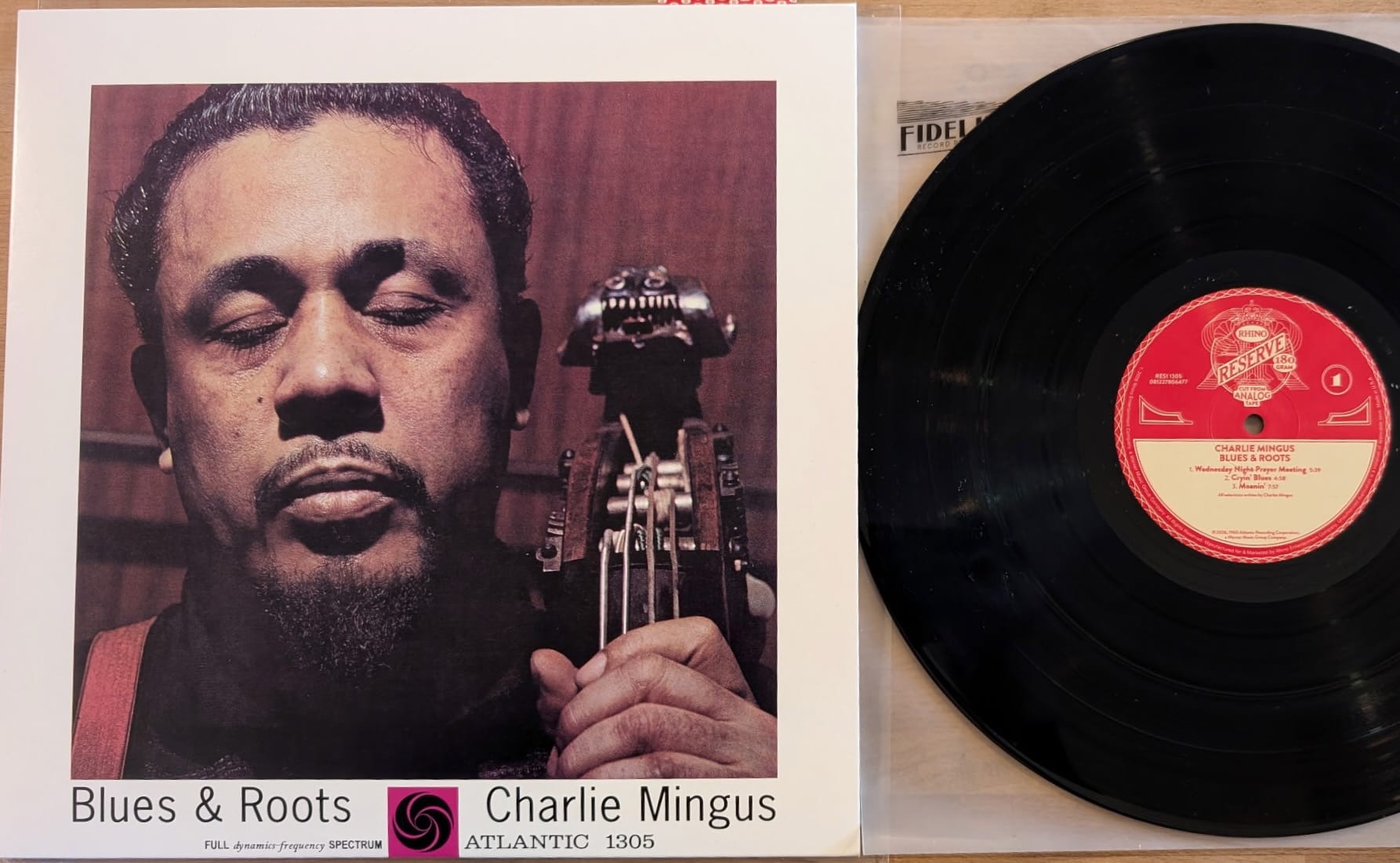
Part of me wishes I had one of the many vinyl versions of Blues & Roots on hand to do a little bit of compare-and-contrast work here, especially the 2023 Analogue Productions 45 RPM edition mastered by Kevin Gray, or even the well-regarded cut David Cheppa made for a 2001 pressing. But I don’t know that anything outside of a clean original Atlantic pressing from 1960 would satisfy me as much as this does. Working from the original mono tapes, engineer Matthew Lutthans has produced a stunning, dead-quiet cut of this album, with a lovely separation around each instrument that is necessary to drink in every detail of these individual performances. The bass is ticked up just so to help spotlight the foundation of each track—an understandable move considering the face and name of the man plucking those strings is right there on the front cover. The increased low end also has the effect of drawing other players forward, especially Adams, Knepper, and Dennis, alongside Ervin, playing tenor sax.
I also don’t know that a stereo pressing of Blues & Roots would have the same effect as this mono edition. The music on this album is at its most effective if it is close to overwhelming. It should be played at a volume that makes the listener feel as though they are about to be swept up in a vortex or pushed to a state of spiritual ecstasy. It needs to sound as though the musicians are jostling for room on a small, rickety stage, cutting through the other instruments with a solo or happily harmonizing with the fray. The hard panning of the instruments on the stereo version that I’ve heard through streaming services doesn’t diminish the artistry but does drain a bit of the music’s essential life and emotion.
Rhino Reserve 1-LP 33 RPM 180g black vinyl
• Jacket: Heavy-duty direct-to-board single pocket
• Inner sleeve: Fidelity Record Pressing–branded poly
• Liner notes, insert, or booklet: Mingus’s original liner notes reprinted on back cover
• Source: Analog; “Lacquers cut from the original mono master tapes”
• Mastering credit: Matthew Lutthans at the Mastering Lab, Salina, KS
• Lacquer cut by: Matthew Lutthans at the Mastering Lab, Salina, KS; “MCL” in deadwax
• Pressed at: Fidelity Record Pressing, Oxnard, CA
• Vinyl pressing quality (visual): A
• Vinyl pressing quality (audio): A
• Additional notes: Comes inside reusable poly sleeve sealed by hype sticker, as per other Rhino Reserve titles.
Listening equipment:
Table: Cambridge Audio Alva ST
Cart: Grado Green3
Amp: Sansui 9090
Speakers: Electro Voice TS8-2
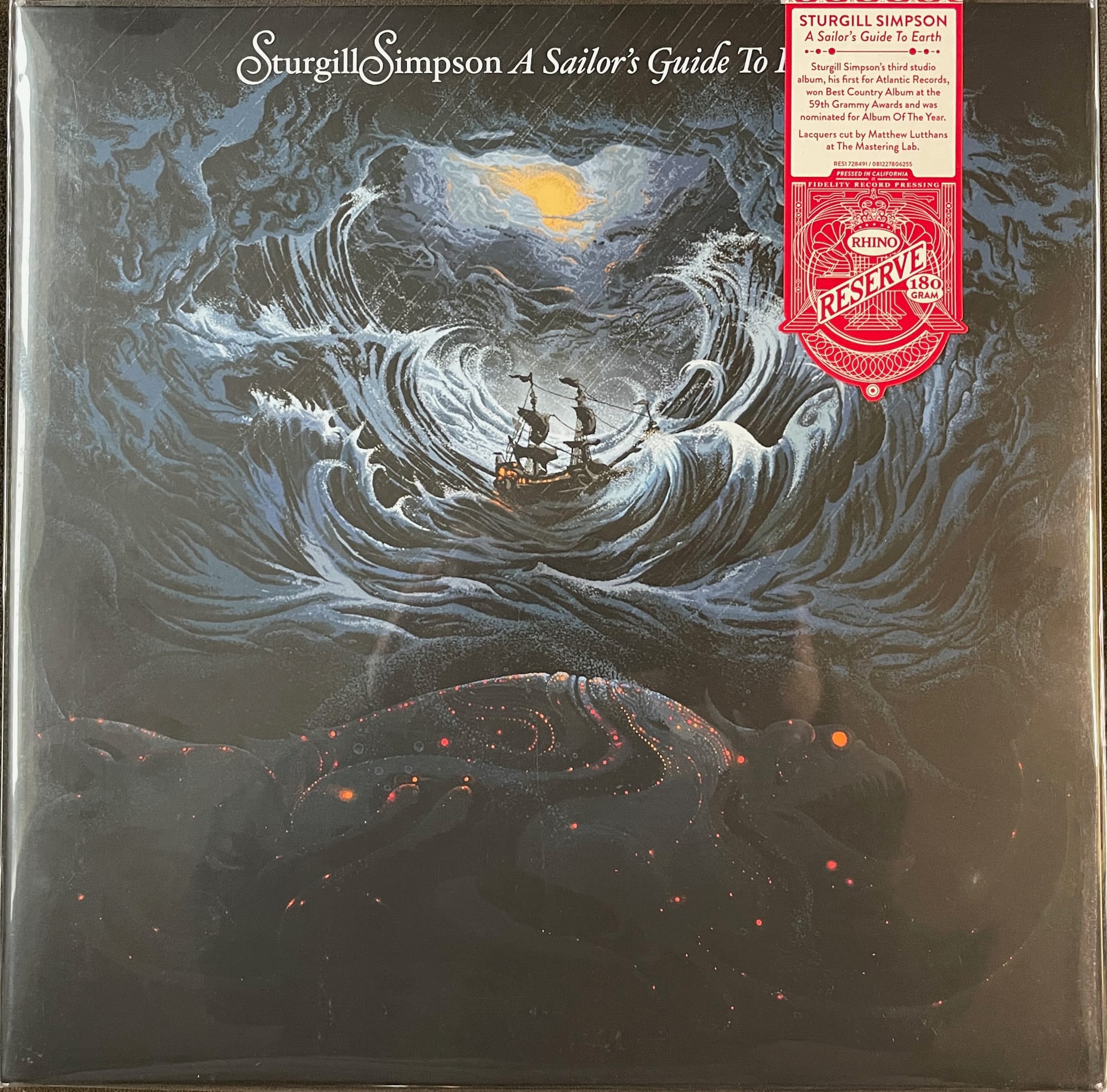
Sturgill Simpson: A Sailor’s Guide to Earth
Review by Ned Lannamann
Sturgill Simpson makes good on his promises. He made a big one with 2014’s Metamodern Sounds in Country Music, even if he didn’t intend to. That album was a shot in the arm for contemporary country music, with Simpson inverting the genre to deal with a range of topics and musical styles that country flat-out wasn’t used to. So for the follow-up, the world expected big things, and by gum, Simpson delivered: 2016’s A Sailor’s Guide to Earth was both a celebration and condemnation of country music, as it stowed soul, psychedelia, Southern rock, ’90s rock, folk, funk, and mainstream commercial pop under its sails. It set the scene on its ear; Simpson won a Grammy and stopped making promises, going off on his own way with admiration—if not superstardom—in his wake.
To Simpson’s credit, A Sailor’s Guide is more than an attention-grabbing stab at commercial success—it also feels intensely personal, making use of a nautical theme to reflect on the Kentucky-born songwriter’s own time in the US Navy. The album starts with “Welcome to Earth (Pollywog),” a sentimental, string-laden lullaby to Simpson’s newborn son that mutates into a Stax dance party, complete with horns by the Dap-Kings. It’s an ecstatic kickoff to the album, although it plateaus emotionally when it feels like it should keep building. The next song (“Breakers Roar”) backtracks to another lullaby, delving into the nocturnal-sky orchestral sound that kicked off the album, while the third (“Keep It Between the Lines”) is another upbeat groover that flirts with funk and blues. “Sea Stories” is a country strummer with soul inflections, with Dan Dugmore’s pedal steel taking the part of the horn section. Side 1 closes with an ingenious cover of Nirvana’s “In Bloom,” which starts off as an noir-ish ballad before acquiring some baroque-pop ornamentation, taking on strings and Dap-King horns as it escalates to a dramatic conclusion.
“Brace for Impact (Live a Little)” is a bass-driven, slow-churning rocker in the vein of Dire Straits or late-era Pink Floyd, with slide guitars and Moog to keep things from sounding too conventional. The waltzing “All Around You” is a perfect marriage of a ’60s soul ballad and a calico country song, while “Oh Sarah” is a pause-and-catch-your-breath meditation with a gently tapped beat and pizzicato strings. The album closes with the breakneck “Call to Arms,” a double-time vamp that wants to end the album in barn-burning mode but never quite gets there, and the LP signs off on a weirdly anti-climactic note. Simpson has woven all the songs together into a continuous musical experience; at the time of A Sailor’s Guide’s release, he cited Marvin Gaye’s ’70s albums as the inspiration for the suite-like effect he was going for.
Sonically, the album is a bit of a mixed bag. It encompasses all the good things and bad things about digital music production in the 21st century. An approximation of a vintage sound—from classic country to golden soul to bong-resin rock—is easy to achieve: Simply dial up the appropriate plug-in and Bob’s your uncle. But there remains an uncanny undercurrent to it. I can’t pretend to know the intentions or techniques that Simpson and engineer David Ferguson used while making A Sailor’s Guide, but my guess is that they were going for an expansive, almost cinematic scope while also trying to keep things as spontaneous and live as possible. They nearly got there, but this may have been an impossible task.
First off, there’s lots of reverb on everything. This gives the songs a celestial feel that’s in keeping with the nautical concept. But occasionally the sonic picture gets diffuse, especially when the arrangements feature a six- or seven-piece band working overtime, plus strings and a horn section. And when the arrangements reach their densest, it creates a level of constriction, if not outright compression, that’s likely the product of the recording situation, where ambition and budget are always at loggerheads. “Keep It Between the Lines” in particular comes at you like a concrete block, with the instruments all fighting for space in an in-your-face soundscape. Rather than imparting a loose feel with plenty of room between the notes for the listener to mentally move between, everything feels pushed forward, without enough space to breathe. The more stripped-back “Sea Stories” fares a lot better, with guitars, organ, piano, and steel guitar working together toward a common purpose, and “In Bloom” shoots off some magic sparks, almost invisibly acquiring instruments along the way as it builds to that star-spangled climax.
On the whole, the album sounds best during its sparser moments, such as “All Around You” and “Oh Sarah.” The album was recorded digitally, so unlike many other Rhino Reserve pressings, this one isn’t from analog tape, and the sensation is noticeable. Matthew Lutthans has cut a disc that is lively and full of color, with rich bass and natural sounding highs. It fills the room and commands attention, even at lower volume levels. But I think the recording itself—in comparison to the other Rhino Reserves that I’ve been listening to this January—simply doesn’t have the alchemical magic that a superlative cut can make the most of. Instead of offering a “more-ish” quality to the music (as in “give me more”), my ear gets a bit overloaded in trying to process everything that’s going on. There are no corners to peer around, no layers to uncover; the dozens of instruments are all right in front of you. The effect is of a killer live show where the band is cooking and the PA is just about to redline—it’s exciting, but it’s not exactly a nuanced sonic experience, and your ears are probably gonna ring afterwards.
The album was initially cut in 2016 from Gavin Lurssen’s digital master, the same one Lutthans cut this version from. It may be that Lurssen’s master is partly responsible for the album’s forceful sound and not simply the production itself. There doesn’t seem to have been a lacquer-cutting credit on the 2016 version, but that’s the stamper that’s been in use ever since, including a 2023 version on clear vinyl. Whether this new Rhino Reserve—featuring a flawless pressing from MoFi’s Fidelity plant—will replace the old cut or sit alongside it on record store shelves remains to be seen. I was not able to compare this new version to the previous cut, but I did listen to it back-to-back with the version that’s currently streaming on Apple Music, and I found the streaming version a bit more forgiving and ear-friendly, although it was substantially more subdued and lacking in precision.
It’s a tricky thing, transferring a digitally produced work to an analog format. Many times it works splendidly; occasionally it doesn’t. A Sailor’s Guide to Earth seems custom-tailored to work brilliantly in the vinyl format—it’s a song cycle that’s inspired by Marvin Gaye, with stylistic variance across every track and a compact, 39-minute running time. But I think the things that vinyl is so good at leave this particular record a bit exposed. The seams are visible, and the vividness of Lutthans’ cut puts some elements out of proportion. Nevertheless, there’s a ton to appreciate here, particularly in the album’s mellower moments, where the nautical theme dovetails perfectly with Simpson’s conceptual ambitions and the killer chops of his backing band. Despite a few stormy squalls, this is generally smooth sailing.
Rhino Reserve 1-LP 33 RPM 180g black vinyl
• New remaster of Sturgill Simpson’s 2016 Grammy-winning album
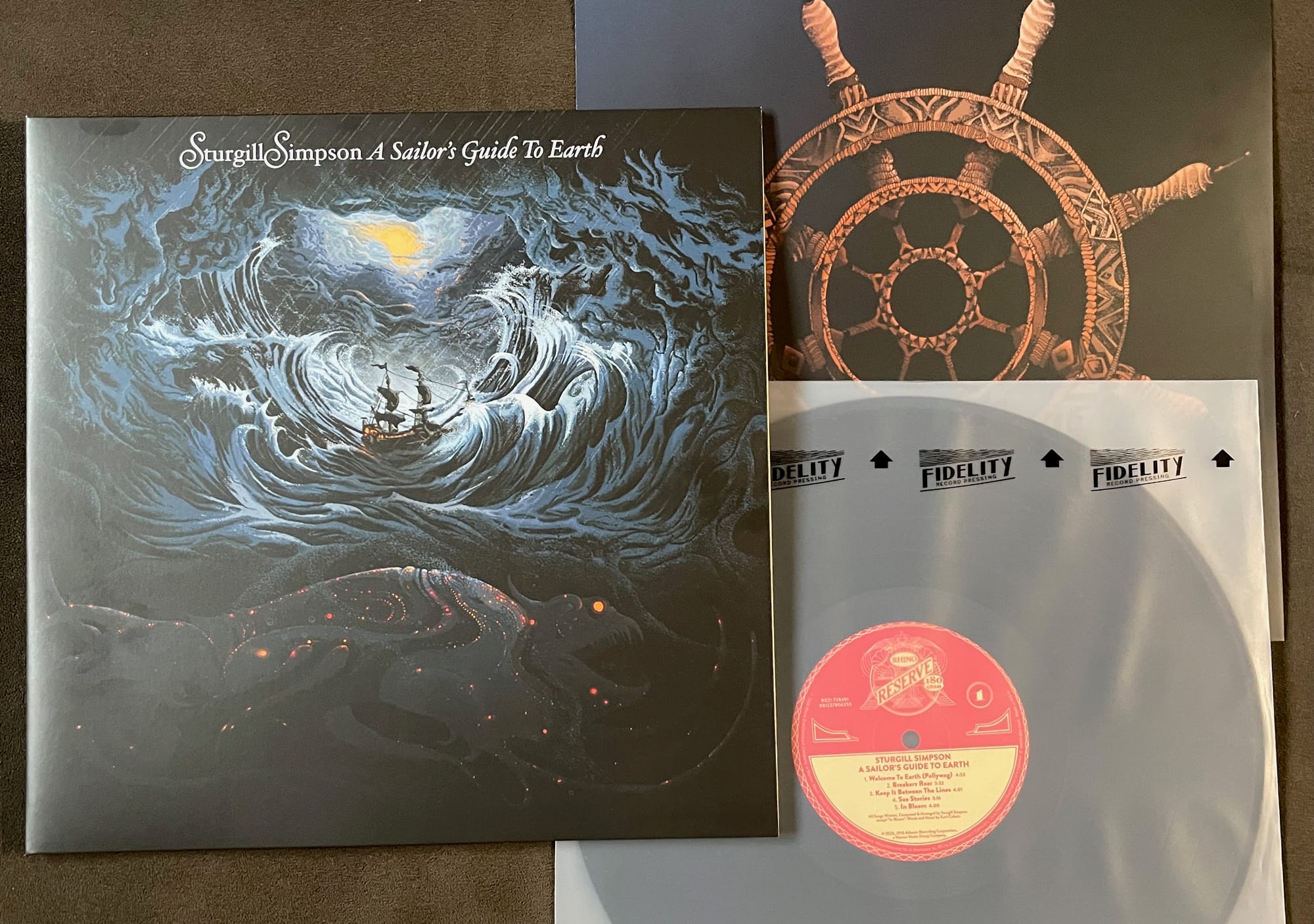
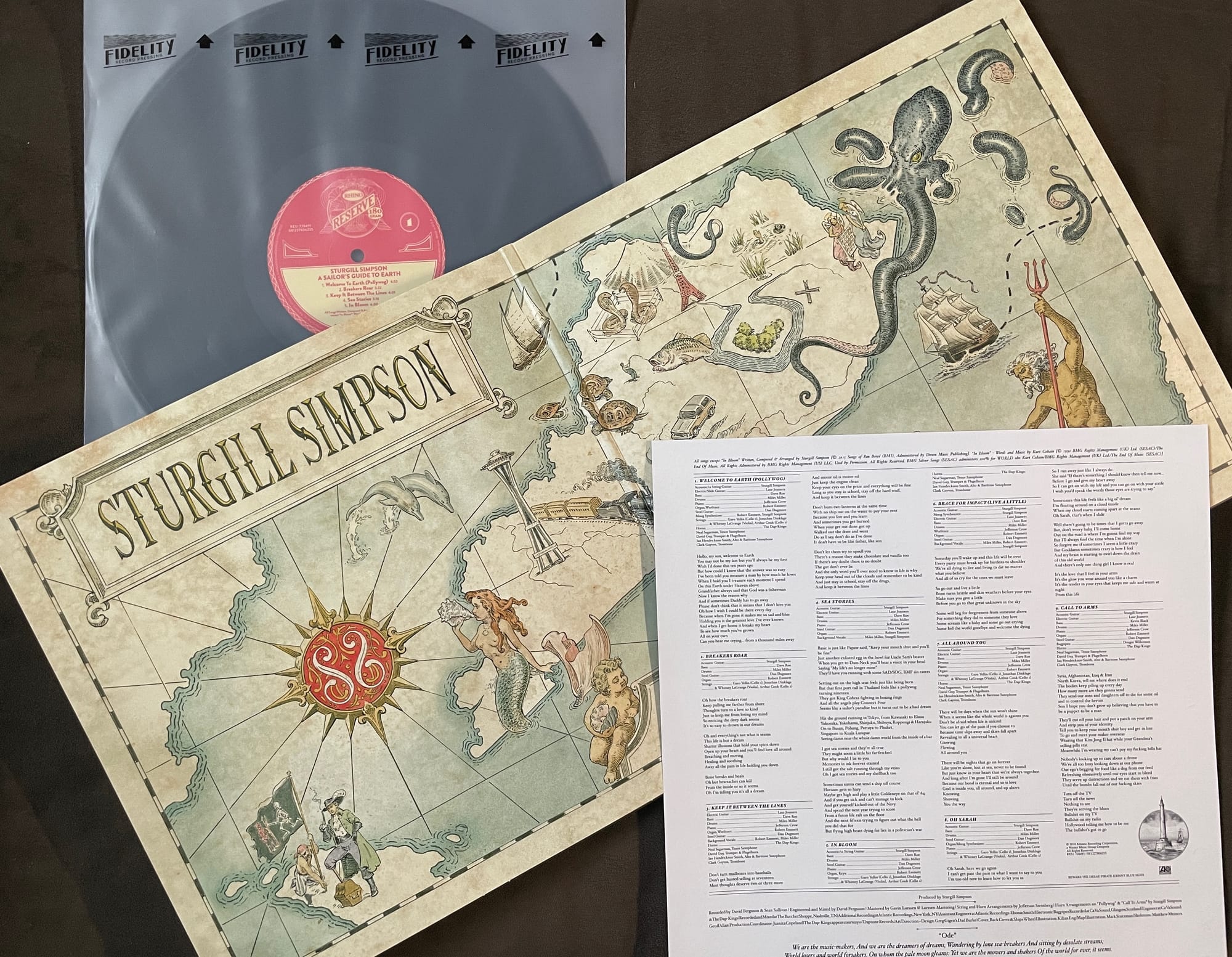
• Jacket: Direct-to-board gatefold
• Inner sleeve: Fidelity Record Pressing–branded poly
• Liner notes, insert, or booklet: Double-sided insert with lyrics and artwork
• Source: Digital
• Mastering credit: “Gavin Lurssen @ Lurssen Mastering”
• Lacquer cut by: Matthew Lutthans at the Mastering Lab, Salina, KS; “MCL” in the deadwax
• Pressed at: Fidelity Record Pressing, Oxnard, CA
• Vinyl pressing quality (visual): A
• Vinyl pressing quality (audio): A- (light noise at the very end of each side)
• Additional notes: Comes inside reusable poly sleeve sealed by hype sticker, as per other Rhino Reserve titles.
Listening equipment:
Table: Technics SL-1200MK2
Cart: Audio-Technica VM540ML
Amp: Luxman L-509X
Speakers: ADS L980