Reviews: Crosby, Stills & Nash | Joni Mitchell

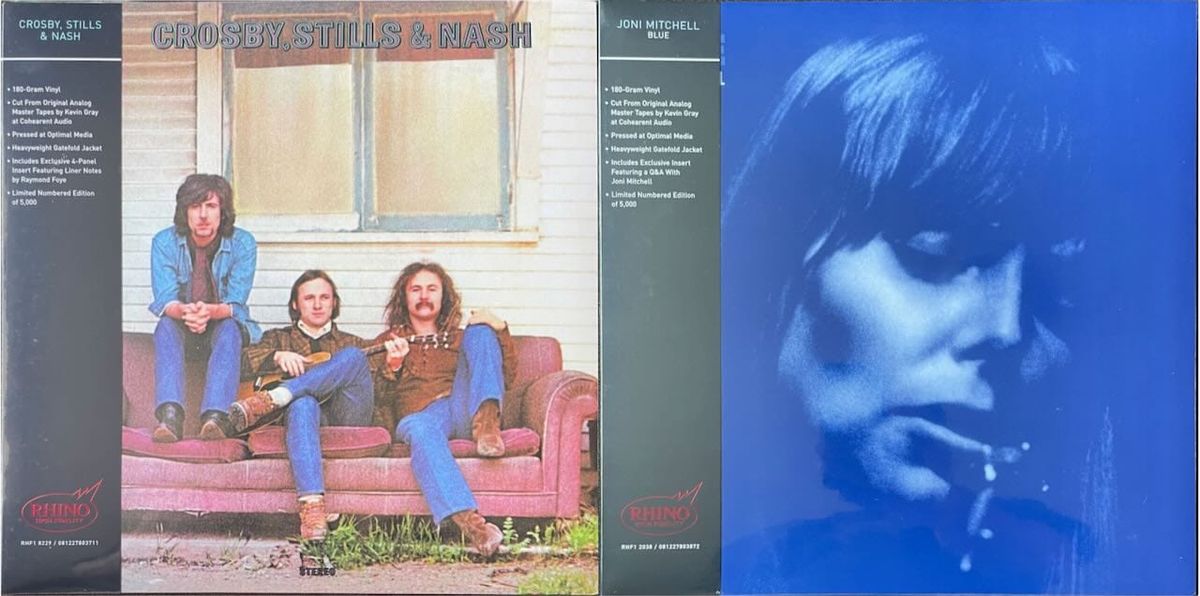
Rhino High Fidelity’s new pressings of CSN’s 1969 self-titled debut and Joni Mitchell’s 1971 masterpiece Blue.
Today I’m catching up on two of the most recent Rhino High Fidelity pressings. These two albums are interconnected in many ways, although they’re actually pretty different listening experiences: One is a collection of three young hotshots coming together to try to change the world, while the other is a document of a young woman processing the changes in herself. They’re both offered in new analog cuts by Kevin Gray, as are all of the RHF pressings.
- Crosby, Stills & Nash: Crosby, Stills & Nash
- Joni Mitchell: Blue
Murmurs are afoot about what’s coming next in the Rhino High Fidelity series—the announcement of a box set is apparently imminent, with much online speculation about who the artist will be. Based on the tidbits that have dropped thus far, it seems the smart money is on one of the following: Fleetwood Mac, Yes, Deep Purple, Jethro Tull, or Genesis. My own two cents are riding on Jethro Tull (and I anticipate a Yes box coming at the end of the year), but this is pure, idle speculation, so be prepared to pass me a nice dish of crow when the announcement comes in the next few days. (Having said all this, dear reader, you know that my heart, as ever, lies elsewhere.)
Before I get into the two RHF reviews, here’s an easy, ignorable reminder that we have a paid tier and it would be awfully nice if you decided to join it. Paid membership at The Vinyl Cut gets you full access to the site’s archives, with all the reviews you’ve come to rely on and/or poke fun at (free-tier subscribers can only see the last six months of articles, and those who aren’t subscribed at all can only see three months). Plus, you get our weekly playlists, commenting privileges, and the ability to enter our monthly vinyl giveaway. It’s pretty swell. You in?
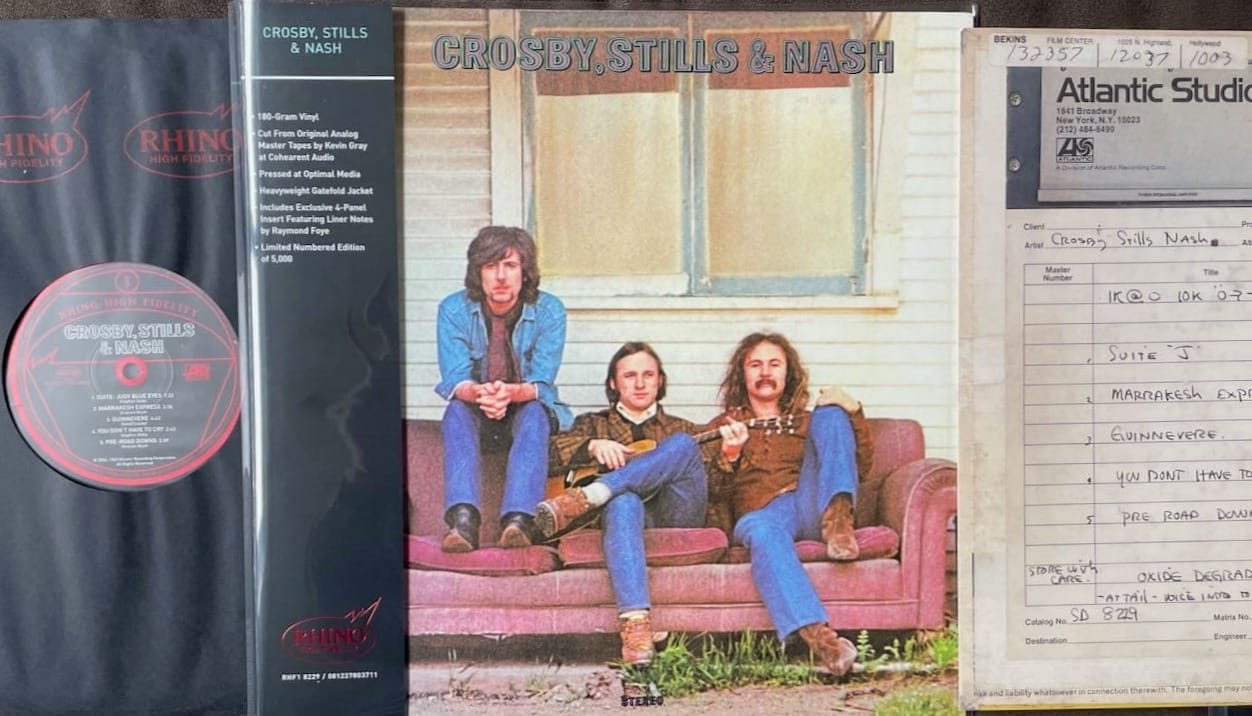
Crosby, Stills & Nash: Crosby, Stills & Nash
The timing couldn’t have been better. When David Crosby, Stephen Stills, and Graham Nash joined forces in July 1968, they had each already spent time in the rock ’n’ roll trenches and had each gotten burned in their own way. In teaming up, there was to be no pretense, no showbiz, no concept, not even a band name, really—just three musicians plying their craft and letting the songs do the talking. By the time Crosby, Stills & Nash’s self-titled debut was released in May 1969, the Beatles were on their last legs, Bob Dylan had gone full country, and rock music was getting louder and heavier under the influence of Jimi Hendrix and Led Zeppelin. Crosby, Stills & Nash and its fortuitous acoustic/electric blend of folk, rock, and pop must have seemed like a bright light coming from just a ways ahead on the path, illuminating the way forward. The group’s breakthrough performance at Woodstock in August sealed the deal, cementing Crosby, Stills & Nash (and, by that point, Neil Young) as the proverbial voices of a generation.
The album has never quite lived up to its weighty reputation. There’s always been a bit of a you-had-to-be-there quality with Crosby, Stills & Nash and its 1970 follow-up (with Young), Déjà Vu. For those born too late to have ever taken “Long Time Gone” to heart or separated seeds and stems inside the debut album’s textured gatefold, CSN looked like mere heralds of the forthcoming singer/songwriter movement, moving the baton forward from the era of Dylan, Simon & Garfunkel, and the Band’s Music from Big Pink to the new class of James Taylor, Carole King, and Cat Stevens. There was always the sense of an unfulfilled promise with Crosby, Stills & Nash: After a brief, undeniably bright blip, they could never again summon up the right songs or get their egos in check in order to fully recapture the magic. And in the end, that makes them the perfect avatars for the Woodstock/Altamont era, when ideals of peace, love, and community collided with the harsh realities of drugs, greed, and violence.
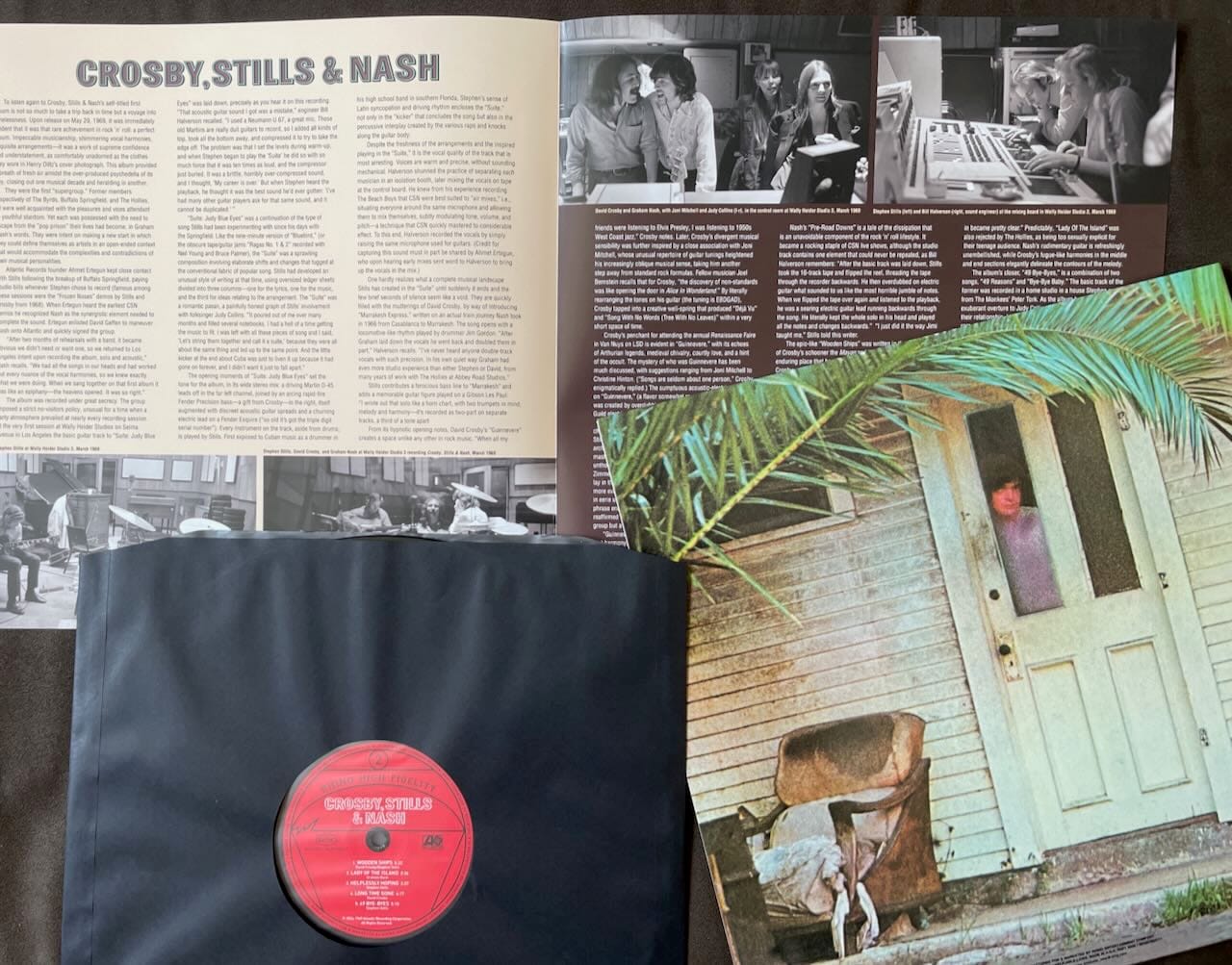
All of this makes taking Crosby, Stills & Nash on its own terms difficult, but what cannot be contextualized away is the fact that it’s a fine late-’60s pop album, with an adventurous spirit and some appealing fire in its belly. Many of the tunes, like Stills’s “Suite: Judy Blue Eyes,” Crosby’s “Guinnevere,” and the pair’s collaboration with Jefferson Airplane’s Paul Kantner, “Wooden Ships,” are ambitious, thoughtful, and admirably individualistic. And the group’s confidence is such that they’re able to push the weaker songs over the top with their well-crafted harmonies, as on Nash’s “Lady of the Island” and Stills’s “You Don’t Have to Cry.”
The album is famously a showcase for Stills, nicknamed “Captain Manyhands” by Crosby and Nash during the recording sessions due to his multi-instrumental prowess. Featuring drummer Dallas Taylor and no other outside musicians (although Jim Gordon drums on “Marrakesh Express” and Cass Elliott, who helped bring the threesome together, can be heard on the chorus of “Pre-Road Downs”), the album is largely a studio concoction, with Stills’s overdubs on guitars, bass, organ, and percussion taking the place of live instrumental spontaneity. However, many of the trio’s vocals were recorded with them sharing a single mic, creating what they’d call an “air mix” rather than manipulating the faders to control the individual voices. They’d usually do two runs at each track for a total of six interlocking voices—or sometimes more—creating the thickly woven blend that became CSN’s sonic signature.
Arrangements and performances aside, the Couch Album (so named for its cover photo by Henry Diltz) has never been regarded as a particularly great-sounding record. It was tracked at Wally Heider’s Studio 3 in Hollywood, with Bill Halverson engineering the sessions. “Heider’s was a dinky little studio,” Crosby wrote in his autobiography Long Time Gone, “but it was technologically okay, with a sixteen-track machine.” On the first night of recording, Halverson accidentally overcompensated for the boominess of Stills’s Martin acoustic, dialing up the treble and adding too much compression to the main guitar part of “Suite: Judy Blue Eyes.” But Stills ended up loving how it sounded: edgy, tight, and bell-like. And that very much dictated how the rest of the album unfolded, with studio tricks—like the backwards guitar that Stills added to “Pre-Road Downs”—alongside straightforward acoustic-guitar-and-vocal performances, such as Crosby’s medieval-tinged “Guinnevere” and Stills’s stunning “Helplessly Hoping.”
The album has been cut to vinyl countless times. For American pressings during the LP era alone, there are almost too many to list. Rob Grenell cut the first Atlantic pressings in 1969, and then it was recut in 1970 by Al Brown, who also cut Deja Vu. Then around 1972 or 1973, it was cut by George Piros; then John Bittner cut it in 1977, likely around the time he cut the CSN (“Boat”) album. It was cut once more by Sam Feldman in the early ’80s, while the first audiophile pressing was made in 1982 by Nautilus Recordings from a half-speed master. This doesn’t even include the various record-club and overflow pressings (the album was a huge seller, necessitating Atlantic to contract extra copies from Columbia’s and RCA’s pressing plants, which do not seem to have used the Atlantic cuts), not to mention all the pressings made for the UK, Europe, Canada, Asia, and South America.
The 21st century has given us almost as many new versions. In 2001, Bernie Grundman cut it from the analog master tape for Classic Records at 33 RPM, released on 180-gram and 200-gram vinyl. He also cut it at 45 RPM, which Classic released on four single-sided LPs in 2005. (Thank heavens the single-sided vinyl trend didn’t catch on.) In 2009, Grundman recut it for Rhino, and that was the standard vinyl version until Grundman’s coworker Chris Bellman cut it in 2021, for a pressing that is still in print today. I am not certain if either of those Rhino cuts were from analog tape, but it seems possible. Then in 2022, Mobile Fidelity did a one-step version from their DSD transfer, cut at 45 RPM on two LPs. Electric Recording Co. also did a ludicrously expensive cut-from-tape version in 2023 in quantities so limited as to guarantee that no one reading this has ever heard it. Most recently, Analogue Productions dug out the old Bernie Grundman/Classic Records metalwork for a 45 RPM 2-LP version that was part of their Atlantic 75 series—a version that has been regarded by some online reviewers as the best-sounding version yet.
Now there’s a new 33 RPM analog cut on Rhino High Fidelity, sourced from the original master tape by Kevin Gray at Cohearent Audio. There are simply too many versions out there for me to be able to provide a substantial comparison, but I can say that the new Gray cut is miles ahead of my 1969 Rob Grenell copy, pressed at Monarch and representative of how the album would have sounded to its original audience. Whereas my Monarch original has muddy mids, wayward bass, and piercing highs—noticeable right from the get-go, on the opening strums of “Suite: Judy Blue Eyes”—the new RHF is lively, spacious, and flattering to the ear. Stills’s bass guitar is subtly pulled out of the mix and given room to roam, while the vocal harmonies are rendered with realistic, humanistic texture, offered in tight-focus clarity rather than a sort of lumped-together blur. I’m astonished that the master tape still sounds this good, as presumably it has gotten quite a workout over the last 57 years (see the previous two paragraphs), but it’s possible that some of the earlier pressings were cut from prepared or EQ’ed cutting copies and not directly from the master itself.
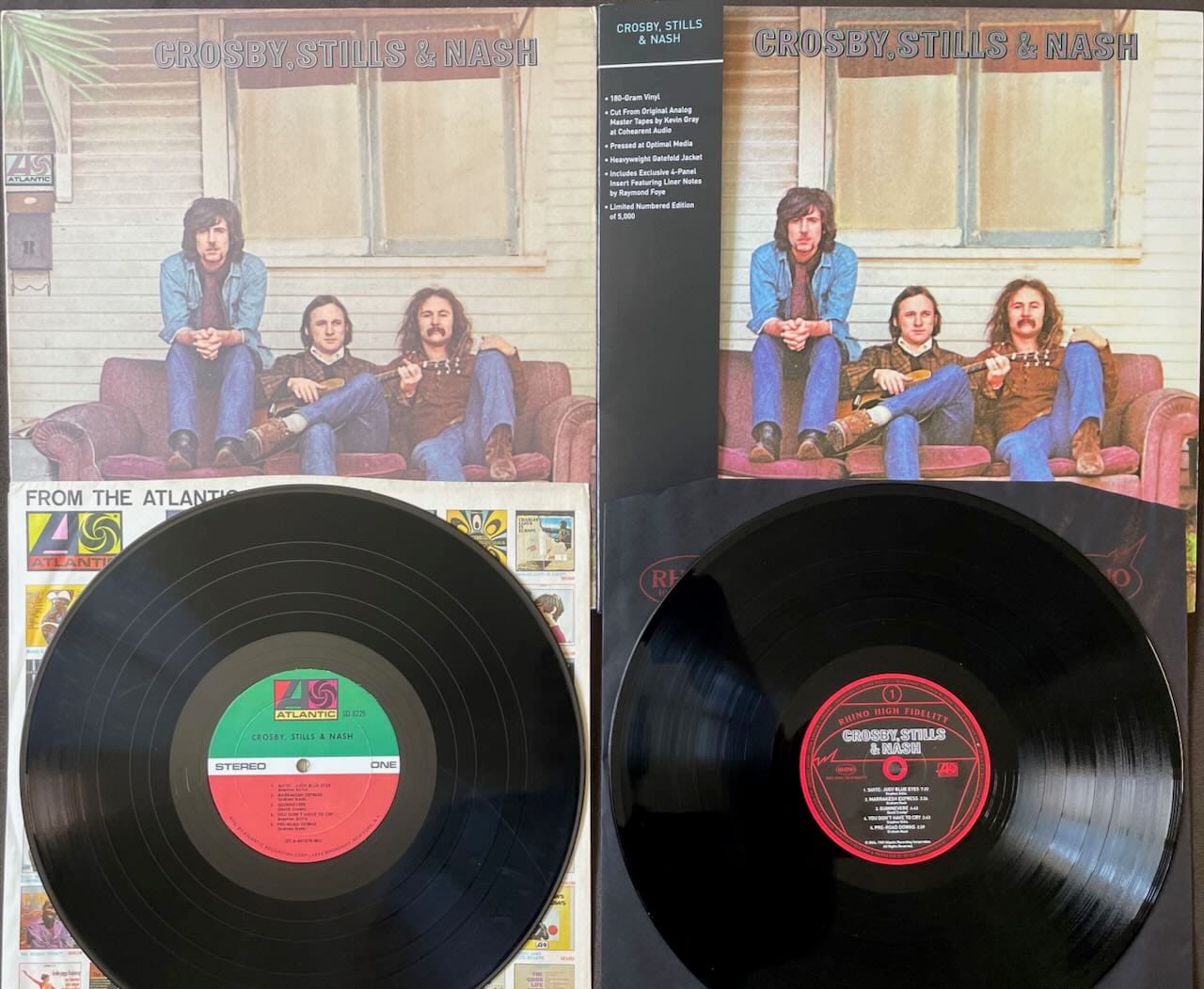
“Wooden Ships” was a useful track for me to examine, as it’s one of the album’s best songs and features a peculiar, problematic mix, with a wide stereo spread and disorienting sonic characteristics. On the 1969 Monarch, there is a substantial distance to the sound, with the different components not sounding at all integrated with each other and an odd underwater quality that sadly doesn’t jibe with the song’s nautical theme. Crosby’s voice in the left channel has heavy sibilance, the bass presence is minimal, and the overall result is top-heavy and unpleasantly splashy. Stills’s muted lead guitar isn’t able to cut free from its surroundings, often taking on the characteristics of a buzzing bee under a heavy blanket, and the overall result is compressed and forced-sounding.
On the RHF, the difference is immediately noticeable. First of all, tape hiss is wholly audible, suggesting that little alteration or veiling was done to what was present on the master tape, and the music’s physicality is immeasurably more open and transparent. Dallas Taylor’s drums, while still confined to the right channel, are much more natural-sounding and dimensional, and although Stills’s busy bass is generally kept to subliminal levels, it augments and bolsters the arrangement rather than acting as a thickening agent. And his muffled lead guitar is far more appreciable on Gray’s cut, its lack of attack working nicely against Crosby’s toothier rhythm guitar.
“Helplessly Hoping” is another standout on the RHF. The recording is marred by distortion on Stills’s acoustic guitar—audible on every version that’s ever been released—and this is the album’s trickiest piece from a vocal harmony perspective, as the trio did not use their patented “air mix” but instead were separately mic’ed and then double-tracked. Featuring wide stereo panning, it’s easy for one or more of the voices to either get lost in the sauce or stand out to an abnormal extent, but on the RHF, each vocal line is fully traceable, and the singers’ composite blend hits a golden sweetness that is just right.
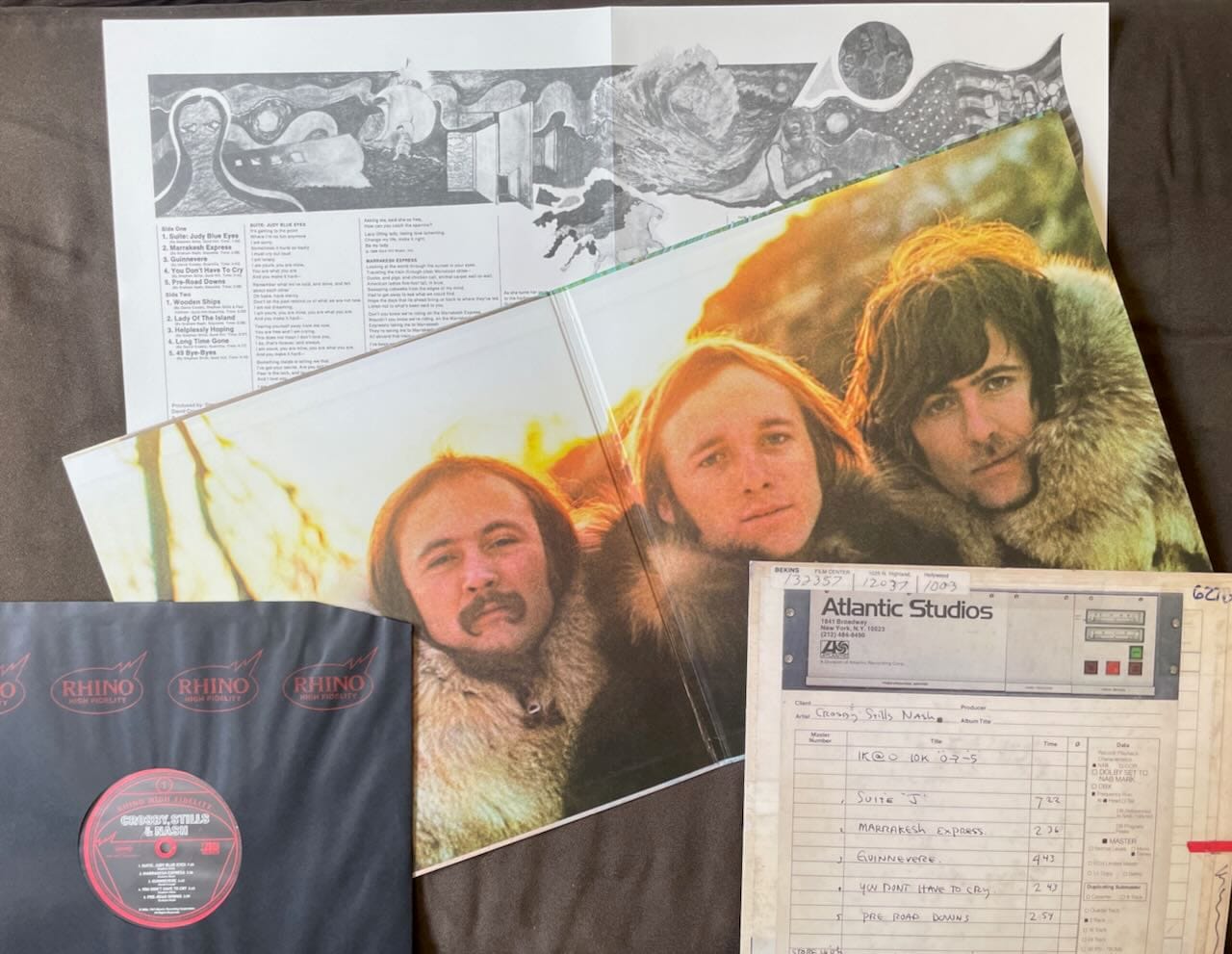
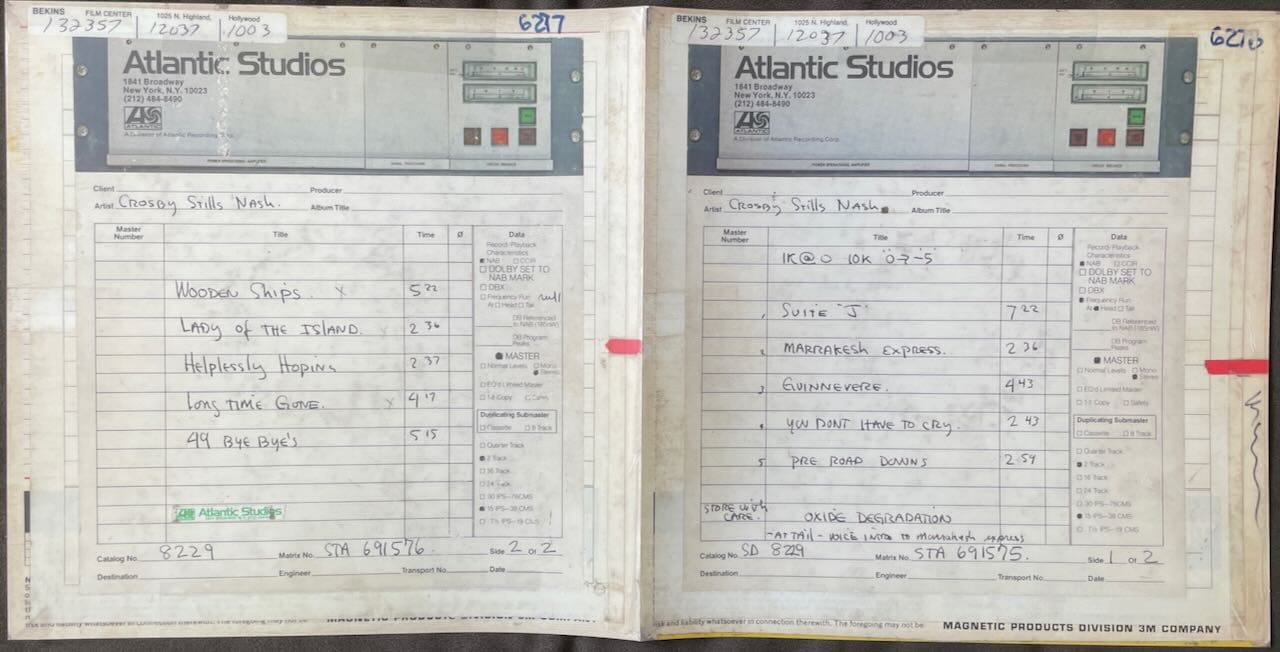
The Rhino High Fidelity edition replicates the original album’s gatefold, although in a hard gloss tip-on printing and not the textured cover the original came in. The fold-out lyric sheet is included, as is a four-page insert with images of the Atlantic master tape boxes—undated and not offering much in the way of scribblings or clues for vinyl detectives to puzzle over. Inside the insert is a slightly abridged version of the liner notes Raymonde Foye wrote for the 1993 version released as part of Atlantic’s short-lived line of gold CDs. Foye’s making-of essay, coupled with Gray’s terrific mastering, elevates this 33 RPM pressing into an authoritative rendering of the 1969 album.
In fact, the only real criticism one could make of this Rhino High Fidelity edition of Crosby, Stills & Nash is one of overfamiliarity. I’ve already provided an overview of how many times the album has been reissued; it’s never been difficult to find on vinyl in either used or new condition. And with Nautilus, Classic Records, Mobile Fidelity, Electric Recording Co., and Analogue Productions all having a stab at it over the years, one could argue that another audiophile pressing isn’t needed.
I don’t subscribe to that belief. To my mind, Rhino High Fidelity should offer definitive editions of the Warner Music Group catalog’s best and most important works, and Crosby, Stills & Nash fits that description like a glove. And this new pressing is likely to sound better than just about any vinyl version already in your possession, excepting the 45 RPM release from Analogue Productions. (The George Piros cut from the ’70s is also well regarded.) This is an updated refurbishment of a fundamental rock text, cut at 33 RPM as the original was, with a presentation that sloughs off much of the mix’s mud and minimizes the recording’s limitations so that it can be heard in the best possible light. It might not stand up to its reputation as a generation-defining classic, but it never was quite able to pull that off in the first place—and now it sounds as good as it ever has for future generations to make of it what they will.
Rhino High Fidelity 1-LP 33 RPM 180g black vinyl
• New remaster of Crosby, Stills & Nash’s 1969 debut album
• Jacket: Heavyweight glossy tip-on gatefold
• Inner sleeve: Rhino High Fidelity–branded poly-lined black paper
• Liner notes, insert, or booklet: Four-page insert with photos of tape boxes and essay by Raymond Foye, plus a separate insert that replicates original album’s fold-out lyric sheet, with song info and credits
• Source: Analog; “Cut from original analog master tapes”
• Mastering credit: Kevin Gray at Cohearent Audio, North Hills, CA
• Lacquer cut by: Kevin Gray at Cohearent Audio, North Hills, CA; “KPG@CA” in the deadwax
• Pressed at: Optimal Media, Germany
• Vinyl pressing quality (visual): A
• Vinyl pressing quality (audio): A
• Additional notes: Limited numbered edition of 5000. With wraparound obi.
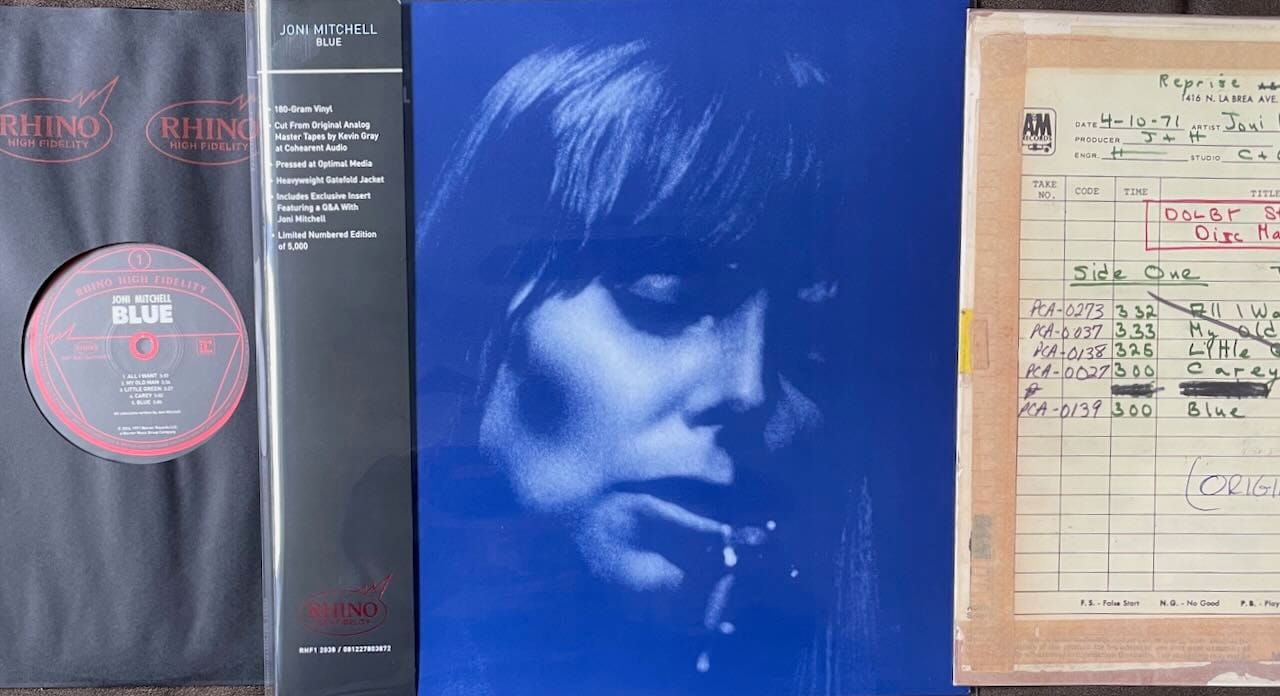
Joni Mitchell: Blue
There is enough connective tissue between Crosby, Stills & Nash and Joni Mitchell’s 1971 album Blue to fill a gossipy book or two. Graham Nash’s portion of Crosby, Stills & Nash was written in the hot rush of his romantic relationship with Mitchell; Blue was written in the aftermath of their breakup and inside the tumult of some other short-lived affairs Mitchell was involved in. But to discuss Blue purely in terms of Mitchell’s personal life is to entirely miss the point—the album’s merits lie in the beauty of Mitchell’s unbridled, unfiltered expression. It’s an album that virtually defined the singer/songwriter confessional genre, and it remains one of the most intimate and revealing statements ever committed to wax.
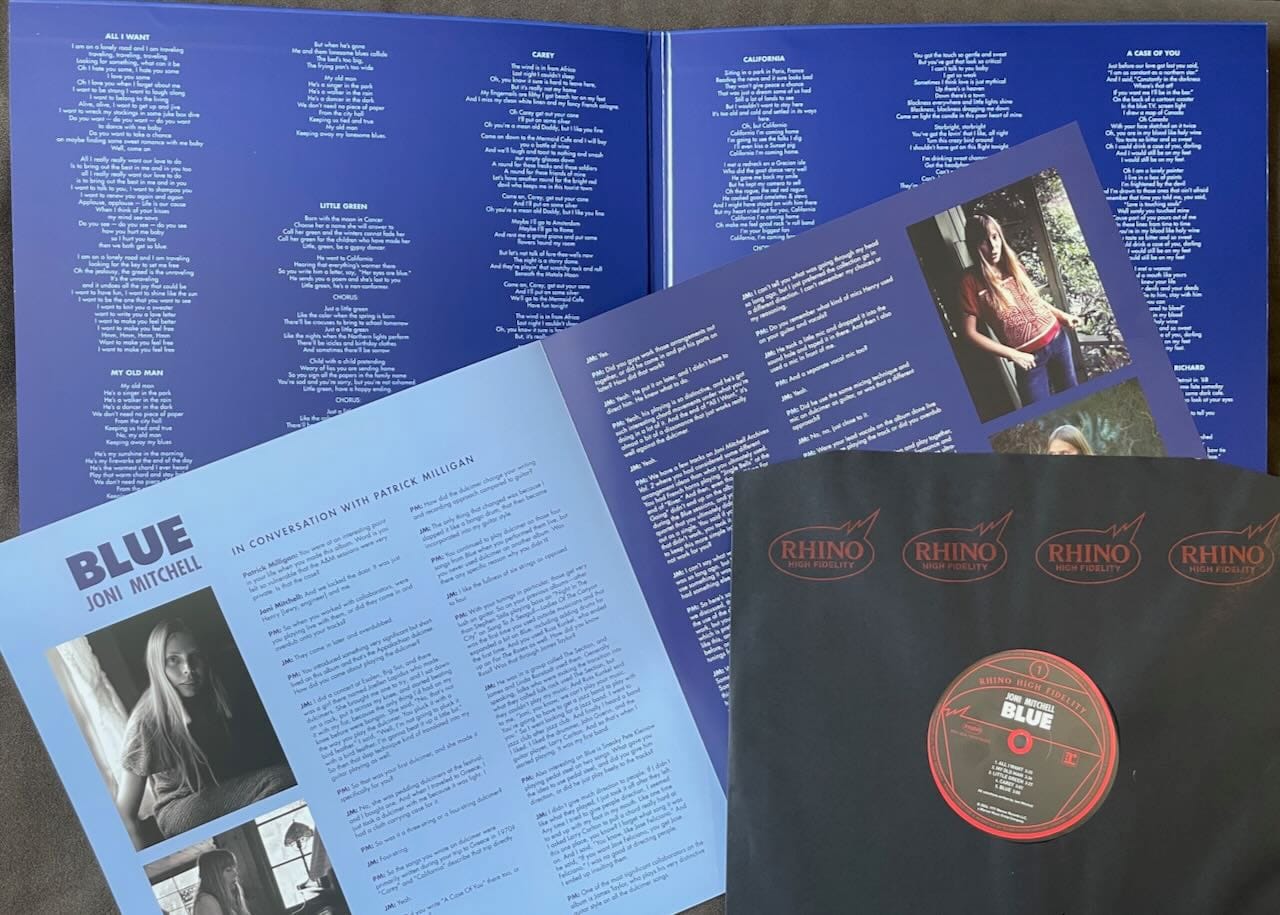
Mitchell herself doesn’t think it’s especially good. In the liner notes for the new Rhino High Fidelity edition—consisting of a Q&A with Mitchell conducted by Rhino’s Patrick Milligan—she says she thinks Blue is “highly overrated,” and that its vulnerability made her male peers uncomfortable. But as she told Bill Flanagan for Musician magazine in 1985, “That album is probably the purest emotional record that I will ever make in my life.” Mitchell’s transparency and unflinching look selfward is what has made Blue resonate with listeners for more than half a century.
The music matches the mindset. The songs are given stark, unfussy arrangements, with Mitchell on piano, dulcimer, or acoustic guitar, and little else, although James Taylor plucks along on three tracks, Russ Kunkel lightly taps percussion on another three, the Flying Burrito Brothers’ “Sneaky” Pete Kleinow plays pedal steel on two, and Stephen Stills fills out “Carey” with bass and guitar. Their contributions were overdubbed later; Mitchell recorded all of her parts in virtual isolation at A&M Studios C, with only recording engineer Henry Lewy on hand. While she kept things deliberately private when laying down her tracks, there was apparently some fraternizing with the musicians in Studio B next door, where Carole King was recording Tapestry and would try to get her hands on Studio C’s reddish wood Steinway piano whenever Mitchell wasn’t using it. For her part, Mitchell turned up on Tapestry, contributing backing vocals to “Will You Love Me Tomorrow.”
One of the narrative themes of Blue emerged from Mitchell’s travels in Europe, undertaken to decompress after the success of 1970’s Ladies of the Canyon and the breakup with Nash. Four of Blue’s songs were written on an Appalachian dulcimer that accompanied her on the trip. Mitchell spent several weeks in the small Greek fishing village of Matala on the southern coast of Crete, with much of that time living in one of the area’s Neolithic-era oceanside caves, where a cluster of international hippies had set up camp. “Carey” reflects that time and her fling with American cook Cary Raditz, while “California” describes her longing for home as she traveled through France and Spain.
But Blue’s strongest emotional undercurrents come from tracks that are less specific in their subject matter but no less impactful. “Little Green” was an older song Mitchell had written about the child she gave up for adoption in 1965, while the gorgeously sorrowful “River” recollects her Canadian background amid regret for a failed relationship and the pressures of public attention. “A Case of You” is another highlight, a tartly gorgeous, cut-to-the-bone breakup song that almost functions as an expression of love and devotion but is devastatingly undercut by the opening line: “Just before our love got lost…” These are remarkable manifestations of emotion, so intensely personal to Mitchell’s experience but so exquisitely and poetically crafted that they offer universal truths.

Blue is a delicate-sounding record, and while its pared-down sonic spectrum doesn’t offer much in the way of room-shaking low end or thickets of aural complexity, its sparseness requires that the pressing is clean and the mastering is sensitively done. The album has been well-served over the years, first cut in 1971 at A&M Studios by its in-house mastering engineer at the time, Bernie Grundman. Recuts and international pressings followed suit, but for our purposes, the first modern vinyl reissue of note came in 2007, when Rhino reissued Blue with mastering by Kevin Gray and Steve Hoffman at AcousTech Mastering, with Gray cutting the lacquer. Around 2019, a solo Gray cut appeared, made at his Cohearent Audio facility, and this cut replaced Rhino’s previous Gray/Hoffman version. Then, 50 years after his original mastering, Grundman cut Blue again for Mitchell’s 4-LP box set, The Reprise Albums (1968–1971), released in 2021. That Grundman cut, made from analog tape, has since been broken out into a stand-alone release. And lastly, Mobile Fidelity issued an UltraDisc one-step pressing in 2024, transferred to digital and cut at 45 RPM across two LPs.
Now there’s a new Kevin Gray cut—his third in roughly two decades. This new Rhino High Fidelity version was cut from the master tape (the exact pedigree of his two previous versions has not been explicitly stated, to the best of my knowledge). I was able to compare the new RHF edition to my 1971 Reprise pressing, cut by Bernie Grundman and pressed at Columbia’s Terre Haute plant, as well as the 2021 Grundman cut from the Reprise Albums box set. All three analog cuts have plenty of strengths and few weaknesses, but there are some differences that make the comparison worthwhile.
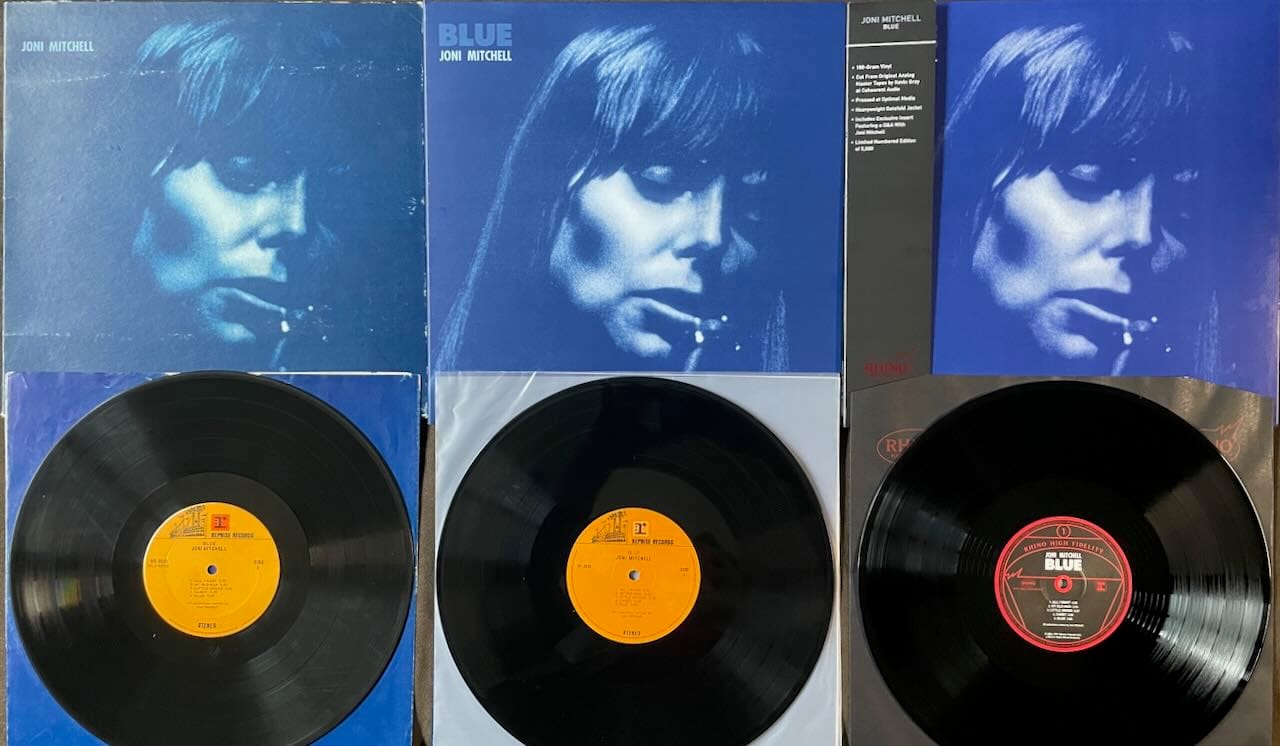
Grundman’s 1971 cut is a fine rendering of the album, full of crispness and presence. At certain points, as on the opening track “All I Want,” there’s a slight brittleness to the overall sound and an edginess from the high end; “Carey” has a similar, very slight excess of sparkle, although the bounce of that track on the ’71 mastering comes across really well. The piano-based tracks have a lovely richness, as on “Blue,” which at times is so full that it almost sounds like there might be two pianos in the room. The latticework of dulcimer and acoustic guitar on “A Case of You” is wholly enchanting, and “Little Green” is natural, open, and honeyed. Overall, everything sounds really good, although there isn’t a “wow” factor.
Grundman’s 2021 cut is—perhaps unsurprisingly—quite faithful to his original. There are some improvements, and the dulcimer/guitar tracks sound a bit more open and spacious. The sweetness and lilt of the songs is emphasized and carried through. But after comparing it to the new RHF pressing, I also noticed a slight sense of remove, as if things were under glass. The soundstage is a bit narrower, and the bass presence is reduced. I wonder how much of this is due to the equipment used rather than any mastering choices. The 2021 also suffers from a significantly noisier pressing, done at RTI.
The 2026 Kevin Gray RHF cut ended up being my favorite, although it had a couple of detriments. The piano on the opening stretches of “Blue” sounds a bit deteriorated, as if some information on the tape has gone missing over the years, and “All I Want” has the top end tamped down—a nice change from the edginess of the ’71, but one that also emphasizes the percussive hits of the metallic strings on the guitar and dulcimer at expense of their resonance. This precision could occasionally be heard on some of the other strummier tracks as well, such as “Carey,” in which some of the warmth is traded for clarity. However, on the Grundman cuts, I found that that track specifically could sound cluttered at times, and it didn’t at all on the Gray.
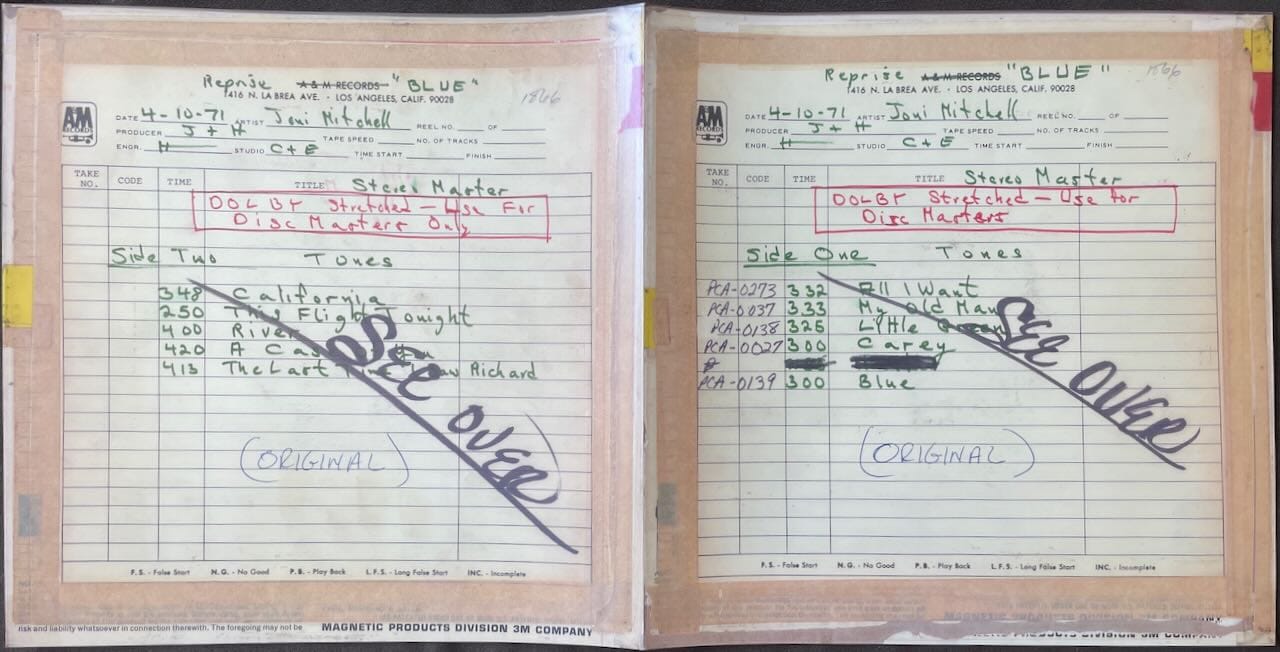
And in the end, the 2026 Gray cut’s strengths won out. “My Old Man” has a terrific freshness and breadth, and the piano on “River” is wonderfully articulated. The low growl of Mitchell’s 12-string guitars on “This Flight Tonight” comes through much more clearly, and the dulcimer on “A Case of You” is given a wonderful, mellow ripeness that didn’t come through on the other cuts, lending that track the proverbial “in-the-room” quality that is pretty spellbinding. What little bottom end the album possesses is increased to a just-right degree—most obvious on “Carey,” which has a fullness that can’t be heard on either of the Grundman cuts. But it’s also there on “California,” which had me close to wondering if maybe an uncredited bass was playing along with the track, and on “Little Green,” too, as Mitchell’s voice is rendered across the full sonic spectrum, with full bass, mid, and treble presence. Overall, the soundstage is larger, fuller, and more dimensional. And my pressing from Optimal was very good, although I did notice a few small clicks here and there after an ultrasonic cleaning. The album is so spacious and delicate, though, that perhaps any small flaw becomes that much more noticeable.
The Rhino High Fidelity high-gloss jacket has a pretty different sensation from the matte finish of the original version, and the original all-blue inner sleeve is not replicated. But the insert, with photos and the tape boxes and the Q&A, is a more-than-welcome substitute, even if a chunk of the good-natured Q&A is about how little Mitchell can remember about the decisions she made while making the album. Truth be told, I was not in the market for yet another pressing of Blue, as I thought my two Grundman cuts were more than satisfactory. But with a new analog cut that expands the album’s sonic footprint without overinflating it, coupled with a near-flawless pressing from Optimal, this new treatment of Blue sounds vibrant, alive, and fully widescreen. Best of all, the gravity of the new pressing doesn’t pull anything away from the sheer emotionality of Mitchell’s songs, which remain as potent, as cathartic, and as invigoratingly, painfully truth-telling as ever.
Rhino High Fidelity 1-LP 33 RPM 180g black vinyl
• New remaster of Joni Mitchell’s 1971 album
• Jacket: Heavyweight glossy tip-on gatefold
• Inner sleeve: Rhino High Fidelity–branded poly-lined black paper
• Liner notes, insert, or booklet: Four-page insert with photos of tape boxes and Q&A with Mitchell conducted by Patrick Milligan
• Source: Analog; “Cut from original analog master tapes”
• Mastering credit: Kevin Gray at Cohearent Audio, North Hills, CA
• Lacquer cut by: Kevin Gray at Cohearent Audio, North Hills, CA; “KPG@CA” in the deadwax
• Pressed at: Optimal Media, Germany
• Vinyl pressing quality (visual): A
• Vinyl pressing quality (audio): A- (a few soft ticks here and there)
• Additional notes: Limited numbered edition of 5000. With wraparound obi.
Listening equipment:
Table: Technics SL-1200MK2
Cart: Audio-Technica VM540ML
Amp: Luxman L-509X
Speakers: ADS L980