Review: Bob Dylan and the Rolling Thunder Revue
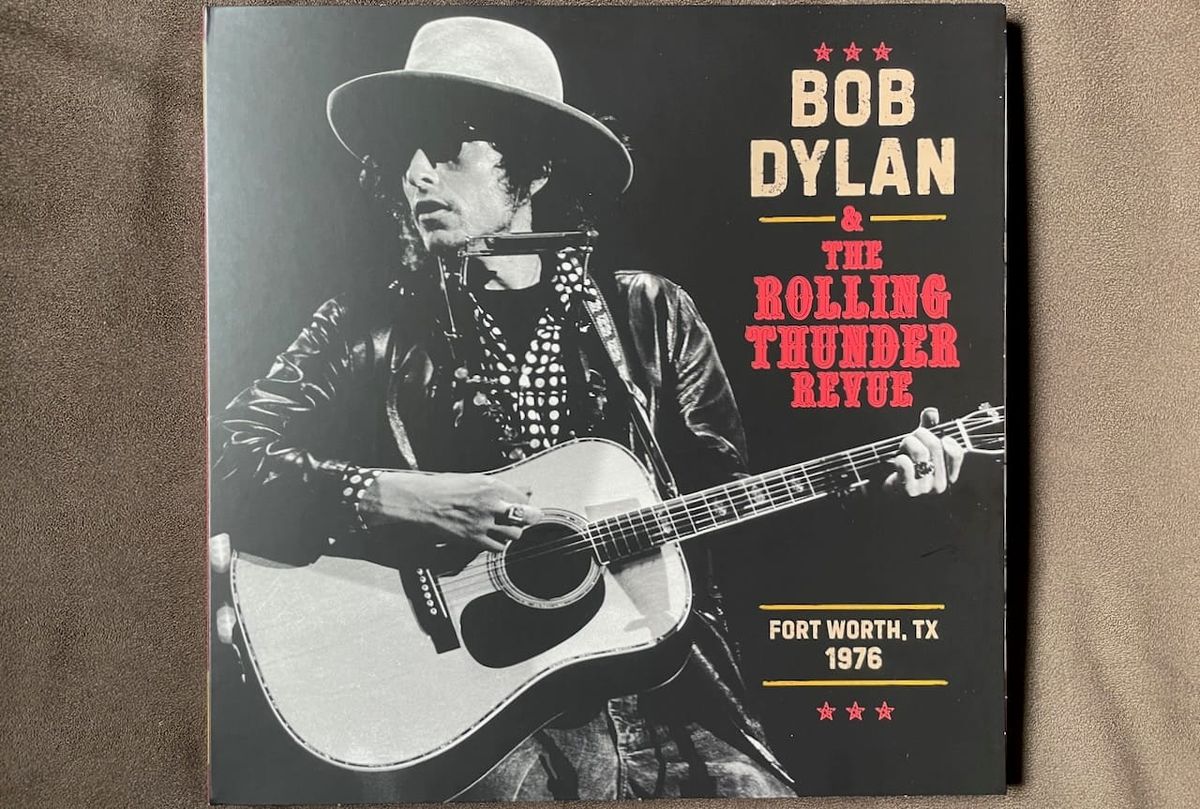
Fort Worth, TX - 1976: A vinyl taster of Rolling Thunder’s second leg.
It’s always been tough to extricate fact from fiction with the Rolling Thunder Revue. The traveling roadshow—led by Bob Dylan and featuring the talents of Joan Baez, Roger McGuinn, Jack Elliott, Bob Neuwirth, and, for a few shows, Joni Mitchell—was a surprisingly communal and almost utopian endeavor from the typically standoffish Dylan, and a culmination of the renaissance period that was ignited by his 1975 studio masterpiece Blood on the Tracks and also resulted in 1976’s nearly-as-good Desire.
The Revue was a spontaneous affair that traipsed through small theaters and halls in New England in the fall of 1975; a second leg operated in the much larger arenas and amphitheaters of the American South the following spring. Having started as a series of impromptu jams in Greenwich Village, the tour positioned Dylan as the leader of a loose collective of musicians that tramped from town to town like carnies, with spontaneity and bonhomie the motivating factors. In theory, it should have captured the mercurial Dylan in perhaps the most human light he’d ever been seen in: as a man with actual friends and peers, part of a democratic, loosey-goosey caravan with the potential to strip away the myth that had surrounded him ever since he exploded on the New York folk scene in the early 1960s.
Instead, more walls came up. Dylan concealed his face in white paint, and he used the tour as a roving film set for his indulgent, four-hour film Renaldo and Clara (eventually finished and released in 1978). A live album, 1976’s unsatisfying Hard Rain, was recorded near the tour’s end, when Rolling Thunder’s reckless abandon had calcified into road-hardened practicality. Much later, a comprehensive documentary of the proceedings, Martin Scorsese’s 2019 film Rolling Thunder Revue, should have been a thorough peeling back of the onion. Instead, it injected new fictions into the story, obfuscating the motivations and events of the tour, perpetuating old legends and creating brand-new ones. (For the record, the film is absolutely brilliant, despite its refusal to operate as a journalistic endeavor.)
Fortunately, the fifth volume of Dylan’s ongoing Bootleg Series, Live 1975: The Rolling Thunder Revue (released in 2002), seems to have captured some of the magic from those early days of the tour. Dylan had only just returned to live performance the previous year after spending nearly eight years off the road following his 1966 motorcycle accident (the occasional Isle of Wight appearance or Bangladesh benefit notwithstanding). His 1974 tour with the Band was a high-profile affair fashioned by promoter Bill Graham as a fabulous moneymaker—one that cast the mold for how large-scale rock tours would function ever after, and one that Rolling Thunder was a deliberate retreat from. A much bigger taste of Rolling Thunder came in 2019 with the 14-CD box set The Rolling Thunder Revue: The 1975 Live Recordings. It wrangled up all the known recordings from the first half of Rolling Thunder, including five live shows and a bunch of rehearsals.
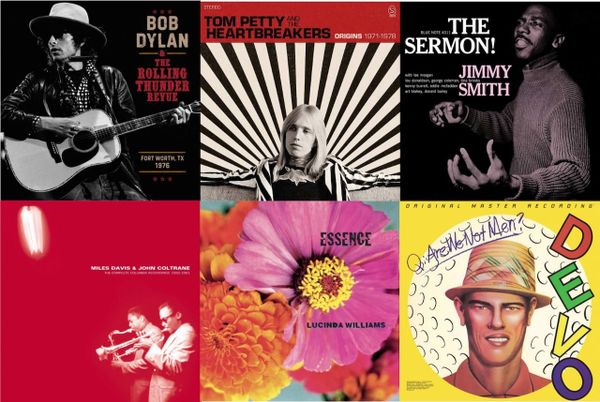
And now all of the extant professional recordings of the 1976 portion of Rolling Thunder have been stuffed into a 39-CD box, The Rolling Thunder Revue: The 1976 Live Recordings, featuring Dylan’s music from 22 of the 25 live shows on that leg. Coming a half-century after it was recorded, the box arrives just in time to preempt the unreleased recordings’ lapse into the public domain in certain European countries, with this release extending their ongoing copyright for decades to come. It’s a mammoth affair, to be sure, with 381 tracks for Dylan obesessives to sift through. For vinyl sticklers, though, the prospect is a bit easier to manage. A single performance from the tour—the May 16, 1976, show recorded at the Tarrant County Convention Center in Fort Worth, Texas—has been released as a 3-LP set, containing all of the songs Dylan performed that night. (The earlier portion of the show, featuring other musicians without Dylan, is not included.)
The Fort Worth vinyl set reveals that Rolling Thunder had mutated, quite comfortably and capably, into an arena-rock show that could play all the way to the cheap seats of these larger venues. It’s one of only two shows in the vast CD box that were recorded to multitrack as opposed to the stereo soundboards that make up the rest of the set; the other multitrack, the May 23 Fort Collins, Colorado, show, is available on streaming. Fort Worth and Fort Collins were the sources used for 1976’s Hard Rain, and the new Fort Worth mix (by Chris Shaw) removes some of the clanging, airport-hangar overtones that permeated the album, replacing them with much-needed clarity and intimacy while still sounding very much like a live recording of the era. It’s a decent recording if not an astonishingly vivid one—the band was oversized, with four or five guitarists strumming along at once, resulting in a somewhat unwieldy runaway-train sound.
At this point in the tour, Dylan had lost the face paint and the band had evolved into a well-oiled jukebox, playing many of the same songs night after night. Dylan’s tendency to stretch out vowels and rejigger the scansion of his most familiar lyrics had lost some of the initial improvisatory spark, but his reinventions had also settled into dramatically effective interpretations that played well to the larger crowds. “Blowin’ in the Wind,” performed as a duet with Joan Baez, bears a different, spikier rhythm to the familiar recorded versions, and “One Too Many Mornings” is now a lighter-in-the-air swayer with gang sing-alongs and Scarlet Rivera’s violin solo. Meanwhile, “I Pity the Poor Immigrant” is a jaunty, stop-start hootenanny with Latin flair. Even newer songs like Desire’s “Isis” are reworked—on this night, it was shifted from a 3/4 waltz into 4/4, beginning at a slower tempo suggested by the album version and shifting midway into a higher-octane reworking of the 1975 live version, as first heard on Dylan’s 1985 box set Biograph.
Dylan shouts many of his lyrics, although he’s found a more musical way to reach his upper registers than the frustrated bark he used on the 1974 live album with the Band, Before the Flood. With bassist Rob Stoner taking the high harmonies, Dylan elongates the last phrases of each line, holding the notes for maximum applause, a little like a circus seal balancing a ball on its nose. Scarlet Rivera’s violin, such a dominant force on Desire, gets a little lost in the thicket of guitars, which are led by the economical phrasing of Mick Ronson, formerly of David Bowie’s band. Ronson’s guitar adds definition to the amassed sound, and Stoner’s deft, ever-moving bass gives the ensemble its footing. (A fun easter egg is when Ronson reprises the staccato feedback trick from the end of Bowie’s “John, I’m Only Dancing” during the show’s finale, “Gotta Travel On,” which at this performance features vocals from Joan Baez, Kinky Friedman, Joni Mitchell, Bob Neuwirth, Roger McGuinn, and Rob Stoner.)
The Blood on the Tracks numbers inject a raw undercurrent to the otherwise jovial proceedings, but those songs, so vulnerable in their studio renditions, have grown coats of armor over the course of the tour. “You’re a Big Girl Now” is almost indulgently melodramatic, flirting with power balladry and turning its chord shifts into hard landings. Conversely, “Shelter from the Storm” and “You’re Gonna Make Me Lonesome When You Go” become dizzyingly upbeat, the former using its newfound guitar spangling to disguise itself as a buoyant pop tune, while the latter is transformed into a brisk barnyard two-step. The show climaxes with “Idiot Wind,” now a street-opera shootout with Dylan shouting fire and brimstone over the Revue’s somewhat chaotic backing.
The sound, as mentioned, is vastly improved over Hard Rain, overcoming the limitations of the live setting and the cluttered sound that would typically accumulate around the large-scale group. Dylan’s voice is the focal point of the mix, with Ronson’s guitar, Stoner’s bass, and Rivera’s violin providing counterbalance, and all of the other instruments condensed into a supporting backdrop. Everything here feels live, with the occasional out-of-tune string or muffled cough all part of the action. You don’t quite get the “you are there” feeling that you can with certain miraculous live recordings, but everything is cleanly and accurately presented. Kevin Przybylowski is credited with the analog-to-digital transfers, and the digital mix was mastered by Mike Piacentini, who is also credited with sound restoration. It’s unclear whether Piacentini (whose name is misspelled in the credits) was operating out of Sony’s Battery Studios for this project, as it was announced that Battery, located at the site of the former Record Plant, would be closing this year. Ryan K. Smith at Sterling Sound in Nashville cut the lacquers, and the vinyl presentation is really nice, perhaps only lacking some bottom-end heft that might have been avoided so as not to upset the already dense mix.
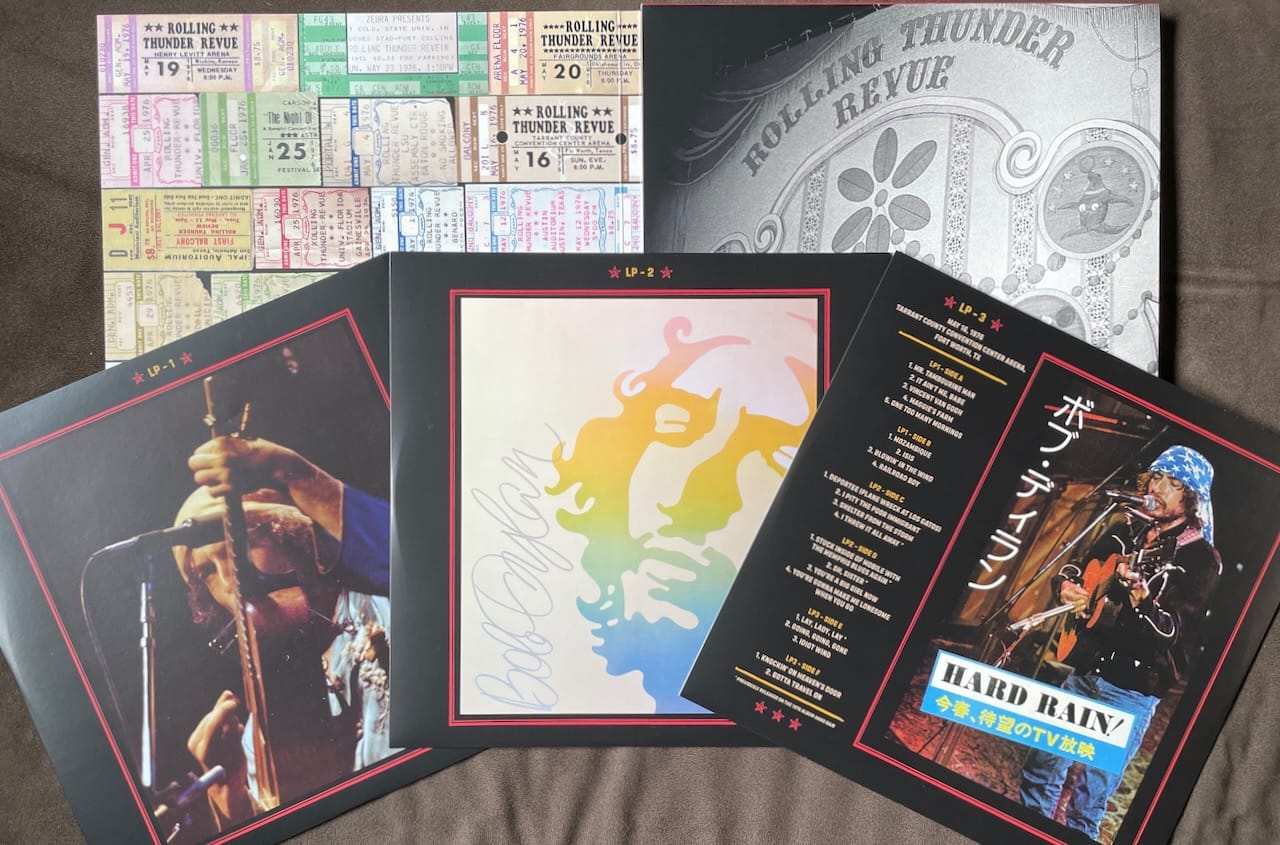
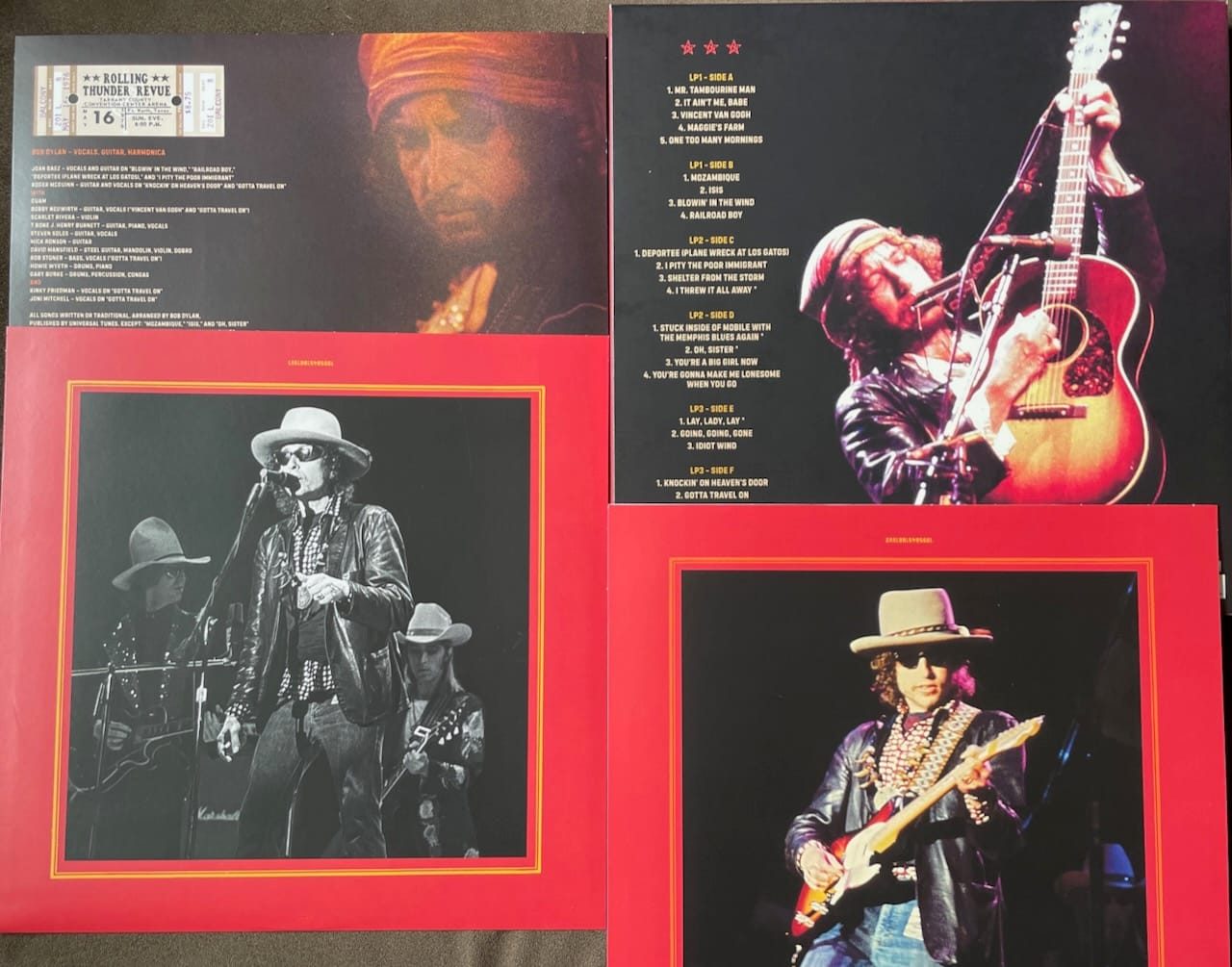
The vinyl itself, pressed at GZ’s Memphis Record Pressing, is more than adequate. My copy had some scuff marks on Side 1 that looked like they might cause problems, but they turned out not to be an issue sonically. The discs come inside printed card sleeves, which slip inside a folder that’s a little like an old Unipak-style jacket, albeit with a much bigger pocket to accommodate the three LPs (with some hidden artwork inside the pocket, too). There are no liner notes at all, which is unfortunate—Mikal Gilmore contributed an essay to the larger CD set, and it would have been nice to have an excerpt from it for the vinyl component. The package is appealing, but it doesn’t quite shake off the feeling of a sampler put out to appease vinyl diehards, lacking the scope and context that the big CD box presumably offers.
All told, though, this Fort Worth show is perhaps as accurate a cross-section of what the second half of the Rolling Thunder Revue actually felt like as we’re likely to get. Everything is competently played and well-executed, resulting in a solidly workmanlike performance by a Dylan who’s here to put on as effective a show as possible and a band that knows how to navigate their leader’s tendency for spontaneous invention. There is the sense that some of the chaos of the tour’s earlier days has been reined in, and perhaps with that control comes a loss of some of the magic that has given Rolling Thunder its legendary status. But the band is road-tested and savvy, with their chops on solid ground. Another way to look at it is as a vast and vital improvement of the Hard Rain album, with much better sound, an expanded tracklist, and the pacing and verve of an actual live gig. And even while its three LPs are a time commitment in and of itself, Fort Worth, TX 1976 pulls off something that seems totally unlikely: It makes you curious about all the other live shows that are inside that giant 39-CD box.
Columbia/Legacy 3-LP 33 RPM black vinyl
- Live recording of Bob Dylan and the Rolling Thunder Revue’s May 16, 1976, show at the Tarrant County Convention Center in Fort Worth, Texas
- Jacket: Direct-to-board double-side-printed Unipak-style foldover sleeve with expanded 3-LP capacity
- Inner sleeve: Printed paper with photos, album credits, and other images
- Liner notes, insert, or booklet: None
- Source: Digital
- Mastering credit: “Mastering and restoration by Mike Piancenti [sic],” “Analog-to-digital transfers: Kevin Przybylowski, Sonicraft A2DX Lab”
- Lacquers cut by: Ryan K. Smith at Sterling Sound, Nashville, TN; “RKS” in the deadwax
- Pressed at: Memphis Record Pressing, Memphis, TN
- Vinyl pressing quality (visual): B (some blemishes on Side 1 that did not affect sound)
- Vinyl pressing quality (audio): A- (some minor background noise, generally quite good)
- Additional notes: None.
Listening equipment:
Table: Technics SL-1200MK2
Cart: Audio-Technica VM540ML
Amp: Luxman L-509X
Speakers: ADS L980