Reviews: RSD Black Friday 2026
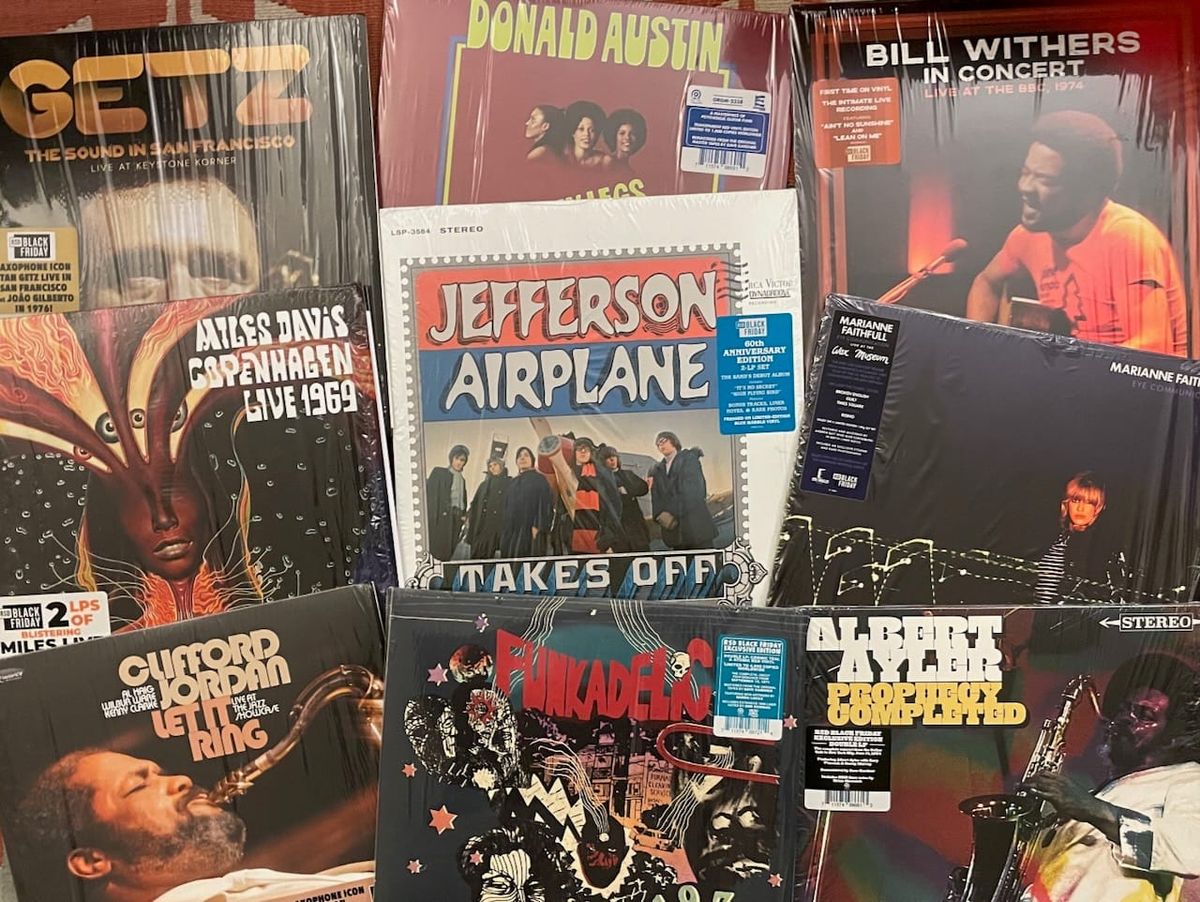
I’ve got nine reviews for nine RSD Black Friday releases today. These will all be at independent record stores this Friday, November 27. There will be, of course, a lot more options to choose from, but these were all of the records I was able to get my hands on ahead of the big day.
- Donald Austin: Crazy Legs
- Albert Ayler: Prophecy Completed
- Miles Davis: Copenhagen Live 1969
- Marianne Faithfull: Eye Communication: Live at the Wax Museum
- Funkadelic: Live at Meadowbrook 1971
- Stan Getz (with João Gilberto): The Sound in San Francisco: Live at Keystone Korner
- Jefferson Airplane: Jefferson Airplane Takes Off
- Clifford Jordan: Let It Ring: Live at the Jazz Showcase
- Bill Withers: In Concert: Live at the BBC, 1974
I was pleased and a little surprised to discover that there wasn’t a dud in the bunch. It’s heavy on live stuff—only two are studio recordings—but all of these new pressings have something to offer for listeners interested in the performers involved.
Let’s get into it.
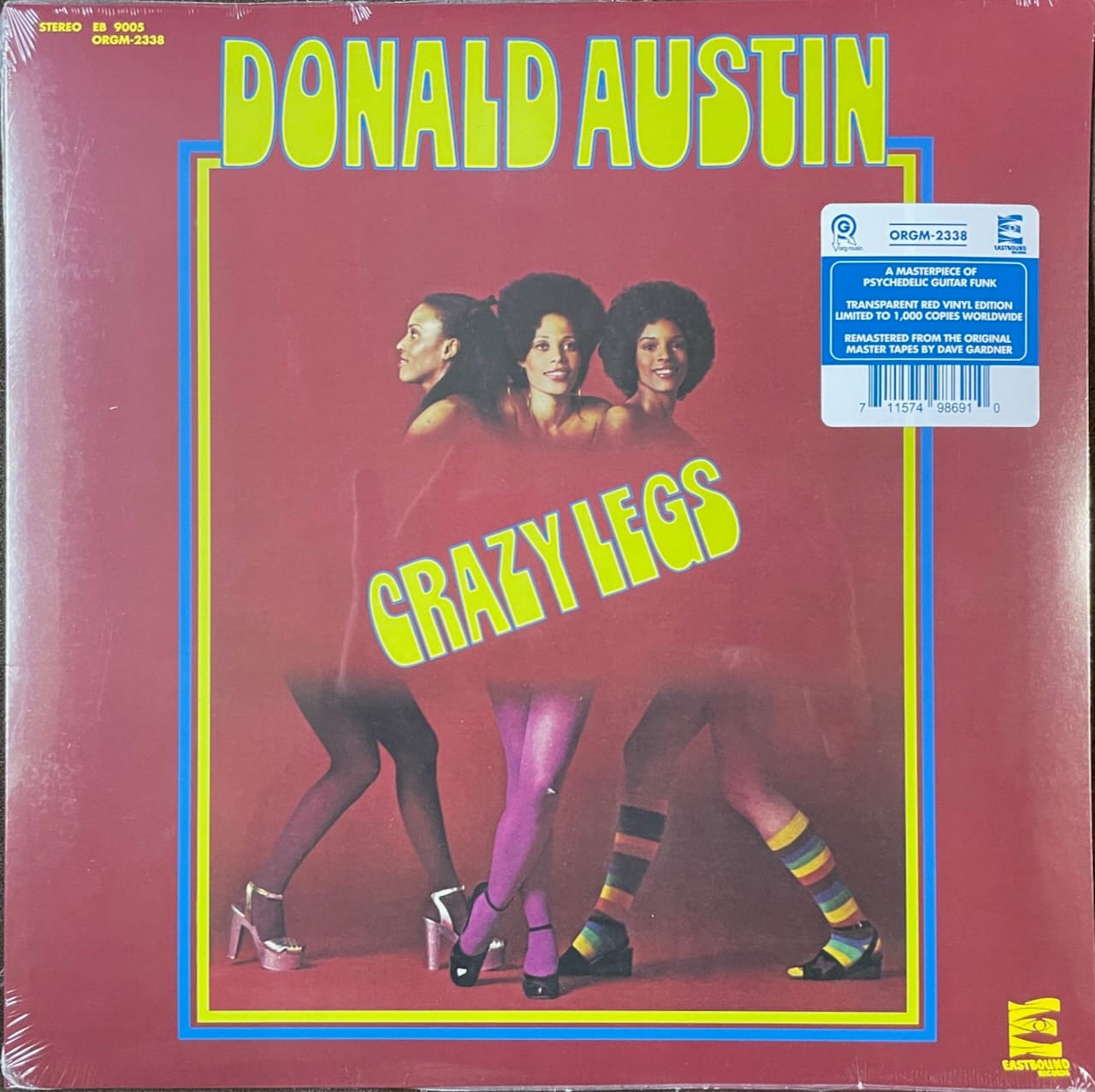
Donald Austin: Crazy Legs
I’m going in alphabetical order, but that just means I get to kick things off with an absolute slammer. Donald Austin’s 1973 album Crazy Legs is a crate-digger’s grail, an instrumental album that marries Memphis soul and Detroit funk in an uncommon and totally fulfilling way. Fans of Booker T. and the MG’s and the Meters’ early Josie sides will definitely want to check this one out—it’s an upbeat groover of tight, concise funk and deep-fried soul that’s going to be one of the highlights of this year’s RSD Black Friday.
Not a whole lot is known about Donald Austin, the soul-funk guitarist behind Crazy Legs. Initially based in Memphis, he and producer Woody Wilson released two singles, “Side Saddle” and “Crazy Legs,” on Wilson’s Woody label in 1972, with the publishing administered by Bridgeport Music, the music publishing company of Westbound Records label head Armen Boladian. It’s unclear to me whether Austin and Wilson were based in Memphis at the time or were operating out of Detroit, but Boladian quickly reissued “Crazy Legs” on his Eastbound Records offshoot label, and Austin, Wilson, and producer Bernie Mendelson (part of the Westbound/Detroit stable, having done some administrative work on some Funkadelic albums) began recording the Crazy Legs full-length in Memphis.
Adding to the mystery are the photos of the participating musicians on the album’s back cover. Austin has a caption over his photo, but the drummer, keyboardist, and percussionist in the pictures? No idea, and none of the musicians are credited. There also must’ve been a bassist, not pictured, and other session musicians were audibly involved, including horns and strings on the handful of Detroit Emeralds covers that Austin and Wilson have tackled. I am guessing that Wilson is the keyboardist here, but I really don’t know. Furthermore, the back cover states plainly it was recorded in Memphis, not Detroit, and it sounds like it. This crew sound like they were local Memphis cats steeped in the Southern soul of Hi, Goldwax, and Stax/Volt Records, not the glistening Motown soul nor the rangy funk that was starting to emerge out of Detroit at the time.
The title track is a hybrid of both styles, built on wack-a-chunk 16th-note strums from Austin’s electric guitar and some light wah-wah coloring but also featuring a beautiful Steve Cropperesque turn-around that sends it in a different direction. Austin’s lead guitar style—I am not sure if he’s doubling on rhythm and lead here, but my guess would be yes, that he overdubbed himself—ranges from tasteful wah-wah accoutrement to more soulful Southern chicken scratch with a little hint of Duane Allman fire. The drums are in the pocket, displaying some teeth on “Side Saddle” but otherwise remaining in the effortlessly laidback style of Al Jackson Jr. A jaunty country fiddle even turns up on “Manassas Boogie,” which otherwise sounds like a lost MG’s classic.
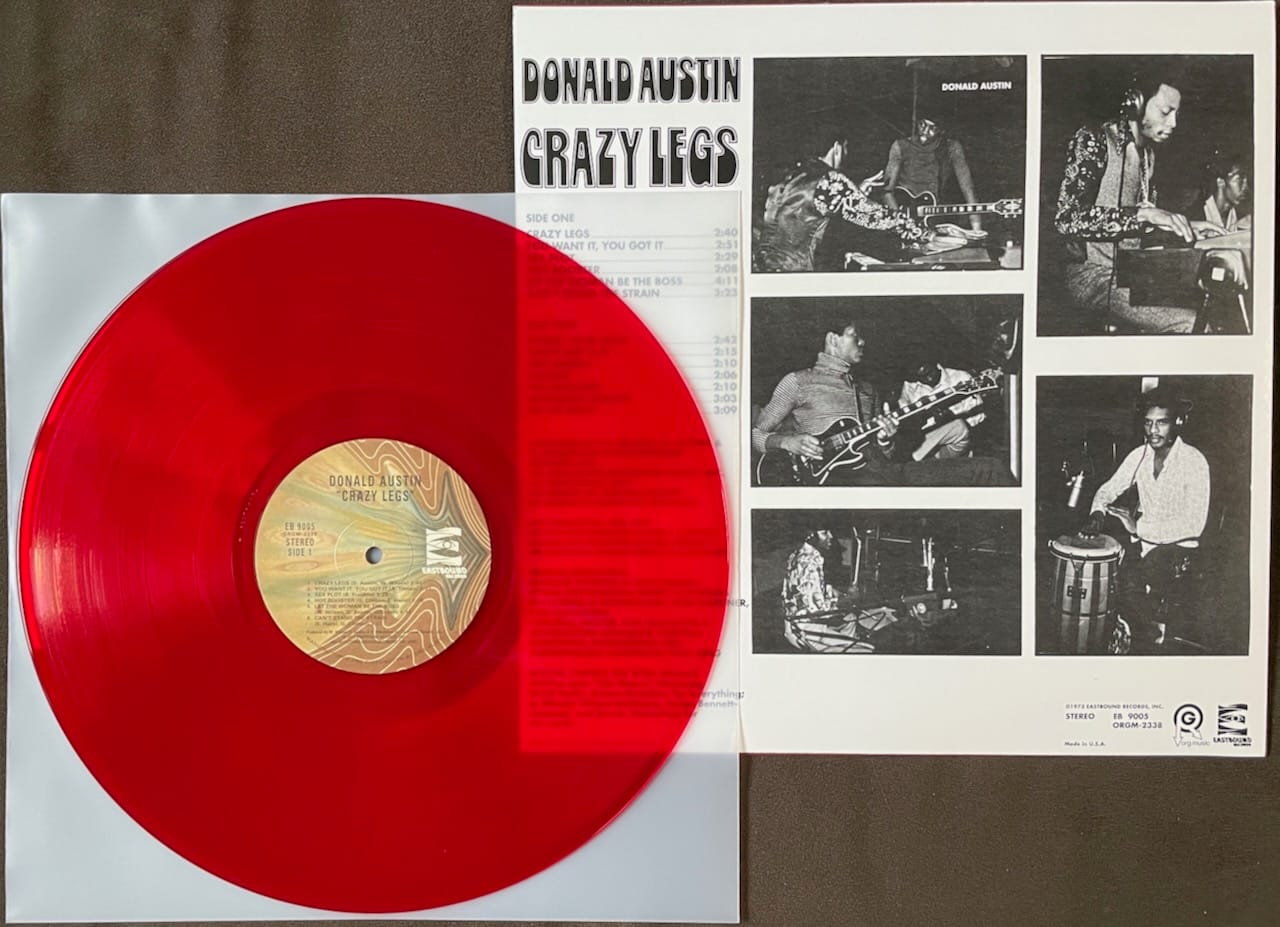
The material is largely co-written by Austin and Wilson or plucked from Boladian’s Bridgeport/Westbound catalog; there are the three aforementioned covers of Detroit Emeralds tunes here written by Abrim Tilmon, and a take on Funkadelic’s “Can’t Stand the Strain,” as well as a number written by George Clinton and Eddie Hazel called “Hot Rooster” that doesn’t seem to have appeared on any Funkadelic records. There’s also a cover of “Sex Plot,” a B-side by Bobby Franklin’s Insanity released on Westbound in 1970. It also looks like “Side Saddle,” for which Austin received sole songwriting credit on the 45, was altered to credit Wilson, Mendelson, and Boladian, so I wonder what happened there.
It’s a little unusual to write about an album that I know so little about. But what’s not unknown is the mastering pedigree. Dave Gardner and Catherine Vericolli are responsible for their much-publicized preserving and refurbishing of the Westbound Records archive of master tapes; as I’ve written about here, they were behind the three mindblowingly good Funkadelic reissues we’ve gotten over the past year and change. For Crazy Legs, they created a high-resolution digital transfer of the analog master in Detroit, which Gardner then mastered in his LA studio, and the results flat-out rip. Gardner’s mastering, with a lacquer cut by Philip Rodriguez of Elysian Masters, has just-right amounts of bass, with an effervescent mid-range, animated transients, and plenty of space around the top end, creating a spatial, clarity-filled mix with luscious decay from the reverb in the original mix.
Crazy Legs will be an RSD Black Friday release in the UK and Europe, but not in the US, where it will be a standard retail release this Friday, November 27, and should be available at independent record stores. It may be lumped in with all the other RSD releases or you may need to look out specially for it. (You may also need to ask for it specifically—just keep in mind that Black Friday will be a trying day for even the most patient record store clerks, so choose your moment.) This spectacular-sounding bit of breezy instrumental funk with some Stax-style seasoning is well worth tracking down.
Org/Eastbound 1-LP 33 RPM transparent red vinyl
- Remaster of Donald Austin’s 1973 album
- Jacket: Direct-to-board single pocket
- Inner sleeve: Heavy-duty plain poly
- Liner notes, insert, or booklet: None
- Source: High-resolution digital transfer of the original analog tapes
- Mastering credit: “Mastering & restoration: Dave Gardner, DSG Mastering; Original master tape transfers & restoration: Catherine Vericolli; Additional engineering and indispensable advice: Nick King”
- Lacquers cut by: Philip S. Rodriguez at Elysian Masters, Pasadena, CA; “PR EM” in the deadwax (the “P” is backwards and looks like a “C”)
- Pressed at: Furnace Record Pressing, Alexandria, VA
- Vinyl pressing quality (visual): A
- Vinyl pressing quality (audio): A
- Additional notes: Limited edition of 1000.
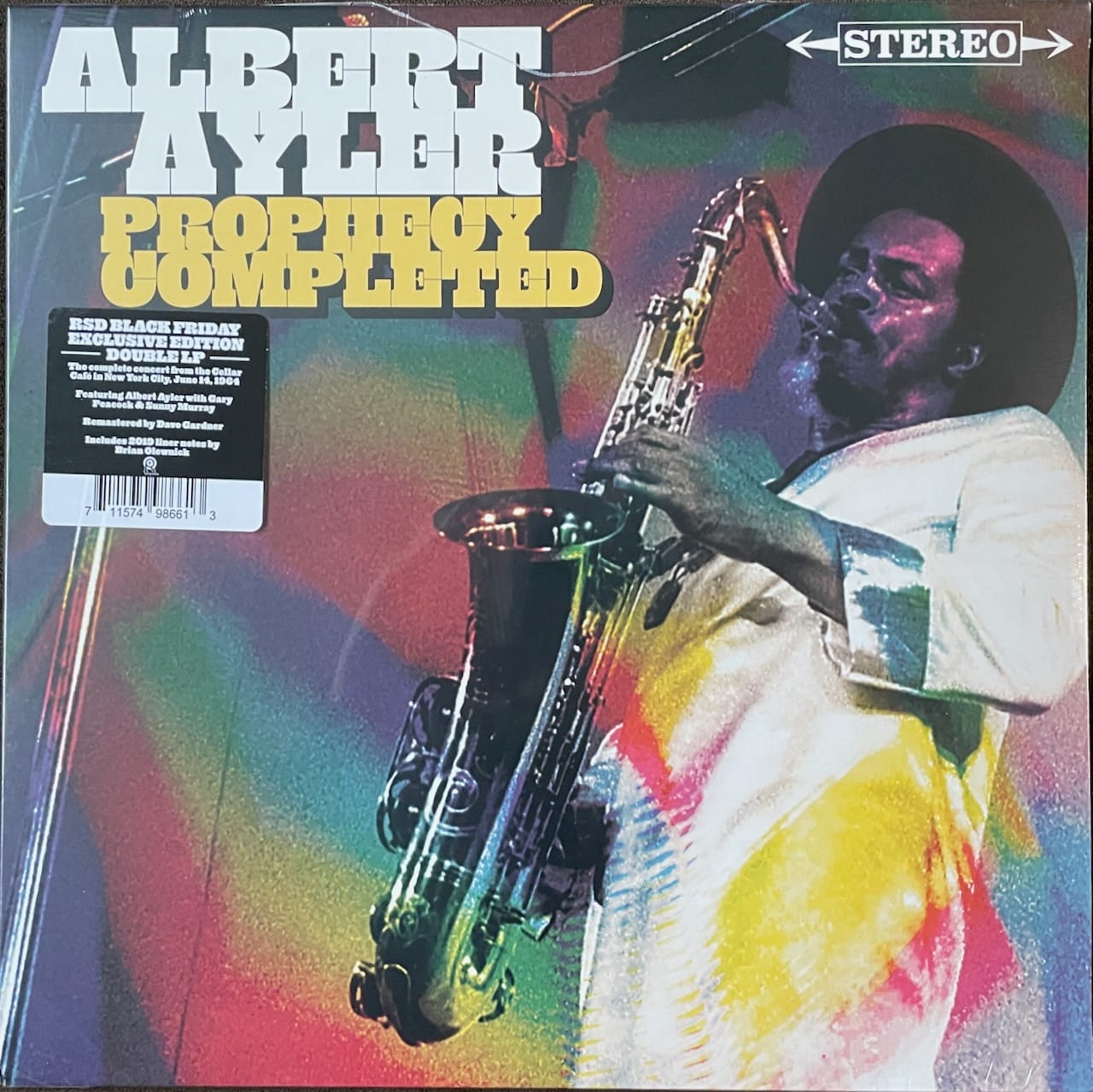
Albert Ayler: Prophecy Completed
This live performance from New York City’s Cellar Cafe on June 14, 1964, has been released in various formats over the years—initially in 1975 as Prophecy on ESP-Disk, the label that also released Ayler’s most important recordings, including the epoch-shattering free-jazz milestone Spiritual Unity. That album was recorded one month after this live date featuring the same trio of Ayler, drummer Sunny Murray, and bassist Gary Peacock, so what we are hearing is very much the preparation work that went into its creation, with an unscrubbed, truly weightless element to the live playing. ESP-Disk botched the initial Prophecy release with subpar sound and at the incorrect speed, and without permission from Ayler’s estate, who had been handling the saxophonist’s affairs since his tragic death in 1970.
This double LP uses a superior master originally sourced from Murray, the one that was used for the 2019 CD Prophecy Revisited on the Swiss label Hat Hut Records, with almost all of the extra material that was first released on the 1996 CD Albert Smiles with Sunny (bar one track). I believe this is the first time the extra material has been released on vinyl. A digital transfer was supplied by Werner Uehlinger of Hat Hut, which was then mastered by Dave Gardner of DSG Mastering, who’s responsible for the excellent Westbound Records reissues that Org has been putting out.
As for the music—it is put-hair-on-your-chest free-range skronk of the wildest and wooliest variety. Ayler’s brand of free jazz was so out there that even dyed-in-the-wool free-jazz aficionados blanch a little bit when they listen to it, muttering into their chinbeards that it goes beyond the established boundaries of the genre. Ayler would toot out these sweet little composed heads with almost sing-song melodies and then shoot far off into the astral plane, eschewing chromatic framework, rhythmic conventions, and even the established laws of physics, bending sound and space with a deep-throated bellow that could thunder like a vengeful god bent on armageddon as well as screech and squeal like the creations being crushed under that god’s angry fist.
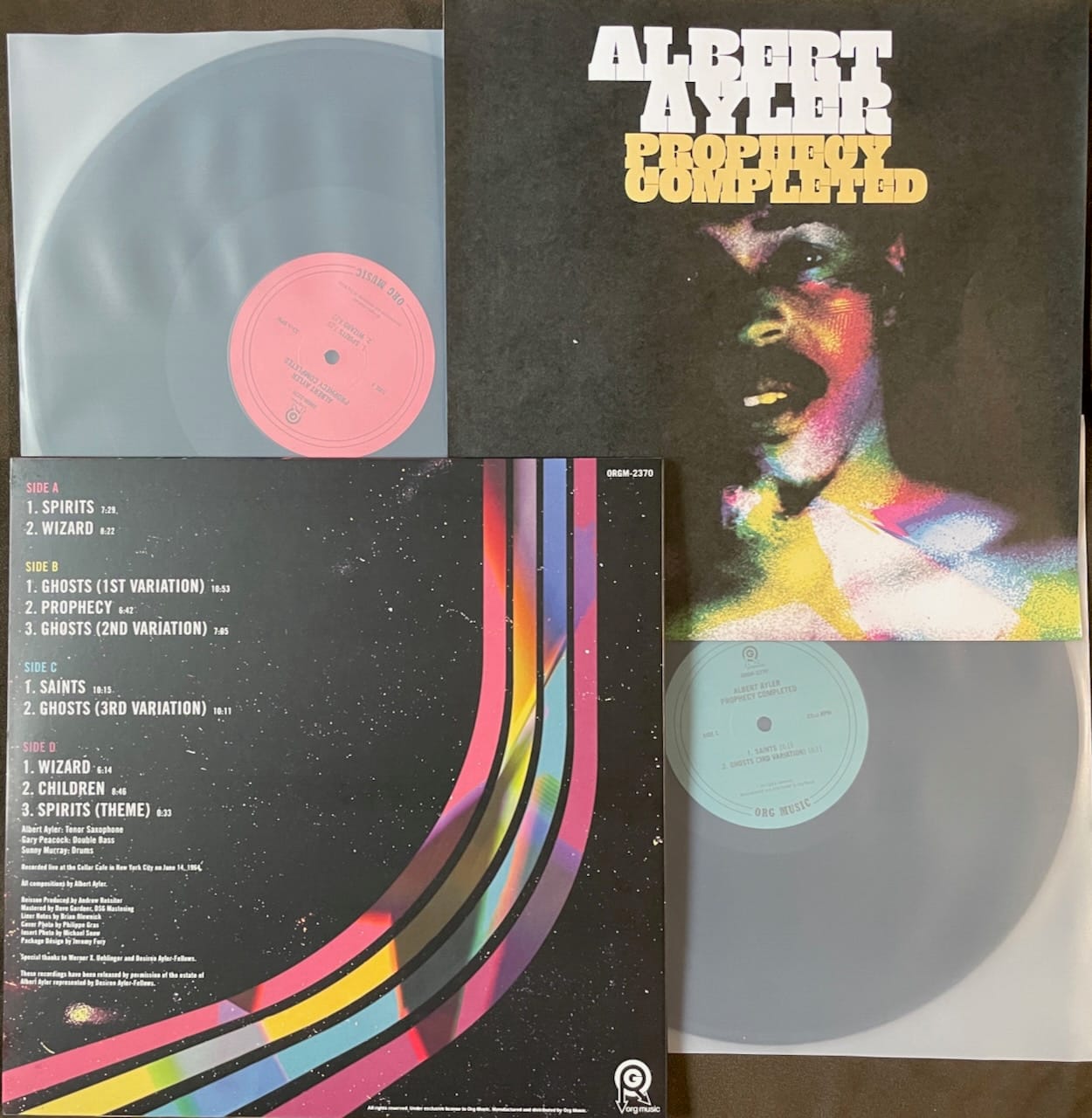
Drummer Sunny Murray and bassist Gary Peacock were game collaborators. Peacock would pluck precise, violet stabs with his fingers and then surround them with infinite little cuts, and Murray provided persistent, fluttering brushwork, with cymbal and snare patters trailing behind Ayler’s lines like incense emanating from a thurible. There’s also a wailing sound in the background, which might be Murray’s groaning—a distuned siren suggesting the lamentation of the elements. Whatever it is, it’s very unsettling.
Prophecy Completed is not a casual pick-up. It’s probably not even the place to start with Ayler, whose Spiritual Unity should likely be absorbed first. But for those venturesome enough to plunge into this maelstrom, the sound is vivid and present, with ace mastering from Gardner and context provided via the liner notes from Brian Olewnick, printed rather cheaply on a paper insert that is the package’s only shortcoming. That aside, everything else here is more than capable of transporting the listener into this dim, smoky Upper West Side basement more than 60 years ago, where Ayler opened a vortex into another dimension with his quacking, quaking horn.
Org 2-LP 33 RPM black vinyl
- Remaster of the live recording from June 14, 1964, at the Cellar Cafe, New York, NY
- Jacket: Direct-to-board single pocket
- Inner sleeves: Heavy-duty plain poly
- Liner notes, insert, or booklet: Two-sided insert with essay by Brian Olewnick, originally published in the 2019 CD edition titled Prophecy Revisited
- Source: Digital
- Mastering credit: “Mastered by Dave Gardner, DSG Mastering,” Los Angeles, CA
- Lacquers cut by: Philip S. Rodriguez at Elysian Masters, Pasadena, CA; “PR EM” in the deadwax (the “P” is backwards and looks like a “C”)
- Pressed at: Furnace Record Pressing, Alexandria, VA
- Vinyl pressing quality (visual): A
- Vinyl pressing quality (audio): A
- Additional notes: Limited edition of 2000.
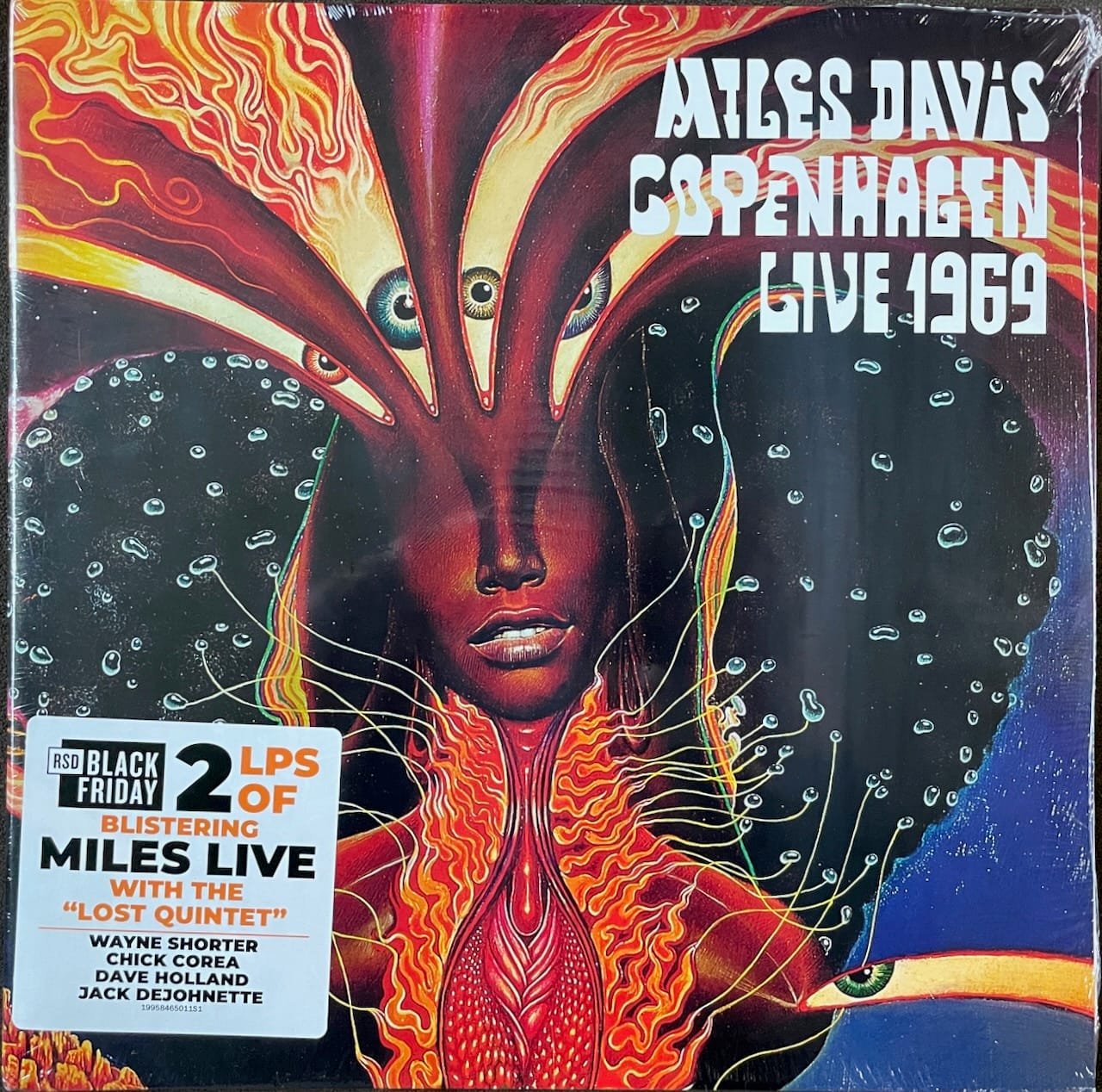
Miles Davis: Copenhagen Live 1969
An altogether new live album from Miles Davis’s renowned Bitches Brew era seems like a far-fetched proposition—how can anything from this era not have been released before? To be sure, this stuff has, most notably as a DVD in the 40th-anniversary box set of Bitches Brew from 2010. But its presence on vinyl and CD is a much rarer thing to come by. A limited vinyl edition of 500 did appear some years back, accompanied an art book by artist Abdul Mati Klarwein, cover artist for Bitches Brew—and Live-Evil, and Santana’s Abraxas, and this set as well, which uses Klarwein’s unforgettable 1970 painting Zonked for its wraparound gatefold, a square of which also made its way onto a Last Poets CD in the ’90s. Any CDs of the material seem to be somewhat dubiously sourced or gray-market at best.
The performance, which was recorded by Danish radio and broadcast on Danish radio and television, is now given a proper vinyl outing, on two LPs with dynamic, heavyweight sound. The mono recording is excellent, and the performance—from November 4, 1969 at Tivoli Konsertsal in Copenhagen—is somewhat unique within Davis’s vast catalog. The performance came during the lengthy interim between the August 1969 recording sessions for Bitches Brew in New York and its street date in March 1970, so much of this material would have been unfamiliar to Danish audiences. The ensemble, too, was one that never backed Miles on a studio album. The so-called “Lost Quintet” included Wayne Shorter on tenor and soprano sax, Chick Corea on electric piano, Dave Holland on double bass, and Jack DeJohnette on drums. They all participated on Bitches Brew but with other musicians added to that album’s dense, frenzied mix; here, the stripped-down quintet tackles scissor-lean versions of the Bitches material as well as some older numbers from Davis’s trick bag.
It’s an incredible performance, with psychedelic rock and fragmented funk just as much a part of the equation as Davis’s cool and modal inventions on the jazz front. The musicians never stop; songs flow in and out of each other, the only interruption being the necessary cuts to accommodate for sides of vinyl. The kaleidoscope of Bitches Brew is pared down to fit the scope of the ensemble, but the sound is one of continual transmutation and osmosis, as whorls of sound expand and contract. Corea and DeJohnette are the primary architects here, with Corea’s burbling electric piano sounding at times like orchestral coloration and at others like a twinkling celeste, and DeJohnette locking into the groove when required but more frequently sketching the outline of one, if not crashing like an onslaught of waves onto the rocky seawall of the beat.
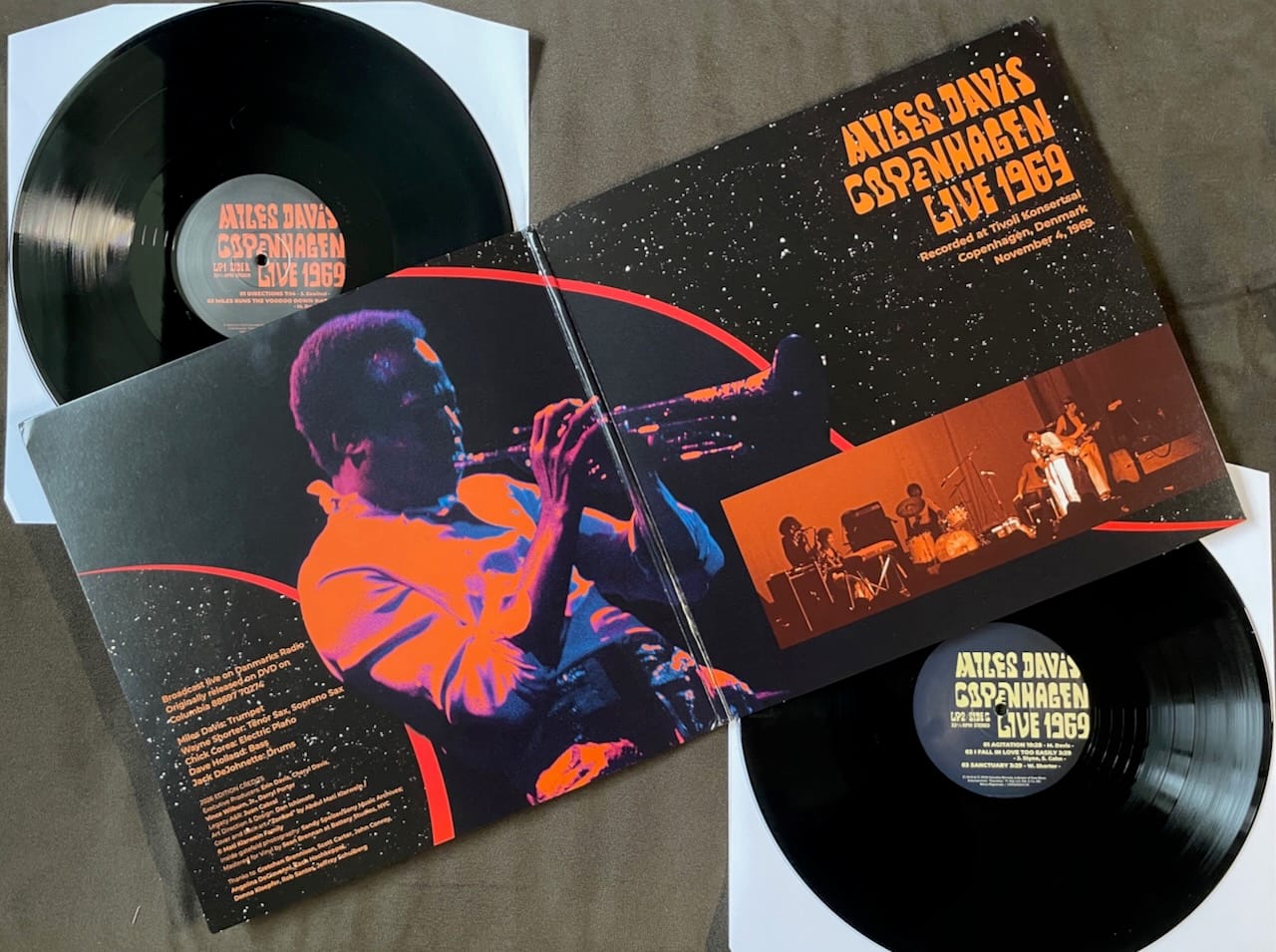
The recording is excellent, too; those Danish radio engineers really knew what they were doing, and the mono mix sounds as good as any live album, with perhaps the only complaint being that Holland’s upright bass sometimes gets swallowed up in the electric hoodoo. To my ears, the mix is vastly improved from what’s on the 40th anniversary DVD—the individual instruments are much more audible, and the overall sound is much less boxed-in, particularly on DeJohnette’s drums. The pressing, from MPO, is decent enough, with not exactly silent backgrounds but no real interference with the music.
With the fantastic sound and a vital performance, this is feeling like a crucial document of the Bitches Brew period, when Miles found the secret tunnelways that connected jazz to electric rock and blasted them open with dynamite. The quintet is an uncommon flavor of Miles for fans to explore as well, and the coherency of the five-piece’s interplay is far more approachable than the live work Davis and an expanded ensemble would pursue in 1970. Don’t let the mono mix or its broadcast origins fool you—I’d consider this a great live album regardless of the fact that it’s a limited RSD release.
Columbia/Legacy 2-LP 33 RPM black vinyl
- Live performance from November 4, 1969, recorded by Danish radio and television
- Jacket: Direct-to-board gatefold
- Inner sleeves: White paper
- Liner notes, insert, or booklet: None
- Source: Digital
- Mastering credit: “Mastered for vinyl by Sean Brennan at Battery Studios, NYC”
- Lacquers cut by: Daniel Krieger at SST, Frankfurt, Germany
- Pressed at: MPO, Villaines-la-Juhel, France
- Vinyl pressing quality (visual): B+
- Vinyl pressing quality (audio): B (some surface noise and light ticks here and there)
- Additional notes: Limited edition of 4400 in the US, with an additional allotment outside the US.
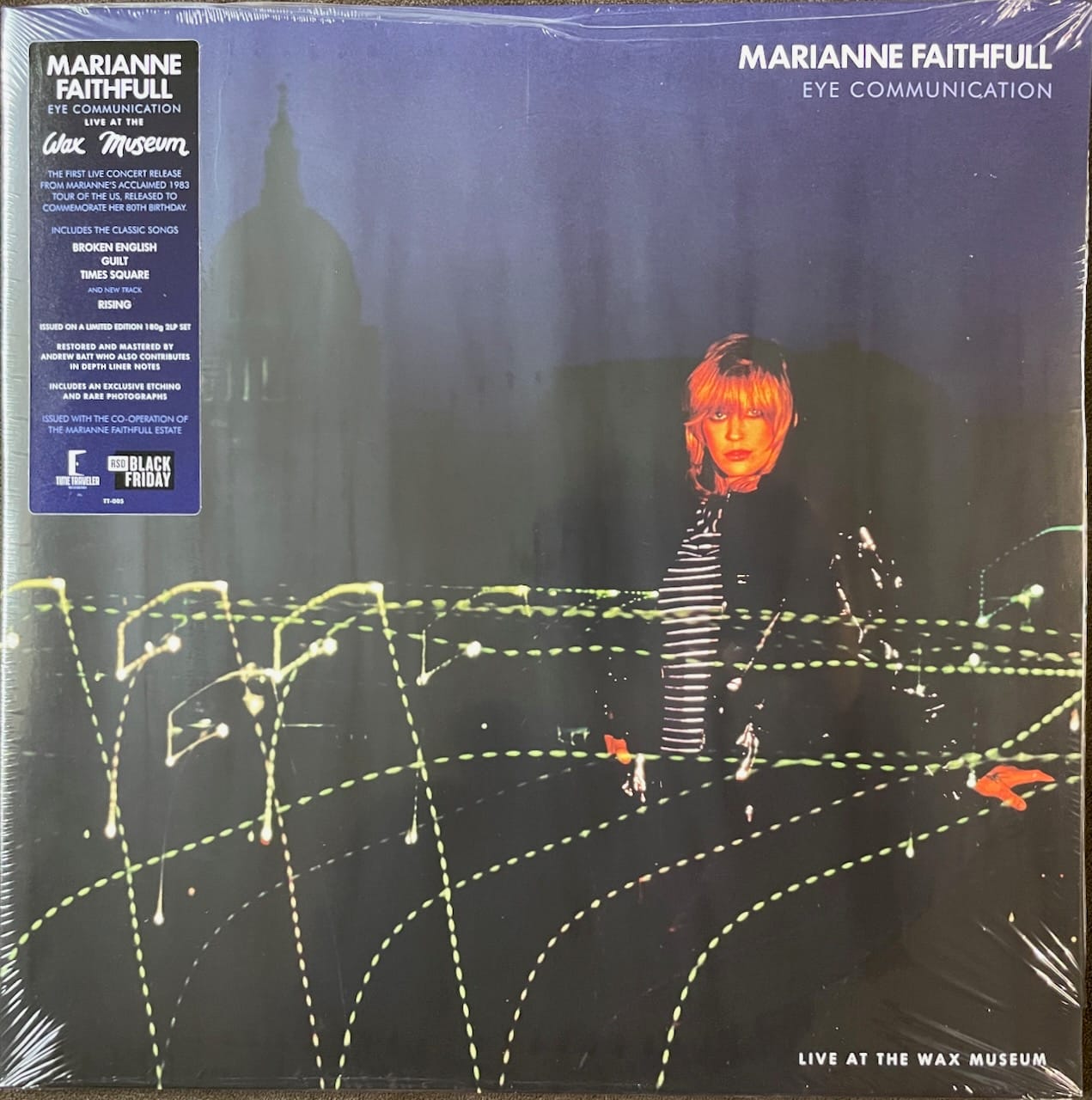
Marianne Faithfull: Eye Communication: Live at the Wax Museum
In 1983, Marianne Faithfull was on her first-ever tour of America, despite having been a recording star for nearly two decades. After being cast aside by Mick Jagger and the Rolling Stones camp and spending most of the ’70s in the wilderness, the singer/actress was now three albums into a mid-period comeback, kicked off by 1979’s startling new-wave reinvention Broken English and followed up by 1981’s Dangerous Acquaintances and 1983’s A Child’s Adventure. Faithfull’s voice had acquired a deeper, duskier tone in the intervening years, gaining in expressiveness what it had lost in range, and Eye Communication documents a show at the short-lived Washington, DC, club the Wax Museum in October 1983.
The Wax Museum operated in DC from 1981 to 1984 (inside, yes, a former wax museum), with room for 1000 patrons and a state-of-the-art sound and video system, including 10-foot screens behind the stage that showed live video footage of the performers. The recording, which is mono, was taken from that video relay—presumably from the soundboard audio which was then captured to VHS, although details about the actual audio source are not specified. The surviving recording is of the first 10 songs of what was a 15-song show, its setlist taken entirely from Faithfull’s three most recent albums. At a little under an hour, the recording is pressed to three sides of vinyl, with an etching taking up the fourth side: a line of poetry by William Blake that Faithfull recites in “Eye Communication,” ostensibly in her handwriting.
The performance is interesting if not quite worthy of the microscope-like scrutiny the recording offers. Faithfull’s voice, with its patina-like rasp, doesn’t quite have the voom to fill the club, and the set’s livelier numbers, like “Eye Communication” and “The Blue Millionaire,” pale in comparison to the slower, torchier songs like the opening “Times Square” and “Guilt,” where Faithfull’s fractured emotionality elevates the material despite some momentary off-pitch blips.
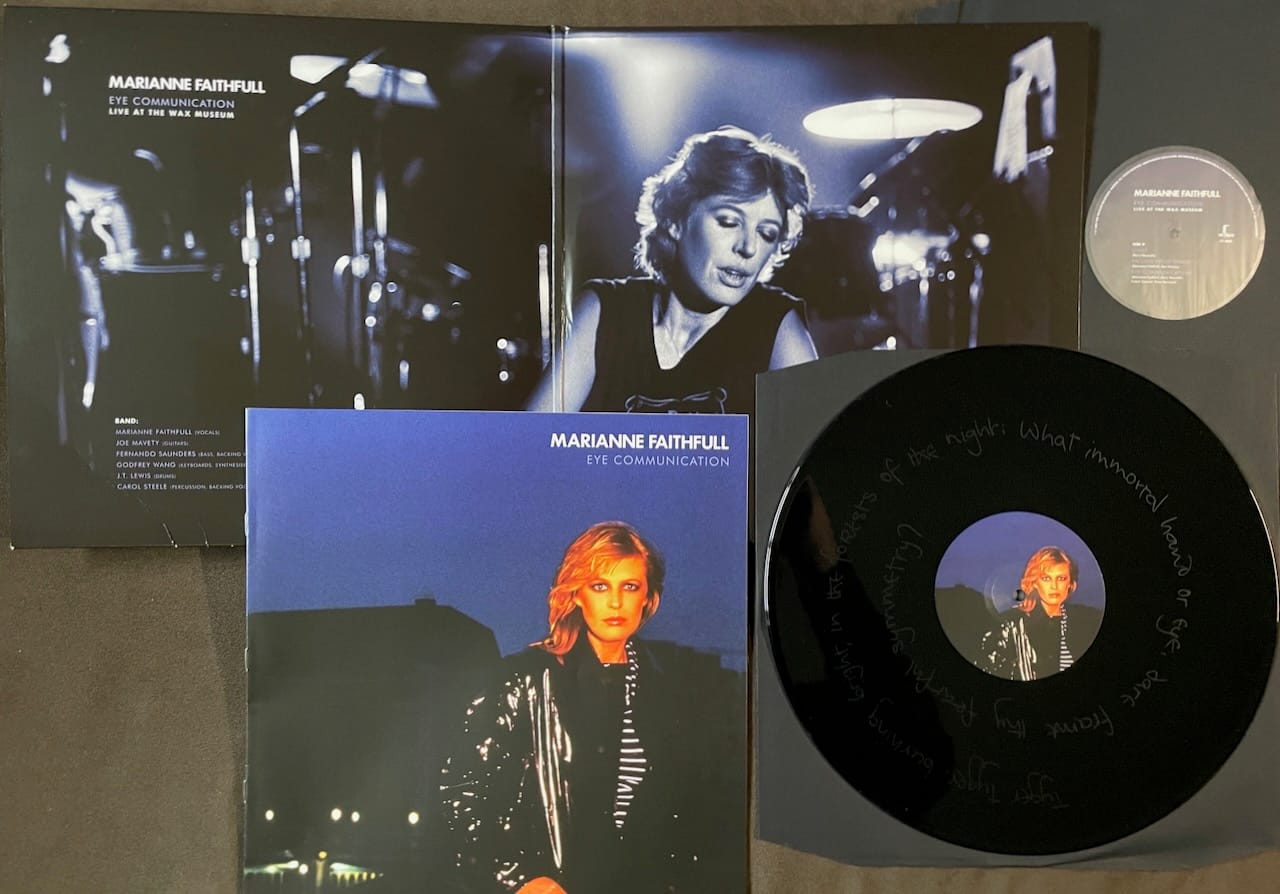
The live band feels elastic and responsive, particularly on the non-album track “Rising,” which apparently was never recorded in the studio and whose fresh appeal to the band is audibly evident. The ensemble is dominated by Fernando Saunders’s fretless bass, treated with chorus effect and sounding very much of the era. Saunders elbows out guitarist Joe Mavety, especially on “Working Class Hero,” where the bass is essentially doing a lead guitar part. Godfrey Wang’s synths add another flavor, and percussionist Carol Steele’s clean vocal harmonies are a fascinating contrast to Faithfull’s careworn gnarl.
There is some noticeable hiss on the recording, which has been refurbished by archivist and engineer Andrew Batt, who also penned the liner notes. Otherwise, the mono recording is revealing, full-bodied, and quite solid, with all the instruments audible in the mix, ample punch and impact, and Faithfull front and center. The GZ pressing gets the job done, and the package is very good from an archival perspective, with plenty of great photos and Batt’s very good essay in the included booklet. All told, though, Eye Communication is really for the Marianne faithfuls, but with live recordings of her from this period thin on the ground, to them it should be close to priceless.
Time Traveler 2-LP 33 RPM 180g black vinyl
- Live recording of Marianne Faithfull’s show on October 2, 1983 at the Wax Museum, Washington, DC
- Jacket: Direct-to-board gatefold
- Inner sleeves: Black poly-lined paper
- Liner notes, insert, or booklet: Eight-page booklet with liner notes by Andrew Batt
- Source: Unknown, likely from a digital transfer of a VHS capture
- Mastering credit: “Sound restoration and mastering by Andrew Batt”
- Lacquers cut by: Henry Rudkins at AIR Mastering, London, UK
- Pressed at: GZ Media, Czechia
- Vinyl pressing quality (visual): A
- Vinyl pressing quality (audio): A-
- Additional notes: Side 4 is an etching. Limited hand-numbered edition of 2000.
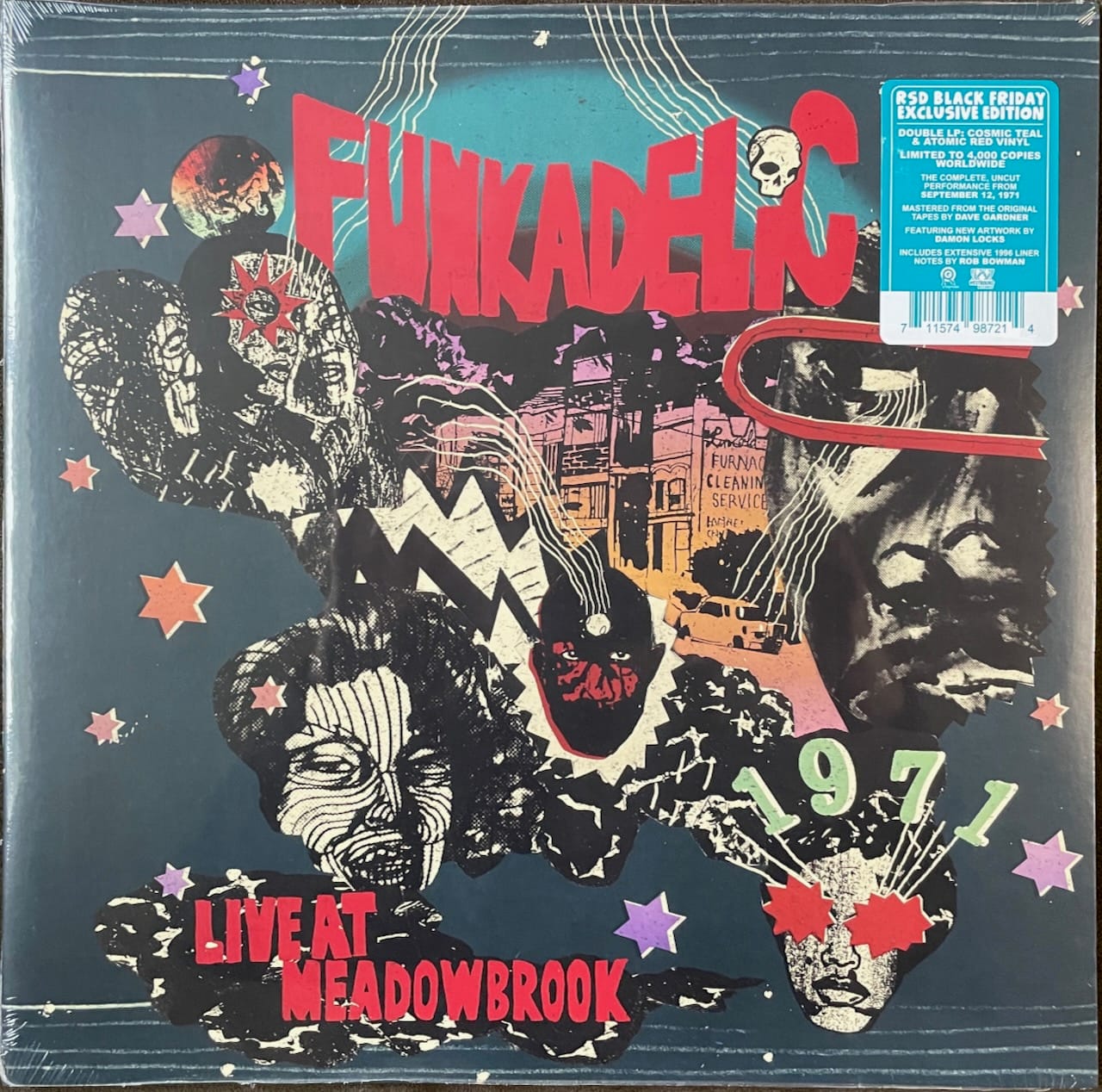
Funkadelic: Live at Meadowbrook 1971
At the time of this September 1971 concert recording, the original Funkadelic was in its death throes. Founding drummer Tiki Fulwood and rhythm guitarist Tawl Ross had just left the group, and about a month later, lead guitarist Eddie Hazel and bassist Billy “Bass” Nelson would follow suit, leaving just songwriter/producer/chief instigator George Clinton and keyboardist Bernie Worrell keeping the Funkadelic flame alive with a crop of new musicians. Two of the new additions, guitarist Harold Beane and drummer Tyrone Lampton, are essentially making their Funkadelic debuts on this live recording, and the legend goes that neither of them had ever rehearsed with the band at the time they took the stage for this show.
The results should be a shambles; indeed, at one point Nelson stormed off the stage due to his dislike of Lampton’s style, and when Westbound label head Armen Boladian listened to the live tapes, he rejected them out of hand. But this recording is much more than a historic curio—it is early Funkadelic in as much glory as could be wrought out of this particular occasion, and as it turns out, that is quite a lot of glory(hallastoopid) indeed. For all their internal struggles, the band is searing, heavy, continually inventive, and absolutely incredible. Nelson, Worrell, and Hazel’s contributions alone (especially the latter’s solo on the epochal “Maggot Brain”) are mandatory listening.
As on record, Funkadelic were joined by the members of Parliament on vocals, making this a full-on P-Funk experience, with Clinton, Fuzzy Haskins, Calvin Simon, Grady Thomas, and Ray Davis all taking their turns on the mic. The first side of the double LP, though, is entirely instrumental, including the aforementioned, epic “Maggot Brain” and the show-starter “Alice in My Fantasies.” Much has been made about the difference between Parliament and Funkadelic, with Parliament being the R&B half and Funkadelic the rock half of the diode. On this recording, that is very much the case, with Funkadelic in full acid-rock mode, with firebrand guitars, smashing, crashing drums, and sublime heaviness riding over the funk grooves.
The recording was made by engineer Ed Wolfrum on a Revox A72 two-track recorder, fed by an eight-channel mixer he’d made himself. I’m not sure what things we hear were part of the front-of-house live mix and what was done on the fly for the rolling tape, but there are some active mixing choices, like the cymbal that whizzes from speaker to speaker on “Alice in My Fantasies,” that suggest that the Funkadelic live experience was meant to be as head-trippy as their albums. The recording has some limitations, including a little bit of bass-drum blow-out, vocal-mic distortion, and a slightly lumpy quality to some of the balance between the instruments, but this new pressing is revelatory, making for deliriously pleasurable listening.
It’s a marked improvement over the 1996 CD, which snipped off about three minutes from the end of the recording in order to fit it onto a single disc. That edited version was also released on vinyl in 2017 by Light in the Attic’s Tidal Waves, but this new master is a game-changer. It’s the result of a new high-resolution digital transfer from the original Westbound tapes by engineer Dave Gardner and archivist Catherine Vericolli during their now-legendary stint in Detroit, with 54 Sound Studio’s Nick King assisting. Gardner then mastered the new hi-res transfer and cut the lacquer at his DSG Mastering facility in LA. Any lingering master-tape limitations, which mostly stem from overdrive on the vocal mics, are swept away in the whitecapped torrent of the performance.
The only downside is that the performance was indeed relentless, with songs flowing directly into each other; chopping it up into four sides of vinyl stymies the natural progression. The transition from “Good Old Music” into “I Got a Thing, You Got a Thing, Everybody Got a Thing,” for example, is spoiled by a side break, and “All Your Goodies Are Gone (The Loser’s Seat)” is split into two sections over two sides of vinyl. I suppose it’s an unavoidable problem—although I think “All Your Goodies” could’ve been kept intact without too much trouble—but it may be a further testament to the value of this performance, which is all about momentum that can scarcely be contained by vinyl. There’s also a weird phenomenon at the end of Side 4, after the applause fades out, when a second-long burst of audience noise reappears as we go into the runout groove. I don’t know whether it’s a mastering glitch or is merely an attempt to reflect what was actually on Wolfrum’s original tape. Either way, it’s hardly a big deal in the grand scheme of things.
This live set, recorded in a predominantly white college in the Detroit suburbs while the band was experiencing some decided growing pains, is really the only document we have of Maggot Brain–era Funkadelic in front of an audience. But despite the lineup problems and the impromptu nature of the recording, this is a molten-hot mass of heavy, funked-up rock that is as crucial and captivating as any live album from the ’70s. It’s just tremendous.
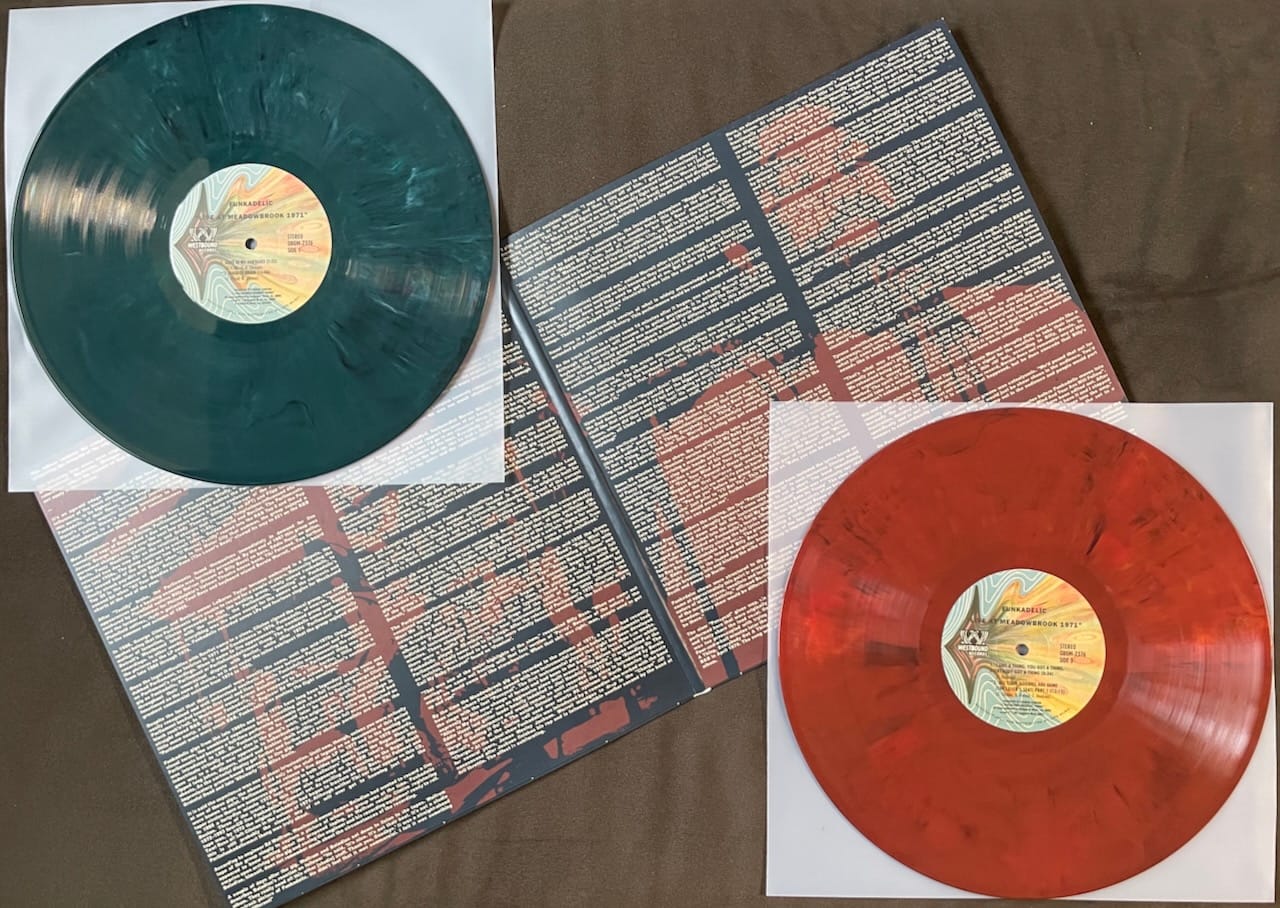
Org/Westbound 2-LP 33 RPM “cosmic teal” & “atomic red” vinyl
- Live recording of Funkadelic at Meadow Brook Amphitheatre at Oakland University, Rochester, Michigan, on September 12, 1971
- Jacket: Direct-to-board gatefold
- Inner sleeves: Heavy-duty plain poly
- Liner notes, insert, or booklet: Inner gatefold reproduces the essay by Rob Bowman from the original 1996 CD
- Source: Digital high-res transfer of the original tapes
- Mastering credit: “Mastering & restoration: Dave Gardner, DSG Mastering; Original master tape transfers & restoration: Catherine Vericolli; Additional engineering and indispensable assistance: Nick King”
- Lacquers cut by: Dave Gardner, DSG Mastering, Los Angeles, CA; “DG” in the deadwax
- Pressed at: Furnace Record Pressing, Alexandria, VA
- Vinyl pressing quality (visual): A
- Vinyl pressing quality (audio): B+ (minor noise from the multicolored vinyl)
- Additional notes: Limited edition of 4000.
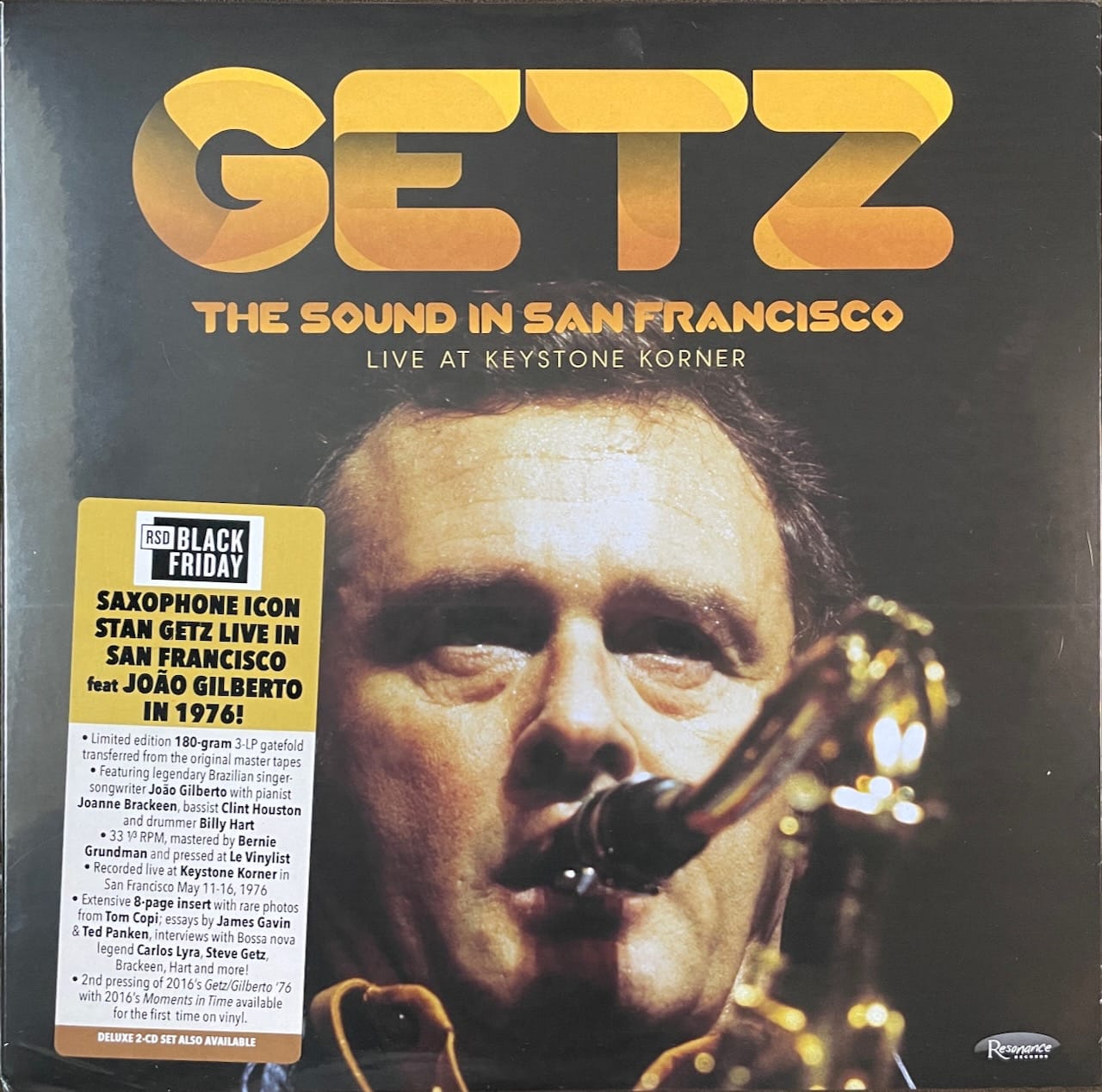
Stan Getz with João Gilberto: The Sound in San Francisco: Live at Keystone Korner
This material is taken from a six-night stand Stan Getz performed at Todd Barkan’s San Francisco jazz club Keystone Korner in May 1976. Barkan operated Keystone from 1972 to 1983 and recorded several of the performances that took place under his roof. With Barkan’s willing participation, jazz reissue producer Zev Feldman and his collaborator George Klabin have taken it upon themself to plunder Barkan’s historic archive, releasing bits and pieces of the goods on a handful of albums since 2011.
Two of their releases came from this Getz run of gigs in ’76, which featured a very special guest sitting in with Getz’s quartet: legendary Brazilian songwriter João Gilberto, who famously collaborated with Getz on their 1964 classic LP Getz/Gilberto and had recently joined Getz in the studio for their 1976 collaboration The Best of Both Worlds, which these shows were promoting. (A pretty big get for Barkan, as Keystone didn’t hold much more than 200 people—it helped that the club was one of Getz’s favorite places to play.)
The Gilberto material was previously released on LP and CD in 2016 as Getz/Gilberto ’76, and the Getz Quartet material—without Gilberto—was released that same year as a CD called Moments in Time. This new release, The Sound in San Francisco, combines both releases for a triple-LP package, providing a definitive overview of the Getz residency at Keystone Korner in ’76. It is the first time the Moments in Time material has been released on vinyl, and Getz/Gilberto ’76, a 54-minute recording originally confined to two sides of vinyl, is here given three sides to stretch out.
The Gilberto stuff is of enormous import. He was a reluctant and infrequent performer in those days, and the first three sides of The Sound in San Francisco are essentially a Gilberto record with Getz and his group providing compassionate, unobtrusive backing. Whereas Gilberto could sound so cool and calm on record, here he sounds withdrawn and extremely sensitive, a quality that lends an entirely new dimension to his familiar bossa nova sound. The gentleness and placidity of his sun-dappled music—which would start a global revolution when Getz helped bring it to the mainstream—belies an artist of perhaps unending anxiety and reluctance. There’s beauty in how completely he seems to be completely locked in with the music coming through him, his fingers flicking along almost involuntarily to the offbeats of his beachy, syncopated rhythms. The audience can only keep perfectly still and hang on, and the musicians, too, are tiptoeing with utmost sympathy. A rare moment of levity cuts through at the end of “Chega de Saudade,” when Gilberto and the audience share a laugh.
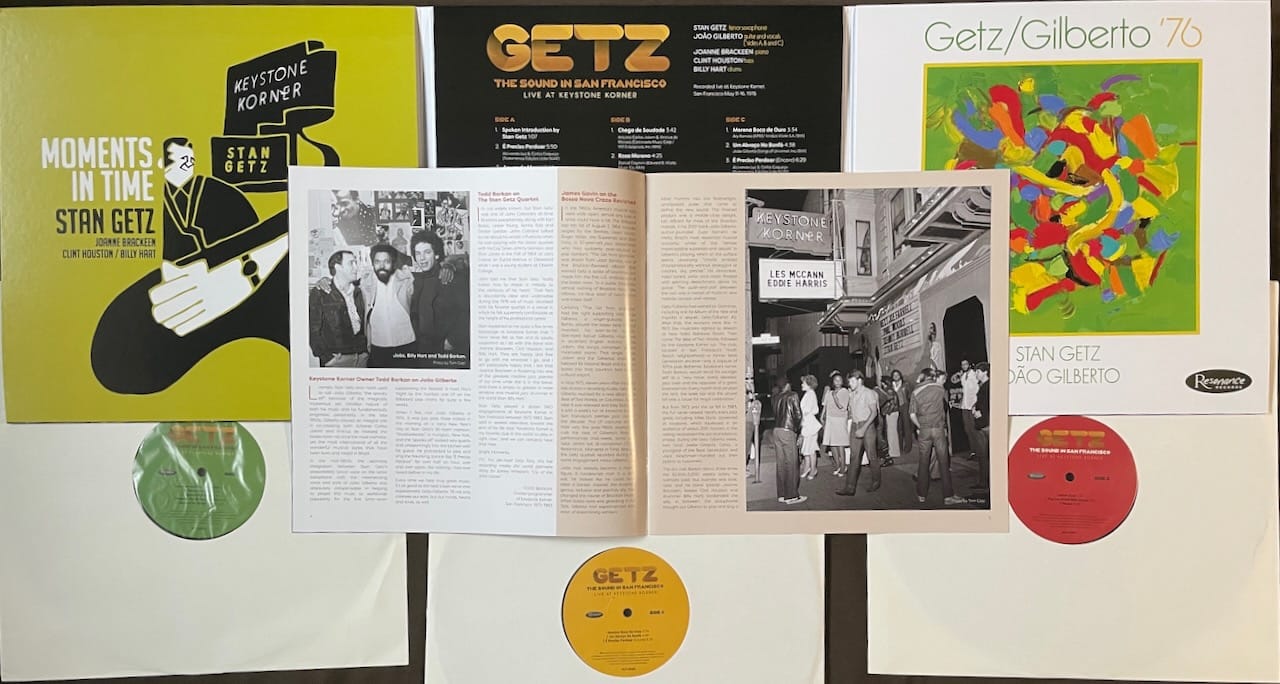
If the first half is a showcase for Gilberto, the second is one for pianist Joanne Brackeen, who is very much Getz’s foil throughout. She takes extended solos and drives the musical conversation in unostentatious, economical ways; in the liner notes she says that playing with Getz was like playing with a singer, and that dictated what notes and chords she chose to back him. Bassist Clint Houston and drummer Billy Hart acquit themselves on both halves of the program, going from subtle shading on the Gilberto set to more interlocked quartet fire on the Getz half. And Getz’s ever-ripe, avuncular playing finds mellow-smooth tones when warranted, as well as taking a few inspired steps further afield.
The sound is very good for what presumably was not a professional-level recording. It’s perhaps one or two notches below a live album of the period, like a very good radio broadcast—it’s several steps above bootleg quality, to be certain, although there are occasional artifacts, like the gremlin eating up the high end of Brackeen’s piano in her solo on “Prelude to a Kiss.” It’s not indicated in the copious liner notes how Barkan actually committed these performances to tape—what mics he used, how they were set up, what kind of tape rig he was rolling (presumably cassette taken from the board). There is some stereo spread to the mix as well as a natural room sound, so perhaps there were ambient mics being used as well. While the musicians are not as present and dimensional as they might be on a studio recording, there’s an intimacy that works quite well with the Gilberto material, as if you’re eavesdropping on a very sensitive, quiet moment for the performer. Some tape hiss is evident in the Gilberto half, likely due to the subdued volume his music necessitated. But his placid, unerring voice comes across like rich butter on tracks like “Rosa Morena.”
The vinyl in my case was clean, flat, and well-pressed. Once or twice I came across a brief, soft repeating click—nothing major for a whopping six sides of vinyl. The liner notes, some of which appeared in the previous editions of these recordings, are exhaustive and informative, and I think the only real question for someone interested in this material is whether they already own it via the 2016 releases. Hearing Gilberto in front of an audience is instructive, and Getz remains the dean of bossa nova jazz, making this for a surprise master class in a style that briefly took over the world in 1964.
Resonance 3-LP 33 RPM 180g black vinyl
- Live material recorded May 11–16, 1976, at Keystone Korner, San Francisco, CA; Sides 1 through 3 were previously released on vinyl and CD in 2016 as Getz/Gilberto ’76, and Sides 4 through 6 were previously released only on CD in 2016 as Moments in Time
- Jacket: Direct-to-board tri-fold gatefold
- Inner sleeves: White poly-lined paper
- Liner notes, insert, or booklet: 16-page booklet containing new intro by reissue producer Zev Feldman and previously published essays by Todd Barkan, James Gavin, Ted Pankin, Billy Hart, Joanne Brackeen, Carlos Lyra, and Steve Getz
- Source: Digital; “transferred from the original master tapes”
- Mastering credit: “Mastering by Fran Gala and George Klabin”; Bernie Grundman is also credited with mastering on the hype sticker
- Lacquers cut by: Bernie Grundman at Bernie Grundman Mastering, Hollywood, CA; “BG” in the deadwax
- Pressed at: Le Vinylist, Quebec City, Canada
- Vinyl pressing quality (visual): A
- Vinyl pressing quality (audio): B+ (some minor soft repeating ticks)
- Additional notes: Limited hand-numbered edition of 2500.
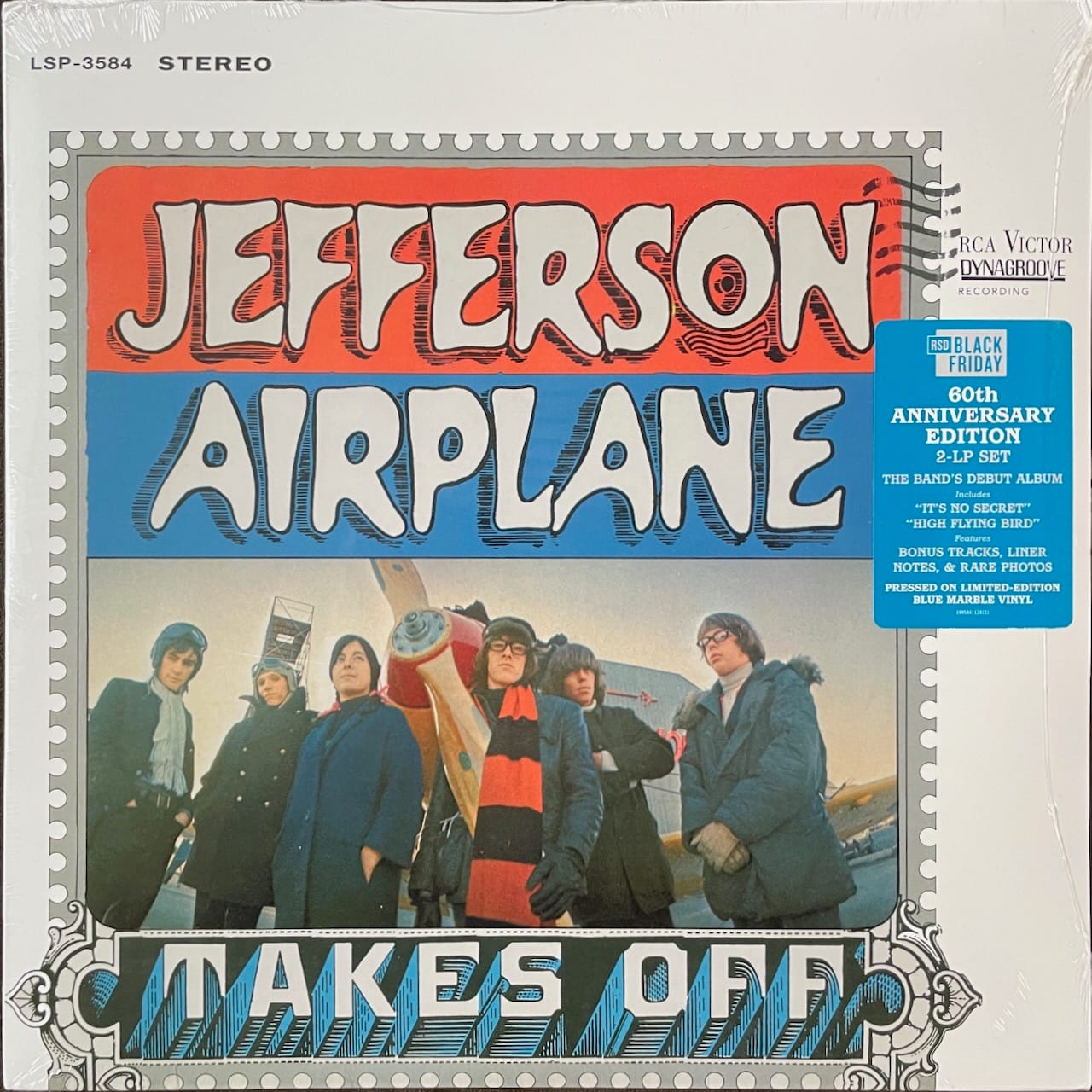
Jefferson Airplane: Jefferson Airplane Takes Off
Jefferson Airplane was the first San Francisco rock group to sign with a major label, and their 1966 debut on RCA, Jefferson Airplane Takes Off, finds the group plying a northern variant of the electrified folk-rock sound that was coming out of Los Angeles through bands like the Byrds and the Mamas and the Papas. Perhaps fittingly, Jefferson Airplane’s version of the California dream was darker, mistier, and chillier, and the forthcoming musical movement that was beginning to rumble beneath the surface—psychedelia—is impossible to miss.
The classic Airplane lineup had not yet solidified. At this point in time, Marty Balin was the unquestionable frontman, with a moony, expressive tenor that adds a shot of nervy energy to the group’s blues- and folk-derived sound. Balin’s foil Signe Anderson has a mighty, tree-felling holler as showcased on the track “Chauffeur Blues,” and has an altogether more human presence than her eventual replacement, chaos agent Grace Slick, but certainly a less distinctive one. And that’s Skip Spence on drums, who would shortly leave the band and join Moby Grape as a singer and guitarist before getting his own grapes mashed and recording 1969’s brilliant, damaged Oar. Paul Kantner’s 12-string is Takes Off’s dominant instrument, with Jack Casady’s cruel, roaming bass providing counterpoint, although Jorma Kaukonen’s wiry lead guitar occasionally cuts through the canvas with its own undeniable character.
This 60th anniversary edition—with an extra disc of alternate versions and outtakes—is essentially a vinyl version of the 2003 BMG Heritage CD, and as such, uses the album’s broad, echo-laden 1966 stereo mix, with Spence’s drums and Casady’s bass pushed to the left channel, the guitars (sometimes as many as three, with Balin occasionally strumming along with Kantner and Kaukonen) clustered in the right, and the vocals centered. As with their 1967 breakthrough, Surrealistic Pillow, Jefferson Airplane’s first album has a more impactful mono mix that wasn’t as slathered in reverb and didn’t leave the instruments stranded on either side of the stereo spectrum. It’s a mix that deserves to be resurrected for an archival pressing, and it was reissued on vinyl in 2005 by Sundazed in a cut by Kevin Gray, with an orange-vinyl repress in 2015, although both are now out of print.
The other decision—made back in 2003, and affecting this reissue—is that the censored version of the album is used. After its original release, the song “Runnin’ ’Round This World” was struck from the tracklist by RCA due to a very mild drug reference, and “Let Me In” and “Run Around” were edited for equally short-sighted reasons. As this is an anniversary edition, a new cut-from-tape pressing of the original, uncensored 1966 mono album could have been absolutely gangbusters, as that was how the album was designed and how Jefferson Airplane were initially presented to the world. But it’s not to be, and the censored version is perhaps in keeping with the Airplane’s legacy of continually rubbing the powers of conformity the wrong way. (For the record, the Sundazed mono Kevin Gray cut used the original, uncensored version of the album, so perhaps a repress of that is overdue, although I can’t find definitive proof that it’s AAA.)
Fortunately, the uncensored versions of the tracks are included on the second LP, so if you’re up for lifting the needle a few times and playing DJ-at-home, you can more or less replicate the original album as first listeners would have heard it in ’66. The uncensored “Let Me In” is the stereo mix while “Run Around” seems to be in mono, and “Runnin’ ’Round This World” is labeled as the mono single mix, although I don’t know if it’s substantially different than the mono LP version was or why all three uncensored stereo versions weren’t used to provide uniformity, but there you go. The second disc also includes some really fantastic outtakes—“High Flying Bird,” “It’s Alright,” and an early version of “Go to Her”—that are easily the equal of what’s on the album. The LP is rounded out by alternate takes of “Chauffeur Blues,” “Blues from an Airplane,” and an extended studio workout of “And I Like It” that slows down the groove to a bluesy ooze. While none of it’s new to buyers of the 2003 CD, it’s all great stuff and most welcome on a reissue like this.
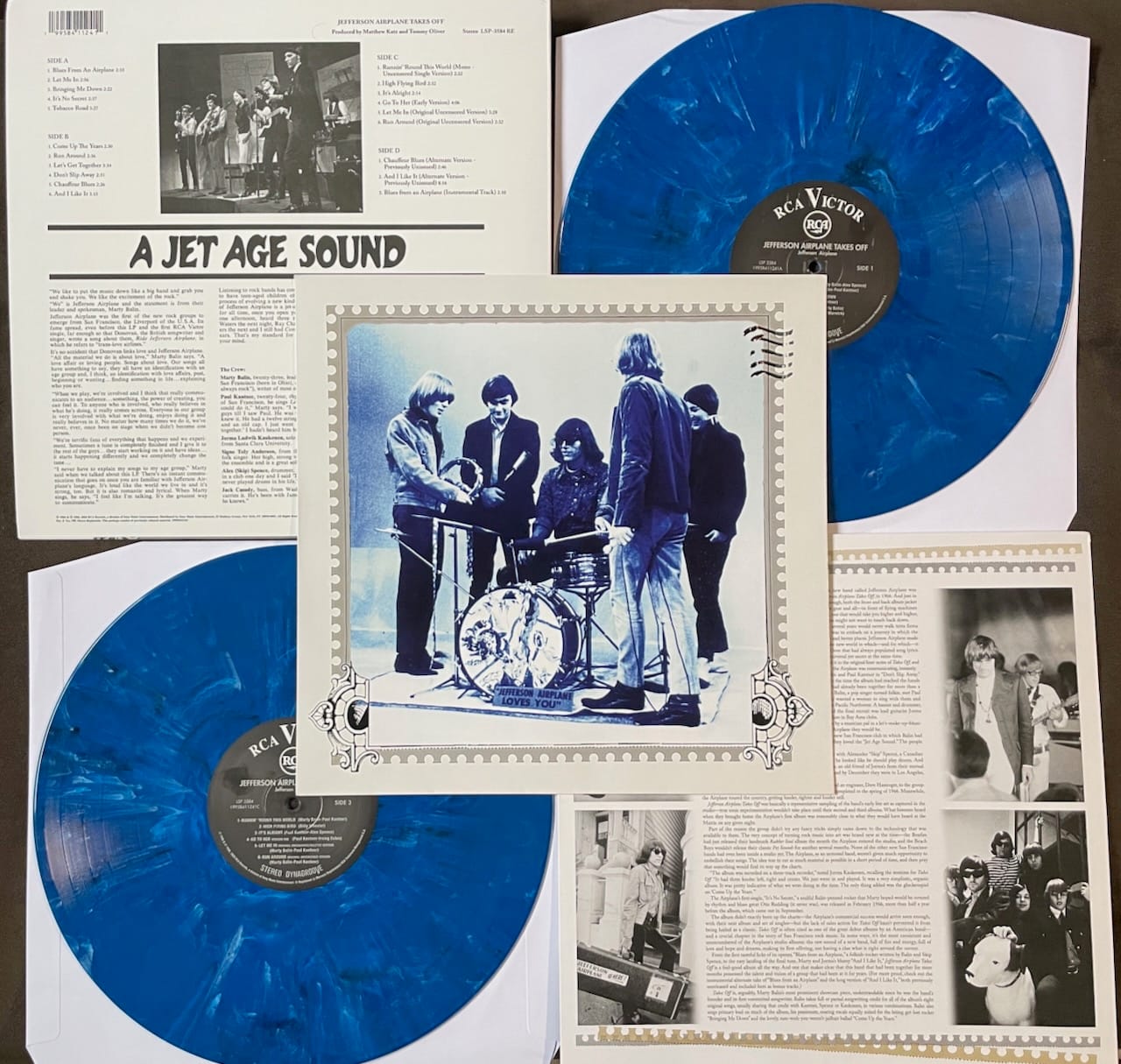
The mastering seems to use the digital master made for the 2003 CD by Sundazed Records’ Bob Irwin, with a new lacquer cut by Daniel Krieger at SST in Germany. The sound is detailed, precise, and full-bodied, with Casady’s growling bass offering plenty of bottom end (albeit confined to the left channel), and Kaukonen’s and Kantner’s interlocking guitars boasting the right amount of shimmer. The top end can occasionally pierce (most noticeably to me during Spence’s ample cymbal crashes on album opener “Blues from an Airplane”), and some of the bounce and shadowy mystery from an original 1960s press is polished over to provide a clean, coherent sonic image. On the whole, the sonics here are excellent if not quite revelatory—and to be fair, those 1960s RCA Dynagroove pressings certainly posed their own problems.
So while I might find some elements to be a bit of a compromise, this 60th-anniversary edition of Takes Off has a lot to offer, and it should serve virtually anyone well as their new go-to copy of the album. (It will be mine.) The records themselves sound first-rate, and it’s great to have the bonus material on wax; furthermore, the new vinyl surfaces provide much nicer backgrounds than, say, a 1967 RCA pressing that’s seen its share of action. Glossy printed inner sleeves are included with liner notes, photos, and track details, but the vinyl discs themselves are put in separate sleeves, presumably to avoid scuffs, but somewhat hilariously, the designated LP sleeves are plain paper and not poly-lined. Maybe the fake sleeves, with the info, would have made more sense as a four-page booklet. Oh well. At least we get the great essay by Jeff Tamarkin, author of Got a Revolution!, the definitive biography of the band.
The easy retrospective view of Takes Off is that this early version of Jefferson Airplane is perkier and more clear-eyed than the shamans of free love and drug culture the band would soon become. But I hear an inherent, intriguing darkness in the group right from the jump, and their sulky romanticism, coupled with Casady’s aggressive edge, is almost proto-goth in its way. This is the sound of a musical movement making the leap from coffeehouses to ballrooms, and while what was to come was of immense import, what’s here is compelling in and of itself.
RCA/Legacy 2-LP 33 RPM blue marbled vinyl
- Jefferson Airplane’s 1966 debut album in stereo in its revised/censored track order, with a second LP of bonus material including the uncensored tracks
- Jacket: Direct-to-board single pocket
- Inner sleeves: White paper
- Liner notes, insert, or booklet: Two glossy printed paper LP sleeves are included, with liner notes, photos, and track info; essay by Jeff Tamarkin reprinted from the 2003 CD edition
- Source: Digital
- Mastering credit: “Mastered by Bob Irwin at Sundazed Studios/Coxsackie, NY”
- Lacquers cut by: Daniel Krieger at SST, Frankfurt, Germany
- Pressed at: MPO, Villaines-la-Juhel, France
- Vinyl pressing quality (visual): B+ (disc 2 was slightly dished)
- Vinyl pressing quality (audio): B (multicolored vinyl has low-level background noise; brief repeating tick on last track of Side 2)
- Additional notes: Limited edition of 2200 for the US, with an additional worldwide allotment.
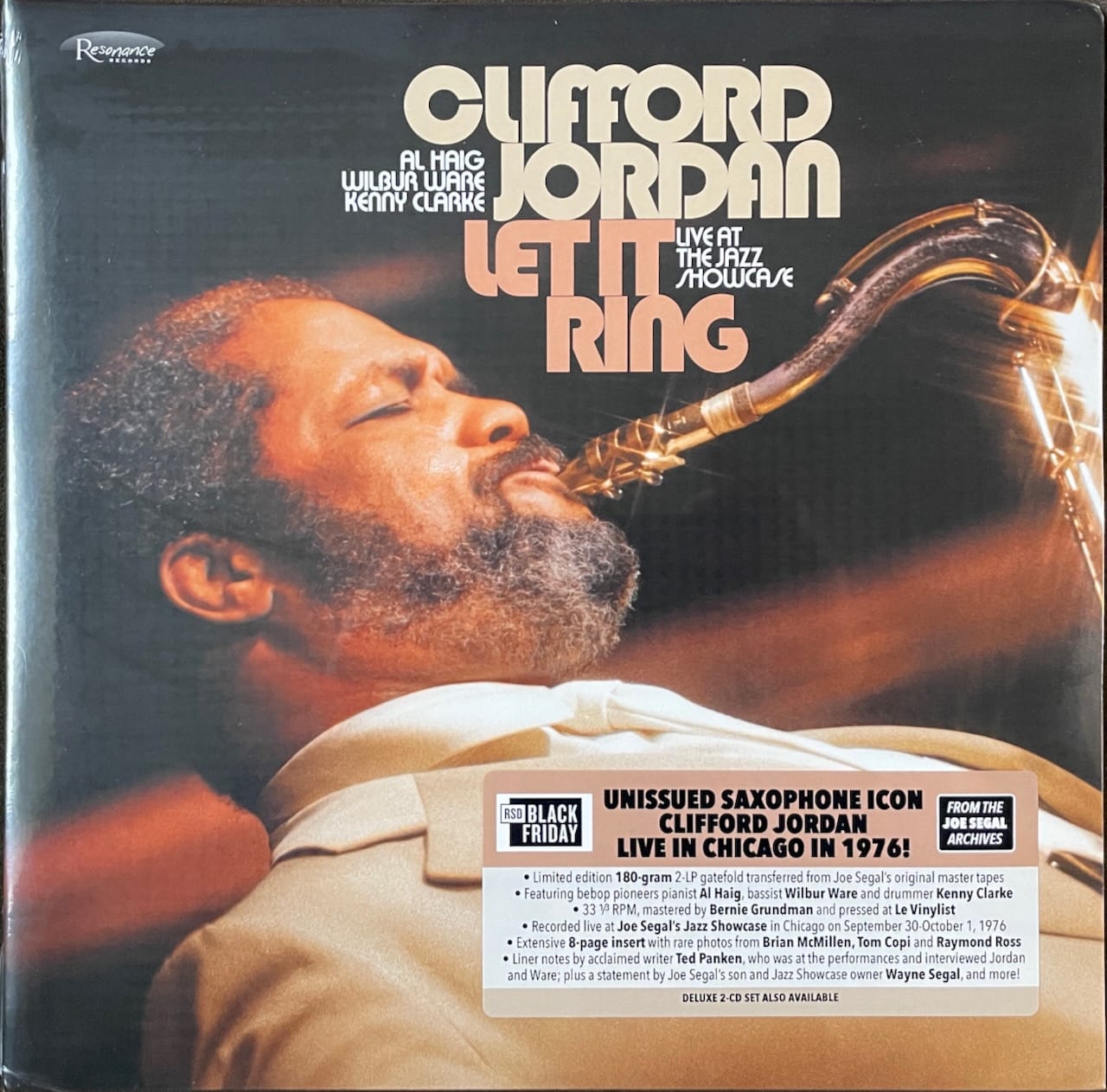
Clifford Jordan: Let It Ring: Live at the Jazz Showcase
It can sometimes seem a little arbitrary which name gets put at the top of the front cover of a jazz album. In this case, Clifford Jordan is the main attraction, but Side 4 of this archival live release doesn’t feature the tenor saxophonist at all. Rather, it includes performances by the older trio that backed him up during this 1976 run of shows in Chicago: pianist Al Haig, bassist Wilbur Ware, and drummer Kenny Clarke, all of whom were crucial in the development of bebop in the 1940s. Jordan was the name on the marquee, but this first-ever release of the 50-year-old live recording makes room for a few interesting moments when the headliner wasn’t on stage.
The recording comes from Joe Segal’s Jazz Showcase club, where Segal would habitually record the gigs he’d booked; over the decades he accumulated an enormous archive of never-before-heard live performances by many of the jazz musicians that passed through the Showcase’s stage door. Resonance Records and reissue producer Zev Feldman released the first few of these recordings earlier this year on Record Store Day, including sets by Joe Henderson, Ahmad Jamal, Yusef Lateef, and Mal Waldron. And the endeavor continues with Let It Ring, culled from mono soundboard cassettes from the first two nights of the Jordan quartet’s residency at the Jazz Showcase on September 30 through October 4, 1976.
The tapes are clear, full, and very good-sounding, considering their origin; the recording has surprising depth and room ambience, which has me thinking there may have been ambient mics in the mix somewhere, especially taking into account that some of the instruments may not have even been amplified. (Ware’s bass was, apparently; the 52-year-old bassist was in poor health and was unable to even carry his bass on and off the stage during the run, and so got mic’ed up for the first time in his career for these shows. A former heroin addict, Ware died in 1979 from emphysema.)
Earlier in his career Jordan had recorded albums for Blue Note and Riverside before joining Charles Mingus’s band in 1964, where he played alongside Eric Dolphy. By the time of the ’76 Jazz Showcase appearance, he had also recorded for Strata-East, and he and Ware—a longtime friend and collaborator from the Chicago scene—had just tracked Jordan’s second album for Muse, Remembering Me-Me, which would be released the following year. The quartet was put together by Segal to take advantage of Haig and Clarke’s participation in a taping for WTTW (Chicago’s PBS member station) that reunited musicians who had played with Dizzy Gillespie during his bebop days. Haig had never played with Jordan or Ware before, and apparently Haig, a difficult and abusive personality, strongly disliked Ware’s playing in his weakened state. Some years later, when Segal informed Haig of Ware’s death, Haig’s response was so insulting that Segal canceled his upcoming booking. (Haig himself would die in 1982 at age 60 from a heart attack.)
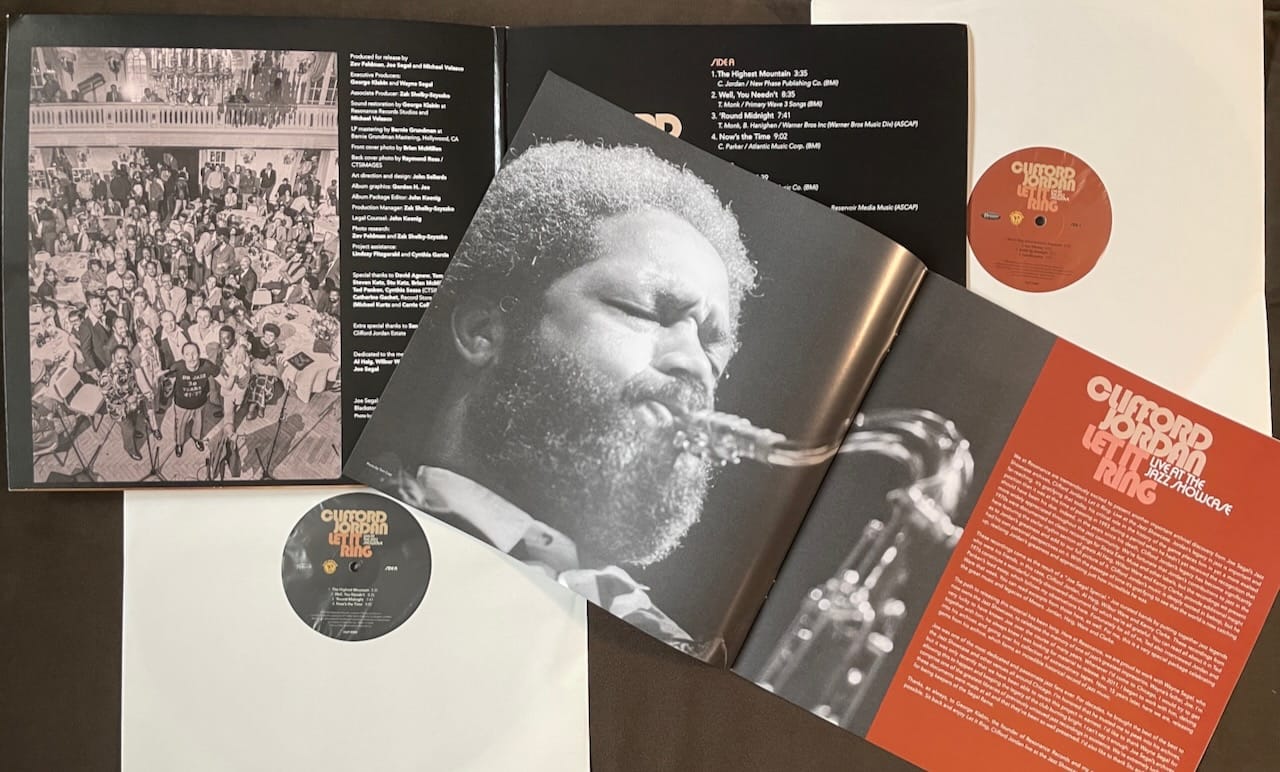
No notes of hostility can be detected in the performance, though, which is graceful if a bit perfunctory. Despite Jordan’s being signed on the adventurous Muse label—and despite jazz at this time being in the throes of fusion, avant-garde, and spiritual evolutions during the mid-’70s—the recording is generally in keeping with bebop traditions, with tight interplay, fluent lines from Jordan and a spryness that seems designed to keep the musical embers smoldering as opposed to letting them fully catch fire. Jordan does occasionally let loose, as on “Stella by Starlight,” but overall this feels like a gig that, perhaps by design, could have happened at any time in the preceding 30 years.
The liner notes by Ted Pankin are a little funny—Pankin attended opening night of the Jordan run but doesn’t have any memories of it to share. Rather, his firsthand reporting comes from interviews he conducted with Jordan and Ware later in the week. His essay is lengthy and informative but jumps around through time as he maps out the individual performers’ relationships to the songs on the recording. It’s long on jazz history that only occasionally touches on the performances at hand.
The vinyl sides are long, between 25 and 28 minutes each, but have been more than capably cut by Bernie Grundman, and the quality of my pressing had no material issues to mention. And the recording really does capture the moment wonderfully well; most of jazz’s recorded legacy is built on the backs of studio sessions, but it’s a genre that lived and breathed in live performance, so any window into its day-to-day existence—when it was about interplay between the musicians and with the audience, instead of with the recording console—is invaluable for serious aficionados. For anyone who laments that they can no longer slip into a nightclub and catch Jordan at work with a trio of older bebop legends, this is a pretty solid consolation prize.
Resonance 2-LP 33 RPM 180g black vinyl
- Live material recorded September 30 & October 1, 1976, at the Jazz Showcase, Chicago, IL
- Jacket: Direct-to-board gatefold
- Inner sleeve: White poly-lined paper
- Liner notes, insert, or booklet: 12-page booklet containing intro by reissue producer Zev Feldman and essay by Ted Pankin, with photos and images
- Source: Digital; “transferred from Joe Segal’s original master tapes”
- Mastering credit: “Sound restoration by George Klabin at Resonance Records Studios and Michael Velasco; LP mastering by Bernie Grundman at Bernie Grundman Mastering, Hollywood, CA”
- Lacquers cut by: Bernie Grundman at Bernie Grundman Mastering, Hollywood, CA; “BG” in the deadwax
- Pressed at: Le Vinylist, Quebec City, Canada
- Vinyl pressing quality (visual): A
- Vinyl pressing quality (audio): A- (some very minor incidental noise)
- Additional notes: Limited hand-numbered edition of 2500.
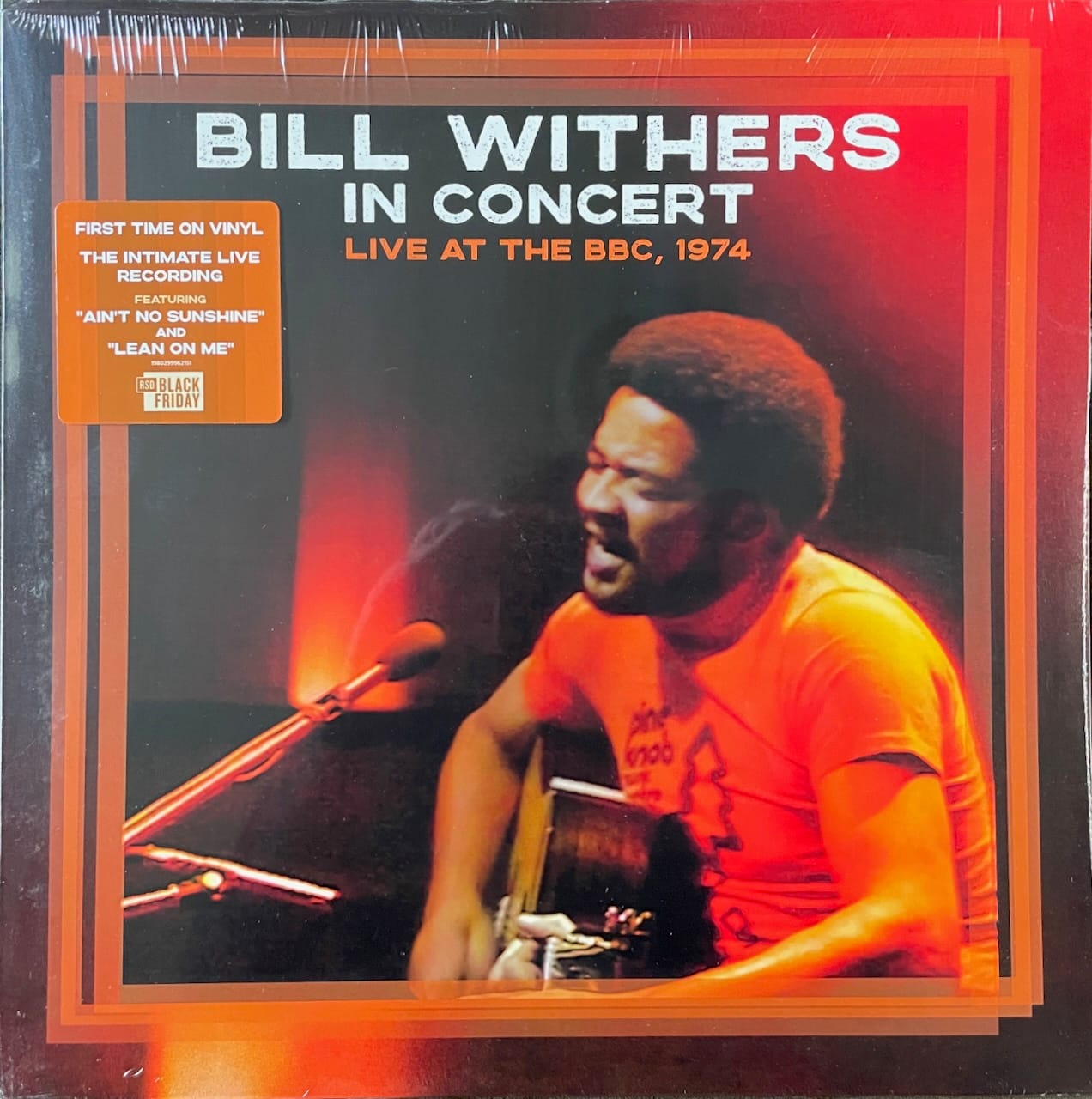
Bill Withers: In Concert: Live at the BBC, 1974
Bill Withers fans will likely be familiar with this one: It’s his performance for In Concert, the BBC television program that ran from 1970 to 1976 and documented the singer/songwriter movement, with well-known performances from Neil Young, Joni Mitchell, James Taylor with Carole King, and many others. This disc includes the audio from Withers’s appearance, taped in November 1973 at Command Studios in London and which was first broadcast as a half-hour on BBC Two in May 1974. It’s an intimate look at Withers at his early peak, fresh off his first two incredible studio albums and 1973’s Live at Carnegie Hall. The four big hits are here—“Ain’t No Sunshine,” “Grandma’s Hands,” “Use Me,” and “Lean On Me”—as are three other songs from 1971’s Just as I Am and 1972’s Still Bill.
The recording is mono, and it sounds absolutely incredible. I’m sure this was well-recorded at the time, but like the Miles Davis record above, the sound on the vinyl elevates what’s on the circulating video with a richness, depth, and texture that really comes through on disc. The performance is great, too, although “Use Me” breaks down at the end when Withers’s guitar goes out of tune. “Lean On Me” is chill-inducing, and “Let Me in Your Life” is a careful, spare duet with just Withers’s voice and guitar and John Barnes on electric piano—an effective and unforgettable combo.
The rest of the ensemble includes bassist Melvin Dunlap, Snuffy Walden on electric guitar, and Fred Casey on drums, with of course Withers on acoustic guitar and piano. At the beginning Withers suggests that there were other band members that couldn’t join them in the UK, and this backing band, apart from Dunlap, is wholly different from the one that backed him on Live at Carnegie Hall. The American-born Walden, for example, was based in England at the time, having played on Free’s last album and with the Manticore Records signees Stray Dog, so his appearance with Withers here may have been a one-off. I can’t find any info about drummer Fred Casey. Barnes and Dunlap continued to work with Withers, participating in the making of his next LP, 1974’s +’Justments.
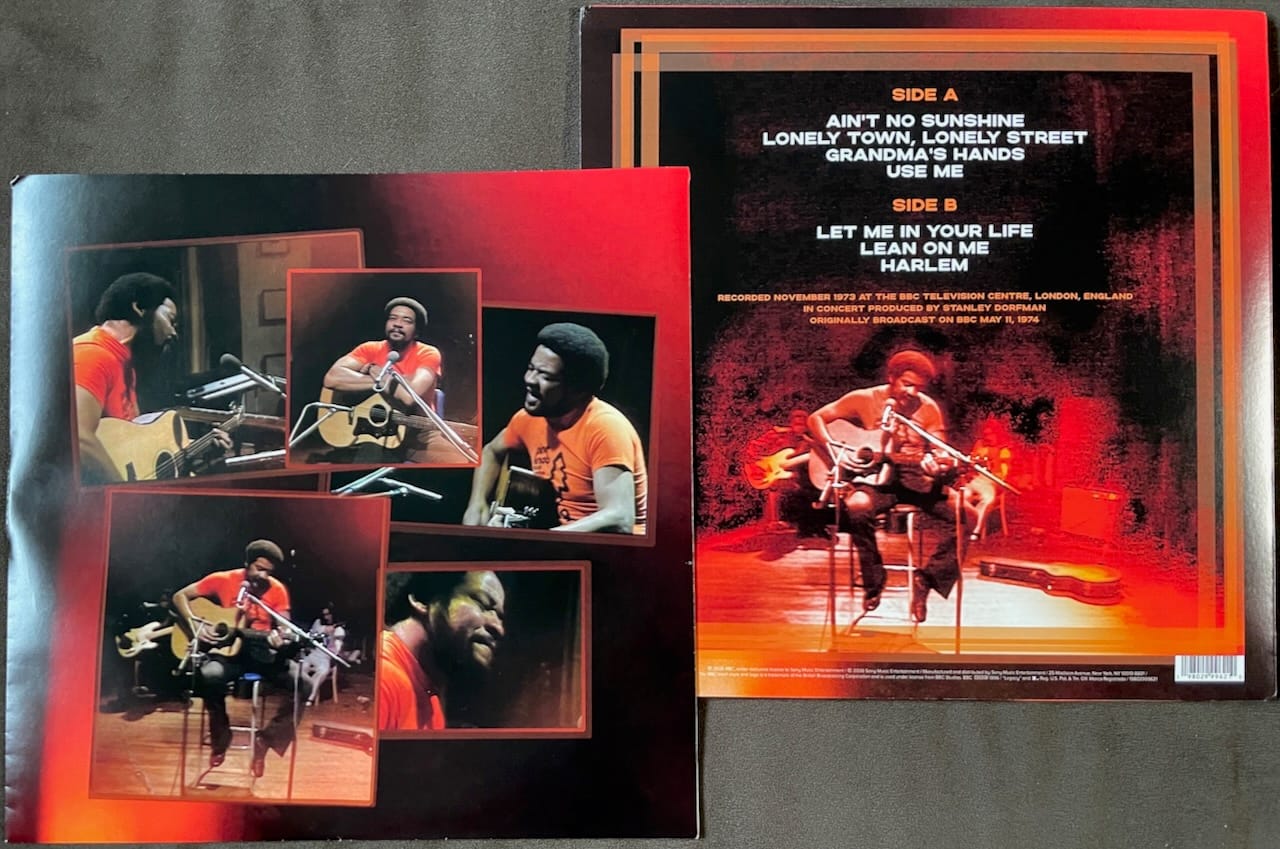
Although it’s brief, In Concert: Live at the BBC, 1974 is a delight from start to finish. The sound, though largely acoustic-based, is warm and punchy, and the restraint Withers uses, often with very simple chords and deliberate rhythms, comes across beautifully in front of a rapt audience. The spell of the performance carries over onto disc, no doubt aided by mastering engineer Mike Piacentini, who has made this thing sound remarkable. There aren’t a ton of vintage live recordings of Withers, so if that’s something that grabs your interest, this won’t disappoint.
Legacy 1-LP 33 RPM black vinyl
- Bill Withers’s live performance for the BBC Two program In Concert, recorded November 1973
- Jacket: Direct-to-board single pocket
- Inner sleeve: Printed paper, with images and basic track info
- Liner notes, insert, or booklet: None
- Source: Digital
- Mastering credit: “Mastered by Mike Piacentini at Battery Studios, New York, NY”
- Lacquers cut by: unknown; possibly DMM done at GZ Media
- Pressed at: GZ Media, Czechia
- Vinyl pressing quality (visual): A- (small warp)
- Vinyl pressing quality (audio): A (no substantive issues)
- Additional notes: Limited edition of 2600 copies in the US, with an additional allotment for the rest of the world. This recording is also available as a CD.
Listening equipment:
Table: Technics SL-1200MK2
Cart: Audio-Technica VM540ML
Amp: Luxman L-509X
Speakers: ADS L980