Reviews: The Velvet Underground | Sigh



Loaded comes to Rhino High Fidelity, plus two reissues from the Japanese black-metal band.
Today’s newsletter contains a pair of reviews for you. The first is for the recently released Rhino High Fidelity edition of the Velvet Underground’s 1970 swan song, Loaded, cut from the original tape by Kevin Gray and pressed in a limited edition (for now—RHFs have a tendency to come out in unnumbered editions once the initial run sells out). The second review covers a pair of 1997 releases from the Japanese black-metal band Sigh, recently reissued on their new label, Peaceville Records.
- The Velvet Underground: Loaded [Rhino High Fidelity]
- Sigh: Hail Horror Hail & Ghastly Funeral Theatre
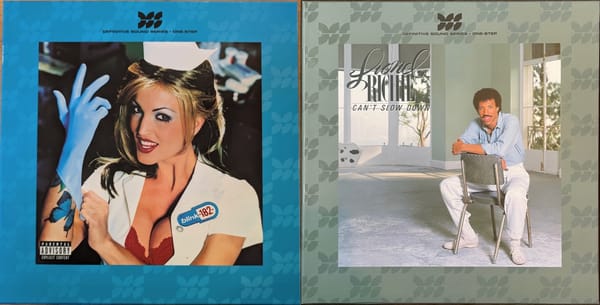
Speaking of the Rhino High Fidelity series, this morning a brand-new one just went up for sale on Rhino’s site. It’s INXS’s inescapable 1987 album Kick, which sent the Australian band into the stratosphere with hits like “Need You Tonight,” “New Sensation,” and “Never Tear Us Apart.”
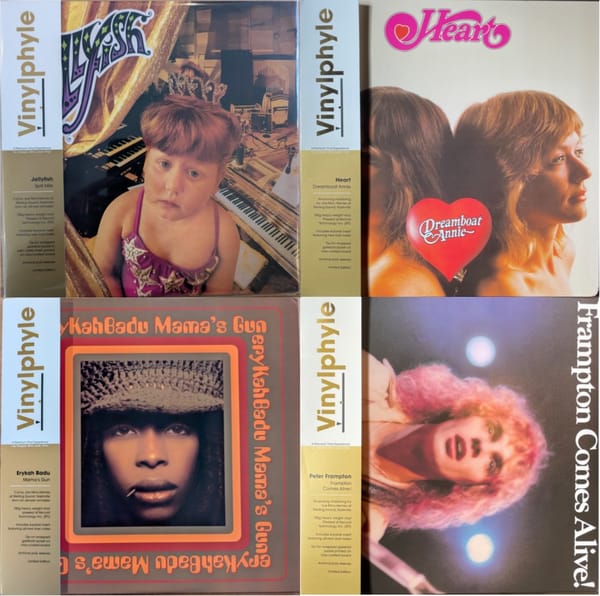
Before we get into the reviews, here is a gentle tap on the shoulder to remind you about our March vinyl giveaway, where the prize is a bundle of FOUR Vinylphyle reissues: Erykah Badu’s Mama’s Gun, Peter Frampton’s Frampton Comes Alive!, Heart’s Dreamboat Annie, and Jellyfish’s Spilt Milk. That is a very good thing to win, so make sure you enter. In order to do so, you’ll need to—excuse me, get to—upgrade to our paid tier, which not only makes you a better person in general but also supports our work and makes everything you read here possible. Click this box for all the details:
 Ned Lannamann
Even if free vinyl isn’t up your alley, please consider upgrading all the same. It really does make a difference on our end, and I guarantee you will feel good about it. You can become a monthly subscriber for less than the cost of a box of Girl Scout Cookies, or you can save 10 bucks by signing up for the year.
And now that you’re thinking about cookies, let’s drop the needle on some new records.

The Velvet Underground: Loaded [Rhino High Fidelity]
Review by Ned Lannamann
Rock fans know of the many musical litmus tests that can determine someone’s personality. Are you a Beatles, Stones, Who, or Kinks fan, for example? Are you a John, Paul, George, or Ringo—or a Paul, Gene, Ace, or Peter? A Lindsay, a Stevie, or a Christine? (And let’s not forget Peter, Danny, Jeremy, Bob, Bob, or… Dave Mason?) Yet one of the most revealing tests has to be: Which Velvet Underground album are you? The art- and drug-damaged debut (1967’s The Velvet Underground and Nico), the chaotic, feedback-drenched follow-up (1968’s White Light/White Heat), the mellow, muted comedown (1969’s self-titled), or the go-for-broke pop blast of their ostensible farewell (1970’s Loaded)? (1973’s Squeeze is ineligible, as it doesn’t feature any of the original band members and is pretty crummy.)
If you chose Loaded, it might suggest that accessibility, commercial viability, and ear-catching hooks are your love language. But that doesn’t mean Loaded is the shallow person’s pick—in fact, it is jammed to the gills with songwriting smarts, courtesy of guitarist/vocalist Lou Reed, and contains some of the most enduringly pleasurable moments in the band’s influential catalog. And its crown jewel is the Velvet Underground’s very best moment, “Rock & Roll,” a tune of such power, grandeur, and ass-shaking greatness that it all but guarantees a big percentage of test-takers will fall in Loaded’s camp.
The album is also now an entry in the Rhino High Fidelity (RHF) series, with a new cut by Kevin Gray from the analog master tape; this is its second audiophile rendering in recent years, following a 2-LP 45 RPM version cut by Ryan K. Smith and released in 2024 by Analogue Productions. Loaded was the Velvet Underground’s welcome album under a new contract with Atlantic subsidiary label Cotillion, and as such, it was meant to be “loaded” with hits, showcasing a listener-friendly side that the Velvet Underground had never revealed on their three LPs for MGM/Verve. There’s a folk-rock element that was hinted at on the previous year’s The Velvet Underground (“New Age”), skewed homages to New Orleans R&B (“Cool It Down”) and Reed’s beloved doo-wop (“I Found a Reason”), a twist of sunshine pop (“Who Loves the Sun”), and even a country rambler that sounds a little like the Grateful Dead (“Oh! Sweet Nuthin’”).

Hang on—the Velvet Underground sounding like the Grateful Dead? Just what the heck is going on here? Much of this blissed-out, warmer sound is due to bassist Doug Yule, who replaced John Cale in 1968 and became a dominant force on Loaded. In addition to singing lead on four songs, Yule played much of the lead guitar and even sat in on drums for half the album, taking over from a pregnant Maureen Tucker, who doesn’t appear on the album at all despite being credited. The drums on the other half were played by Yule’s brother Billy, producer Adrian Barber, and a session guy named Tommy Castagnaro. Doug Yule added some sugar to the Velvet Underground recipe, and it blended beautifully with Reed’s more caustic tendencies; Yule’s reedy, quavering voice, too, was a welcome counterpart to Reed’s deadpan delivery.
The band recorded Loaded at Atlantic’s New York studio during a summer when they were also playing a residency at Max’s Kansas City. Reed would quit the band at the end of the residency, before the final mix of Loaded was delivered to the label. Three songs would be edited before its release—something Reed bemoaned in later years, although some sources state that he approved the edits before his departure. The full-length versions would be reinstated to Loaded during the CD era, but this RHF pressing is true to the 1970 version, with the edits in place and no space in between “Who Loves the Sun” and “Sweet Jane” (some later editions would add a brief gap of silence in between the two). The controversial edit in “Sweet Jane” robs the song of its bridge, but I’m a firm believer that the song is stronger without it, and I’m happy to have the edit present on this new remaster. It’s historically accurate.
The new cut by Kevin Gray is expectedly good, exhibiting a wide soundstage that does justice to the entire sound spectrum. The bass is strong and locked-down, and the high end is on display in full detail. On an early listen, I thought there was some edginess to the treble, with some occasional piercing moments (during the chorus of “Sweet Jane,” for example), but it may have been my ears or my headspace, as it was not an issue for me on later spins. The high dings of the triangle on “Who Loves the Sun”—a ripe candidate for shrill piercing—sound appropriately balanced and integrated here. Also, there are elements in the mix that newly reveal themselves, such as Reed’s spontaneous handclaps in the vocal booth during “Sweet Jane” or the hesitant lip-smacks before the vocals enter in “I Found a Reason.” Indeed, the vocals overall are much more vivid and detailed, almost feeling like they’ve been pulled up in the mix.

The mastering is transparent enough that some of the production limitations become evident, and the mix on Loaded is quite quirky, maintaining some of the lo-fi elements that characterized the Velvet Underground’s sound while also involving a good amount of studio trickery. Cymbal crashes are watery, guitars are often reduced to just the sound of the pick hitting the strings, and the bass sometimes gets buried altogether within a tightly compressed mix. The thunk about five minutes into “Oh! Sweet Nuthin’,” coming right before the ginal guitar solo—perhaps the result of a clumsy edit—sounds even clumsier on the Gray cut; it shocked me the first time through and had me wondering if something was wrong with the disc. (It’s present on earlier vinyl editions but is all but seems to have been smoothed out on the digital versions.)
And yet there are moments of beauty that sound particularly exquisite on the RHF, such as the graceful piano notes throughout “New Age,” or the dark, growling twang of the down-tuned acoustic guitars on “Rock & Roll.” The flipside, however, is that the disc sometimes has a very faint flickering quality, like the sound is wavering before my ears; this may be due to the age of the master tape, going on 56 years at this point, or perhaps an over-emphasis on the mids. And the Optimal pressing in my case was, uh, less than optimal. (Rim shot, Moe! Oh wait, she’s not here.) My copy was significantly dish-warped, which resulted in deep rumbling during the silences in between songs.
The Gray cut, though, is a real contender. For many, the mastering to beat will be the Ryan K. Smith–mastered Analogue Productions 45 RPM version from 2024, but I did not have a copy on hand. I did, however, compare the new RHF cut to an early ’80s Cotillion pressing with a pink/purple label that has been my Loaded go-to. That version, pressed at Specialty, is a staggeringly good-sounding record, full of life and excitement and just-rightness. The RHF improves on it in certain ways—particularly in terms of clarity, instrument separation, and the improved bass—but the Cotillion pressing has a fresher and more direct sound, without any hint of that flickering that I noticed occasionally on the RHF. Apparently cut from the original metalwork, the Cotillion sounds more like a band actually playing together than a mixdown of various performances recorded on different days. I like the RHF very much, but I will not be giving up my Cotillion. They both have a lot to offer.

I also was able to listen to the Ron McMaster cut, released by Rhino in 2014. That disc has noticeable sibilance and a very edgy high end, but it still contains a momentum and groove that makes it a fun listen. Nevertheless, it fails in certain aspects, such as the final shrieking guitar solo in “Rock & Roll,” which completely falls apart into a jumble of noise. Whether it was cut from digital or analog is not verified, but I suspect it could be from the analog tape, as it contains the three edited songs and not the full-length tracks that appeared on digitally sourced versions, as well as the bump in “Oh! Sweet Nuthin’.” In my shootout, the McMaster came last.
All told, the new Rhino High Fidelity of Loaded does justice to the Velvet Underground’s last real hurrah. Its presentation sweeps away some of the pop ambitions to emphasize the album’s rockier side, pulling out the darkly velvet art-rock qualities of “Train Round the Bend,” for example—making the song sound oddly like the solo efforts that erstwhile Undergrounder John Cale recorded with members of Roxy Music—or the fire-dancing frenzy of “Head Held High.” The liner notes from David Fricke are a welcome addition, detailing the album’s creation during a period of irrevocable disintegration for the band. While Loaded might be the Velvet Underground’s most user-friendly album on the surface level, the new RHF digs deeper, revealing it to be perhaps their most enriched and complicated work, due to both the turmoil of its creation and the level of studio artistry that went into it. It says many things about someone’s personality if this is their VU of choice—the most important being that they love fantastic music.
Rhino High Fidelity 1-LP 33 RPM 180g black vinyl
• New all-analog remaster of the Velvet Underground’s 1970 album
• Jacket: Tip-on gatefold with obi
• Inner sleeve: Custom Rhino High Fidelity–branded black poly-lined
• Liner notes, insert, or booklet: 4-page booklet with liner notes by David Fricke and photos of tape boxes
• Source: Analog; “Cut from original analog master tapes”
• Mastering credit: Kevin Gray at Cohearent Audio, North Hills, CA
• Lacquer cut by: Kevin Gray at Cohearent Audio, North Hills, CA; “KPG@CA” in deadwax
• Pressed at: Optimal Media, Germany
• Vinyl pressing quality (visual): B (disc is dish warped)
• Vinyl pressing quality (audio): B (some noise and rumble due to warp)
• Additional notes: Limited numbered edition of 5000.
Listening equipment:
Table: Technics SL-1200MK2
Cart: Audio-Technica VM540ML
Amp: Luxman L-509X
Speakers: ADS L980

Sigh: Hail Horror Hail & Ghastly Funeral Theatre
Review by Robert Ham
Hail Horror Hail, the 1997 full-length by Japanese black-metal group Sigh, comes with a disclaimer. On the back cover of the original CD release, right underneath the tracklist, is a note that reads, in part:
Every sound on this album is deliberate and if you find that some parts of the album are strange, it isn’t because the music is in itself strange, but because your conscious self is ill-equipped to comprehend the sounds produced on this recording.
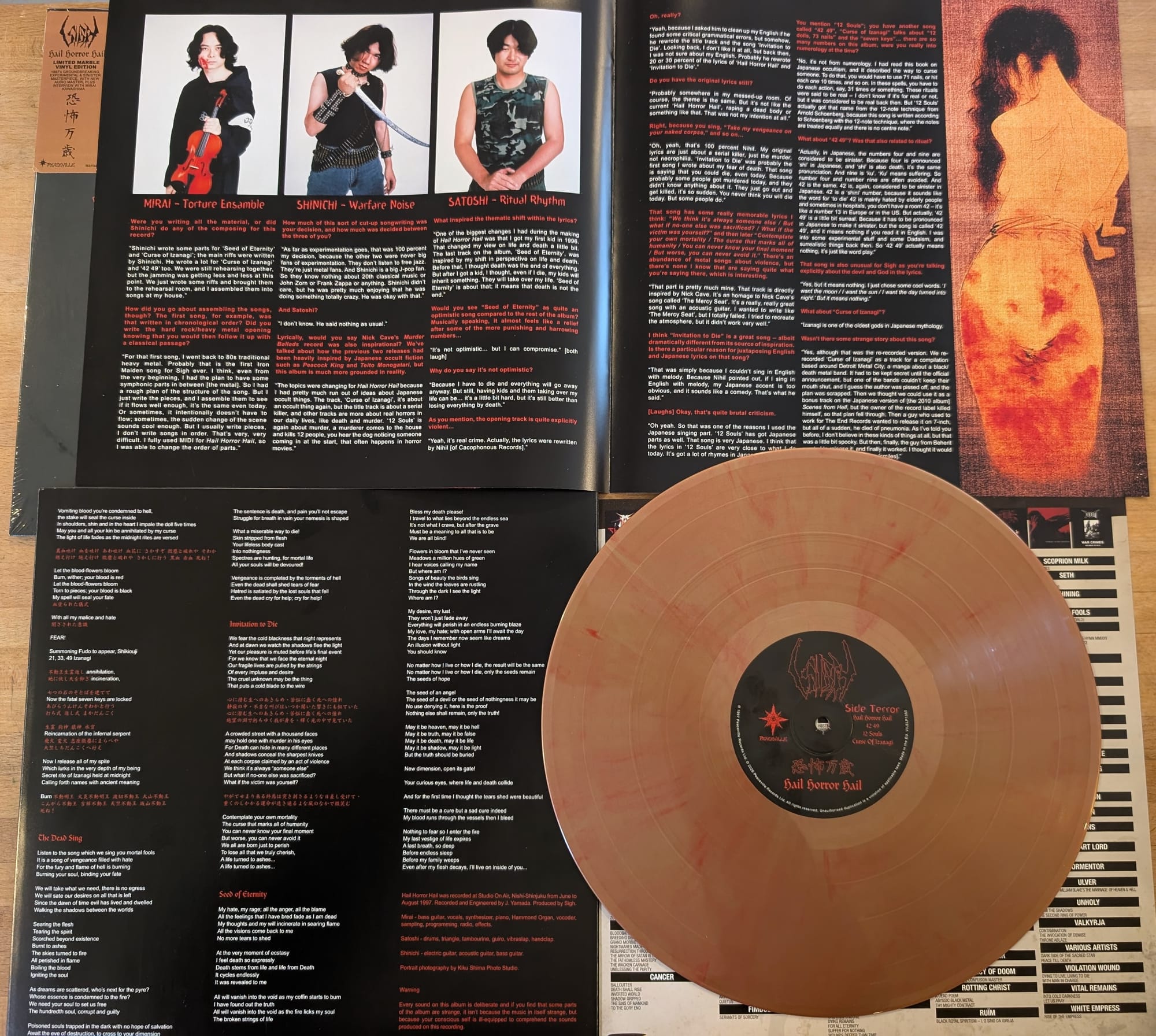
The clause was part provocation, part capitulation to the demands of Sigh’s then-label, Cacophonous Recordings. As the band’s leader Mirai Kawashima told writer Dayal Patterson in an interview included with the recently reissued edition of Hail Horror Hail, label head Neil Harding, aka Frater Nihil, was a little freaked out by what he heard. “[The album] has some noises in the title track right before going into the orchestral part,” Kawashima remembers, “and Nihil wanted to delete that as he thought some fans might think it was just some unintentional noise. Of course, I said no, but he suggested having some notice on the back cover.”
The idea that anyone would be thrown off by anything on a metal album seems quaint, but Hail Horror Hail and Ghastly Funeral Theatre, the EP that Sigh had released six months earlier, represented a hard left turn for the band. Up to that point, the group had released some fine music that bore a huge debt to foundational black-metal artists like Celtic Frost and Bathory. But as Kawashima moved forward, his interest turned to 20th-century classical composers like Alfred Schnittke and György Ligeti, the modern jazz of John Zorn, and the bombastic rock of Nick Cave. He steeped himself in music theory, bought an Ensoniq TS-12 synthesizer, and started writing bold, symphonic black metal epics. The growling vocals, thunderous drums, and shredding guitar remained, but they were joined by swells of fake string and horn parts, tubular bells, operatic singing, and over-the-top piano solos. And on “Invitation to Die,” one of the best cuts on Hail, Kawashima even indulges in a little synthpop.
Harding’s worries were entirely unfounded, as fans and critics quickly embraced both Ghastly Funeral Theatre and Hail Horror Hail, with the latter winding up on metal magazine Terrorizer’s list of the most important albums of the ’90s. As metal fans adore physical media, and as the records were originally issued on CD only, demand was high for proper vinyl versions. They’ve gotten their wish in recent years. US label Dark Symphonies put together deluxe reissues of both the EP and full-length on their The Crypt sublabel in 2010 and 2011, respectively, while a repress of Ghastly came out on UK imprint Deathheadz in 2022.
But in all of the above cases, the pressings were done in extremely limited numbers, leaving most of the band’s worldwide fanbase still hungry for fresh wax. This year, Sigh’s current home at Peaceville Records came to the rescue with new vinyl editions of Ghastly and Hail on both colored and black vinyl. It’s a development I want to celebrate more fully, but my excitement is dampened by these rather underwhelming pressings. Whenever I drop the needle on a metal album, I want to be pummeled by the music, but both Sigh reissues have lackluster sound that only occasionally sparks to life.
There are plenty of potential explanations for this. Engineer Patrick W. Engel of Temple of Disharmony remastered both reissues from the original DAT masters made for the CD release. While transferring a digital source to an analog medium doesn’t necessarily spell disaster, in this case the music suffers in the translation, tamping down the vicious snap of Satoshi Fujinami’s drums and casting much of the low end in an ugly light. The midrange of Kawashima’s guitar and some of the synth lines fare better, but that only serves to make the rest of the album feel off-balance. There’s also the matter of squeezing all 51 minutes of Hail Horror Hail onto a single disc with the tight grooves adding to the sonic constriction. (I also wonder how purists are going to react to the decision to shuffle the track order, pushing “Curse of Izanagi” to the end of Side 1 from its original spot as the album’s penultimate track.) Ghastly Funeral Theatre comes out a bit better as it was cut at 45 RPM, which helps give some welcome zip to the low end and Kawashima’s vocals, but it still sounds overall like Engel was pulling his punches.

Though my disappointment with the sound of these reissues remains, I have to give credit to Peaceville for packaging them with the appropriate amount of care. Each disc features an extensive interview with Kawashima that goes deep into this fascinating period of Sigh’s history and the process of putting these songs together. I don’t know how often these records will land on my turntable in the future, but they will remain on my shelves as a useful research tool in my self-directed studies of metal past and present.
Hail Horror Hail: Peaceville 1-LP 33 RPM gold and red marble vinyl
• Remastered reissue of Sigh’s 1997 album
• Jacket: Direct-to-board single-pocket
• Inner sleeve: Printed paper with album lyrics and credits
• Liner notes, insert, or booklet: Four-page booklet featuring an interview with Mirai Kawashima, and double-sided insert with Peaceville vinyl catalog
• Source: Digital; “new transfer from original DAT source”
• Mastering credit: Patrick W. Engel, Temple of Disharmony, Bamberg, Germany
• Lacquer cut by: Heino Leja at Optimal Media, Germany; “HL” in deadwax
• Pressed at: Optimal Media, Germany
• Vinyl pressing quality (visual): A
• Vinyl pressing quality (audio): A
• Additional notes: Limited edition pressing. A black vinyl version is also available.
Ghastly Funeral Theatre: Peaceville 1-LP 45 RPM transparent silver and black marble vinyl
• Remastered reissue of Sigh’s 1997 EP
• Jacket: Direct-to-board single-pocket
• Inner sleeve: Printed paper with album lyrics and interview
• Liner notes, insert, or booklet: Interview with Mirai Kawashima on inner sleeve, plus double-sided insert with Peaceville vinyl catalog
• Source: Digital; “new transfer from original DAT source”
• Mastering credit: Patrick W. Engel, Temple of Disharmony, Bamberg, Germany
• Lacquer cut by: Heino Leja at Optimal Media, Germany; “HL” in deadwax
• Pressed at Optimal Media, Germany
• Vinyl pressing quality (visual): A
• Vinyl pressing quality (audio): A
• Additional notes: Limited edition pressing. A black vinyl version is also available.
Listening equipment:
Table: Cambridge Audio Alva ST
Cart: Grado Green3
Amp: Sansui 9090
Speakers: Electro Voice TS8-2