Review: Charles Wright & The Watts 103rd Street Rhythm Band
Share
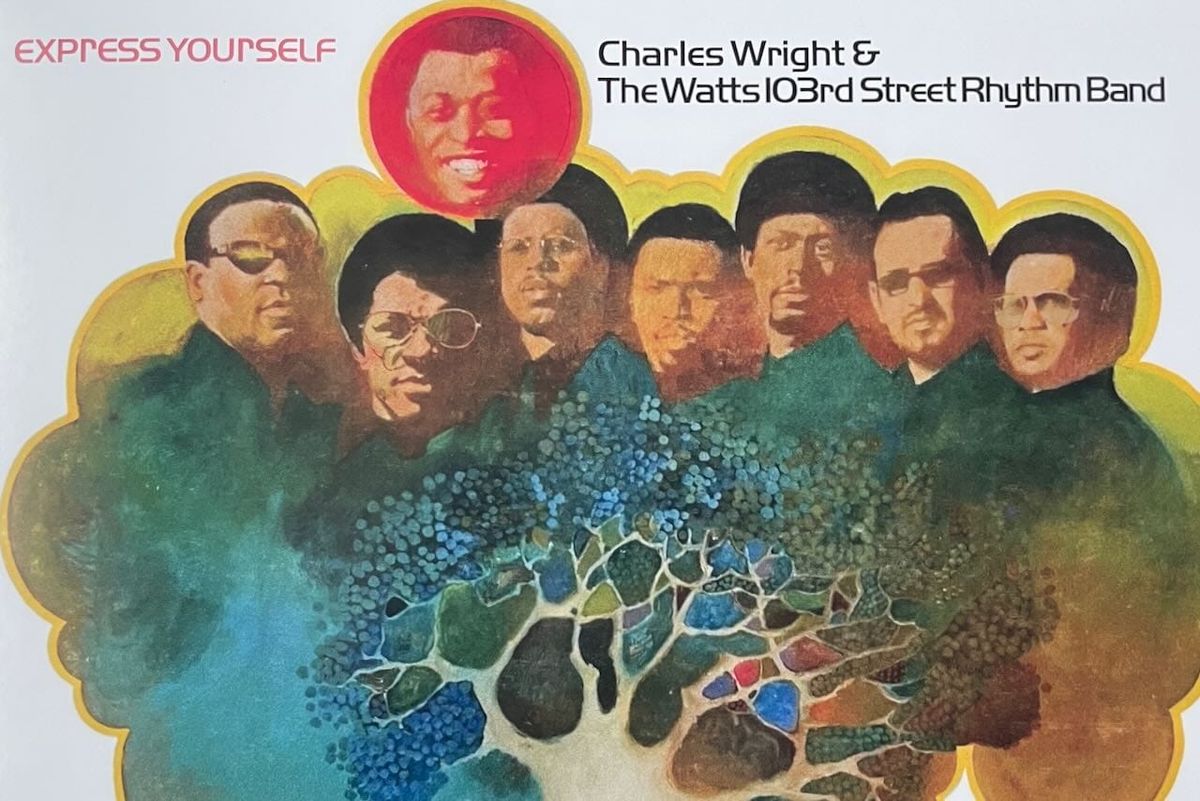
Image from the cover of Charles Wright & The Watts 103rd Street Rhythm Band's Express Yourself.

A new Rhino Reserve pressing makes 1970’s Express Yourself bigger than ever.

Today I’m continuing my survey of the five Rhino Reserve pressings that came out in June as part of Black Music Month. Last week I reviewed Betty Wright’s I Love the Way You Love and Little Beaver’s Party Down, which both originated from the TK Records scene in Hialeah, Florida, and today I’m writing about at an album that came out of Los Angeles, the entertainment capital of the US—a city that, despite the presence of countless record labels and recording studios, never really had a huge R&B scene of its own.

Before I get to the review, a number of interesting vinyl reissues were announced in recent days and are worth mentioning. With the holiday shopping season starting earlier than ever—September, at this point, it seems—we’re starting to get advance notice of all the things that will be coming our way in the last third of the year. Last week’s announcements of Funkadelic’s Maggot Brain and the Rush and Donald Fagan MoFis were only the tip of the iceberg.

DSS one-steps of Hole and Beck.

So… this just in! Interscope-Capitol’s Definitive Sound Series has announced its newest one-step, which will be Hole’s 1994 album Live Through This. Due out September 25, it’s cut from the original analog tapes by Chris Bellman of Bernie Grundman Mastering and pressed on high-quality vinyl at RTI. It’s the first time a vinyl version of the album has been cut from the tapes, which were prepared by Bob Ludwig and long though lost, but were recently rediscovered in a storage locker by Hole guitarist Eric Erlandson.

Interestingly, another DSS one-step has also just been announced, and for the first time in the series, it’s not for a reissue. Instead it’s for Ride Lonesome, Beck’s brand-new studio album that drops September 18. It’s cut from 24/96 files by Levi Seitz at Black Belt Mastering, who also did the phenomenal DSS one-step for Beck’s Morning Phase (read our review here)—fitting, as the album, which was produced by Beck and mixed by Nigel Godrich, is reportedly an intentional hearkening back to the sounds of Morning Phase and Sea Change. The DSS is available for pre-order, and the album will also be available on conventional vinyl.

Upcoming releases by Phil Collins and David Bowie.

Meanwhile, Rhino made two announcements this morning. Phil Collins’s 1981 solo debut Face Value is being expanded to a 4-LP set titled Full Value (Face Value) that includes a half-speed master of the album cut by Miles Showell at Abbey Road, plus live material and demos, much of which has been released before but almost none of it on vinyl. A Blu-ray with Dolby Atmos and stereo remixes by Steven Wilson is being made available separately; both versions will be released on September 18.

And Rhino’s second announcement is for an archival David Bowie release coming from their Parlophone arm, collecting the 1965 recordings a teenaged Davie Jones recorded with producer Shel Talmy, which resulted in two unsuccessful singles and a bevy of outtakes. Several of these were released on the long-out-of-print 1991 Rhino CD Early On (1964–1966), but The Shel Talmy Recordings includes 10 tracks that have never been issued before. The CD includes 22 tracks, while the vinyl, available in black and limited red variants, only includes 12 tracks, although this isn’t currently reflected in Rhino’s listing (buyer, take note). Perhaps the other 10 tracks will be made available on vinyl via a Record Store Day 10-inch or something. The release, due out September 18, is also available via David Bowie’s online store, along with a huge amount of tie-in swag. There’s also apparently going to be a version with an alternate cover being sold at HMV and independent record stores, limited to 1,965 copies.

And now with all of that potential distress to your bank account out of the way, let’s get into today’s review.

Cover art for Charles Wright & The Watts 103rd Street Rhythm Band.

Charles Wright & The Watts 103rd Street Rhythm Band: Express Yourself

Despite being one of the hubs of recorded music in the 1960s, Los Angeles never developed a prominent soul scene the way Detroit, Memphis, or Philly did. It’s tough to say why, exactly—LA was a hotbed for other musical movements during that era, developing its own counterculture among white musicians in the folk-rock and psychedelic scenes that culminated in the dope-scented Laurel Canyon community, which cradled the vastly popular singer/songwriter movement of the early 1970s. But Black musicians remained at a remove from the Los Angeles music industry at large, perhaps because of the way the city’s sprawl and highway system kept Black and white populations isolated from each other. It wasn’t until the 1970s that acts such as Barry White, Bill Withers, and Earth, Wind & Fire gave LA an eventual R&B identity of its own.

Prior to that, the closest thing LA had to a flagship soul band may well have been Charles Wright and the Watts 103rd Street Rhythm Band. Their name, of course, refers to the main drag in South LA’s Watts neighborhood, a black enclave that suffered unrest and destruction during the historic riots in August 1965. Wright, born to a Mississippi sharecropper, moved to LA at age 12 and had worked in his adopted hometown as a musician, songwriter, and occasional A&R man for several years by the time Bill Cosby tipped him and a group of session musicians to back him on the comedian’s 1967 album of songs, Silver Throat: Bill Cosby Sings. That led to Cosby’s label at the time, Warner Bros., to sign Wright and some of the other musicians as an act called the Watts 103rd Street Rhythm Band—the first R&B band on the label’s roster. Amid much personnel change, the Watts Band recorded five albums for the label, eventually solidifying a somewhat stable lineup around Wright on piano, Melvin Dunlap on bass, and James Gadson on drums.

Express Yourself is the fourth of those, and was the first Watts 103rd Street Rhythm Band album to have Wright’s name out in front, appearing in the summer of 1970 accompanied by the single of its glorious title track. “Express Yourself” was a moderate hit at the time, reaching number 12—the third of the group’s singles to reach the Top 40, following the raw, live-recorded “Do Your Thing” and the silky, string-laden “Love Land”—but it has since gone on to become an instantly recognizable landmark of R&B and funk. The song had its origins during a vamp on “Do Your Thing” at a live show in Texas, but Wright met resistance when he fleshed out the song to stand on its own. “No one wanted to record it,” Wright told LA Weekly in 2014. “I had to sneak a bass player, drummer, and engineer into the studio one Sunday and cut it in secret. The president of Warner Bros. told me I made a mistake. So did every DJ that I played it for.”

It’s crazy to imagine any label executive or DJ with functioning ears not immediately reacting to “Express Yourself” with anything less than unbridled enthusiasm, but perhaps the drums sounded a bit too overdriven, the slice-and-dice groove a bit too dirty, and Wright’s lyrical exhortations a bit too sketchlike and minimal for it to be accepted in conventional pop terms. Still, by this time James Brown had achieved success by stripping back soul-music conventions to let his group’s wire-tight, ever-repeating riffs propel the music. Wright and the Watts Band sweetened the pot by adding some sunny positivity by way of the song’s stepladder progression of major chords and by making the rhythm even more irresistible, with the syncopation of the drums against the even strumming of the guitar making it impossible to hear without at least thinking about shaking a leg.

Charles Wright, bassist Melvin Dunlap, and drummer James Gadson, as they appear on the back cover of Express Yourself.

The rest of the album finds Wright and the Watts Band cultivating their own flavor of Los Angeles soul. The gospel overtones are undeniable right from Express Yourself’s kickoff, the gorgeously stately “Road Without an End,” led by reverential piano and organ atop a propulsive beat from drummer Gadson, kick-started on every bar by a flurry of notes from bassist Dunlap. “I’m Aware” finds Wright and Gadson harmonizing Sam & Dave–style over a jazzily relaxed version of a four-on-the-floor Stax soul stomp. And “I Got Love” offers dense, Metersesque funk augmented by the Watts Band’s five-piece horn section, riding the groove’s natural acceleration to a fade-out finish.

The album is dominated by two lengthy versions of “High as Apple Pie,” dubbed “Slice 1” and “Slice 2.” The first “Slice” is the faster rendition, in the loose-limbed vein of “Do Your Thing,” with the instrumentalists sketching in space around the song’s framework. Once the melody reveals itself, it’s pure church, with a backing choir turning the funk workout into a revival meeting. The second “Slice,” which closes the album, is more avant-garde and exploratory, with the musicians’ jazz chops evoking a more thoughtful, loping groove; when the gospel choir enters the fray this time, the effect is ghostly and psychedelic, floating in and out of the band’s improvisations. While not a flawless album—there simply may be too much “Apple Pie” for one sitting—Express Yourself is deliriously enjoyable, and strong enough to function as a calling card for turn-of-the-decade LA soul.

However, the album suffered a convoluted release history due to two versions being issued a few months apart in 1970. The album originally opened with “Road Without an End” and also included a fantastic ballad called “Tell Me What You Want Me to Do” on Side 2. This version was replaced later in the year with an amended tracklist that swapped “Road Without an End” with “Love Land,” the hit single that had already appeared on the group’s previous album, 1969’s In the Jungle, Babe. “Tell Me What You Want Me to Do” was also removed, and more than a minute was edited out of “High as Apple Pie - Slice 1.” Meanwhile, “High as Apple Pie - Slice 2” nearly doubled in length, going from nine and a half minutes to close to 18. It’s unclear why “Love Land” was added to the album after the fact, especially when it was available elsewhere, but the revised version with “Love Land” was what lingered on record-store shelves for years after the album’s release, and it’s the version used for the album’s two most recent reissues on vinyl, a 2020 edition released on Real Gone Music and a 2023 pressing from Music on Vinyl, both cut from digital transfers.

The new Rhino Reserve reinstates the original tracklist, with “Road Without an End” and “Tell Me What You Want Me to Do,” plus the unedited version of “High as Apple Pie - Slice 1.” However, it also includes the complete 18-minute version of “High as Apple Pie - Slice 2,” making this essentially a complete vinyl edition of Express Yourself. Only “Love Land” is missing, but it could be argued that the song—which, in my opinion, is inferior to every track on Express Yourself—never belonged on the album to begin with. This “complete” album tracklist has appeared on CD before, on a 2007 expanded edition that’s now out of print, but it’s never been on vinyl until now—and the new Rhino Reserve is cut from tape, no less.

Back cover and disc for Charles Wright & The Watts 103rd Street Rhythm Band.

I wondered how that was possible, since the original album master reel would have had the shorter “High as Apple Pie - Slice 2” on it. In a post on the Steve Hoffman Music Forums, mastering engineer Matthew Lutthans described the process of putting all the pieces back together for this new lacquer cut: “I was sent reels of tape that contained the revised running order (side A and side B reels), and a reel containing all of the stuff that was swapped out, removed, edited, etc., and then had to splice everything back together in the original order, side A and side B. All the material was in great shape, and it worked well.” As such, this is the definitive vinyl version of Express Yourself, although it also means that Side 2 now runs in excess of 27 minutes. Happily, I found that no significant compromises in the sound resulted from the extended side length—the bass even seems to carry as much gravity as it does on Side 1.

Indeed, both sides of the new Lutthans cut are pretty incredible. This is par for the course, of course—his work throughout the Rhino Reserve series has been virtually unimpeachable—but the character of the Mastering Lab’s all-tube system that Lutthans works on is a particularly good match for this type of soul music. It’s driven by warmth, bass, and rhythm, but also allows for delineated space around the guitar and keyboard parts, with occasional waves of horns and strings to shade in sections of the canvas. Here, the sonic image is unified, projected in subtle 3D depth with a pleasingly wide soundstage. When needed, the bass becomes massive; Dunlap’s part on “I Got Love,” for example, is deep and arrestingly present—it’s the kind of thing that has you putting on the track for your friends as you stammer, “You gotta hear this…” The pressing, from Fidelity, is as fine as ever.

The album is an effective collision of gossamer soul and grimy funk, played with more feeling than accuracy. But the occasional fluffed cues and missed notes keeps everything live- and fresh-feeling, and the realism and presence of the Rhino Reserve cut make the raggedy edges all part of the appeal. At quieter listening levels, it’s a rounded, appealing listen that gives everything room to breathe, but when the volume is pushed up, the bass really takes root and this thing becomes a monster.

Perhaps the revised, inferior tracklist dinged Express Yourself’s legacy, and maybe the lack of a unified Los Angeles soul scene that could have elevated its stature prevented the album from taking root as an essential R&B text. As such, it’s like a wildflower growing out on its own, sprouting up between the cracks in a desert of concrete. But its strong ties to gospel, its easygoing incorporation of jazz, and its buoyant, sunlit interpretation of the nascent funk sounds that were starting to take hold in the R&B scene make the soul of Charles Wright and the Watts 103rd Street Rhythm Band its own thing. And this splendid Rhino Reserve pressing gives us more of it than has ever appeared on a single piece of wax.

Rhino Reserve 1-LP 33 RPM 180g black vinyl
• New analog remaster of Charles Wright and the Watts 103rd Street Rhythm Band’s 1970 album, using the first version’s tracklist, augmented by the extended take of “High as Apple Pie - Slice 2” that appeared on the second version
• Jacket: Direct-to-board single pocket
• Inner sleeve: Fidelity Record Pressing–branded poly
• Liner notes, insert, or booklet: None
• Source: Analog; “Lacquers cut from the original analog master”
• Mastering credit: Matthew Lutthans at The Mastering Lab, Salina, KS
• Lacquer cut by: Matthew Lutthans at The Mastering Lab, Salina, KS; “MCL” in the deadwax
• Pressed at: Fidelity Record Pressing, Oxnard, CA
• Vinyl pressing quality (visual): A
• Vinyl pressing quality (audio): A- (very slight dishing on my copy)
• Additional notes: Comes inside a reusable poly outer sleeve sealed by a hype sticker, as per other Rhino Reserve titles.

Listening equipment:
Table: Technics SL-1200MK2
Cart: Audio-Technica VM540ML
Amp: Luxman L-509X
Speakers: ADS L980