Reviews: Betty Wright | Little Beaver

Share
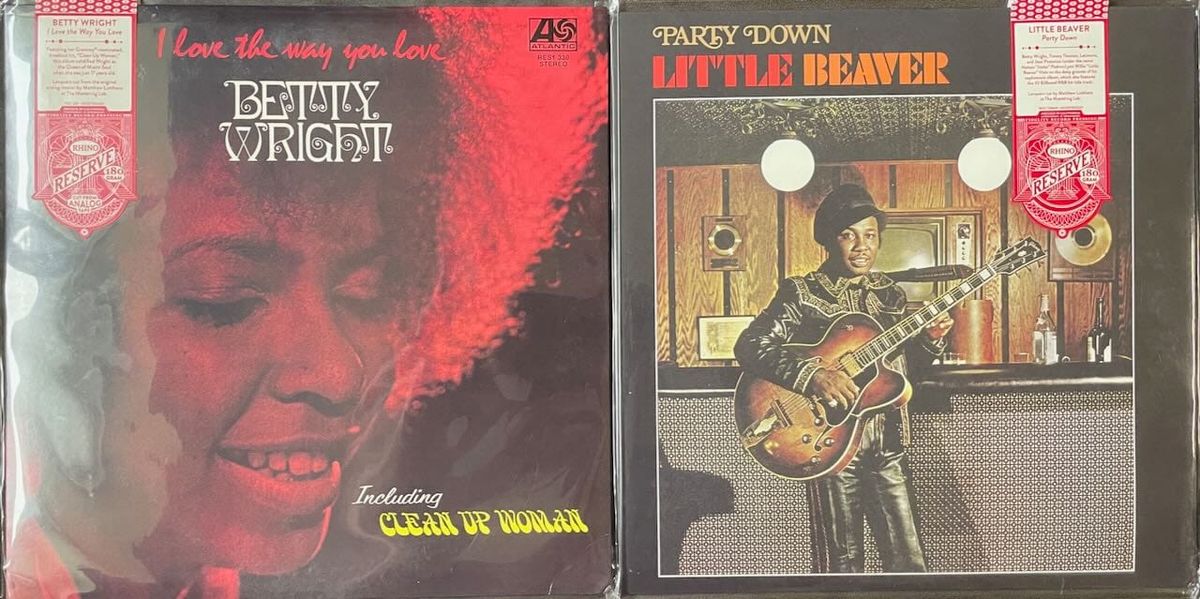
Cover art for Betty Wright and Little Beaver.

The Rhino Reserve series revisits two gems of Miami soul.

Just a couple of quick newsy bits before I get into today’s reviews:

Maggot Brain is coming! The third installment in Org Music’s reissue series of Funkadelic’s Westbound Records catalog will be arriving on September 11. This is the big one that Funkadelic fans have been waiting for. 1971’s Maggot Brain is getting both 33 RPM and 45 RPM cuts from analog tape, making this a near-definitive reissue of a highly coveted album that just keeps getting more expensive and harder to find in the used bins. Org’s previous Funkadelic reissues have knocked my socks off (read my reviews here and here), and I have little doubt Maggot Brain will do the same. Preorders can be placed on Org’s site as well as through most online retailers; there are a lot of colored-vinyl variants floating around out there, too, if that’s your kind of funk.

• Also, Mobile Fidelity announced that three Rush reissues are coming this year, with more on the way. The first two Rush albums, 1974’s Rush and 1975’s Fly by Night, are getting the 2-LP 45 RPM rendition, while 1977’s A Farewell to Kings will also be cut at 45 RPM but issued as an UltraDisc one-step pressing on premium vinyl in a slipcase, with a price tag to match. Fly by Night and A Farewell to Kings are due “Summer 2026” (meaning August or September, I think) while Rush is coming “Fall 2026” (meaning October through December, probably). The rest of Rush’s catalog up through 1985’s Power Windows is on tap for 2027; sone of those will be UltraDisc one-steps but it hasn’t been announced which ones. It’s a big week for MoFi, as they also announced an UltraDisc one-step edition of Donald Fagan’s 1993 solo album Kamakiriad, although no specific release date has been set.

• Lastly, the newest Rhino High Fidelity installment will be announced this Friday, July 10—just as the current one, Joni Mitchell’s Blue, starts to ship out from their warehouses. Steve Westman will be hosting Rhino’s Patrick Milligan on a livestream that begins Friday morning at 9 am Eastern/6 am Pacific, if you’d like to tune in and be one of the first to find out what the next RHF will be. I should have a direct link for that livestream in time for tomorrow’s New Vinyl Reissues newsletter, or you can go to Westman’s YouTube page and look for it there.

Onward to the reviews!


The Miami/Hialeah Sound

Thanks to the preeminence of Motown and Stax during soul music’s heyday in the 1960s, the cities of Detroit and Memphis are often regarded as the two crucial hotbeds of soul and R&B. But the music possessed an enormous wingspan, with dozens of localized pockets around the United States that developed their own styles, thrived for a time, and then faded away. As soul matured in the 1970s, incorporating elements of Latin, funk, and eventually disco, radio grew more homogenized and musical trends began to shape at a national scale. But even amid those shifts, the local scenes kept putting their own spins on the new licks and rhythms, all while carrying on individual traditions that stretched back to R&B’s origins in the 1940s.

In June, as part of Black Music Month, the Rhino Reserve series reissued five vintage R&B albums, all of which were recorded outside of the two major soul-music capitals of America. Listened to individually, each is a worthwhile LP in its own right, but taken collectively, they provide a snapshot of the diversity of American R&B in the ’70s and early ’80s, when the individual sounds coming from different parts of the country influenced each other and cross-pollinated even as they maintained their own homegrown identities. Two of those reissues are for albums that came from the thriving South Florida scene of the 1970s, centered around Miami and the adjoining city of Hialeah—home to Alston Records and the TK Records label group. TK and its many subsidiaries were all started by Henry Stone and Steve Alaimo, who would merge the companies together when TK became a disco powerhouse, before the whole enterprise went bankrupt in 1981.

But in the ’70s, Alston, TK, and associated labels like Cat Records were the incubators where world-class songwriters, producers, musicians, and artists plied their trade—like songwriter/producer Clarence Reid, who moonlit as the masked, spandexed Blowfly, responsible for filthy parody records intended to be played at late-night parties; or Harry Wayne Casey, who was a co-writer of George McCrae’s proto-disco smash “Rock Your Baby” before fronting his own hugely successful act, KC and the Sunshine Band, which transferred the Junkanoo street sounds of the neighboring Bahamas into the disco milieu. Miami was also home to the renowned Criteria Studios, where big-name out-of-towners like Stephen Stills and Eric Clapton would roll tape, and where Bee Gees would merge disco and pop to create some of the most irresistible—and, eventually, irritating—records of all time.

But in the years before Miami’s disco explosion, and long before the backlash, Miami and Hialeah nurtured a soul scene as vibrant and unique as any in the country. Today we’ll look at two of those ’70s South Florida records, which show just how quickly the music evolved in just a few short years, even with many of the same players involved. (For more about the Florida soul scene, check out John Capouya’s book Florida Soul, published by University Press of Florida.)


Cover art and disc for Betty Wright.

Betty Wright: I Love the Way You Love

Bessie Regina Norris grew up in Miami, embarking on a recording career when she was still a child, as part of a gospel group with her siblings. She went solo at age 12 under her stage name, Betty Wright, and signed to Miami’s Alston label when she was just 14, releasing her first album after an early single, 1968’s “Girls Can’t Do What the Guys Do,” got some national chart attention. So by the time “Clean Up Woman” hit it big in 1971, Wright was already something of a veteran, even though she was just 17 years old.

“Clean Up Woman” was written and produced by Clarence Reid and Willie Clarke, the local songwriting and producing team that had been working with Wright for years by that point. Together, Wright, Reid, and Clarke concocted a marvelous slice of Miami soul, built around two intersecting guitar parts that play off of one another’s syncopation. (That’s Little Beaver on at least one of the guitars, and we’ll get to him in a bit; a third guitar eventually joins in for some tasty Steve Cropperisms.) Riding a righteous strut that lands in that sweet spot just between a straight beat and a shuffle, the song has echoes of deep-fried Southern soul and New Orleans street-walking rhythms but carries its own unique sense of amiable defiance.

“Clean Up Woman” was massive, so naturally the second Betty Wright full-length album followed suit. Reid and Clarke remain at the reins of 1972’s I Love the Way You Love, and they gently reposition Wright as a singer of soul ballads, well-versed in the intersecting spheres of bedroom-eyes devotion and tear-stained heartbreak. Hints of rambunctious funk creep into “All Your Kissin’ Sho’ Don't Make True Lovin’,” and inevitable traces of Motown’s influence can be heard on the upbeat Supremes pastiche “If You Love Me Like You Say You Love Me,” while Wright channels the more introspective side of Diana Ross on the album-closing “Let’s Not Rush Down This Road of Love.” 

Back cover and disc for Betty Wright.

Meanwhile, the Miami players take on “Ain’t No Sunshine,” turning Bill Withers’s deliberate tempo into a somewhat stoned-sounding lurch, with blearily heavy chord stabs and a continually scavenging bassline. The album’s other cover, “I Found That Guy,” is a reworking of the Jackson 5’s “I Found That Girl,” with Wright transposing Jermaine’s solo showcase into something less fussy and distinctly more sincere, as the Miami crew dirties up the Corporation’s rococo sound with a funkified 12/8 beat and Little Beaver’s Beatlesque guitar lines.

Across all of this, Wright rises to every challenge that comes her way, using her aerial-acrobatic range to convey careworn tones that are well beyond her years. And it makes for a simply wonderful album, with long, loving looks back to the warmth and glow of ’60s soul and a simultaneous eye forward on the more rhythmically dense, dramatic places that R&B would be going in the coming years. Every song is a treat—“no skips,” in the parlance of today’s playlist-inculcated young ’uns—but more than that, I Love the Way You Love captures that ineffable essence that makes for perfect pop, when carefree youth is in the process of becoming something more mature and worldly-wise, melodic simplicity is gently feathered with hints of harmonic complexity, and the rhythms are there to not just make you dance all night but also keep you moving forward the next morning.

The Mastering Lab’s Matthew Lutthans is the go-to mastering engineer and lacquer cutter for the Rhino Reserve series, and he cut I Love the Way You Love from the analog master tape, as is indicated on the hype sticker. The all-tube system at the Mastering Lab lends the album a warm-blooded, toothsome sound that’s perfectly suited to the arrangements and material, opening up the spaces in between the notes and players while also putting each piece under flattering lighting. The tasteful strings and horns take on just the right presence, offering support, sugar, or suspense depending on the situation, and the bass is exquisitely positioned, riding out in front of the soundstage and controlling the thermostat. There’s no astringency to the sound, even when Wright reaches into her slightly uncontrolled upper register or the strings glide heavenward; Lutthans allows the music’s muscularity and the delicate dexterity of Wright’s voice to push things forward in equal measures. It’s an album that sounds more like a classic the more you listen—I Love the Way You Love will reward fans of the humid, swampy sound of Southern soul even as it simultaneously offers a relieving South Floridian sea breeze. 

Rhino Reserve 1-LP 33 RPM 180g black vinyl
• AAA remaster of Betty Wright’s 1972 album
• Jacket: Direct-to-board single pocket
• Inner sleeve: Rhino Reserve–branded poly
• Liner notes, insert, or booklet: None
• Source: Analog; “Lacquers cut from the original analog master”
• Mastering credit: Matthew Lutthans at The Mastering Lab, Salina, KS
• Lacquer cut by: Matthew Lutthans at the Mastering Lab, Salina, KS
• Pressed at: Fidelity Record Pressing, Oxnard, CA
• Vinyl pressing quality (visual): A
• Vinyl pressing quality (audio): A
• Additional notes: Comes inside a reusable poly outer sleeve sealed by a hype sticker, as per other Rhino Reserve titles.


Cover art and disc for Little Beaver.

Little Beaver: Party Down

Betty Wright turns up as a backing vocalist on her friend Little Beaver’s 1974 album Party Down—Beaver being the featured guitarist, of course, on “Clean Up Woman” and I Love the Way You Love. Little Beaver wasn’t a dirty-minded sobriquet devised by Blowfly; it was actually a childhood nickname that Willie Hale earned as a result of his prominent front teeth.

Along with Wright—who co-wrote the album track “I Can Dig It Baby”—several other Alston/TK regulars make appearances on Party Down, Little Beaver’s third LP for the TK sublabel Cat Records. Producer Willie Clarke and drummer Robert Ferguson are on board, as is bassist Ron Bogdon and keyboardist Benny Latimore (aka just Latimore, a performer in his own right), all of whom played on the Wright LP a couple of years prior. Timmy Thomas and Jaco Pastorius—under an alias, Nelson (Jacko) Padron—also turn up here, giving Hale an all-star backing for this modest but wholly hospitable affair.

The album’s title track became a big hit in ’74, and it’s a slow jam that maintains a surprising amount of funkiness and forward momentum, aided by Latin tinges and Hale’s chipper exhortations to keep the party going. Clearly, Hale was paying attention to George McCrae’s “Rock Your Baby,” as it follows that track’s revolutionary trend of using a programmed beatbox to provide the song’s underpinning. But whereas “Rock Your Baby” was dreamy, swoony, and full of sea foam, “Party Down” means business, and its business is pleasure. Robert Christgau once wrote, unkindly, “The great T.K. guitarist (né Willie Hale) has a problem when he sings, which is that he can't.” This is, quite frankly, a complete load of balderdash from our esteemed dean of rock critics. Hale’s vocals continually impress throughout the LP—get a load of his liberally applied falsetto shriek—even as his fluid, conversational guitar is the dominant voice here.

Clearly Hale and the TK powers-that-be thought “Party Down” was their winning ticket, as they positioned it as the album’s opening track—and then immediately followed it with a second instrumental version, cutting the album off at its knees just as it’s getting underway. It seems obvious that the two versions of “Party Down” should either have been mixed together into one long, continuous jam or been separated on the tracklist, perhaps with one as the opening cut and the other one closing. Unfortunate sequencing aside, the album does eventually locate some different gears within its low-key funk milieu, although all the songs take place at different intervals along the dimly lit hallway that stretches between the all-night blowout going down in the living room and the darkened back bedroom where more horizontal things are transpiring.

Back cover and disc for Little Beaver.

The analog master tape for Party Down has either gone missing or is in no shape to be rethreaded, so this Rhino Reserve reissue is cut by Matthew Lutthans from a digital source. To add to that, the album has some noticeable recording limitations that are baked in, including an element of blown-out distortion on “Money Vibrations,” some significant background squelching and hissing that’s noticeable during the song fadeouts, and an overall muddier sound than was found on the Betty Wright album. There’s also a bit of edgy high end from the electronic beatbox used on most of the tracks, although it’s nicely counterbalanced by a rich, woolly bottom end that ends up being the album’s sonic calling card. This cut should satisfy bassheads, as the lower reaches are powerful and well-articulated while avoiding a boomy or distended sound. It’s a record suitable for, well, partying down rather than super-close audiophile-style listening, so if attention to detail is what you’re craving, well, then, it really isn’t that kind of record to begin with.

Throughout the album, Little Beaver’s guitar shakes off stereotypical blues patterns to inhabit a style of jazz-inflected funk whose spidey-sense is tingling, telling us that disco is right around the corner. Indeed, the undertow of the dance floor is where the album’s center of gravity comes from, and the murkiness of the sound never gets in the way of its compulsive beats. While tunes like “Let the Good Times Roll” and “Get into the Party Line” are somewhat lacking in emotional content, the late-night funk ’n’ grind can be pretty tough to resist from a physical standpoint.

I like the warm, thumping sound of the Rhino Reserve cut of Party Down, but potential listeners should be aware that it’s dark, dense, and bottom-driven. It sounds to me like Hale and Clarke produced these tracks from a basis of beatbox and guitar, laying on the bass as thick as they dared and then treating all the subsequent pieces if not as afterthoughts then as accoutrements that wouldn’t shift the overall dynamic they’d already established. Any digital element from the master sounds fully mitigated to me by the Mastering Lab’s all-tube treatment, and the album, while slight from a songwriting perspective, does eventually make up for the lost momentum of having those two back-to-back “Party Down” tracks frontloaded. And if the sound is a bit dimmer and less articulate than you might want out of your ’70s funk, well, this album’s all about that time of the night when you want to keep those lights turned down nice and low.

Rhino Reserve 1-LP 33 RPM 180g black vinyl
• Remaster of Little Beaver’s 1974 album
• Jacket: Direct-to-board single pocket
• Inner sleeve: Rhino Reserve–branded poly
• Liner notes, insert, or booklet: None
• Source: Digital
• Mastering credit: Matthew Lutthans at The Mastering Lab, Salina, KS
• Lacquer cut by: Matthew Lutthans at the Mastering Lab, Salina, KS
• Pressed at: Fidelity Record Pressing, Oxnard, CA
• Vinyl pressing quality (visual): A
• Vinyl pressing quality (audio): A
• Additional notes: Comes inside a reusable poly outer sleeve sealed by a hype sticker, as per other Rhino Reserve titles.

Listening equipment:
Table: Technics SL-1200MK2
Cart: Audio-Technica VM540ML
Amp: Luxman L-509X
Speakers: ADS L980