Reviews: Funkadelic | Larrison | Therapy?

Share
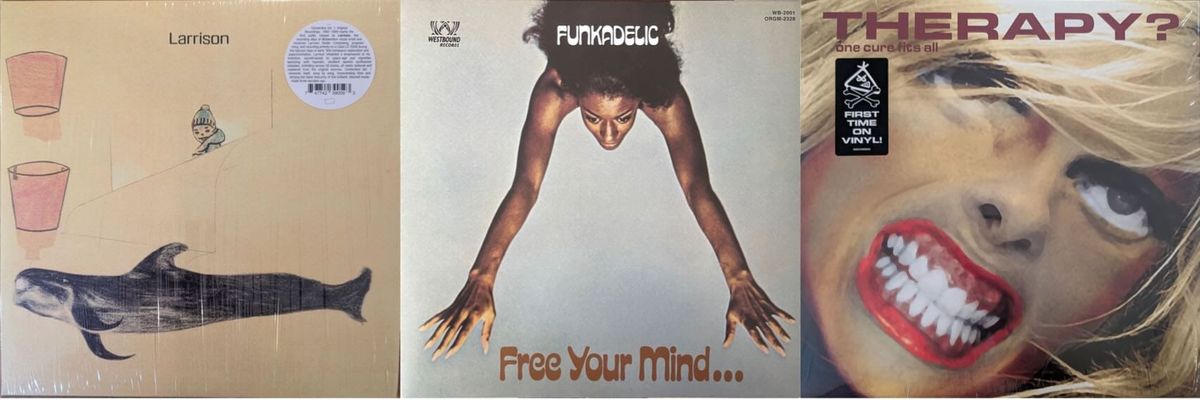
Cover art for Larrison, Funkadelic, and Therapy?

We’ve got three new reviews for you today, including a look at the second installment in Org Music’s reissue series of the formidable Funkadelic catalog. We’ve also got some wonderful rediscovered synth music that was found as part of a long-forgotten trove of cassettes, and a ’00s rock record that has never been issued on vinyl before.

Something for everyone? Maybe; maybe not. But we hope there’s something for you.

And you can let us know in our shiny new comments section! It’s at the bottom of this—and every—article, but it’s only for paid subscribers. So if you’ve got something to say and you’d like to support our work while getting all of the benefits that come with a paid subscription, click right here, if you would be so kind:

As for the rest of you, you may read silently among yourselves.


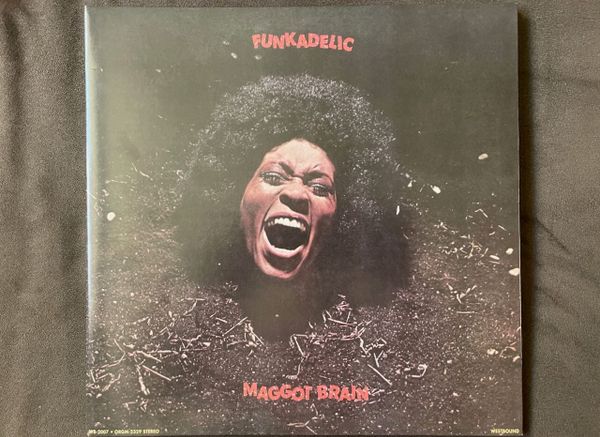
Cover art for Funkadelic.

Funkadelic: Free Your Mind and Your Ass Will Follow

Review by Ned Lannamann

Funkadelic bandleader George Clinton famously said that Free Your Mind and Your Ass Will Follow was an attempt to see if the group could record an entire album while tripping on acid. That’s as fine a summation as any for the second LP from the Detroit-by-way-of-New-Jersey outfit, released in 1970 just a few short months after their self-titled debut. It’s a record of cranium-splintering sounds and inner-eye dilation, combining the optimism of spiritual vision-questing with an undertow of genuine unease. Clinton’s art always kept one foot in the act of disorientation, and Free Your Mind is as hallucinatory as music gets. It may well be the most psychedelic album ever recorded.

The album, originally released on Detroit’s Westbound Records, was released simultaneously with Parliament’s debut full-length, Osmium, which came out on crosstown label Invictus Records. The two groups were entwined in ways that are too convoluted to go into here, essentially functioning as a single unit on Funkadelic, but by the time of Free Your Mind and Osmium, the separation had become a bit more pronounced. Parliament’s Osmium can be heard as the more conventional effort, with intelligible song structures and straightforward vocals, although it remains a deeply eccentric and psychedelic pop-soul record. Free Your Mind, however, became the repository for all of the truly weird wildness the musicians were exploring at the time. Clinton and his band of pranksters had internalized the acid rock and psychedelic soul movements, using their own combustible chemistry to merge and mutate them into something much heavier, far stranger, and eons more lysergic.

Org Music has partnered with Westbound to reissue the label’s influential back catalog, and Free Your Mind is the second Funkadelic release to come out as part of that yearslong project. The first, last August’s re-release of Funkadelic, was positively sublime; its 2-LP all-analog configuration was one of the best reissues of 2025. Free Your Mind is a bit more of a challenge. It is not as conventionally nice-sounding a record—saying a lot, as Funkadelic is decidedly outré in its own right—and indeed, Free Your Mind’s destabilizing production effects can sometimes sound primitive, abrasive, or downright murky.

Back cover of Funkadelic.

For example, the title track is a preamble without the expected deliverance to follow. Rather, it’s a 10-minute incantation based around a black-mass call and response: “Free your mind and your ass will follow.” “The kingdom of heaven is within!” Electronic hums and whirrs speckle the track as voices dart around the stereo spectrum, while guitarist Eddie Hazel lays down wraithlike Hendrixisms and keyboardist Bernie Worrell pilots a blown-out electric piano like a dive bomber. The stereo image is bifurcated, oscillating between mirror images of itself as the groove proceeds, with the entire track drenched in echo and hard panning; you can hear the mixing console’s internal cogs and pots become part of the sonic picture.

On “I Wanna Know If It’s Good to You?” a torpid, torchlit groove led by Billy Nelson’s hog-grunt bass gains momentum and fervency, but even after the pieces lock into place, it feels like the ecstasy is taking place just over the horizon, like you’re within earshot of an incredible music festival but well away from the center of the action. The track’s instrumental second half plays like dub if it had been invented not on Jamaica but rather on one of the actively volcanic Lesser Antilles isles, with the music throbbing and washing like a log flume ride on a lava flow. Meanwhile, the imperishably funky “Friday Night, August 14th” pushes the treble into the red, leading to a sort of ear-blindness on the part of the listener. And the mix of “Funky Dollar Bill” thrusts the lead vocals and Hazel’s guitar in and out of primary focus, sometimes positioning them jarringly out of balance with the backing track, leading to a fisheye-lens sort of experience.

With this new mastering, by Dave Gardner and Catherine Vericolli, all of this sounds positively spectacular. What was confrontational now becomes invitational, as Gardner and Vericolli have located the access points to the space and dimension within this very dense stew, allowing the listener to travel inside and bounce off different instruments and sonic effects while journeying deeper into the mix. Clinton’s production mischief and the band’s musical marauding become a thrilling thing to participate in; the aural turmoil coheres into a vivid, almost transcendent rite of sonic sacrament. By the time of the album’s closing track, “Eulogy and Light” (actually just a tape of Funkadelic’s earlier B-side “Open Our Eyes,” a piano-led gospel number, played backwards with overdubbed varispeed sermonizing from Clinton), the promise of “Free Your Mind and Your Ass Will Follow” is fulfilled. The kingdom of heaven is within—not within the listener, per se but within the warm jelly-mountains of sound that the listener can plunge into and paddle through.

Inner gatefold and disc for Funkadelic.

Gardner and Vericolli have cut this new pressing from analog tape. With Funkadelic, they made new analog master duplicate reels from the Westbound originals, which were in quite poor shape. I don’t know if they needed to do the same for Free Your Mind or if the original master was used. Dupe or not, it sounds pretty incredible. There is also a 2-LP 45 RPM version, which may sound even better that my 33, although I haven’t heard it. It’s possible that the lushness and presence may be upped just a touch with 45 RPM, although Free Your Mind is quite a short album—just under 31 minutes—and does not suffer from the lengthy sides that Funkadelic did; therefore, it’s not quite as obvious a choice for a 45 RPM 2-LP cut. (Technical side note: All of the new vinyl versions of Free Your Mind are cut from analog, while only the 2-LP 45 RPM version of Funkadelic was. The 33 RPM 1-LP of Funkadelic was cut from Gardner and Vericolli’s newly made digital transfer, to aid the cutting of its lengthy sides.)

Review: Funkadelic’s first album is back on wax—twice!
An in-depth review of Org Music’s new all-analog 45 RPM and digitally sourced 33 RPM vinyl pressings of Funkadelic’s 1970 debut album.

Free Your Mind also comes in a cornucopia of color variants. My copy was on blue multicolored vinyl, but I recommend looking for a standard black pressing, as I had some stray noise on my copy that kept it from having anything approaching silent backgrounds. Nothing interfered with the music, and there were no pressing flaws as such, but during the silent passages I encountered some minor noise that I associate with colored vinyl blends.

In all, I’m nearly as floored with Org Music’s reissue of Free Your Mind as I am with their superlative edition of Funkadelic. This is quite a strange and deliberately off-putting album, but the depth, dimensionality, and absolutely massive soundstage on this new pressing make it completely immersive. My ear never strained to hear the band’s funk chops beneath all of Clinton’s pyromancy, nor did the jumble of sound ever obscure the path the music was charting. This new pressing of Free Your Mind and Your Ass Will Follow is the very best kind of psychedelic experience: one that takes you on a trip of inexplicable phantasmagory and potential madness, then returns you safe and snug to your listening chair—no drugs required.

Org Music 1-LP 33 RPM “blue swirl with yellow and red splatter” vinyl
• Analog remaster of Funkadelic’s 1970 album
• Jacket: Direct-to-board gatefold
• Inner sleeve: Poly
• Liner notes, insert, or booklet: None
• Source: Analog; “mastered direct from analog tape to lacquer”
• Mastering credit: “Mastering & restoration: Dave Gardner, DSG Mastering”; “Original master tape archival & restoration: Catherine Vericolli”
• Lacquer cut by: Dave Gardner & Catherine Vericolli, DSG Mastering, Los Angeles, CA; “DSG” & “CV” in the deadwax
• Pressed at: Furnace Record Pressing, Alexandria, VA
• Vinyl pressing quality (visual): A
• Vinyl pressing quality (audio): B+ (minor noise from the multicolored vinyl)
• Additional notes: A 2-LP 45 RPM version is also available, as are “blue mist,” “splatter scene,” “blood orange,” and good ol’ plain black vinyl variants for the 33 RPM. The ‘In’ Groove is also releasing an exclusive 33 RPM black-vinyl version in a numbered Stoughton tip-on jacket.


Larrison: Connecters Vol. 1: Original Recordings, 1992–1999

Review by Robert Ham

Jed Bindeman is one of the world’s greatest tape collectors. His Instagram account is frequently filled with samples and photos of cassettes that he’s acquired either on his own or through Little Axe Records, the Portland record store he co-owns. Bindeman’s reputation on that front grew to the point that, in 2020, he was tipped off by the manager of Austin’s End of an Ear Records that sitting in storage at that shop were boxes of tapes originally sent to the editor of ND, a magazine from the ’80s and ’90s that focused on DIY music. Bindeman was able to take possession of those tapes and set about listening to them all. Most of them featured harsh noise or experimental sounds, but one knocked him sideways. The cassette was filled with short instrumentals played on a synthesizer. The tone of much of the music was warm and playful, as if made for the soundtrack of a late ’70s animated children’s TV series filled with colorful creatures and sweet life lessons. 

The tape in question was a one-off mix of material sent to ND by Larrison, an artist originally from Indiana but who had moved to Austin, Texas, in the early ’90s. The young musician had recorded dozens of experiments and tunes and compiled a sampler of his work for ND in hopes of scoring a review in the magazine. The writeup didn’t happen, and the tape remained unheard until it landed in Bindeman’s hands, who spent the next few years tracking down the artist (full name Larrison Seidle) and more of his music for Connecters Vol. 1: Original Recordings, 1992–1999, a newly released compilation on Freedom to Spend, the label Bindeman co-manages.

The story behind how this album came to be is fascinating on its own (and similar to how Bindeman rescued Bay Area dreampop artist Carola Baer from obscurity after his then-partner found a tape of her work at a Goodwill outlet), but Seidle's music is equally intriguing. Using a Casio CZ-5000 gifted to him as a teen by his father, he created richly layered compositions using the synthesizer’s built-in sequencer, which allowed him to record short melodic phrases and patterns that he could use as a base for his tunes. The instrument’s small array of effects also enabled him to pitch-bend and change the waveform of notes to create adorably chintzy facsimiles of guitar and marimba sounds.

Back cover, insert, and disc for Larrison.

Though Larrison seemed to come out of nowhere, his music isn’t without precedent. Jacob Arnold’s liner notes mention how Seidle’s father would screen 8mm and 16mm educational films borrowed from the library. Surely the soundtracks from some of those reels leached into the young musician’s creative consciousness. There are also shades of the work of Bruce Haack and Mort Garson, two early electronic artists who did their fair share of soundtrack work, as well as the influence of the classic rock played in Seidle’s home. The desiccated chords and solid rhythms of “Driving to Austin” sounds like Switched-On Neil Young, and “Dap” has a Byrdsian quality baked into its jangly melodies. 

Considering Seidle’s choice to record to cassette, sometimes even recording over thrifted tapes of mass-market releases, it’s a wonder Connecters sounds as good as it does. Make no mistake: There’s plenty of audible hiss and haze, but Lucas Padulo, the audio engineer who transferred the original tapes to digital files, and Carl Saff, the mastering engineer for this release, did a remarkable job making sure it sounds as pleasant as possible. The sometimes stinging quality of the synth tones that Seidle chose is tamped down nicely, and that ever-present whoosh of the tape source rests comfortably in the background. Once your brain acclimates itself, you’ll no doubt get quickly and joyously lost in the spirit and sound of Larrison’s delightful work.

Freedom to Spend 1-LP 33 RPM black vinyl
• First collection of material recorded from 1992 to 1999 by artist Larrison Seidle
• Jacket: Direct-to-board single-pocket
• Inner sleeve: White poly-lined
• Liner notes: Double-sided insert with liner notes by Jacob Arnold and album credits
• Source: Digital; “Tape transfers by Lucas Padulo”
• Mastering credit: Mastered by Carl Saff, Saff Mastering, Chicago, IL
• Lacquer cut by: Carl Saff, Saff Mastering, Chicago, IL; “SAFF” in deadwax
• Pressed at: Drummond Vinyl, Quebec City, Quebec
• Vinyl pressing quality (visual): A
• Vinyl pressing quality (audio): A
• Additional notes: None.


Cover art for Therapy?

Therapy?: One Cure Fits All

Review by Robert Ham

Irish rockers Therapy? have never been an easy band to pin down. The group’s earliest efforts found them tossing samples of sci-fi and cult films into their Killing Joke–inspired noise rock, while later albums for A&M Records, like 1995’s Infernal Love, featured ballads and shimmering pop alongside Jawbreaker-like odes to social isolation. By the time Therapy? settled into Jacobs Studios in Surrey, England, in early 2006 to record their ninth LP, One Cure Fits All, the band’s main songwriter Andrew Cairns was writing heavy, anthemic tunes that carried echoes of American post-grunge groups like My Chemical Romance and Queens of the Stone Age. 

The sound that Cairns and bandmates drummer Neil Cooper and bassist Michael McKeegan chose suited them quite nicely. With producer Pedro Ferreira—whose other credits include Permission to Land, the breakthrough album for British glam metal outfit the Darkness—behind the boards, One Cure Fits All became one of the strongest entries into the Therapy? discography. The directness and bluntness of both the music and Cairns’s lyrics are a straight shot to the jugular rather than the slow bleed-out of previous albums. 

The palpable chemistry of the band also comes more firmly to the fore. This lineup of Therapy?, which is still active to this day, had built a bond over four years of touring and recording two previous records: 2003’s High Anxiety and 2004’s Never Apologise Never Explain. Cooper, who took over for Graham Hopkins, brought a heavier wallop to the group, and the 2004 departure of Martin McCarrick, the auxiliary member who played cello and guitar, pushed the band to simplify everything. The individual parts each man plays are well-defined and distinctive on their own but sound even better when they lock in with the rest of the group. They upraise one another dynamically on the lacerating “Private Nobody” and stay in a forceful formation on the more bludgeoning numbers like “Into the Light” and “Lose It All.” 

Back cover, inner sleeve, and disc for Therapy?

In March, Therapy? and Universal issued One Cure Fits All on vinyl for the first time as part of a 20th-anniversary celebration for the record that included the release of a 2-CD set packed with B-sides and demos. One Cure and Therapy?’s previous four albums were never issued on wax upon original release, and now that I’ve spun this particular LP for a couple of weeks, I’m hoping the rest of the outliers get the same treatment. Whitfield Mastering’s Naweed Ahmed did sensational work on the remaster, bringing an added layer of sonic excitement, highlighting the firm snap of Cooper’s drums and the dynamism of Cairns’s use of effects pedals that reminded me of Helmet’s Meantime. Cairns’s vocals also sound more detailed and full than the previous digital version of the album I was familiar with. Add to it a flawless, flat pressing and you have the ideal listening experience for this potent, excellent album. Therapy? is a band that never blew up in a big way here in the States, but a fine reissue like this could help turn the tide in their favor at long last. 

Mercury Studios/UMG 1-LP 33 RPM black vinyl
• First vinyl edition of Therapy?’s 2006 album
• Jacket: Direct-to-board single-pocket
• Inner sleeve: Thin printed card with lyrics and album credits
• Liner notes: None
• Source: Digital
• Mastering credit: “Remastered by Naweed [Ahmed] at Whitfield Mastering,” London, UK
• Lacquer cut by: Naweed Ahmed at Whitfield Mastering, London, UK; “NAWEED” in deadwax
• Pressed at: MPO International, France
• Vinyl pressing quality (visual): A
• Vinyl pressing quality (audio): A
• Additional notes: Red vinyl variant also available.