Reviews: Black Paladins | Kraftwerk

Share
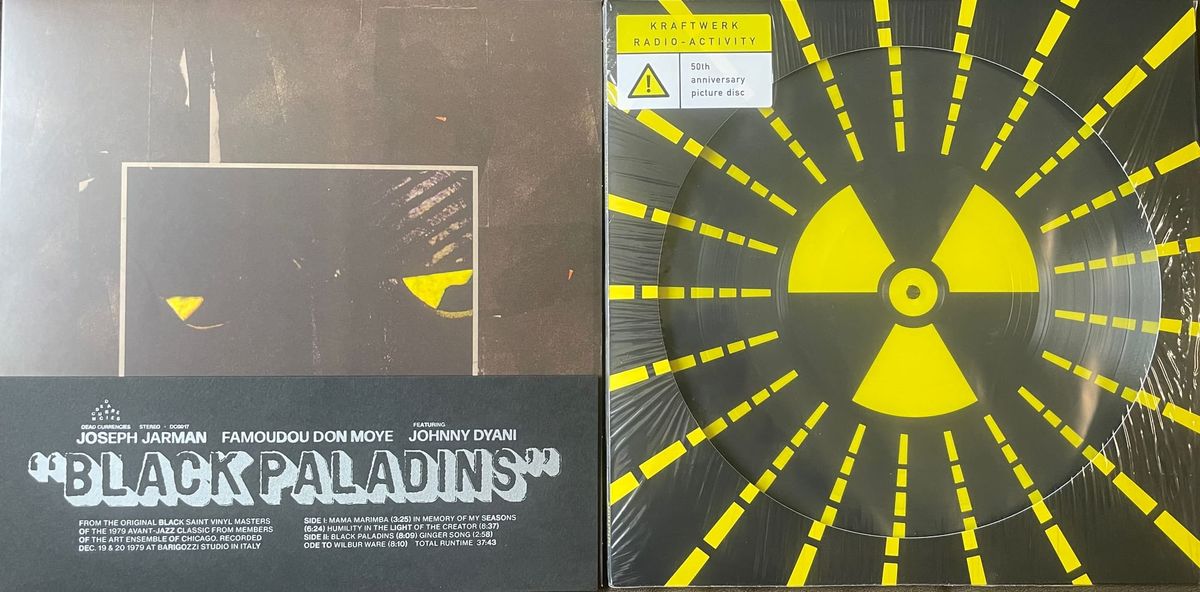
Cover art for Black Paladins and Kraftwerk.

I talk a lot about sound quality in this newsletter. That’s hardly surprising. But one of the reasons we’re all into vinyl is that it can offer a lot more than just an aural experience. (There are plenty of perfectly good-sounding digital streaming services you can listen to, if sound is all you want.) Vinyl offers more: It’s a tactile and visual medium, and it’s always a joy when care and creativity are invested in the design elements of an album reissue, allowing the experience to go beyond just the sonics.

Of course, a well-appointed jacket and snazzy colored wax can be like lipstick on a pig if the record isn’t any good. And we all have our preferences—I gravitate toward well-researched liner notes and period photos over splatter vinyl and expensive tip-on jackets, and of course you may feel the exact opposite. But when the stars align, the result can be a stunning-sounding record contained within a gorgeous package, each component reinforcing the enjoyment of the other.

Today I’m reviewing two recent vinyl reissues that have noteworthy visual elements. The first is a remarkable experimental-jazz album from the boutique Nashville label Dead Currencies, who make bespoke limited editions that contextualize and invigorate the music within by means of strikingly crafted jackets and vinyl. The second is a picture disc from a group whose graphic elements have become an intrinsic part of the band’s identity over the decades. This particular reissue dispenses with the original album art entirely, replacing it with simple iconography that furthers the band’s revisionist branding at the expense of the music.

Before we dive into the reviews, here’s a quick reminder that our June vinyl giveaway is live. Our paid-tier subscribers can enter to win a copy of Michel Petrucciani’s Kuumbwa live album from Elemental Music. Click the rectangle below to find out more, and to upgrade to our (very worthwhile) paid tier!

Win a copy of Michel Petrucciani’s 1987 live album!
One copy of Kuumbwa will be given away to a paid subscriber. Every month, The Vinyl Cut gives away a piece of choice vinyl to one of the excellent subscribers on our paid tier. And this month is no exception. For June, we’re giving away Michel Petrucciani’s Kuumbwa,

Cover art for Joseph Jarman & Famoudou Don Moye.

Joseph Jarman & Famoudou Don Moye (featuring Johnny Dyani): Black Paladins

Jazz is habitually referred to as an American art form, but not long after its inception in the early part of the 20th century, it became a global language. And while its pioneers and first practitioners were Black Americans of African descent, jazz grew to reflect not simply experiences in the Americas but also those of the entire African diaspora.

A significant part of the vernacular’s expansion and dissemination developed when jazz musicians came to Europe. There was a 20th-century movement of Black American artists living abroad, of course—writers like Richard Wright and James Baldwin relocated to Paris in the 1940s, while visual artists like Herbert Gentry and Walter H. Williams spent time in Copenhagen and Stockholm in the ’50s and ’60s. For members of the Art Ensemble of Chicago, Europe was the site of their artistic coming-of-age; the group settled on their name and famously recorded 14 albums during their residency outside of Paris from 1969 to 1971. Even after the Ensemble’s return to the States, Europe maintained a strong site of inspiration for the avant-jazz collective, with a Montreux festival recording resulting in the 1974 live album Kabalaba, released on their own label AECO, and three LPs recorded in West Germany for the ECM label in the late ’70s and early ’80s. (A fourth ECM album was recorded in New York.)

During this period, saxophonist Joseph Jarman and percussionist Famoudou Don Moye formed a splinter unit outside of the larger Ensemble; with a rotating chair of musicians, the duo recorded three albums for the Italian label Black Saint. The second of those, 1980’s Black Paladins, enlisted South African bassist/pianist Johnny Dyani and was recorded during two days in Milan in December 1979. There’s almost no evidence of any Italian qualities in the music itself, although perhaps a very loose connection could be made to the pioneering work of Gruppo di Improvvisazione Nuova Consonanza and some of the other avant-garde qualities that had developed in 1970s Italian music via modern classical composers and progressive rock bands—suggesting that the Italians at Black Saint were more conditioned and receptive to the innovative sounds Jarman and Moye were making than any American label would have been.

Reaching through the entire continuum of American jazz, Jarman, Moye, and Dyani tap into ancestral African musics, making use of unusual percussion and wind instruments to supplement their conventional Western instrumentation. Dyani—a South African living in Europe—meshed almost supernaturally well with the two Americans. That Black Paladins was their only collaboration before Dyani’s early death in 1986 makes the remarkable recording that much more valuable.

Image from the album insert, depicting the musicians and poet Henry Dumas. Dumas's poem "Saba: Black Paladins" is reprinted here.

The album is thick with ghosts. Despite this, the music is precisely articulated and never gauzy. Jarman’s saxophones and flutes act as sentinels, connecting the sensations of the living with the memories of the dead, while Moye’s percussion symbolizes the cycles of the earth and the passage of time. Two ghosts are named explicitly in the text: The album’s title comes from a poem by Henry Dumas called “Saba: Black Paladins,” which is reprinted in full on the back cover of the Dead Currencies reissue; Jarman also recites the poem during the title track. Dumas was murdered in 1968 in a Harlem subway station by a New York City transit officer, cutting short the career of one of the leading poets of the Black Arts Movement. And the album’s final track is a Moye composition titled “Ode to Wilbur Ware,” identifying the jazz bassist who appeared in the Great Day in Harlem photo and played with Thelonious Monk, Sun Ra, and countless others. Ware died in September 1979, three months before the album sessions.

Dyani contributes the opening track, “Mama Marimba,” a rapturous spiritual-jazz call for communion. Rhythmically and harmonically, it’s the most conventional piece on the album, with Dyani’s piano and voice offering the stepping stones for the explorations to follow. The next track, “In Memory of My Seasons,” dispenses with any familiar anchoring, moving arrhythmically from tableau to tableau, like various points illuminated on a darkened stage. Jarman’s flute holds the narrative while Moye’s whirrs of percussion provide color and drama and Dyani’s piano—played both on the keyboard and struck on the strings within—evokes suspense and forward momentum.

Dyani’s bowed bass and Jarman’s sax provide voices for the ghosts in “Humility in the Light of the Creator,” where the two instruments at first seem to mirror each other tonally, like twin trunks on a tree, before growing their own separate ways. Moye’s drums thump and eventually grow dominant, building to a climactic solo to close the piece. In “Black Paladins,” a slinky groove is introduced following Jarman’s recitation of the Dumas poem; the groove is then deconstructed, upending jazz idioms before becoming untethered from them altogether. And “Ode to Wilbur Ware” is built on the sounds of whistles and pronounced breathing, with Dyani’s bass eventually carving a groove; the group overdubs themselves to add more color to the scene.

Despite the expansiveness of its sonic palette and its emphasis on the connection between material and immaterial planes, Black Paladins’ mix is very interior, living almost entirely inside one’s headspace. The instruments are recorded quite drily, with little decay or reverb added. The soundscape, however, is expansively wide, and the album mastering offers strong isolation between the different sounds and plenty of articulation for the voicings. It’s an interesting recording to evaluate, as parts of it are designed to disorient, with certain sounds meant to be jarring or displacing, but there are also many stretches where the music is vivid and palpably present. It was cut at Nashville Record Productions, although a specific mastering engineer isn’t named. Dead Currencies confirms that NRP cut the lacquer from a high-resolution digital file provided by the rights holders at CAM Jazz (who own Black Saint’s catalog), who state they sourced the file directly from the original master tape. The pressing was done at United, also in Nashville; while United has not had the best reputation for quality vinyl in recent years, my copy was perfectly quiet and without any pressing issues. Perhaps this signals a positive development for this historic pressing plant.

Jacket, insert, and disc for Black Paladins.

I mentioned the visual component earlier. It’s wonderful. Dead Currencies have updated the artwork entirely, taking the central image from the original jacket and creating entirely new surroundings for it. The insert and spinewrap are both screen-printed on heavy paper stock, and the artwork now includes a photo of the poet Henry Dumas. The vinyl is clear with black marbling, with an effect that feels very much of a piece with the jacket. The entire package is unified and memorable, and a marked improvement on the not-particularly-inspiring look of the original 1980 release. If it feels handmade, it indeed was, as all 200 copies were hand-assembled and numbered by the Dead Currencies folks. 

It’s a record well worth seeking out for fans of adventurous and off-the-beaten-path jazz; while the album is sold out on Dead Currencies’ site, it is still available through Bandcamp, and a small number of copies will also be making their way to certain brick-and-mortar retailers in the coming weeks. I found myself challenged and continually drawn in by the music, and the handsome packaging enhanced rather than distracted from the sonic experience. There’s something very contemporary about the sounds Jarman, Moye, and Dyani were making back in 1979, and the Dead Currencies edition of Black Paladins goes a step beyond recontextualizing history—it makes the album a document of the here and now.

Dead Currencies 1-LP 33 RPM clear-and-black “black smoke” vinyl
• Remaster of Joseph Jarman and Famoudou Don Moye’s 1980 album, recorded in collaboration with Johnny Dyani
• Jacket: Direct-to-board single pocket
• Inner sleeve: Black paper
• Liner notes, insert, or booklet: Two-sided screen-printed insert with original album liner notes by Lee Jeske
• Source: Digital transfer files sourced from CAM Jazz, Italy, taken directly from the master tapes
• Mastering credit: None
• Lacquer cut by: Uncredited engineer at Nashville Record Productions, Nashville, TN; “NRP” in the deadwax
• Pressed at: United Record Pressing, Nashville, TN
• Vinyl pressing quality (visual): A
• Vinyl pressing quality (audio): A- (a few flecks of noise)
• Additional notes: Includes a screen-printed, hand-numbered spine wrap; limited edition of 200. Comes inside a resealable poly bag.


Cover art for Kraftwerk.

Kraftwerk: Radio-Activity (50th anniversary picture disc)

This might be a bit of a reach, but bear with me: Since the end of World War II, Kraftwerk has had a greater global impact than any other German artist—musician, writer, filmmaker, what have you. The Düsseldorf band’s contribution to electronic-based music, and its trickle-down effects on the birth of hip-hop, would be enough of an influence to make that case. And their themes of a man/machine symbiosis and the inevitable merging of humanity with technology were almost disturbingly prophetic, growing from satirical explorations of the cultural perceptions of Germans and German culture into a universally applicable worldview.

In 1975, though, Kraftwerk’s two founding members—Ralf Hütter and Florian Schneider—were ex-hippies charting an uncertain future forward in the realm of electronic sounds. Their 1974 album Autobahn had been a significant international breakthrough that found unlikely success in the US and UK. For the follow-up, Kraftwerk dispensed with any lingering ties to rock music altogether, using exclusively electronic instruments and solidifying their lineup with new member Karl Bartos, who tapped on electronic percussion alongside Wolfgang Flür, who had joined the group in 1973.

Radio-Activity, released in November 1975, reflects Kraftwerk’s global travels in the wake of Autobahn’s success. The album—titled Radio-Activität in Germany—refers to nuclear radiation as well as the everyday radio waves used for both two-way communication and one-way transmissions of music and news. While touring the US, Hütter became intrigued by American radio and the sheer number of stations that could be found on the dial in any given part of the country, as well as the fact that they were owned by private companies or even individuals, rather than run by the state. The juxtaposition of the concept of the democratization of communication with the double-edged promise of nuclear power—enhanced by the invisible, ghostlike natures of these two phenomena—gives Radio-Activity a melancholic and introspective flavor.

The album contains some of Kraftwerk’s most beautiful music. “Radioland” intermingles radio waves with childlike synthesizers over a gently pulsating rhythm, as Hütter and Schneider trade murmured lines in German. The instrumental “Transistor” uses echo-delayed synth arpeggios to create a lovely cascading effect, and “Radioactivity” uses the Vako Orchestron’s choir sound to approximate the spectral apparitions that British bands were conjuring via Mellotron, but offering a more resigned, downtrodden tone. Meanwhile, “Antenna” uses synth squelches and heavily echoed vocals to convey a more ominous mood, made further manifest on “Radio Stars,” where relentlessly rising synth globules depict the intermittent beams of electromagnetic radiation traveling to us from pulsars hundreds of light-years away.

For its slightly belated 50th anniversary, Kraftwerk released a Blu-ray of Radio-Activity featuring a new Dolby Atmos mix and bearing new artwork. Perhaps as an afterthought, a picture disc was released on vinyl, also with this new artwork. The picture disc features the 2009 Kling Klang digital remaster, which is helpfully notated on the top spine of the LP. Going off the information available on Discogs, it looks like Radio-Activity has used two separate lacquers of this 2009 digital remaster interchangeably in all the pressings since. One lacquer contains “J.C.” in the deadwax, while the other says “STUMM.” This picture disc uses the “STUMM” cut.

Disc and back cover for Kraftwerk.

The updated artwork is quite different and disappointingly generic-looking, although the Kraftwerk camp may have understandably been reluctant to use the original cover art that depicted a Deutscher Kleinempfänger radio model from the 1930s, which would have been used to transmit Nazi propaganda in its day. The 2009 remaster used an updated version of the original cassette artwork, with a radioactive symbol depicted in yellow and pink. The 2026 remaster updates it further, in clear shades of black and yellow. The picture disc has spokes radiating from the center of the image to the disc’s edge, creating a neat sort of strobing effect while the record is rotating. And the radioactive symbol looks a lot like a reel-to-reel tape, which I’m sure did not escape Kraftwerk’s notice.

Unfortunately, the LP also contains the pitfalls of picture-disc technology, in that there is a significant amount of background noise on the vinyl, taking the form of a mushy sort of whoosh beneath the audio. While most of the music is playing, it isn’t audible, but it is undeniably present during the quieter passages and in the spaces between the music. There are also more pops and ticks than should be present on new vinyl. Otherwise, the 2009 remaster is quite assertive, and its digital origins do nothing to detract from the musical qualities, which are precise and very well defined. The soundstage is close to massive, and despite the album’s largely subdued tone, the audio is conveyed with impact and definition. 

Radio-Activity is such a great album, and so full of subtle depths, that it’s a real shame this gaudy picture disc is how it’s being commemorated on vinyl. However, Kraftwerk have capitalized on the visual elements of their live shows over the years—so much so that virtually everyone knows the iconography of the four robot-men standing on stage behind their keyboards more than they are familiar with the strains of “Autobahn” or “Trans-Europe Express.” This redesign feels like a move in that icon-legacy direction, although vinyl shoppers who ordinarily gravitate to the visual appeal of picture discs will end up discovering a lot of worthwhile music in the grooves.

In the end, though, nothing can take the place of properly crafted vinyl, and this album deserves a gimmick-free reissue on high-quality vinyl with silent backgrounds. The conceptual element added by this new artwork—and the novelty of seeing the disc spinning on the turntable—ends up being undercut by the extraneous picture-disc noise. I should say, it’s not severe enough for me to discourage anyone from picking this up, if the package truly appeals to them. But Radio-Activity is a remarkable and important piece of work that’s being delivered on an imperfect medium. Maybe there’s a conceptual element to that, too—one that reflects on not just radioactive decay but the disintegration of any sort of temporal experience. All right, now I’m really reaching.

Parlophone 1-LP 33 RPM picture disc
• 50th-anniversary repress of Kraftwerk’s 1975 album, using the 2009 digital remaster of the original 1975 stereo mix; this particular cut has been in use since 2009
• Jacket: Direct-to-board die-cut single pocket
• Inner sleeve: Clear poly
• Liner notes, insert, or booklet: None
• Source: Digital; “Kling Klang digital master”
• Mastering credit: None; the 2009 remasters were all done by Kraftwerk themselves
• Lacquer cut by: Uncredited; no initials in the deadwax
• Pressed at: Pallas, Diepholz, Germany
• Vinyl pressing quality (visual): B+ (disc is slightly dished)
• Vinyl pressing quality (audio): C- (whooshing background noise, other pops & ticks)
• Additional notes: None.


Listening equipment:
Table: Technics SL-1200MK2
Cart: Audio-Technica VM540ML
Amp: Luxman L-509X
Speakers: ADS L980