Review: Curtis Mayfield’s Super Fly on Rhino High Fidelity

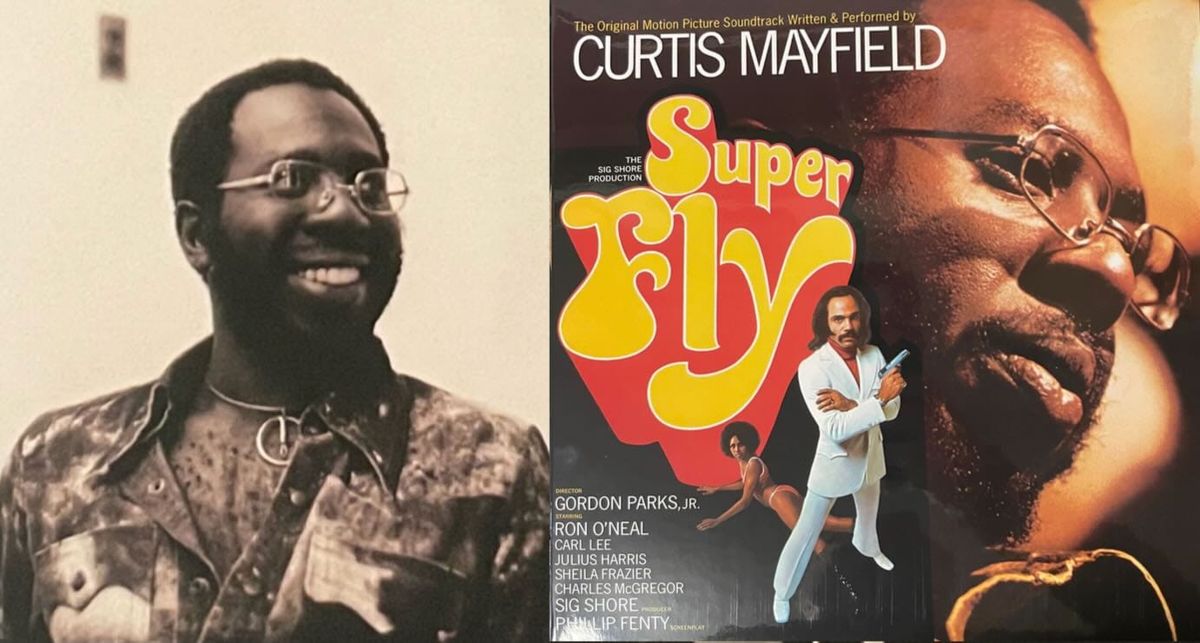
Today I’ve got a deep dive on the latest release from Rhino High Fidelity for you, for Curtis Mayfield’s immortal Super Fly. For those keeping tabs on the series, Rhino have also announced their next release: an upcoming RHF pressing of Joni Mitchell’s 1971 album Blue, which ships out out on July 10.
In other announcements of fancy-pants vinyl reissues, the Definitive Sound Series said yesterday that their next one-step will be for A Perfect Circle’s Thirteenth Step, the 2003 album from the project of guitarist Billy Howerdel and Tool vocalist Maynard James Keenan. This one has a bit of a convoluted pedigree: It was mastered by Levi Seitz at Black Belt Mastering from 24/96 files that themselves were transferred from flat analog masters, except for two tracks (“Crimes” and “Lullaby”) that were sourced from 24/44.1 files. I’m guessing those particular songs were never mixed down to analog. Whether the remaining analog pieces were all recorded to analog multi-track or whether they were digital recordings that were then mixed to analog is unspecified. Seitz did a flabbergastingly good job with the digital masters of Beck’s Morning Phase, so I very much doubt sound quality will be a concern.
Before we get into Super Fly, I wanted to offer a big congratulations to Vinyl Cut reader Chris! Chris is the winner of our June vinyl giveaway and is receiving a copy of Michel Petrucciani’s Kuumbwa, a 1987 archival live recording that was made available this year on Elemental Music. Congrats, Chris! And thank you so much for being a paid subscriber.
If you’d like to be eligible for our monthly vinyl giveaways and receive other nifty paid-subscriber perks—like weekly playlists, commenting privileges, and full access to our archives—simply upgrade your subscription by clicking here.
And now, let’s get into the Curtis. The only game you know is do or die, ah ha ha.
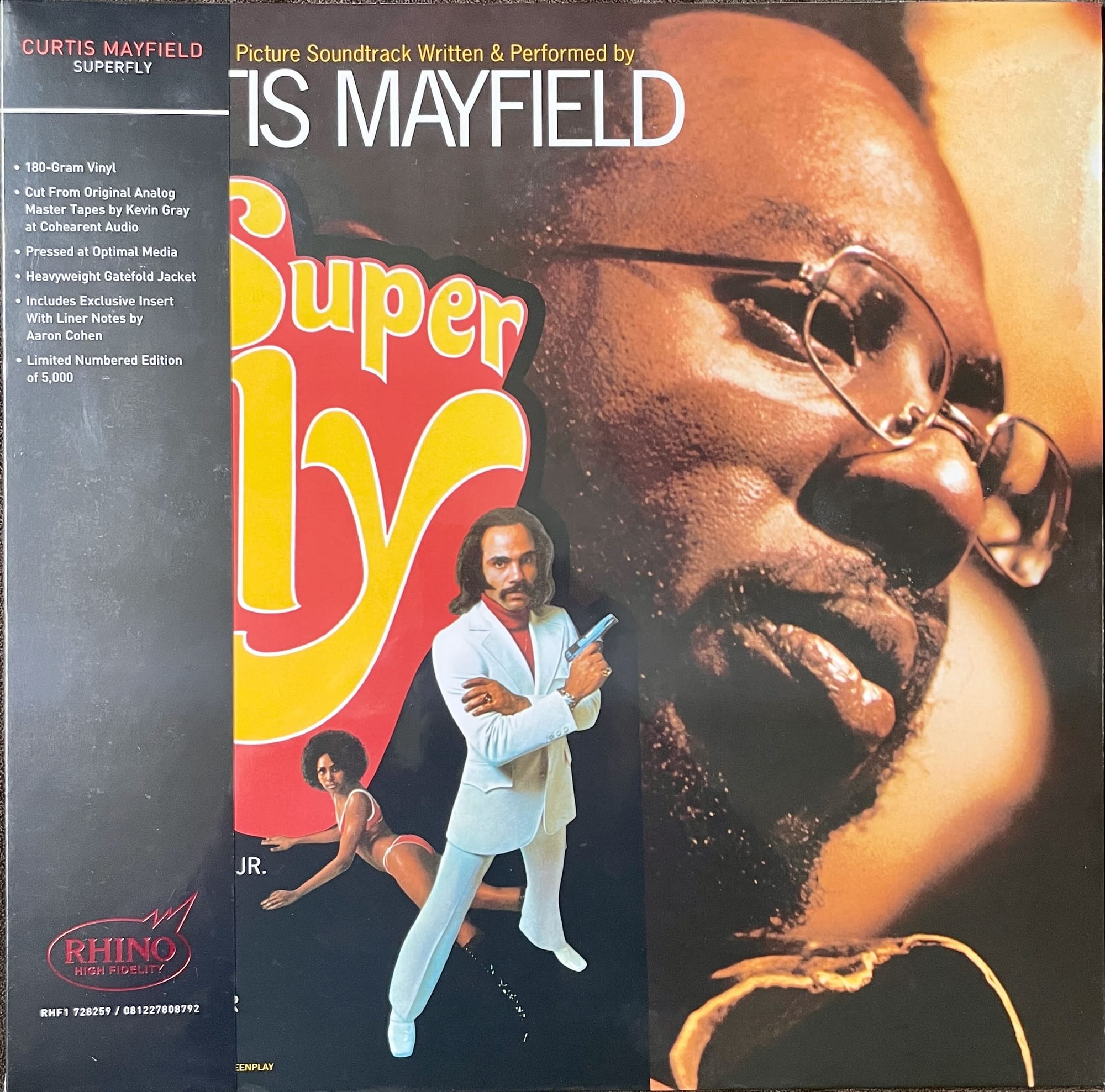
Curtis Mayfield: Super Fly
The familiar knock on the 1972 Blaxploitation movie Super Fly is that it doesn’t hold a candle to its soundtrack. The acting is wooden, the camera work is clumsy, the lighting is bad (when there’s even lighting to speak of), and the script barely hangs together. But it’s impossible to separate the movie from the music, and with Curtis Mayfield’s brilliant score as part of the equation, Super Fly needs to be evaluated as an essential work of 1970s cinema. The music does more than unify the film—it elevates the soulfulness of Ron O’Neal’s central performance as Priest, providing an emotional undercurrent to the story of a Harlem coke dealer looking for one last big score in order to get out of the game. The wisdom in Mayfield’s music offers real-time commentary for the story unfolding onscreen, frequently criticizing the decisions of the characters and lamenting the hardscrabble street life that leads so many to lives of drugs and violence.
I’d always assumed that you could get away without watching Super Fly and simply enjoy Mayfield’s soundtrack album in isolation. But having recently watched the movie for the first time, I now appreciate the music even more. The scene where a low-level dealer in Priest’s network gets killed is a pretty ham-handed depiction sorely lacking in believability, but the song “Freddie’s Dead” now carries an emotional resonance that wasn’t fully accessible to me before—that doomed dealer, Freddie, was a smiling, peace-loving wife guy who got himself into a bad game and paid the price for it. And “No Thing on Me (Cocaine Song)” finds Mayfield offering a pointed counterargument against Priest’s constant onscreen coke sniffing: “My life’s a natural high,” Mayfield sings. “The Man can’t put no thing on me.”
Directed by Gordon Parks Jr.—the son of famed photographer Gordon Parks, who had directed Shaft one year earlier—Super Fly depicts Priest’s moral ambiguity and ruthlessness without fully reckoning with them in the text itself. Without Mayfield’s optimism and humanity, Super Fly would be a pretty dark wallow in a bleak and seedy underworld. But by incorporating Mayfield’s music and his songwriting perspective, the story becomes a surprisingly impassioned indictment of the desperation and societal injustice that forces Black communities into economies of crime. Listening to the Super Fly soundtrack without a full understanding of the movie could lead some, like me, to simply glide over the top of Mayfield’s funky-pop smarts and not pay attention to what’s going on beneath.
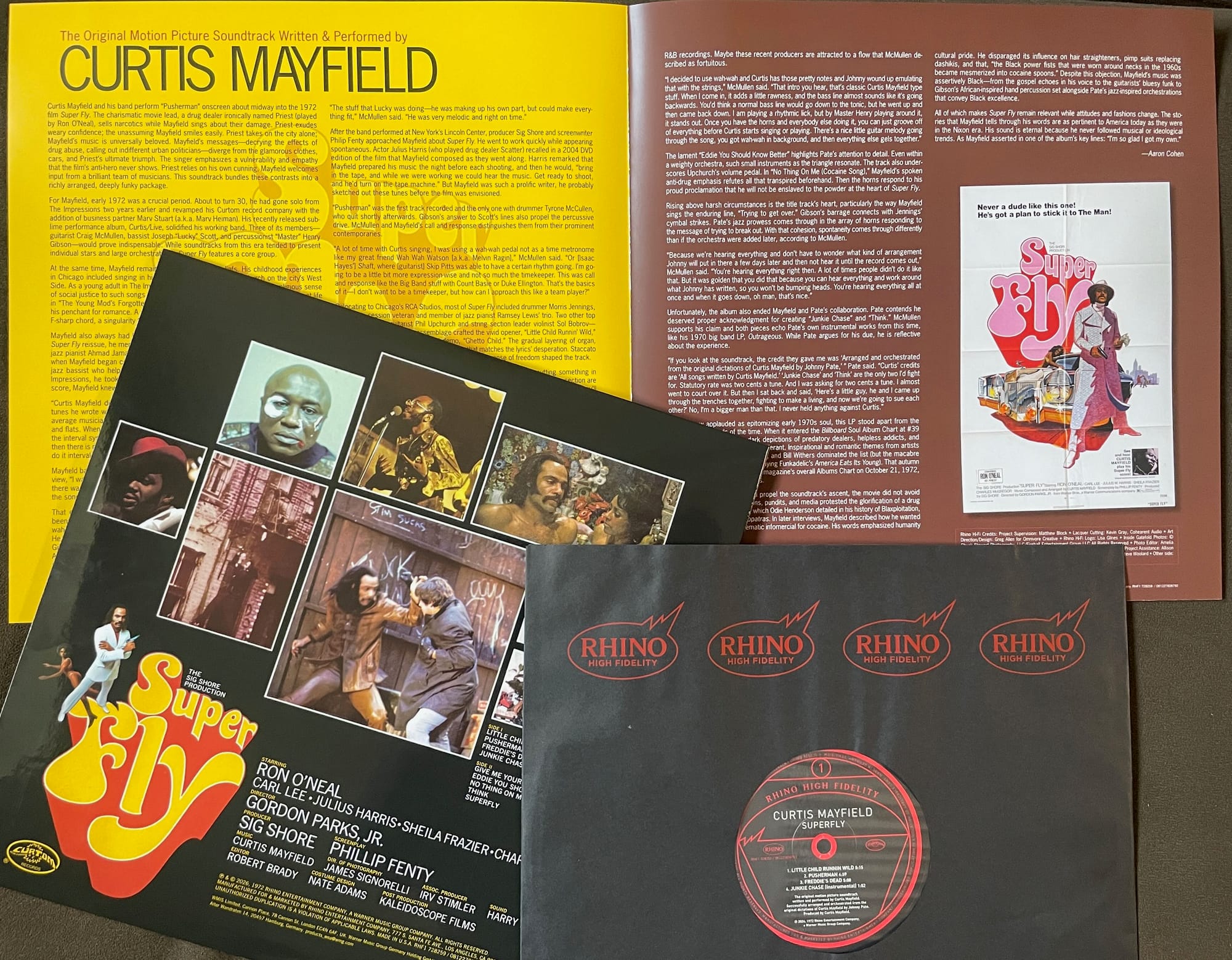
In June, Rhino High Fidelity (RHF) issued a new analog-cut vinyl version of Mayfield’s Super Fly soundtrack album, first released in July 1972 on Mayfield’s own Curtom label, which at the time was distributed by Buddah Records. (Rhino has also released the album on reel-to-reel tape.) While the Rhino High Fidelity line occasionally shape-shifts depending on what albums its executives and project managers are able to get across the finish line, it most frequently takes the form of a prestige imprint with the aim to produce reference-quality vinyl showpieces of the most important albums in the Warner Music catalog. By this measure, their selection of Super Fly is a slam dunk. The album was a monumental hit in its time, but more than that, it shaped the trajectories of 1970s funk, R&B, and film soundtrack music with implications that are still very much audible in the music of today. It’s an album where initial impact, ongoing influence, and sheer musical enjoyability all reach the very top tier. Even more than half a century later, it’s an album that demands to be heard.
There has been no shortage of choices over the years when it comes to Super Fly on vinyl. The original 1972 Curtom/Buddah US release was cut at Bell Sound by Sam Forman and released in a Unipak-style sleeve with a die-cut flap. In 1979, the album was reissued through Curtom’s new distributor, RSO Records, in a standard sleeve and featuring a new cut by “Jo.G” at Kendun Recorders. (Discogs contributors seem to think the signature refers to John Golden, but I’m pretty sure it belongs to Joe Gaswirt.) This 1979 Kendun cut is regarded as a particularly fine-sounding version. There’s also a 1988 edition from when Curtom was distributed by the Atlanta-based Ichiban Records. Then in 2009, Rhino reissued Super Fly in a die-cut jacket with a new cut by Ron McMaster at Capitol Studios. This version was advertised on its initial hype sticker as being cut from the analog tape; it has since been repressed on various colors of vinyl and is still the standard vinyl edition that’s readily available. In 2019, Mobile Fidelity issued a 2-LP 45 RPM version, which was cut from a safety copy tape and not converted to DSD, going against MoFi’s standard practice of digitization (which was a secret at the time). MoFi also released an SACD edition around this time, presumably from the same source. And then in 2022, Run Out Groove issued a 2-LP version, with the album on the first disc cut from tape by Kevin Gray at Cohearent Audio; the second disc contained the bonus tracks that appeared on Rhino’s 1997 25th-anniversary 2-CD edition (except for an audio interview with Mayfield). This version came on either black or orange vinyl with a slipmat, a fold-out poster of the album cover, and a four-page insert with excellent liner notes by Aaron Cohen of DownBeat and the Chicago Tribune.
And now Kevin Gray has cut Super Fly a second time, this time for Rhino High Fidelity. It’s understandable that the question would rise as to whether the same mastering engineer can make a substantial improvement on the same source material four years later. But in comparing the Run Out Groove to the new Rhino High Fidelity, it’s clear that Gray had a different tape available to him this time. On the Run Out Groove version, there’s a noticeable dropout in the left channel at the end of the title track, during the “trying to get over” part just before the album concludes. This dropout is not present on the new Rhino High Fidelity cut. The dropout can also be heard on the MoFi SACD, so I assume it’s also on MoFi’s vinyl version, although I can’t definitively confirm that. This strongly suggests to me that Gray’s 2022 cut for Run Out Groove comes from the same source as the Mobile Fidelity versions: a safety copy tape of some sort, although not much more info has been confirmed beyond that.
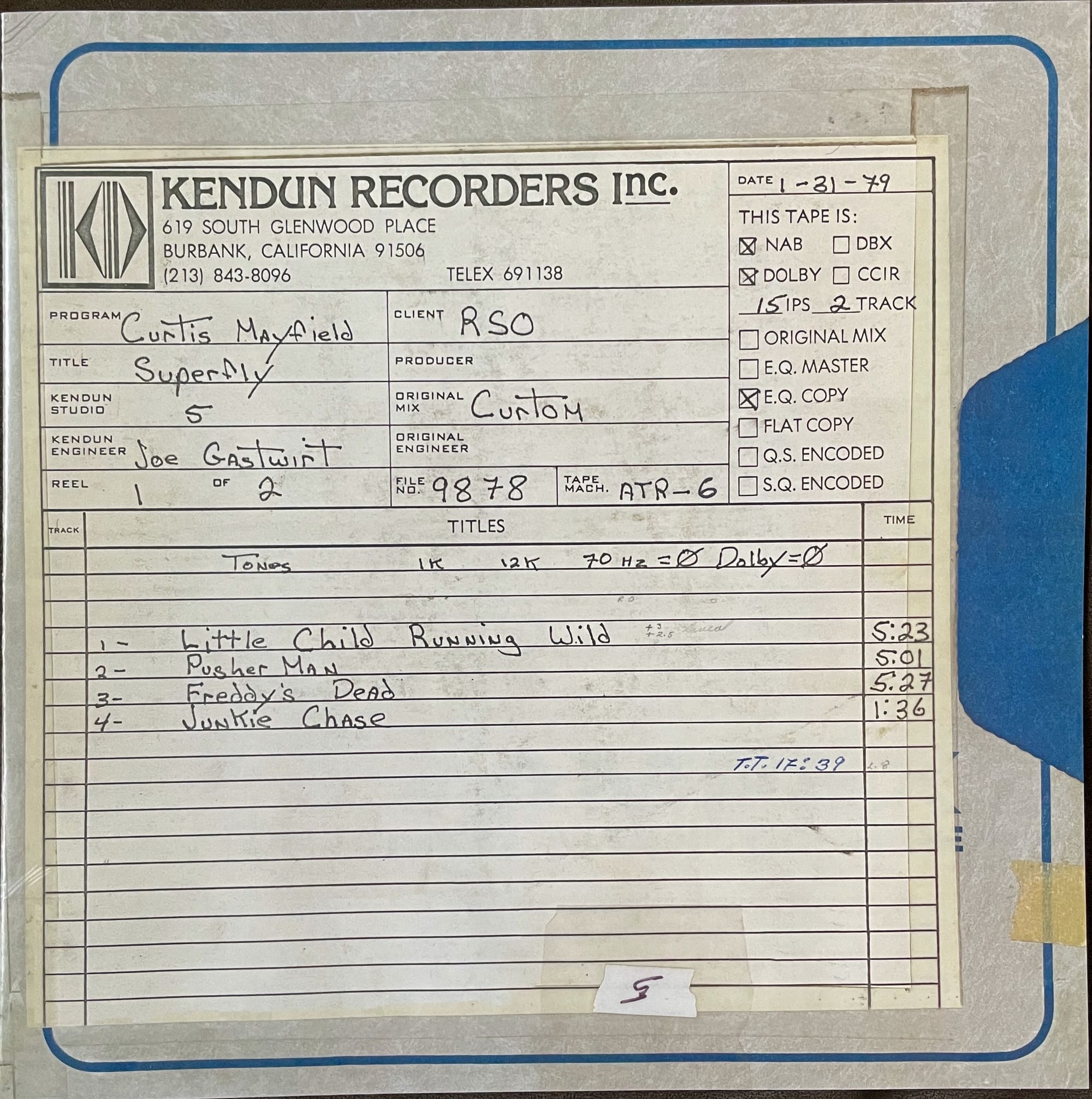
Meanwhile, the insert in the new RHF version contains images of the 1979 Kendun EQ’ed master reels, with Joe Gastwirt as the credited engineer—not John Golden. While neither the liner notes nor promotional material say anything explicitly about these Kendun reels being the source, I don’t think there can be any doubt that they were. The “trying to get over” dropout is absent, and there are other subtleties in the overall sound and shape of the album’s audio-frequency profile that I believe are the results of the decisions made at Kendun in 1979. It’s not clear to me if this Kendun master—which, I should point out, is one generation removed from the 1972 Curtom master tape—was made by Gastwirt as a safety reference while he was cutting the lacquer from the original tape, or if it and all of its EQ decisions were prepared beforehand, and then Gastwirt cut the lacquer from this newly constructed tape. (If pressed, I’d guess the former, but I can’t say for sure.) Either way, the tape Gray used is probably the closest thing we have to the much-loved 1979 Kendun cut, and it’s great news that this tape was located for this new pressing, as opposed to the copy tape that was used for the MoFi and the Run Out Groove versions.
In listening to the new RHF Super Fly, my first point of comparison was a 1972 Bell Sound/Sam Forman–mastered copy pressed at Monarch Record Pressing. It’s a lively and lovely-sounding thing, with clarity, effervescence, a medium-sized soundstage, and well-sculpted bass that does the job but never reaches into subsonic territory. The orchestral arrangements by longtime Mayfield collaborator Johnny Pate have plenty of texture, adding excitement to the more dramatic moments—like the bright, staccato 16th notes in “Little Child Runnin’ Wild”—and layering in beautifully with the rhythm section. Fascinatingly, Mayfield’s band recorded their parts at the same time as the orchestra, as opposed to overdubbing the orchestra later. This gives the arrangements remarkable sympathy and looseness, with no one stepping on anyone else’s turf. Everything on the Bell Sound cut sounds period-correct to 1972. The scope is just so slightly boxed in, with some minor sibilance, a slight high-end piercing quality to certain sounds (some of Mayfield’s falsetto and a few guitar lines get a bit overly edgy), and perhaps the overall sensation of something printed on a piece of white paper that has yellowed over the years. There’s power, but also a delicate patina that puts the music at a very slight remove.
Unfortunately, I wasn’t able to evaluate a 1979 Kendun reissue or the 2019 MoFi, nor was I able to hear a 1988 Ichiban copy or any of the Rhino/McMaster pressings that have appeared since 2009. But I did listen extensively to my orange-vinyl pressing of Kevin Gray’s 2022 cut on Run Out Groove, which has a noticeably boosted treble presence. (This probably has little to do with the sound, but the 2022 Gray deadwax also bears the initials of podcaster Mitch Anderson, who must’ve been in the room when Gray cut the lacquers.) There’s added clarity to the recording and more space around the instruments, most noticeable in the prolonged decay of the individual notes. The soundstage is subtly expanded, and the depth of field is very gently increased as well. But there’s also a mild traffic-jam of sound when the tracks get busy, and things begin to lose their articulation and individuality. At louder volumes, the top-end edge became too much on my system, verging into unpleasant territory. There is also the aforementioned dropout at the end of “Superfly,” which is pretty minor in the scheme of things but needs to be mentioned in any sound evaluation.
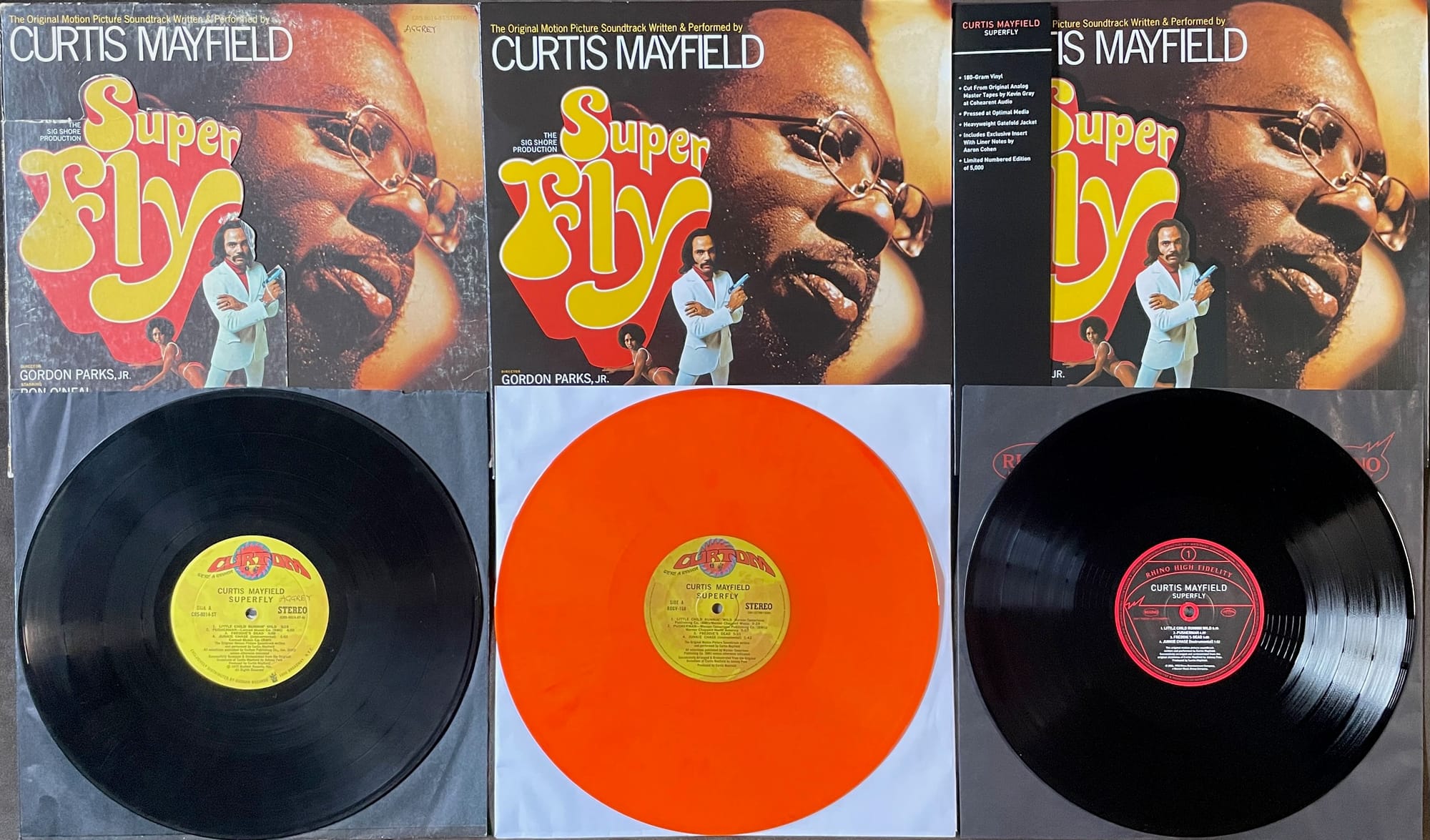
Gray’s new 2026 cut for the RHF takes the improved qualities of the 2022 and enhances them even further while simultaneously cutting back on his previous cut’s overdone top end. As mentioned, I think this is due to the Kendun EQ’ed reference tape being used, and there’s a gracefulness and bounce to the sound that’s harder to detect in the Run Out Groove version. The instruments sound more natural to my ear, as if they’re designed to be felt in addition to heard; this is particularly true of the remarkable bass playing of Joseph “Lucky” Scott, who’s like the usher passing the collection plate while Mayfield preaches. There’s also a noticeable 3D depth to the RHF that I didn’t perceive on either of the other two cuts. It’s easily the most enjoyable listen out of the versions available to me. If pressed to find a criticism, I think there is a very slight muted quality to the tail ends of notes, as if they’re disappearing into noise reduction—that’s not what I think is happening, but I’m using it as an illustration. I think this sensation is very likely due to the treble being reduced.
The size of the 2026 pressing’s soundstage is comparable to that of the 2022, and the bass could stand, to my taste, to be edged up even further, but the new RHF holds together when the volume is cranked, which wasn’t the case with the Run Out Groove. The instrumental track “Think” sounds particularly sweet on Gray’s new cut, as Mayfield’s gorgeous guitar arpeggios give way to Pate’s hopeful orchestrations, highlighted by oboe and French horn. Percussionist Henry Gibson’s talking drums and congas are also really nicely rendered on the RHF, with his rapid playing and occupation of certain frequencies never creating muddiness within the mix.
The more I listened, the clearer the case became for Gray’s new Rhino High Fidelity cut being an improvement over his previous one. And as stated, I think this is largely due to the Kendun tape. But there’s also an elasticity that I really responded to, with the instruments all firmly independent inside their individual lines but inextricably bound together by the overall blend of sound. It’s a sort of durable, pliant quality that I’m not really sure how to put in words, but it appeals to my brain chemistry.
The Rhino High Fidelity Super Fly was, as the series always is, pressed at Optimal Media in Germany. I ran into one section of about three soft ticks on Side 2 but found no other pressing issues. In addition to images of the Kendun reels, the insert contains a fine new essay by Aaron Cohen that updates his liner notes from the 2022 Run Out Groove edition. The two essays contain many of the same anecdotes and quotes but each is different enough to be worth reading. And while the RHF is my new go-to, the bonus tracks contained on the second LP of the Run Out Groove ensure that I can’t get rid of it, as much as I prefer the RHF for the album itself. The single mix of “Freddie’s Dead,” with its alternate introduction, and the raw demo version of “Little Child Runnin’ Wild” are enough to ensure that the Run Out Groove edition will always have a home on my shelf.
Nevertheless, the new Rhino High Fidelity is the clear winner for me, although a clean 1979 Kendun could very well give it a run for its money, especially considering that they are likely from near-identical sources. My guess is that the MoFi will share some of the issues that I have with the Run Out Groove, but having not heard it, I can’t say for sure.
Curtis Mayfield was at the top of his game in the first half of the 1970s, starting with his first solo album, 1970’s Curtis, and continuing through 1975’s There’s No Place Like America Today. He was untouchable during this period, although he shared the vocation—alongside Sly Stone, Marvin Gaye, Gil Scott-Heron, Stevie Wonder, the Staple Singers, and others—of instilling social commentary into soul music, a genre that had, in the previous decade, been the province of straightforward love songs. Super Fly is the most digestible and succinct of these efforts, as it’s tied to a story of intrigue and urgency, so it’s only fitting that it’s become the album that serves as the front door to Mayfield’s marvelous catalog. Its commemoration in the Rhino High Fidelity series, via this new Kendun-derived analog cut by Kevin Gray, does this very worthy music justice.
Rhino High Fidelity 1-LP 33 RPM 180g black vinyl
• All-analog remaster of Curtis Mayfield’s 1972 soundtrack album for the film Super Fly
• Jacket: Heavyweight glossy tip-on gatefold
• Inner sleeve: Rhino High Fidelity–branded poly-lined black paper
• Liner notes, insert, or booklet: Four-page insert with photos of the 1979 Kendun tape boxes and an essay by Aaron Cohen
• Source: Analog; “Cut from the original analog master tapes”
• Mastering credit: None; “Lacquer cutting: Kevin Gray, Cohearent Audio”
• Lacquer cut by: Kevin Gray at Cohearent Audio, North Hills, CA; “KPG@CA” in the deadwax
• Pressed at: Optimal Media, Germany
• Vinyl pressing quality (visual): A
• Vinyl pressing quality (audio): A- (some brief minor ticks)
• Additional notes: With wraparound obi. Limited numbered edition of 5000.
Listening equipment:
Table: Technics SL-1200MK2
Cart: Audio-Technica VM540ML
Amp: Luxman L-509X
Speakers: ADS L980