Review: Lekan Animashaun

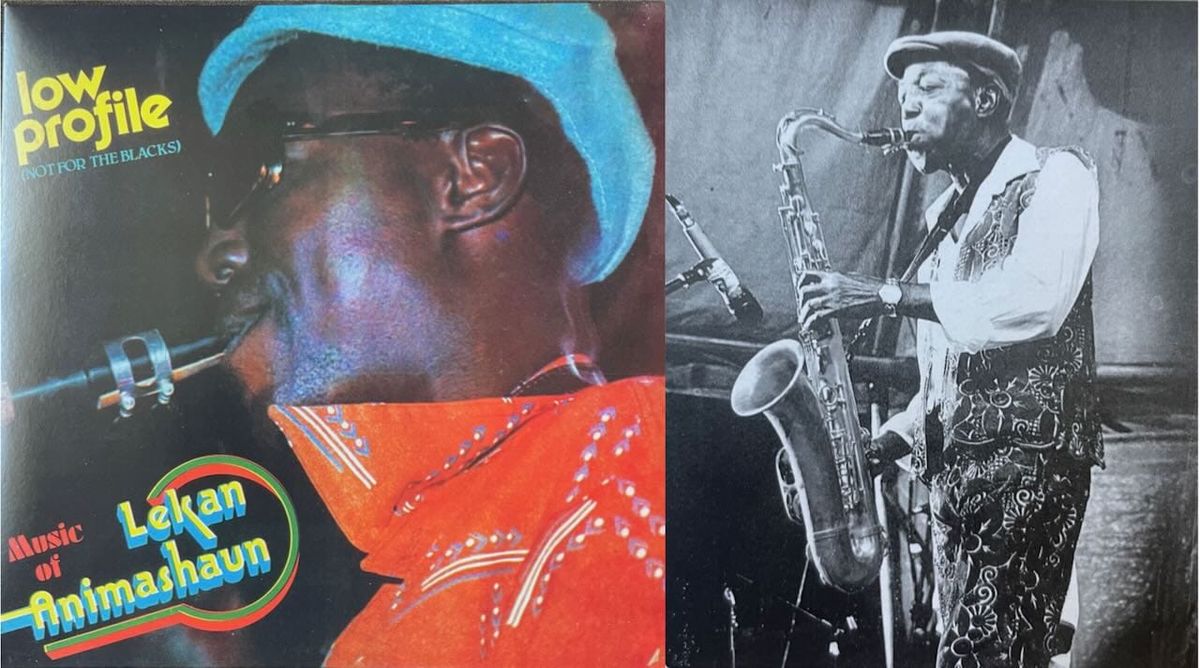
Hello—today’s review covers the only solo album from one of Fela Kuti’s most indispensable sidemen: baritone saxophonist and Egypt 80 bandleader Lekan Animashaun. The album had a protracted process of creation and a delayed release, all of which I’ll get into. Despite being cut from the same cloth as Kuti’s best work, the record has never really gotten its fair due from Afrobeat fans. Strut Records’ new reissue should hopefully remedy that.
Over the weekend I appeared on Steve Westman’s Live Audiophile Roundtable, discussing, in addition to some other more vinyl-oriented topics, the phenomenon of $1500 CDs. (I’m anti-, for the record.) I wanted to provide the link in case you missed it and would like to watch. It was a great discussion, and I also got show off some Bonzo Dog Doo-Dah Band records I recently picked up. I believe there are a few new readers here today as a result of my appearance on Westman’s show—welcome! Happy to have you here. And some of you may be here thanks to Westman’s brand-new email newsletter—welcome to you as well!
For those of you have yet to sign up to Westman’s newsletter, I recommend doing so, as it’s full of fine things in addition the links to my reviews here, including some pretty sweet vinyl giveaways. He’s already given away a copy of the upcoming Definitive Sound Series one-step of Marvin Gaye’s Let’s Get It On and is now giving away the just-announced Rhino High Fidelity pressing of the first Crosby, Stills & Nash album, cut from tape by Kevin Gray. To sign up for Steve Westman’s newsletter, simply email him at liveaudiophileroundtable@gmail.com. (Website readers: You’re already signed up for this newsletter, right? Right??)

Lekan Animashaun: Low Profile
The recorded catalog of Fela Anikulapo Kuti is a massive thing to wrap one’s head around. The Nigerian bandleader made more than 50 albums over the length of his career—all the more impressive when you take into account that his life ended relatively early, at age 58. When he was at the peak of his formidable powers in the 1970s, Kuti might release more than half a dozen LPs within a single calendar year, all of them with the backing of his peerless Africa 70 ensemble. When that group shed its musical bandleader, drummer Tony Allen, along with many of its members in the late ’70s, leadership shifted to baritone saxophonist Lekun Animashaun. The group was eventually redubbed Egypt 80 and remained under Animashaun’s leadership until Kuti’s death in 1997.
While Kuti’s discography can be daunting for new listeners to venture into, virtually any of the ’70s albums with Africa 70 will serve as a dynamite introduction to Kuti’s massive musical world. And once you’re converted, those dozens of albums are simply not enough—Kuti’s music has a narcotic pull, with infectious rhythms, incendiary delivery, and miraculous instrumental interplay that is simply unparalleled.
However, there’s an obscurity within the Kuti/Africa 70 catalog that gets overlooked by even the most devoted Afrobeat fans (myself included), and I’m overjoyed to discover that it’s as essential and indelible as anything released under Kuti’s name. I’m talking about the lone solo album of Lekun Animashaun, which features the full instrumental backing of Africa 70, with Kuti playing organ and acting as producer. Newly reissued on vinyl by Strut Records, Animashaun’s Low Profile is like uncovering a long-lost Fela Kuti album, only with Animashaun fronting the formidable ensemble and Kuti nodding in affirmation from a supporting role.
Like many of Kuti’s own albums, Low Profile consists of two extended songs, one per side, each just under 12 minutes long. But despite the streamlined tracklist, Low Profile was apparently put together over the span of many years. In his comments in the new liner notes, Animashaun says that most of it was recorded in 1979, which would have not been long after Tony Allen’s final performance with Africa 70 at the 1978 Berlin Jazz Festival—indeed, Allen drums on one track, while replacement drummer Masivswe Anam plays on the other. Animashaun also states that recordings initially started as far back as 1977, but that the process was interrupted by the raid on Kuti’s Kalakuta Republic compound that resulted in the destruction of the on-premises recording studio and the fatal injury of Kuti’s mother at the hands of Nigerian soldiers. Animashaun adds that additional recording was done in Paris in 1986 following Kuti’s release from an 18-month prison term.

The album’s piecemeal origins cannot be detected in the finished product, except for a noticeably twinkly synthesized electric-piano sound at the start of “Se Rere” that surely must be from the Paris ’86 session. The rest of the album sounds fully integrated—and, indeed, it gives the impression that the takes were captured live from start to finish, as was the case with many of Kuti’s albums. My guess would be that the two performances we hear are essentially from the ’79 recordings, with some additional sweetening and overdubbing done in ’86. Even then, the album was not released until 1995, giving the project an incubation period of nearly two decades.
The tumultuous events that surrounded Kuti, Animashaun, and Africa 70/Egypt 80 during the album’s extended lifespan cannot help but make themselves heard in Low Profile. The music is designed to inhabit and animate the body, but it is far from being merely celebratory—sorrow and anger run through the grooves alongside the summoning of rhythmic ecstasy, giving the music a double-edged fierceness and the sense that any rapturous release it might provide is hard-won. There’s a principled, organized chaos to the sound, one that Kuti’s fans will instantly recognize: The complex polyrhythms and tightly coiled instrumental lines are at once hypnotic in their repetition and snakelike in their sidewinding and elusiveness. The dense percussion is not mere latticework but structural support that would weaken the entire construction if one piece was out of place.
Animashaun’s compositions are politically and societally minded: “Low Profile (Not for the Blacks)” is the response to a comment made by Nigerian military leader Olusegun Obasanjo, that Black Nigerians with wealth should keep a low profile. Animashaun rejected this idea out of hand, and the song says that Blacks should feel free to live like kings and queens if they wished, especially when those in power are living ostentatiously. The title of the other track, “Se Rere,” means “Do Right,” and carries a straightforward message of treating others with kindness and following a moral code. Animashaun’s vocal presence is decidedly less fiery than Kuti’s but holds its own against the mammoth power of the band and some extended call-and-response with the densely layered backing singers. Indeed, “Se Rere” served as the opening piece for Kuti and Egypt 80’s concerts for many years.
When Low Profile was finally released in 1995, it was initially given a vinyl-only release in Nigeria on Kuti’s Kalakuta Records, and in his comments Animashaun laments that it was not a particularly successful seller. In 2004, the UK label Honest Jon’s reissued it on vinyl, as well as on a CD that also included Mr. Big Mouth, the 1977 solo album from Africa 70 trumpeter Tunde Williams, who had left the group by the time Low Profile was recorded. (Williams’s replacement, Olu-Fayeun Otenioro, features heavily on Animashaun’s album, taking extended solos on both tracks.) The source for Strut’s new vinyl reissue is not fully disclosed, and a comment in Animashaun’s liner notes says, “The recorded materials were left at the house of the band’s manager at the time.” Is he saying that the masters were misplaced? It’s unclear exactly what he’s referring to here.

What comes through on the vinyl is certainly much more than adequate. The many years in between sessions and the lengthy gap that led up to its delayed release likely ensured that this would never be a sparkling-sounding recording. To me it sounds similar to Kuti’s other albums from the late ’70s, with ample balance between the instruments and a slight murk that actually serves to reinforce the mesmerizing effects of the music. Nothing leaps out from the sonic picture, with everything balanced and contained to a pleasing degree and a precision to each instrument that only improves by turning up the volume. Frank Merritt at the Carvery Studio in London is credited with mastering and lacquer cutting here, and he has done exemplary work across the board.
The disc was pressed at Sonopress in Germany using their EcoRecord technology, made from a PET (polyethylene terephthalate) compound rather than conventional PVC. EcoRecord was designed to be easier to recycle and is created using a high-pressure injection moulding method rather than conventional steam-powered record presses. I praised this innovation in a previous review for Strut’s reissue of Dr. K. Gyasi and His Noble Kings’ Sikyi Highlife, the pressing of which I found to be essentially flawless. And this release is of similarly excellent quality, proving to me that Sonopress’s EcoRecord method is a viable sustainable alternative to conventional vinyl pressing. The disc was completely free of background noise, with no ticks, clicks, or interference; a comparison to the recording on high-resolution streaming via Apple Music gave me evidence that nothing unintended was added to or taken away from the record’s sonic properties. Indeed, the LP offered a more dimensional, tangible sound than the stream, with a more natural-sounding openness and air in the recording’s mid-range and highs.
If you have yet to embark on your Fela vinyl journey, Low Profile might not make sense as your first stop. (While original copies of Fela albums are fun to have, they’re often only found in atrocious condition—fortunately, Kuti’s catalog has been reissued thoroughly on Knitting Factory Records; I’ve got a bunch of them and have been pleased with all but a couple of the pressings.) But no Fela collection can be complete without Lekan Animashaun’s album accompanying it on the shelf. It’s an essential continuation of the musical explorations and ideas that Kuti and his cohort laid down during those intense days in the 1970s. And with Animashaun taking center stage, the talented backing musicians are offered more of the spotlight than they normally receive behind Kuti, revealing the incredible power and interplay of the ensemble. Despite its brief running time, the album feels close to monumental—it’s a real “where has this been?” kind of recording. To get a little cute about it, Low Profile has labored under the condition of its title for far too long. This Strut Records reissue gives this Afrobeat classic the profile it’s long deserved.
Strut/!K7 1-LP 33 RPM slightly translucent PET EcoRecord
• New remaster of Lekan Animashaun’s solo album, recorded in 1979 and 1986 and released in 1995
• Jacket: Direct-to-board single pocket
• Inner sleeve: Black poly-lined paper
• Liner notes, insert, or booklet: Double-sided insert with recollections from Animashaun, taken from an interview with Quinton Scott of Strut Records
• Source: Digital
• Mastering credit: “Mastering and vinyl cut by Frank Merritt at The Carvery,” Leyton, East London, UK
• Lacquer cut by: Frank Merritt at the Carvery, Leyton, East London, UK
• Pressed at: Sonopress, Germany
• Vinyl pressing quality (visual): A
• Vinyl pressing quality (audio): A
• Additional notes: Comes in a reusable poly outer bag with hype stickers.
Listening equipment:
Table: Technics SL-1200MK2
Cart: Audio-Technica VM540ML
Amp: Luxman L-509X
Speakers: ADS L980