Reviews: Talking Heads | Jimmy Smith
Plus, news of the different Beach Boys 'Pet Sounds' reissues.

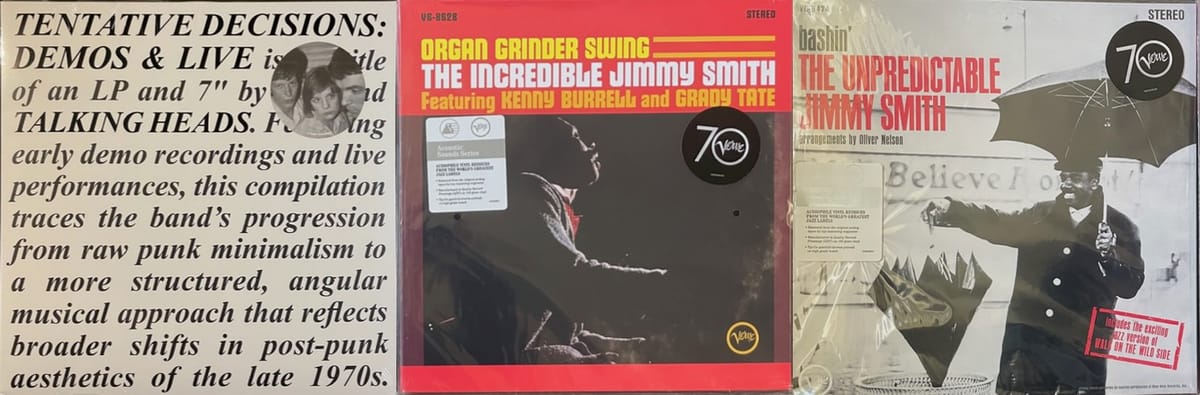
Greetings, friends. Today I’m catching up on some reviews for pieces of vinyl that have been kicking around my turntable the past few weeks. The Talking Heads LP contains the band’s earliest recordings, while the two Jimmy Smith albums are high-quality reissues that come from Kansas’s renowned Acoustic Sounds label.
- Talking Heads: Tentative Decision: Demos & Live
- Jimmy Smith: Bashin’: The Unpredictable Jimmy Smith & Organ Grinder Swing
Before we sink our teeth into that, I’ve got to mention the big vinyl news this week, that being the announcement of the big to-do surrounding the Beach Boys’ Pet Sounds celebrating its 60th anniversary this May. The band’s label, Capitol, and its parent company, Universal, are pulling out all the stops. As a result, there are actually four separate Pet Sounds vinyl things you can choose from, and you’re probably going to have a difficult time deciding what you actually want.
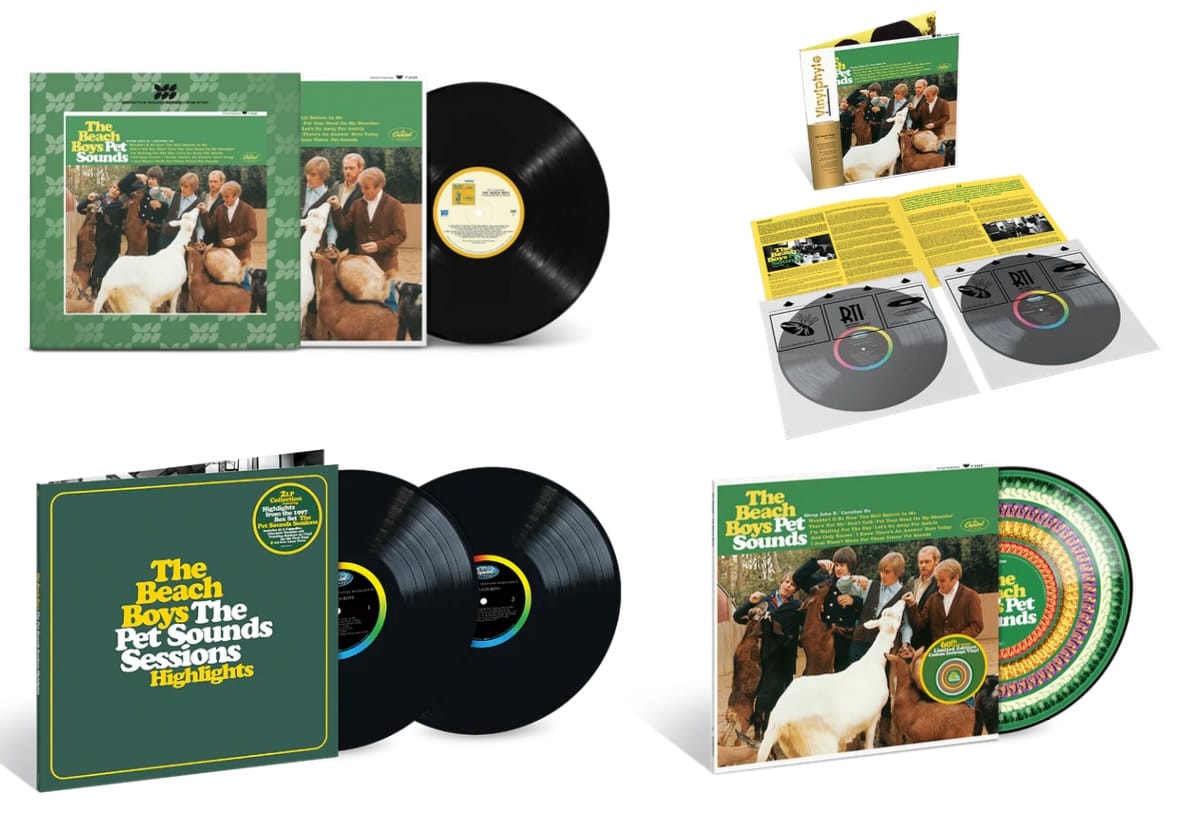
First up is the Definitive Sound Series one-step pressing of the album. This comes from the Interscope-Capitol wing of the company and is the latest in a series of extraordinarily high-end pressings of vital albums. (We’ve reviewed previous DSS releases here and here and were pretty blown away by then.) This one-step pressing comes from a ’70s mono master tape that was likely either the source for (or is sonically identical to the source used for) the 1972 Brother/Reprise pressing of Pet Sounds that was included as a second disc to the Beach Boys’ new-at-the-time album Carl and the Passions - “So Tough”. Many, including myself, consider that 1972 pressing of Pet Sounds to be among the best; I can definitely assert it sounds miles better than my 1966 original pressing.
Last night, Steve Westman hosted a livestream chat with the producer of the Definitive Sound Series, Tom “Grover” Biery, as well as the new one-step’s mastering engineer Chris Bellman and audiophile writer and vinyl advocate Michael Fremer for a round-table conversation about the new DSS one-step of Pet Sounds. They talk about this Brother/Reprise source tape, which, interestingly, is still a bit shrouded in mystery, despite countless hours of research. It’s well worth a watch if you want to learn more about the project. The DSS price is $100, so it’s easily the most expensive option. But judging by the track record of those involved, it should sound incredible.
However, that’s not the only Pet Sounds vinyl reissue that’s coming in May. Universal’s Vinylphyle series—which we are also very impressed by (see here, here, and here for our reviews)—is releasing a 2-LP version that includes the original 1966 mono mix and a digital stereo mix that was created in 1996. (Pet Sounds was never mixed in stereo at the time; producer Brian Wilson could only hear out of one ear, so he always preferred mono.) The mono disc is an analog cut from a 1966 “assembled master reel,” and the extent to which it’s different from the later tape used by the DSS folks is unknown. However, Joe Nino-Hernes is responsible for the mastering and has done a killer job with all the Vinylphyle releases so far, so it should sound pretty impressive.
The Vinylphyle double LP is priced at $55 and is the clear choice for those who want to hear Pet Sounds in stereo. It should also be a formidable option for those who want to hear Brian Wilson’s original mono mix, although come May, there should be dozens of comparisons between the Vinylphyle and the DSS. (Maybe you’ll read one here? TBD.) Interestingly, this isn’t the first time Vinylphyle and the Definitive Sound Series have put out competing product; back in December, they offered dueling versions of Nat King Cole’s The Christmas Song that turned out to be from totally different sources and thus sounded quite different in the end.
There’s still more. Universal is also releasing a 2-LP set called The Pet Sounds Sessions Highlights, which culls tracks from the 1997 4-CD box set that went super-deep on the Pet Sounds recording sessions. The new release includes vocals-only tracks, alternate versions, and rough mixes that have never been on vinyl before. It’s available in a premium-priced green splatter vinyl version and a much more sensibly priced standard black edition.
Last—and least, in this writer’s opinion—is the zoetrope picture disc of the album. The 1-LP set contains a cut of Pet Sounds from undisclosed sources, so it’s likely a bog-standard digital cut that’s been used on most of the recent pressings of the album. All of these new versions of Pet Sounds are coming out on May 15.
That took longer to explain that I thought it would. Thanks for bearing with me (or for politely scrolling down without complaint). Now we can get into today’s reviews.
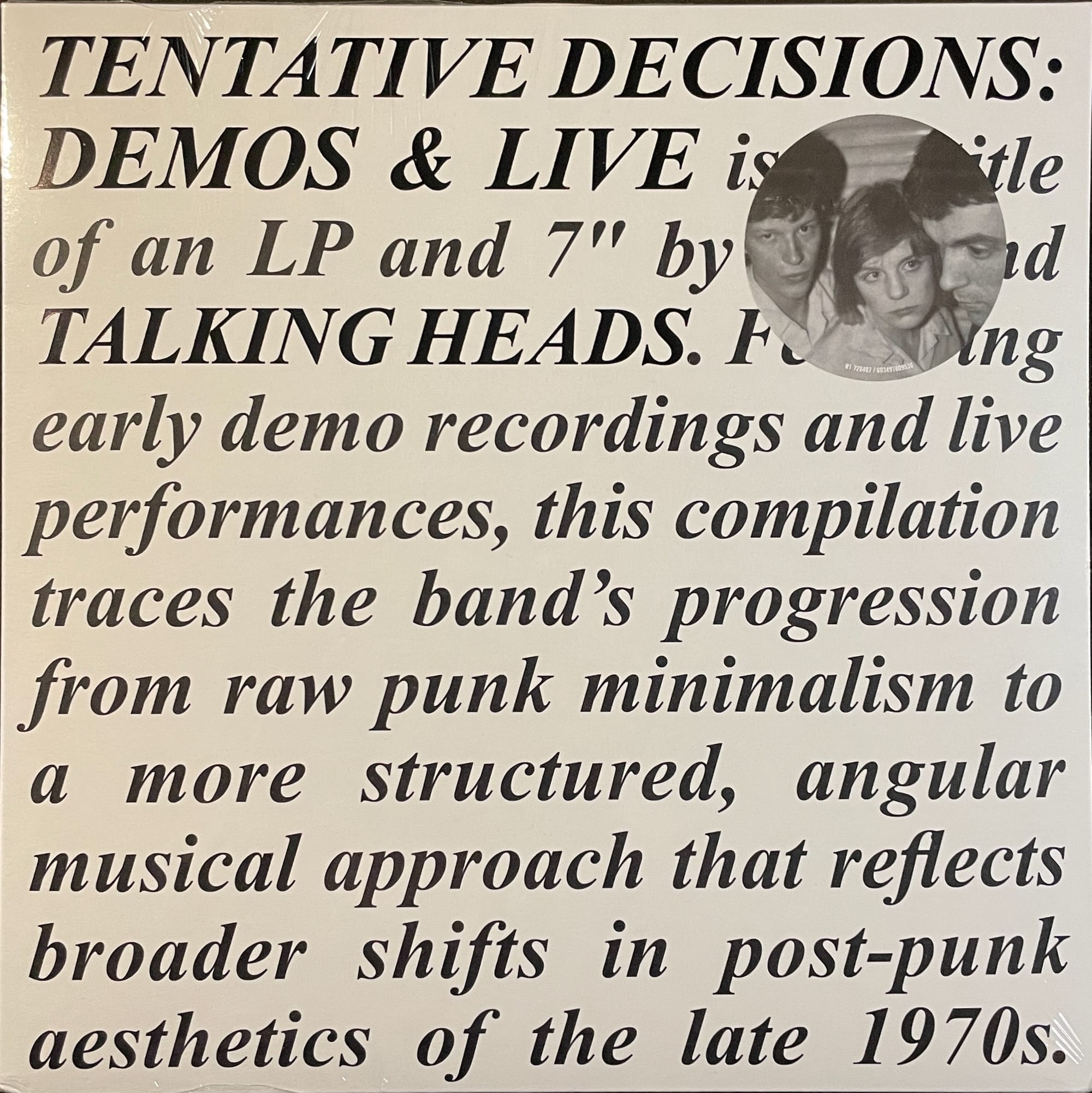
Talking Heads: Tentative Decisions: Demos & Live
Last year, members of Talking Heads celebrated the 50th anniversary of the band, which formally started with a gig at CBGB opening for the Ramones on June 5, 1975. But the group—at that point still a trio of singer/guitarist David Byrne, bassist Tina Weymouth, and drummer Chris Frantz—had been kicking around in various incarnations while the three were students at the Rhode Island Institute of Design (RISD). A recent collection gathers up demos and live recordings from the band’s roughly two-year apprenticeship that stretched from that first CBGB gig to the recording of their first album, Talking Heads: 77, in spring 1977. The complete Tentative Decisions: Demos & Live collection was released as a 3-CD set earlier this month; its first disc was also released as a stand-alone LP with a bonus 7-inch, in a wide release that followed a limited-edition teaser release on Record Store Day Black Friday in an edition of 7,500.
We briefly reviewed the RSD Black Friday version at the time but wanted to revisit the wider pressing now. For all intents and purposes, they are the same, although the new wide-release version comes on black vinyl as opposed to the clear version released on Black Friday. This is the first breakout LP we’ve gotten from that larger 3-CD collection, but the second disc is being released on vinyl on Record Store Day this year (April 18) as The CBS/Columbia Demos on 45 RPM double LP, and I would bet dollars to doughnuts that we’ll get the third disc, which consists of live tracks, as a double LP set on Black Friday in November.
This first LP is hugely important historically, but the primary takeaway is that the band—despite all of the groundbreaking achievements that were to come—did not arrive fully formed. The playing is scruffy and lacks confidence, and the songs are murmured rather than declared. Even a classic like “Psycho Killer” sounds pretty unremarkable at this early stage. This is not to be critical, as these recordings were just made for the band’s reference rather than for public exposure—and thank heavens they were, as historical documents like these allow us to see a full portrait of a band’s growth, and to have embryonic work for a band that would go on to become as important as Talking Heads is incredibly rare. All of these early songs would turn up vastly improved on the band’s first two albums, except for “Love Goes to a Building on Fire” and “I Wish You Wouldn’t Say That,” which would be re-recorded for Talking Heads’ first single in 1976.
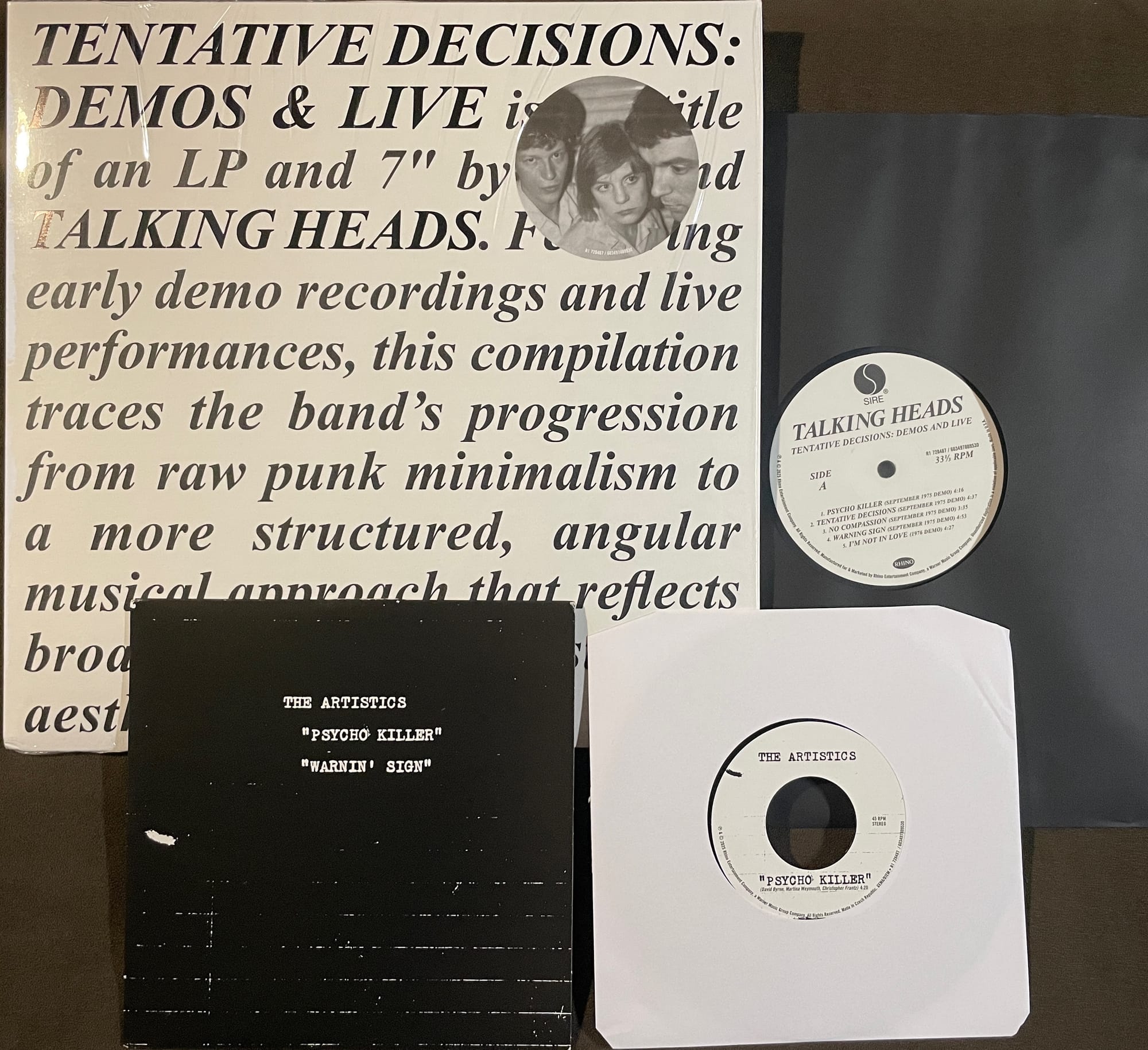
The recordings on this LP were made by the band’s good friend J.R. Rost in a little studio he set up in the basement of a brownstone in Park Slope. They were recorded on a TEAC four-track in different batches, and the chronological tracklist of the album charts the band’s growth in skill and poise. Rost also recorded a live show at the Lower Manhattan Ocean Club in August of 1976, from which one track is included here, a somewhat shambling “Artists Only.” Rost died in 2023, and these tapes—forgotten for many years—were rediscovered. All of this history is lovingly recounted in some brief liner notes that Frantz and Weymouth wrote for the CD version of Tentative Decisions, but sadly those notes did not make their way to the vinyl version.
The LP also includes a bonus 7-inch that consists of the very first recordings of Byrne and Frantz, made while they were members of a band called the Artistics, whose ranks also included guitarist David Anderson and bassist Hank Stahler. (Stahler was away when these tracks were recorded, so Anderson fills in on bass.) Recorded with a single mic in Frantz’s apartment, it’s really just a historic curio, although interestingly the band’s performances are a bit more frenetic than some of the later Talking Heads demos.
The sound is primitive, but the music is quite full and clear, considering the age and the sources. The tapes were transferred by Steve Rosenthal and mastered by Ted Jensen at Sterling Sound’s New York City outpost. Lacquers were cut by Joe-Nino Hernes at Sterling in Nashville, and he has done a fine job of getting the sound in the grooves with a minimum of fuss. Sadly, the Memphis Record Pressing is a bit lacking, with some stray noise and clicks and a noticeable noise floor. I suppose a generous listener could say that adds to the authenticity. At any rate, it’s unlikely these early recordings will win Talking Heads any new converts, but it’s pretty remarkable that we get to hear them at all. And with the rest of the anthology surely making its way to wax later this year, vinyl listeners will soon have the full prologue to the Talking Heads story.
Rhino/Sire 1-LP 33 RPM and 7-inch 45 RPM black vinyl
• The earliest known recordings of the band Talking Heads, dating from 1974 to 1976
• LP jacket: Direct-to-board single pocket; 7-inch also comes in a direct-to-board single-pocket jacket
• LP inner sleeve: Black poly-lined; 7-inch comes in paper sleeve; on my copy, the 7-inch crunched up the LP inner sleeve a bit, presumably from sliding around inside the jacket
• Liner notes, insert, or booklet: None; the CD version does have some but they weren’t included in the vinyl
• Source: Digital
• Mastering credit: “Analog Tape Transfers and Sound Restoration by Steve Rosenthal at the Magic Shop, New York, NY; Mastered by Ted Jansen at Sterling Sound, New York, NY
• Lacquer cut by: Joe Nino-Hernes at Sterling Sound, Nashville, TN; “JN-H” in deadwax
• Pressed at: Memphis Record Pressing, Memphis, TN
• Vinyl pressing quality (visual): A-
• Vinyl pressing quality (audio): B- (some noise and clicks)
• Additional notes: First released on clear vinyl in a limited edition on Record Store Day Black Friday 2025. There’s a hype sticker with a great photo of the band that you should be careful not to accidentally throw away.
Listening equipment:
Table: Technics SL-1200MK2
Cart: Audio-Technica VM540ML
Amp: Luxman L-509X
Speakers: ADS L980
Jimmy Smith: Bashin’: The Unpredictable Jimmy Smith & Organ Grinder Swing
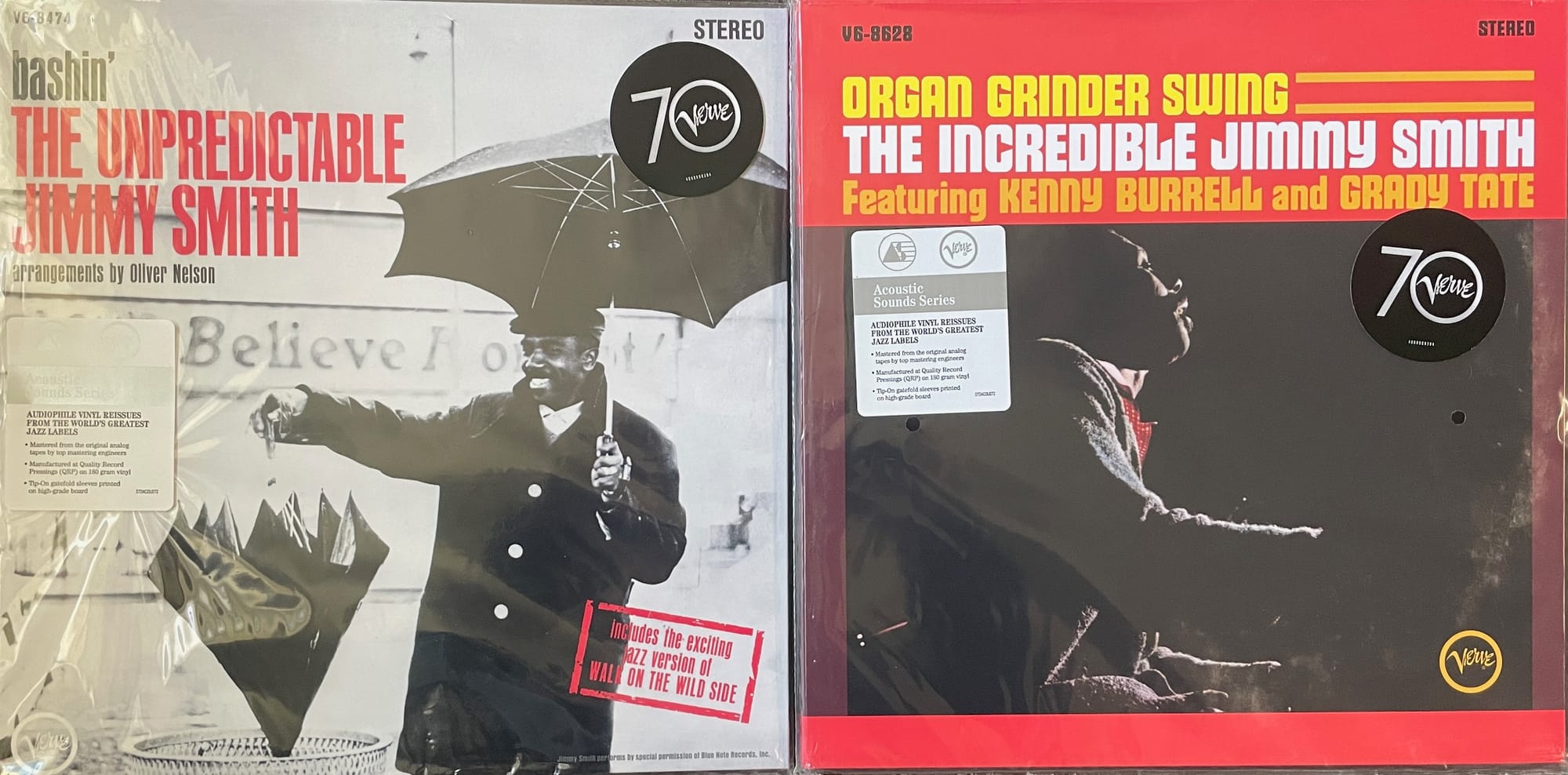
In January, Acoustic Sounds reissued a pair of albums from Jimmy Smith as part of their long-running Acoustic Sounds Series of quality reissues from Universal’s jazz catalog, drawing heavily from the Verve and Impulse! labels. (This series is not to be confused with the relatively new Verve Vault series, which we examined a couple weeks back.) Perhaps by design, the two albums Acoustic Sounds selected showcase the dual sides of the prolific Smith. 1962’s Bashin’: The Unpredictable Jimmy Smith, Smith’s first LP for Verve, finds the organist backed by a big band arranged by Oliver Nelson on half of the tracks; those songs are bold, brash affairs whose showbiz glitz sounds a bit cheesy by today’s standards. Meanwhile, the other half of Bashin’—and the entirety of Organ Grinder Swing: The Incredible Jimmy Smith, first issued on Verve in 1965—sees Smith returning to the stripped-down trio format that he used to record his many sessions for Blue Note Records in the 1950s.
Bashin’ kicks off with the song touted on the cover: the “exciting jazz version of ‘Walk on the Wild Side,’” which is of course not the Lou Reed song but rather the theme song from the 1962 movie of the same name, originally performed in the film by Brook Benton. Smith’s version became a substantial hit and provided him with momentum through the next phase of his career, but funnily enough the song’s massive arrangement sounds like schlock to today’s ear, with a decent organ solo in the second half but otherwise driven by overwrought horns blasting away to high heaven.
The rest of Side 1 is similarly pop-minded, with a tiptoeing version of “Ol’ Man River” accompanied by muted trumpets—is there any sound more midcentury?—and a genteel take on Duke Ellington’s “In a Mellow Tone” (here titled “In a Mellotone”). Nelson’s arrangements treat Smith’s organ as if it’s the voice of a pop singer, like Sinatra or Ella Fitzgerald, and while it’s a fine showcase for his quick fingerwork, the end effect is lacking in grit and artistry. Nelson would soon figure out how to showcase Smith more effectively, and their collaboration—very much considered a success in its day—would continue through Smith’s run at Verve.
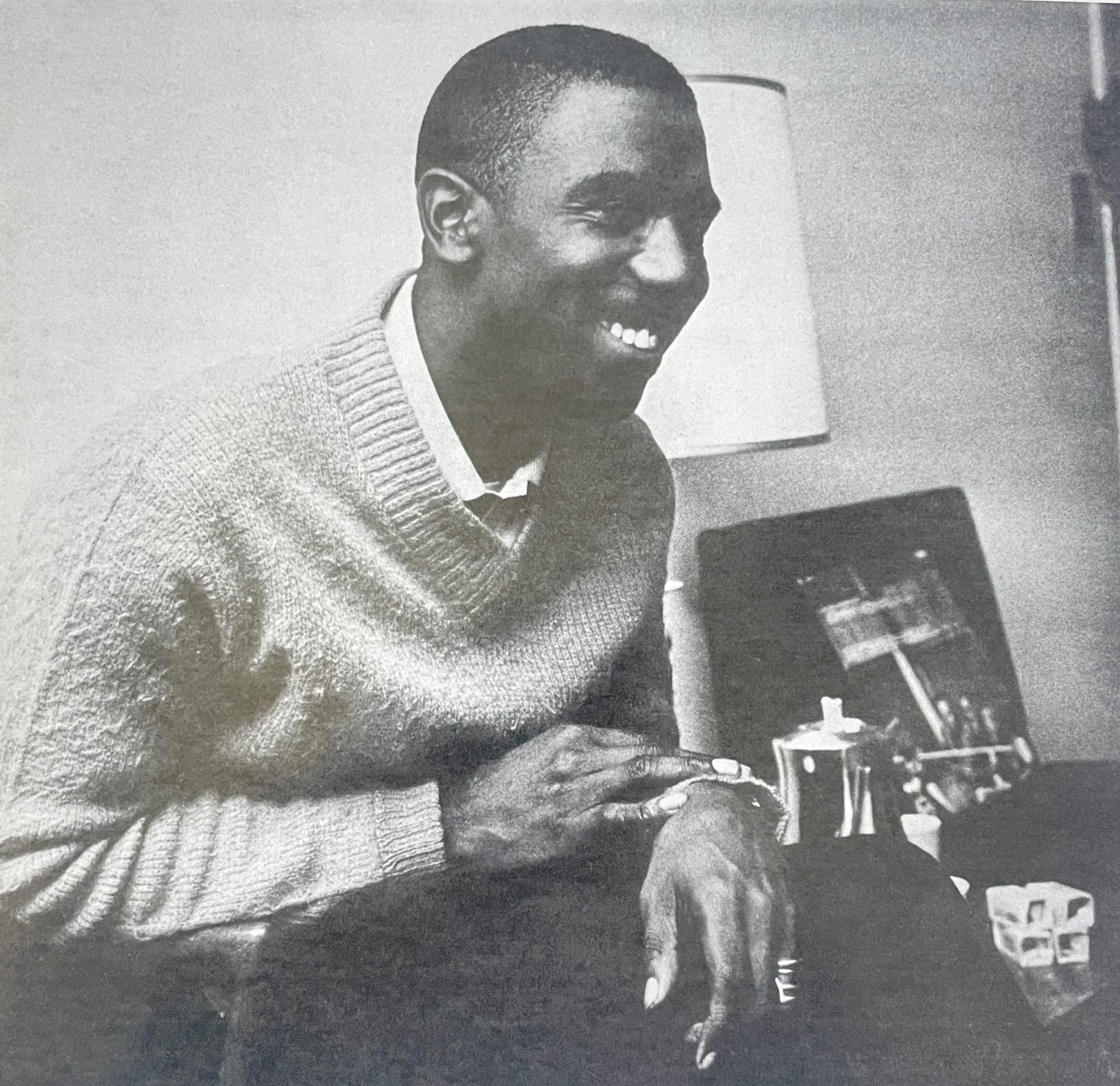
Side 2 of Bashin’ is far more involving, with a small trio configuration that features guitarist Jimmy Warren and drummer Don Bailey. The playing is subtle and suspenseful, with Smith’s Hammond B-3 organ showing off its sonic versatility. Sometimes it purrs, and other times it caws like a crow; sometimes Smith sits back and lets the organ glow beatifically or even seems to strum it like a guitar, and other times he coaxes martial fanfares out of it. That second half of the album is all about restraint, all the more remarkable considering how over-the-top the first half is.
I did not have an original stereo pressing of Bashin’ on hand to compare with this new pressing. (The only other pressing of note in the album’s release history is a 2011 edition from Speakers Corner, cut at Emil Berliner Studios in Berlin, Germany, which I also did not have access to; there are also a few gray-market releases from the last few years that should be avoided.) But I did have an original Rudy Van Gelder–cut mono edition that I put on just to see how they’d match up. The mono and stereo are really two different beasts, with the mono sounding much more forceful and assaultive, with some piercing shrillness when the horns get going. I preferred the way the stereo let the sonic picture unfold more cinematically, with space and distance between the members of the ensemble rather than a tight wad of everything in the middle. (I’m generally a fan of mono, just not in this case.)
The analog cut by Matthew Lutthans is sweet and true-sounding, with an impressively broad and deep soundstage; the big-band numbers are impressive sonically even if musically they’re a bit overbearing. The instruments all sound refreshingly live, although the echo-chamber reverb slightly punctures the you-are-there illusion. I’d certainly recommend Bashin’ for those who want to hear the wow factor of the big-band stuff, even if I have reservations about it musically. The trio stuff doesn’t sound quite as good, sounding at times slightly muffled, as in during the guitar solo on the title track; I’m guessing this is likely due to the source tape. At times Smith’s organ emits some ugly groans for a moment as well. The quieter passages, though, come across wonderfully well, sounding exquisite against the dead-silent background of the QRP-pressed vinyl.
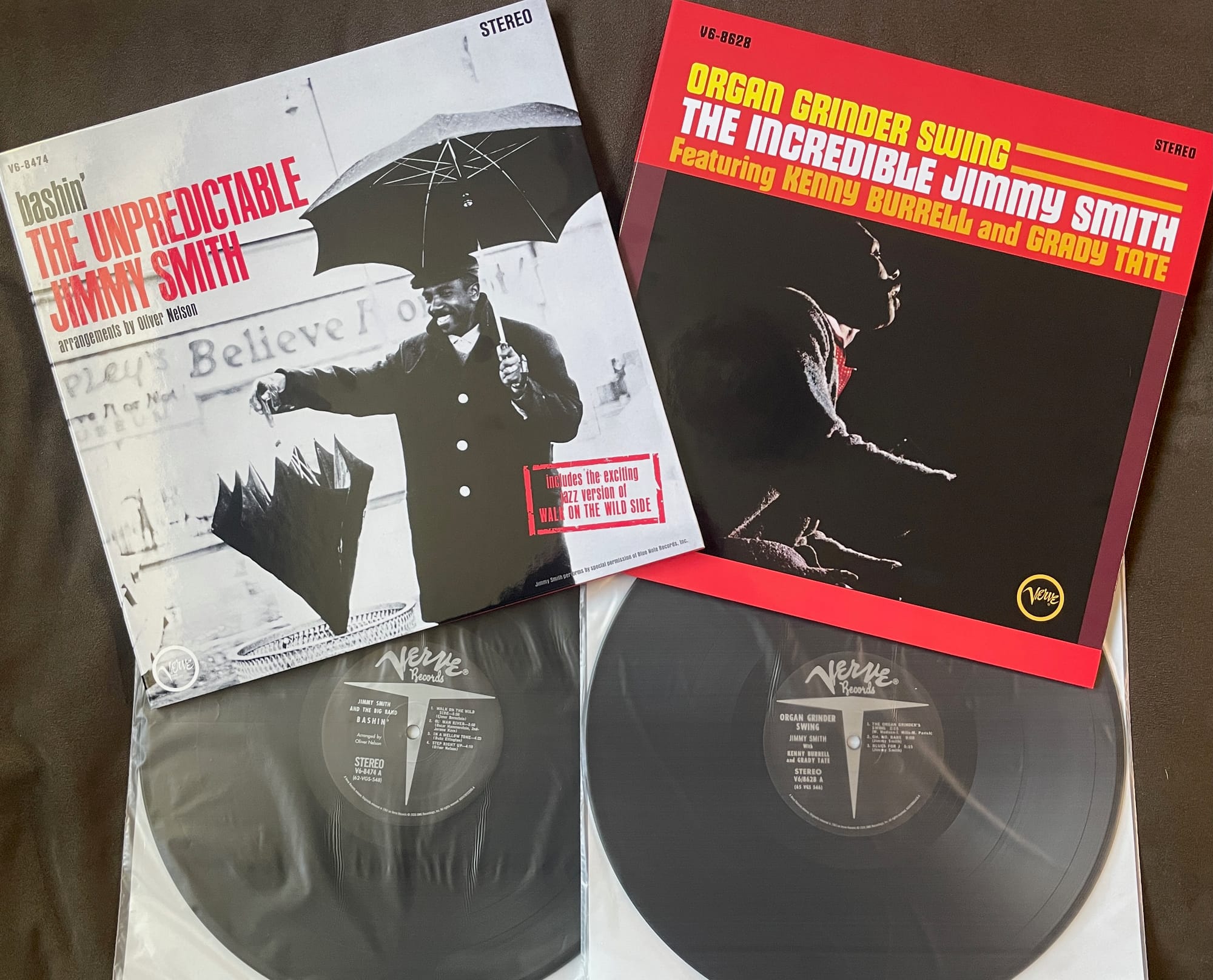
The other release, Organ Grinder Swing, is a late-night record, with Smith joined by guitarist Kenny Burrell and drummer Grady Tate for a moodier, bluesier, and far more subtle and intriguing set. The brief title track is kind of an overture before the main event kicks in: “Oh No, Babe,” is an extended blues number, told in hushed tones with little eruptions of excitement, throughout which Smith audibly moans and groans—a sonic hallmark of the entire album. “Blues for J” (its title misprinted as just “Blues for” on the back cover, one of two misprints on the outer jacket) is an upbeat strut, with Smith providing an animated bass line with his left hand on the B-3’s lower manual and plenty of finger-fireworks with his right hand on the upper manual. Elsewhere, Smith, Burrell, and Tate tackle a whirling version of “Greensleeves” and a finger-snapping, frosty-cool rendition of Duke Ellington’s “Satin Doll.”
The album has not been available on vinyl in the US since the ’60s, although German and Japanese reissues continued through the ’80s, and Universal released a version in Europe in 2010. This new pressing, featuring analog mastering by Matthew Lutthans, sounds magnificent, with the trio sounding fresh and alive. Burrell is in the left channel and Tate in the right, with Smith occupying center field, but the wide separation did not bother me and allowed me to pay close attention to each performance’s merits. Smith’s at-times relentless soloing is articulate and nuanced, with never a keystroke getting lost in the murk and his most cyclonic phrases taking on the muscular characteristics of a fish fighting on the line. Every detail of Tate’s drums are rendered immaculately, too, with just the right sparkle on the cymbals and hi-hat, and the brushwork on the snare sounding vividly lifelike.
I’d give Organ Grinder Swing the edge for both sonics and musical content; the trio stuff on Bashin’ does sound a notch below, although the big-band selections are appropriately explosive if that’s what you’re looking for. In either case, the pair of Acoustic Sounds reissues make for a fine summation of Smith’s tenure at Verve, showcasing both his bigger pop sound and his more nuanced approach with the trio.
Bashin’: Verve/Acoustic Sounds 1-LP 33 RPM 180g black vinyl
• Analog stereo remaster of Jimmy Smith’s 1962 album
• Jacket: Tip-on gatefold
• Inner sleeve: Unbranded rice-paper-style poly
• Liner notes, insert, or booklet: Two-sided insert with Acoustic Sounds Series catalog
• Source: Analog; “Mastered from the original analog tapes”
• Mastering credit: Matthew Lutthans at the Mastering Lab, Salina, KS
• Lacquer cut by: Matthew Lutthans at the Mastering Lab, Salina, KS; “MCL” in deadwax
• Pressed at: Quality Record Pressings, Salina, KS
• Vinyl pressing quality (visual): A- (very minor dishing)
• Vinyl pressing quality (audio): A
• Additional notes: Comes in perforated reusable plastic outer bag.
Organ Grinder Swing: Verve/Acoustic Sounds 1-LP 33 RPM 180g black vinyl
• Analog stereo remaster of Jimmy Smith’s 1965 album
• Jacket: Tip-on gatefold
• Inner sleeve: Unbranded rice-paper-style poly
• Liner notes, insert, or booklet: Two-sided insert with Acoustic Sounds Series catalog
• Source: Analog; “Mastered from the original analog tapes”
• Mastering credit: Matthew Lutthans at the Mastering Lab, Salina, KS
• Lacquer cut by: Matthew Lutthans at the Mastering Lab, Salina, KS; “MCL” in deadwax
• Pressed at: Quality Record Pressings, Salina, KS
• Vinyl pressing quality (visual): B+ (disc was dished)
• Vinyl pressing quality (audio): A+ (sonically flawless)
• Additional notes: Comes in perforated reusable plastic outer bag.
Listening equipment:
Table: Technics SL-1200MK2
Cart: Audio-Technica VM540ML
Amp: Luxman L-509X
Speakers: ADS L980