Review: Flamin’ Groovies

Shake Some Action gets a 50th anniversary reissue with a new analog cut and an extra disc of bonus music.
Today I’ve got a review for the 50th-anniversary expanded edition of Flamin’ Groovies’ fantastic 1976 album Shake Some Action, which has just been released as part of Rhino’s Spirit of ’76 retail campaign for July. That series features a bunch of 1976 albums freshly reissued—and in many cases newly remastered—for their semicentennials. Before we get to that, two things.

• First, Acoustic Sounds/Analogue Productions made a big announcement yesterday that they’ve got four reissues from the Who on tap. 1969’s double concept album Tommy and 1971’s Who’s Next are getting the UHQR treatment, with 33 RPM pressings on 200-gram “Clarity” vinyl.” And 1965’s My Generation (in mono) and 1970’s Live at Leeds are receiving 45 RPM 2-LP pressings on 180-gram black vinyl. The mastering comes from Chris Bellman at Bernie Grundman Mastering, who cut these around 25 years ago for the now-defunct Classic Records label (Acoustic Sounds honcho Chad Kassem bought up all of their metalwork some years back). My Generation and Live at Leeds are shipping as soon as next week, on July 24, while the UHQRs of Tommy and Who’s Next—which are limited to 3500 and 7500 copies, respectively—will ship at the end of August. There are also SACD and reel-to-reel editions for the real freaks, and there is ample evidence to believe that Acoustic Sounds will in the future reissue the remaining Who albums from the Keith Moon period, with Quadrophenia as a limited 33 RPM UHQR 2-LP set (it was originally a double, same as Tommy) and the others as 45 RPM 2-LPs.
This is a weird campaign to get my head around. I love the Who a whole lot, and the idea of new audiophile pressings cut from tape is super exciting. But the non-conformity seems strange—it’s odd that some of them are coming on UHQR at 33 RPM while others are non-UHQRs at 45 RPM. These are also quite expensive, at $65 for the non-UHQRs and either $125 or $150 for the UHQRs. Ouch. (Hey, have you thought about signing up for our paid tier? Today’s the day!) And while I have every reason to believe the Bellman/Classic Records cuts are very good—I actually haven’t heard any of them—it reduces my enthusiasm, for some reason, to know that these are coming from old metalwork (although I believe the 45 RPMs have never been released before… I might be wrong about that). The excellent new cuts we’re getting from the likes of Matthew Lutthans, Kevin Gray, and of course Bellman and Grundman these days make me wonder if vinyl mastering technology is measurably better than it was 25 years ago.

• Next up! My friend Steve Westman has launched an audacious shoot-the-moon campaign to get Jimmy Page to reissue the Led Zeppelin catalog in new pressings cut from the original analog master tapes, perhaps through Rhino’s High Fidelity series with mastering engineer Kevin Gray involved. He’s circulating an online petition that he’s hoping will reach 10,000 signatories or more. New copies of Led Zeppelin albums are currently in print only via the digital transfers that Page has said are the final word on the band, but vinyl-loving fans have generally found the sound of them wanting, especially when compared to older pressings. With the clock ticking on not just the condition of the master tapes but also Page’s own life expectancy (I’m not hinting at anything, it’s just that he’s 82 at this point), this might be the last chance such a thing could actually happen. You can watch the announcement video for Westman’s petition here, and he’d be really bummed if I didn’t urge each and every one of you to sign it. So go do that!
Will it actually work? That’s not the point! The point is that there are only so many RL pressings of Led Zeppelin II to go around, and that clean used copies of Physical Graffiti are getting way too expensive as it is. Westman’s already got a big contingent of the online vinyl community on board, and it’s pretty clear that Atlantic/Rhino would leap at the chance if they ever got the go-ahead. How about it, Jimmy?

Flamin’ Groovies: Shake Some Action (50th Anniversary Edition)
The road to Shake Some Action was not a short one. The defining album from San Francisco rockers Flamin’ Groovies experienced several false starts before seeing release on Sire Records in 1976—more than five years after their previous effort, 1971’s Teenage Head. Along the way, four record labels got involved, and the band’s lineup shed and acquired members on multiple occasions. At the end, Flamin’ Groovies emerged with a totally new sound and a bona fide power-pop classic.
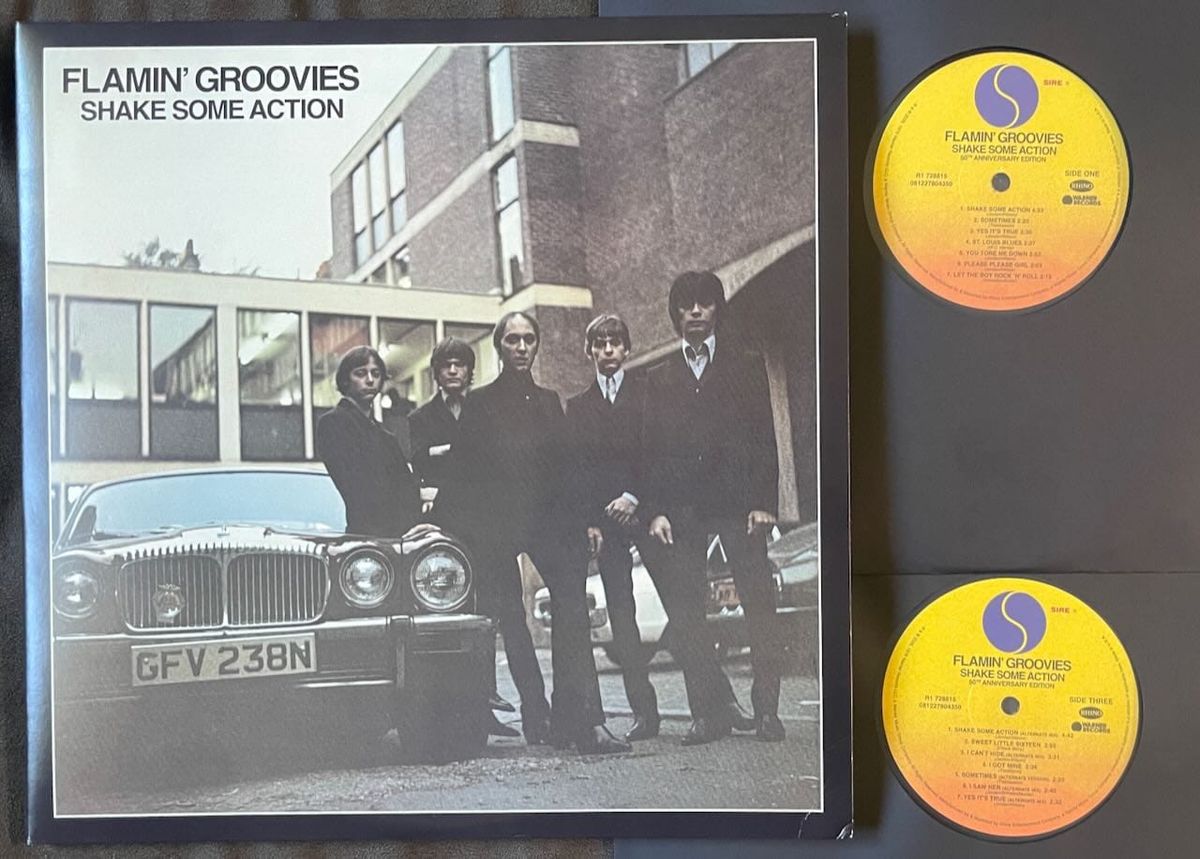
Shake Some Action has been reissued on vinyl and CD by Rhino Records for its 50th anniversary, and both editions include a second disc of previously unreleased outtakes, alternate mixes, and live material from a 1976 show at the Roxy. The vinyl edition was cut by Chris Bellman of Bernie Grundman Mastering—and the first disc, the album itself, was cut from the analog master tape. The extra material will make it a must-own for Groovies groovers, but I also wanted to see how the new Bellman cut stacked up against previous vinyl pressings.
Wielding three guitarists, the Groovies were paddling against the current from day one, playing snappy, Stones-y garage rock at the peak of San Francisco’s acid-dipped, jam-loving ballroom scene in the late 1960s. Frontman Roy Loney and guitarist Cyril Jordan wrote some killer originals for the group’s first three albums—1969’s Supersnazz, on Epic Records, and 1970’s Flamingo and 1971’s Teenage Head, both on Kama Sutra Records—but the Groovies’ repertoire always contained a healthy portion of covers of vintage R&B and rock ’n’ roll. Although Teenage Head found them perfecting a style of proto-punk that was years ahead of its time, the group was on shaky ground. Jordan’s push to move in a more Beatlesque pop direction and the band’s lack of success led Loney and co-founding guitarist Tim Lynch to leave the group in 1971 and Kama Sutra to drop them from their roster.
However, the British arm of the United Artists label was interested (the suits at the American head office had already passed on the band) and British label head Andrew Lauder brought the group over to record with producer Dave Edmunds in 1972. By this time, new guitarist James Ferrell had joined—as had guitarist/singer Chris Wilson, whose musical sensibilities meshed well with Jordan’s, and the pair embarked on a not particularly prolific songwriting partnership that nevertheless resulted in some fantastic tunes. Two of the songs recorded at those initial sessions at Edmunds’ Rockpile studio in Wales ended up on Shake Some Action four years later: the magnificent title track and “You Tore Me Down,” a thoughtful number laden with acoustic 12-strings.

Both songs are shockingly prescient for their time, anticipating the rise of power pop alongside punk in the late ’70s as well as the jangle-pop and neo-psychedelia movements of the ’80s. “Shake Some Action” stakes a claim as being the finest power-pop song ever conceived. (It’s running neck-and-neck alongside Big Star’s “September Gurls.”) With endless layers of vapourous guitars, a radiant five-note descending riff, and stacked harmonies that rise à la “Twist and Shout,” it’s an ecstatic blast that fuses the pop astuteness of the Beatles with the rock sinew of the Who. Jordan once told me he based the intro lick on Marvin Gaye’s “Can I Get a Witness,” meaning there’s some Motown R&B in its glorious cocktail as well.
“You Tore Me Down” is nearly as good, sounding like a Beatles for Sale number slingshotted forward in time to the early ’80s, where it could have become a flagship song of the Flying Nun catalog or Los Angeles’s Paisley Underground scene. But the sessions in Wales progressed slowly amid strings of European tour dates, and United Artists grew impatient, extracting two unsuccessful singles out of the band—“Slow Death,” a razor-toothed rocker left over from the Roy Loney days, and a cover of Frankie Lee Sims’s “Married Woman”—before throwing in the towel. (That they passed on “Shake Some Action” and “You Tore Me Down” remains one of the greatest record-label boners of all time.) The Groovies were back at square one; longtime drummer Danny Mihm also decided he’d had enough.
A nibble of interest from Capitol Records in 1973 came and went, but not before resulting in a second recording of “Shake Some Action”; the shorter, more concise take is driven by chiming acoustic guitars and remains Jordan’s preferred version. (It doesn’t appear on this new Rhino edition, nor do the assorted singles and leftovers from the 1972 sessions.) Greg Shaw got permission from United Artists to release “You Tore Me Down” as a single on his Bomp! label in 1974, and Shaw also proved instrumental in getting Sire Records’ Seymour Stein interested in the band. With Stein and Sire now on board, as well as new drummer David Wright, the group returned to Wales in 1975 to continue work on the album with Edmunds, recording the remaining 12 songs—half of them covers—that make up Shake Some Action.
The cover songs are fun, but they’re what keeps Shake Some Action from being a start-to-finish masterpiece. The Jordan/Wilson originals are so catchy and great, and the band sounds so much more mysterious and singular on them, that retro tracks like “St. Louis Blues” and “Let the Boy Rock ’n’ Roll” can’t help but sound like they belong in a Flash Cadillac revue and not coming from the group that was more or less inventing power pop in real time. Conversely, “I Can’t Hide” is a lovely Byrdsian flyght on a simple two-chord craft that soars to unexpected heights, while “Yes It’s True” sounds like it crawled fully formed out of the River Mersey. Meanwhile, “I Saw Her” is a mad-prince stagger of Between the Buttons–era psych, and “Teenage Confidential” is a gorgeous alloy of 12-string-driven folk rock and Dave Edmunds’ Spectoresque wall-of-sound production.

Assuredly, Shake Some Action’s high points carry the day, and the album has had a long history as an influential cult classic, despite the Flamin’ Groovies never managing to capture the world’s imagination at large. It was first released in France on Philips via a licensing deal Sire made with Philips’s parent company Phonogram—the Groovies had a bigger following in France and mainland Europe than they ever did back home in the US. A UK release on Sire followed, accompanied by a high-profile show at London’s Roundhouse on July 4, 1976, with the Ramones and the Stranglers providing support, a night that is considered by some to be crucial gasoline that fueled the nascent British punk movement. Last came Shake Some Action’s unveiling in the US, where the cover text was altered and the tracklist slightly reconfigured (to the album’s detriment, in my opinion). To promote the release, the Groovies performed their first gig on their home country’s soil since 1971, playing four shows in two nights at trendy Hollywood nightclub the Roxy, with Sire labelmates the Ramones again providing support.
A raucous portion of one of the August 12 shows at the Roxy appears on the second disc of Rhino’s 50th-anniversary edition. It finds the band charging through seven breakneck covers in 15 minutes, including “She Said Yeah,” “Under My Thumb,” and a version of “Please Please Me” that fades out after one minute, likely due to the tape being cut off. The band is in full butt-kicking mode, with any sloppiness in the playing merely adding to the effect of revelry and spontaneity. The recording sounds fantastic—the Record Plant’s mobile truck was parked outside and also captured the Ramones’ sets, which are being released in full by Rhino later this month—and the wild energy makes for a great counterbalance to the pop polish of the Shake Some Action album itself.
The rest of the bonus disc consists of new remixes of half of the Shake Some Action tracks, as well as three outtakes: a guitar-and-vocal demo of “Sometimes,” and two discarded covers, of Chuck Berry’s “Sweet Little Sixteen” and the old folk-blues song “I Got Mine,” first recorded by Frank Stokes. The new remixes, by Brian Kehew and Bill Inglot, seem designed to uncover some of the finer details of the multi-track recordings, although I’m not sure if they were looking to improve upon the originals. “Shake Some Action,” for example, strips away some of the pixie dust of the album mix to reveal that the interlocking guitar parts are not quite as tangled and layered as they seem on the LP; it’s interesting but inessential. The remix of “Yes It’s True” cuts down on the extreme treble of the original but clumps the instruments and voices together in a left-center-right stereo configuration that puzzles me—to resemble a vintage mid-’60s stereo mix, perhaps?
I’m sure it was great fun for the remixers to get their hands on these multi-tracks, as Edmunds’ original mix is notoriously porridge-like, so it must have been fascinating to peel everything apart. But I wonder if the space might have been better used with the leftover 1972 songs (which, granted, are available elsewhere) in order to provide a more thorough document of the album’s creation. I also wonder if there is other stuff on the Roxy live tape that was deemed unfit for release, or if we could possibly get more live Groovies on an upcoming Record Store Day.

I was able to compare the new Rhino 50th-anniversary cut by Chris Bellman to a French first pressing on Philips—which preceded the 1976 Sire UK and US pressings, per the liner notes in the Rhino edition—as well as the 2022 cut by Kevin Gray from Jackpot Records, pressed at RTI on green vinyl. It was immediately obvious that the French pressing is from a different master altogether—not only are the songs in a different order (they match the UK release, with “Yes It’s True” making for a much stronger second track than “Sometimes,” per the US edition), but the sound on the Philips release is significantly different, coming off as much more wild and untamed.
In some cases, as on the title track and “I Can’t Hide,” the French pressing is really terrific-sounding and fun; “You Tore Me Down” also sounds perfectly balanced in a way that the two newer cuts didn’t quite pull off. This cut accentuates much of the treble, and as a result I could often hear into the mix better, especially on a song like “Sometimes,” where I was able to clearly pick out the acoustic guitar strums. At other times, as on “Please Please Girl,” the top end was way, way too much, resulting in a crushed-out mess with unwanted sibilance and hiss. Additionally, the album sounds much less unified, with certain tracks sounding absolutely massive—typically the ones full of Spectoresque production murk—while others sounded relatively reduced in scope. It was an uneven listen that I felt bested both the Bellman and Gray cuts on certain tracks but fell short on others.
The Bellman/Rhino and Gray/Jackpot cuts are verrry similar, clearly both coming from the same source. The Jackpot pressing includes scans of tape boxes from Kendun Recorders in Burbank, California, although, bizarrely, it shows two different Side 2 reels with no images of a Side 1 reel. Obviously the album was resequenced and the US master was prepared at Kendun, by either Rick Heenan or Patrick Collins (the boxes simply say “Rick”). The question is, which tape did Kevin Gray use, the one dated 4/6/76 (with the “Original mix” and “CCIR” boxes checked) or the one dated 4/13/76 (with “E.Q. copy” and “Dolby” checked) that is clearly labeled “CUTTING MASTER”? (Or could they in fact be the same tape, with the images showing both sides of the same box?) Whatever the case, I feel confident in my theory that Bellman and Gray worked with the same Kendun tape. The similarities are undeniable.

When push comes to shove, I think I have to give a slight edge to the Gray/Jackpot cut, although its green vinyl pressing from RTI had some light surface noise. At the end of the day, this cut just has a touch more body and shape, emerging out of the speakers with dimensionality and presence that is just a smidgen reduced on the new Bellman/Rhino cut. Additionally, the Bellman is more consistent, which might be more pleasing in some regards, but it also means that some of the exciting stray surges and flare-ups on the Gray cut are tamped down. However, they really are so close that I am splitting hairs to find significant advantages in one or the other. I thought “Shake Some Action” and “I Can’t Hide,” two of my favorite tracks, had a little more bounce and life on the Gray cut, while also thinking “You Tore Me Down” was stronger on the Bellman and preferring its soft-yet-powerful treatment of “Teenage Confidential.” I also feel like I could easily change my mind about all of this tomorrow.
The truth is that the album is densely produced and breaks a lot of audiophile rules. Instruments are mushed together for their cumulative effect, and high-end sizzle is used as a fundamental tool to generate excitement. The end feel is more important than the precision of the sound, and both of these cuts are likely to please fans of the album even as they offend the more discerning audio snob. The Bellman and Gray are also a bit stronger in the bass department than the French Philips cut, although there are a handful of tracks on the Philips that are thrillingly unbridled in their low-end whomp.
My pressing of the new Rhino 50th left a bit to be desired. It was manufactured at GZ’s Memphis Record Pressing and contained a significant amount of crackle that did not disappear after an ultrasonic cleaning. It was usually mild enough to generally stay hidden behind the music, but it was consistently present throughout all four sides. I also heard some rotational grind during the silent gaps in between tracks. None of the pressing’s defects overly interfered with the music, in my opinion, but I think it fell short of the acceptable level for new vinyl. I hope my experience is isolated and that most of the other pressings out there are better.
The package is expanded from a single sleeve to a gatefold, containing a fantastic array of color photos of the band in the studio with Edmunds. There’s also a four-page insert with black-and-white photos of the band both in the studio and onstage as well as an oral history compiled by music historian and archivist Alec Palao, with recent quotes from all the band members. It’s a great-looking (and -reading) presentation that makes for a significant selling point of this new edition.
This incarnation of the Groovies would go on to record two more albums for Sire before disintegrating in the early ’80s, although Jordan and founding bassist George Alexander kept the band alive with new musicians until 1991. I think their stubborn reliance on covers held them back—if Jordan and Wilson had ever managed to fill up an entire LP’s worth with their own material, we might be talking about the band differently today. Regardless, it was always part of the Flamin’ Groovies’ charm that they always carried a torch for rock ’n’ roll’s past and never felt like they needed to outgrow their origins as a lean ’n’ dirty outfit that could play grimy dive bars just as comfortably as Paris’s renowned music palace the Olympia. That blend of garage rock and poised power pop is what makes Shake Some Action worthy of attention half a century later. And that title track remains as infectious as ever—best-case evidence that a peppy beat, some jangling guitars, and a few sweet harmonies can, for a few brief moments, achieve pure pop perfection.
Warner/Rhino 2-LP 33 RPM black vinyl
• New remaster of the Flamin’ Groovies’ 1976 album, with a second disc of outtakes, remixes, and live material recorded at the Roxy on August 12, 1976
• Jacket: Direct-to-board gatefold
• Inner sleeves: Black poly-lined paper
• Liner notes, insert, or booklet: Four-page insert with photos and an oral history by Alec Palao
• Source, Disc 1 (album): Analog; “The original album cut from analog tape,” per hype sticker
• Source, Disc 2 (bonus material): Digital
• Mastering credit: “Mastered by Dan Hersch with Bill Inglot at d² Mastering,” Los Angeles, CA
• Lacquer cut by: Chris Bellman at Bernie Grundman Mastering, Hollywood, CA; “CB” in the deadwax
• Pressed at: GZ’s Memphis Record Pressing, Memphis, TN
• Vinyl pressing quality (visual): A-
• Vinyl pressing quality (audio): C- (excessive noise and crackle)
• Additional notes: None.
Listening equipment:
Table: Technics SL-1200MK2
Cart: Audio-Technica VM540ML
Amp: Luxman L-509X
Speakers: ADS L980