Review: Public Image Ltd on Rhino Reserve
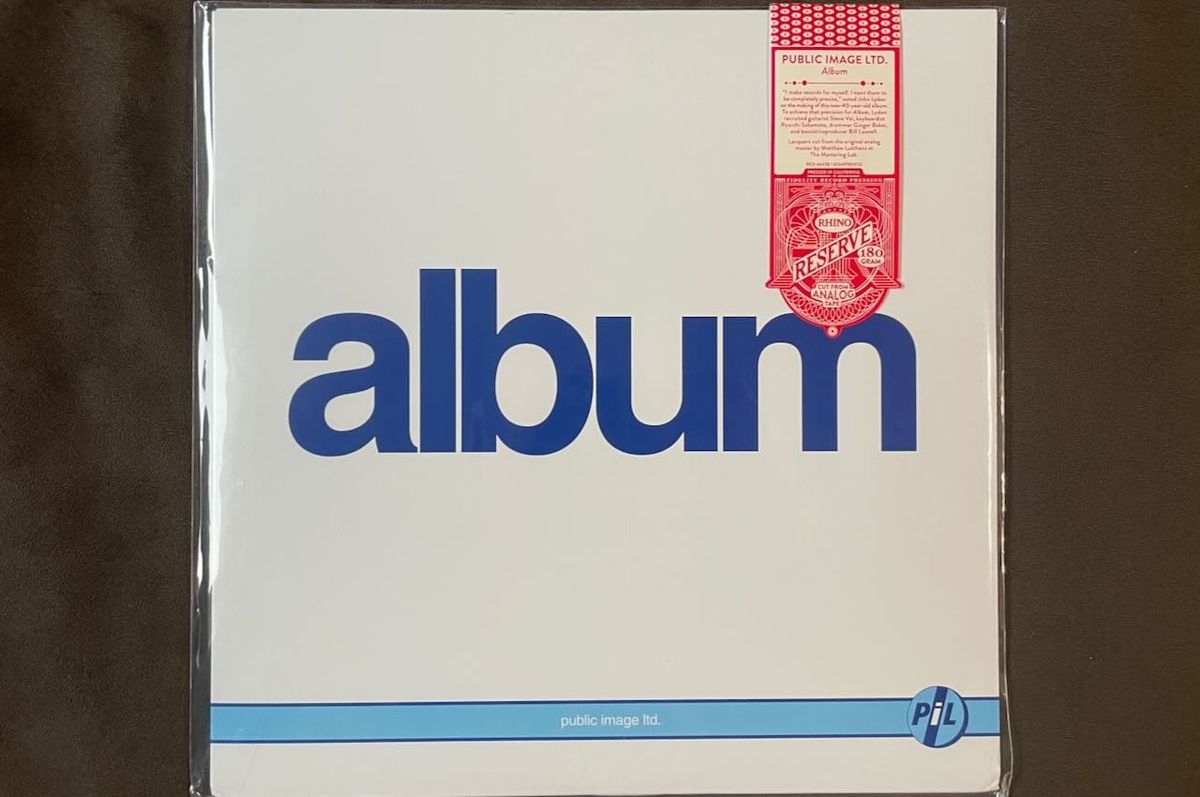
Here’s a Saturday record review for you, for the recent Rhino Reserve reissue of Public Image Ltd’s somewhat controversial album from 1986, Album. (Yes, it’s called Album.) Before you dig into that, I wanted to mention that I appeared on this morning’s edition of Steve Westman’s Live Audiophile Roundtable. We discussed the latest vinyl reissues and other news, and there was even a dispatch from Acoustic Sounds’ Vinyl Summit that’s going on this weekend in Salina, Kansas.
Watch it here! And now let’s get into today’s review.
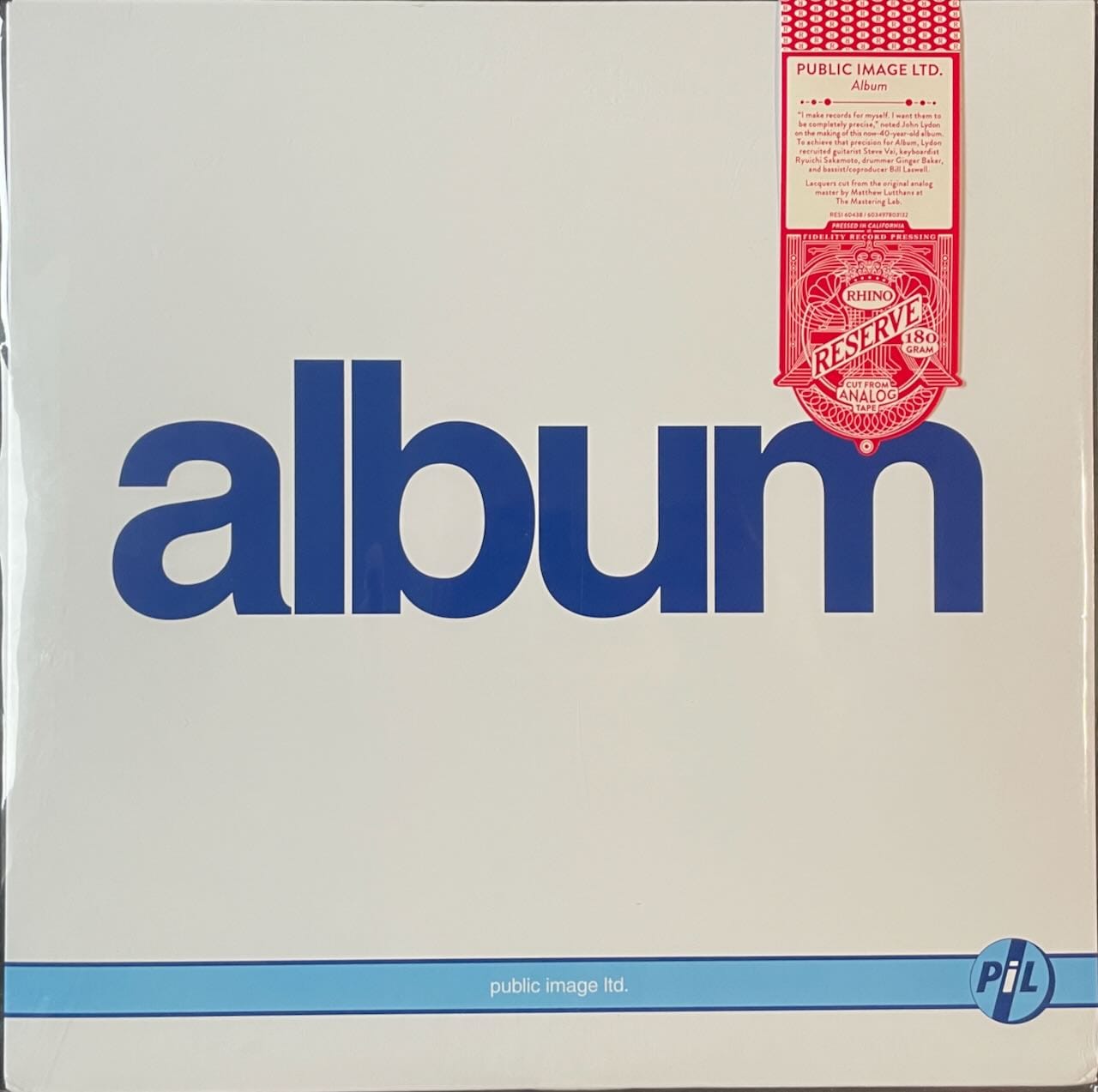
Public Image Ltd: Album
The title was deliberately generic, a point driven home by the artwork, meant to mimic the design of no-brand grocery products—a visual choice surely inspired by the 1984 movie Repo Man. (The cassette configuration of Album was titled Cassette and the CD was called, you guessed it, Compact Disc.) The band, too, was virtually anonymous: Neither musician credits nor any recording information could be found on the packaging, nor were any hints or visual cues given as to what the music inside might sound like.
Of course, when Album was released in January 1986, most people knew that Public Image Ltd was the post–Sex Pistols project of John Lydon (aka Johnny Rotten). But the band surrounding him had consistently acquired and shed members since the release of the first PiL album in 1978. By the time the Album sessions began in New York City in late 1985, only Lydon from the original lineup remained. He’d recently acquired a new touring band of young musicians from California, but for Album, the British singer and his producer, Material bassist Bill Laswell, realized they weren’t up to the task.
Laswell and Lydon had first worked together when Lydon collaborated with Afrika Bambaataa on the 1984 “World Destruction” single by Time Zone, with Laswell producing. Laswell was soon tasked with enlisting a crack team of session aces to lay down tracks for the next PiL full-length. The drummers were jazz legend Tony Williams and former Cream wildman Ginger Baker; the guitarists included Nicky Skopelitis and Steve Vai. Parliament-Funkadelic’s Bernie Worrell played organ and Yellow Magic Orchestra’s Ryuichi Sakamoto programmed the Fairlight CMI, while Shankar bowed his trademark double violin (LSD) on a pair of tracks. Laswell played bass.
The music was certainly not generic, but it was deliberately agnostic, with studio polish, aggression, and a pan-global approach to rock and dance music among its dominating attributes. Lydon’s songs were quite malleable, and with Laswell directing, each musician was given a great degree of latitude to put their individual imprints on the pieces. Some songs even emerged out of Laswell-led studio jams without Lydon present, including the album’s single, “Rise.” The drums were recorded at the Power Station and bear the famous Manhattan studio’s trademark big-beat sound, so prevalent in the mid-’80s. Other parts were tracked at different studios around the city, including Electric Lady, RPM, and Quadrasonic.
The end result is the strange beast that is Album, a slippery and unlikely hybrid of corporate ’80s studio tropes with rebellious and deliberately provocative attitudes, dovetailed with repetitive tribal sounds and influences accumulated from around the globe, just as its participant musicians had been. The standout, “Rise,” comes cloaked as a joyous major-chord anthem with the most straightforward melody of any PiL song thus far. And yet tension remains: “Anger is an energy,” Lydon chants atonally, over and again. But when the song transitions into its gracious refrain, “May the road rise with you” (taken from an Irish proverb), it sounds like an apotheosis of Lydon’s entire career thus far, in which anger was indeed the driving energy but our shared humanity is what’s left after the anger burns away.
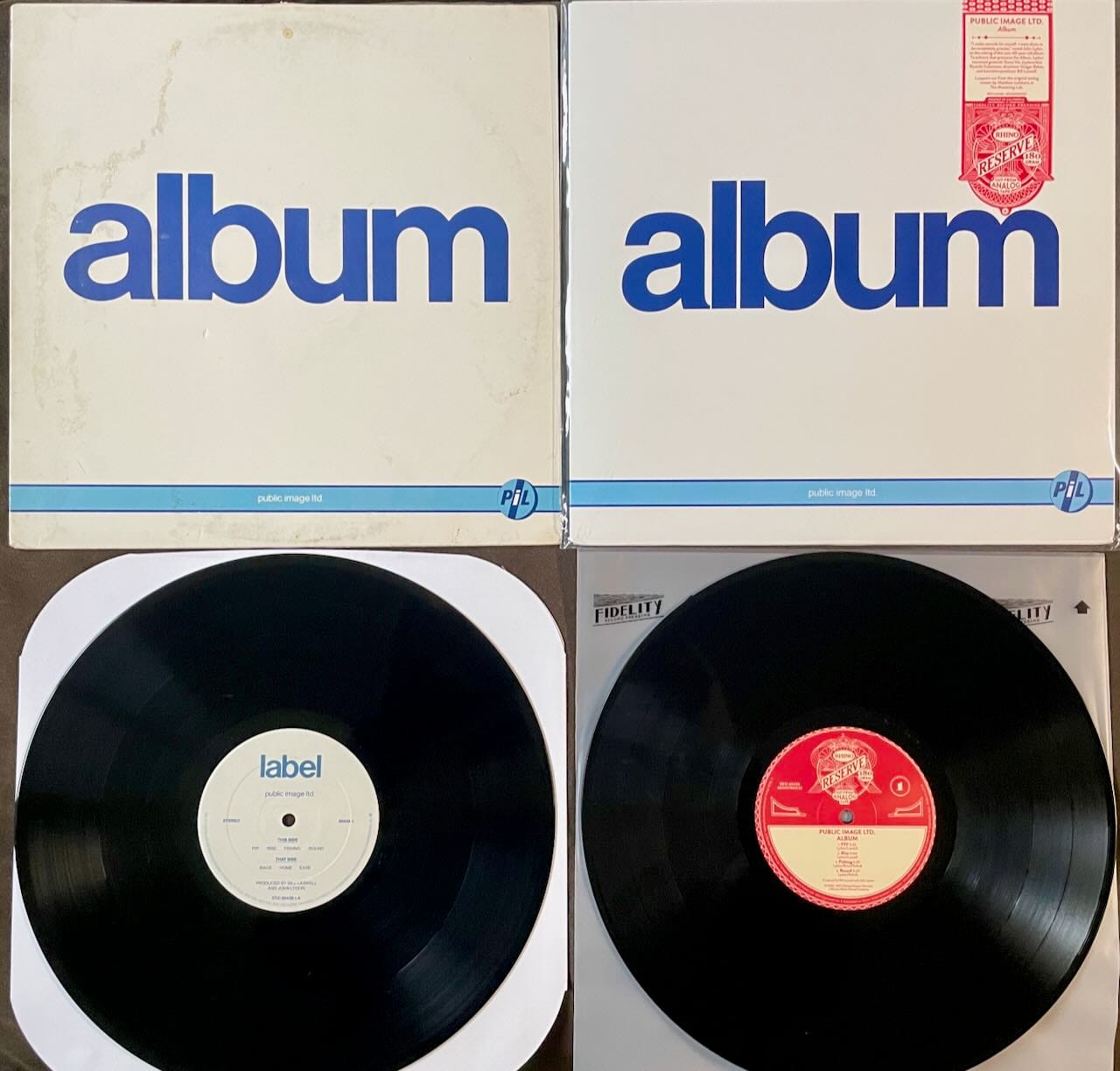
The original 1986 pressing of Album was mastered by Howie Weinberg, who cut the lacquer at Masterdisk at its Manhattan location near Lincoln Center. Indeed, the pulse and energy of New York City runs through every element of the album, right down to Weinberg’s mastering, which feels like a product of the high ’80s. On my original US pressing on Elektra Records, the treble hatch is kicked all the way open, with huge amounts of air, crush, and white noise making up the sound profile. It makes for tremendous excitement, with a scope bigger than those Midtown Manhattan skyscrapers, but it also nails down the album to its time of origin, sounding entirely like a product of its go-go era. The extreme high end also occasionally fatigued my ear and prevented me from dialing up the volume too much.
The new Rhino Reserve pressing was cut by Matthew Lutthans at the Mastering Lab in Salina, Kansas. It’s a much, much warmer cut, with a thick bottom end running underneath the music’s surface like magma and all of that intense Weinberg treble reined in. The wide-open white-out brightness is mitigated, and Laswell’s bass and the project’s tribal rumble are emphasized in its place. The sound even turns thunderous on occasion, as on “Fishing,” when the smack-thwack of the drums becomes something more geologic.
The two cuts are so different that there are bound to be allegiants of each, and those whose ears gravitate toward boosted high-end may find the original is the one they prefer. I genuinely liked both, but I found the new Rhino Reserve pressing a more satisfying and inviting listen in the long run—the music sounded less trapped in time and more nuanced with that ’80s studio sheen pulled back, without any of the detail being lost. The Lutthans cut, done using the Mastering Lab’s tube equipment, emphasizes the album’s global components, with underlying heat and rhythm drawing the listener in rather than the flash, crash, and bang of the ’80s pressing. The new Reserve version also allows the more ridiculous Eddie Van Halenesque guitar shrieks from Vai to leap out of their surroundings in greater relief, letting them function as the silly punchlines that they are.
The record is virtually flawless from a pressing standpoint, as has now become de rigueur for vinyl from the Fidelity plant, but funnily enough, the standardized Rhino Reserve design serves to make the package even more generic. The original’s custom labels are gone in favor of Rhino Reserve’s usual red labels, and the now-familiar wrap-over hype sticker adds a slight assembly-line feeling to the visual component. But I think the tamed treble and the much warmer sound allows the emotion of a song like “Rise” to pump forth from the speakers with significantly greater ease. Finding precision within experimentation may have been Lydon and Laswell’s operating procedure in recording Album, with extra care taken not to swear allegiance to any one ideology or sound. This new Rhino Reserve edition emphasizes the musicality of what they were exploring and not merely the posturing that went with it. Album’s still a tough one to wrap one’s arms (and ears) around, but it sounds more visionary than ever.
Rhino Reserve 1-LP 33 RPM 180g black vinyl
• New remaster of Public Image Ltd’s 1986 album.
• Jacket: Direct-to-board single pocket
• Inner sleeve: Fidelity Record Pressing–branded poly
• Liner notes, insert, or booklet: None
• Source: Analog; “Lacquers cut from the original analog master”
• Mastering credit: Matthew Lutthans at the Mastering Lab, Salina, KS
• Lacquers cut by: Matthew Lutthans at the Mastering Lab, Salina, KS; “MCL” in the deadwax
• Pressed at: Fidelity Record Pressing, Oxnard, CA
• Vinyl pressing quality (visual): A
• Vinyl pressing quality (audio): A
• Additional notes: Comes inside a reusable poly outer sleeve sealed by a hype sticker, as per other Rhino Reserve titles.
Listening equipment:
Table: Technics SL-1200MK2
Cart: Audio-Technica VM540ML
Amp: Luxman L-509X
Speakers: ADS L980