Review: Rokk Í Reykjavík

It feels a little funny to be listening to a compilation of Icelandic artists during the hottest days of American summer. But as every non-Icelandic person surely knows by now, Iceland is more than a realm of glaciers and snowdrifts—it’s a place of volcanos and hot springs, of black sands and endless greenery. And its music scene, which came to international prominence with the rise of stars like Björk and Sigur Rós, is similarly versatile, with room for metal acts like Sólstafir, hushed-voice stomp-folk from Of Monsters and Men, the retro-lounge jazz-pop of Laufey, and the modern classical music of Hildur Guðnadóttir and the late soundtrack composer Jóhann Jóhannsson.
The diversity of Iceland’s music scene was evident as far back as 1982, the year Rokk Í Reykjavík aired on Icelandic television. The documentary film, directed by Friðrik Thor Friðriksson, was one of the first attempts to survey the wide range of music that was emerging from Iceland’s capital, with 20 acts across the musical spectrum playing punk, new wave, post-punk, pub rock, avant-garde experiments, and even a sampling of traditional Icelandic folk music. The soundtrack was released in Iceland as a double vinyl LP in limited quantities, and its scarcity has led it to become hotly coveted among collectors, not only for its inclusion of a couple of rare early Björk performances—who sings two songs with her band Tappi Tíkarrass, which means “cork the bitch’s ass” in Icelandic—but for the snapshot it provides of a particularly fertile and individualistic music scene.
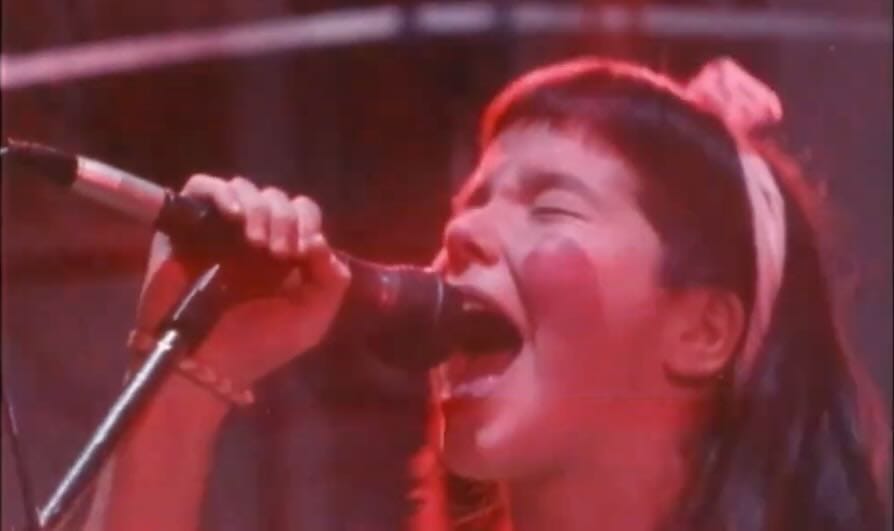
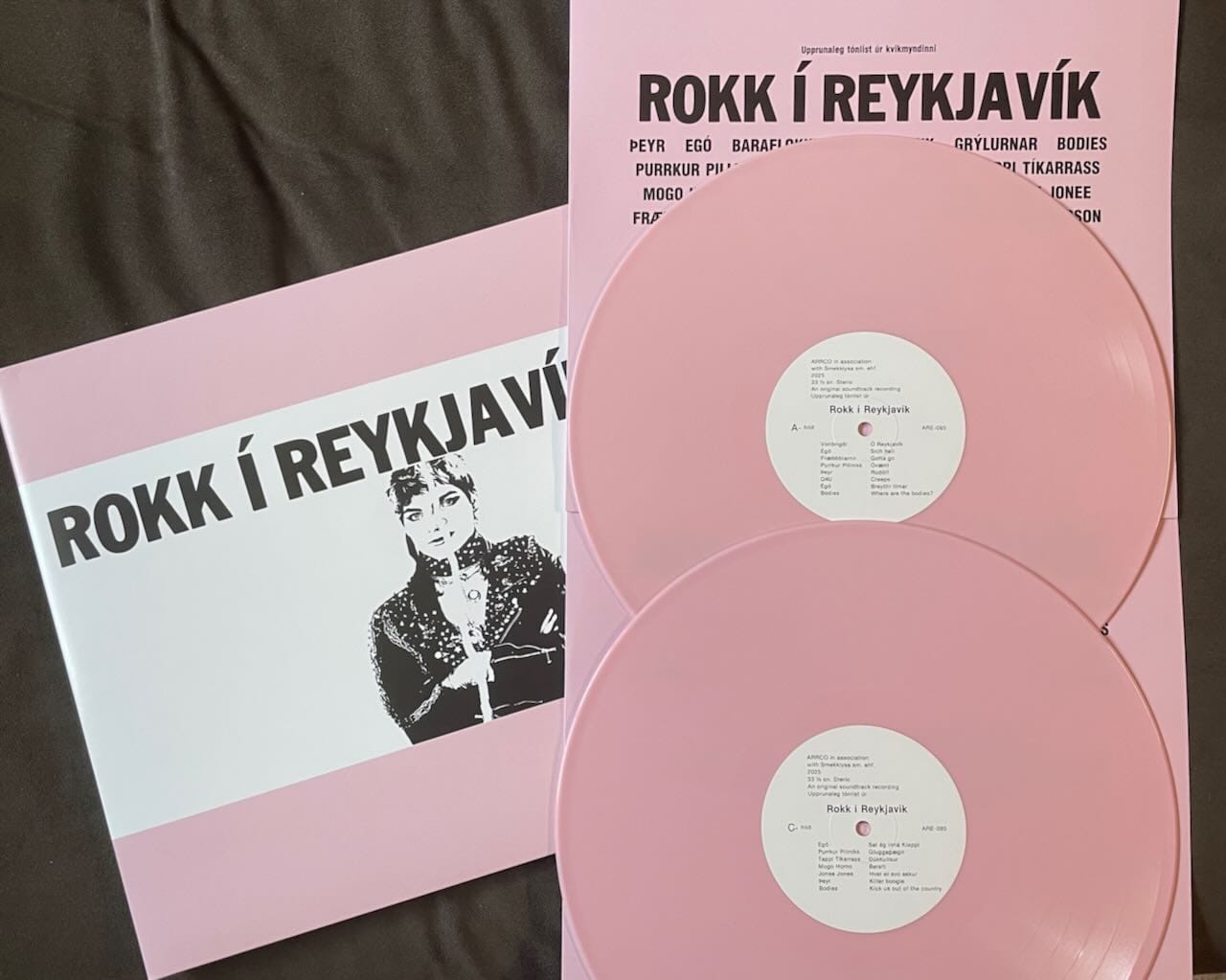
While Rokk Í Reykjavík has received a CD release from Icelandic label Smekkleysa, vinyl copies remain rare, so Portland-based label Arena Rock Recording Company partnered with Smekkleysa to reissue the soundtrack on vinyl. It’s now more widely available than it's ever been before, allowing the rest of the world to hear the punk-driven explosion of music that swept Iceland four and a half decades ago.
Arena Rock’s Greg Glover took his first trip to Reykjavík in the early 2000s during his days at London Records, when he and a plane full of other A&R “scallywags,” to use his term, flew to the small island nation to catch the Iceland Airwaves music festival as part of a promotional tour package offered by Iceland Air and the Icelandic tourism board. Glover fell in love with the place and has been returning to Iceland regularly ever since. Fascinated with the country’s music scene, he tracked down Rokk Í Reykjavík in an unsubtitled version on YouTube—it’s viewable here—and despite not understanding what anybody was saying during the interview segments, he was captivated by the performances. Before long, Glover found himself paying through the nose for a vinyl copy of the soundtrack, and then tracking down a CD copy via a local Icelandic seller he met on Discogs.
The album is largely made of live performances from the film, which captures the Icelandic acts on stage—at clubs, discos, and makeshift performance spaces—and in their rehearsal studios. The film ends with the punk-rock band Egó performing an outdoor concert in the heart of Reykjavik. Some of the bands are at the cutting edge of new wave and post-punk circa 1981, while others are clinging to the hidebound trappings of leather-and-chains punk circa ’77. One or two have lingering traces of prog in their DNA, and others are purely good-time rock bands playing upbeat tunes for the Saturday disco set.
As wide-ranging as the styles are, they’re all part of a very small and connected music scene; indeed, much of Glover’s affection for Reykjavik comes from that small-town feeling. During a recent visit for Iceland Airwaves, he found himself in a local record store, Lucky Records, asking the store owner why the Rokk Í Reykjavík soundtrack was so hard to find. “I was like, ‘Well, I have a label and I want to reissue it,’” Glover says. “And he says, ‘Well, the guy you want to talk to is right over there.” The store owner pointed across the store to Ási Jónsson, one of the founders of Smekkleysa, deep in conversation with Rolling Stone scribe David Fricke, whom Glover knew casually. So he walked up and broke the ice, and the wheels were set in motion for the soundtrack to be re-released.
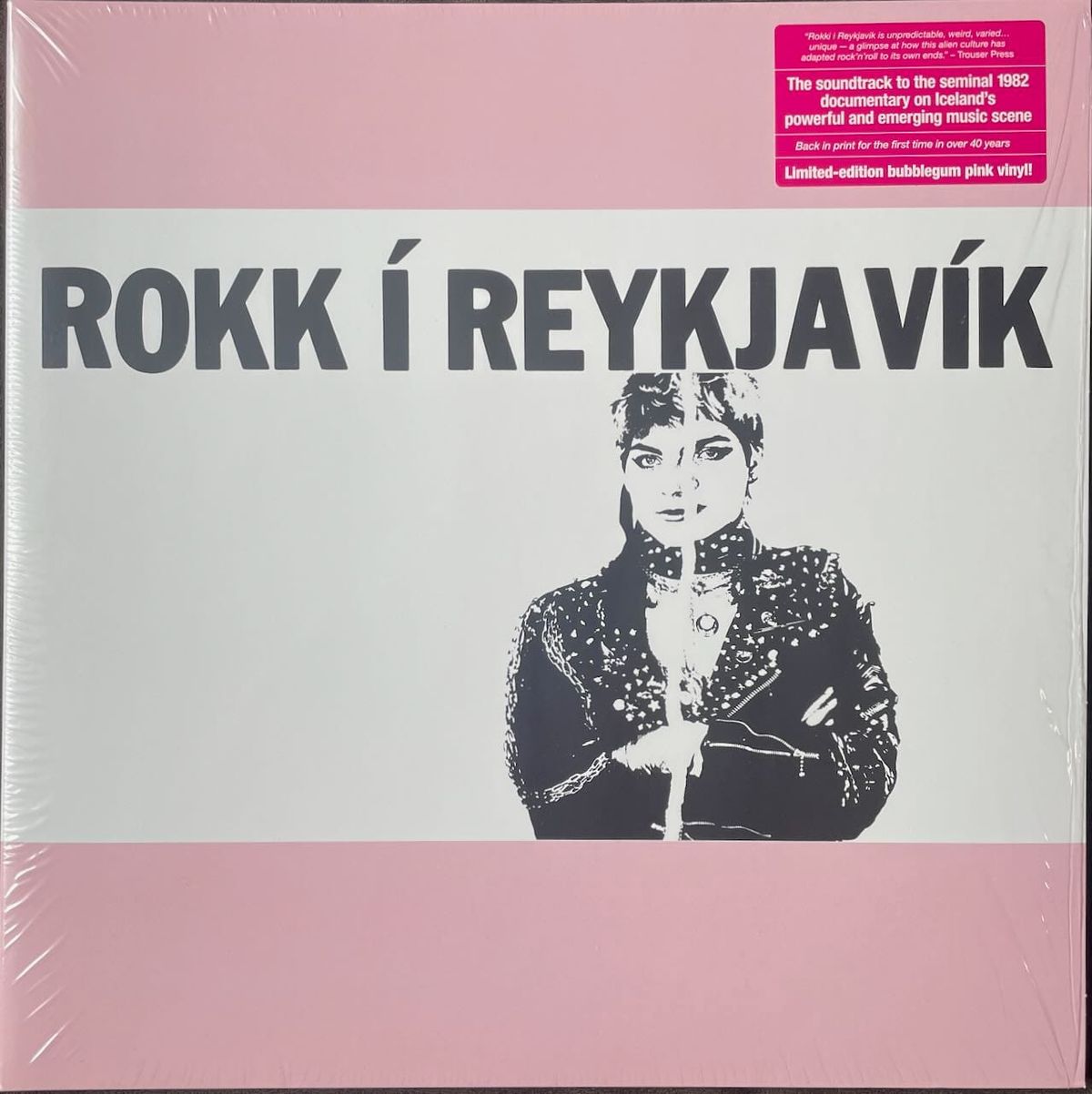
It was a slow process at first, Glover says. “The way the Icelanders work is very different from Americans. There is an Icelandic saying”—Þetta reddast—“that means it will all work out, or it will get done. And that's the way they operate over there.” Any potential red tape in terms of getting clearances from Friðriksson, the film’s director, was avoided by straightforward conversations and a simple agreement, and the project accelerated toward a finish line that took place during the 2025 installment of Iceland Airwaves, where the documentary was screened with English subtitles for the first time ever. The first copies of the new reissue were made available there, and last month, the vinyl made its way to American retailers. It comes on bubblegum-pink vinyl to match the original album cover, which Arena Rock’s version authentically replicates.
The album is loaded with musical highlights, none of which are unfamiliar to even the most seasoned crate-diggers. Vonbrigði’s “Ó Reykjavik” is a perfect punk anthem to kick-start the proceedings, while Bodies’ “Where Are the Bodies” has muscle, mystery, and a powerful groove. The two Tappi Tíkarrass numbers are a fascinating glimpse into the fledgling singing style of the teenaged Björk; the band plays an unusual form of funk-inflected new wave that escapes easy categorization. And Egó seems very much in control of a hard-edge melodic rock sound on songs like “Breyttir Timar” and “Sat Ég Inni Á Kleppi.”
There’s also some anti-fascist commentary in some of the songs that, without English translation or contextual explanation, might be difficult for some listeners in 2026. Egó’s “Sieg Heil” is intended satirically, as the vitriol of the song enunciates, but stripped of the context of the times and without a translation of the lyrics accessible, its repeated refrain could easily be misconstrued. There’s a similar problem with Þeyr’s “Rúdolf,” an otherwise strong punk charger that’s meant to denounce the loathsome worldviews of racists and neo-Nazis. In the film, however, they illustrate this by ill-advisedly dressing in Nazi costumes, and they insert a clip of a Hitler speech midway through the song that’s also audible on the soundtrack. Unfortunately, the effect of the stunt’s shock value overshadows the levels of commentary, condemnation, and social discourse that are also at play, making those two tracks particularly challenging for non-Icelandic audiences several decades later. (On that note, the experimental group Bruni BB is also heard on the soundtrack, with an unpleasant electronic piece called “Af Litlum Neista Verður Mikið Mál.” Apparently, during the live performance in the film, a member of the group cuts off the head of a hen, but that scene has been edited out in the version currently on YouTube.)
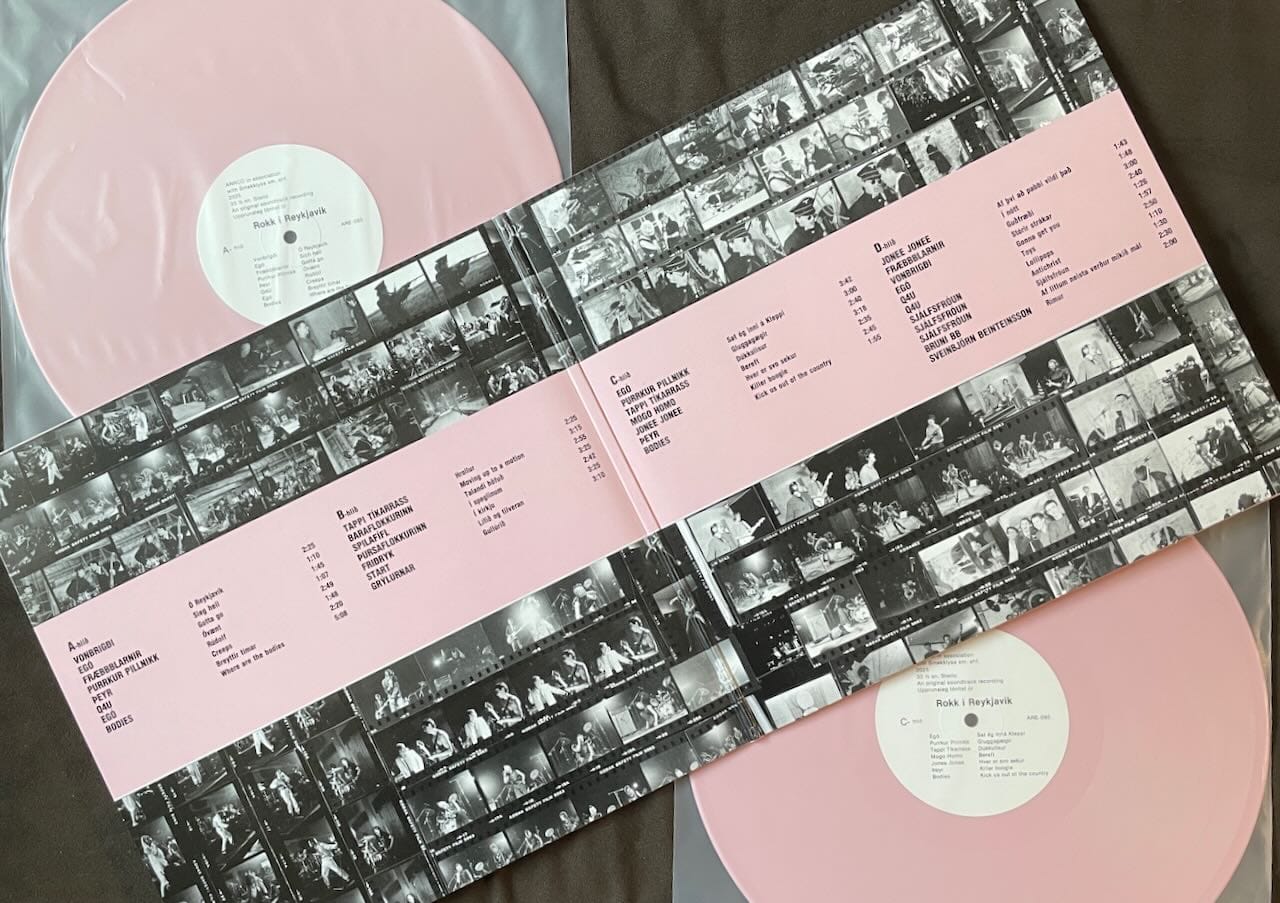
These rough edges are all part of a complete depiction of a scene that in many ways was immature but was also in the throes of exploring revolutionary forms of musical expression. Again, the blend of punk, post-punk, and new wave suggests that there was a lot of real-time discovery happening as this music was being made. Indeed, the super-abrasive atonal punk of Sjálfsfróun was performed by a trio of kids not older than 14, while the more established veterans of Þursaflokkurinn—shown in the film during a studio recording session—were making arty cabaret-rock that provided glimpses of frontman Egill Ólafsson’s future as a musical theater composer.
By necessity, the new vinyl edition was sourced from the CD reissue of the soundtrack. “There was no way that we were going to be able to find all those tapes,” Glover says, although he’s been told that there are outtakes of unreleased performances somewhere in storage. With much of the material recorded live or in run-and-gun style, fidelity was always less important than immediacy, and considering its origins, the end product sounds awfully good. The CD was well-mastered to begin with, and Timothy Stollenwerk of Stereophonic Mastering polished and upgraded the sound and made it ready for vinyl. The bass and high end both properly reach the edges of the frame without overextension, and the power of each performance is cleanly and accurately conveyed.
Considering the vibrancy of Reykjavík’s music scene in the early 1980s and the scarcity of any documentation of it outside of Iceland, this reissue of Rokk Í Reykjavík’s soundtrack is a significant event for fans of Icelandic music and Björk collectors specifically. But more than that, it’s a crucial release for scholars of punk and post-punk, serving as the fundamental text of an endemic music scene that developed and thrived more or less wholly on its own, digesting influences from overseas, mixing them with homegrown elements, and turning the results into something unique. In the ensuing decades, the music of Iceland became a global concern and drew listeners from around the world. Rokk Í Reykjavík chronicles a time when the nation’s music was spontaneous and raw, meant for immediate localized consumption. Forty-five years later, it still sounds vital and alive.
Arena Rock Recording Company/Smekkleysa 2-LP 33 RPM pink vinyl
• Soundtrack for the 1982 Icelandic television documentary Rokk Í Reykjavík
• Jacket: Direct-to-board gatefold on black-backed board
• Inner sleeve: Card sleeves with original and reissue credits
• Liner notes, insert, or booklet: None
• Source: Digital
• Mastering credit: Timothy Stollenwerk at Stereophonic Mastering, Portland, OR
• Lacquer cut by: DMM mastering at GZ Media, Czechia
• Pressed at: GZ Media, Czechia
• Vinyl pressing quality (visual): A
• Vinyl pressing quality (audio): A
• Additional notes: None.
Listening equipment:
Table: Technics SL-1200MK2
Cart: Audio-Technica VM540ML
Amp: Luxman L-509X
Speakers: ADS L980