Review: Terry Callier

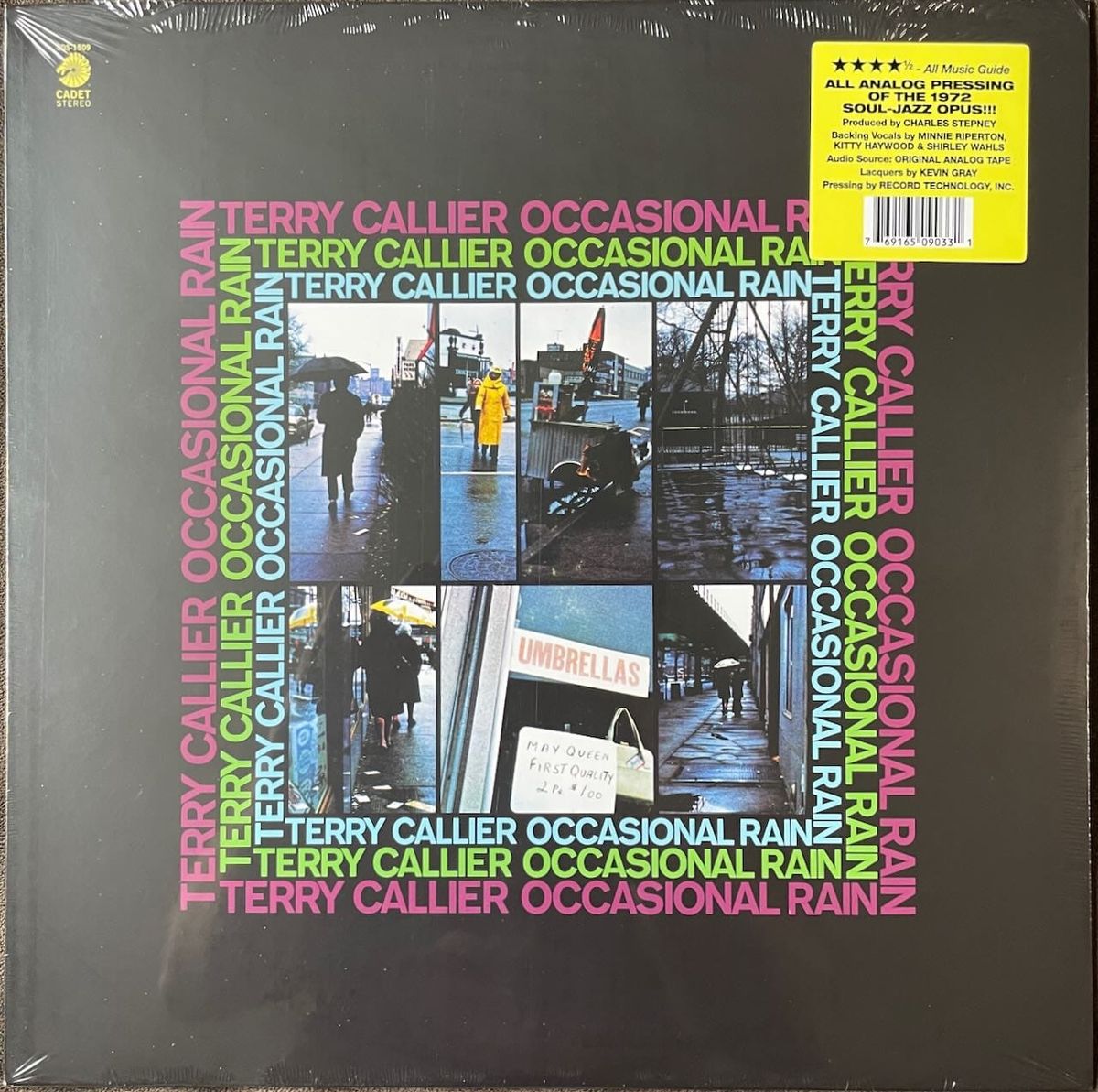
1972’s Occasional Rain gets an all-analog Kevin Gray cut on Slow Down Sounds’ vinyl reissue.
There isn’t anyone quite like Terry Callier. In fact, even picking a genre descriptor for his reflective, forlorn music leads to qualifying statements and a whole lot of hemming and hawing. Is it folk? Is it soul? Is it jazz? It is none of those things and yet it is all of them, and a few other things as well.
That inability to be pigeonholed was surely a substantial factor in Callier’s career never fully taking flight. The Chicago singer/songwriter recorded for multiple labels, including Prestige Records in the 1960s, Cadet Records (an offshoot of Chess) in the early 1970s, and Elektra Records in the late 1970s, as well as a few other labels, including Verve Forecast and Mr Bongo, during his career revival in the late ’90s and 2000s. (Callier passed away in 2012 from throat cancer at age 67.) But despite respect from his peers, and close associations with musicians like David Crosby, Charles Stepney, and the Impressions’ Jerry Butler, Callier’s exquisite, foggy-morning blend of soul/jazz/folk/other failed to find a toehold in the record-buying marketplace.
That same inability to be pigeonholed is what makes Callier’s music sound so fresh and vibrant today, and his albums, overlooked in their time, are now fervently sought after by crate diggers and other vinyl adherents. In recent years, his 1968 debut, The New Folk Sound of Terry Callier, was given loving treatments by both the Electric Recording Co. and Acoustic Sounds’ Craft/Bluesville series, while his 1979 album Turn You to Love received a reissue from Speakers Corner. And now it’s Occasional Rain’s turn in the spotlight—the 1972 album that was Callier’s first of three for Cadet Records with the legendary Charles Stepney in the producing chair. The Cadet era is Callier’s high-water mark, with his introspective songwriting and slightly glum performance style dovetailing gorgeously with Stepney’s ingenious arrangements.
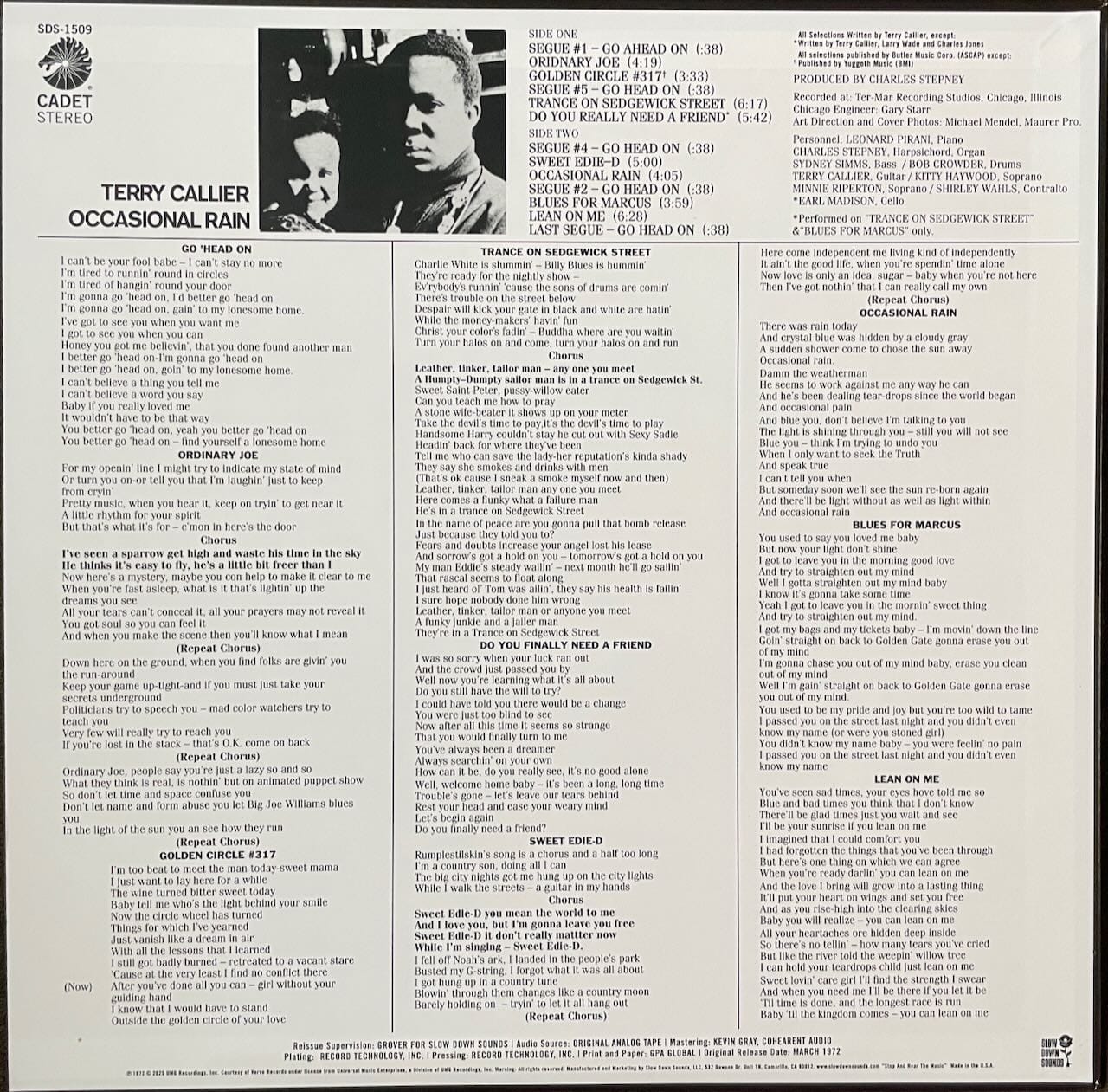
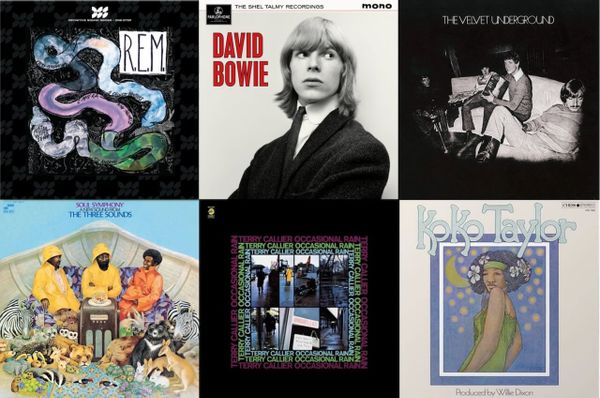
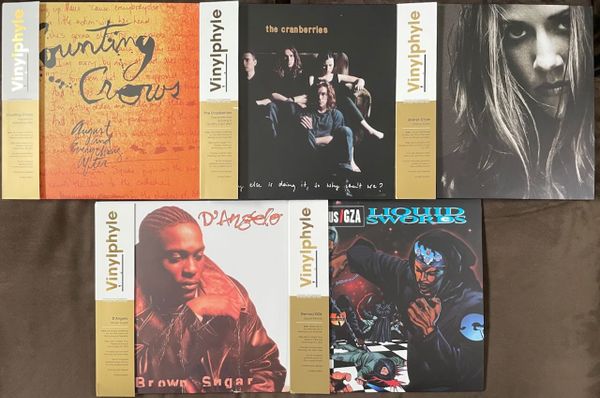
This new reissue of Occasional Rain has been undertaken by Tom “Grover” Biery for his label Slow Down Sounds. Biery is the team captain for Interscope-Capitol’s Definitive Sound Series as well as Warner Music’s Because Sound Matters, two imprints that have recently created remarkable if high-priced one-step pressings of well-known albums by the likes of the Beach Boys, R.E.M., Marvin Gaye, and Tom Petty. Slow Down Sounds, then, is Biery’s side-labor of love; the label’s previous release was a collection of unreleased Chet Baker takes, and this one is a straightforward reproduction of Callier’s original 1972 Cadet LP, and although it’s not a one-step, no detail has been skimmed over in the sonics department. Kevin Gray of Cohearent Audio cut the lacquer from the “original analog tape,” with pressing done at RTI, all inside a tip-on style jacket. (Biery has even posted a needledrop of a test pressing of this new cut, which you can currently test-drive through this link. I have never seen a vinyl reissue label offer this before, and I would love to see more of it.)
Callier grew up in the Cabrini–Green Projects in Chicago’s North Side, where his childhood neighbors included Curtis Mayfield, Jerry Butler, and Ramsey Lewis. He auditioned for Chess Records while still in high school, even coming close to having an early single released, but his mother pulled him out of the teen-idol path and had him focus on his studies. In college, Callier became infatuated with the music of John Coltrane and immersed himself in the folk-revival scene that was blossoming in Greenwich Village and cities like Chicago. He recorded the Prestige album in 1964 at age 19, but it remained unreleased for four years, during which he kept on moving through the folksinging circuit, even forming a short-lived duo with David Crosby during a brief stint in New York. By the late ’60s, Callier was getting by as a jobbing folksinger and songwriter-for-hire, eventually landing some tracks with Chicago psych band H.P. Lovecraft; in 1970 he joined Jerry Butler’s Chicago Songwriters Workshop as a salaried tunesmith. That led to one of his songs getting placement on a Dells album, released by Chess sublabel Cadet, with Charles Stepney producing. Stepney remembered Callier from his first go-round with Chess and recognized that the former teenager had matured into a unique talent worthy of fronting his own recordings.
Unlike the later two Cadet/Stepney albums (1972’s What Color Is Love and 1973’s I Just Can’t Help Myself), Occasional Rain is relatively stripped down, without the horn-and-string embellishments that became Stepney’s calling card on productions for Earth, Wind & Fire and the Emotions, although Earl Madison plays multitracked cello on two songs. The album is perfectly titled: Occasional Rain conjures up a mood of cozy melancholy, with a bite of lingering chill that could, with luck, be remedied by a warm hearth and a well-knit sweater. It’s an album of introspection and daydreaming, but also of looking forward to sunnier skies tomorrow.
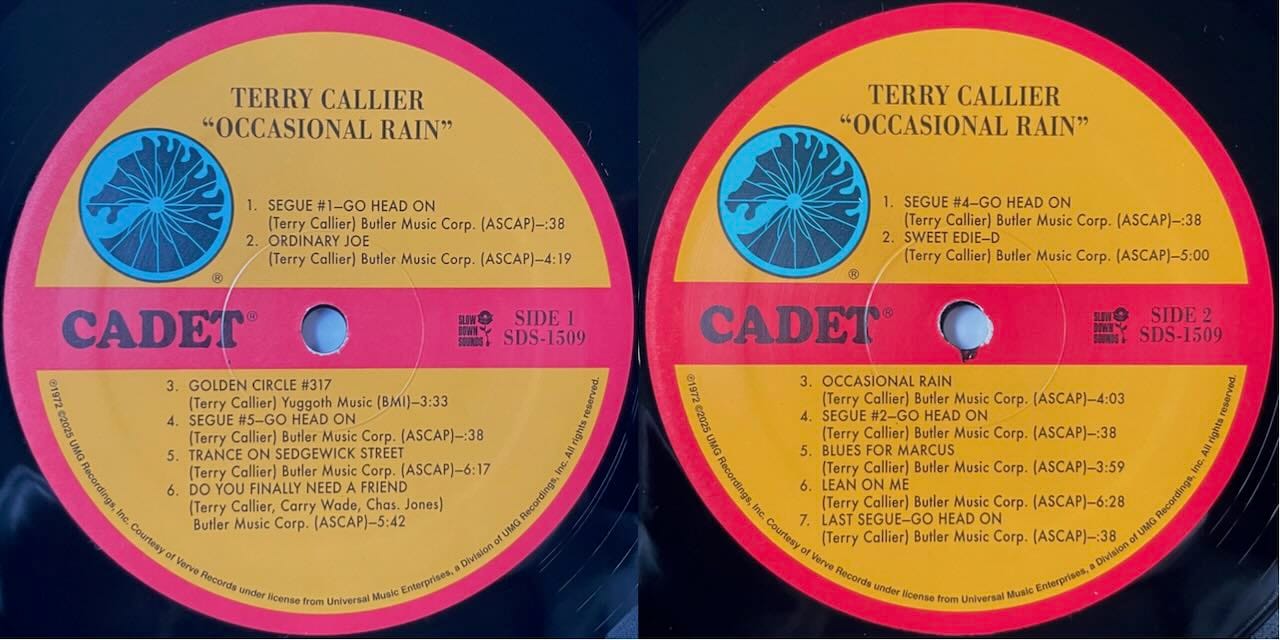
There’s a leitmotif threaded throughout the album, a simple two-chord acoustic vamp called “Go ’Head On” that turns up in 38-second fragments at the start and end of the album and in between a few of the album’s eight full-length songs. While seemingly disposable, it unifies the album thematically and draws a thread back to Callier’s folksinger past—not to mention that chopping it up into brief snatches was a useful repurposing of a song that likely was a bit too weak to stand on its own. “Ordinary Joe” springs out of the same jaunty, lightly shuffled rhythm of that opening interlude, transforming itself into a slice of sprightly psychedelic soul, delivered in a medium-cool jazz cadence and augmented by Stepney’s electric harpsichord and organ. Drummer Bob Crowder, bassist Sydney Simms, and pianist Leonard Pirani round out the ensemble with casual, sympathetic playing.
“Ordinary Joe” and the country-soul-inflected “Sweet Edie-D” are Occasional Rain’s two most upbeat stretches, with the latter featuring Callier harmonizing with himself over a Chips Moman–style production as Crowder, confined elsewhere on the album to tasteful pitter-patter, lets loose on the drum kit. Outside of those two buoyant numbers, Callier is more typically prone to pensive, expressive ballads like “Golden Circle #317” and “Do You Finally Need a Friend,” which feature Minnie Riperton, Kitty Haywood, and Shirley Wahls on backing vocals, although their voices at times take on the trappings of an angelic choir. (The trio is credited as “soprano,” “soprano,” and “contralto,” respectively, illustrating the virtuosic, classically-tinged disposition of their contributions.)
Meanwhile, “Trance on Sedgewick Street” is a rogue’s gallery of character sketches that could be direct recollections of Callier’s North Side neighborhood upbringing, and “Blues for Marcus” is a hit-the-road farewell to a girl too stoned to recognize him on the street. These tracks feature Earl Madison on cello, adorning Callier’s simple guitar and voice with multiple overdubbed lines that were painstakingly arranged by Stepney, at times evoking the work of English string arranger Robert Kirby (Nick Drake, Vashti Bunyan). The cumulative effect of Madison’s interweaving lines is stunning, with the cellos creating a stark but strikingly theatrical backing as their notes form patterns like the branches of a bare tree in winter.
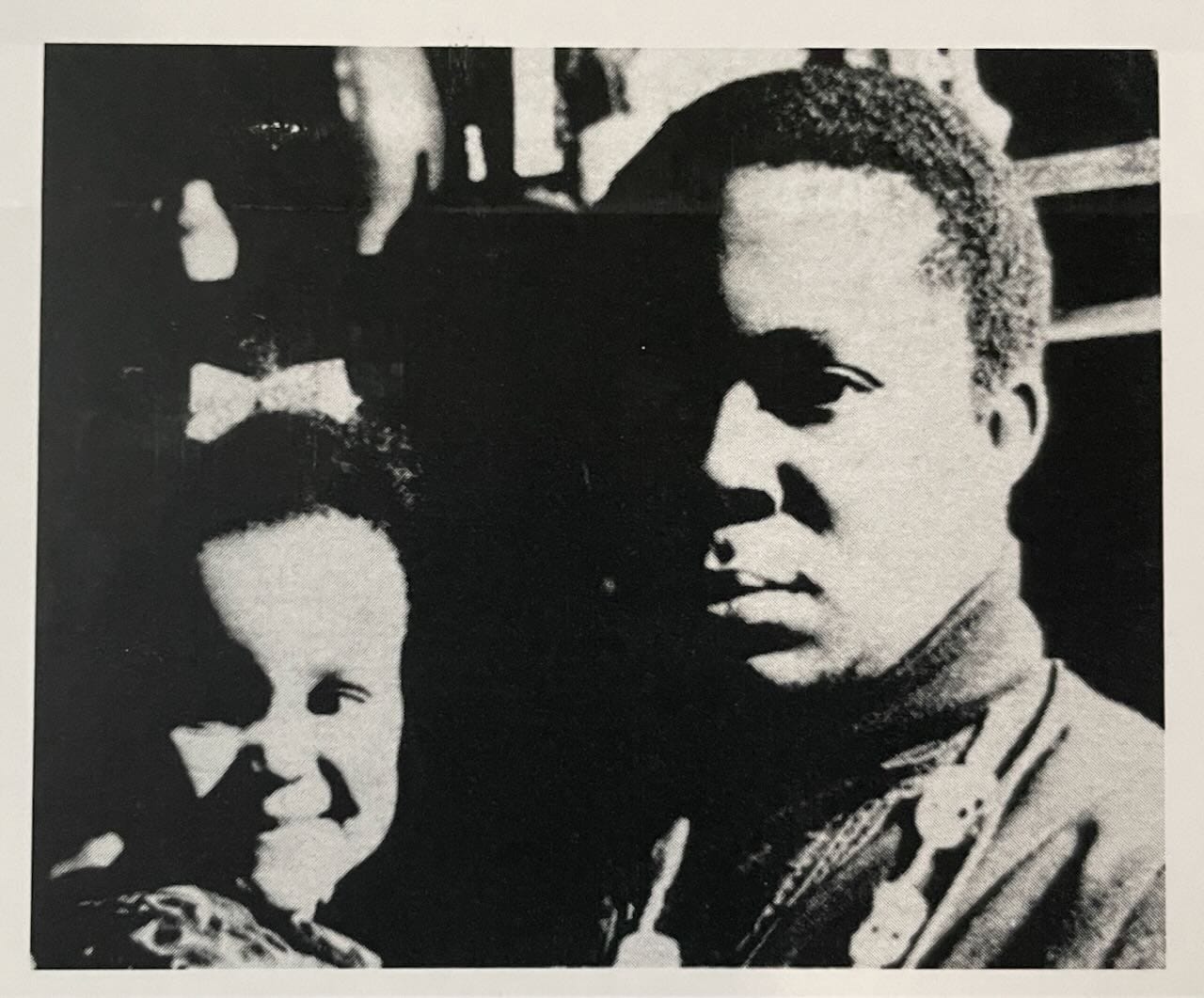
The title track, “Occasional Rain,” is the show-stopper. As Callier gently coaxes arpeggiated major-ninth chords out of his acoustic guitar, Stepney deploys Riperton, Haywood, and Wahls like drops of water, having them hit sustained bell-like tones that linger like rain slowly running down a pane of glass. The effect is otherworldly and gorgeous, with Stepney adding in some graceful organ that adds gravity to the weightlessness of the arrangement. The album’s grand finale, “Lean On Me,” fully leans into the gospel overtones hinted at in the earlier tracks, resolving the searching, questioning songs that preceded it with a testimony of faith and assurance. It is not a small detail that the album’s back cover photo is of Callier and his young daughter, for whom he would eventually give up his music career to raise.
The new Slow Down Sounds edition is fresh and lucid-sounding, with Gray’s cut presenting the master tape without gimmick or deformity. A spritz of tape hiss is audible during the fade-in on the opening track, suggesting that he did little to obscure the master’s inherent sonic qualities. The soundstage is well proportioned, and the instruments and voices sound natural and lifelike. The bass is precise and deep but never overpowering, and the high end—such as Riperton’s legendary whistle register, which is amply used here—never pierces or breaks up into white noise. Madison’s bow work on the cello has all the details of brushstrokes on a painting, and the ensemble blend is rich and wholly legible. And Callier’s voice is dynamic, emotive, and consistently engaging, even when he sings with restraint.
The album was recorded at Chess’s Ter-Mar Studios in Chicago, and the original 1972 Cadet pressing was cut by Geoff Sykes at Ter-Mar’s mastering facility. Over the past 55 years, there have not been many repressings: a 1975 repress on Cadet, likely using the same lacquer; a 1996 Japanese pressing on MCA Victor; a test pressing for Speakers Corner in 2003 that never made it to production; a David Cheppa cut in 2006 for a Scorpio reissue pressed at Rainbo; a 2015 cut pressed at GZ for the Japanese market; and, most notably, a Bernie Grundman analog cut for Vinyl Me, Please’s 2023 box set The Story of Cadet Records, also pressed at GZ. The 1972 Cadet original and the Bernie Grundman/Vinyl Me, Please cut are likely the most relevant previous pressings. Now, I don’t have either of those at hand to compare with the new Gray cut, but the majority of vinyl listeners don’t have this album to begin with, making a shootout a bit less relevant. I can tell you that this new mastering does not have any shortcomings whatsoever—in Gray’s hands, the album’s cloudy-day sound becomes ripe and ravishing—and the pressing from RTI in my case was essentially flawless.
It’s just a wonderful-sounding, wonderfully made pressing of a special album, full of fragile emotion, compassion, and quiet but determined strength. Callier’s method of tugging at the heartstrings is slow, sneaky, and unconventional—his worldview is not of unbridled emotion but of patience, resilience, and hard-won truths. Whether the new Slow Down Sounds pressing of Occasional Rain is someone’s introduction to Terry Callier or simply the latest addition to an already abundant collection, it will do the most important thing a reissue like this can do: bring the listener fully inside the world of Terry Callier, a place of melancholy beauty and soft-spoken sincerity.
Occasional Rain is available at record stores and at Slow Down Sounds’ online storefront.

Slow Down Souls 1-LP 33 RPM 140g black vinyl
• New remaster of Terry Callier’s 1972 album
• Jacket: Tip-on single pocket with matte finish; Printing credit: “Print and paper: GPA Global”
• Inner sleeve: RTI-branded rice-paper-style poly
• Liner notes, insert, or booklet: None
• Source: Analog; “Original analog tape”
• Mastering credit: “Kevin Gray, Cohearent Audio,” North Hills, CA
• Lacquer cut by: Kevin Gray at Cohearent Audio, North Hills, CA; “KPG@CA” in the deadwax
• Pressed at: Record Technology, Inc. (RTI), Camarillo, CA
• Vinyl pressing quality (visual): A
• Vinyl pressing quality (audio): A
• Additional notes: None.
Listening equipment:
Table: Technics SL-1200MK2
Cart: Audio-Technica VM540ML
Amp: Luxman L-509X
Speakers: ADS L980