Review: The Who on UHQR

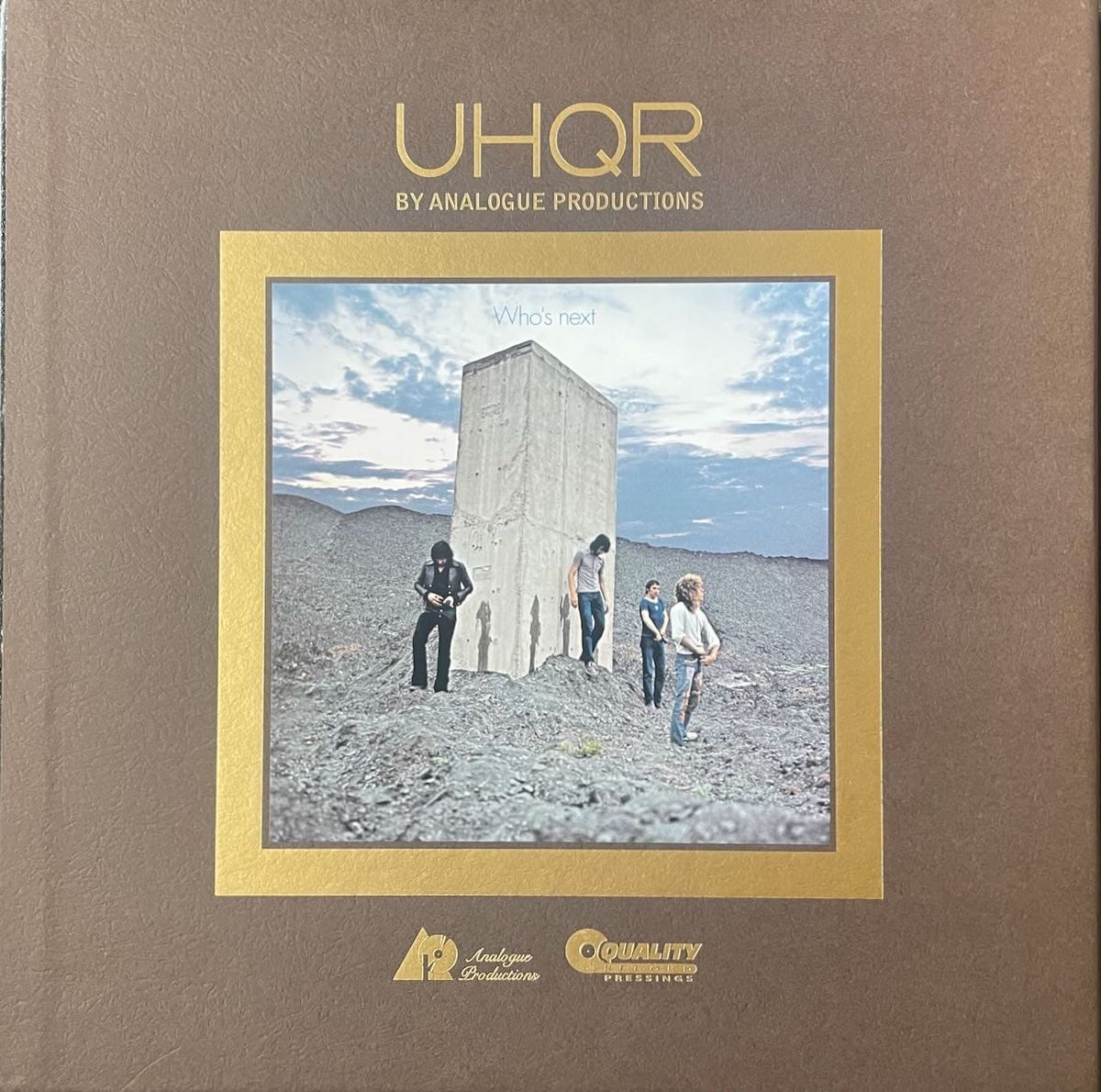
Who’s Next might be the greatest salvage job of all time. The convoluted origins of the Who’s 1971 album—a lean, mean bullet train of rock—have passed into legend over the years, due to the size of its original ambition. It was initially planned as a sprawling conceptual multimedia project called Life House, with Who songwriter/guitarist Pete Townshend envisioning film, stage, and album components as part of a complicated, improvisatory science-fiction story that also was intended to somehow incorporate audience interaction and participation.
Townshend was trying to up the ante after the tremendous artistic and commercial breakthrough of the Who’s Tommy, the 1969 double album that was billed as the world’s first “rock opera”—a slightly overblown notion, but one that certainly garnered headlines and gave Townshend and the Who immense credibility in terms of elevating the notion of rock music as an art form. Having been a firsthand participant in the power of the Who reaching their live apex during the many months of touring for Tommy, and having ensconced himself in the philosophical teachings of guru Meher Baba, Townshend was attempting to turn the Who’s next project into an event that could allow the band and audience to merge into a single consciousness and attain collective enlightenment.
It was a stretch, and the narrative and metaphysical implications of Life House are too complex to go into here (and perhaps Townshend was the only person who ever had a complete grasp on what they were). Needless to say, the project soon fell apart under its own weight, with the other three members of the Who unsure of how it all was supposed to work, their co-manager/producer Kit Lambert succumbing to heroin addiction, and the first draft of the album—recorded live with Mountain’s Leslie West on lead guitar at the Record Plant in New York, with Lambert theoretically serving as producer—not quite passing muster. When the band brought engineer/producer Glyn Johns on board to finish the attempted recordings back in England, it was decided that Life House would be put to the side and stripped for parts, with its strongest songs making up the Who’s next proper full-length. Even the title suggests a throwing of hands in the air, as does the schoolboy humor on the front cover.
The New York recordings were shelved altogether, and Who’s Next was almost entirely recorded on 8-track at Olympic Studios in London (“Won’t Get Fooled Again,” the first song recorded as part of these new UK sessions, was taped at the Rolling Stones’ Stargroves estate using their 16-track mobile recording system). At this point, the Who were at the top of their game, having spent months working on the Life House songs not just in the studio but in front of audiences as well—the band had taken up residency at the experimental Young Vic Theatre in London’s South Bank in order to work out Life House’s stage component, with the exploratory performances eventually reverting to standard Who concerts as the concept sputtered out. All of these false starts meant that Townshend’s songs had been rehearsed, stress-tested, tightened, and refined by the band so that the Johns recordings were nothing short of jaw-dropping. It helped that in spite of Life House’s shaky foundation, its best songs were not merely the best Townshend would ever write but among the greatest in the entire rock canon.
Indeed, in this listener’s opinion, Who’s Next is on the short list of the very best rock albums of all time, and that’s not a controversial take by any means. Townshend’s eight songs, along with a ninth by bassist John Entwistle, remain flabbergastingly good more than half a century later, with magisterial showpieces like “Baba O’Riley” and “Won’t Get Fooled Again” providing climaxes at the start and finish of the LP, undeniable highlights like “Bargain,” “The Song Is Over,” and “Behind Blue Eyes” sustaining the momentum throughout, and lower-key but still incredibly strong tunes like “Love Ain’t for Keeping” and “Going Mobile” buttressing the whole while allowing the listener to catch one’s breath. Johns’s engineering work (he’s also credited as an associate producer) gives the band their biggest and mightiest recorded sound, with resounding power from all four members, including Townshend on guitars and keyboards, Entwistle’s gymnastic bass, Keith Moon’s ecstatic, battering drums, and Roger Daltrey’s resounding voice.
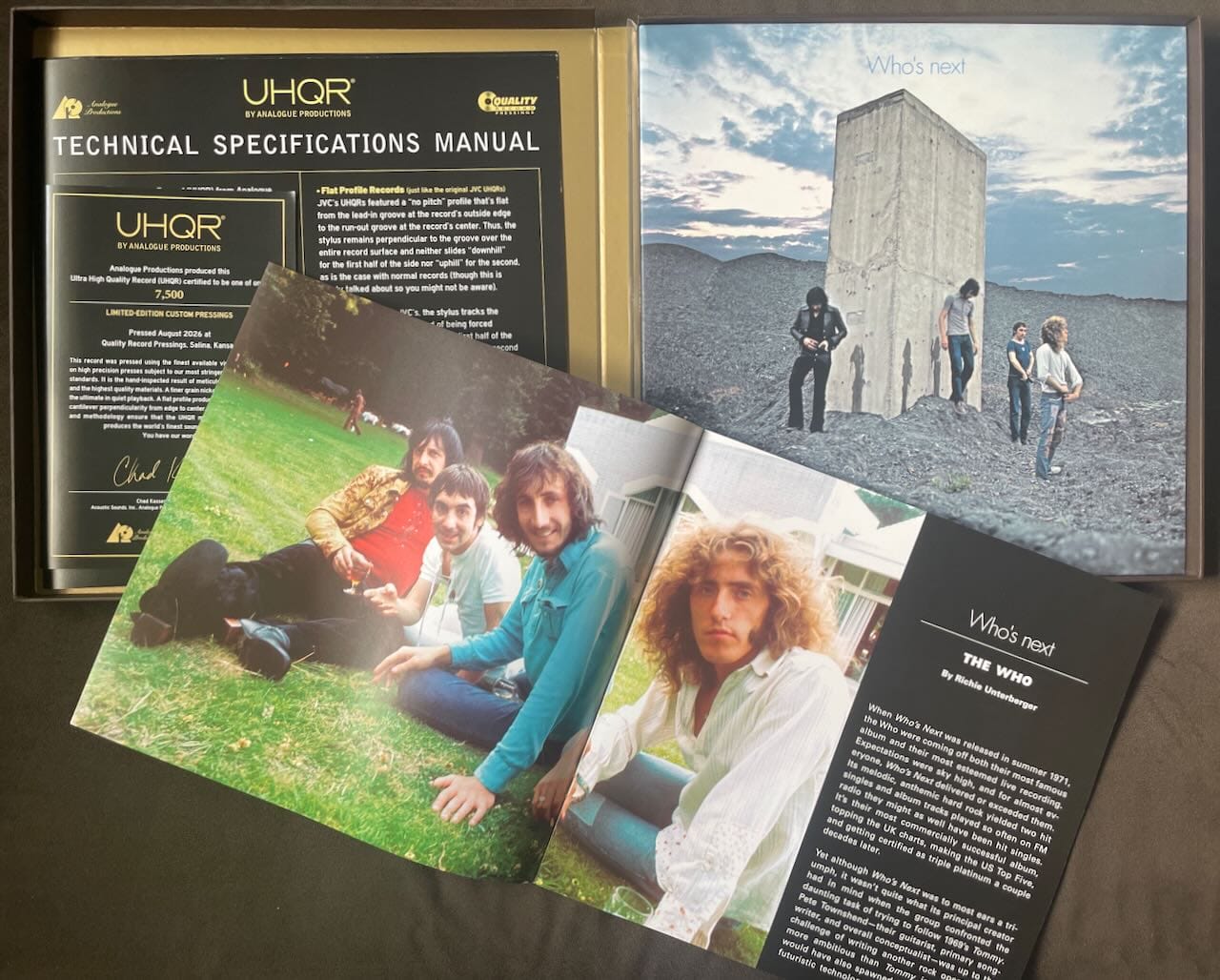
Analogue Productions’ 33 RPM UHQR pressing of Who’s Next came out earlier this year as part of a series that also included a 33 RPM UHQR of Tommy and 45 RPMs (non-UHQR) of the Who’s 1965 debut My Generation and their seminal 1970 live album Live at Leeds. While no official announcement has been made yet, it seems likely that Analogue Productions will reissue further Who titles at some point. UHQR stands for “Ultra High Quality Record” and is the Salina, Kansas, company’s most premium product, pressed at their Quality Record Pressings (QRP) plant using a special plating technology and an advanced vinyl formulation. However, the metalwork for Analogue Productions’ Who reissues come from the days of Classic Records, the now-defunct audiophile label whose assets were bought by Analogue Productions’ Chad Kassem in 2010. This mastering for Who’s Next was originally done for the 2005 Classic Records pressings of the album, using a lacquer cut by Chris Bellman at Bernie Grundman Mastering. In other words, this is not a new cut, but rather reuses the Bellman/Classic mastering from more than two decades ago.
Fortunately, it’s a wonderful cutting job and has held up exceptionally well, even as vinyl mastering fashions have evolved over the past 20-plus years. Bellman was able to cut from the original analog master tape, and in fact he reportedly did two separate cuts of Who’s Next for Classic. The first was cut hotter (louder) and reportedly led to complaints of needle-hopping, while the second had the volume reduced a smidge. It is this second cut that’s been reused for the UHQR, although apparently there is no easy way to tell the difference between the two Classic cuts simply from the deadwax, as the information in the runout is the same, with the only differences printed on the spine of the exterior jackets.
I imagine this leaves some Who fans unsure how to proceed, especially those who already own one of the Classics. The UHQR is prohibitively priced—at $125—and while it comes with all the technological advancements of the UHQR pressing in addition to the deluxe packaging, including a slipcase, liner notes, and a matte-finish tip-on gatefold inside the box, it might be hard to justify the expense of this significantly costly new pressing. With so many different masterings over the years, tracking down the best-sounding Who’s Next could be an endless quest. I’ll try my best to provide my conclusions, although there are plenty of pressings I haven’t heard, including the 2005 Classic Records version from where this Bellman cut originated.
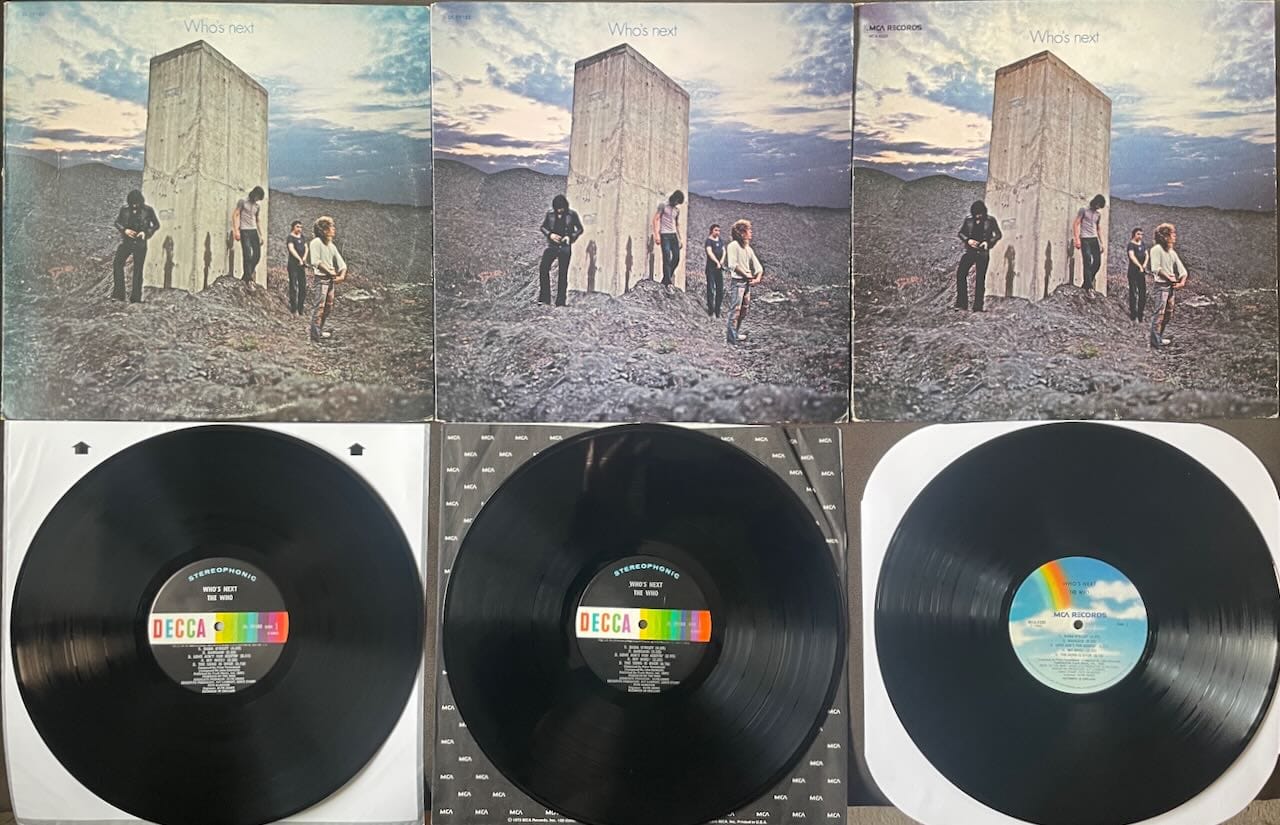
My handful of copies of Who’s Next are, for the most part, standard US masterings—I don’t own any previous audiophile editions or any European or Japanese versions, nor do I have any UK pressings, which means I wasn’t able to directly compare it to any of the fabled “Bilbo” masterings, for example. I do have a first US Decca pressing, cut by engineer Doug Sax of the original Mastering Lab in Hollywood, with his telltale sloped “8”s hand-etched in the deadwax. My copy is a “W2/W2” cut, pressed at MCA’s plant in Pinckneyville, Illinois. (More about Sax’s different “W” cuts in a moment.)
I also have a later US Decca pressing (from 1972, based on the evidence) that has stamped numbers in the deadwax, not Sax’s hand-etching. This was pressed at Gloversville, New York, and I was pleased to find it compared very favorably to the 1971 Sax cut. It sounds quite similar, just with slightly less presence and definition, suggesting to me that it comes from a similar source, perhaps an EQ’ed copy tape made at the time of Sax’s cut or following his mastering notes very closely. Additionally, I have a 1980 MCA pressing cut by Larry Boden with “W6/W6” matrices in the deadwax. I had always considered this a lesser pressing, but in doing these direct comparisons, I was pleased by how well it fared. It has a much more emphasis on the treble end, with a noticeable loss of impact to the bass and drums, but there was a clarity to the vocals, guitars, and other elements in the high end that made it an enjoyable and revealing listen, although the vinyl quality is pretty crummy.
Lastly, I have two copies of the recent Miles Showell cut that came with the two separate 2023 deluxe vinyl editions of the album, one a 3-LP set including some (but not all) of Townshend’s Life House demos and the other as part of a 4-LP mini-box including a 1971 San Francisco live show. (A digression, if you don’t mind: The fact that these were sold separately, requiring one to purchase the main album twice in order to get all the extra material on vinyl, is abhorrent and actively hostile to Who fans. I’d like to wish an incurable pox on whatever marketing slug made that decision. And this is not to mention that a large amount of the material on the 2023 deluxe CD box set of Who’s Next is, more than three years later, still not available on vinyl. Just terrible.) These two Showell cuts are identical, and are not to be confused with his (ostensibly superior) half-speed-mastered cut that was issued separately as a stand-alone LP, which I haven’t heard. (Again, a generational curse upon these loathsome bean counters for hacking up all of this material into separate packages.) Sad to say, Showell’s regular-speed-mastered cut, sourced from his digital remaster, is the weakest of all the vinyl versions I listened to, with a drastically reduced soundstage, a distant and somewhat filtered sound, and missing much of the impact that the album is capable of delivering.
So the 2023 was easy to dismiss, and despite the good qualities of my 1972 and 1980 copies, they paled in comparison to my 1971 Doug Sax “W2/W2.” Sax did three cuts in 1971 for the first US pressings of the album: “W1” for the East Coast, pressed at MCA/Decca’s Gloversville, NY, pressing plant; “W2” for the Midwest, pressed at their Pinckneyville, IL, plant; and “W3” for the West Coast, most or all of which were contract-pressed at Capitol Records’ Los Angeles plant. These Sax cuts used the actual Olympic Studios UK master tape, not a copy tape shipped across the Atlantic, and are generally considered to be the ultimate Who’s Next on vinyl—better than the first UK cuts, even, and the subsequent Bilbo re-cuts—and mine is incredible sounding, to be sure. Some claim that the W1 cut sounds superior to the other two, and that may be possible, but Sax would have done them all three at the same time and logic suggests they should be nearly identical-sounding. It would be more likely that pressing plant quirks and differences would create any of the potential variances between the three Sax cuts than any actual mastering changes.
For the purposes of this review, the competition really only came down to the UHQR Bellman cut and the 1971 Sax cut. Both are remarkable in their own way, and both have more similarities than differences. The Sax cut is lively and full of thunder, with a massive soundstage, appreciable 3D depth, and Moon’s drums packed with slam and wham. On my system, the high end was slightly more fractured, with a sharper bite but a bit more broken up as a result. The sound was also marginally more homogenous, in that the individual instruments did not leap out of the mix with as much character. The entrance of Townshend’s rhythm guitar in the right channel of “Baba O’Riley,” for example, was something of a non-event, even as the rest of that track’s incredible build from its synthesized organ introduction to incorporate piano, drums, and bass was flawlessly constructed. When Townshend plays a more searing electric guitar, or a twanging acoustic, it cuts through on the Sax very cleanly. On the whole, I’d say the Sax mastering has a touch more aggression but less body, with slightly murky bass (noticeable on the instrumental conclusion of “Bargain”) and just a faint whisper of transistor-radio-like compression to the overall range, to me a symptomatic quality of ’70s-era pressings.
The advantages of Bellman’s UHQR cut were not smack-you-in-the-face obvious, but they became undeniable at repeated listens and at higher volumes. At no point did the album’s extreme moments of treble—such as Entwistle’s horns on “My Wife” or Daltrey’s infamous scream on “Won’t Get Fooled Again”—pierce or slice the ear, as they occasionally could on the Sax W2 cut. The aural “lighting” was perhaps more muted, resulting in rounder, more shadowed shapes, and the lead vocals, particularly Daltrey’s, are a trace more subdued in the Bellman cut, or at least their consistent eye-of-the-hurricane positioning within tracks that are stuffed with all kinds of other musical activity is that much more noticeable. But in every other way, the UHQR was a more involving, satisfying listen, eliciting not just foot taps but the kind of air-drumming and windmill-guitaring that will be familiar responses to any Who fan worth their salt.
In fact, the UHQR kept growing on me the more I listened, and I found my knee-jerk bias against its stiff price tag dissolving, even as I did my best to remember that by recommending it to you I am playing right into Big Audiophilia’s hands. With apologies to you, I have to admit that I kept getting drawn back to its warm, full-blooded sound, where the rollercoaster clatter of Moon’s drums and the alternating purr and growl of Entwistle’s bass cleaved irresistibly to my eardrums.
Townshend’s envelope-follower guitar solo on “Going Mobile” pops and squelches like the bark of a cheerful dog, whie East of Eden violinist Dave Arbus’s fiddle at the end of “Baba O’Riley” keens with maypole-wreathing liveliness, and the three-part harmonies of “Behind Blue Eyes” glide with elegance and grace. Moon’s bass drum punches out into the listening space with excitement, and the soundstage is even wider than the Sax cut, although not to distracting extremes. The 3D depth on the UHQR is perhaps not as perceptible as on the Sax, but the instruments are more holographic, with more heft and shape to their positions in the stereo spectrum.
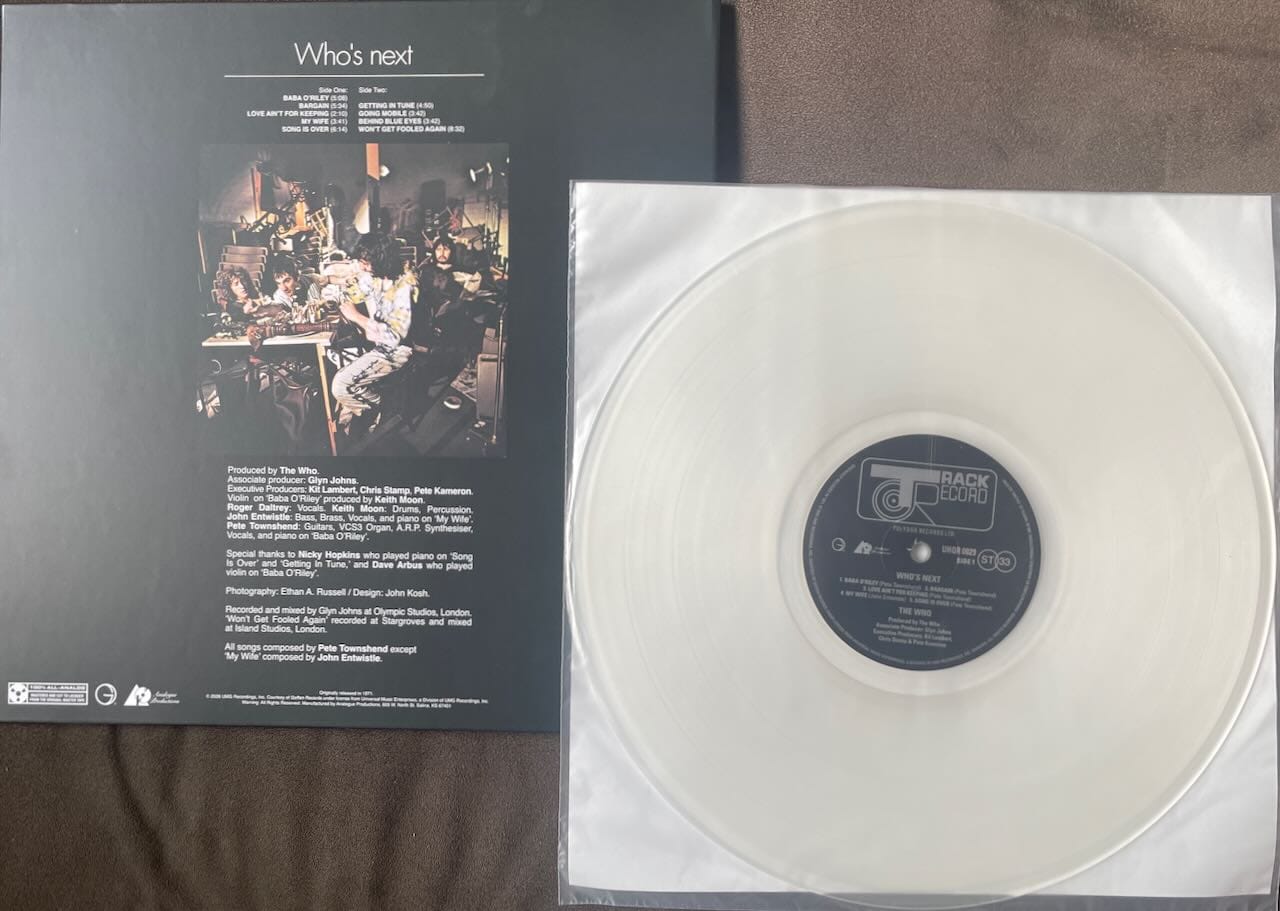
Again, this is not a redefining-sounding version of Who’s Next. You will not be thrust inside the sheer realism of the recording, which, despite Johns’ fabulous engineering and mixing, this album simply doesn’t have. And to be clear, the Sax cut has no shortage of immediacy. But every time I returned to the UHQR to make a direct comparison—to hear if, say, the high end was muted to the point of missing some information or if a tonal blend didn’t quite sound as intoxicating as it did on the Sax W2—Bellman’s cut earned more of my appreciation. I even found myself noticing new details, such as the handclaps in the right channel during the verses of “Bargain,” which I suppose I’d always heard but never picked out until now.
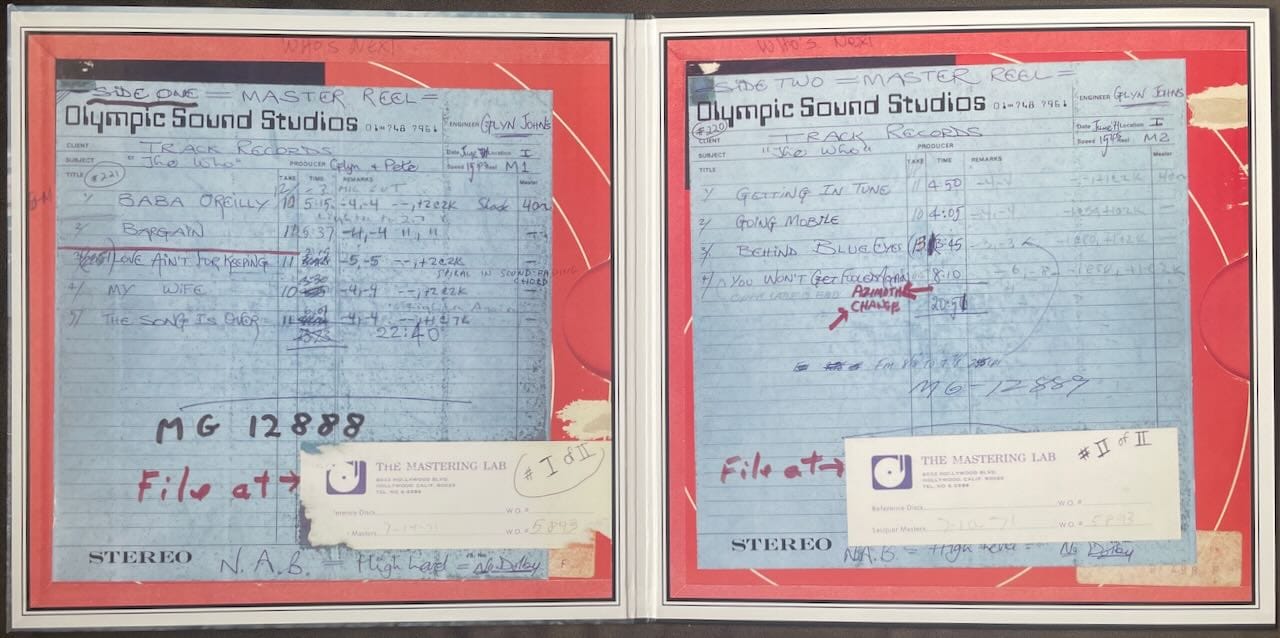
The pressing is extraordinarily good—not dead silent but damn near close. The consistency of QRP’s “Clarity” vinyl allows for the decay of the individual notes to recede into near-blackness instead of being prematurely chewed into by the noise of the Decca/MCA vinyl, for example, and it makes the album’s more challenging mixes (“My Wife,” for example, which is a bit muddy on the Sax cut) much more legible. The packaging is neat but hardly a game-changer; the heavy tip-on jacket is nice, to be sure, particularly its reproduction of the master tape boxes inside the gatefold. Richie Unterberger’s liner notes provide some useful context for newcomers but won’t impart any new information to the already-converted types who are the target demographic for this reissue. A promotional insert about Analogue Productions’ other products, a stiff-card pamphlet about the advantages of the UHQR process (with ample technical jargon), and a certificate of authenticity round out the enclosed materials. The outer box is the kind of thing you either love or are indifferent to. I find it adds a layer of remove from getting to the actual meat of the album and takes up unnecessary shelf space, but others may be more enamored with it, I’m sure.
Despite all the fancy accessories, the UHQR allows Who’s Next’s assorted qualities to represent themselves without interference. The louder moments pulverize appropriately, while the more delicate elements—Daltrey’s singing on “Love Ain’t for Keeping” and “Getting in Tune,” or Townshend’s acoustic guitar on “Going Mobile” and “Behind Blue Eyes”—are rendered with sweetness and care. Who’s Next is in some ways the platonic ideal of a rock album, with virtuosic, vigorous performances from the four key musicians, edge and heaviness when required, a seasoning of otherworldly synthesizers, and a perfect blend of rehearsedness and spontaneity. It was state of the art for 1971 and still sounds head and shoulders above most rock records that followed it. And while I can’t guarantee that the UHQR will go so far as to replace your very favorite pressing of Who’s Next—as it did mine—I think you’ll agree that there isn’t much that could be done to better it.
Analogue Productions 1-LP 33 RPM 200g off-white translucent (“Clarity”) vinyl
- UHQR pressing of the c.2005 Classic Records mastering of the Who’s 1971 album
- Jacket: Outer clamshell box with tip-on matte-finish gatefold jacket inside; disc is not housed inside the gatefold jacket but provided in a separate poly sleeve
- Inner sleeve: Unbranded rice-paper-style poly
- Liner notes, insert, or booklet: 8-page booklet with liner notes by Richie Unterberger and photos; four-panel “Technical Specifications Manual”; authenticity pamphlet with patent reproductions; promotional brochure for other Acoustic Sounds/Analogue Productions titles
- Source: Analog; “100% analog masters,” “Original master tapes” on hype sticker
- Mastering credit: Chris Bellman at Bernie Grundman Mastering, Hollywood, CA
- Lacquers cut by: Chris Bellman at Bernie Grundman Mastering, Hollywood, CA; “CB” in the deadwax
- Pressed at: Quality Record Pressings, Salina, KS
- Vinyl pressing quality (visual): A
- Vinyl pressing quality (audio): A
- Additional notes: Limited numbered edition of 7500 copies.
Listening equipment:
Table: Technics SL-1200MK2
Cart: Audio-Technica VM540ML
Amp: Luxman L-509X
Speakers: ADS L980