Reviews: John Coltrane | Miles Davis Quintet

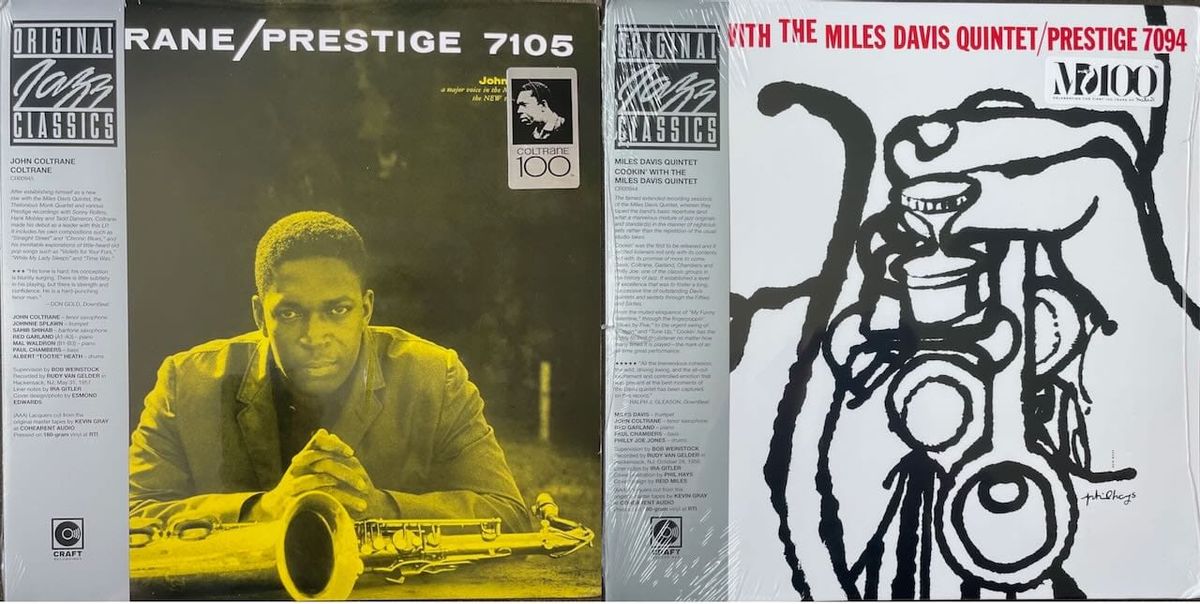
Two recent OJCs commemorate Coltrane’s centennial.
One hundred years ago today, John Coltrane was born in Hamlet, North Carolina. He died at age 40 of throat cancer in Long Island on July 17, 1967. In the years between, he comprehensively transformed American music by resculpting the parameters and possibilities of jazz to match the sonic visions in his head, leaving behind a legacy of hundreds of hours of performances that form one of the cornerstones of 20th-century music.
This centennial is why you’ve been seeing so many Coltrane reissues this year. The saxophonist was nothing if not prolific, and his catalog contains at least a dozen or so crucial albums for even the most casual listeners of jazz. Record companies have made out like bandits since his passing, gathering up unreleased sessions, live tapes, alternate takes, and more—as well as reissuing his best-known work again and again.
Today I’m reviewing the newest reissue of the very first album Coltrane headlined: Coltrane, released on Prestige Records in October 1957. Prior to this solo debut, Coltrane had performed and recorded under Miles Davis, and I’ve got a review of one of those albums today as well: 1957’s Cookin’, released on Prestige mere weeks before “7105.” This pair of reissues came out last month as part of the Original Jazz Classics series, originally launched in 1982 by Fantasy Records and currently administered by Craft Recordings. It turns out that 2026 is Miles Davis’s centennial year as well—he was born on May 26, 1926, and you’ve no doubt noticed the exhaustive number of reissues of Miles Davis records in recent months alongside all those new John Coltrane pressings.
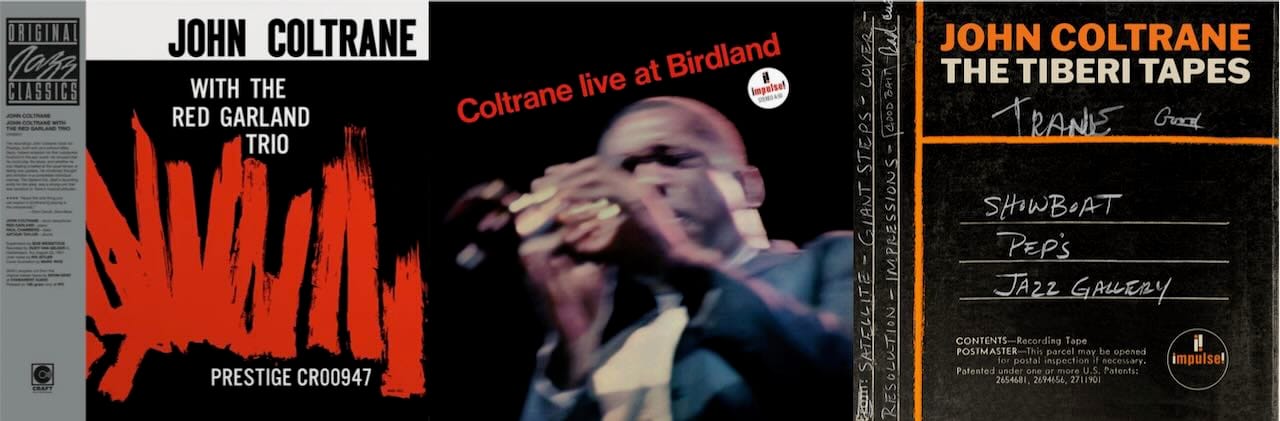
There’s more on the way: On October 9, Original Jazz Classics (OJC) will release 1958’s John Coltrane with the Red Garland Trio and Relaxin’ with the Miles Davis Quintet (featuring Coltrane). In addition to that, Rhino is releasing a 6-LP Coltrane centennial compilation: John Coltrane 100: Selections from 1951–1967, with important material licensed from other labels to provide a more or less complete summation of his body of work; a 2-LP Highlights edition will join it on release day on October 2. And on October 23, the Verve Acoustic Sounds Series will reissue 1964’s staggeringly great Live at Birdland (my personal favorite Coltrane album), while on November 13, Craft is issuing a 3-LP set of Coltrane’s 1958 recordings with Wilbur Harden for Savoy Records. And lastly, on November 6, Sony Legacy will issue the 9-LP The Complete Columbia Recordings 1955–1961 from Miles Davis and John Coltrane, collecting all of the two musicians’ collaborative work on the Columbia label including the albums Kind of Blue, Milestones, and ’Round About Midnight; a 2-LP Best Of will also be available for the less financially committed.
To top it all off, Universal just announced this morning that their long-awaited archival release, The Tiberi Tapes, is now finally up for preorder. Culled from Frank Tiberi’s dozens of hours of live bootleg recordings of Coltrane made surreptitiously at performances in New York and Philadelphia from 1960 to 1964, the best of those will be appearing on a 4-LP set, out November 6. (A 3-CD version is also available.) A taster of the recordings came out on Record Store Day, and while I haven’t heard it, the reports were that the sonics were less than desirable, although perhaps that’s to be expected. Meanwhile, for those who want to hear everything, expense be damned, a brass-plated USB drive containing all 26 hours of Tiberi’s recordings will be available on April 2, 2027; it comes inside a $500 package that also includes an LP and a hardcover book, in an edition limited to 750 copies. For all that’s been touted about these recordings’ historical significance, making the bulk of them only available in this exclusive fashion is disappointing, to say the least.
All of this is to say, if you feel like the Coltrane centennial caught you unprepared, you’re going to have plenty of ways to catch up before year’s end. And while I can understand some revulsion at all of the market machinations that are capitalizing on Coltrane almost 60 years after his death—especially that obscenely priced, brass-plated Tiberi set—this frenzy of activity also serves to institutionalize him as a significant musical figure, in the only way Americans seem to really know how to do it: by buying stuff. Lord knows we don’t have the cultural leadership on a national level that has the interest, capability, or credibility to honor Coltrane’s legacy in the way that it merits.
Before I get into today’s reviews, I just wanted to mention the crazy vinyl story that came out of the UK at the end of last week—you may have seen it. The Guardian reported that a massive vinyl counterfeiting operation was shut down, run by one Rehan Ahmed and operated under the names Phoenix of Vinyl or Paragon Music. The raid uncovered pressing machines, metalwork, lacquers, outer jackets, and other record-making components; Ahmed would sell the unlicensed counterfeit records directly to shops or via online platforms like eBay and Discogs. The records he typically counterfeited were those missing from the legitimate vinyl marketplace, through inattention, clearance rights, or other reasons. They include important works by Frank Ocean and De La Soul and complete shit by the likes of Drake and Kanye West. The Guardian’s story is absolutely fascinating, as is the accompanying video (embedded above), which goes behind the scenes of this operation—and to be frank, it looks like a complete pigsty, or a chemical fire waiting to happen. Check it out here.
We’ve all fallen prey to a counterfeit pressing or two, especially during the dark days before the current vinyl renaissance. I personally have a very suspect copy of the Master’s Apprentices brilliant 1971 album Choice Cuts (which we still need a proper reissue of) and a dodgy version of Neil Young’s 1989 Eldorado EP, originally only available in Australia and Japan but which Young finally released on a wider scale in 2021.
One last thing before I get to the reviews: Our September vinyl giveaway is still live! But entries close tonight at 11:59 pm Pacific time. If you’d like to enter—or if you’d like to upgrade to The Vinyl Cut’s paid tier and get all the fun perks that come with it—tap on the box below and attain enlightenment.
 Ned Lannamann
On to the reviews, finally. I’ll start with the Miles Davis album, as that came first chronologically.
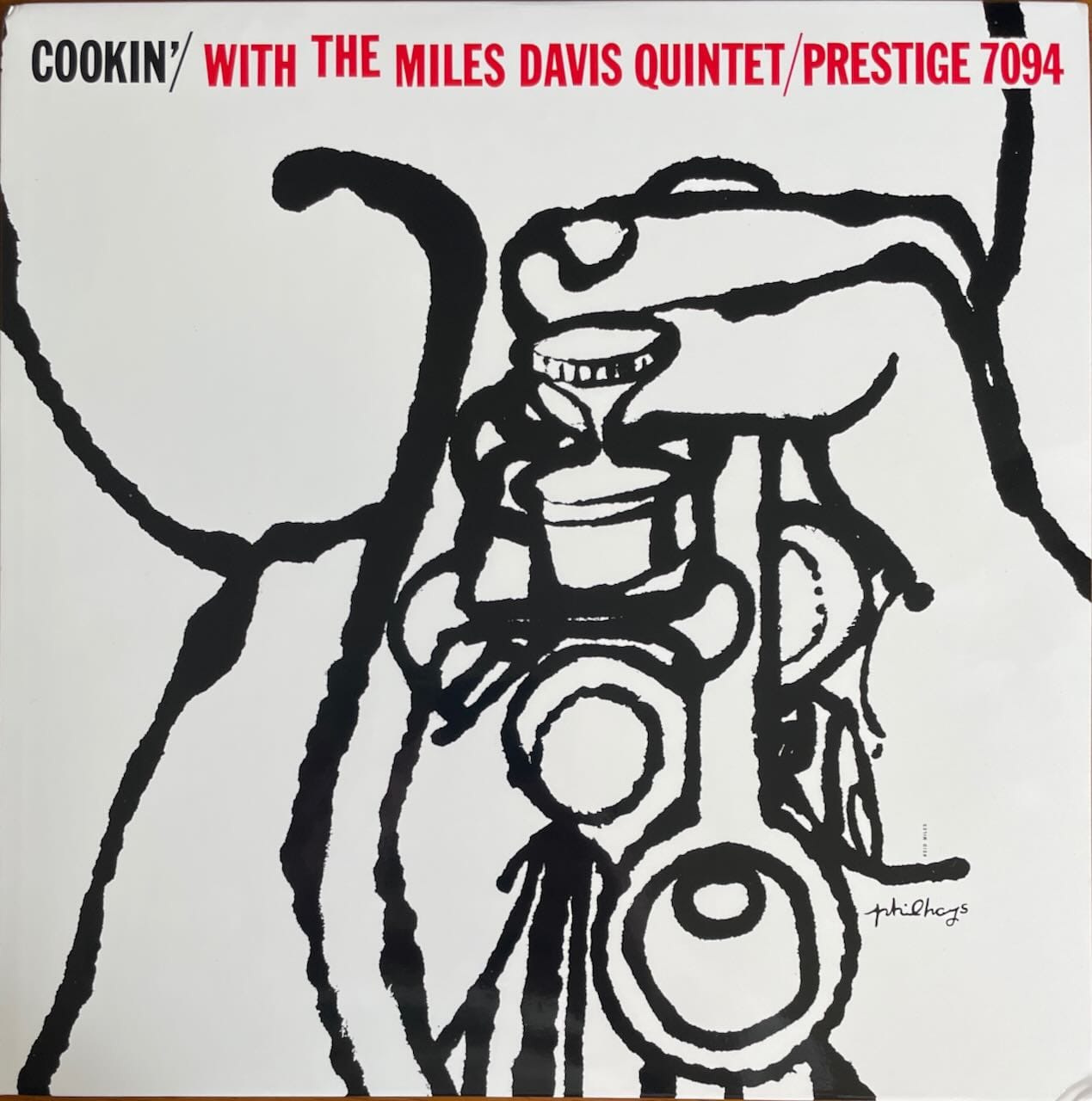
Miles Davis: Cookin’ with the Miles Davis Quintet
Cookin’ is one of four albums the Miles Davis Quintet recorded in 1956, which were dribbled out by Prestige over the period of a few years: Cookin’ (1957), Relaxin’ (1958), Workin’ (1960), and Steamin’ (1961). The four-pack was recorded during two separate marathon sessions at Rudy Van Gelder’s studio in New Jersey, one on May 11, 1956, and the other on October 26, 1956. Although Cookin’ was the first to be released, it comes from the October 26 session. The outfit was the first “Great” Miles Davis Quintet, including John Coltrane on tenor sax, Red Garland on piano, Paul Chambers on bass, and Philly Joe Jones on drums. Coltrane was in the throes of heroin addiction, and would be dismissed by Davis at the start of 1957, but Trane would kick the habit and recover, recording work under his own name before rejoining the fold and collaborating with Miles again on 1959’s Kind of Blue.
It’s been suggested that because the musicians were paying for the sessions themselves, the music was played as efficiently and spontaneously as possible. The album’s own liner notes say the recording date was like a club gig, with the band hardly taking breaks between songs, and running down their current repertoire without doubling back for retakes. This certainly lends Cookin’ a bit of rough-hewn power, but I think it wouldn’t be quite honest to say that it has all the unbridled energy and urgency of a live show. Rather, the Quintet sounds confident and perfectly poised, as if Rudy Van Gelder’s tape machine was a time capsule that demanded their most coherent, cohesive playing for the permanent record. In some ways, it was.
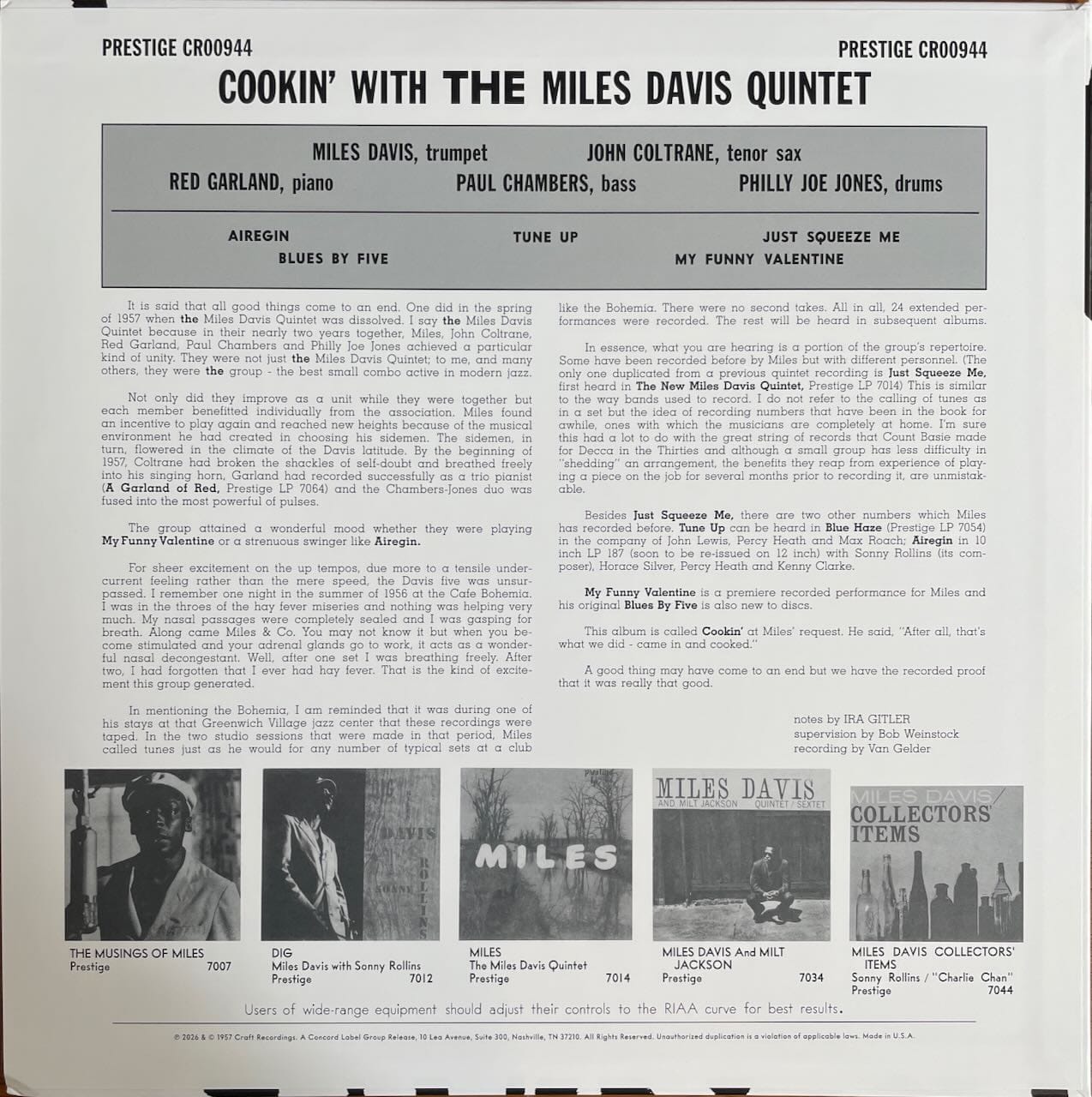
By this time, the Quintet was as well-oiled a machine as jazz had ever seen, with the players working together on a near-telepathic level, locking into gear when needed and allowing each other space when not. On Cookin’, pianist Red Garland is often the skipper, piloting the craft by holding down the framework and locating the precise mood with his chords. He’s the one who draws back the curtains on Miles for album opener “My Funny Valentine,” a showcase for Davis’s honeyed ballad-style playing that turns an unexpected corridor following his first trumpet solo, when the rhythm section locks into a double-time groove. Coltrane sits this one out altogether, but joins in for “Blues by Five,” a tune that is credited to Davis on the LP, although other sources say it’s a Garland composition. Regardless, Garland is again the ringleader here, and after Davis’s solo, Coltrane steps forward and offers hints of what Downbeat critic Ira Gitler would come to call Coltrane’s “sheets of sound,” delivering quick arpeggios that weave and wend their way to their destination note. Garland, Chambers, and Jones take turns at center stage as well, making this a crowd-pleasing round robin.
Side 2 kicks off with the Sonny Rollins–penned “Airegin,” bringing the first African tones into the LP; “Airegin” is Nigeria spelled backwards, although the song’s formative chords sound a little more like Egypt than Afrobeat. Jones offers quick-chop work on his hi-hat and cymbals, giving Davis and Coltrane a dense backdrop for their curlicues and woodpecker-hammers. “Tune Up” continues the breathless pace, with Davis and Coltrane in full bebop mode, delivering rapid-fire solos before Garland takes a spin and Jones knocks down a few full-kit fills. The band doesn’t take a beat before continuing with “When Lights Are Low” (mislabeled as “Just Squeeze Me” on the original back cover and not corrected on this reissue). The midtempo number finds the band relaxing into an authoritative, good-night swing, with Chambers walking up and down the tightrope of the lower end and Davis pushing clean, bright tones out of his trumpet.
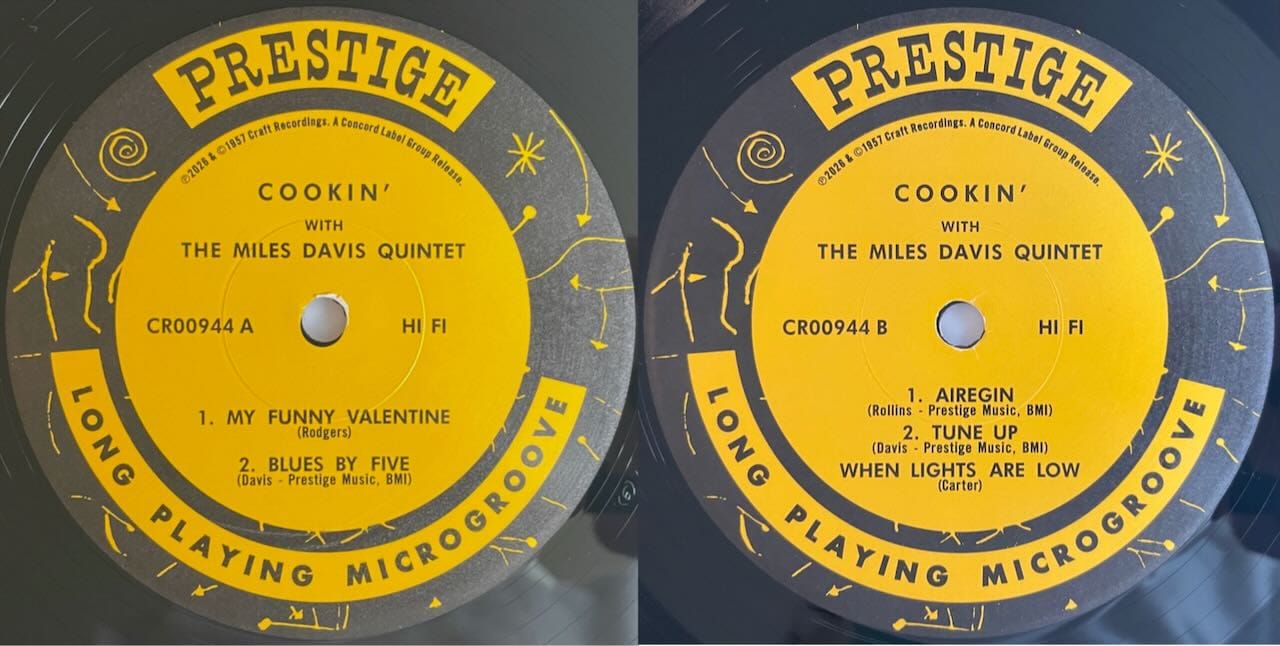
This new pressing was cut from tape by Kevin Gray, and the mono recording is lively and large (a stereo mix of the album doesn’t exist). Gray has dialed in the tones of the individual instruments with utmost authenticity, but more importantly, his treatment allows for laser-sharp focus on their interplay. The transients and decay are articulate and full of intrigue, and while Van Gelder’s recording adds almost nothing in terms of polish to the sound, that directness leads to an immersive quality—one that eluded me at lower volumes but really opened up and brought me into the room when I tipped the volume knob up just a bit. The source tape sounds fresh and alive; the busy high end of “Airegin” was perhaps the only stretch that sounded less than inviting.
I did encounter a minor but unusual noise at the very end of “Blues by Five,” toward the end of Side 1. It sounded like a metallic-sounding chirrup of a nocturnal bug. I don’t hear it on any streaming versions of the track, so I gather it to be a pressing flaw of some sort, rather than something baked into the mastering. It was the only demerit I found on this otherwise exemplary pressing, which was flat, quiet, and on perfect-looking glossy vinyl. I don’t think it was non-fill—it was a sound I couldn’t identify.
These sessions were the last hurrah of the Quintet in this particular incarnation; Davis recorded all this material so that Prestige could stockpile it and fulfill his contract as he moved on to Columbia Records. Coltrane would take some time away to clean up; when he returned, Prestige wanted his next recording to have his name on the front cover.
Original Jazz Classics/Craft/Prestige 1-LP 33 RPM 180g black vinyl
• New mono remaster of the Miles Davis Quintet’s 1957 album
• Jacket: Tip-on single pocket with glossy finish
• Inner sleeve: Craft Recordings–branded rice-paper-style poly
• Liner notes, insert, or booklet: Brief notes on wraparound obi; Ira Gitlin’s original liner notes are reproduced on the back cover
• Source: Analog; “(AAA) lacquers cut from the original master tapes”
• Mastering credit: “Kevin Gray at Cohearent Audio,” North Hills, CA
• Lacquer cut by: Kevin Gray at Cohearent Audio, North Hills, CA; “KPG@CA” in the deadwax
• Pressed at: Record Technology, Inc. (RTI), Camarillo, CA
• Vinyl pressing quality (visual): A
• Vinyl pressing quality (audio): B+ (unusual unidentified noise at the end of Side 1)
• Additional notes: None.
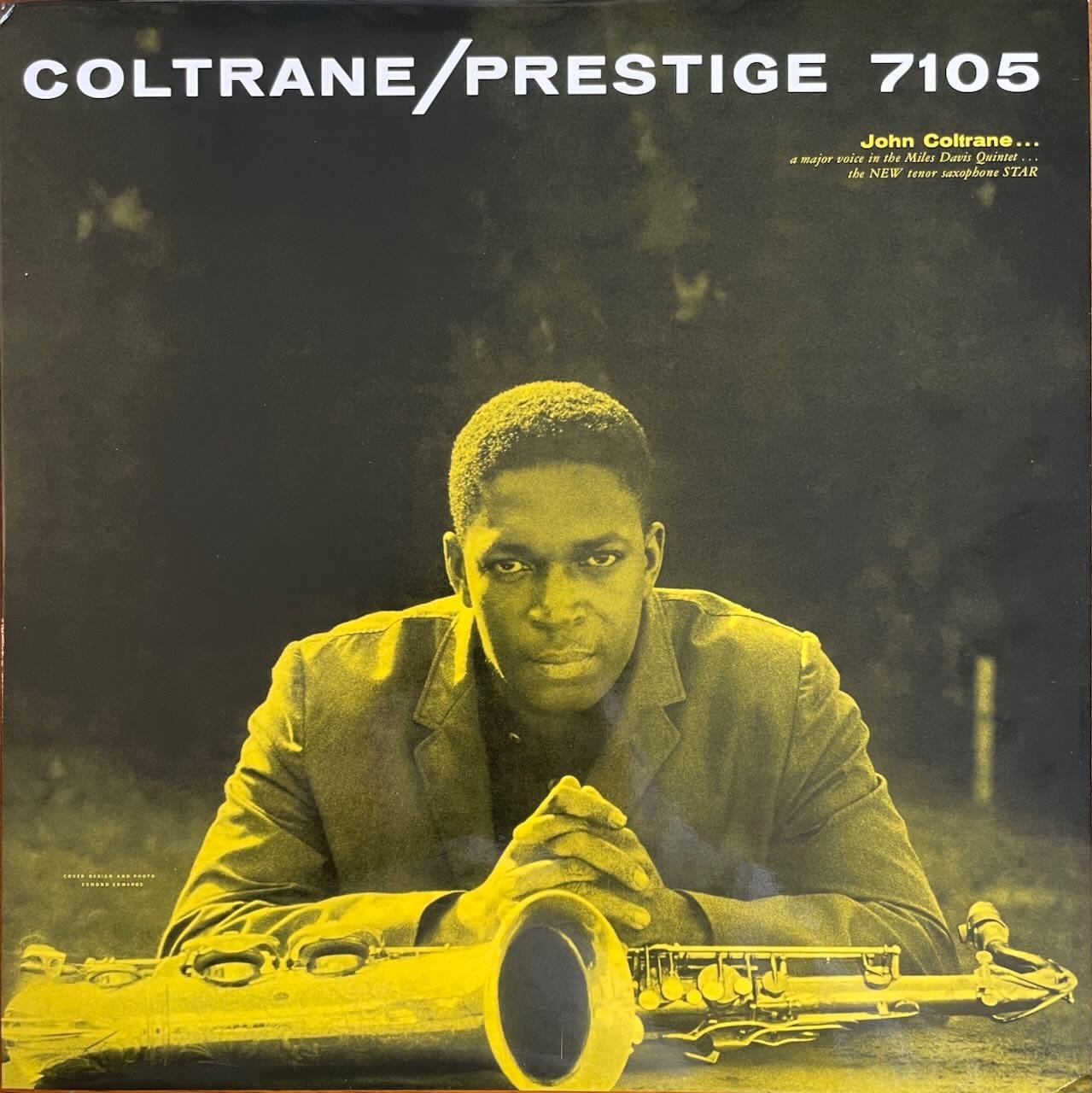
John Coltrane: Coltrane
In some ways, the world’s first John Coltrane album is a bit of a non-entity. Not because of any failings of the music—which is downright dazzling—but because rather than any sort of grand statement of purpose, it’s simply one of many way-stops on Coltrane’s unceasing musical journey. His well-documented work with Miles Davis already served to introduce him to the greater listening public, and he’d achieve monumental breakthroughs in music that was yet to come. That makes Coltrane, sometimes known as “Prestige 7105” due to the prominent placement of the album’s catalog number on the front cover, a mere snapshot of a particular moment in time as opposed to any sort of geological event.
It actually was a significant moment for Coltrane on a personal level. Having been fired by Davis for his heroin addiction, he had kicked the habit in the weeks leading up to the “7105” recording session on May 31, 1957, and his sobriety had allowed him to achieve a newfound spiritual clarity that would carry him through the next 10 years of musical exploration. The way this manifests most audibly on “7105” is through Coltrane’s clearly discernible joy in music-making. His tenor playing is joined by Paul Chambers and Red Garland from the Davis Quintet, although Mal Waldron switches out with Garland on piano for half of the tracks. The other musicians include drummer Al “Tootie” Heath, trumpeter Johnnie Splawn—both friends of Coltrane’s from Philadelphia—and baritone saxophonist Sahib Shihab, who had played in Dizzy Gillespie’s big band, as had Trane.
The opening cut, Cal Massey’s “Bakai,” deposits the listener straight into the middle of a jagged, uncentered rhythm, with a baritone pulse from Shihab that sounds like a siren in the night. The African motif then shifts to a straightforward swing, with Coltrane delivering quick “sheets of sound” runs. “Violets for Your Furs” finds Coltrane’s tenor transmitting a silken quality as Garland’s piano provides steady underpinning, and “Time Was” is a dance-worthy potboiler, with Trane again stringing along surprising patterns on his tenor that show his outside-the-box approach to melody and counterpoint.
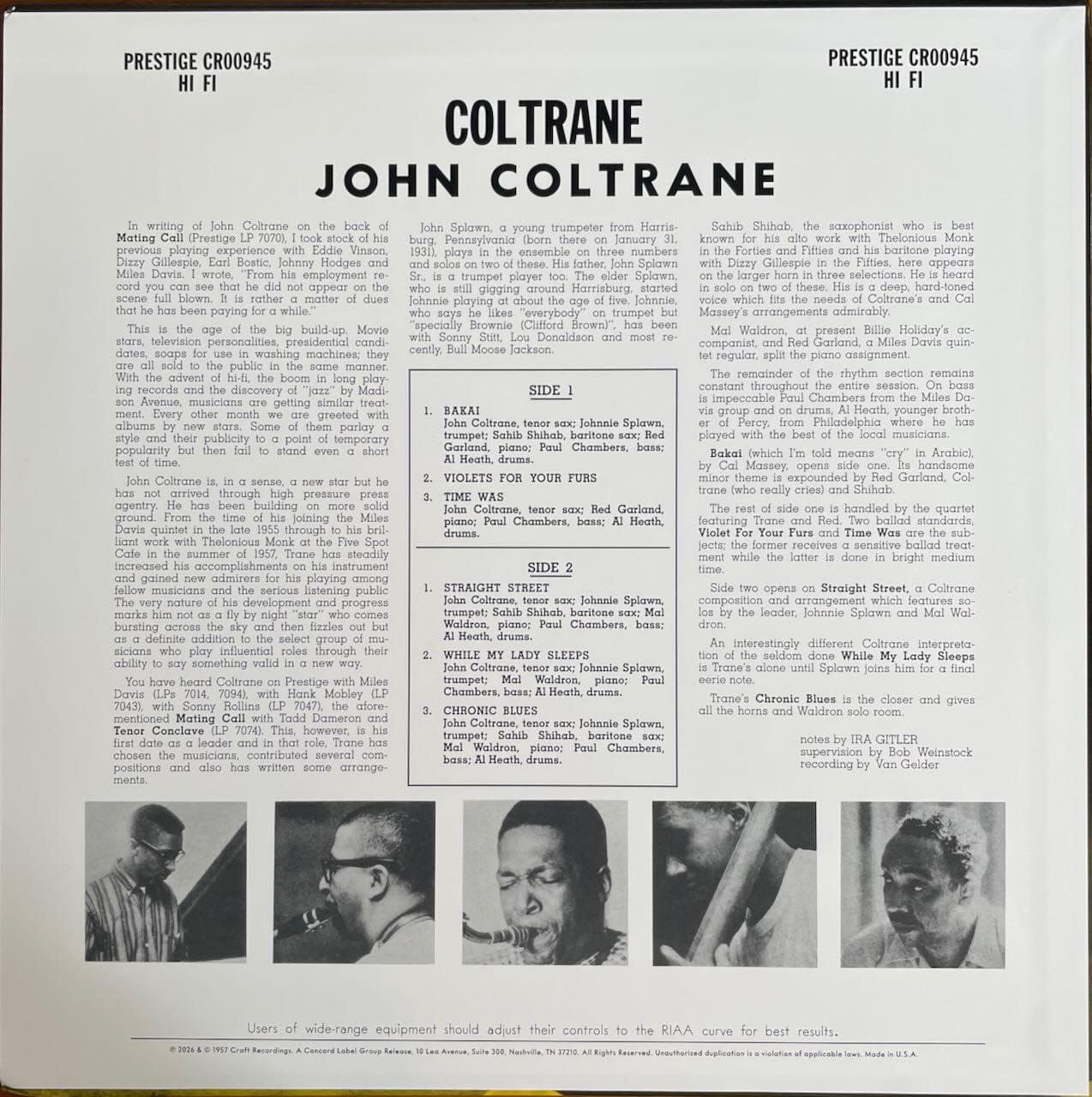
On Side 2, Mal Waldron takes over on the keys. Shihab’s baritone provides darker color to the head of Coltrane’s composition “Straight Street”—a nod to his recently kicked habits—but Coltrane’s solo is all wide-open avenues and sunlight streaming in; Splawn follows suit, while Waldron’s piano creeps spiderlike through the more shadowy corners of the piece. “While My Lady Sleeps” is a moodier, duskier piece that occasionally pivots to romantic ballad, with Coltrane monologuing fluidly throughout, until Splawn joins him for the final passage. Lastly, “Chronic Blues” is an ensemble showpiece, with Shihab indulging in some enjoyable squawks and bleats, Coltrane bobbing and weaving, Splawn’s fanfares riding behind the beat, and Waldron diagramming the song’s parameters with clean-lined, ball-point-pen style playing.
Kevin Gray’s mastering is full-bodied, with a pleasingly big soundstage, plenty of depth, and a sonic picture that is plain and clear. The bottom end, coming from both Paul Chambers’s bass and Sahib Shihab’s baritone sax, is positioned just right, and the high-end from the cymbals and trumpet never sizzles or turns into crush. However, it sounds like the master tape itself is not in pristine shape. I noticed multiple dropouts throughout the recording, and while some are minor, at least a few of them are pretty noticeable, such as during Garland’s piano solo during “Violets for Your Furs,” the final dying note of “Time Was,” Splawn’s trumpet solo in “Straight Street,” and Waldron’s piano solo on “Chronic Blues.” Since the musical information elsewhere on the recording is full and robust, it does not sound like degradation has affected wide swaths of the tape, but some listeners might be perturbed by the momentary dropouts. I did not find that they interfered with my enjoyment of the music—each of them lasts only a split-second—but others may feel differently.
These tape dropouts raise the endless debate: Should the master tape be presented as it exists in its current state, keeping true to its analog origin, or should digital wizardry be introduced to fix little blemishes like tape dropouts? I know many people have strong opinions about it one way or the other. I myself see the historical value in having the tape presented as it currently sounds in 2026, but I also agree that a flawed master can’t result in a definitive presentation of a particular recording, especially one that’s been released so many times before. That said, I really like the sound of this new Kevin Gray/OJC cut, and the dropouts did nothing to change that—it otherwise sounds flat-out terrific.
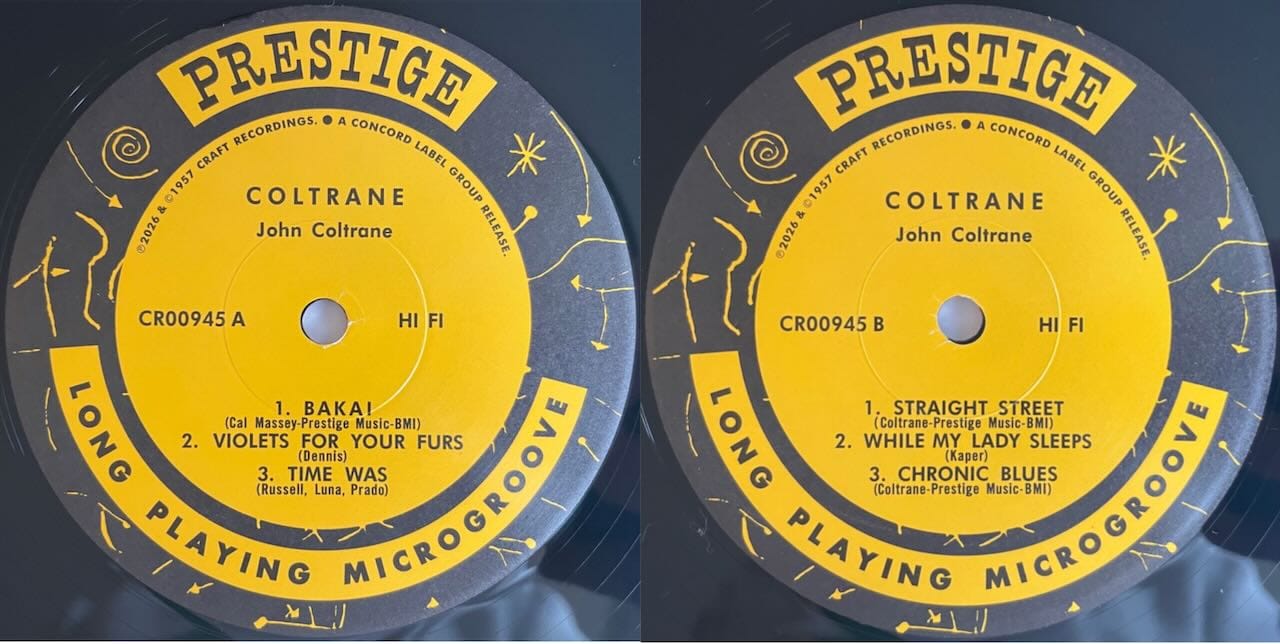
There was also some talk about earlier pressings containing a low-end subsonic thump, possibly coming from the sustain pedal on the piano. I didn’t hear any of that on this OJC pressing. There are a couple of instances of distortion on Garland’s piano during “Time Was”—which is part and parcel of many Rudy Van Gelder recordings—but I couldn’t hear the thumping that garnered complaints about the Analogue Productions pressing from a few years ago.
Coltrane/“7105” was perhaps bound to be overshadowed by what was to come. In September, Coltrane would record the ground-breaking Blue Train for Blue Note; he’d spend the second half of the year playing in Thelonious Monk’s ensemble before reteaming with Miles Davis at the start of 1958, playing on Milestones and perhaps the most legendary jazz recording of all, Kind of Blue. Coltrane’s stint on Atlantic Records would follow, with “My Favorite Things” and Giant Steps, and he would then move to Impulse! for perhaps his most significant work as a bandleader, an astonishing run of albums that included A Love Supreme.
To be fair, Coltrane/“7105” is not the match of some of those loftier achievements. But taken on its own merits, it is an astounding display of artistry, showcasing Coltrane’s incredible improvisatory skills and his virtuosic ability to find unexpected harmonies within a piece’s melodic structure. It was also the clearest portrait thus far of Coltrane as a composer, and certainly an impressive introduction of him as the leader of an ensemble. In fact, the Coltrane centennial seems like the perfect time for an album like this to be reexamined, as it gives us a more rounded, comprehensive view of the musician who often gets boiled down to a handful of his greatest achievements. Coltrane’s rich catalog has more to offer, of course, and what “7105” shows us is that those 10 or so magnificent years of Coltrane as a headlining act began with assurance, passion, and more than a little hidden brilliance.
Original Jazz Classics/Craft/Prestige 1-LP 33 RPM 180g black vinyl
• New mono remaster of John Coltrane’s 1957 album
• Jacket: Tip-on single pocket with glossy finish
• Inner sleeve: Craft Recordings–branded rice-paper-style poly
• Liner notes, insert, or booklet: Brief notes on wraparound obi; Ira Gitlin’s original liner notes are reproduced on the back cover
• Source: Analog; “(AAA) lacquers cut from the original master tapes”
• Mastering credit: “Kevin Gray at Cohearent Audio,” North Hills, CA
• Lacquer cut by: Kevin Gray at Cohearent Audio, North Hills, CA; “KPG@CA” in the deadwax
• Pressed at: Record Technology, Inc. (RTI), Camarillo, CA
• Vinyl pressing quality (visual): A
• Vinyl pressing quality (audio): A- (a few minor ticks here and there)
• Additional notes: None.
Listening equipment:
Table: Technics SL-1200MK2
Cart: Audio-Technica VM540ML
Amp: Luxman L-509X
Speakers: ADS L980