Review: Funkadelic's Maggot Brain

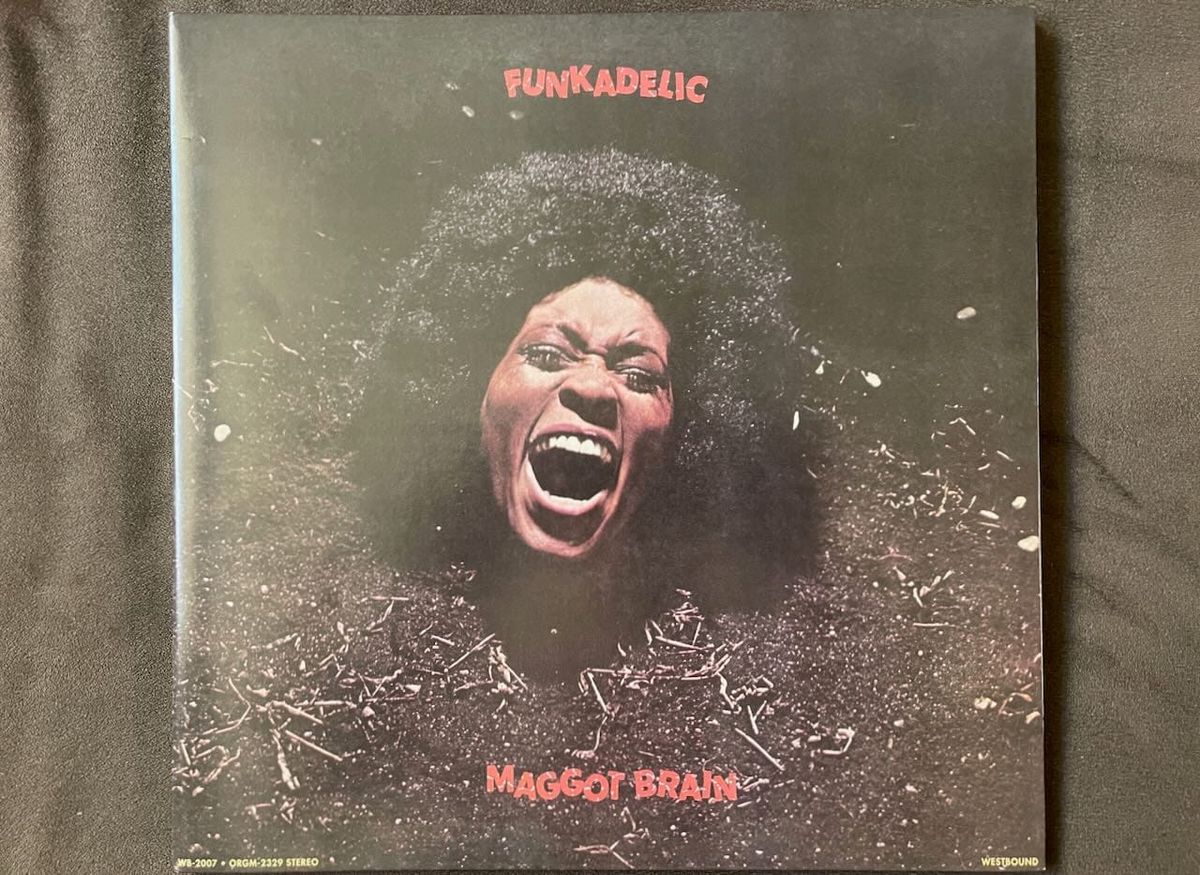
When Org Music partnered with Westbound Records to produce a series of authoritative vinyl reissues of the Westbound catalog, the first thing out of everyone’s mouths was, “Yeah, yeah, yeah, great—so when’s Maggot Brain coming?” To their credit, Org did not rush to satisfy market demand. Their overhaul of the Detroit R&B label’s inventory was intensive and thorough, with tape archivist Catherine Vericolli and mastering engineer Dave Gardner locating, cataloging, and transferring a tangled trove of masters that had been stored in less-than-ideal conditions. Now, three years after the campaign was first announced, their efforts in restoring and remastering Maggot Brain have arrived on wax. It was worth the wait.
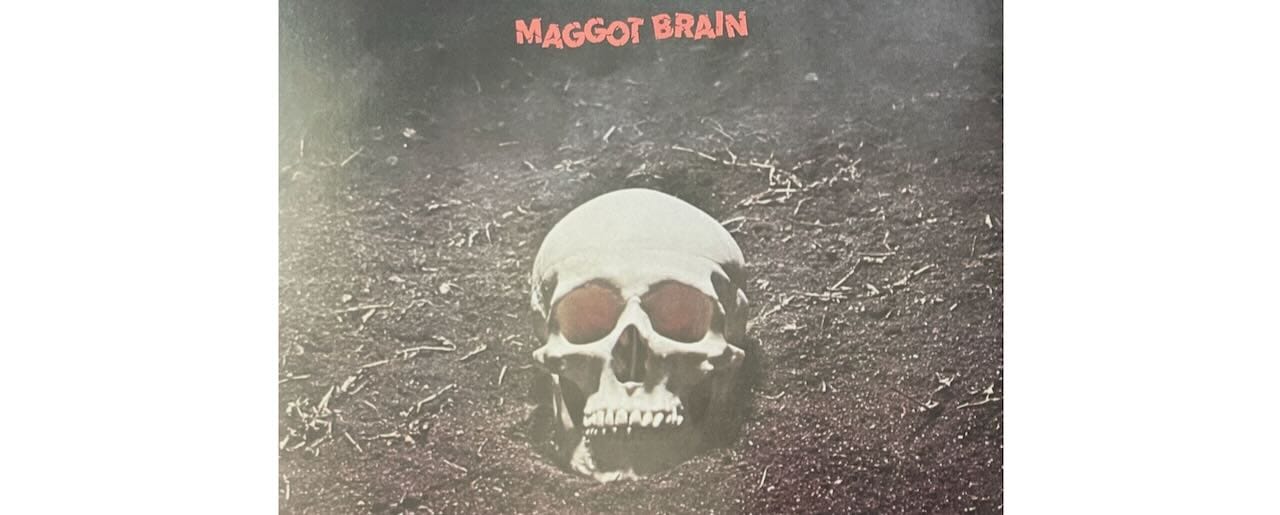
The 1971 album by Funkadelic is by equal measures beloved and notorious, a jolting assemblage of psychedelic R&B, phantasmagoric funk, and blotter-sheet rock that aims for the solar plexus and leaves listeners simultaneously enraptured and unsettled. The near-mythic title track—an almost impossibly expressive 10-minute guitar solo—strips away the expected funk rhythms in favor of a sorrowful, animalistic yawp deployed by guitarist Eddie Hazel, who recorded the piece under instruction from Funkadelic bandleader George Clinton to play as if his mother had just died. Some sources say that “Maggot Brain” was also Hazel’s nickname, while others suggest the phrase comes from Clinton’s discovery in his teens of his brother Robert’s body after a fatal overdose, with his skull cracked open. Either way, it remains a powerful image that conveys the undertow of violence in America ever-present in the early ’70s, when both the Vietnam War and the Civil Rights Movement were at top of mind—not to mention its evocation of the inevitable fate that awaits us all.
The rest of the album unfolds under that cloud, with the rest of Funkadelic joining Hazel and Clinton in shaping piston-and-cylinder funk-rock grooves that are descended from Jimi Hendrix and Sly and the Family Stone but inhabit their own dark corner of delirium. The other Hazel showcase, “Super Stupid,” is a near parody of Hendrix at his most acid-rock, while “You and Your Folks, Me and My Folks” spikes the essence of the Family Stone’s “Sing a Simple Song” by means of a colossal drum sound that sounds like it’s in the process of being excavated from a massive underground tomb.
“Can You Get to That” is perhaps the only bit of outright sunshine on the LP, with acoustic guitar and piano driving an easygoing sing-along, as the female voices in Isaac Hayes’s Hot Buttered Soul backing trio and members of Parliament join the chorale. The album does run out of steam on the last two tracks, as the underwritten “Back in Our Minds” is cluttered by obnoxious flexatone “poings” and half-hearted singing. And the closing, nine-minute “Wars of Armageddon” is a sound collage built on top of a quick-step funk jam, but while the assembled effects and found sounds make for an effectively nightmarish listen, its aural realization of a freakout (complete with fart sounds) isn’t nearly as profound as the proceeding half hour of music.
Gardner and Vericolli’s efforts on Org Music’s previous two Funkadelic albums—Funkadelic and Free Your Mind and Your Ass Will Follow, both originally released in 1970—resulted in two of the best vinyl reissues of the past 12 months, and their work on Maggot Brain is of the same caliber. Vericolli posted an in-depth piece about the overall restoration process on Org’s site that is well worth a read if you’d like to know more about how the reissue series was put together. For Maggot Brain, as with the majority of the Westbound masters, the analog album master reels were in too-frail shape for the repeated use needed for cutting new lacquers. So they created a 1:1 master tape print—a dub, in other words—resulting in new reels that they could use and reuse to safely cut from. (Vericolli offered a look at this process for Maggot Brain in a recent Instagram post.) Org is releasing Maggot Brain at both 33 RPM and 45 RPM, both of which were cut from this 1:1 master tape print. For analog purists, it is the best possible source available to us today; it’s up to you whether you want to get the single disc or spring for the 45. This review is for the 33 RPM version.
 Ned Lannamann
From a reissue standpoint, Maggot Brain has already gone through the wringer. Original pressings remain highly coveted, and the later vinyl versions have muddied the waters with inadequate audio or subpar pressing quality. There were, very broadly speaking, two original American vinyl editions: the first 1971 Westbound pressings, distributed by Janus Records, and the 1975 repressings that were distributed by 20th Century Records. Within these two categories, there may have been multiple lacquers cut with different masterings; the information on Discogs is difficult to make sense of. But I think generally speaking, it is safe to assume that these were mastered from functioning cutting masters and can be considered to be roughly interchangeable as ideal vintage representations of the album.
There were many non-US pressings as well, including British and German pressings; the original German pressing on Bellaphon Records is regarded by some to be quite good, although it would of course have descended from a copy tape of some sort. It wasn’t until 1989 that Maggot Brain was pressed again on vinyl in significant numbers, to accompany the first CD reissue. The source information for the 1989 and 1990 European vinyl pressings proudly touts that they are “direct metal mastered from digital tapes”; reports of these pressings vary wildly as well (and the one I listened to for this review had some issues, which I’ll detail shortly). In 2008, the much-maligned 4 Men with Beards label took a stab at an iffy pressing that stayed in print for a good while but is probably best ignored. Lastly, an odd assortment of European pressings—some legit, some not, and in a different array of colors—have landed record stores over the past decade or so. Several of these were officially licensed by Ace Records in the UK while others appear to be more dubiously sourced.
In short, finding a great Maggot Brain on vinyl has become one of the 21st-century record collector’s most frustrating pursuits. And so prices for the original 1970s pressings climbed and climbed, with even well-played copies commanding more than $150 on the used market. The new Org Music should put an end to all of this, as it puts a properly sourced, well-pressed version of Maggot Brain back in record stores available to all comers, and the hype sticker makes it explicitly plain which version you’re buying. It is an affordable, great-sounding presentation of an album that has been one of the most difficult to get a decent vinyl copy of for a reasonable price.
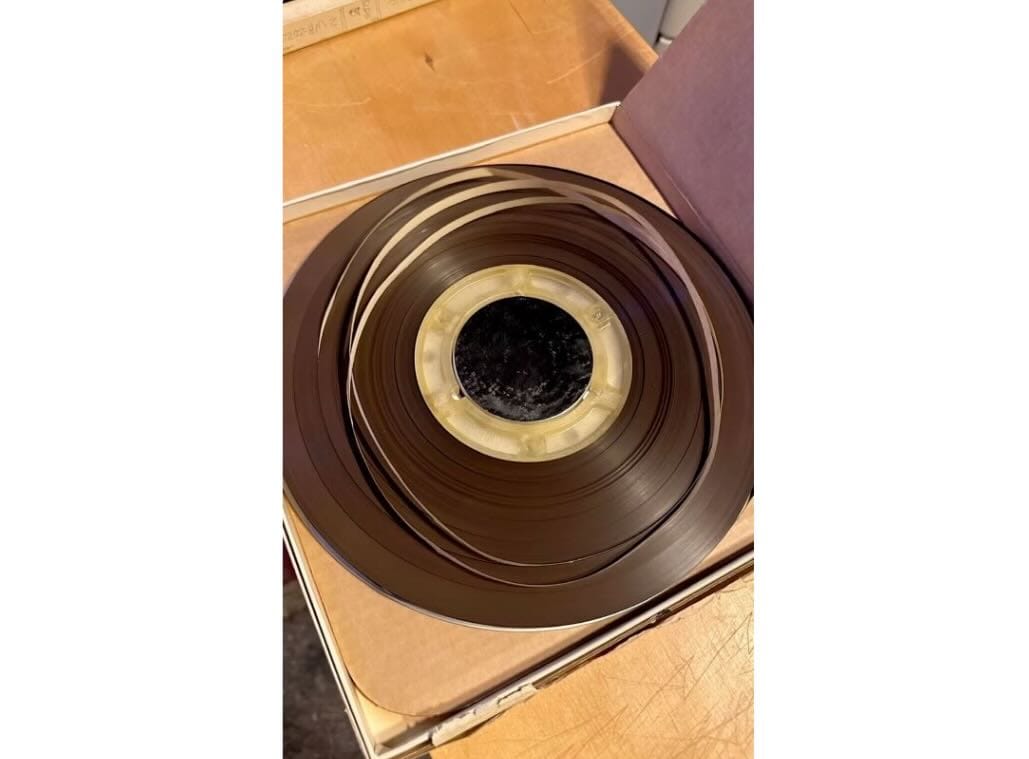
Gardner and Vercolli’s restoration and mastering work on the new Org Music pressing makes for a powerful and resplendent listen. The soundstage is wide and deep, with a cavernous sense of space and Clinton’s studio manipulations rendered clearly without letting the music be obscured under the frippery. The title track positively emulsifies the listener, with Hazel’s guitar rising, soaring, falling, swooping—not merely riding the currents but also turning them into immense panoramas. Clinton’s heavy hand on the Echoplex adds fractal dimensions to the notes, but the new mastering does not allow Hazel’s playing to become muddled even for an instant.
The title track’s hymnlike incantation is followed by “Can You Get to That,” which is like throwing open the church doors on a bright Sunday morning after a doom-and-gloom service. And the circular, eat-its-own-tail riffing of “Hit It and Quit It” makes use of an enormous soundstage, even as it sounds like a blacklight-poster version of a Sesame Street counting cartoon. All of the little particulars—xylophone, tambourine, the shift in Bernie Worrell’s organ stops for his solo—are vivid and full of detail. Many of the recording’s limitations, like the boxed-in drums of “Super Stupid” or the varying sound quality of the different elements mixed into “Wars of Armageddon,” are very nearly overcome by the sheer scope and robustness of this fabulous new master.
 Ned Lannamann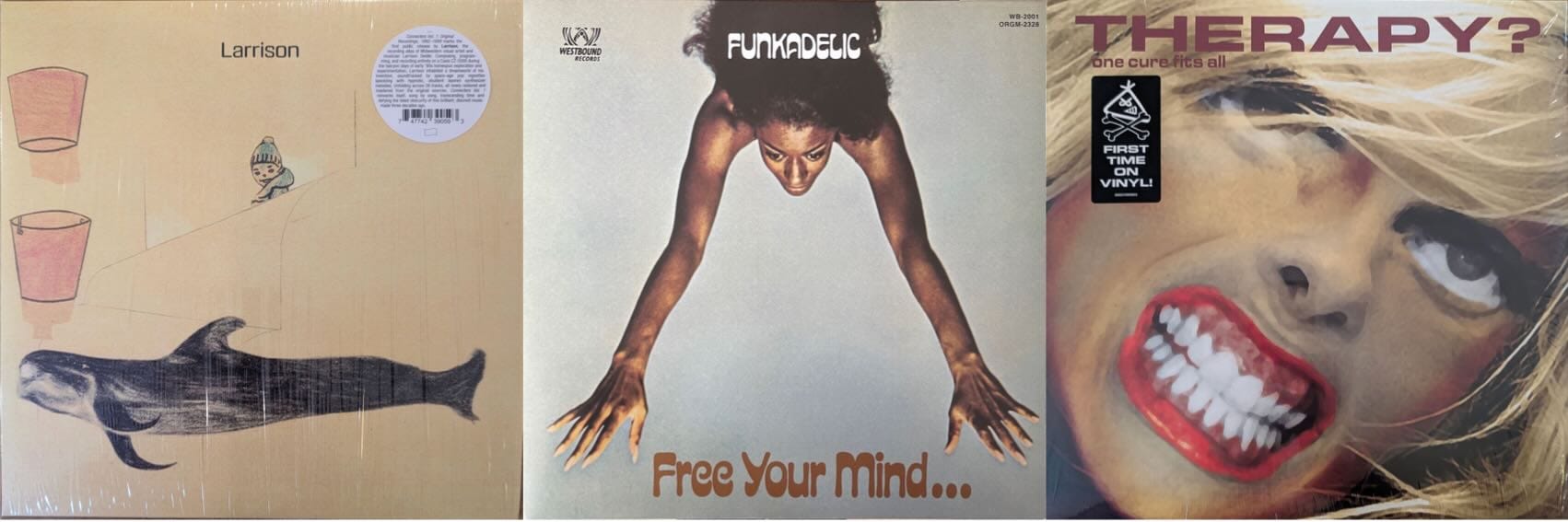
The vocals and instruments sound naturalistic and denuded, and the bass, mids, and treble are all healthy and fully oxygenated. I found that some of the high end of the acoustic guitar on “Can You Get to That” occasionally became a bit teeth-rattling, but the sound never crushed, broke up, or maxed out. There is space around the instruments, although Clinton’s heavily treated mix doesn’t allow for a lot of “air”; nevertheless I got a real sense of the analog tape, especially on “Wars of Armageddon,” where a heavy band of tape hiss is audible toward the end of the track. This is a good thing—it suggests that little to nothing has been removed or filtered from the actual properties of the master.
Over the years, some reissues of Maggot Brain have reversed the left and right channels. There are even indications that some of the earliest pressings may have had the stereo image swapped. This makes it difficult for me to say which version is correct, although one poster on the Steve Hoffman Music Forums says that a white label promo copy—which should be as close to an original first pressing as possible—places Hazel’s lead guitar on “Maggot Brain” in the right channel. The new Org pressing has this reversed, with the guitar coming out of the left. [UPDATE: Additional posters on the Hoffman Forums report that their early pressings have Hazel coming out of the left, including on a 1971 US Pitman pressing, a 1971 Canadian pressing, and an original German pressing.]
With all the care and attention Gardner and Vericolli have put into the Org/Westbound reissue line otherwise, it seems unlikely to me that they would have goofed up the stereo channels for Maggot Brain—surely the series’ most hotly anticipated title. My theory is that the new mastering reflects what is actually on the Westbound master, and that a widely used “cutting master” copy tape, created very early on, had the channels accidentally reversed. However, this is just my own working theory and I don’t have the evidence to support it. I think some people will believe that Hazel’s guitar coming from the right channel is more accurate and will think that Org got it wrong. They are certainly welcome to think so. I trust Gardner and Vericolli.
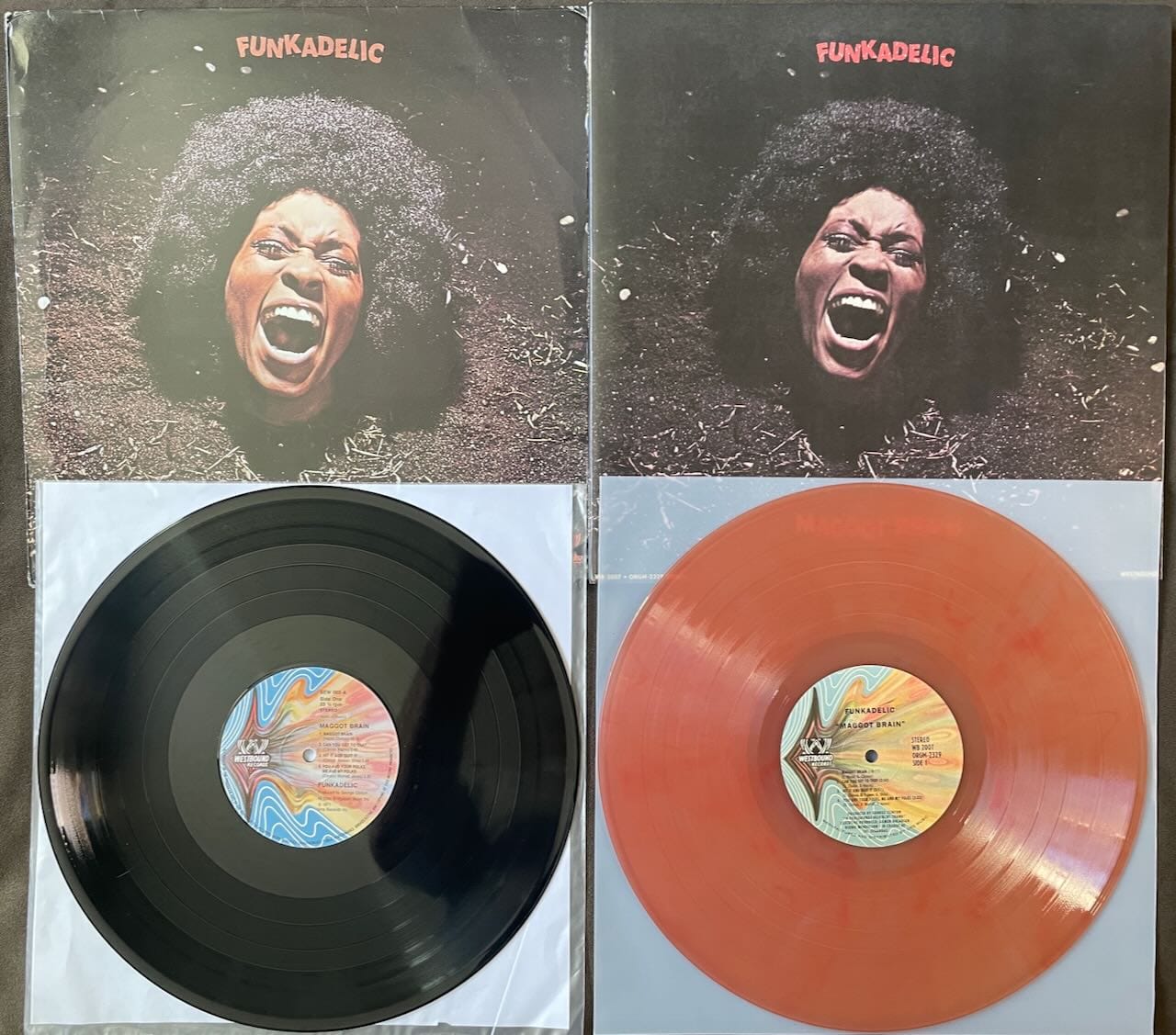
As you may have surmised, I did not have a 1970s pressing to hold up to the new Org Music version, but I was able to listen to a later vinyl copy, pressed in France in 1990 from a digital source, as per the note on the back cover. It has Eddie’s “Maggot Brain” guitar coming from the right and runs at a slightly slower speed. While generally solid-sounding, the 1990 French pressing occasionally gets congested during denser passages, and the bass sometimes disappears and then comes back with a vengeance; the pressing quality also leaves a bit to be desired. The new Org mastering bests it in every regard.
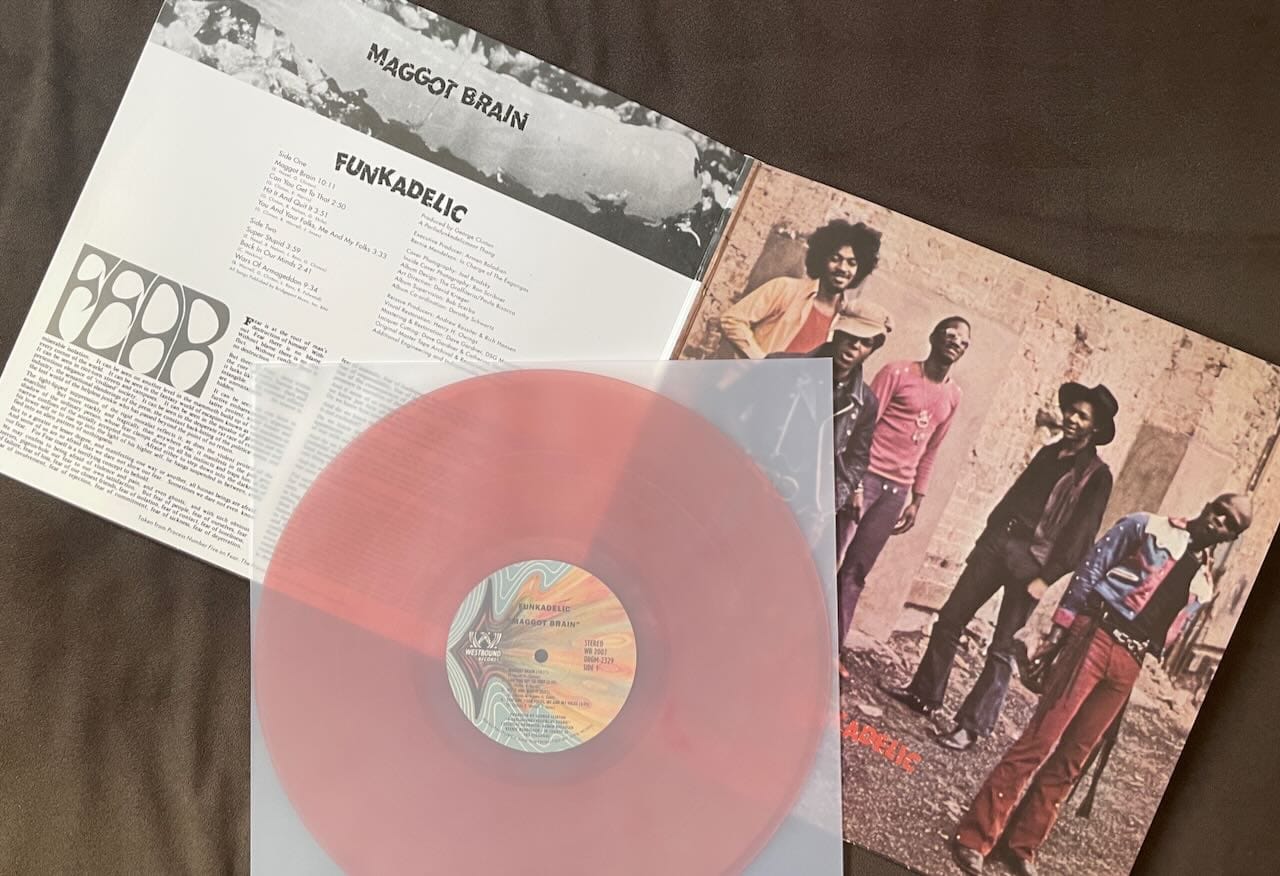
As mentioned, I listened to the 33 RPM version, but Org has also prepared a 45 RPM edition on two LPs for those who prefer to listen to music that way. It stands to reason that the 45 will be a fraction better-sounding than the 33, at the expense of breaking up the flow of the original vinyl album sides (and of course the literal added expense of the extra disc). In addition to the black vinyl version, Org has also prepared a huge array of colored-vinyl variations as exclusives for certain retailers; my copy is Org’s own “Armageddon Red” variant, a pinkish multicolored blend. It had a few clicks and ticks throughout, making me long for a standard black pressing. If you have the option—and you do—I recommend that you go for the black. Because of the hushed sections of “Maggot Brain” and a few other sparse passages, you will want the vinyl as quiet as possible, and in my experience, multicolored vinyl is prone to more noise than single-colored vinyl. All of the variants were pressed at Metallica’s Furnace Record Pressing in Alexandria, Virginia.
Gardner, Vericolli, and Org Music are now three for three with their Funkadelic reissue series. Their renditions of Funkadelic and Free Your Mind… were both exceptional records, pulsing with life and saturated in full-bodied sound. Maggot Brain continues the succession with nary a dip or blip in quality, and Hazel’s epically fulgent guitar showcase makes this installment perhaps the most musically crucial yet. The new pressing depicts Clinton’s carnivalesque sonics and the band’s energetic playing in full-spectrum sound, peeling off decades of dirt, digital debris, and other forms of obfuscation in order to make Maggot Brain sound as ferocious and trippily gorgeous as ever. It’s among the best and most crucial reissues of the year.
Org Music 1-LP 33 RPM “Armageddon Red” colored vinyl
• New remaster of Funkadelic’s 1971 album
• Jacket: Direct-to-board gatefold
• Inner sleeve: Heavy-duty plain poly
• Liner notes, insert, or booklet: None
• Source: Analog; “Mastered direct from analog tape to lacquer,” sourced from a newly constructed 1:1 master tape “print,” or duplicate
• Mastering credits: “Mastering & Restoration: Dave Gardner, DSG Mastering,” Los Angeles, CA; “Original master tape archival & restoration: Catherine Vericolli”; “Additional engineering and indispensable assistance: Nick King,” 54 Sound, Ferndale, MI
• Lacquer cut by: “Dave Gardner & Catherine Vericolli,” DSG Mastering, Los Angeles, CA; “DSG CV” in the deadwax
• Pressed at: Furnace Record Pressing, Alexandria, VA
• Vinyl pressing quality (visual): A
• Vinyl pressing quality (audio): B+ (minor clicks and ticks here and there)
• Additional notes: A black vinyl 33 RPM pressing is also available (you should get that one!), as is a 45 RPM 2-LP set, also on black vinyl and in an upgraded Stoughton tip-on gatefold. Additional 33 RPM versions include a brown vinyl version with pink splatter, available at Midwest indie stores; a “Blood Orange” pressing exclusive to Zia Records; a “Tequila Sunset” exclusive to Rough Trade; a “Solar Flare” pressing for Seasick Records and Plaid Room; and a “Bubble Yum” edition for Levitation Records. Also, The “In” Groove has the standard black vinyl pressing available in a numbered high-gloss tip-on gatefold.
Listening equipment:
Table: Technics SL-1200MK2
Cart: Audio-Technica VM540ML
Amp: Luxman L-509X
Speakers: ADS L980