Review: The Beau Brummels

Share
Cover art for the Beau Brummels.

Real Gone Music expands the 1975 reunion album with an extra LP.

Before we get into the review today, here’s a quick reminder that today (Sunday, June 7) I’ll be appearing on Steve Westman’s Live Audiophile Roundtable at 10 am Pacific Time (1 pm Eastern). You can watch it right here—either live or anytime after—or click on the embed below. The topic is “Why do we keep buying the same albums over and over again?” and I’m guessing that, since you’re subscribed to a vinyl reissue newsletter, you can relate. Join us! And be sure to go to Westman’s YouTube page and subscribe.

The other bit of vinyl news from the last few days is that Rhino unveiled its next Rhino High Fidelity offering: A shiny new Kevin Gray cut of Curtis Mayfield’s Super Fly. (There’s also a reel-to-reel for you true sickos.) This is a no-brainer in my book—Super Fly is one of the defining albums of the 1970s and an easy entry point into the crucial catalog of Mayfield. It deserves to be instituted in Rhino’s premium reissue line.

However, there’s been some fiddle-faddle about the necessity of a new pressing, considering that Gray already did an analog cut for a 2022 release on Run Out Groove, and there was also a MoFi back in 2019—plus, original pressings sound mighty fly on their own, not to mention a 1979 Kendun cut that is thought to be particularly good. But all of these are out of print. This new RHF version is—I should think—primarily for people who don’t already have the album on vinyl. Right? And if you already have a copy you’re happy with, it should be easy to pass the new one by. But if you still feel compelled to buy another version, well then, today’s Westman show should feel especially topical.

Now let’s look at an album that has been utterly ignored by the vinyl reissue makers since its original release more than 50 years ago.


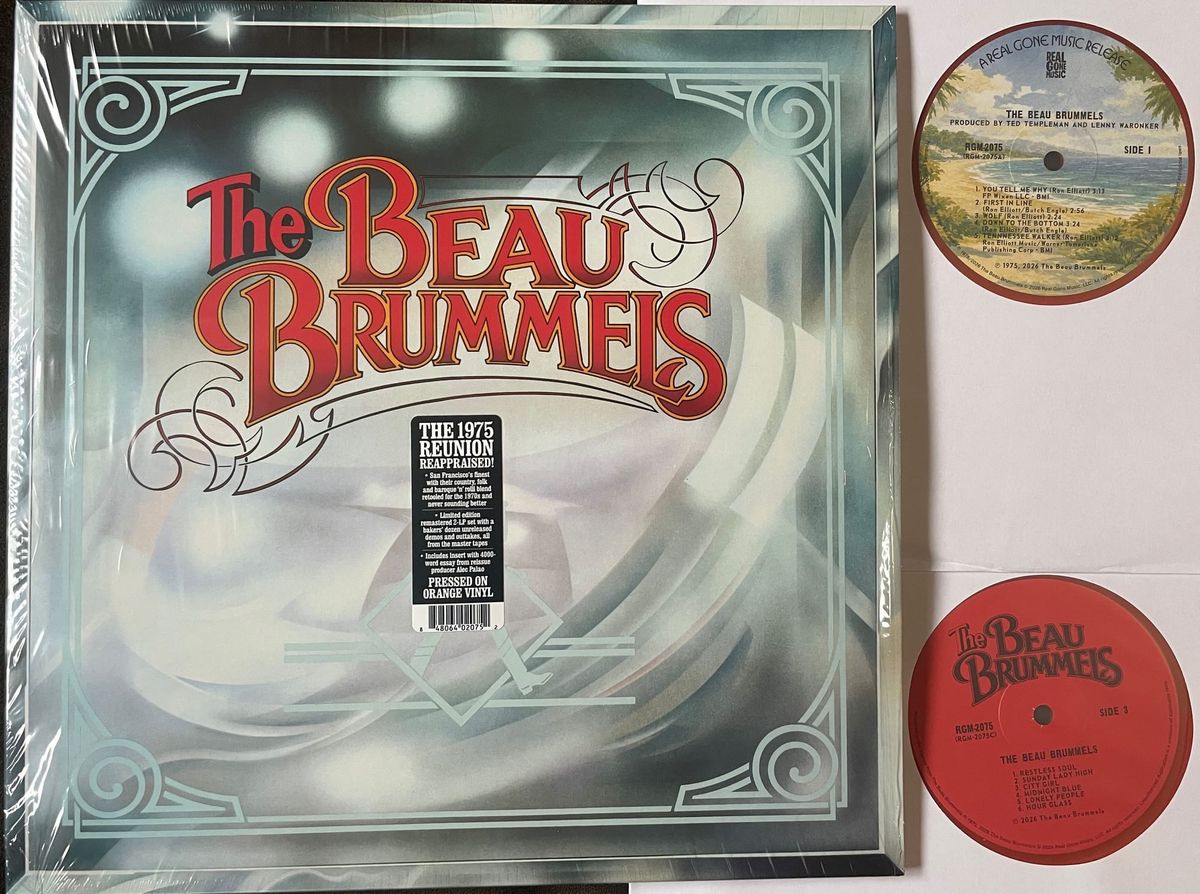
The front cover of the Beau Brummels' 1975 self-titled album.

The Beau Brummels: The Beau Brummels

The ’70s reunion album from a once-successful ’60s band is something of an ignominious micro-genre. The most famous example is the maligned 1973 Byrds reunion album (simply titled Byrds), but the Animals also gave it a try (1977’s Before We Were So Rudely Interrupted), as did three-quarters of Small Faces (with 1977’s Playmates and 1978’s 78 in the Shade). Even Country Joe and the Fish had a go at it, with 1977’s unimaginatively titled Reunion. It says something that all of these bands—except Country Joe—are among my very favorites but that I neither own nor have listened to any of these reunion albums. (Hmm. That might be a fun project to tackle for the newsletter in the future. You’ve been warned.)

The Beau Brummels’ 1975 reunion album is often undeservedly lumped in with this disreputable hodgepodge. Titled The Beau Brummels—perhaps following the Byrds’ trend there—it found the five original members of the San Francisco group reconvening under the auspices of the Warner Bros. label with significant support from A&R head Lenny Waronker and big-time producer Ted Templeman. The Brummels had achieved huge success in their earliest days, with their first three singles all making the Top 40 in 1965, and their Beatle-y folk-rock sound positioned them as a Northern California counterpart to Los Angeles’s Byrds. But as their career progressed and original members started to drop off, the band’s commercial momentum slowed—even as guitarist/songwriter Ron Elliott and singer Sal Valentino were making the best music of their career. They recorded 1967’s baroque-pop masterpiece Triangle with original bassist Ron Meagher, who was conscripted to serve in Vietnam during the sessions, leading the remaining pair to make the just-as-masterful 1968 country-rock milestone Bradley’s Barn as a duo. The two remaining Brummels hung it up the following year, when not much of anybody was paying attention.

Over the next few years, Valentino kept busy with the jumbo-sized Bay Area band/collective Stoneground, while Elliott recorded a solo record as well as a one-off album with a group called Pan. Elliott also co-produced Stoneground’s second album and did session work for Templeman, who remembered the Brummels’ heyday fondly as he himself was becoming a rising star as singer for Santa Cruz pop band Harpers Bizarre. Meanwhile, Beau Brummels ex-drummer John Petersen had joined Harpers Bizarre before that group’s breakup in 1970 and gone on to marry Templeman’s sister to boot. And rhythm guitarist Declan Mulligan had formed the Black Rose Band, a successful San Francisco bar band that Meagher joined after his return from service (Meagher and Mulligan eventually swapped instruments). None of the puzzle pieces were scattered too far apart, so when Templeman and Waronker became enthusiastic about Elliott’s latest batch of songs, a Beau Brummels reunion must have seemed like the next natural step.

A lengthy rehearsing and demoing process followed in the early stages of 1974, centered around a Sacramento club called the Shire Pub. The Brummels then decamped to LA to make a long string of demos, and indeed Real Gone Music’s new double-LP reissue of The Beau Brummels features 10 additional Elliott compositions that didn’t make the album, with recordings in various stages of completion. (Meagher’s song “Lonely People” and two early versions of album tracks round out the second LP.) It’s fortuitous that all of this unused material is so well documented, although my final takeaway is that, with one or two exceptions, the band used the correct 10 songs for the final album. (Nine of the LP tracks were new Elliott compositions, while one was a re-recording of the Brummels’ 1965 single “You Tell Me Why,” a cherished favorite of Templeman’s.)

Back cover, insert, and discs for the Beau Brummels.

Once the sessions were underway, Warner Bros. decided to make some changes, bringing on new management and kicking Meagher out of the band, for reasons that remain unclear today. In his excellent and otherwise thorough liner notes for the 2-LP set, reissue producer Alec Palao isn’t sure who precisely deserves the blame for Meagher’s dismissal, suggesting either the new managers or the label itself. The reissue swaps out the original back-jacket photo of Petersen, Valentino, Mulligan, and Elliott with one that features the five-member lineup—including Meagher—correcting a historical wrong that somewhat soured the reunion experience for the group at the time.

Templeman and Waronker produced the album, and they opted for a smooth, commercial sound that put Elliott’s songwriting and Valentino’s remarkable voice in the foreground. That was really the knock on The Beau Brummels for many years—that its overly produced and polished soft-rock sound left the band sounding limp and a bit gooey. But this sounds to me the equal of any mid-’70s California folk-rock album, with rich beds of acoustic guitars, fluid laidback playing, and the not-insignificant gravity of Valentino’s voice, which by this point had reached full maturity, evoking the richness, bite, and velour-like smoothness of a perfectly brewed cup of coffee.

In his essay, Palao denigrates the remake of “You Tell Me Why,” but I think it’s one of the album’s highlights, conjuring a sound that’s both ponderous and carefree at the same time, graced by pleasing George Harrisonesque guitar licks. Indeed, as the Brummels were compared to the Beatles during the ’60s, so can the reunion album be compared to the Beatles’ solo work of the ’70s. The sound is mellower and more song-forward; ballads have become the lingua franca, with the occasional tilt into string-laden overproduction. Palao cites the moony slow-shuffle of “Tennessee Walker” as one of the album’s highlights, but it’s a callback to pre-rock pop that, to my ear, sits uneasily with the country- and folk-flecked material that provides The Beau Brummels’s backbone. With Valentino sounding unconvinced on the mic, it’s the album’s only dud.

An image of a session reel from the insert.

Elsewhere, though, Palao is spot-on with his assessment of the music’s artistic value and shows his well-researched expertise in the band’s history. But his mastering work is really what makes this reissue excel. The LP’s sound has a clarity and radiance that allows the individual instruments to shine, and the multilayered production appeals to the ear without becoming overcooked or soggy. The guitars’ upper registers sparkle while the bass is both melodic and grounded; the drums sit properly in the pocket without either becoming obscured by the strata of guitars or sticking out awkwardly. The soundstage is appealingly broad, although there is not much dimensionality to the imaging. The focus, then, is where it should be: on Elliott’s masterful songwriting and Valentino’s fine singing, which manages to sound both modest and debonair.

The bonus material is a trove for Brummels diehards, with a few nuggets ripe for discovery—like “Midnight Blue,” which could have been buffed into an album-worthy track with a few more takes, and “Paper Plane,” which showcases the band in their more rough-and-tumble Shire Pub form. The pressing, done by GZ Media on orange vinyl, is generally adequate, but my copy had low-level surface noise (more noticeable on Disc 2) and a few instances of non-fill crunch, becoming quite intrusive on “Tennessee Walker.” The discs were flat, centered, and otherwise problem-free.

Released to a mixed reception in 1975, The Beau Brummels might have seemed slight, especially after the lengthy gap since the band’s last effort. And I think the album is missing the kind of attention-grabbing song that could have taken it to the next level, solidifying the band’s new identity and justifying the reunion’s existence. As such, TBB on its own is more than pleasant, and virtually every track has something to recommend it, but in sum total the experience doesn’t quite travel through enough changes to distinguish itself. That said, the extra disc of outtakes changes the complexion of the listening experience, turning it into a mine of uncut gems that the listener can sift through, turn over, and examine. The outline of a 10-song album becomes less important, and this expanded format functions as something that’s more like a scrapbook—one that looks back on a time when a gifted and capable band had the raw materials for some really special music.

Real Gone Music 2-LP 33 RPM orange vinyl
• Remaster of the Beau Brummels’ 1975 reunion album and a bonus LP of contemporaneous outtakes
• Jacket: Direct-to-board single pocket
• Inner sleeve: White poly-lined
• Liner notes, insert, or booklet: Two-sided insert with thorough liner notes by reissue producer Alec Palao
• Source: Digital
• Mastering credit: “Tape transfer and mastering by Alec Palao”
• Lacquer cut by: Anonymous DMM cut at GZ Media; no initials in deadwax
• Pressed at: GZ Media, Czech Republic
• Vinyl pressing quality (visual): A
• Vinyl pressing quality (audio): B (some nonfill and light surface noise)
• Additional notes: None.

Listening equipment:
Table: Technics SL-1200MK2
Cart: Audio-Technica VM540ML
Amp: Luxman L-509X
Speakers: ADS L980