Reviews: Woody Shaw | The Waterboys

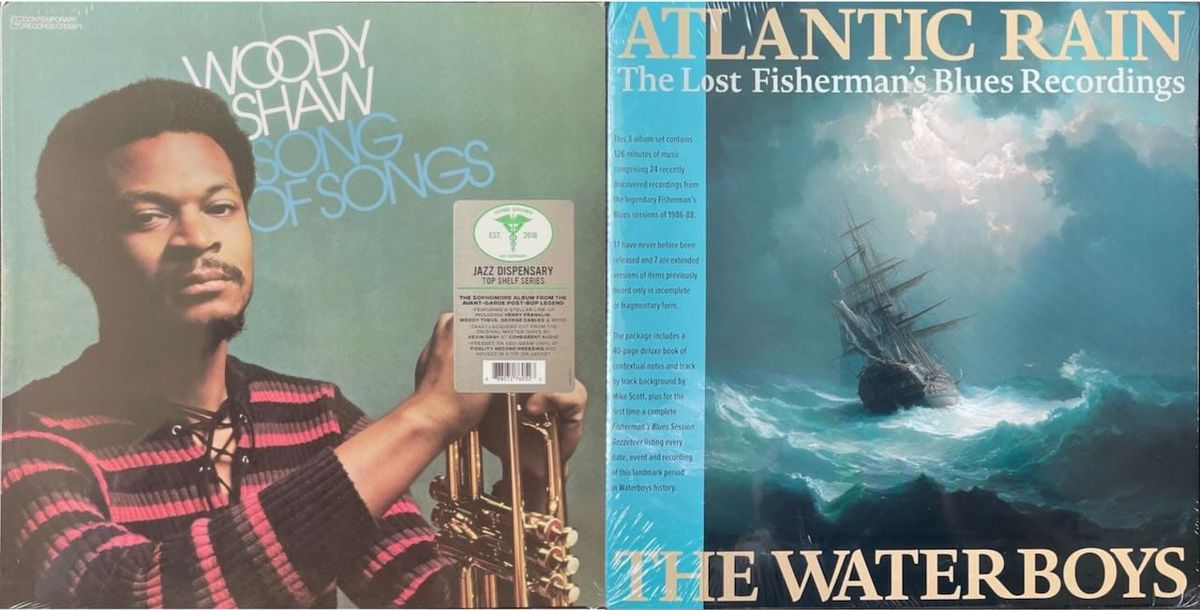
I’ve got two reviews for you as we Americans head into this holiday weekend. One is for a heady experimental jazz record from 1973 and the other is for a triple-LP set of outtakes from a band’s prolific high-water mark in the 1980s.
- Woody Shaw: Song of Songs
- The Waterboys: Atlantic Rain: The Lost Fisherman’s Blues Recordings
Labor Day vinyl sales are afoot this three-day weekend, so hopefully you’re able to grab something you really want for a good price—just don’t fall into the trap of buying a record you don’t actually want simply because it’s 15 percent off. Happy listening, wherever the weekend takes you.
Woody Shaw: Song of Songs
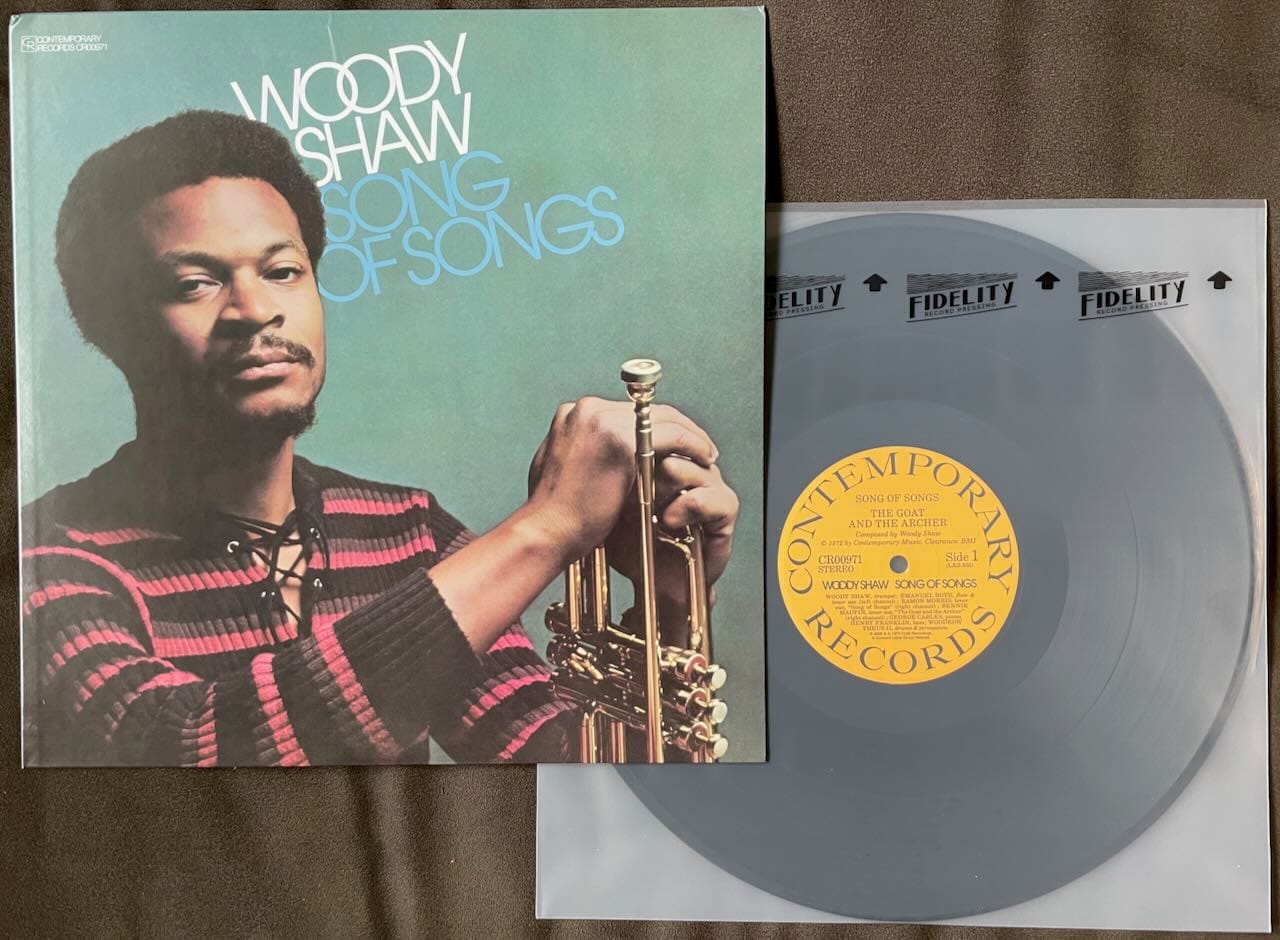
The first thing to know about the new Jazz Dispensary reissue of Woody Shaw’s 1973 album Song of Songs is this: Don’t pay too much attention to the hype sticker. It says the LP was cut by Kevin Gray at Cohearent Audio. It wasn’t. It was in fact cut by Bernie Grundman of Bernie Grundman Mastering—his initials (“BG”) are in the deadwax, along with the signature triangle that indicates that he cut it with his facility’s diamond cutting head. Presumably the rest of the hype sticker is correct, in that it is an AAA pressing cut directly from the original Contemporary Records master tapes; the part about it being pressed at Fidelity Record Pressing is certainly accurate.
The second thing to know is that I don’t think you’ll give a hoot that Grundman cut it as opposed to Gray. It’s a rewarding presentation of some fearlessly off-kilter performances, and Grundman’s treatment of the material is truthful and richly presented, forgiving to the ear even though the music can be deliberately antagonistic. Hilariously, Craft Recordings made the exact same error on their 2023 Jazz Dispensary reissue of Woody Shaw’s other album for Contemporary, 1970’s Blackstone Legacy—it said on the outside that Gray cut it, but the inside revealed it was actually Grundman. I’m pretty sure Grundman has been at this long enough not to develop a complex about it. (Gray typically cuts all of the Jazz Dispensary discs, but Grundman cuts the Contemporary Records reissues, hence the confusion. Online materials have already been corrected and future pressings will have a revised hype sticker.)
The Jazz Dispensary banner gently implies that you could always augment your listening with certain herbal supplements. I don’t think that’s necessary with Song of Songs, and it may even be worth a warning that Shaw’s album is quite a bit more cerebral and musically discombobulating than you might be anticipating as you sink deep into the couch. But this is part of Jazz Dispensary’s Top Shelf line, which has generally been pretty unafraid to send listeners down paths of unapologetically experimental jazz. Shaw’s music here approaches jazz as a continuum with well-established parameters that are nevertheless in need of a few new wrinkles. No sacred cows here, even as Shaw pays homage to those who came before.
Song of Songs was made during the trumpeter’s West Coast sojourn, a couple of years in the early ’70s when Shaw was based in San Francisco and cultivated relationships within the California jazz scene. Prior to that, he had undergone a long apprenticeship in the late ’60s as one of Blue Note Records’ regulars, playing trumpet on albums by Hank Mobley, Jackie McLean, Andrew Hill, and many others. This followed a baptism-by-fire in the Paris jazz scene, where Shaw had arrived in 1964, originally planning to work with Eric Dolphy; Shaw had to make his own way when Dolphy died unexpectedly before his arrival. By the time of Song of Songs, Shaw had already headlined his first album, Blackstone Legacy, and had not only matured as an eminently capable trumpeter fluent in all kinds of genres but had developed as a composer and bandleader as well.
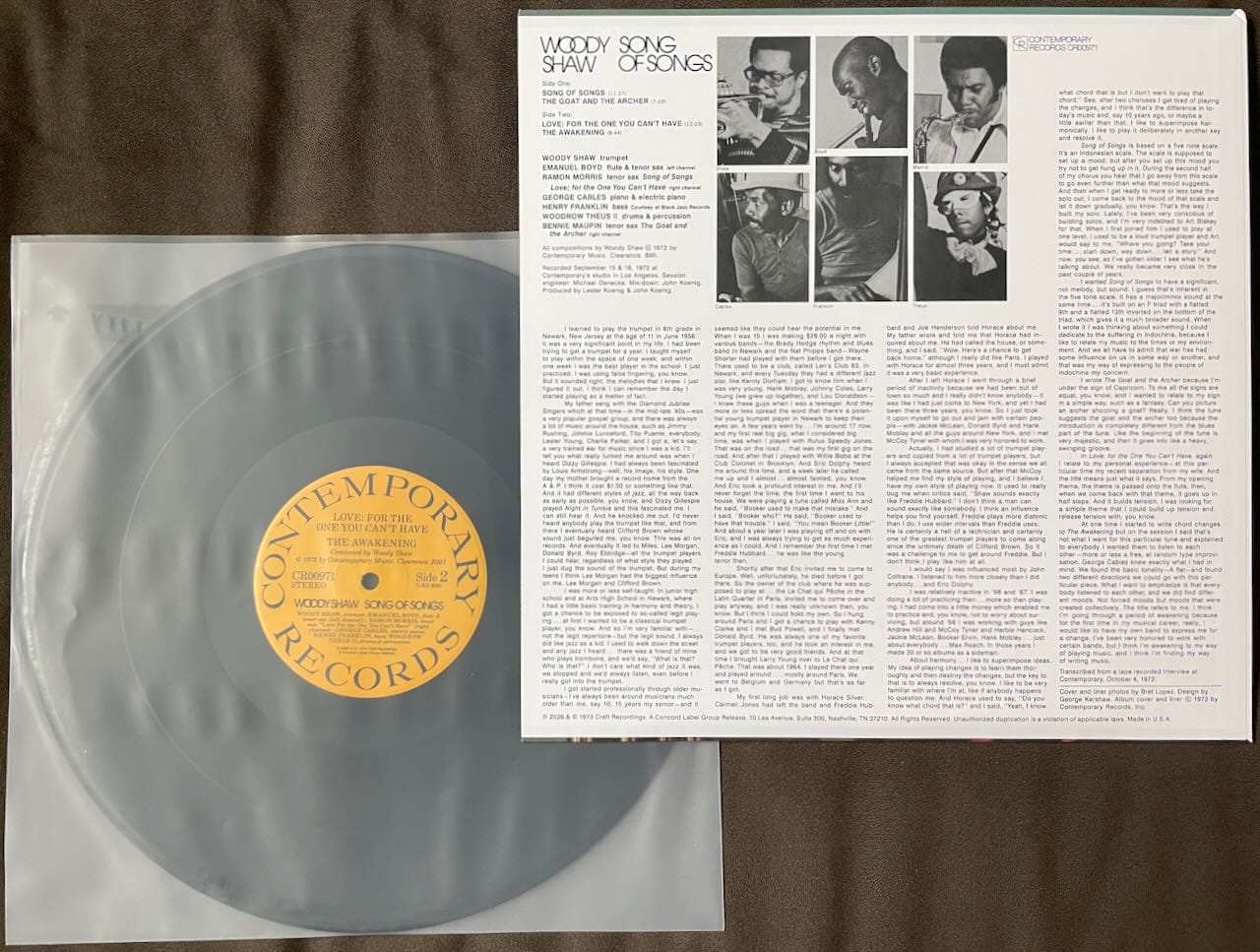
The album was recorded at Contemporary Records’ Los Angeles studio on September 15 and 18, 1972, with a rhythm section of Woodrow Theus II on drums and percussion, Henry Franklin on upright bass, and George Cables on piano. It’s Cables who’s most responsible for dictating the mood of the pieces, as he plays acoustic piano on Side 1 and switches to electric piano for Side 2. This makes for a bifurcated LP, with a first half that features a wholly acoustic ensemble, which serves to fix the music to certain jazz traditions even as it upends others. Meanwhile, the darker, dreamier, electrified second half navigates cautiously around the funk and rock elements that began to seep into jazz during the late ’60s and early ’70s. Shaw and his ensemble feel like they’re trying their best to stave off jazz’s oncoming absorption into more mainstream genres even as they use some of its newer tropes to uncover a few undiscovered avant-garde crevices and burrows. It’s a bracing and stimulating listen.
The rest of the ensemble includes Emanuel Boyd on flute and tenor sax on all four tracks, Bennie Maupin on tenor for one tune, and Ramon Morris on tenor on two others. Shaw’s trumpet is more shaman than ringmaster, divining the direction a piece will go even as he allows the soloists complete freedom and acting as a calming, centering agent for their wilder digressions. When Shaw takes his turn, he’s deliberate and poised, turning the limitations of his instrument into strengths by way of sonorous intonation, bruised and broken notes, and his trademark wide intervals. The architecture of Shaw’s songs contain indications of his heroes, like Dizzy Gillespie, Clifford Brown, and of course Dolphy, but he’s also fascinated by modal and spiritual jazz elements as well as the dissonance and arrhythmia of more experimental playing.
Grundman’s mastering, as mentioned, is forthright and warm. The mix is quite widely spread, with instruments mostly hard-panned—an unusual choice for a 1970s recording (Shaw stays confidently situated in the middle). At times, Theus’s drums are crouched all the way in the right corner, and frequently his snare drum sounds off-mic, with bleed-through coming in on the other tracks. The heavy stereo split allows your ear to follow the individual performances. Rather than make for an unbalanced listening experience or creating an unrealistic sense of spatial dimensions, it permitted me to quite effortlessly follow the musical conversations between the various players.
The pressing was done at Fidelity Record Pressing and is generally excellent, although I did get some surface noise in between the two pieces on Side 1 and again at the very end of that side. Fortunately, it did not interfere with the music at all. The album is packaged in a sturdy tip-on jacket with the original liner notes reprinted on the back; it’s a transcribed interview with Shaw that allows him to expound on his biography and musical upbringing, with perhaps some convenient embellishment. This is a brainy, unpredictable bit of music-making, and while we’re spoiled for choice with AAA vinyl jazz reissues these days, it’s unlikely you’ll find something that’s more engrossing and intriguing to the ear than Song of Songs—Kevin Gray or no.
Craft/Jazz Dispensary 1-LP 33 RPM 180g black vinyl
• Remaster of Woody Shaw’s 1973 album, originally released on Contemporary Records
• Jacket: Tip-on single pocket
• Inner sleeve: Fidelity Record Pressing–branded poly
• Liner notes, insert, or booklet: None
• Source: “(AAA) lacquers cut from the original master tapes”
• Mastering credit: “Kevin Gray at Cohearent Audio”—however, this is incorrect; Bernie Grundman actually mastered it
• Lacquer cut by: Bernie Grundman at Bernie Grundman Mastering, Hollywood, CA; “BG” in the deadwax
• Pressed at: Fidelity Record Pressing, Oxnard, CA
• Vinyl pressing quality (visual): A
• Vinyl pressing quality (audio): B+ (some surface noise during silent sections on Side 1; music is not affected)
• Additional notes: None.
The Waterboys: Atlantic Rain: The Lost Fisherman’s Blues Recordings
In 1987, Virgin Records took over the storied Olympic Studios space in Barnes, London, and proceeded to toss decades’ worth of master tapes into rubbish skips, or dumpsters. This included multitracks by Led Zeppelin, Jimi Hendrix, the Rolling Stones, and countless other treasures, some of which were rescued by enterprising fans and collectors and others that were trashed forever. The famous Universal warehouse fire in 2008 similarly resulted in the destruction of countless masters, the extent of which has still never been fully tallied. Los Angeles’s Sunset Sound studio has a slightly less depressing story, albeit one where the studio became proxy caretakers for the thousands of tapes that were abandoned by the record companies and license holders. These tapes, stacked and unclaimed, were haphazardly stored for decades in the facility’s second floor, with the occasional prize to be plucked out of the morass—like the multitracks for 1975’s The Who by Numbers, which have been put to use for new remixes of that album due later this year.
In short, the custodians of these historic artifacts often are, at best, not conscious of the present and future worth of the masters that they may have in their possession, and, at worst, downright hostile to the idea of their preservation. It’s nothing short of a miracle, then, that when Blue Raincoat Music bought Chrysalis Records in 2016, they conscientiously took inventory of what they owned under their newly acquired copyright. And among the things they located were hours of uncatalogued recordings from the sessions for the Waterboys’ 1988 album Fisherman’s Blues.
This was already well-trodden territory. The Scottish band, which had relocated to Ireland at the start of 1986, recorded almost continuously for two and a half years in and out Dublin during the album’s creation period, resulting in dozens of hours of music. A massive amount of this stuff had already been plundered for exhaustive reissues and archival releases. First, the Too Close to Heaven CD came out in 2001, and was then expanded the following year into a 2-CD set called Fisherman’s Blues, Part 2. Then a reissue of Fisherman’s Blues came out in 2006 with a second disc appended with further outtakes. And then in 2013, a 7-CD set, Fisherman’s Box, included everything that had been released thus far plus an additional 85 unreleased tracks. Surely that was enough to close the book on this prolific period.
But it turned out there was more. Waterboys frontman Mike Scott was encouraged by Blue Raincoat to dig further into the archives, and in his introduction in the booklet for Atlantic Rain: The Lost Fisherman’s Blues Recordings, he writes, “I was shocked to discover nearly 80 of the nearly 400 multitrack reels we recorded between 1986 and ’88 had no song titles on their labels. The music they contained—unlisted, unmixed, unlistened to—had been forgotten.” In addition, 60 additional three-hour digital audio tapes ran uninterrupted alongside the multitracks to capture every last bit of music; when Scott went back in to look for more material he discovered that nearly half of them had never even been played.
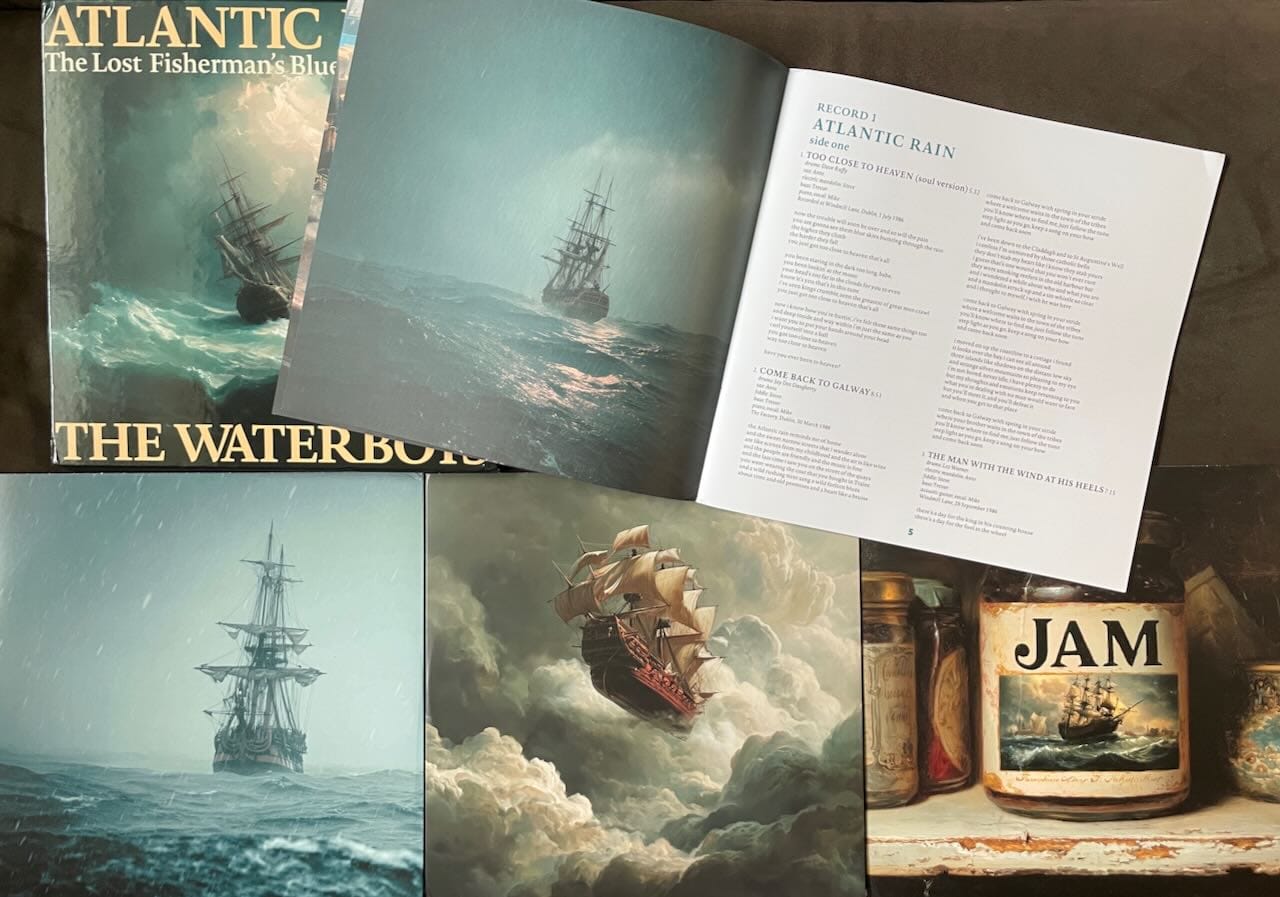
Atlantic Rain: The Lost Fisherman’s Blues Recordings, then, is one final trawl through the enormous ocean of music that the Waterboys committed to tape from 1986 to 1988. Newly inspired by Celtic and American folk music, Scott and the rest of the group—bassist Trevor Hutchinson, saxophonist/mandolinist Anthony Thistlethwaite, and violinist Steve Wickham, with a rotating crew of drummers—were exploding with not just creativity but the desire to play nonstop. They’d struck an incredibly rich and long-lasting seam which they took full advantage of, and perhaps in the end paralyzed themselves with the amount of material they racked up, knowing that at some point they would need to whittle it down into an album.
They did so quite successfully, and Fisherman’s Blues remains a superb record—heavily indebted to Bob Dylan, of course, but also invigorated by the traditional musics the band had immersed themselves in. And so Atlantic Rain is not really meant to match that record, but rather function as yet another one of its appendices. The wise decision was made to split the newfound material into three discrete, coherent LPs, one of which (Atlantic Rain) plays like a very solid alternate Waterboys album from the era, and the other two (Indian Summer and Fisherman’s Jam) that play at times like after-hour sessions at the pub, full of covers and extended versions of previously released songs, alongside some studio jams that were probably a lot of fun to play at the time but are less so to listen to some 40 years later.
The first LP’s centerpiece is “Come Back to Galway,” a meandering nine-minute epic that was recorded in 1988 without a vocal. Decades later, Scott rewrote the lyrics and newly recorded the vocal, more or less replicating his original unsung draft; it details his relationship with Wickham, his close collaborator and musical compatriot, and describes a period of burnout during the Fisherman’s Blues era when Scott moved out of Dublin to a small village near Galway for a few months to get some perspective on the sprawling project. It feels like a hidden thesis statement for the entire Fisherman’s Blues enterprise, although with Scott’s latter-day vocal it decidedly straddles two different eras. As it turns out, there are quite a few tracks on the collection with newly recorded vocals, so purists should be aware that the decades of perspective they offer are an inherent part of the package.
The rest of the first LP is almost as good as “Galway.” “And Then the Gods” is a lovely, wistful improvised instrumental that shows how well-oiled the musicians were as an ensemble, with Wickham’s violin piloting the craft through calm but uncharted waters. “Too Close to Heaven (Soul Version)” is exactly what it sounds like, a soul-stomping version of the album outtake. “Saints and Angels” is a patient hymn recorded during mixing sessions at Rockfield Studios in Wales, in a fine and heartfelt performance that was deemed not good enough at the time but was reevaluated by Scott to be better than his memory recollected. And “The Man with the Wind at His Heels” feels like a lost Rolling Thunder Revue number, with Wickham’s windswept violin and Thistlethwaite’s unflappable mandolin pulling the song forward like a pair of draft horses.
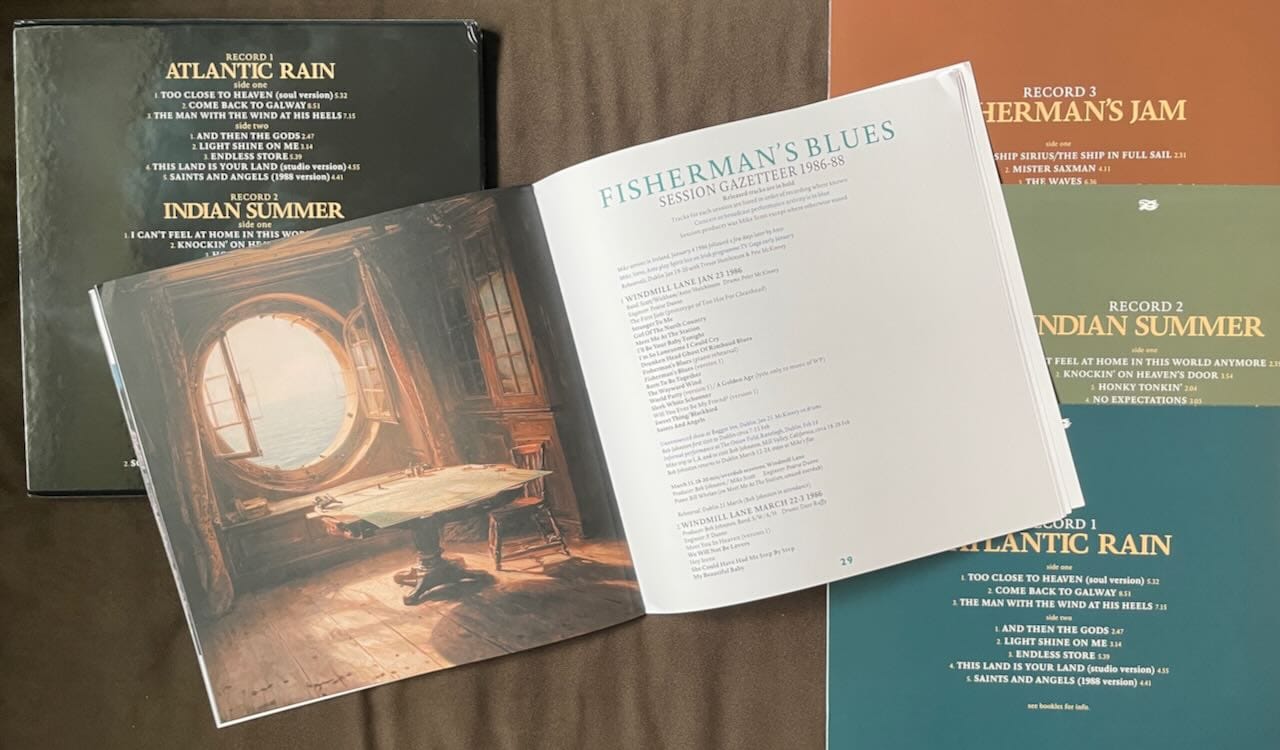
The first side on the second disc is a loose-limbed, knees-up collection of overly familiar cover songs: Dylan’s “Knockin’ on Heaven’s Door,” the Stones’ “No Expectations,” Willie Nelson’s “Angel Flying Close to the Ground,” and, improbably, Prince’s “When Doves Cry,” with just Scott and Wickham deconstructing the song, not entirely successfully. It’s all pleasant enough, but these versions don’t do much to recontextualize the songs or even take temporary ownership of them; they feel tossed-off, and the historical record suggests that they probably were. The second side of LP 2 features unedited versions of previously released songs, like “We Will Not Be Lovers” and “Killing My Heart,” and makes for a fine, rollicking listen.
The third LP is geared toward Waterboys diehards, documenting a collection of extended workouts and meandering jams. It’s highlighted by a raucous medley of Wickham’s “The Good Ship Sirius” with the traditional Irish folk song “The Ship in Full Sail,” as well as a pleasingly intense instrumental improvisation called “The Waves” that might’ve been shaped into something forceful and powerful if they had taken the time to fashion a song out of it. The nadir comes on the final LP side, which consists of an interminable medley of the Beatles’ “Sgt. Pepper’s Lonely Hearts Club Band” and “Hey Jude,” rounded out by a runthrough of “Sgt. Pepper’s Lonely Hearts Club Band (Reprise)” recorded at Fantasy Studios in Berkeley, California, with drummer Jim Keltner. It’s an entirely unnecessary 20 minutes, I’m sorry to say.
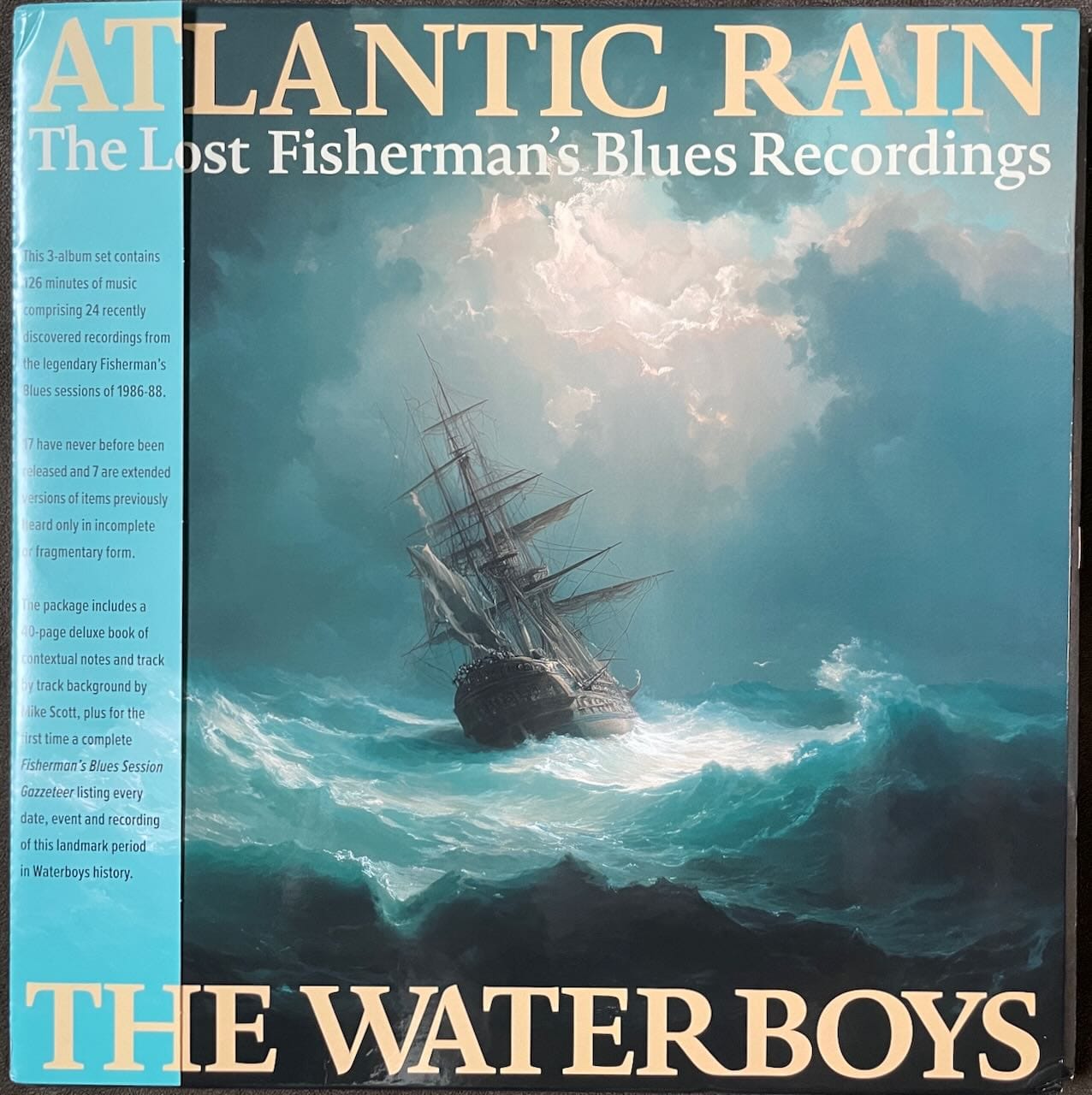
The vinyl version of Atlantic Rain comes in an appealing slipcase with a 40-page booklet that thoroughly documents the sessions. The marine-themed artwork is meant to look like Turner paintings, or one of his contemporaries, I suppose; I wouldn’t dream of venturing a guess as to whether any of it was software-generated. The vinyl is warmly rendered, with some tracks sounding a little better than others, due to the varied sources and whether or not that particular performance was sourced from a multitrack or one of the raw, three-hour session tapes. For a hodgepodge collection of odds ’n’ sods, everything here sounds fulsome, clear, and fully conveyed in the bass, mid, and treble ranges without any overextension.
For casual listeners, the first LP might be more than enough; the second and third LP really are for those a bit more keenly obsessed with the Waterboys and still haven’t gotten their fill of the Fisherman’s Blues era. It is interesting to hear what a band with mountains of inspiration and a particularly hot hand of material does with ample resources and a patient record label. There’s a sense that Scott and his fellow musicians were repeatedly trying to catch the proverbial lightning in a bottle, hastily getting themselves in front of the tape machines when the bolts of inspiration hit (in the manner of Dylan or Neil Young) and then perhaps not always having the patience to follow through and fine-tune the work into something exceptional (also in the manner, at times, of Dylan and Young). For those obsessed with process, though, Atlantic Rain is an interesting glimpse into one band’s indefatigable love for playing music together. For others, it will be the last word on Fisherman’s Blues, and then some—at least until the next batch of archival tapes is unearthed.
Chrysalis 3-LP 33 RPM black vinyl
• Outtakes from the 1988–88 sessions for the Waterboys’ 1988 album Fisherman’s Blues
• Jacket: Medium-weight outer slipcase
• Inner sleeves: Three custom paper sleeves with artwork and tracklists
• Liner notes, insert, or booklet: 40-page booklet with comprehensive session information and an introduction and notes for each song by Mike Scott
• Source: Digital
• Mastering credit: Felix Davis at Metropolis Studios, London, UK
• Lacquer cut by: Felix Davis at Metropolis Studios, London, UK
• Pressed at: GZ Media, Loděnice, Czechia
• Vinyl pressing quality (visual): A
• Vinyl pressing quality (audio): B (quiet backgrounds for the most part; occasional noise here and there, but nothing major)
• Additional notes: None.
Listening equipment:
Table: Technics SL-1200MK2
Cart: Audio-Technica VM540ML
Amp: Luxman L-509X
Speakers: ADS L980