Reviews: Joni Mitchell and Cher on Rhino High Fidelity

Analog-cut reissues of Court and Spark and 3614 Jackson Highway arrive on Rhino’s premium vinyl line.
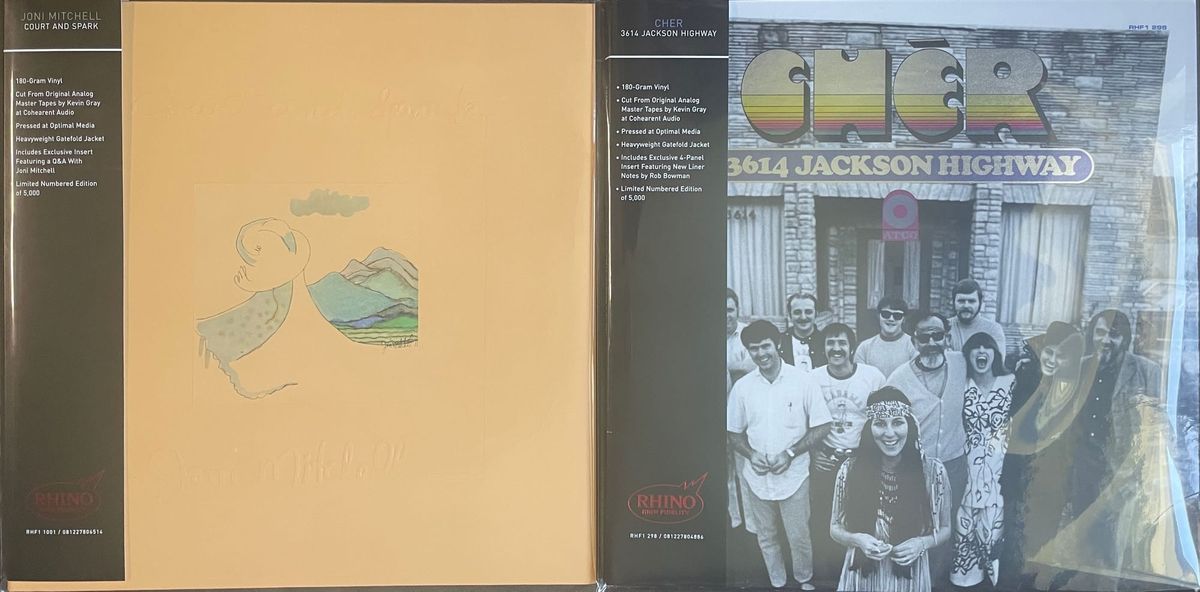
I’m reviewing two of the latest Rhino High Fidelity reissues today, both cut from tape by Kevin Gray and arriving in oversized tip-on gatefold jackets.
- Joni Mitchell: Court and Spark
- Cher: 3614 Jackson Highway
Rhino also released Dusty Springfield’s Dusty in Memphis as part of this batch, and while I don’t have a copy of it to review at the moment, that album is definitely worth checking out.
First, a couple items of business. I’m pleased to announce that Vinyl Cut paid subscriber Scott has won our May vinyl giveaway! Scott is receiving a vinyl copy of the recent Cecil Taylor Unit release from Record Store day, a triple-LP of free jazz recorded live in Paris in 1969. Congrats, Scott! And thank you for being a paid subscriber.
You should be like Scott and become a paid subscriber too! It’s really easy. Just click here to get started.
Also, for those who have been following Rough Trade’s 50th anniversary vinyl series, they announced Drop Three this morning. The longtime UK indie record store and label is reissuing one record from each year of its existence, and the new batch includes records from 1996 to 2005.
1996 - Belle and Sebastian: Tigermilk
1997 - Blur: Blur
1998 - Neutral Milk Hotel: In the Aeroplane Over the Sea
1999 - Sigur Rós: Ágætis Byrjun
2000 - Lemon Kelly: Lemonjelly.ky
2001 - Richard Hawley: Late Night Final
2002 - The Streets: Original Pirate Material
2003 - The White Stripes: Elephant
2004 - Max Richter: The Blue Notebooks
2005 - Sufjan Stevens: Illinois
These are limited edition pressings of 500* each, and it looks like the Belle and Sebastian and White Stripes records have already sold out! (I must say I think there are a couple other choices in this batch that will take a bit longer to hit 500, although I should add that I have underestimated the Brits’ undying passion for the Streets before.) These are deluxe editions on colored vinyl with inserts that include new liner notes, although the mastering is not anything different from the standard editions, as far as I know. [*CORRECTION: My apologies; the editions range in pressings of 500 to 2500, depending on the title. The Streets album is limited to 2000 copies.]
Lastly, I know some people have been anticipating The Vinyl Cut’s Pet Sounds coverage. I apologize that it’s taken so long to get my piece together. I got copies of both the Definitive Sound Series and Vinylphyle pressings last week, but the online discussion around the DSS edition in particular has been pretty nuts, and the story keeps evolving, although it seems that perhaps things have finally cooled down. I’ll get into all of it with my review, which is coming as soon as I can manage. Hopefully by then you won’t be sick of hearing about Pet Sounds. It really is a good album, y’know.
On with today’s reviews.

Joni Mitchell: Court and Spark
There’s no producer credit on Court and Spark. At the time of the 1974’s album’s recording, Joni Mitchell was vehemently anti-producer, as she stated in a 1973 interview with Malka Marom: “A record producer is completely unnecessary. It’s a babysitter, it’s an interior decorator.” But there’s no mistaking who is in command of every second of the album—Mitchell’s essence and vision are imbued in each note and word. With her trusted recording engineer Henry Lewy and the backing of woodwind/reed player Tom Scott and his band L.A. Express, Mitchell evolved a new form of her unconventional songwriting, shedding off the last trappings of her folksinger incarnation—a summit she’d conquered with 1971’s Blue—and leaning hard into the elements of jazz she’d begun to incorporate on 1972’s For the Roses.
Court and Spark also documented Mitchell’s reintegration into the Los Angeles landscape after months of self-imposed exile on the coast of British Columbia. By then, the pastoral Laurel Canyon scene had transformed into something a bit more cynical, capitalistic, and cocaine-driven, with the stars of New Hollywood rubbing shoulders with the rock ’n’ roll glitterati. Mitchell watched all this with the keen eye of a documentarian and the nervy wit of a poet, all while indulging in the goings-on like a curious Nick Carraway. “People’s Parties” is about a scene at Jack and Anjelica’s, while “Same Situation” is rumored to be about Warren Beatty; “Car on a Hill” may reference a brief encounter with Jackson Browne, while the album-closing cover of Lambert, Hendricks & Ross’s “Twisted” features cameos by the LA comedians of the moment, Cheech and Chong.
Through it all, Mitchell sounds urbane, slick, skeptical, and scabrously intelligent. There’s a newfound space in her songwriting, which perhaps came from working with a greater array of musicians. On earlier records, Mitchell was inclined to fill up musical square footage with back-and-forth strums on the 12-string; now with a broader musical palette at her disposal, she lets fewer chords frame the songs—although those chords have grown in chromatic complexity and jazzy unorthodoxy. She also plays just as much piano as guitar on the album, and her pellucid playing lends an almost classical austerity to certain pieces.

Indeed, the unadorned piano chords that open the title track are like the first rays of a rising sun, and the band’s subtle parts, introduced gradually, are like color slowly filling in the horizon. Mitchell sings in a lower register than we’re used to, using the metaphor of a potential romance to describe her ongoing relationship with the artistic muse. “I couldn’t let go of LA, city of the fallen angels,” she concludes, embracing the raggedness of humanity over the desire to achieve aesthetic purity. And yet there is a pristine-ness to the sound of Court and Spark, where each note is carefully chosen and expertly played. It’s perhaps the warning signal of a sterility that would encroach upon record production in the 1970s, best exemplified by the lab-concocted impeccability of bands like Steely Dan. Fueled by Mitchell’s dazzling songwriting, though, the seductive polish of Court and Spark is arresting and moreish, going down smoothly but with a heady, lingering burn.
It’s always been a remarkable-sounding album, and therefore a perfect fit for Rhino High Fidelity, as it’s a crown jewel in the Warner catalog. It has, however, been quite well-served on vinyl already. Original pressings, mastered by Bernie Grundman, are plentiful and sound amazing, and a number of reissues have popped up over the last three decades. In 1997, a version mastered by Steve Hoffman and Kevin Gray came out on DCC Compact Classics, and in 2009 Rhino released one cut by Chris Bellman. A pressing with Optimal Media in-house engineer Heino Leja’s initials in the deadwax also popped up in 2013. Then, in 2022, The Asylum Albums (1972–1975) box set included a new cut by Bernie Grundman, Mitchell’s preferred mastering engineer; the Grundman cut was also released as a stand-alone. And in 2024, Mobile Fidelity released a 2-LP 45 RPM cut pressed as an UltraDisc one-step. Apart from the MoFi and Leja cuts, there’s a good chance these were all sourced from analog tape, although I don’t believe that has been documented and confirmed.
And now here’s this new Kevin Gray version, cut directly from the A&M Studios master tape. It, too, sounds incredible—and absolutely massive. There’s a sense of the zoom function being enabled, as the sonic image is not just wide but tall, with almost distracting detail on the instruments. I was at first taken aback by the presentation, as I felt it was at odds with the intimacy of Mitchell’s songwriting and the subtlety of the performances, but the more I listened, the more I was sucked into the experience, and the tastefulness of the arrangements ensured things never became too overwhelming. Gray’s bass is thick and firmly rooted but without bloat, the drums have an appealing crispness, Larry Carlton’s guitar shivers just so, and the vividness of Mitchell’s voice is particularly striking, like she’s inches away from your ear. I noticed some slight sibilance on the first song, but nowhere else on the LP.

The question, of course, is whether this new cut supplants all the others. My only point of comparison, I’m afraid, is an original ’70s Asylum Records pressing, which has always sounded stupendous to me, so much so that I have never invested in any of the more recent versions. (My copy has the Saul Bass Warner logo in the rim text and “AR” on the label, so it was pressed at Allied in 1975 or in the years after.) After listening to the immensity of the Gray cut, I went back expecting to find the sound on my OG comparatively shriveled, but in fact, it was much bigger and more assertive than I remembered, with exceptional weight and stability. I also realized that the nature of Gray’s approach meant that certain instruments would come in and out of prominence—a dominant instrument or voice would occasionally obscure the other elements through its sheer size. On my original ’70s version, that never happened; everything stayed consistent and in focus.
However, the excitement of the Gray cut was like an action movie—it kept me continually engaged, particularly during Scott’s shape-shifting arrangement of “Down to You,” in which what seem like dozens of sonic timbres are introduced for brief cameos, and the fluid, ghostlike groove of the Marvin Gaye–influenced “Trouble Child.” The latter shares a stepladder riff with “Just Like This Train,” where notes ascend like puffs of smoke from a train engine, and the Gray cut gives the listener an actual feeling of forward motion, while the bright exuberance of “Free Man in Paris” invokes the spirit-affirming sense of a spring day in a lively, beautiful city. These offset the slightly overblown qualities of more aggressive tracks like “Raised on Robbery,” where the busier playing becomes a bit bothersome on the Gray cut.
Credit’s also due to Gray for keeping the levels of each side consistent—it’s one of the more famously lopsided albums in history, with Side 1 running around 14 minutes and Side 2 longer than 22. The liner notes include a Q&A conducted by reissue project manager Patrick Milligan, and it’s a fun read with some interesting tidbits, although it doesn’t offer a definitive account of the recording of the album. The embossed cover is recreated on the tip-on jacket, and Mitchell’s cover painting is much more vivid and blue than on my original.
In the end, I think any vinyl listener who holds Court and Spark in any esteem—as well they should—will want to hear the new Rhino High Fidelity version. It conjures up a level of heat and steam that one doesn’t often associate with Mitchell, and it strips away any associative sense of studio sterility that the album might have accrued in the wake of albums like Aja and Rumours that owed a great debt to Court and Spark’s immaculate approach to production. Whether it is Mitchell’s best album is a debate that can never be resolved; Blue, For the Roses, and Hejira are all in the bracket, of course. But what this RHF pressing enunciates is how imaginatively crafted and confidently delivered Court and Spark is—and what a fantastic record producer Joni Mitchell was, even if she didn’t feel like announcing it on the back cover.
Rhino High Fidelity 1-LP 33 RPM 180g black vinyl
• Analog remaster of Joni Mitchell’s 1974 album
• Jacket: Tip-on gatefold
• Inner sleeve: Rhino High Fidelity–branded poly-lined black paper
• Liner notes, insert, or booklet: Four-page insert with photos of the master tape boxes and an interview with Mitchell by Patrick Milligan
• Source: Analog; “Cut from original analog master tapes”
• Mastering credit: “Mastering/Lacquer Cutting: Kevin Gray, Cohearent Audio”
• Lacquer cut by: Kevin Gray at Cohearent Audio, North Hills, CA; “KPG@CA” in the deadwax
• Pressed at: Optimal Media, Germany
• Vinyl pressing quality (visual): A
• Vinyl pressing quality (audio): A- (a few stray flecks of noise after cleaning)
• Additional notes: With wraparound obi. Limited numbered edition of 5000.

Cher: 3614 Jackson Highway
If you’re driving between Memphis and Nashville, you have to go well out of your way to stop through Muscle Shoals. And yet this little city in northern Alabama somehow became a recording destination in its own right, one whose country-soul records embodied a perfect stylistic blend of those two Tennessee musical meccas. It all started at FAME Studios, a modest recording facility that attracted world-class talent in the 1960s, including Aretha Franklin, Etta James, and Otis Redding. In 1969, the studio’s crackerjack house band—the Muscle Shoals Rhythm Section—splintered off to form their own studio. Rather than pick up sticks and relocate in either Memphis or Nashville, they opted to set up shop in a former coffin showroom just six minutes north in neighboring Sheffield, Alabama.
The newly opened Muscle Shoals Sound Studio would go on to host luminaries such as the Rolling Stones, Paul Simon, and Lynyrd Skynyrd, but the first marquee name to walk through its doors was Cher, whose 1969 album 3614 Jackson Highway—named for the studio’s address, of course—has been given Warner Music Group’s most prestigious vinyl treatment in the form of a Rhino High Fidelity reissue. It seems that some RHF collectors have flinched at the idea of bringing a Cher record into their homes, let alone putting it on their turntables. But as the first album recorded at a historic studio, 3614 Jackson Highway is worthy of museum-caliber attention. (In Rob Bowman’s liner notes, he says that “a few insignificant sessions with a couple of regional acts” were the first things committed to tape at Muscle Shoals Sound, but presumably Cher was the first to record an entire full-length there.)
3614 Jackson Highway is a covers album, with three tracks plucked from Bob Dylan’s brand-spankin’-new Nashville Skyline as well as tunes by Otis Redding, Buffalo Springfield, Dr. John, the Box Tops, and others. Atlantic Records producer Jerry Wexler was the mastermind behind the project; he had secured a loan from Atlantic for the nascent studio and helped them set up their new eight-track tape machine, getting a year’s worth of reduced studio rates in return. With Sonny & Cher’s recording career more or less on pause and Cher’s parallel solo career having reached the end of its contract with Imperial Records, Wexler took Cher down to Alabama to see if they could musically reinvent the California singer’s image with a more authentic rock- and soul-inflected sound. (Comically, Sonny Bono followed them there but proved to be a nuisance and was locked out of the studio on at least one occasion.) The hope was that they could repeat the triumph that Wexler and co-producers Tom Dowd and Arif Mardin had had with Dusty Springfield’s Dusty in Memphis, recorded at American Sound in Memphis and released just weeks earlier. (Dusty in Memphis has also just received the Rhino High Fidelity canonization.)

It didn’t quite work, at least not commercially. 3614 Jackson Highway was a flop on its release and augured the end of Cher’s association with ATCO/Atlantic. (An equally unsuccessful, Bono-produced soundtrack for the 1969 film Chastity followed just a few weeks later, bringing Cher and Bono’s relationship with the label to a definitive close.) The magical lightning of Dusty in Memphis, where the English singer meshed so inventively and beautifully with Memphis musicians, didn’t strike a second time in Cher’s attempt. Her thick, saturated contralto has strength and drama but is in many ways the polar opposite of Springfield’s graceful, wounded tone. On those early Sonny & Cher records, Cher’s youth was at fortuitous odds with her power-belter tendencies, and she located just the right register in those Spector-influenced baroque folk-pop productions. Here, her voice is weightier, relying more on technique and less on instinct, and she rides heavy on the musicians’ country-soul backing, pushing the music a little further down into the swamp rather than pulling it forward.
The album is still deserving, however, of not just reappraisal but also the finest audio treatment, which it has received here, via a cut-from-tape mastering job from Kevin Gray. While this was one of the first productions at a newly christened studio, the sound is warm, natural, and in the pocket. This is in large part due to the Muscle Shoals Rhythm Section—aka the Swampers—and the infectious production from Wexler, Dowd, and Mardin, who generally opt on the side of restraint but occasionally go a trick too far, like the Jew’s-harp boinging on “For What It’s Worth.” With gingerly applied touches of horns, strings, and female backing vocals (the quartet of session singers included Donna Jean Godchaux), Cher is fronting one of the finest bands of its day, capable of soul, country, rock, pop, and all the delectable spaces in between. Barry Beckett’s drums offer a perfect ballpark-frank snap, David Hood’s bass provides the common sense, and lead guitarist Eddie Hinton doles out heat-lightning melodies that surely draw from his own songwriting talents.
Sometimes the chemicals blend perfectly, as on “(Just Enough to Keep Me) Hangin’ On,” an enchanting slice of country soul, and the inventive reinterpretation of “I Walk on Guilded [sic] Splinters,” where Dr. John’s raw, spooky stew of gris-gris is pasteurized for Cher’s version but still contains an intoxicatingly funky groove. Elsewhere, the proceedings are wholly pleasurable but don’t really move the needle, as on a too-faithful rendition of “Sittin’ on the Dock of the Bay” (thankfully, Cher doesn’t try to whistle) or an over-enunciated version of “Lay Lady Lay,” which strips out all of the romantic longing that Dylan managed to conjure, while the band plays quizzically, as if they’re not sure whether they should be playing it faster or slower.

All told, though, this is a well-above-average late-’60s pop record, buttered with the Swampers’ fine musical instincts and the Atlantic crew’s compassionate production. Cher is at her most believable on the album’s two least-known songs, “Please Don’t Tell Me” and Hinton’s “Save the Children,” where perhaps she isn’t trying to overcome the roadblock of someone else’s interpretation taking up space in her imagination. And when she reaches into her upper register for “Cry Like a Baby,” the fraying of her voice works beautifully. But it’s the Swampers’ playing, and that golden-vintage Muscle Shoals sound, that provides the most juice; the Rhythm Section’s feeling of liberation in launching a brand-new business venture shines through in their confident work.
Gray’s mastering maintains the recording’s inherent Southern grit and the production’s late-’60s pop elegance while expanding the soundstage to appealing extremes—all the more impressive considering the hard panning of the period mix, which could have skewed the sonic picture if treated too cavalierly. Beckett’s drums and Hinton’s guitars sound splendid and true, and the bottom end is rounded and not overdone, while the high end only occasionally reaches into white-out territory; the slightly uncooked qualities of Cher’s voice are readily apparent but never strident in Gray’s transparent depiction. My pressing was near-perfect, although there were about three or four split-second flashes of noise that suggested non-fill, and a small scuff at the very end of Side 2 resulted in loud clicks during the final two rotations of the LP.
So this didn’t turn out to be Cher in Memphis—or, rather, Cher in Muscle Shoals—nor did it become an immediate sonic calling card for the new Muscle Shoals Sound Studio. (They did, however, make a sign that recreated the lettering from the album cover for the front of their building; the cover photo by Stephen Paley might be better known than any of the individual songs within.) Considering the album’s relatively slight reputation some 50-some-odd years later, perhaps a more proportionate presentation and price point would have been to reissue it as a Rhino Reserve rather than as part of the premium Rhino High Fidelity line. But I’m grateful for the thorough RHF treatment, because of Gray’s fine cut and also because it means we get Rob Bowman’s very good liner notes. And perhaps an intrinsic sense of well-intentioned folly is baked into 3614 Jackson Highway, which reached for the stars and came back mostly empty-handed, but with a few glimmer-grains of greatness to show for it.
Rhino High Fidelity 1-LP 33 RPM 180g black vinyl
• Analog remaster of Cher’s 1969 album
• Jacket: Tip-on gatefold
• Inner sleeve: Rhino High Fidelity–branded poly-lined black paper
• Liner notes, insert, or booklet: Four-page insert with liner notes by Rob Bowman and photos of the master tape boxes.
• Source: Analog; “Cut from original analog master tapes”
• Mastering credit: “Mastering/Lacquer Cutting: Kevin Gray, Cohearent Audio”
• Lacquer cut by: Kevin Gray at Cohearent Audio, North Hills, CA; “KPG@CA” in the deadwax
• Pressed at: Optimal Media, Germany
• Vinyl pressing quality (visual): A-
• Vinyl pressing quality (audio): B+ (three or four split-second bursts of non-fill; two loud ticks at the end of Side 2)
• Additional notes: With wraparound obi. Limited numbered edition of 5000.
Listening equipment:
Table: Technics SL-1200MK2
Cart: Audio-Technica VM540ML
Amp: Luxman L-509X
Speakers: ADS L980